Neuropsychiatric Disease and Treatment 2017:13 2243–2250
Neuropsychiatric Disease and Treatment
Dove
press
submit your manuscript | www.dovepress.com 2243
O r i g i N a l r e s e a r c h
open access to scientific and medical research
Open access Full Text article
analyzing a single nucleotide polymorphism in
schizophrenia: a meta-analysis approach
Oluwadamilare Falola1
Victor chukwudi Osamor1,2
Marion adebiyi1,2
ezekiel adebiyi1,2
1covenant University Bioinformatics research (cUBre), 2Department of computer and information sciences, college of science and Technology, covenant University, Ota, Ogun state, Nigeria
Background: Schizophrenia is a severe mental disorder affecting .21 million people
worldwide. Some genetic studies reported that single nucleotide polymorphism (SNP) involving variant rs1344706 from the ZNF804A gene in human beings is associated with the risk of schizo-phrenia in several populations. Similar results tend to conflict with other reports in literature, indicating that no true significant association exists between rs1344706 and schizophrenia. We seek to determine the level of association of this SNP with schizophrenia in the Asian population using more recent genome-wide association study (GWAS) datasets.
Methods: Applying a computational approach with inclusion of more recent GWAS datasets,
we conducted a meta-analysis to examine the level of association of SNP rs1344706 and the risk of schizophrenia disorder among the Asian population constituting Chinese, Indonesians, Japanese, Kazakhs and Singaporeans. For a total of 21 genetic studies, including a total of 28,842 cases and 35,630 controls, regression analysis, publication bias, Cochran’s Q and I2 tests were
per-formed. The DerSimonian and Laird random-effects model was used to assess the association of the genetic variant to schizophrenia. Leave-one-out sensitivity analysis was also conducted to determine the influence of each study on the final outcome of the association study.
Results: Our summarized analysis for Asian population revealed a pooled odds ratio of 1.06,
95% confidence interval of 1.01–1.11 and two-tailed P-value of 0.0228. Our test for heterogene-ity showed the presence of large heterogeneheterogene-ity (I2=53.44%, P =0.00207) and Egger’s regression
test (P =0.8763) and Begg’s test (P =0.8347), indicating no presence of publication bias among our selected studies. In our sensitivity analysis, 10 different studies comprising of ~50% of the entire study had an impact on our final results as each leave-one-out test became insignificant. Our result suggests that genetic variant rs1344706 might be associated with the development of schizophrenia in Asians.
Keywords: meta-analysis, schizophrenia, single nucleotide polymorphism, heterogeneity,
genetic variant
Introduction
Schizophrenia is a severe mental disorder, characterized by profound disruptions in thinking, thereby affecting language, perception and sense of self.1 It has been identified
as one of the world’s major health disorders. It is one of the disorders that has had a significant effect on the world population, affecting .21 million people. This disorder is mainly common among young people between ages of 15 and 35 years.
The manner of development of schizophrenia may be dependent on our different genetic makeup.2 The genetic differences of individuals from different ethnic groups
may determine who is susceptible to schizophrenia or not, and the identification of these variations can be helpful in delivering personalized treatments to patients.3
Personalized treatments also involve the prevention and delivery of treatments to correspondence: Victor chukwudi Osamor
Department of computer and information sciences, college of science and Technology, covenant University, PMB 1023, Ota, Ogun state, Nigeria email [email protected]
Journal name: Neuropsychiatric Disease and Treatment Article Designation: Original Research
Year: 2017 Volume: 13
Running head verso: Falola et al
Running head recto: Analyzing a single nucleotide polymorphism in schizophrenia DOI: http://dx.doi.org/10.2147/NDT.S111900
Neuropsychiatric Disease and Treatment downloaded from https://www.dovepress.com/ by 118.70.13.36 on 25-Aug-2020
For personal use only.
Number of times this article has been viewed
This article was published in the following Dove Press journal: Neuropsychiatric Disease and Treatment
Dovepress
Falola et al
patients, based on their genetic makeup and environment.4
Genome-wide association study (GWAS) has proved to be a useful technique in associating variations in our genome to specific diseases using statistical procedures.
In the event of identifying a significant association between the single nucleotide polymorphism (SNP) and a disease phenotype, such an association is validated by the replication of the statistical procedures on another sample or a smaller subset of the initial sample.5 However, when
different authors undertake different GWAS experiments, they sometimes may obtain conflicting reports using the same experimental conditions; conflicts in reports occur when dif-ferent authors are not able to replicate their results under the same experimental conditions, all things being equal.
Meta-analysis is a technique used to resolve conflicts and discrepancies in GWAS reports. An added advantage of meta-analysis is that it reduces the stress experienced when handling the full genotype data for several GWAS analyses; only the result files are required in a meta-analysis.3,6 Another
advantage of meta-analysis in GWAS is the elimination of the dangers of passing on confidential information and genotype data for the cases, as they are not useful in the computation.
Much research has been undertaken to find variations in human DNA that make susceptibility to schizophrenia possible. In the study by O’Donovan et al,7 SNP rs1344706
was identified as a risk factor to the pathogenesis of schizo-phrenia in European populations. Chen et al8 also found a
significant association of SNP rs1344706 with schizophrenia in Chinese population, indicating stronger association of SNP rs1344706 with higher intelligent quotient (IQ) scores in schizophrenia patients. However, Li et al9 did a candidate
gene study in two different groups and found no significant association between SNP rs1344706 and schizophrenia in Chinese population. In their analysis, SNP rs359895 was found to have a strong association with schizophrenia in the Chinese population.
Li et al10 did a meta-analysis of 10 Chinese samples
and two Japanese samples and found no association with SNP rs1344706. In addition, performing further analysis, they detected that the SNP rs359895 has an association with schizophrenia in the Chinese population. Zhu et al11
performed a meta-analysis containing 13 Chinese samples, 10 Caucasian samples and two samples from other popula-tions. Stratified and combined analysis in the three different groups showed association of SNP rs1344706 with schizo-phrenia. The abovementioned narrative indicates the presence of inconsistent results in the association of SNP rs1344706 in the Han Chinese population; hence, there is the need of
meta-analysis. In this meta-analysis, a total of 21 genetic studies were used, with 13 of these studies reporting no association between the SNP and schizophrenia,7,9,12–19 while
eight studies reported that there was an association.8,20–26
Methods
Search for relevant studies from 2006 to 2016 was conducted using online databases which included Web of Science, PubMed and Science Direct. Keywords applied in the search process are listed as “Schizophrenia”, “Chinese”, “associa-tion”, “rs1344706” and “ZNF804A” between 2006 and 2016. There were previous meta-analysis studies that were obtained in our initial search, and their bibliographies were searched to obtain more results.
The selection criteria for this meta-analysis included the following: study must be case/control design, study must have at least 100 cases and controls, study must genotype the polymorphism rs1344706 and, finally, the disease being investigated must be schizophrenia. Table 1 shows our initial results.
Description and preprocessing
of input data
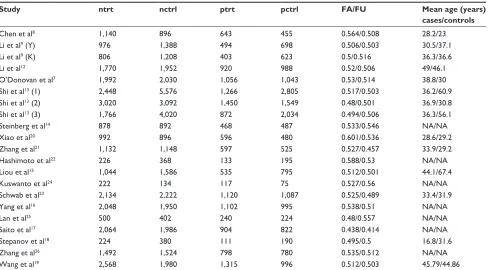
Table 2 shows the selected studies that were used by the packages for the meta-analysis. The columns include the author name and the year of publication, the number of cases multiplied by 2 (ntrt), the number of controls multiplied by 2 (nctrl), the number of cases that have the risk allele (events in cases, ptrt), the number of controls that have the risk allele (events in controls, pctrl), the frequency of the risk allele (A or T) in affected persons (FA), the frequency of the risk allele in unaffected persons (FU) and the mean ages of cases and controls, and the inference column indicates if the authors’ results show association. The values in ntrt and nctrl columns have been scaled by two compared to that found in Table 1. This is done because an SNP has typically two alleles; therefore, this is accounted for by multiplying the total number of individuals for a study by 2. Table 2 shows the result of preprocessed input data used by our program.
regression analysis between mean ages
and effect sizes
We checked if the mean ages could have influenced the values of the odds ratio (OR). The mean age for each study is shown in Table 1. We could not obtain the mean ages for seven different studies, so we excluded them from our analysis. Our results shown in Table 3 indicate that the OR is not greatly influenced by the mean ages.
Neuropsychiatric Disease and Treatment downloaded from https://www.dovepress.com/ by 118.70.13.36 on 25-Aug-2020
Dovepress analyzing a single nucleotide polymorphism in schizophrenia
Table 1 selected studies for our meta-analysis
Study, year Cases/
controls
Area Country FA/FU Mean age (years)
cases/controls
Association
chen et al,8 2012 570/448 shandong china 0.564/0.508 28.2/23 Yes
li et al,9 2011 488/694 Yuxi china 0.506/0.503 30.5/37.1 No
li et al,9 2011 403/604 Kunming china 0.5/0.516 36.3/36.6 No
li et al,12 2012 885/976 singapore singapore 0.52/0.506 49/46.1 No
O’Donovan et al,7 2008 996/1,015 shanghai china 0.53/0.514 38.8/30 Yes
shi et al,13 2011 1,224/2,788 shanghai and anhui china 0.517/0.503 36.2/60.9 No
shi et al,13 2011 1,510/1,546 Beijing and shandong china 0.48/0.501 36.9/30.8 No
shi et al,13 2011 883/2,010 guangdong and guangxi china 0.494/0.506 36.3/56.1 No
steinberg et al,14 2011 439/446 sichuan china 0.533/0.546 Na/Na No
Xiao et al,20 2011 496/448 Xinxiang china 0.601/0.536 28.6/29.2 Yes
Zhang et al,21 2011 566/574 Xi’an china 0.527/0.457 33.9/29.2 Yes
hashimoto et al,22 2010 113/184 Nr Japan 0.588/0.53 Na/Na Yes
liou et al,15 2012 522/793 Taiwan Taiwan 0.512/0.501 44.1/67.4 No
Kuswanto et al,24 2012 111/67 Nr china 0.527/0.56 Na/Na Yes
schwab et al,23 2013 1,067/1,111 Jakarta indonesia 0.525/0.489 33.4/31.9 Yes
Yang et al,16 2013 1,024/975 Xinxiang china 0.538/0.51 Na/Na No
lan et al,25 2013 250/201 Nr china 0.48/0.557 Na/Na Yes
saito et al,17 2014 1,032/993 Nr Japan 0.438/0.414 Na/Na No
stepanov et al,18 2015 112/190 Nr Kazakhstan 0.495/0.5 16.8/31.6 No
Zhang et al,26 2015 746/762 shanghai china 0.535/0.512 Na/Na Yes
Wang et al,19 2016 1,284/990 Jiangsu china 0.512/0.503 45.79/44.86 No
Note: Fa – the frequency of the risk allele in affected persons (a or T), FU – the frequency of the risk allele in unaffected persons.
Abbreviations: Nr, not reported; Na, not applicable.
Table 2 Preprocessed input data
Study ntrt nctrl ptrt pctrl FA/FU Mean age (years)
cases/controls
chen et al8 1,140 896 643 455 0.564/0.508 28.2/23
li et al9 (Y) 976 1,388 494 698 0.506/0.503 30.5/37.1
li et al9 (K) 806 1,208 403 623 0.5/0.516 36.3/36.6
li et al12 1,770 1,952 920 988 0.52/0.506 49/46.1
O’Donovan et al7 1,992 2,030 1,056 1,043 0.53/0.514 38.8/30
shi et al13 (1) 2,448 5,576 1,266 2,805 0.517/0.503 36.2/60.9
shi et al13 (2) 3,020 3,092 1,450 1,549 0.48/0.501 36.9/30.8
shi et al13 (3) 1,766 4,020 872 2,034 0.494/0.506 36.3/56.1
steinberg et al14 878 892 468 487 0.533/0.546 Na/Na
Xiao et al20 992 896 596 480 0.601/0.536 28.6/29.2
Zhang et al21 1,132 1,148 597 525 0.527/0.457 33.9/29.2
hashimoto et al22 226 368 133 195 0.588/0.53 Na/Na
liou et al15 1,044 1,586 535 795 0.512/0.501 44.1/67.4
Kuswanto et al24 222 134 117 75 0.527/0.56 Na/Na
schwab et al23 2,134 2,222 1,120 1,087 0.525/0.489 33.4/31.9
Yang et al16 2,048 1,950 1,102 995 0.538/0.51 Na/Na
lan et al25 500 402 240 224 0.48/0.557 Na/Na
saito et al17 2,064 1,986 904 822 0.438/0.414 Na/Na
stepanov et al18 224 380 111 190 0.495/0.5 16.8/31.6
Zhang et al26 1,492 1,524 798 780 0.535/0.512 Na/Na
Wang et al19 2,568 1,980 1,315 996 0.512/0.503 45.79/44.86
Notes: ntrt, the number of cases multiplied by 2; nctrl, the number of controls multiplied by 2; ptrt, the number of cases that have the risk allele (events in cases); pctrl, the number of controls that have the risk allele (events in controls); Fa, the frequency of the risk allele in affected persons (a or T); FU, the frequency of the risk allele in unaffected persons, and the mean ages in cases and controls. (1), shanghai and anhui; (2), Beijing and shandong; (3), guangdong and guangxi.
Abbreviations: Na, not applicable; (Y), Yuxi; (K), Kunming.
Neuropsychiatric Disease and Treatment downloaded from https://www.dovepress.com/ by 118.70.13.36 on 25-Aug-2020
Dovepress
Falola et al
From our coefficient of determination (R2), ~3.9% of the
OR can be determined by the mean ages for cases and 16% for the controls. In addition, the P-values obtained (P=0.4987) for cases and (P=0.1524) for controls are not statistically significant; hence, the mean ages are not influencing the OR results in any way.
assessing publication bias
Meta-analysis is a useful technique for finding a true effect size among a distribution of effect sizes. However, the results of a meta-analysis are only as valid as the results of the studies included in it. If studies are selected for inclu-sion into the meta-analysis with bias, the validity of such analysis will be greatly affected. Publication bias is said to occur when favorable findings are reported by the author rather than unfavorable ones.27,28 In Figure 1, we show the
funnel plot for our meta-analysis. The eyeball test shows that the distribution of studies is symmetrical, ie, studies are not coagulated into one quadrant of the funnel.
The Egger’s regression test (P-value =0.8763) and Begg’s test (P-value =0.8347),29 which are other tools that can also
be used to assess publication bias, showed no presence of publication bias.
assessing degree of heterogeneity
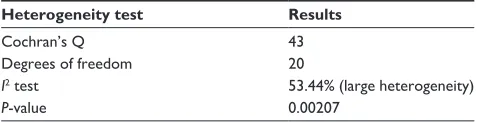
Our Cochran’s Q and I2 tests for heterogeneity showed the
presence of large heterogeneity. This is very feasible since
most studies were not conducted by the same author, random errors that could occur as a result of mistakes made by the experimenter and actual between variance could be the causes of the amount of heterogeneity observed.
The null hypothesis says that “all studies share a common effect size”, and from our P-value, we reject this hypothesis. The Cochran’s Q and I2 test results shown in Table 4 confirm
the fact that all studies do not share a common effect size.
computation of Dersimonian and laird
random-effects model
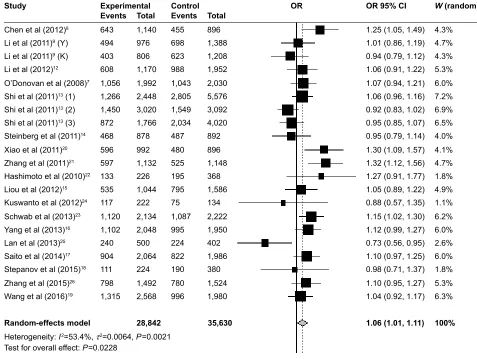
This meta-analysis used the allelic model of comparison to inspect the association of SNP rs1344706 with schizophrenia in Asian populations, which included Chinese, Kazakhs, Singa-poreans, Indonesians and Japanese. Random-effects model was used in the computation of the meta-analysis, since hetero-geneity of 54% was obtained. From our results, we observed that individuals who are carriers of the A or T allele of the SNP rs1344706 have a 6% increased risk of susceptibility to schizophrenia in Asian population. Table 5 shows our statistical results; Figure 2 shows the forest plot for included studies.
sensitivity analysis
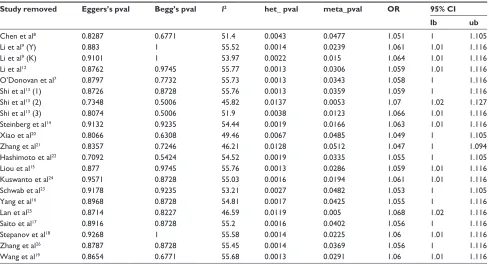
This analysis is performed to check if any single study included in the meta-analysis might have a significant effect on the final results. To achieve this test, data for each study is removed such that the heterogeneity, publication bias, and meta-analysis are then recalculated for the remaining studies, so that the impact of the removed data on the overall study can be ascertained. Table 6 shows the results of our sensitivity analysis. The P-value and OR were not significant for 10 studies of the leave-one-out sensitivity analysis. This indicates that these studies have a significant impact on the results of the final meta-analysis.
Table 3 statistical results of regression analysis between Or and mean age in cases and controls
Regression analysis Results in cases Results in controls
R2 0.03897 0.1629
adjusted R2 -0.04112 0.09315
F-statistic 0.4866 2.335
P-value 0.4987 0.1524
suggested regression equation Or =1.192-0.0032*mean_age Or =1.235+0.0038*mean_age
Abbreviation: Or, odds ratio.
Figure 1 Funnel plot showing publication bias for meta-analysis of rs1344706 (standard error vs log Or).
Abbreviation: Or, odds ratio.
/RJ25
±
±
6WDQGDUGHUURU
Table 4 results of heterogeneity tests (cochran’s Q and I2 tests)
Heterogeneity test Results
cochran’s Q 43
Degrees of freedom 20
I2 test 53.44% (large heterogeneity)
P-value 0.00207
Neuropsychiatric Disease and Treatment downloaded from https://www.dovepress.com/ by 118.70.13.36 on 25-Aug-2020
Dovepress analyzing a single nucleotide polymorphism in schizophrenia
Discussion
SNP rs1344706, an intronic SNP in ZNF804A, has been identified with an increased risk of schizophrenia in several human populations. However in the Asian human population, the results have been inconsistent. Steinberg et al14 undertook
GWAS and follow-up analysis for several populations and found no significant association between the SNP rs1344706 and schizophrenia in the Chinese population. Li et al9 also
did a candidate gene study in two different groups and also found no significant association between SNP rs1344706 and schizophrenia in the Chinese population. In their analysis, SNP rs359895 also located in the same ZNF804A gene was
found to have a strong association with schizophrenia in the Chinese population. However, Chen et al,8 investigating the
association of SNP rs1344706, found that it had a significant association with schizophrenia in the Chinese population; the interaction of the association with different levels of patient IQ scores was checked, and it was observed that there was a stronger significant association of SNP rs1344706 with higher patient IQ scores. Meta-analysis has been a proven tool useful for resolving conflict reports and to increase power in a study. Meta analysis tries to estimate the consistency of effect size across the group of studies, and based on this consistency, it tries to estimate a summary effect size.30 Meta-analysis was
used to find the true effect size of SNP rs1344706 against the risk of schizophrenia.
A total of 21 genetic studies were included in this meta analysis, of which 13 were in support of the null hypothesis, while the other eight studies found a positive association. Looking at the reports of each study that reported no asso-ciation, reasons for lack of association could be extracted. A common reason for non-association observed from several
Figure 2 Forest plot showing meta-analysis for the association between sNP rs1344706 and schizophrenia.
Abbreviations: OR, odds ratio; CI, confidence interval; SNP, single nucleotide polymorphism; (Y), Yuxi; (K), Kunming.
+HWHURJHQHLW\, τ 3
7HVWIRURYHUDOOHIIHFW3 ([SHULPHQWDO &RQWURO (YHQWV 7RWDO 25&, :UDQGRP (YHQWV 7RWDO 5DQGRPHIIHFWVPRGHO 6WXG\ :DQJHWDO =KDQJHWDO 6WHSDQRYHWDO 6DLWRHWDO /DQHWDO <DQJHWDO 6FKZDEHWDO .XVZDQWRHWDO /LRXHWDO +DVKLPRWRHWDO =KDQJHWDO ;LDRHWDO 6WHLQEHUJHWDO 6KLHWDO 6KLHWDO 6KLHWDO 2¶'RQRYDQHWDO /LHWDO
/LHWDO.
/LHWDO<
&KHQHWDO
25
Table 5 random effect summary results
DerSimonian and Laird random-effects model
Results
Or 1.06
95% ci 1.01–1.11
P-value 0.0114
P-value (two tailed) 0.0228
Abbreviations: OR, odds ratio; CI, confidence interval.
Neuropsychiatric Disease and Treatment downloaded from https://www.dovepress.com/ by 118.70.13.36 on 25-Aug-2020
Dovepress
Falola et al
Table 6 leave-one-out sensitivity analysis
Study removed Eggers’s pval Begg’s pval I2 het_ pval meta_pval OR 95% CI
lb ub
chen et al8 0.8287 0.6771 51.4 0.0043 0.0477 1.051 1 1.105
li et al9 (Y) 0.883 1 55.52 0.0014 0.0239 1.061 1.01 1.116
li et al9 (K) 0.9101 1 53.97 0.0022 0.015 1.064 1.01 1.116
li et al12 0.8762 0.9745 55.77 0.0013 0.0306 1.059 1.01 1.116
O’Donovan et al7 0.8797 0.7732 55.73 0.0013 0.0343 1.058 1 1.116
shi et al13 (1) 0.8726 0.8728 55.76 0.0013 0.0359 1.059 1 1.116
shi et al13 (2) 0.7348 0.5006 45.82 0.0137 0.0053 1.07 1.02 1.127
shi et al13 (3) 0.8074 0.5006 51.9 0.0038 0.0123 1.066 1.01 1.116
steinberg et al14 0.9132 0.9235 54.44 0.0019 0.0166 1.063 1.01 1.116
Xiao et al20 0.8066 0.6308 49.46 0.0067 0.0485 1.049 1 1.105
Zhang et al21 0.8357 0.7246 46.21 0.0128 0.0512 1.047 1 1.094
hashimoto et al22 0.7092 0.5424 54.52 0.0019 0.0335 1.055 1 1.105
liou et al15 0.877 0.9745 55.76 0.0013 0.0286 1.059 1.01 1.116
Kuswanto et al24 0.9571 0.8728 55.03 0.0016 0.0194 1.061 1.01 1.116
schwab et al23 0.9178 0.9235 53.21 0.0027 0.0482 1.053 1 1.105
Yang et al16 0.8968 0.8728 54.81 0.0017 0.0425 1.055 1 1.116
lan et al25 0.8714 0.8227 46.59 0.0119 0.005 1.068 1.02 1.116
saito et al17 0.8916 0.8728 55.2 0.0016 0.0402 1.056 1 1.116
stepanov et al18 0.9268 1 55.58 0.0014 0.0225 1.06 1.01 1.116
Zhang et al26 0.8787 0.8728 55.45 0.0014 0.0369 1.056 1 1.116
Wang et al19 0.8654 0.6771 55.68 0.0013 0.0291 1.06 1.01 1.116
Notes: Sensitivity analysis used to monitor the influence and impact of each study on the entire population. This table shows the publication bias P-value (Begg’s), the heterogeneity I2 and het_pval, the overall P-value (meta-pval) and the overall Or with a 95% ci.
Abbreviations: pval, P-value;OR, odds ratio; CI, confidence interval; lb, lower bound; ub, upper bound; (Y), Yuxi; (K), Kunming.
studies included the risk allele frequencies of the SNP in the comparison groups. Li et al9 argued that studies with allele
frequencies that differed to an extent from the frequency of the allele on HapMap31 and from the frequency reported in
their studies were likely to have an opposite association. In their work, the T allele frequency of rs1344706 in the com-parison (case/control) samples was 0.509, which is similar to the frequencies reported by O’Donovan et al7 (0.514)
and Steinberg et al14 (0.546) as well as the frequency in
the Han Chinese population from the HapMap31 database
(0.524). It is quite different, however, from the frequency reported by Zhang et al21 (0.457) or Chen et al8 (0.564). We
performed simple logistic regression to determine if the risk allele frequency of each study might affect the significance of a study result. We obtained a P-value of 0.0596 (~0.06), indicating that the allele frequencies might not be directly influencing the statistical association for each study. Other factors that might affect the association of a genetic study include the use of covariates in the analysis, subgroup analysis performed, disease model or type of statistical analysis used, type of multiple testing corrections used, etc. On the other hand, uncontrolled bias can also affect statistical association. Another strong reason given for the absence of association includes genetic architecture exist-ing between the Asian and Caucasians. Li et al12 stated that
the SNP might be inherited together with a functional change in the gene in Europeans, which is not the case in Asians. The linkage disequilibrium map of the genomic region showed a sharp change between the Caucasians and Asians. Wang et al19 stated that demographic differences can be the cause of
inconsistencies in results. China is a country known to have complex demography and ethinic diversity, which might cause people from different regions to be born with different genetic traits. Other reasons include genetic heterogeneity, where different alleles are contributing to the pathogenesis of the genetic disorder; environmental exposure; the local culture and difference of schizophrenia subtypes in the subjects included.
The results of this meta-analysis indicated that a statisti-cal significance exists between the phenotype of interest and genotype; several tests were also performed to ensure the validity of the meta-analysis. Regression analysis was performed between the OR and mean ages to check for rela-tionships; publication bias was performed to remove false results, and degree of heterogeneity was checked to detect the variance among the selected studies. This meta-analysis used the allelic model of comparison to inspect the association, and we observed that individuals who are carriers of the A or T allele of the SNP rs1344706 have a 6% increased risk of susceptibility to schizophrenia in the Chinese population.
Neuropsychiatric Disease and Treatment downloaded from https://www.dovepress.com/ by 118.70.13.36 on 25-Aug-2020
Dovepress analyzing a single nucleotide polymorphism in schizophrenia
From the entire population study investigated, the output generated from the meta-analysis portends that there is a sig-nificant association between the considered SNP rs1344706 and the prevalence of the schizophrenia disease. However, the systematic investigation of the Chinese population as a subgroup that accounted for 16 studies out a total of 21 stud-ies investigated reveals that there is no significant association between the SNP and the disease condition. The implication may be that the effect of the SNP toward the prevalence of schizophrenia in Chinese is predominantly less compared to other Asian populations considered in this work. Considering the implication of our discovery, the significance of improv-ing and increasimprov-ing investments in this field of research is recommended by virtue of the fact that the SNP rs1344706 is indicted in the disease risk condition of schizophrenia. This will also help to address the issues of management therapy and treatment discovery for ameliorating the condition of patients plagued with schizophrenia.
Conclusion
Meta-analysis study appears to be a continuous process as fresh genotyping datasets from new GWAS studies for a specific population are made available. To this end, meta-analysis tests are performed to revalidate existing hypotheses using newer GWAS datasets. The association of this SNP has been inspected by four previous meta-analyses,10,11,32,33
with the first study consisting of 12 studies from the Chinese population and stating no association and the second study consisting of 13 studies from the Asian population and stating the presence of association. The third meta-analysis consisted of 30 studies, which included Asians, Caucasians and Americans. The results presented stated the presence of association between the SNP and schizophrenia disorder. The last meta-analysis consisted of 18 studies from Asian population, and the results showed statistical significance. However, we included more datasets in our work for Asian population. Our work also provided a unique perspective view to a combination of population studies from various authors with GWAS experimental data. We also applied R programming, which is a powerful statistical programming tool in our analysis. In addition, Li et al10 had a different
result from our analysis, while our result seems to agree with references.11,32,33 It is important to note that due to our interest
in understanding the controversy surrounding the associa-tion of schizophrenia with SNP rs1344706 among Chinese, Japanese, Singaporean, Indonesian, and Kazakh holistically, it was not in our interest to include populations such as the Caucasian and American as in the study by Sun et al.32
Our result shows that individuals who are carriers of A and T allele of SNP rs1344706 have 6% increased risk of schizophrenia susceptibility among the combined population of Chinese, Japanese, Singaporean, Indone-sian and Kazakh. While desiring to investigate the effect of each study on the overall result of the meta-analysis, our sensitivity analysis reveals that 48% of the studies used in the analysis had undue dominance or influence on the overall result. This may be due to other unforeseen factors in the experimental design since we also took account of age and other factors that could bias our results.
The motivation to perform new GWAS studies could discover more polymorphisms associated with the disease as this disease is multigenic or polymorphic with a higher statisti-cal significance; this can be boosted by GWASs with a higher sample size or usage of latest sequencing technologies.
Schizophrenia is one of the severe brain disorders affect-ing .21 million people in the world today. Although the disorder has a remedy, identifying the areas of the DNA responsible for susceptibility to such a disorder can help in building more therapeutic remedies for it. SNP rs1344706 has been identified as being associated with the susceptibility of schizophrenia in several populations; however, in the Asian and Chinese populations, there have been several conflicting reports. This study thus confirms and validates further the claim by the (eight) previous authors/literature of a significant association between the genotype and phenotype.
Disclosure
The authors report no conflicts of interest in this work.
References
1. World Health Organization [webpage on the Internet]. Schizophrenia. 2014. Available from: http://www.who.int/mental_health/management/ schizophrenia/en/. Accessed April 7, 2015.
2. Williams HJ, Owen MJ, O’Donovan MC. Schizophrenia genetics: new insights from new approaches. Br Med Bull. 2009;91(1):61–74. 3. Bush WS, Moore JH. Genome-wide association studies. PLoS Comput
Biol. 2012;8(12):e1002822.
4. Harvey A, Brand A, Holgate ST, et al. The future of technologies for personalized medicine. N Biotechnol. 2012;29(6):625–633.
5. König IR. Validation in genetic association studies. Brief Bioinform. 2011;12(3):253–258.
6. Cantor RM, Lange K, Sinsheimer JS. Prioritizing GWAS results: a review of statistical methods and recommendations for their application. Am J
Hum Genet. 2010;86(1):6–22.
7. O’Donovan MC, Craddock N, Norton N, et al; Molecular Genetics of Schizophrenia Collaboration. Identification of loci associated with schizophrenia by genome-wide association and follow-up. Nat Genet. 2008;40(9):1053–1055.
8. Chen M, Xu Z, Zhai J, et al. Evidence of IQ-modulated associa-tion between ZNF804A gene polymorphism and cognitive funcassocia-tion in schizophrenia patients. Neuropsychopharmacology. 2012;37(7): 1572–1578.
Neuropsychiatric Disease and Treatment downloaded from https://www.dovepress.com/ by 118.70.13.36 on 25-Aug-2020
Neuropsychiatric Disease and Treatment
Publish your work in this journal
Submit your manuscript here: http://www.dovepress.com/neuropsychiatric-disease-and-treatment-journal
Neuropsychiatric Disease and Treatment is an international, peer-reviewed journal of clinical therapeutics and pharmacology focusing on concise rapid reporting of clinical or pre-clinical studies on a range of neuropsychiatric and neurological disorders. This journal is indexed on PubMed Central, the ‘PsycINFO’ database and CAS,
and is the official journal of The International Neuropsychiatric Association (INA). The manuscript management system is completely online and includes a very quick and fair peer-review system, which is all easy to use. Visit http://www.dovepress.com/testimonials.php to read real quotes from published authors.
Dovepress
Dove
press
Falola et al
9. Li M, Luo XJ, Xiao X, et al. Allelic differences between Han Chinese and Europeans for functional variants in ZNF804A and their association with schizophrenia. Am J Psychiatry. 2011;168(12):1318–1325. 10. Li M, Zhang H, Luo XJ, et al. Meta-analysis indicates that the European
GWAS-identified risk SNP rs1344706 within ZNF804A is not asso-ciated with schizophrenia in Han Chinese population. PLoS One. 2013;8(6):e65780.
11. Zhu M, Liu T, Zhang J, Jia S, Tang W, Luo Y. Association between rs1344706 of ZNF804A and schizophrenia: a meta-analysis. Genomics
Proteomics Bioinformatics. 2014;12(6):292–296.
12. Li M, Shi CJ, Shi YY, et al. ZNF804A and schizophrenia susceptibility in Asian populations. Am J Med Genet B Neuropsychiatr Genet. 2012; 159(7):794–802.
13. Shi Y, Li Z, Xu Q, et al. Common variants on 8p12 and 1q24.2 confer risk of schizophrenia. Nat Genet. 2011;43(12):1224–1227.
14. Steinberg S, Mors O, Børglum AD, et al. Expanding the range of ZNF804A variants conferring risk of psychosis. Mol Psychiatry. 2011; 16(1):59–66.
15. Liou YJ, Wang HH, Lee MT, et al. Genome-wide association study of treatment refractory schizophrenia in Han Chinese. PLoS One. 2012; 7(3):e33598.
16. Yang Y, Li W, Yang G, et al. Evaluation of the relationship between the ZNF804A single nucleotide polymorphism rs1344706 A/C variant and schizophrenia subtype in Han Chinese patients. Int J Psychiatry
Med. 2013;45(3):269–278.
17. Saito T, Kondo K, Iwayama Y, et al. Replication and cross-phenotype study based upon schizophrenia GWASs data in the Japanese popula-tion: support for association of MHC region with psychosis. Am J Med
Genet B Neuropsychiatr Genet. 2014;165(5):421–427.
18. Stepanov VA, Bocharova AV, Saduakassova KZ, et al. Replicative study of susceptibility to childhood-onset schizophrenia in Kazakhs.
Russ J Genet. 2015;51(2):185–192.
19. Wang J, Zhao S, Shugart YY, et al. No association between ZNF804A rs1344706 and schizophrenia in a case-control study of Han Chinese.
Neurosci Lett. 2016;618:14–18.
20. Xiao B, Li W, Zhang H, et al. To the editor: association of ZNF804A polymorphisms with schizophrenia and antipsychotic drug efficacy in a Chinese Han population. Psychiatry Res. 2011;190(2):379–381.
21. Zhang R, Lu SM, Qiu C, et al. Population-based and family-based asso-ciation studies of ZNF804A locus and schizophrenia. Mol Psychiatry. 2011;16(4):360–361.
22. Hashimoto R, Ohi K, Yasuda Y, et al. The impact of a genome-wide supported psychosis variant in the ZNF804A gene on memory func-tion in schizophrenia. Am J Med Genet B Neuropsychiatr Genet. 2010; 153(8):1459–1464.
23. Schwab SG, Kusumawardhani AA, Dai N, et al; Indonesian Schizophre-nia Genetics Consortium. Association of rs1344706 in the ZNF804A gene with schizophrenia in a case/control sample from Indonesia.
Schizophr Res. 2013;147(1):46–52.
24. Kuswanto CN, Woon PS, Zheng XB, et al. Genome-wide supported psychosis risk variant in ZNF804A gene and impact on cortico limbic WM integrity in schizophrenia. Am J Med Genet B Neuropsychiatr
Genet. 2012;159(3):255–262.
25. Lan X, Wei L, Wu X, et al. Association analysis of ZANF804A rs1344706 polymorphism and schizophrenia. Chin J Nerv Ment Dis. 2013;39(4):213–217.
26. Zhang C, Wang Z, Hong W, Wu Z, Peng D, Fang Y. ZNF804A genetic variation confers risk to bipolar disorder. Mol Neurobiol. 2015; 53(5):2936–2943.
27. Egger M, Smith GD, Schneider M, Minder C. Bias in meta-analysis detected by a simple, graphical test. BMJ. 1997;315(7109):629–634. 28. Ahmed I, Sutton AJ, Riley RD. Assessment of publication bias, selection
bias, and unavailable data in meta-analyses using individual participant data: a database survey. Br Med J. 2012;344:d7762.
29. Begg CB, Mazumdar M. Operating characteristics of a rank correlation test for publication bias. Biometrics. 1994;50(4):1088–1101. 30. Borenstein M, Hedges LV, Higgins J, Rothstein HR. Front Matter.
Chichester, England: John Wiley & Sons Ltd; 2009.
31. International HapMap Consortium. The international HapMap project.
Nature. 2003;426(6968):789–796.
32. Sun Y, Hu D, Liang J, et al. Association between variants of zinc finger genes and psychiatric disorders: systematic review and meta-analysis.
Schizophr Res. 2015;162(1):124–137.
33. Huang L, Ohi K, Chang H, et al. A comprehensive meta-analysis of ZNF804A SNPs in the risk of schizophrenia among Asian populations.
Am J Med Genet B Neuropsychiatr Genet. 2016;171B(3):437–446.
Neuropsychiatric Disease and Treatment downloaded from https://www.dovepress.com/ by 118.70.13.36 on 25-Aug-2020