DATA INTEGRITY TECHNIQUES IN CLOUD
Mr. Anuj gupta11. INTRODUCTION
Cloud computing is another worldview and measurement of the data and innovation (IT), which intends to providereliable, altered and ensured registering dynamic condition on "Pay-per-utilize" or "Pay-as-you-go" reason for the end clients. "Clouds are a huge pool of effectively accessible, usable and open virtualized assets, (for example, equipment, advancement stage and additionally benefits). These assets can progressively reconfigured to conform to a variable load (scale), permitting additionally for an ideal asset utilization."[1] Cloud figuring is an innovation which give you an administration service through which you can utilize all the computer hardware and Software sitting on your work area, or some place inside your organization's system however they are definitely not all things considered installed on your PC, it is provided to you as an administration service by another organization and got to over the web. End clients can get to these administrations services accessible in the web without knowing how these assets are overseen and where. This is straightforward to end clients. [2] It is constantly accessible. It is very portable and accessible crosswise over platforms. Cloud decreased the cost of arrangement. It permits boundless storage. Cloud expanded processing power with fast scalability as what's more, when required. It permits less demanding workgroup cooperation progressively. It decreased the danger of information loss. Clouds require less maintenance concerns as there is no compelling reason to introduce or upgradesoftware and hardware. Cloud enhances compatibility between operating systems. [3][14].
It requires always on and rapid internet availability. This innovation is still at an early stage. All things considered, in Cloud computing, there is uncertain, security and protection concerns. There is an absence of industry standards and between operability among applications. It is having constrained features. In clouds, clients are liable to numerous terms and conditions. It isn't naturally sustainable [3][14].
reasonable. Now and then your information will be lost from the server. [3][14]
2. SERVICE MODELS OF CLOUD COMPUTING
Depending on the services provided by the cloud, it is isolated into main three classifications:
2.1. Infrastructure As A Service (Iaas)
IAAS is an administration service which gives an access to the equipment resources, for example, storage or computing hardware as pay per utilize premise. Case of this kind of administration is assume you pay month to month or yearly membership to facilitating organization which thus stores your records on their server.[1][2][14]
2.2. Software As A Service (Saas)
SAAS gives a product administrations service to the end client. Online email and Google reports are best case of this administration. End client gets access to this software service benefit however he/she can't change this programming utility. Software is installed on cloud utility and not introduced on end client PC. [1][2][14]
2.3. Platform As A Service (Paas)
1
M.TECH.[CFIS] Student, Cyber Forensics & Information Security Department, Ganga, Engineering College, Kabnala, Haryana
Abstract:Cloud computing is the new innovation in the field of data and innovation. It gives such a significant number of things as far "As-A-Service" premise. For Cloud storage, protection and security are the mainconcerns. At the point when clients store their information on the cloud at that point there might be a danger of losing the information, or here and there information might be changed or refreshed. It may not be completely reliable in light of the fact that customer doesn't have duplicate of all stored information. Cloud storage moves the client's information to large data centres which are remotely situated, on which client does not have any control. In this paper we will talk about the security concerns of cloud condition. This paper for the most part centresaround the review of the security procedures that has been proposed so far for the information uprightness like POR (Proof Of Retrivability), PDP (Provable Data Possession),HAIL (A High-Availability and Integrity Layer For Cloud Storage), Static PDP, Dynamic PDP, and so on in the cloud condition for the information honesty. Keywords— Cloud computing, privacy, PDP(Provable Data Possession),POR(Proof of Retrivability), HAIL (A High-Availability and Integrity for Cloud Storage), Static PDP, Dynamic PDP, Data Integrity, Mobile Computing.
This administration service gives a platform or a condition on which end client can build up his own application. Client is straightforward about the area of the platform whether it is facilitated on cloud or not. Google App Engine is a case of PAAS. [2][14]
A portion of the best cases for cloud storage are Amazon S3, Windows Azure Storage, EMC Atmos, Files Anywhere, Google Cloud Storage, Google App Engine Blobstore, iCloud by Apple.
3. DEPLOYMENT MODELS OF CLOUD COMPUTING
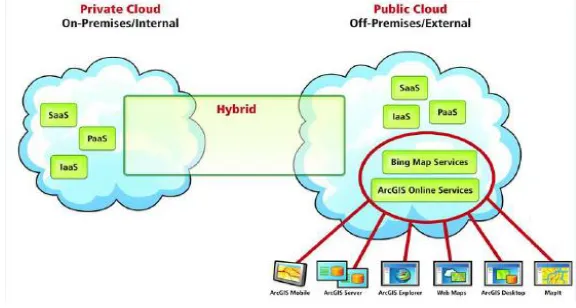
Fig. 1 demonstrates the kinds of cloud deployment models. These are portraying in the following segment.
3.1. Public CLOUD
In a public cloud the computing infrastructure is utilized by the association or end client through cloud service providers or sellers. Public clouds are commonly offered through virtualizationand circulated among different physical machines. [1][2] [14]
3.2. Private Cloud
In a private cloud the computing infrastructure is devoted to the specific associations and not imparted to other association. Private clouds are more secure than publicsclouds. [2][14]
3.3. Hybrid CLOUD
This is a combination of the other two types of cloud. In mixture cloud associations may havebasic application on private clouds and applications which are having less security concerns facilitated on public mists. It is otherwise called cloud blasting. [2][14]
3.4. Community Cloud
It includes sharing of computing infrastructure in the middle of associations of the same group. For instance all Government associations inside the province of Delhi may share computing infrastructure on the cloud to manage information identified with the residents living in Gujarat. [2][14]
4. PRIVACY
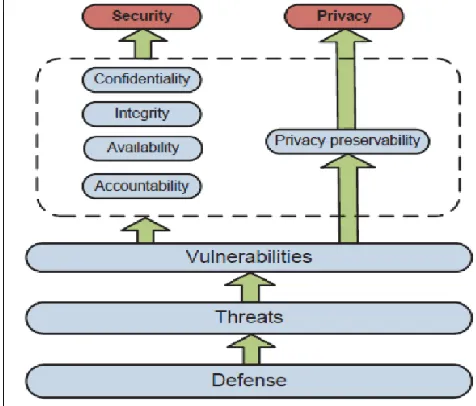
Protection and security are the intenseconcerns of any innovation, and cloud condition is additionally not an exceptional case. As cloud is still at its early stage, protection and security get more concern. Protection is the basic right of the individual. Security of the client information and individual data can be given by the cryptographic capacity and innovation. As cloud computing is the virtual condition in which the autonomous systems are associated in a networkand also this will make the cloud. Presently this cloud will serve "as a service" premise, so client need to enlist himself to the cloud server or to the outsider which give the cloud benefit. So the protection of the information and security should be considered.
Writing speaks to the risk of cloud security and protection that is a customer side security, security worries from cloud service providers, information proprietorship and information area, absence of control over the information, network security, information recuperation on cloud environment, securing information in cloud environment, establishment and maintenance of firewalls, information encryption, information purification, backup and recovery and identity and access management. [4][14]
5. PRIVACY TECHNIQUES
Creator of paper [5] propose some defence methodologies for the information integrity. Integrity checking is a wide theme for inquire about.
Traditional strategies can't be straightforwardly connected for the integrity checking, on the grounds that the principle concern for integrity checking of information is that enormous amount of information are remotely put away on cloud server which are untrustworthy. Once in a while it isn't achievable to download whole document and perform the integrity check because of the way that it is computationally costly and data bandwidth consuming.
The following segment depicts the protection strategies for information integrity.
Fig. 2 Cloud security and privacy
6. PROVABLE DATA POSSESSION
This technique is utilized to check the integrity of the information that is put away on the cloud server. These all techniques are utilized for the customer to occasionally check their information that is put away on a server. So this techniques is for the client to guarantee that their information is secure on the server or not. This PDP incorporates the following number of techniques to perform integrity check of the information.
6.1. A Naive Method
The primary thought behind this algorithm is to compare the information. In this method, customer will figure the hash value for the document F and having key K (i.e. h(K,F)) and accordingly it will send the document F to the server. Customers are having distinctive gathering of keys and hash values so it can do multiple checks on the document F. At whatever point customer needs to check the document it discharge key K and sends it to the server, which is at that point asked to recomputed the hash value, in light of F and K. Presently server will answer back to the customer with hash value for recomputed.
This method gives the solid evidence that server is having the first document F. However, this method has high overhead as each time hashing process is keep running over the whole document. It is having high calculation cost.
6.2. Original Provable Data Possession
In this technique, the information is pre-handled before sending it to the cloud server. Here the information is loaded with some label esteem or say meta-information for the confirmation at the customer side. Presently whole information is sent over to the server and at the customer side meta-information is put away. This meta-information is utilized for the confirmation at the point when client requirement for it. At the point when client needs to check for integrity it will sends the test to the server at that time server will react with the information. Presently the customer will compare the reply data with the nearby meta-information. Along these lines customer will say that the information is altered or not. Unique PDP has low calculation also, capacity overhead.
Homomorphic hashing technique is utilized to make multiple block inputs into a single value to reduce the size of proof. [5][7][14]
6.3. Proof Of Retrivability (Por)
Proof of retrievability implies Verify the information stored by client at remote location in the cloud isn't altered by the cloud. POR for massive size of records named as sentinels. The primary part of sentinels in cloud needs to get to just a little segment of the record (F) rather than getting to whole file.
Fig. 3 A data file with 6 blocks
The above fig. 3 demonstrates the information document which is having 6 information squares and these whole 6 information piece contains singular sentinels.
This technique utilizes the auditingprotocol when taking care of the concern of integrity. Here any customer who needs to check the integrity of the outsourced information at that point there is no compelling reason to recover full content.
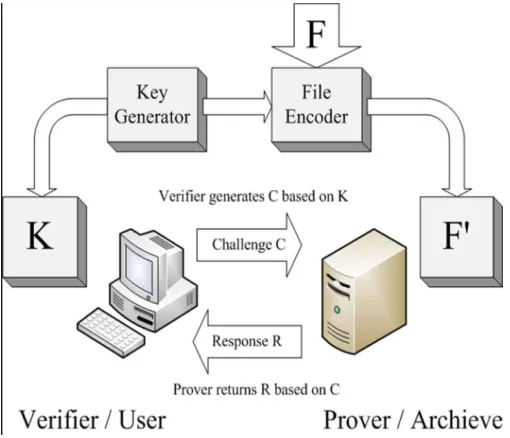
Here client stores just a key, which is utilized to encode a record F which gives the encypted document F'. This system leaves the arrangement of sentinel values at the end of the document F'. Server just stores F'. Server doesn't realize that where the sentinel values are stored since they vague from normal and it is randomlystored in the document F'.
Author of paper [13] proposed a Schematic perspective of a proof of retrievability in light of embeddingrandom sentinels in the information document.
Fig.4 Schematic view of a POR
At the point when customer send the challenge to the server to check for integrity, around then in challenge responseprotocol server will ask to return a subset from sentinels in F'. If the information is altered or erased the sentinels may get corrupted or lost thus the server can't produce the confirmation of the original file. In along these lines customer can demonstrate that server has corrupted or lost the document.
POR is designed to be lightweight; it attempts to give least storage in customer and server side, number of data blocks accessed, the communication complexity of a review. POR likewise gives the error-correcting codes to recoup document having little portion being corrupted. POR can be applied to the static records only. Document should be encoded before transferring to the server. It requires extra space to cover sentinels. [5][6][8][12][14]
6.4 Scalable Pdp
Adaptable PDP is an enhanced form of the original PDP. The difference is that Scalable PDP utilizes the symmetric encryption while unique PDP utilizes public key to diminish computation overhead.
Scalable PDP can have dynamic task on remote information. Scalable PDP has all the challenges and answers are pre-processed and limited number of updates.
Scalable PDP does not require mass encryption. It depends on the symmetric-Key which is more effective than public Key encryption. So it does not offer public verifiability. [5][9][14]
6.5 Dynamic Pdp
As the name recommend this is the dynamic PDP so it supports full unique tasks like embed, update, modify, erase and so forth. Here in this method the dynamic task enables the authenticatedinsert and erase functions with rank-based authenticateddirectories and with a skip list. In spite of the fact that DPDP has some computational complexed nature, it is as yet effective.
For instance, to produce the evidence for 1GB document, DPDP just delivers 415KB proof information and 30ms computational overhead.
This strategy offers completely unique activity like modification, erasure, insertion and so forth as it supports fully dynamic operation there is relatively higher computational, communication, and capacity
Overhead. Every one of the difficulties and answers are dynamically produced. [5][10][14]
6.6 A High Availability And Integrity Layer For Cloud Storage (Hail)
HAIL is not the same as alternate strategies those have been talked about up until now. HAIL permits the customer to store their information on various servers so there is aredundancy of the information. Also, at the customer side just little measure of information is stored in local machine. The dangers that can be assaulted on HAIL is portable adversaries, which may corrupt the document F.
This method is relevant for the static information just (i.e. append information). It is conceivable to check information integrity in the dispersed storage by means of information redundancy. Here confirmation is produced that is free of the information size and it is reduced in size. HAIL utilizes the pseudorandom function, message authentication codes (MACs). [5][11][14]
7. CONCLUSION AND FUTURE WORK
Protection and security are the mainconcerns of any innovation. Writing says that security and protection are not the two unique things but rather privacy gets concernwithin the security. As cloud is mostly utilized for the storage of the information, information integrity is the fundamental concern of the customer. Subsequent to uploading information to the server, customer will lost the control of the information. So as the information can be altered or updated or infrequently erased by the unauthorized access or by server. There are such a large number of methods accessible in the writing out of which we have analysedsome of the technique and compare them. Concurring that PDP methods are extremely valuable for the integrity checking. PDP supports completely dynamicoperations so it is conceivable to confirm information if there should arise a modification or deletion. This procedures can be controlled to reduce the computational and storage overhead of the client as well as to minimize the computational overhead of the remote storage server. New methods can be designed to limit the measure of the proof of information integrity in order to diminish toreduce the computational and storage overhead of the client as well as to minimize the computationaloverhead of the remote storage server.
8. REFERENCES
[1] J. Ruiter and M. Warnier, Privacy regulation for cloud computing, compliance andimplementation in theory and practice, article.
[2] P. Metri and G. Sarote, Privacy Concerns andChallenges in Cloud Computing, Internationaljournal of Advanced Engineering Sciences
andTechnologies, Vol. No. 5, Concern No. 1,001-006.
[3] A white paper on, Cloud Computing: What How and Why.
[4] A. Methew, Security and Privacy Concerns of Cloud computing: solution and secureframework, International Journal ofMultidisciplinary Research
Vol.2 Concern 4,(2012), ISSN 2231 5780
[5] Z. Xiao and Y. Xiao, Senior Member, IEEE, Security and Privacy in Cloud Computing,IEEE COMMUNICATIONS SURVEYS &TUTORIALS,
[6] H.shancham and B.Waters, Compact proofs of Retrivability, Advances in Cryptology-ASIACRYPT (2008) 90-107.
[7] G. Ateniese, R. Burns, R. Curtmola, J. Herring, L. Kissner, Z. Peterson, and D. Song, Provable data possession at untrusted stores, ACM CCS, (2007)
598-609.
[8] A. Juels and B. S. Kaliski, PORs: Proofs of retrievability for large files, ACM CCS, (2007) 584-597.
[9] G. Ateniese, R. D. Pietro, L. V. Mancini, and G. Tsudik, Scalable and efficient provable datapossession, SecureComm, 2008.
[10] C. Erway, A. K ¨ upc¸¨u, C. Papamanthou, and R. Tamassia, Dynamic provable data possession, Proc. 16th ACM conference on Computer and
communications security, ( 2009) 213-222.
[11] K.D. Bowers, A. Juels, and A. Oprea, HAIL: A high-availability and integrity layer for cloudstorage, Proc. 16th ACM conference onComputer and
communications security, (2009)187-198.
[12] S. Eswaran, Dr. S. Abburu, Identifying DataIntegirty in the Cloud Storage, InternationalJournal Of Computer Science Concerns, Vol.9Concern 2,
(2012), ISSN 1694-0814
[13] R. Sravan and Saxena ,”Data integrity proofs in cloud storage” in IEEE 2011.
[14] R. Pandya, K. Sutaria, “An analysis of privacy techniques for data integrity in the cloudenvironment”, International Journal ofComputer and