e-ISSN : 2278-067X, p-ISSN : 2278-800X, www.ijerd.com
Volume 12, Issue 11 (November, 2016), PP.24-31
Effect of the Classifier Training Set Size on Accuracy of
Pattern Recognition
Husam Ahmed Al Hamad
Faculty of Computer Science and Informatics, Department of Computer Information System,
Amman Arab University, Amman, Jordan
[email protected] [email protected]
Abstract: The paper determines the correlation between training set size and accuracy of neural handwritten recognition. The paper investigates and compares between four variant neural networks, it practices between two different sizes of training sets. The paper illustrates a novel technique contains two major algorithms; first one aims to locate Prospective Segmentation Points (PSP) within the word image, second aims to evaluate each PSP and determining the valid and invalid points. The technique implements four different classifiers and compares their results. To do so, the paper investigates the fusion equations to evaluate confidence values of each PSP, equations obtain a fused value of confidence values from three neural to report whether keep valid segment points (SP) or remove invalid one. The research tracks CPU times and accuracy of the algorithm, as well as, compares the performed experimental results of the classifiers with each other and with related works in the literature.
Keywords: handwritten recognition, segmentation techniques, neural network, training set.
I.
I
NTRODUCTIONHandwriting term means artificial graphic marks that contains some messages through relation of marks to language [1]. Pattern recognition by machines can observe and learn to distinguish interest patterns, and give the categories of these patterns, in most instances, humans are the best recognizers of pattern, until now science does not understand how humans recognize patterns [2].
In recognition, there are two major available types; first, off-line handwriting recognition, it refers to the process of recognition words images that stored as digital format, thereafter perform further processing for recognition. The main challenge of off-line Arabic handwriting recognition is segmenting word image into its characters or patterns, and this what called recognition of individual characters or patterns technique. Whereas there is another technique called non-segmentation recognition of the whole word image [3]. The second type is on-line handwriting recognition; this type captures and stores words images in digital form, it uses a special pen with an electronic surface. It maps two-dimensional coordinates of successive periods when the pen moves across the surface or paper stored in order by function of time [4]. By the way, online recognizing method has results than off-line so fare, this maybe because there are more information capture in the on-line such as speed, direction, and strokes order when words handwritten words written on a digital medium not on a paper.
This research involves and highlights the off-line segmentation and recognition of Arabic handwritten characters and words using Artificial Neural Networks (ANNs). Arabic handwritten scripts difficult to identify because it include a lot of privacy, for example: (1) Overlapping of Arabic words. (2) Arabic language contains many external objects. These reasons make segmentation and recognition more difficult. (3) Arabic characters holds at least three or four shapes according to their position as initial, middle, final, or standalone [5].
This research investigates the ANNs models; the most common family of neural networks for pattern classification recognition is Feed-Forward Back-Propagation network (FFBP) which is very simple and effective for implement. First established was [8], it applies successfully to different application domains such as pattern recognition, controlling, prediction, system identification, etc. [11]. Weight inputs transmits to the neurons in the first layer and the neurons transmits their outputs to the neurons in the next layer, etc. The network doesn't contain any cycles or loop as an advantage [12]. Another popular type of network is Multilayer Perceptron (MLP). It used widely in many applications such as filtering, noise removal, pattern recognition, and coupled with the back-propagation (BP) algorithm [13]. Neurons organize themselves as layers and the weights connect neurons in successive layers. BB requires a training procedure calculated based on the target classes and training samples [14]. Radial-Basis Function (RBF) is also a network type widely used; RBF is a feed-forward neural network that contains only a hidden layer with an unsupervised training method [15]. It is found to be very attractive for many computing problems and used in a lot of research fields, such as, noisy interpolation, regularization, pattern recognition, and function approximation [16] [17]. Learning speed of the classifier is very fast and easy where it contains local tuned neurons [18]. Finally, one of the widely applied networks is Self-Organizing Map (SOM) [19]. Kohonen describes the relation between input signal and synaptic adaptation of neurons in 1982 [20] [21]. The input layer can have different dimensions and topology, it learns from high dimensional data and maps them on a low dimensional data [22] [23].
II.
H
ANDWRITINGD
ATABASEThis research investigates two training sets; first dataset has obtained from 20 different persons [24]; it contains 500 words for the training and the same number for the testing. The second database is larger [25], it has obtained from 113 different persons; it contains 16,214 words for training and 16,676 for testing [26]. Both of databases have extracted from two Arabic paragraphs that include all shapes of Arabic characters.
III.
R
ESEARCHT
ECHNIQUESThe research investigates many techniques. As a first step, we implement and apply Arabic Heuristic Segmentor (AHS) to detect PSPs. Then, we implement direction feature extraction to extract features of each character. Next, we implement neural networks and fusion equations to validate each PSPs. Following sections displays details of these techniques. The algorithms are built using Matlab v. 2010. Computer specification is core i7, 3.40GHz processor, 8GB memory, windows 8.1-64bit operating system.
A. Arabic Heuristic Segmentor (AHS)
AHS is a new heuristic technique [5] [27]. It divides the handwritten words into primitive parts (over-segmentation), over-segmentation processes further to provide the best segmentation points. Thereafter, calculates three specific errors to calculate the accuracy, these errors are oversegmented, missed, and bad segmentation point.
AHS employs three major attributes. First, pre-processing of word image, it includes filtering and thinning of word image, this step aims to prepare the word image before utilize other techniques; employs this technique increases segmentation accuracy. Second, removing punctuation marks (dots), this step aims to enhance detection of the image baseline; baseline determines the important region of the word image, which contains the connection points (strokes) between the characters, the technique removes ascenders and descenders of the word image before starting the segmentation process. Another reason for removing the dots is decreasing numbers of training set in the classifiers, after eliminating dots, shape of some characters become similar form, for example, the characters Ba'a ب, Ta'a ت, and Tha'a ث have the same shape after eliminating the dots. Accordingly, number of characters that will be entered to the classifiers will reduced from 106 characters into 62 characters; this leads to reduce training time and errors of the neural network, as well as increase the performance accuracy of the technique. Finally, detecting the ligatures between the characters, a ligature means a stroke (mall point) uses to connect between two characters; vertical histogram technique is developed to locate the PSP, the histogram calculates the distance between top and bottom foreground pixels of the word image after thinning.
Table I. Performance of AHS Over-segmentation for 500 words image [5].
SP Correct
Segmentation
Over-Segmentation Error Rates
Over-segmented Missed Bad Total
3349 2832 49 9 459 517
84.56% 1.46% 0.27% 13.71% 15.44%
B. Direction Feature Extraction
The technique employs a feature extraction algorithm; it extracts handwritten characters features. It combines vector of a local feature and information of global structural, then it send these features to a classifier for training and testing. This technique traces counter the outline of existing character image, then, comprising the detected characters using directions of segments and then replacing foreground pixels with an appropriate direction values array. The extracted structure features of the character and area contours have categorized into four directions, these directions are number 2 for vertical direction, number 3 for horizontal direction, number 4 for right diagonal, and number 5 for left diagonal. Thereafter, the technique extracts and normalizes the characters features according to location of background to foreground pixel transitions. The technique calculates Location Transitions (LTs) and Direction Transition (DT) vectors at a particular location; the technique stores also each transition vectors and the values [LT, DT].
C. Neural Networks and Fusion Confidence Values
Using neural network aims to validate each prospective segmentation points and decided if it valid or invalid. Each network needs number of vectors for training; each vector contains set of features of character or segment area (SA). This research implements two different networks, first network trains with extracted features of segment area; the network verifies whether each particular area is or is not characteristic of a segment point (SP). Second network trains with extracted features of right character (RC) and central character (CC) of PSPs [24]. The technique processes neural confidence-based module to evaluate a PSP, evaluation process obtains a fused amount from three neural confidence values: segment point validation (SPV), right character validation (RCV), and central character validation (CCV). Neural networks trained with two different sets of database size, first set contains 620 characters and second contains 78,584 characters, and tested by 500 words [5] [26]. Reason of using the same number of words for testing is to make the performance comparison more accurate and objective. The classifiers that have implemented are Feed-Forward Back-Propagation (FFBP), Multilayer Perceptron (MLP), Radial-Basis Function (RBF), and finally Self-Organizing Map (SOM) network.
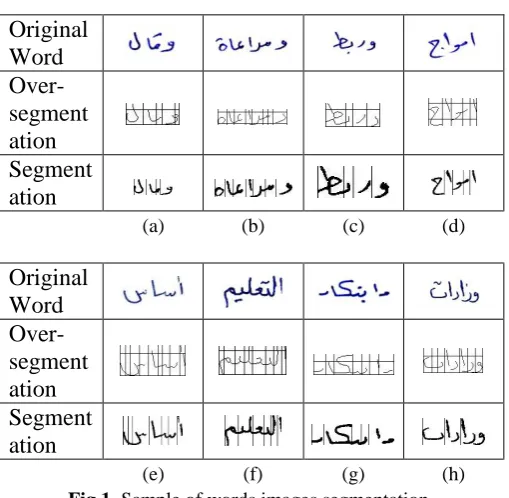
The research investigates new fusion equations; fusion equations calculate the entered confidence value then take the final decision of each segment point if it is valid or invalid. The technique develops two possible types of fusion equations. First equation calculates Correct Segmentation Point (CSP), where Segmentation Point Validation (SPV) >=0.5 as shown in Eq. (1). The second equation calculates Incorrect Segmentation Point (ISP), where SPV<0.5 as shown in Eq. (2). Finally, the technique finds fusion decision by calculating maximum value between CSP and ISP as shown in Eq. (3). If CSP confidence value is larger than ISP confidence value, the segmentation point will consider valid point. Conversely, if the ISP confidence value is larger, the SP will discard as invalid point and will no longer used for further processing. The entire technique analyses each word from right to left. Figure 1 shows sample of successful and unsuccessful segmentation of word images.
f
CSP(ft1, ft2, ft3) = f
SPV_Ver(ft1) + f
RCC_Ver(ft2) + (1-f
CCC_Ver(ft3))
(1)
f
ISP(ft1, ft2, ft3) = (1-f
SPV_Ver(ft1)) + f
RCC_Ver(ft2) + f
CCC_Ver(ft3)
(2)
f(confidence) = max [(CSP), (ISP)]
(3)
Where,
fSPV_Ver: confidence value of SPV.
fRCC_Ver: confidence value of right character.
Original
Word
Over-segment
ation
Segment
ation
(a) (b) (c) (d)
Original
Word
Over-segment
ation
Segment
ation
(e) (f) (g) (h)
Fig 1. Sample of words images segmentation,
(a-d) successful segmentation, and (e-h) unsuccessful segmentation.
IV.
E
XPERIMENTAL RESULTSThe technique obtains experimental results and verifying PSP by employing heuristic segmenter technique and using the over-segmentation method. Following sub-sections shows the obtained results.
A. Results of Character Recognition
Table II shows experimental results of the four neural networks FFFB, MLP, RBF, and SOM. The table contains details about training errors, CPU time, and the classification rate of the test set. The algorithm trains all networks with 300 epochs; 120 inputs of direction feature for each character/area.
Table II. Experimental results of characters recognition using direction feature and 120 inputs.
Database Neural Network
Training Error
CPU time (Second)
Classification
Accuracy Rate Set
DB1 [training set 620, testing set 620]
FFBP 10.48% 56.1448 78.06% 484/620
MLP 1.45% 449.4233 72.58% 450/620
RBF 1.13% 103.5379 95.32% 591/620
SOM 13.93% 202.3333 24.35% 151/620
DB2 [training set
78584, testing set
80288]
FFBP 7.34% 6720 87.56% 70300/80288
MLP 1.03% 43215 85.35% 68525/80288
RBF 0.86% 11325 97.24% 78072/80288
SOM 9.76% 23468 48.68% 39084/80288
Above table shows results of recognition rate and CPU time for all classifier. Figure 2 illustrates rates of characters recognition of all networks.
Fig. 2. Characters recognition rates for all neural networks.
B. Results of Neural-based Segmentation Technique
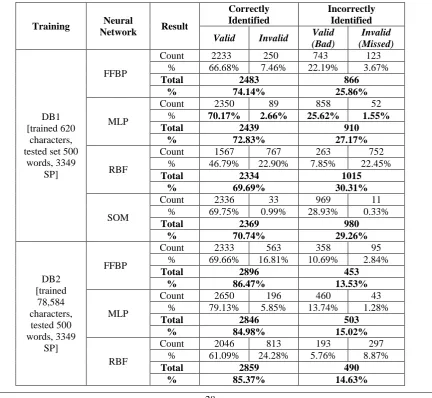
After the technique calculates recognition rate by training and testing neural networks, this step here validates all PSP. Neural network verifies whether prospective segmentation points are valid or invalid based on neural confidence-based module. If the network outputs a height confidence value, this indicates that the point is a valid segmentation point; a low confidence value indicates that the point should be ignored. Accuracy of AHS technique, networks, and fusion equations effect on the efficiency and accuracy of the overall segmentation techniques. Table III shows the results of the neural-based segmentation technique for the two databases and all classifiers. Figure 3 shows performance of all networks, include correctly and incorrectly of validate / invalidate segment points.
Table III. Performance results of the technique for 500 words (3349 SP)
Training Neural
Network Result
Correctly Identified
Incorrectly Identified
Valid Invalid Valid (Bad)
Invalid (Missed)
DB1 [trained 620
characters, tested set 500
words, 3349 SP]
FFBP
Count 2233 250 743 123
% 66.68% 7.46% 22.19% 3.67%
Total 2483 866
% 74.14% 25.86%
MLP
Count 2350 89 858 52
% 70.17% 2.66% 25.62% 1.55%
Total 2439 910
% 72.83% 27.17%
RBF
Count 1567 767 263 752
% 46.79% 22.90% 7.85% 22.45%
Total 2334 1015
% 69.69% 30.31%
SOM
Count 2336 33 969 11
% 69.75% 0.99% 28.93% 0.33%
Total 2369 980
% 70.74% 29.26%
DB2 [trained
78,584 characters,
tested 500 words, 3349
SP]
FFBP
Count 2333 563 358 95
% 69.66% 16.81% 10.69% 2.84%
Total 2896 453
% 86.47% 13.53%
MLP
Count 2650 196 460 43
% 79.13% 5.85% 13.74% 1.28%
Total 2846 503
% 84.98% 15.02%
RBF
Count 2046 813 193 297
% 61.09% 24.28% 5.76% 8.87%
Total 2859 490
% 85.37% 14.63%
7
8
.0
6
%
7
2
.5
8
% 9
5.
3
2
%
2
4
.3
5
%
8
7.
5
6
%
8
5
.3
5
%
97
.2
4
%
4
8
.6
8
%
20% 40% 60% 80% 100%
FFBP MLP RB SOM
A
cc
u
ra
cy
[%
]
Neural Networks
Recognition accuracy for different types of Neural Networks
Training Neural
Network Result
Correctly Identified
Incorrectly Identified
Valid Invalid Valid (Bad)
Invalid (Missed)
SOM
Count 2405 117 814 13
% 71.81% 3.49% 24.31% 0.39%
Total 2522 827
% 75.31% 24.69%
Fig 3. Correctly/Incorrectly identify valid/invalid of the neural-based segmentation.
In general, and through analysis the obtained above results, we note that there is a direct correlation between size of the training set and accuracy of character recognition / segmentation. This clearly indicates that whenever the size of the training set is large, the results will be more precision. As seen in Table II, there is a very clear different between rate of the recognition and training error of all classifiers. RBF network produces a good recognition rate for second database; the recognition rate for the first database are 97.24 for the second database and 95.32%. As well as, all other networks (FFBP, SOM, and MLP) produce better recognition and segmentation rate results for the second database. The results of all classifiers rates need more study and analysis to explain the behaviour of each network. Table IV illustrates some literature results compared with the results of this paper.
Table IV. Comparison the results with the related works in the literature.
Accuracy Language Data set Research
85.70% Cursive English handwriting 50 real mail envelopes [28] 90.00% Printed English handwriting Alphanumeric characters [29] 75.90% Cursive English handwriting CEDAR database [30] 81.21% Cursive English handwriting Griffith University database [31]
75.28% Cursive English handwriting CEDAR database [1]
86.90% Cursive English handwriting CEDAR database [32] 69.72% Arabic handwriting 360 addresses, 4000 words [33]
85.74% Cursive English handwriting
(Testing 1031 from 1718 SP) CEDAR database [34]
6 6 .6 8 % 2 2 .1 9 % 6 9 .6 6 % 1 0 .6 9 % 1 3 .7 1 % 2 .6 6 % 7 9 .1 3 % 1 3 .7 4 % 4 6 .7 9 % 7 .8 5
% 61
.0 9 % 5 .7 6 % 6 9 .7 5 % 2 8 .9 3 % 7 1 .8 1 % 2 4 .3 1 % 7 .4 6 % 3 .6 7 % 1 6 .8 1 % 2 .8 4 % 7 0 .1 7 % 2 5 .6 2 % 5 .8 5 % 1 .2 8 % 2 2 .9 0 % 2 2 .4 5 % 2 4 .2 8 % 8 .8 7 % 0 .9 9 % 0 .3 3 % 3 .4 9 % 0 .3 9 % 0% 20% 40% 60% 80% 100% Co rr ec t In co rr e ct Co rr ec t In co rr e ct Co rr ec t In co rr e ct Co rr ec t In co rr e ct Co rr ec t In co rr e ct Co rr ec t In co rr e ct Co rr ec t In co rr e ct Co rr ec t In co rr e ct V al id / In val id [ % ]
Neural Networks [correctly/Incorrectly]
Performance of neural-based segmentation validation
Valid Invalid
DB1 DB2
FFBP
DB1 DB2
MLP
DB1 DB2
RBF
DB1 DB2
Accuracy Language Data set Research
74.14% Arabic handwriting Local database (500 words) [36]
86.47% Arabic handwriting Local database (16,214 words) This Research
V.
C
ONCLUSIONWe conclude that using a large training set of database will lead to increase accuracy of recognition rates; for example, results of RBF network has reached to accuracy of 97.24% when the large database has applied and 95.32% when the small database has applied. MLP network result has also reached to accuracy of 85.35% and 72.58% when the small database has applied. Therefore, we notice that there is a clear link between size of the training set and accuracy of recognition rate of Arabic handwritten. We also notice a significant reduction in the training error rate; and increasing in CPU time because the classifiers trained with a larger database set. The large database produces highest accuracy of recognition rate. Validation of segmentation points using the large database also produces high accuracy, where it is 86.47% for FFBP classifier whine the large database has used and 74.14% when the small database has used. The results for MLP classifier is 84.98% and 72.83%, for RBF classifier 85.37% and 69.69%, and for SOM classifier 75.31% and 70.74%. Finally, we can say whenever the size of the training set is bigger the results will be better.
VI.
R
EFERENCES[1] Blumenstein M., "Intelligent Techniques for Handwriting Recognition, School of Information Technology", PhD Dissertation, Griffith University-Gold Coast Campus, Australia, 2000.
[2] Basu J.K., Debnath Bhattacharyya, Tai-hoon Kim., "Use of Artificial Neural Network in Pattern Recognition", International Journal of Software Engineering and Its Applications, 2010, 4(2):24–32. [3] Fan X., Brijesh Verma. , "Segmentation vs. Non-Segmentation Based Neural Techniques for Cursive Word
Recognition: An Experimental Analysis", International Journal of Computational Intelligence and Applications, 2002, 2(4):377–384.
[4] Plamondon R., S.N. Srihari, "On-line and Off-line Handwriting Recognition: A Comprehensive Survey", IEEE Transactions on Pattern Analysis and Machine Intelligence, 2000, 22:63–84.
[5] Al Hamad H.A., Abu Zitar R, "Development of an Efficient Neural-based Segmentation Technique for Arabic Handwriting Recognition", Pattern Recognition journal, 2010, 8(43):2773-2798.
[6] Rosenblatt F., "The Perceptron: A Probalistic Model for Information Storage and Organization in the Brain", Psychological Review, 1958, 65:386-408.
[7] Fukushima K., "Cognition: A self-organizing multilayered neural network", Biological Cybernetics, 1975, 20(3–4):121–136.
[8] Rumelhart D.E. Hinton, Geoffrey E., Williams, Ronald J., "Learning representations by back-propagating errors", Nature, 1986, 323(6088):533–536.
[9] Kohonen T., "Self-organized formation of topologically correct feature maps", Biological Cybernetics, 1982, 43(1):59–69.
[10] Broomhead D.S., D. Lowe., "Multivariate functional interpolation and adaptive networks", Complex Systems, 1988, 2:321–355.
[11] Bilski J., "The Ud Rls Algorithm for Training Feedforward Neural Networks", International Journal of Applied Mathematics and Computer Science, 2005, 15(1):115–123.
[12] Abdalla O.A., Zakaria M.N., Sulaiman, S., Ahmad, W.F.W, "A comparison of feed-forward back-propagation and radial basis artificial neural networks: A Monte Carlo study", Information Technology (ITSim), 2010, 2:994–998.
[13] Durai A.E., A. Saro, "Image compression with back-propagation neural network using cumulative distribution function", World Academy of Science. Engineering and Technology, 2006, 17:60–64.
[14] Ebeid H.M., "Using MLP and RBF neural networks for face recognition: An insightful comparative case study", International Conference on Computer Engineering and Systems (ICCES), 123–128. 2011.
[15] Chen S., C.F.N. Cowan, and P. M Grant, "Orthogonal least squares learning algorithm for radial basis function networks", IEEE Trans. Neural Networks, 1991, 2(2):302–30.
[16] Khalifa AS., R.A Ammar, M. F. Tolba, T., "Fergany. Dynamic online allocation of independent task onto heterogeneous computing systems to maximize load balancing", 8th IEEE International Symposium on Signal Processing and Information Technology, art. no. 4775659, 418–425, 2008.
[18] Babu R.V., S. Suresh, A Makur., "Robust object tracking with radial basis function networks", IEEE International Conference on Acoustics, Speech, and Signal Processing (ICASSP), 937–940, U.S.A. 2007. [19] Kohonen T., "Self-OrganiZing Maps", Berlin: Springer-Verlag, 1997.
[20] Kohonen T., "The self-organizing map", Proceedings of the IEEE, 1990, 78(9):1464–1480.
[21] Deotale N., Vaikole S.L., Sawarkar S.D, "Face recognition using artificial neural networks", The 2nd International Conference on Computer and Automation Engineering (ICCAE), 446–450, 2010.
[22] PalHi M., T. Honkela, T., "Kohonen. Bibliography of self-organizing map (SOM)", papers: 2002-2005 addendum, Information and Computer, 2009.
[23] Yong Z., Xue ZhiMao, "RBF Neural Network Application to Face Recognition", International Conference on Challenges in Environmental Science and Computer Engineering (CESCE), 381–384, 2010.
[24] Al Hamad H.A., "Neural-Based Segmentation Technique for Arabic Handwriting Scripts", 21st International Conference on Computer Graphics, Visualization and Computer Vision (WSCG 2013), Czech, 2013. [25] Al Hamad H.A., Hamdi-Cherif A, "The Arabic Center for Document Analysis and Recognition (ACDAR) -
Structure and Perspective", European Conference of COMPUTER SCIENCE (ECCS '12), 85–91, 2012. [26] Al Hamad H.A., "Skew Detection/Correction and Local Minima/Maxima Techniques for Extracting a New
Arabic Benchmark Database", International Journal of Advanced Computer Science and Applications (IJACSA), 2015, 6(9):1-10.
[27] Al Hamad H.A., "Over-segmentation of handwriting Arabic scripts using an efficient heuristic technique", IEEE International Conference on Wavelet Analysis and Pattern Recognition (ICWAPR), 180–185, 2012. [28] Han K., I. K. Sethi., "Off-line Cursive Handwriting Segmentation", Proceedings of the 3rd International
Conference on Documents Analysis and Recognition, 894–897, 1995.
[29] Lee S-W., D-J. Lee, H-S. Park, "A New Methodology for Gray-Scale Character Segmentation and Recognition", IEEE Transaction on Pattern Analysis and Machine Intelligence, 1045–1051. 1996,
[30] Eastwood B., A. Jennings, A. Harvey, "A Feature Based Neural Network Segmentor for Handwritten Words", International Conference on Computational Intelligence and Multimedia Applications, ICCIMA, Gold Coast, Australia, 286–290, 1997.
[31] Blumenstein M., B. Verma, "A Segmentation Algorithm used in Conjunction with Artificial Neural Networks for the Recognition of Real-World Postal Addresses", International Conference on Computational Intelligence and Multimedia Applications, 155–160, Australia, 1997.
[32] Nicchiotti G., C. Scagliola, "A Simple and Effective Cursive Word Segmentation Method", Proceedings of the 7th International Workshop on Frontiers in Handwriting Recognition, Amsterdam, 499–504, 2000. [33] Hamid A., Ramzi Haraty, "A Neuro-Heuristic Approach for Segmenting Handwritten Arabic Text",
ACS/IEEE International Conference on Computer Systems and Applications, AICCSA, 1–10, 2001. [34] Cheng Ch.K., Michael Blumenstein, "The Neural-based Segmentation of Cursive Words using Enhanced
Heuristics", ICDAR, 8th International Conference on Document Analysis and Recognition 650–654. 2005. [35] AlKhateeb J.H., Jianmin Jiang, Jinchang Ren, Stan S. Ipson, "Component-based Segmentation of Words
from Handwritten Arabic Text", Proceedings of World Academy of Science, Engineering and Technology 31:1307–6884, 2008.
![Table I. Performance of AHS Over-segmentation for 500 words image [5].](https://thumb-us.123doks.com/thumbv2/123dok_us/1405058.1652766/3.595.121.476.94.169/table-i-performance-ahs-segmentation-words-image.webp)