29
Speech Coding Techniques: A Comparative Study
1
Rashmirekha Ram,
2Hemanta Kumar Palo,
3Mihir Narayana Mohanty,
4B.N. Sahu
1,2,3,4Dept. of ECE, ITER, Siksha ‘O’ Anusandhan University, Bhubaneswar, Odisha, India
Abstract
A major challengeof speech coding system is optimum utilization of channel bandwidth. To preserve bandwidth researchers have resorted to speech coders with fewer bits. Ultimately, intelligibility, SNR and overall speech quality have deteriorated. It forced speech engineers for a trade-off between different parameters affecting speech coding mechanism. To assess the impact of these parameters and their utility, a comparative analysis is performedwith different speech coding techniques.The performance analysis of these coders on a self-generatedregional oriya language have been incorporated and validated with standard English language dataset.
Keywords
PCM, DPCM, ADPCM, LPC, CELP, ACELP
I. Introduction
Speech coding aims in compact digital representations of the uttered
signals [1-3]. Few factors often discussed in designing an efficient
speech coding mechanism are: transmission quality, multiuser capability, low storage requirements, bandwidth conservation and speech quality enhancement with higher signal to noise ratio (SNR) [1]. As all the above parameters are associated with some cost components, speech coding continued to be a hot topic of research for telecommunication and multimedia industries. Hence speech engineers have been striving to achieve a bandwidth
efficient speech coder at low data rates with accepted speech
quality. Based on perceptual quality, coding delay, complexity and bandwidth speech coders can be grouped into narrowband (300 Hz to 3400 Hz with 8 KHz sampling) and wideband coders (<50 Hz to 7000 Hz with 14 to 16 KHz sampling). In order to obtain desired signal compression rate, removal of redundant data remains a priority with corresponding reduction in number of bits [2]. In 1971,Atal and Hanauer proposed voice coding using Linear Prediction (LP) Analysis. It is by far the most popular approach to low-rate speech coding. An attemptfor low rate speech coder at AT& T Laboratories, USA without any perceptually loss in signal quality has been a major breakthrough in this area [3-4]. Despite the low bandwidth necessary for speech transmission of this system, it was not widely accepted. In many applications, true low-rate vocoders (as opposed to the higher low-rate ‘waveform’ coders) did not achieve great popularity [5]. An elaborate description on speech coding mechanism, various techniques LPC, CELP (code-excited linear prediction), history and evolution of speech coding systems have been emphasized in literatures [6-7]. Ways of reducing bit rates, modelling of speech utterances have been elaboratedby these authors.Human auditory system is analysed, with relevance to speech charactersticsexplained. These parameters can help indevelopment of effective speech coding systems.To layout design guidelines absolutely, considerable effort need to be given as human perception is very little understood. Alternative
classification criteria with diversified survey on existing speech
coding technology, subjective and objective measuring criteria for speech coding system performance have been a boon for research directions [7-8]. Mean opinion score (MOS) as subjective measure and signal-to-noise (SNR) as objective measurement are mostly used for these compression algorithms.
Digitization made speech coding system simple and effective [2, 9]. A.M. Kondoz, provided digitization of speech and the Coding schemes for low bit rate Communications Systems [1]. Many advances in speech coding techniques have since been taken place from early systems to waveform coders, parametric coders and Hybrid coders. All these systems strive to achieve a good quality speech with perceptual reduction in bit rate. Essentially, pulse code modulation (PCM) is widely developed for the digitization of speech signals. It is conceptually simple to interpret, thus serve as an yardstick of comparison for other coders. In DPCM(Differential PCM) prediction-error signal is quantized rather than the signal sample. In this past samples can predict present sample.Removal of redundancies and thus, bit ratehelps in reduction of bandwidth.
The system has both fixed predictor and quantizer. In ADPCM
(adaptive differential PCM) by trackingtime-varying behaviourof signal input considerable insight can be achieved. The quantizer, the predictor or both can be used for adaptation [7].LP has been
significantly considered as a vital modulemost speech coding
schemes. Itclosely follows acoustic tubes model for human vocal tract system.Based on principle of LP most advanced coders have been developed with fairly improved performance [9-12].CELP is one such advanced speech coding technique. Searching of an excitation codebook to provide a reliable excitation sequence during encoding is the fundamental behind CELP working [5]. Many advanced standard coders have later developed based on CELP principle [12].
With help of an excitation codebook, which is searched during encoding to locate the best excitation sequence, is the basis of
CELP coders [5]. CELP is among one of the most influential
ideas in speech coding. Its principles lay the foundation for many standardized coders [12].
II. Metheodology
In exploring a reliable estimation of speech coding comparison algorithm, variety quality measurement standards have been established [11]. Database representing speech utterances and
efficient coding algorithm are two fundamental modules of any
speech coding mechanism.
A. Proposed Database
First step in modelling a speech recognition system is the preparation of required database. As a supplement,utterancesof regional Oriya digits from “shunya” to “nau” from a single female speakerare recorded using “Gold wave software”. Each digit was uttered ten times by the speaker. A total of one hundred utterances thus recorded and processed further for simulation by MATLAB software. Sampling rate of 16 KHz with 8-bit per sample have been selected for preparation of database.
B. Speech Coding Techniques
compared to parameter and hybrid coders. Parameter coding model depends on certain speech parameters. Analysis of these speech parameters before transmission and synthesizing at the receiving end for reconstruction of the original signal is essential part of this scheme.Hence the output waveform cannot resemble as that of input. However, these coders outperform waveform coders on speech quality enhancement at corresponding lower bit rate. LPC and mixed excitation linear predictive coders (MELP) come
in this category.To deliver good quality efficient speech coding
schemes, hybrid coders has to compromise between waveform and parametric coders. As with parametric coder, its performance depends on accuracy of corresponding speech model for estimation of model parameters during encoding. Adequate Optimization of model parameter helps in replicating the decoded output as near as input based on certain error threshold. CELP and its variants are hybrid coders [12].
1. Pulse Code Modulation (PCM)
Both the parameters amplitude and time are expressed in digitized form in PCM modulation. Quantization operation combined with sampling permits the use of coded pulses for representing the message signal.In telephony, speech signal is encoded at 8KHz with 8 bits per sample. Thus the bit rate became 64 kbps. In PCM, normally compression using eitherµ-law (Japan and North America) or A-law (most of the world including Europe) is incorporated [11-12]. This system is described by international standard G.711.The DFT of a signal with frequency f, sampling frequency fsa and windowing duration Nsain samples can be expressed as
2. Differential Pulse Code Modulation (DPCM)
High correlation exists in speech signals as they do not change fast. So adjacent samples are likely to be correlated, thus introduce redundancy. Temporal redundancy removal by prediction of current samples using past samples is the basic theme of DPCM [7]. By coding the predictive residuals instead of the original speech signal helps in reduction of energy.
The prediction error with x(nTs) as quantized input and x̂(nTS) as predicted value given as
e(nTS) = x(nTS) -x̂(nTS) (1)
Decoder
+
+ Output
Prediction Filter Input
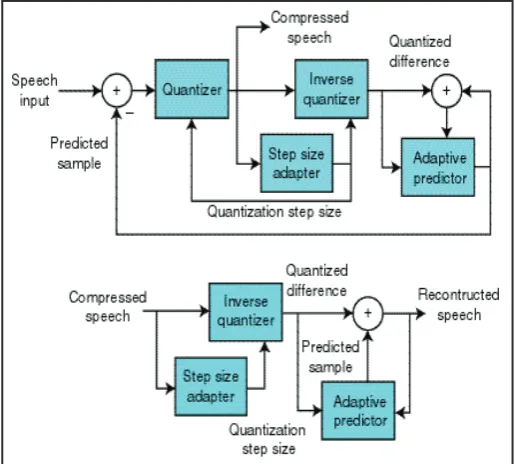
Fig. 1: DPCM Transmitter and Receiver
3. Adaptive Differential Pulse Code Modulation (ADPCM)
Merging Number of bits/sample can be reduced from 8 to 4, by using an ADPCM. In this both quantizer and predictor are adaptive in nature.Bandwidth reduction associated with a given SNR is the prize of ADPCM compared to DPCM.Prediction gain based on adaptive logice is another milestone of this system. It also determines the current sample at any instant adaptively with the help of past history [7, 12].
4. Linear Predictor Coder (LP)
Linear prediction estimates the current sample by combining
past few samples linearly [3, 9]. The basic approach is to find a set of predictor coefficients that minimize the mean-squared
error over a short segment of speech waveform. Although auto correlation and covariance methods have been mostly used to
determine LP coefficients, the former method is used in this work
for convenience. A frame size of 30ms with 10ms overlapping between frames is chosen here.
The LPC filter with coefficients at and filter order tis given as
(2)
A value of t=10 has been selected.
Impulse Train Generator
Random Noise Generator
Time-Varying Digital Filter Pitch Period
Vocal Tract parameters
G
s(n) u(n)
voiced/unvoiced switch
Fig. 2: Speech Synthesis Model Based on LPC Model
31
Fig. 4: CELP Encoder Analysis-by-Synthesis Loop
5. Code Excited Linear Predictor (CELP)
Frame duration of 10 to 30 ms is used in CELP coders.LP
coefficients and filter pitch parameters are optimally extracted for
quantization. Successive division of each frames into sub frames of 5 ms are performed before searching of desired codebook. It provides required vector input to the quantized predictor system forsuitablespeech signal generation.The function of decoder is to unpack and decode neededfeatures from the bit-stream. Speech synthesisation is then followed using the unpacked and decoded data. The quality enhancement of output signal can be formalized
using the post filter [1, 3-8, 12].
Fig. 5: Block Diagram of a CELP Decoder
6. Algebraic CELP (ACELP)
It is a variant of CELP coder that follows analysis-by-synthesis algorithm as LP model [12]. However, the codebook used here is adaptive in nature to accommodate pitch periodicity on long term.
C. Subjective Performance Measure
MOS is a subjectivetechnique used to measureoutput qualityof human utterances [6-8]. Listeners are made familiarized with rating method and conditions of listening. Rating is obtained by taking mean of a number of listened samples. MOS have following scoring criteria
Score Quality
4-4.5 network quality 3.5-4 communications quality 2.5-3.5 synthetic quality
In this project five listeners are chosen at random for rating the
quality of the speech signal. Computation of MOS rating is done with following criteria: Excellent (5), Good(4),Fair (3), Poor (2) and Unsatisfactory (1).
III. Results and Discussions
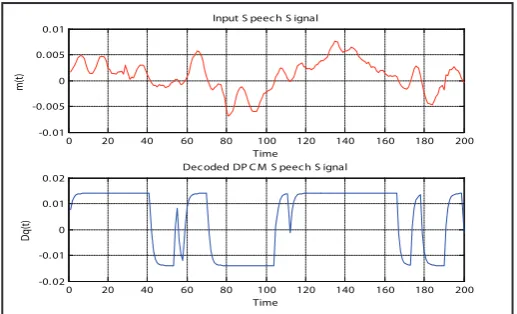
MATLAB simulation of the chosen regional oriya digits for different coders have been plotted graphically (Fig.6-Fig.10). CELP reproduces the signal more closely to the original signal as compared to other coders. This is due to the fact that CELP uses long term and short term linear prediction models. The performance
of CELP is superior over LPC based coders because it uses both magnitude and phase information during synthesis.
As observed from the mean opinion score (MOS), PCM has the highest speech quality among all (Table I). However, it also has highest bandwidth hence bit rate among all coders (Table I).Thus it
is most bandwidth inefficient. All other waveform coders are also bandwidth inefficient compared to parameter and hybrid coders. CELP and ACELP are most bandwidth efficient for the same
number of bits when used with other coders followed by LPC coders. Hence hybrid coder like CELP and ACELP are suitable for multiuser need as a result of bandwidth conservation with perceptually acceptable speech quality
The computational algoritthm and codec delay of waveform coders are better than other form of speech coding techniques.This makes these coders less suitable for multiuser need. However, for equal number of bits used, CELP has lowest complexity andbetter speech quality like ACELP.
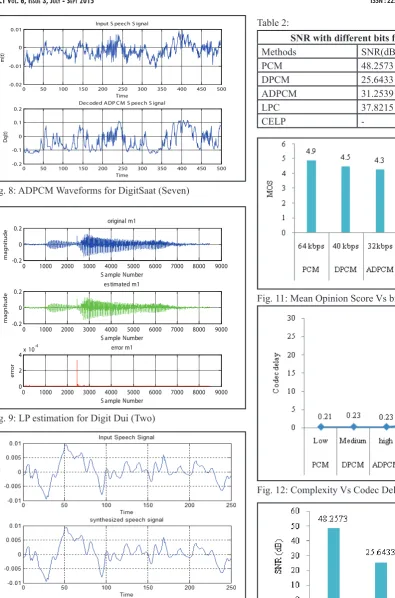
PCM has the simplest speech coding scheme with lowest codec delay among all studied coders in this work.It has output SNR of around 48 dB as compared toDPCM (approximately26 dB) as observed from table II. ADPCM has a better SNR of around 31 dB, due to use of adaptive quantization and adaptive prediction. LP coder proved to have better output SNR compared to DPCM and ADPCM but lower than PCM. But since bandwidth is scarce, these coders are unsuitable for bandwidth constrained channels. The complexity of the speech coders, PCM, DPCM, ADPCM and CELP in termsof bit rate is shown in table I.. We note that as the bit-rate goes down, the computational increases on a large scale for different bits used. This introduces a delay as well as an increase in the cost of implementation. However, for equal number of bits used bandwidth in CELP and ACELP is reduced drastically than waveform coders, making them most suitable in bandwidth scarcity situations.
0 50 100 150 200 250
-0. 01 -0. 005 0 0. 005
0. 01 P C M Input S ignal
Time
m(t)
0 50 100 150 200 250
-4 -2 0 2x 10
-3 P C M Output S ignal
Time
PCM Signal
Fig. 6: PCM Waveforms for DigitPanch (Five)
0 20 40 60 80 100 120 140 160 180 200
-0. 01 -0. 005 0 0. 005
0. 01 Input S peech S ignal
Time
m(t)
0 20 40 60 80 100 120 140 160 180 200
-0. 02 -0. 01 0 0. 01
0. 02 Decoded DP C M S peech S ignal
Time
Dq(t)
0 50 100 150 200 250 300 350 400 450 500 -0.02
-0.01 0
0.01 Input S peech S ignal
Time
m(t)
0 50 100 150 200 250 300 350 400 450 500
-0.2 -0.1 0 0.1
0.2 Decoded ADP C M S peech S ignal
Time
Dq(t)
Fig. 8: ADPCM Waveforms for DigitSaat (Seven)
0 1000 2000 3000 4000 5000 6000 7000 8000 9000
-0.2 0
0.2 original m1
S ample Number
magnitude
0 1000 2000 3000 4000 5000 6000 7000 8000 9000
-0.2 0
0.2 es timated m1
S ample Number
magnitude
0 1000 2000 3000 4000 5000 6000 7000 8000 9000
0 2 4x 10
-4 error m1
S ample Number
error
Fig. 9: LP estimation for Digit Dui (Two)
Fig. 10: CELP Waveforms for Digit Shunya (Zero)
Table 1:
Comparison of speech coders
Algorithm Bit Rate (bit/sec) Complexity Codec delay (ms) MOS
PCM 64 kbps Low 0.21 4.9
DPCM 40 kbps Medium 0.23 4.5 ADPCM 32kbps high 0.23 4.3 LPC 2.4kbps Lower 1.19 2.9 CELP 4.8 kbps Lowest 1.27 3.7
Table 2:
SNR with different bits for different coders
Methods SNR(dB) Number of Bits
PCM 48.2573 8
DPCM 25.6433 5
ADPCM 31.2539 4
LPC 37.8215
-CELP -
-Fig. 11: Mean Opinion Score Vs bit rate for different coders
Fig. 12: Complexity Vs Codec Delay for Different Coders
Fig. 13: Comparison of Signal to Noise Ratio for Different Coders
IV. Conclusion
33
a hybrid coder which has shown its superiority over waveform coders in terms of bit rate and reduction in bandwidth requirement. However, on reducing the bit rate, its MOS quality decreased.
References
[1] A. M. Kondoz,“Digital Speech: Coding for Low Bit Rate Communications Systems”, John Wiley and Sons Publishing, England, 1994.
[2] Thomas F. Quatieri,“Discrete-Time Speech Signal Processing”, Prentice-Hall, third edition, 1996.
[3] B. S. Atal, S. L. Hanauer,“Speech Analysis and Synthesis by Linear Prediction of the Speech Wave”, J. Acoust. Soc. Am, Vol. 50, No. 2, pp. 637-655 August 1971.
[4] Bishnu S. Atal, Nikil S. Jayant,"AT&T Bell Laboratories, Murray Hill, New Jersey, USA.
[5] B. S. Atal, M. R. Schroeder,“Predictive coding of speech signals and subjective error criteria”, IEEE Trans. Acoust., Speech, Signal Proc., Vol. ASSP-27, pp. 247-254, June 1979.
[6] B. Gold, N. Morgan,“Speech and audio signal processing”, John Wiley and Sons, 2003.
[7] A. S. Spanias,“Speech coding: A tutorial review”, Proc. IEEE, Vol. 82, pp. 1541-1582, Oct. 1994.
[8] Jacob Benesty, M. Mohan Sondhi, Yiteng Huang (Eds.), “Springer Hand book of Speech Processing”, Springer-Verlag Berlin Heidelberg 2008.
[9] L. R. Rabiner, B. H. Juang,“Fundamental of Speech Recognition”, 1st ed., Pearson Education, Delhi, 2003. [10] Klejin, W. B., Paliwal, K. K.,"Speech Coding and Synthesis”,
Elsevier, Amsterdam, 1995.
[11] W. C. Chu,"Speech Coding Algorithms: Foundation and Evolution of Standardized Coders”, John Wiley & Sons, 2003.