SIGNATURE VERIFICATION USING PCA AND GEOMETRIC
FUNCTIONS
Basavanna M1, Prem Singh M2, Chandraiah T3, Prakash raje urs M4
1. INTRODUCTION
Biometrics can be categorized as behavioral and physiological. Handwritten signature belongs to behavioral biometr ic. In most of the places, the verification is done manually either by a person who is familiar with the signature or by matching it against a few signature templates handwritten. Signature verification can be classified into offline and online signature recognition system. Between the two, the later is more reliable because of its higher efficiency in terms of accuracy and time. However, the other systems cannot be ignored, since its applicability and ease of use are more in comparison to online systems in many parts of the world. There are many approaches, but our approach contains four major phases for verifying a signature. These are Data gathering, Preprocessing, Training, and Testing as shown in Figure 1. Training is a phase in which we will find correlation between a features of signature then we find the mean and deviation from correlation values and save them in database. Testing is done to test the input image is correct or forged.
Figure 1. Block diagram of handwritten signature verification system
1
Assistant Prof., Post Graduate Dept. of Computer Science, Government College (Autonomous), Mandya, Karnataka, India
2
Assistant Prof., Post Graduate Dept. of Computer Science, Government College (Autonomous), Mandya, Karnataka, India
3
Assistant Prof, Dept. of Computer Science, Yuvaraja's College, University of Mysore, Mysore, Karnataka, India
4
Assistant Professor, Dept. of Computer Science, Maharani’s Science College for Women, Mysore, Karnataka, India Data
Gathering
Pre-Processing
Training Testing
Abstract: Signature is now serving as importants of personal verification tool for most of the commercial transactions in the era of information technology which emphasizes the need for an automatic verification system. It can be performed either offline or online based on the application. The later use dynamic information of a signature captured at the time the signature is obtained, where as offline systems work on the scanned image of a signature. In this paper we present a method for offline verification of signatures using a set of simple shape analysis based on the scanned images. Offline signatures are worke d by having some geometric functions or shaping’s, center of gravity, shaped angle and aspect ratio. This signature verification will be used for finding the forgery signatures with compares of original signature by using PCA (Principal Component Analysis) method and geometrical features.
Keywords: Offline Verification, Geometric Features, PCA, Aspect Ratio, Signature Verification
The desired plan of work is based on the standard data set and training data set collected from people. In this method signatures were collected in different styles which were signed in handwriting as shown in Figure 2.
In this work original handwritten signature from the members and fake handwritten signatures from other members were collected, for every signature as shown in Figure 3 and 4 respectively, we perform the pre-processing steps for noice removal. For every signature we find the geometrical features of the objects such as area, height, width, aspect ratio, standard deviation, mean, kurtosis and skewness and also compares the values of the each signature degree of sloping by finding the angles from orientation values using PCA.
In this work we focus on two signature verification techniques that have been defined such as, 1. Boundary based technique.
2. Principal Component analysis based technique
1.1 Boundary based technique
area, aspect ratio, standard deviation and skewness of signature image more clearly as compared to area based technique. It is fast in processing and needs less computation than area based technique.
1.2 Principal Component analysis based technique
PCA method focuses mainly to compress the components and finding the values for each component. It represents component features such as major axis length, minor axis length, eccentricity and orientation of signature components. It is clearly finding the angle of components by having the orientation value of the signature. It is fast in processing and computes the angles between signatures.
Whereas boundary based technique focuses mainly on object boundary. It represents shape of the signature component more clearly as compared to area based technique. Due to fast processing and easy computation, it is widely used in real time and practical applications. We consider just the boundary based technique.
2. LITERATURE SURVEY
original set of variables that nonetheless retains most of the samples information. Finally we can conclude that there is no method to prove 100% Signature verification[14-21].
From the above literature review, it is found that there is no perfect method to give perfect solution to solve the problem of signature verification. Hence, we propose a new method called signature verification using PCA and geometric functions based method to overcome the problems of the existing methods.
3. PROPOSED METHOD
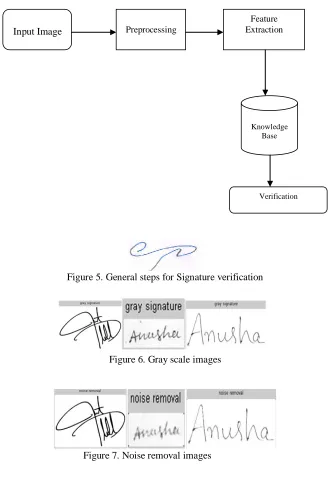
In our proposed method, we identified the fake signatures by using PCA and geometric functions. As shown in Figure 5 first we take the original image of RGB image as the input. The input is like different signatures which are collected from different people. We have used different available datasets and took training datasets of original signatures from original member and took fake signatures from other people. The input RGB signature image is converted into a grayscale image and preprocessing activities such as noise removal are done using median filter method. Various geometrical approaches are used to describe the objects using global and local descriptors such as mean, standard deviation, kurtosis, skewness and circularity.
Figure 5. General steps for Signature verification
Figure 6. Gray scale images
Figure 7. Noise removal images
Input Image Preprocessing
Feature Extraction
Knowledge Base
Figure 8. Binary images
Figure 9. Connected components
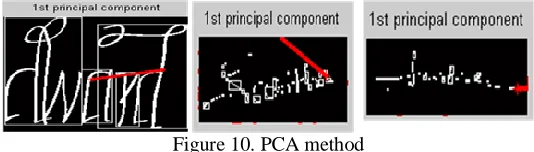
Figure 10. PCA method
We propose PCA to compute angle for each signature block to find the direction of the signature. The reason to use PCA is that PCA gives accurate principal axis for the signature objects that have regular shape. The method feeds x and y coordinates of pixels to PCA to compute angle for each block as the angle is computed based on Sobel edges corresponding to pixels in the signature block. The Sobel edge map is obtained by performing Sobel edge operator on the input signature image.
4. EXPERIMENTAL RESULTS
More than 335 sample signatures were collected in two different categories, in the datasets we have collected original signatures samples from original people and fake signatures from other people. In order to prove the accuracy of our proposed recognition system, more test signatures were considered, for each type of signature in the system domain and used to test the system with various training signature images which are of different styles, shapes and pressure. Table 1 shows the system is convincible to say that the system is robust enough and able to recognize any input signature images that are being captured in any conditions.
Table 1. Proposed method acceptance and rejection rate
Nature of Signature No. of Samples Acceptance Rate Rejection Rate
Original 335 97.6 2.4
Forged 335 96.0 4.0
5. CONCLUSIONS AND FUTURE SCOPE
6. REFERENCE
[1] K. Jain, A. Ross, and S. Prabhakar, An introduction to biometric recognition, Circuits and Systems for Video Technology, IEEE Transactions on , vol. 14, no. 1, 2005, pp-4–20.
[2] L. G. Hafemann, R. Sabourin, and L. S. Oliveira, Offline Hand-written Signature Verification-Literature Review, arXiv preprint arXiv:1507.07909, 2015.
[3] Fincy Francis, Aparna M.S, and Anitta Vincent, Biometric Online Signature Verification, OSR Journal of Electronics and Communication Engineering (IOSR-JECE), National Conference on Network Security, pp-82-89.
[4] Luiz G. Hafemann, Robert Sabourin, and Luiz S. Oliveira, Learning features for offline handwritten signature verification using deep convolutional neural networks, Pattern Recognition 70, 2017, pp-163–176.
[5] Priya Metri, and Ashwinder Kaur, Handwritten Signature Verification using Instance Based Learning, International Journal of Computer Trends and Technology, 2011, pp-1-4.
[6] Harpreet Anand and D.L Bhombe, Enhanced Signature Verification and Recognition using Matlab, International Journal of Innova tive Research in Advanced Engineering (IJIRAE), Volume 1 Issue 4, 2014, pp-88-94.
[7] L B. Mahanta and Alpana Deka, A Study on Handwritten Signature, International Journal of Computer Applications,Volume 79, No. 2, 2013, pp -1-5. [8] Suhail Odeh and Manal khalil, Apply Multi-Layer Perceptrons Neural Network for Off-line signature verification and recognition, IJCSI
International Journal of Computer Science Issues, Vol. 8, Issue 6, No 2, November 2011 ISSN (Online): 1694 -0814.
[9] Meenakshi S Arya, and Vandana S Inamdar, A Preliminary Study on Various Off-line Hand Written SignatureVerification Approaches, ©2010 International Journal of Computer Applications (0975 –8887) Volume 1 –No. 9.
[10] Sachin A. Murab, and Vaishali. M.Deshmukh, An Empirical Study of Signature Recognition & Verification System Using Va rious Approaches, International Journal of Engineering and Advanced Technology (IJEAT) ISSN: 2249 – 8958, Volume-2.
[11] Alan McCabe, Jarrod Trevathan and Wayne Read, Neural Network based Handwritten Signature Verification, Journal of Computers, Vol. 3, No. 8, August 2008.
[12] Debasish Jena, Banshidhar Majhi and Sanjay Kumar Jena, Improved Offline Signature Verification Scheme Using Featur e Point Extraction Method, Journal of Computer Science 4 (2): 111-116, 2008.
[13] Lindsay. I Smith, A tutorial on Principal Components Analysis, Feb. 26, 2002.
[14] D.Bertolinia, L.S.Oliveirab, E.Justinoa, and R.Sabourinc, Reducing forgeries in writer -independent off-line signature verification through ensemble of classifiers, Volume 43, Issue 1, January 2010.
[15] Han, and I.K. Sethi, Handwritten Signature Retrieval and Identification, Pattern Recognition 17, 1996, pp. 83 -90.
[16] Priya Metri, and Ashwinder Kaur, Handwritten Signature Verification usingInstance Based Learning, International Journal of Co mputer Trends and Technology-March to April Issue 2011.
[17] Meenu Bhatia, Off-Line Hand Written Signature Verification using Neural Network, International Journal of Application or Innovation in Engineering & Management (IJAIEM), Volume 2, Issue 5, May 2013.
[18] Pradeep Kumar, Shekhar Singh, Ashwani Garg, and Nishant Prabhat, Hand Written Signature Recognition & Verification using Neural Network, International Journal of Advanced Research in Computer Science and Software Engineering Volume 3, Issue 3, March 2013.
[19] Kritika Raghuwanshi Niketa Dubey, and Riju Nema Rishabh Sharma, Signature Verification through MATLAB Using Image Processing, International Journal of Emerging Trends in Electronics and Computers (IJETECS) Volume 2, Issue 4,April 2013.
[20] Umesh. Bhadade, Rupal Patil, Nilesh Y. Choudhary, and Bhupendra M Chaudhari, Signature Recognition & Verification System U sing Back Propagation Neural Network, International Journal of IT, Engineering and Applied Sciences Research (IJIEASR) ISSN : 2319-4413Volume 2, No. 1, January 2013.