Article
Static Formation Temperature Prediction Based on
Bottom Hole Temperature
Changwei Liu 1, Kewen Li 1,*, Youguang Chen 2, Lin Jia 1 and Dong Ma 3 1 School of Energy Resources, China University of Geosciences, Beijing 100083, China;
[email protected] (C.L.); [email protected] (L.J.)
2 Department of Petroleum and Geosystems Engineering, University of Texas at Austin, TX 78712, USA;
3 Petroleum Engineering College, Yangtze University, Wuhan 430100, China; [email protected]
* Correspondence: [email protected]; Tel.: +86-010-823-22460
Abstract: Static formation temperature (SFT) is required to determine the thermophysical properties and production parameters in geothermal and oil reservoirs. However, it is not easy to determine SFT by both experimental and physical methods. In this paper, a mathematical approach to predicting SFT, based on a new model describing the relationship between bottom hole temperature (BHT) and shut-in time, has been proposed. The unknown coefficients of the model were derived from least squares fit by the Particle Swarm Optimization (PSO) algorithm. Besides, the ability to predict SFT using a few BHT data points (such as the first 3, 4, or 5 points of a data set) was evaluated. The accuracy of the proposed method to predict SFT was confirmed by a deviation percentage less than ±4% and a high regression coefficient R2 (>0.98). The proposed method could be used as a practical tool to predict SFT in both geothermal and oil wells.
Keywords: static formation temperature; shut-in time; least squares; PSO
1. Introduction
Deep drilling is necessary for the exploitation of deep geothermal reservoirs [1]. In this case, borehole drilling is a complicated process in which a constant thermal anomaly (in addition to the circulating drilling mud) affects the static formation temperature (SFT) around the borehole [2]. Determining SFT at any depth demands a lot of time, to measure the bottom-hole temperature
(BHT) and shut-in time[3]. Measuring BHT can be costly due to the usage of sophisticated logging
equipment and the necessity to temporarily stop the wellbore drilling [4].
Optimal estimation of SFT is required for several applications: including the determination of geothermal heat flow, analysis of well logs, estimation of geothermal potential, evaluation of in-situ thermophysical formation properties[5], determination of hydrocarbons properties in petroleum systems [6-8].
Estimation of SFT is usually achieved by analytical and numerical simulation methods. Most of the analytical methods are based on the constant linear and cylindrical heat source models. Analytical methods most commonly used to estimate SFT include the Horner-plot method (HM) or the line-source method [9], the Kutasov-Eppelbaum method (KEM) or the generalized Horner method [10], the Manetti method (MM) or the cylindrical source with a conductive heat flow method [11], the Hansan and Kabir method (HK) or the cylindrical heat source with a conductive-convective
heat flow method[12], the Bernnand method (BM) or the radial source with a conductive heat flow
method [13], the spherical and redial heat flow method (SRM) proposed by Ascencio et al. [14], the Leblanc method (LM) or the cylindrical source with a conductive heat flow method [15].
Numerical simulation is another method to estimate SFT, which can also be applied to determine geothermal gradients and describe the thermal history [18]. For example, Garcia et al.[19] developed the numerical simulator TEMLOPI for estimating transient temperature distribution in a wellbore and the surrounding rock formation. Application to well Az-29 from the Los Azufres Mexican geothermal field shows satisfactory results. This simulator could be used by drilling engineers to determine the optimal design of cement slurries and their setting times during well construction.
However, both analytical and numerical simulation methods have some limitations such as the excessive amount of some other data that is needed besides BHT and shut-in time, (e.g. thermophysical and transport properties of the wellbore, drilling and cementing materials, formation and rock materials, whose data is rarely available and therefore limits the usage of these methods) and the accurate circulation time that is usually unknown or difficult to determine under drilling conditions.
Against this background, a reliable and practical tool to estimate SFT is still required in geothermal and petroleum industries. In this paper, a mathematical function has been proposed to correlate BHT and shut-in time. The coefficients of the function were obtained from Particle Swarm Optimization (PSO) algorithm based on the least squares fit target.
PSO is a stochastic, population-based optimization method that was introduced by Kennedy and Eberhart [20]. It belongs to the family of swarm intelligence computational techniques and is inspired by social interaction in human beings and animals (especially bird flocks and fish schools). PSO optimizes a problem by having a population of candidate solutions, dubbed particles here, and moving these particles around in the search-space according to simple mathematical formulae over the particle's position and velocity. Each particle's movement is influenced by its local best known position but, is also guided toward the best known positions in the search-space, which are updated as better positions are found by other particles. PSO algorithm has been used in many numerical solution problems and shows its wide applicability [21 -23].
PSO has some advantages in solving optimization problems, for example, it requires few parameters to be tuned by users, it is high accuracy, it is less affected by initial solutions compared with other algorithms, it is fast convergence, it is easy codes due to the simple underlying concepts and demands no requirement for preconditions such as continuity or differentiability of the objective functions [24].
2. Methodology
A function correlating BHT and shut-in time was derived to fit the BHT data and the estimated SFT. The coefficients of this function can be obtained from least squares fit method using Particle Swarm Optimization (PSO) algorithm. Besides, other methods were also introduced for comparison purpose with the new method. Statistical tests were applied to evaluate the validity of the predicting methods.
2.1 Method Development
2.1.1 Function Derivation
Horner method for determining the static formation temperature is widely used in oil and gas industry [9]. This analytical method is based on the assumption that thermal effect of drilling is a constant linear heat source. The approximate solution is given by:
BHT(t) = T − ( ) ∙ log ( + )⁄ (1)
where T is the static formation temperature, log ( + )⁄ is the Dimensionless Horner
Time (DHT), and are the circulation time before shut-in and the time elapsed since the circulation stopped, respectively. One of the problems in Equation (1) is that of being inconsistent
with the boundary conditions. BHT approaches to the static formation temperature, T , when t
This problem may also decrease the fitting quality of the model. We propose the following mathematical model in order to solve this problem in Equation (1). The modified model is expressed as:
BHT(t) = a − ∙ log ( ∙ )+ 1 (2)
where a, b, and c are constants, a is actually equal to T , which can be estimated using
Equation (2) when shut-in time tends to infinity:
SFT = lim
t→∞BHT = (3) Equation (2) meets all of the boundary (time) conditions:
As t approaches infinity, maximum BHT is obtained:
BHT = T = (4) when t approaches to zero, the minimum BHT is obtained:
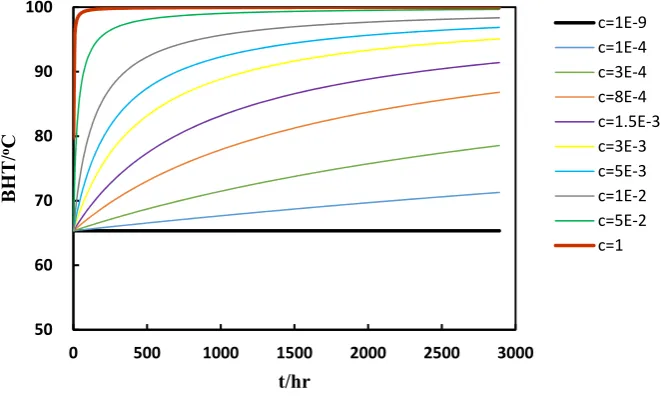
BHT = − ∙ 2 (5) One can observe that the problem in Equation (1) has now been solved by Equation (2). When the maximum and minimum values of BHT have been determined, the shape of the BHT-time curve will only depend on the value of c. The curve of the BHT-time function is illustrated in Figure 1. The equation can characterize the BHT-time function in a large scope, as shown in Figure 1.
Figure 1. Relationship between BHT and shut-in time, when a=100, b=-50, and c varies from 1E-9 to 1.
2.1.2 Solutions to the Three Parameters in the New Function
In order to obtain the best fit of the equation, the least squares fit target is applied. The difference between the proposed function and the measured value of temperature is denoted by Q, which is obtained using the following equation:
Q = ∑ (BHT − BHT ) (6)
where BHT and is measured and calculated BHT using equation (2).
The least squares fit method requires minimization of Q. Here we used Particle Swarm Optimization (PSO) algorithm to obtain the best fitting coefficients of a,b, and c that yields the minimum value of X.
The position and velocity of the ith particle are respectively denoted by Xi and Vi, which are the best position and velocity attained by each particle and therefore referred to as its personal best. For the ith particle, the position vector of its personal best is denoted by Pi and its objective value is
50 60 70 80 90 100
0 500 1000 1500 2000 2500 3000
BHT/
oC
t/hr
denoted by Pbest. The best position attained by the swarm is referred to as either the swarm best, global best or leader. It is denoted by Pg and its objective is denoted by gbest. At each iteration t, the positions and velocities of all particles are updated by Equations (7) and (8) which are also called the update equations [24].
( + 1)= ( )+ 1 1( − )+ 2 2 − ( = 1,2, … , ) (7)
( + 1)= ( )+ ( + 1) ( = 1,2, … , ) (8)
where is inertia weight; 1 is the cognitive acceleration coefficients, which prompts the
attraction of the particle towards its own personal best; 2is the social acceleration coefficients,
which prompts the attraction of the particle towards the swarm best; 1 and 2 are two random
numbers in [0,1].
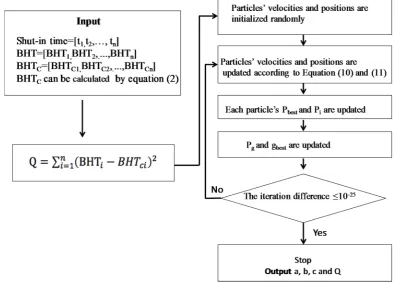
A schematic of the solving process of the proposed method is depicted in Figure 2.
Figure 2. Schematic representation of the solving process of the proposed method.
2.2 Existing Methods
2.2.1 Selection of the Analytical Methods
A few previous analytical methods have been discussed in this paper for comparison with the new proposed method in this paper. Three most commonly used analytical methods were introduced. The equations, analytical models and sources of these methods are listed in Table 1. Basically, two regression models were applied to obtain the coefficients in each analytical method.
Table 1. A summary of the analytical methods used for comparison with the method developed in this paper.
Method Physical model Equation Sources
Horner (HM) Constant Linear heat source BHT(t) = T − (12) Dowdle and Cobb (1975)
Manetti (MM) Conductive cylindrical heat source
BHT(t) = T − (13) Manetti (1973)
Ascencio (SRM) Spherical-radial heat flow BHT(t) = T −
√ (14)
2.2.2 Selection of the Regression Models
Two regression methods were used as regression models to obtain the coefficients in the three analytical methods: the ordinary linear regression (OLR) model and quadratic regression (QR) model.
The general equation of the OLD model is: y = a + b ∙ x, where a and b are the intercept and the slope of the fitted straight line [16], while that for the QR model is given by: y=a+bx+cx2, where a, b and c represent the polynomial coefficients [16].
2.3 Statistical Evaluation
2.3.1 Deviation Percentages (DEV%)
In order to test the estimation accuracy of the estimated SFT, the deviation percentages (DEV%) between the estimated and reference SFT values were used:
DEV% = [( )] × 100 (9)
where is the value of SFT estimate, SFT is the true SFT value reported in the literature. It should be noted that this evaluation test was not applied from data set without reference SFT (Data 7 and Data 8). The closer the DEV% to zero, the better the estimation of SFT.
2.3.2 Regression Coefficient (R2)
The regression coefficient (R2) is applied for testing the fitting ability of each method. The value
can be obtained from:
2= 1 −∑( − )2
∑( − )2 (10)
where is the measured value of BHT, is the estimated BHT and is the mean of the measured BHT values. The fitting is more satisfactory if the value of R2 is closer to 1.
2.3.3 Residual Sum of Squares (RSS)
The fitting result of each method can also be evaluated through estimation of the normalized
residual sum of squares (RSS), which is calculated by the following equation:
RSS =∑ ( ) (11)
where and are same as in equation (10), n is the total numbers of elements in a BHT data set. The smaller the value of RSS in a data set, the better the fitting result. The goodness of fitting can
be evaluated by DEV% and R2. However, the comparison between different methods should be
based on the whole accuracy and fitting ability of each method. To evaluate each method comprehensively, the following synthetic statistical parameters were also used.
2.3.4 Theil Inequality Coefficient (TIC)
TIC is applied to test the estimation accuracy comprehensively when only very few BHT data
are available. For each data set and each method used, the TIC value can be obtained from:
TIC = ∑ ( )
∑ (12)
The value of TIC is in [0,1], and could be used to compare between different data sets. For each method, the closer the TIC to zero, the more accurate the method is.
2.4 Data Sources
Eight thermal recovery data sets were collected from published literature (see Table 2) for the accuracy and application tests. They include:
(1) Four synthetic data sets selected from literature and
(2) Four data sets logged in some boreholes from long logging work in geothermal and petroleum
fields.
These data sets are summarized in Table 2[25-30].
It should be pointed out that the data 1 to 6 all have reference SFT values, which can be very useful to evaluate the application of the proposed method and conduct comparisons between different methods.
Table 2. Summary of the BHT data sets used in this paper.
Data Type n tc (hr) Sources Data name in this paper
SHBE Synthetic data 8 5 Shen and Beck (1986) Data 1
CLAH Synthetic data 15 5 Cao et al. (1988) Data 2
CJON Synthetic data 12 0.2 Cooper and Jones (1959) Data 3
KJ-21 Geothermal field data 6 2.5 Steingrimsson and Gudmundsson (1989) Data 4
SG Geothermal field data 12 3 Schoeppel and Gilarranz (1966) Data 5
MOU Synthetic data 3 10 Mou (2013) Data 6
DA-XIN Geothermal field data 40 5 Da-Xin (1986) Data 7
UASM Petroleum field data 14 10 Kutasov (1999) Data 8
3. Validation and Discussion
3.1 Accuracy of the SFT
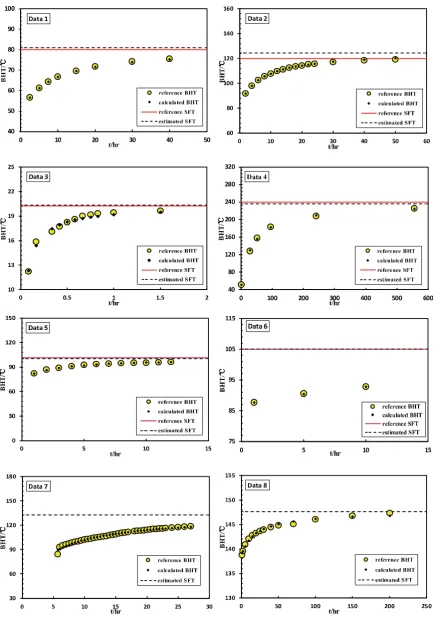
Figure 3. Comparison between the BHT and SFT estimates obtained using data from the proposed method and data from literatures.
Using the synthetic set of Data 1, the SFT value estimated by the proposed method was 80.99 oC, which is in agreement with the true SFT, 80 oC. The error in this case is 1.24%. The SFT estimated
For those data sets from well-logging (Data 4 and 5), the deviation percentages fall in the range of -2%
to 1%. Data 6 was recorded at three shut-in times, with an SFT value of 105.296 oC estimated
accurately by the proposed method, and a deviation percentage of 0.28% with the reference SFT value of 105 oC.
Figure 4 shows the comparison between estimated SFT values using the proposed method and true SFT values for 6 data sets using the true SFT values ranging from 20.25 to 240 oC, during the last shut-in time from 1.5hr to 600 hr. The number of the data set varies from 3 to 15. The DEV% of each data set is in [-2%, 4%], a satisfactory range for a practical predicting tool.
3.2 Fitting Results
The regression coefficients R2 determined by Equation (10) and the normalized RSS by
Equation (11) were calculated for all data sets using the proposed method. The calculation results are presented in Table 3, and the BHT values calculated by the proposed method are also shown in Figure 3. For the Data sets 1 and 2, the values of R2 are both greater than 99.9%, which indicates that the proposed method can fit the BHT data accurately. As for those BHT data sets obtained from well-logging, the proposed method also showed a good fitting ability because R2 for each data set is more than 98%. Based on the good matching results, the proposed method seems to provide acceptable correlations between BHT and shut-in time.
Table 3. Results of each data set using the proposed method.
NO. coefficients of the Proposed method STF SFT DEV% R2 RSS
a b c (reference) (estimated)
Data 1 81.000 45.960 0.172 80.000 81.000 1.249 1.000 0.025
Data 2 124.232 63.459 0.243 120.000 124.232 3.527 0.999 0.089
Data 3 20.327 30.865 28.299 20.250 20.327 0.380 0.987 0.073
Data 4 236.084 280.837 0.039 240.000 236.084 -1.632 0.999 2.243
Data 5 100.132 21.111 0.694 101.111 100.132 -0.968 0.999 0.026
Data 6 105.296 26.481 0.067 105.000 105.296 0.282 1.000 0.000
Data7 132.459 133.588 0.289 N/A 132.459 N/A 0.979 11.053
Data 8 147.600 12.809 0.071 N/A 147.600 N/A 0.979 0.085
Figure 4. Comparison of the SFT estimates using the proposed method and reference SFT values. (n is the number of data points of each data set)
0 50 100 150 200 250
0 50 100 150 200 250
SF
T
(e
st
im
at
ed
)
SFT(reference) Geothermal field data,n=6
Geothermal field data,n=12 Synthetic data,n=8
Synthetic data,n=15
Synthetic data,n=3
In addition, comparisons of estimates and reference SFT values using various methods was carried out, the results of which is shown in Table 4. It is obvious that the SFT values predicted by the proposed method are much better than others.
Table 4. Comparison of estimates and reference SFT values using various methods.
HM MM SRM Proposed Method Reference SFT
OLR QR OLR QR OLR QR
Data1 75.871 79.372 74.713 77.936 77.362 86.914 80.999 80
Data2 119.66 123.26 117.45 121.15 125.63 131.91 124.231 120
Data3 20.328 18.981 20.003 21.302 22.132 19.499 20.327 20.25
Data4 187.60 223.5 220.64 230.65 207.39 260.87 236.084 240
Data5 98.449 100.07 97.048 98.257 99.858 106.16 100.133 101.111
Data6 94.261 98.535 94.971 N/A 94.334 101.23 105.296 105
4. Applications in the Case of A Small Number of Data Points
The fitting ability of the proposed method has been tested in the cases of a set having a small number of BHT data points. Three different analytical methods with two different regression models mentioned in Section 2 were applied for comparison. The first 3, 4 or 5 data points of each data set were applied to estimate SFT in different analytical methods including the proposed method. The results are discussed in this section.
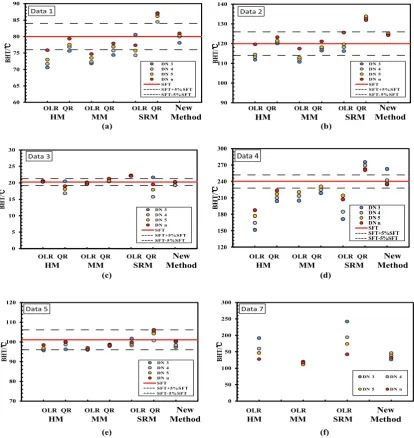
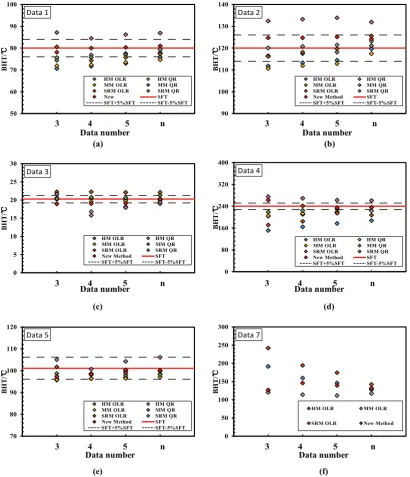
Figure 5 and 6 present the SFT estimation results using different methods when the first 3, 4, 5 data points or all the n data points in each set (i.e. DN 3, DN4, DN 5, and DN n) are used. The red full line in diagrams a to e represents the true value of SFT for each data set, whereas the black dashed lines above and below the red line represent the SFT values with the DEV% of 5% and -5% of the true SFT value, respectively. The circles in Figure 5 and the diamonds in Figure 6 represent the results of SFT estimations using different methods. It should be mentioned that the red diamonds in Figure 6 represent the SFT estimates of our proposed method. The results of deviation percentages between each estimate with the reference SFT value are listed in Table 4 for reference. The SFT estimates discussed here were obtained using 7 methods when the first 3, 4, 5 points or all data elements in each set were applied, in the ranges [SFT-5% SFT to SFT +5% SFT], which is called “the acceptable range”.
By comparing the SFT estimates with the reference SFT values, it can be observed in Figure 5 that the SFT values estimated by the Horner Method (HM) when OLR model is applied were typically underestimated in all data sets except for Data 3. Besides, the aspheric heat-flow method (SRM) with OLR model was likely to overestimate the SFT, as mentioned in [17]. As for the regression models, results showed that SFT values estimated by using ordinary linear regression model were less than those by the quadratic regression model in Figure 5. This observation was also reported in other literature [16,17].
proposed method was the only method in which the estimates lied in the acceptable range (using DN 4, DN 5 and DN n). All but one SFT estimated by the MM method with QR model on the DN n were unacceptable. For Data 5, the predicting results of the proposed method and other four methods all lied in the acceptable range. For Data 7 without the reference SFT value, the predicting ability of each method can still be seen in Figure 5(f). The estimates obtained from HM method with
OLR model and SRM method with OLR model were uncertain, with a range of 63.77℃and 99.74℃
respectively. However, the proposed method as well as the MM method with OLR model can still be used to estimate SFT reliably. Except for the SRM method with QR model using our proposed method, the estimates using other methods were likely to be underestimated when only the first 3, 4 or 5 points of the data set were used. While the estimates by the SRM method with QR model were more likely to be exaggerated. However, estimates obtained from the proposed method were likely to distribute but close on both sides of the reference SFT value (red full lines in Figure 5), which is also an indication of the advantage of the proposed method.
Based on the results of these statistical tests and the analysis above, the proposed method can be considered to estimate SFT accurately and reliably in the cases with few data.
Figure 5. SFT estimates for each method using the first 3, 4 5, or n points of a data set. (e.g. DN 3 represents use of the first 3 points of a given data set).
90 100 110 120 130 140 BH T/ Data 2 DN 3 DN 4 DN 5 DN n SFT SFT+5% SFT SFT- 5% SFT
OLR QR
HM
OLR QR
MM
OLR QR
SRM 60 65 70 75 80 85 90 BHT/ Data 1 DN 3 DN 4 DN 5 DN n SFT SFT+5% SFT SFT- 5% SFT
OLR QR
HM
OLR QR
MM
OLR QR
SRM New Method New Method 0 50 100 150 200 250 300 BHT/ Data 7
DN 3 DN 4 DN 5 DN n
OLR HM OLR MM OLR SRM New Method (a) (b)
(c) (d)
(e) (f) 0 5 10 15 20 25 30 BHT/ Data 3 DN 3 DN 4 DN 5 DN n SFT SFT+5%SFT SFT-5%SFT
OLR QR
HM
OLR QR
MM
OLR QR
SRM New Method 70 80 90 100 110 120 BHT/ Data 5 DN 3 DN 4 DN 5 DN n SFT SFT+5% SFT SFT- 5% SFT
OLR QR
HM
OLR QR
MM
OLR QR
SRM New Method 120 150 180 210 240 270 300 BHT/ Data 4 DN 3 DN 4 DN 5 DN n SFT SFT+5%SFT SFT-5%SFT
OLR QR
HM
OLR QR
MM
OLR QR
SRM
Figure 6. SFT estimates for each method using the first 3, 4, 5 points or all (n) data of a set.
Table 5. Deviation percentages of the SFT estimates using different methods.
Method
Data 1 Data 2
Data number Data number
3 4 5 (n) 3 4 5 (n)
HM OLS -11.756 -10.378 -8.765 -5.161 -6.808 -5.583 -4.608 -0.283
QR -5.456 -3.944 -3.058 -0.785 0.067 0.658 1.217 2.717
MM OLS -10.186 -9.576 -8.091 -6.609 -7.708 -6.708 -5.908 -2.125
QR -6.975 -5.304 -3.828 -2.580 -2.933 -2.100 -1.508 0.958
SRM OLS 0.734 -7.094 -5.307 -3.298 -3.142 -1.517 -0.250 4.692
QR 8.970 5.601 7.781 8.643 10.367 11.017 11.592 9.925
Proposed method -2.367 0.028 0.470 1.249 3.929 3.971 4.289 3.527
50 60 70 80 90 100 BH T/ Data 1
HM OLR HM QR MM OLR MM QR SRM OLR SRM QR New SFT SFT+5%SFT SFT-5%SFT
3 4 5 n Data number 90 100 110 120 130 140 BH T/ Data 2
HM OLR HM QR MM OLR MM QR SRM OLR SRM QR New Method SFT SFT+5%SFT SFT-5%SFT
Data number 3 4 5 n
0 5 10 15 20 25 30 BH T/ Data 3
HM OLR HM QR MM OLR MM QR SRM OLR SRM QR New Method SFT SFT+5%SFT SFT-5%SFT
3 4 5 n Data number 0 80 160 240 320 400 BHT / Data 4
HM OLR HM QR MM OLR MM QR SRM OLR SRM QR New Method SFT SFT+5%SFT SFT-5%SFT
Data number 3 4 5 n
70 80 90 100 110 120 BHT / Data 5
HM OLR HM QR MM OLR MM QR SRM OLR SRM QR New Method SFT SFT+5%SFT SFT-5%SFT
3 4 5 n
Data number Data number
(a) (b)
(c) (d)
(e) (f) 0 50 100 150 200 250 300 BH T/ Data 7
HM OLR MM OLR
SRM OLR New Method
Data 3 Data 4 Data 5
Data number Data number Data number
3 4 5 (n) 3 4 5 all 3 4 5 (n)
HM
OLS 1.600 0.835 0.212 0.385 -36.800 -31.438 -26.250 -21.833 -5.350 -4.717 -4.125 -2.632
QR 1.215 -16.928 -10.731 -6.267 -14.917 -12.404 -9.500 -6.875 -4.779 -2.457 -1.191 -1.029
MM
OLS -0.435 -3.289 -2.528 -1.220 -14.583 -11.029 -8.067 -8.067 -5.123 -4.740 -4.602 -4.017
QR 0.652 2.588 2.074 5.195 -8.842 -6.358 -3.896 -3.896 -2.332 -2.546 -3.131 -2.822
SRM
OLS 9.852 9.931 9.151 9.294 -28.617 -22.992 -10.754 -13.588 0.613 -2.937 -2.070 -1.238
QR 6.963 -22.089 -11.501 -3.709 14.696 12.213 9.367 8.696 3.907 -0.386 3.106 4.995
Proposed method
-4.95
8 -4.844 -0.543 0.380 9.501 0.784 -2.198 -1.632
-3.66 7
-2.66 1
-0.78 1
-0.96 7
Both data quantity and method will affect the accuracy of prediction, some methods at specific condition may have better results than the new proposed method, so Theil inequality coefficient (TIC), an overall evaluation, was used to assess all the data. The value of TIC is in [0,1], and could be used to compare the results of different data sets. For each method, the closer the TIC to zero, the more accurate that method is. The results of Theil inequality coefficient (TIC) are depicted in Figure 7. It is to be observed that the new proposed method is the only one in which the TIC values for all data sets are less than 3%, indicating that the new proposed method can not only estimate SFT using a few data accurately, but also reliably.
Figure 7. Comparison of TIC values for each data set and various estimating methods.
Note that the SFT may vary with depth and rock type of the formation because the corresponding thermal stress varies with depth and rock type of the reservoir. This, however, has not been investigated in the current study and a research plan has been embarked to further explore the possible relationship between SFT and depth as well as rock type.
5. Conclusions
(1) A numerical method was proposed to estimate SFT from the BHT data and shut-in time. The
unknown coefficients of the model were derived from least squares fit by the Particle Swarm
Optimization (PSO) algorithm.
0% 2% 4% 6% 8% 10% 12% 14% 16% 18% 20%
TI
C
Data 1 Data 2 Data 3 Data 4 Data 5
HM OLR HM QR MM OLR MM QR SRM OLR SRM QR New Method 3%
(2) The estimation accuracy and fitting ability of the proposed method was verified using 8 BHT data
sets including synthetic, geothermal and petroleum field data. The deviation percentages are less
than ±4% and regression coefficient R2 are greater than 0.98.
(3) A comparison among different methods was conducted. The new proposed method could
estimate SFT accurately and reliably, even by using a small number of BHT data points
(
the TICvalues for all data sets are less than 3%).It might be used as a practical tool to predict SFT in both
geothermal and oil wells.
Author Contributions: This study was done as part of Changwei Liu’s doctoral studies supervised by Kewen Li. Changwei Liu revised the models and conducted some of the calculations. Kewen Li
established the main research ideas and wrote the manuscript. Youguang Chen mainly performed
the fitting. Lin Jia and Dong Ma were responsible for the data analysis and editing and of the
manuscript.
Conflicts of Interest: The authors declare no conflict of interest.
References
1. Saito, S., Sakuma, S., and Uchida, T.: Drilling Procedures, Techniques and Test RM Results for a 3.7 km
Deep, 500 oC Exploration Well, kakkonda, japan, Geothermics, 27, (1998), 573-590.
2. Fomin, S., Chugunov, V., and Hashida, T.: Analytical Modelling of the Formation Temperature
Stabilization during the Borehole Shut-in Period, Geophysical Journal International, 155, (2003), 469-478.
3. Santoyo, E., Garcia, A., Espinosa, G., Hernandez, I., and Santoyo, S.: Static_temp: a Useful Computer
Code for Calculating Static Formation Temperatures in Geothermal Wells, Computers & Geosciences, 26, (2000), 201-217.
4. Wisian, K. W., Blackwell, D. D., Bellani, S., Henfling, J. A., Normann, R. A., & Lysne, P. C., et al. (1998). Field comparison of conventional and new technology temperature logging systems. Geothermics, 27(2), 131-141.
5. Bassam, A., Santoyo, E., Andaverde, J., Hernández, J.A., and Espinoza-Ojeda, O.M.: Estimation of Static
Formation Temperatures in Geothermal Wells by Using an Artificial Neural Network Approach, Computers & Geosciences, 36, (2010), 1191-1199.
6. Melton, C.E., and Giardini, A.A.: Petroleum Formation and the Thermal History of the Earth's Surface.
Journal of Petroleum Geology, 7, (1984), 303–312.
7. Armstrong, P.A., Chapman, D.S., Funnell, R.H., Allis, R.G., and Kamp, P.J.J.: Thermal Modeling and
Hydrocarbon Generation in an Active-margin Basin: Taranaki Basin, New Zealand. Aapg Bulletin, 80,
(1996), 1216-1241.
8. Matthai, and Stephan, K.: Reservoir Simulation: Mathematical Techniques in Oil Recovery, Geofluids, 8,
(2008), 344-345.
9. Dowdle, W.L., and Cobb, W.M.: Static Formation Temperature from Well Logs - an Empirical Method,
Journal of Petroleum Technology, 27, (1975), 1326-1330.
10. Kutasov, I.M., and Eppelbaum, L.V.: Determination of Formation Temperature from Bottom-hole
Temperature Logs—a Generalized Horner Method, Journal of Geophysics & Engineering, 2, (2005), 90-96.
11. Manetti, G.: Attainment of Temperature Equilibrium in Holes during Drilling, Geothermics, 2, (1973), 94–
100.
12. Hasan, A.R., Kabir, C.S., and Hasan, A.R.: Static Reservoir Temperature Determination from Transient
Data after Mud Circulation, SPE Drilling & Completion, 9, (1994), 17-24.
13. Brennand, A.W.: A New Method for the Analysis of Static Formation Temperature Test, Proceedings, 6th
New Zealand Geothermal Workshop, New Zealand (1984).
14. Ascencio, F., García, A., Rivera, J., and Arellano, V.: Estimation of Undisturbed Formation Temperatures
under Spherical-radial Heat Flow Conditions, Geothermics, 23, (1994), 317-326.
15. Lech, P.J., Pappoe, R., Nakamura, T., and Russell, S.J.: The Temperature Stabilization of a Borehole,
16. Espinoza-Ojeda, O.M., Santoyo, E., and Andaverde, J.: A New Look at the Statistical Assessment of Approximate and Rigorous Methods for the Estimation of Stabilized Formation Temperatures in Geothermal and Petroleum Wells, Journal of Geophysics & Engineering, 8, (2011), 233-258(26).
17. Wongloya, J. A., Andaverde, J., & Santoyo, E. (2012). A new practical method for the determination of
static formation temperatures in geothermal and petroleum wells using a numerical method based on rational polynomial functions. Journal of Geophysics & Engineering, 9(6), 711-728.
18. Tragesser, A. F., Crawford, P., & Crawford, H. (1967). A method for calculating circulating temperatures. Journal of Petroleum Technology,19(11), 1507-1512.
19. Garcia, A., Hernandez, I., Espinosa, G., and Santoyo, E.: Temlopi: a Thermal Simulator for Estimation of
Drilling Mud and Formation Temperatures during Drilling of Geothermal Wells, Computers & Geosciences, 24, (1988), 465-477.
20. Kennedy, J., and Eberhart, R.: Particle Swarm Optimization. Neural Networks, 1995, Proceedings, IEEE
International Conference (1995)
21. Chen, M. R., Li, X., Zhang, X., and Lu, Y. Z.: A Novel Particle Swarm Optimizer Hybridized with
Extremal Optimization, Applied Soft Computing, 10, (2010), 367-373.
22. Ziari, I., and Jalilian, A.: Optimal Placement and Sizing of Multiple APLCs Using a Modified Discrete
PSO, International Journal of Electrical Power & Energy Systems, 43, (2012), 630-639.
23. Mahor, A., and Rangnekar, S.: Short Term Generation Scheduling of Cascaded Hydroelectric System
Using Novel Self-adaptive Inertia Weight PSO, International Journal of Electrical Power & Energy Systems, 34, (2012), 1-9.
24. Jordehi, A.R.: A Review on Constraint Handling Strategies in Particle Swarm Optimization, Neural
Computing & Applications, 26, (2015), 1-11.
25. Cooper, L.R., and Jones, C.: The Determination of Virgin Strata Temperatures from Observations in Deep
Survey Boreholes, Geophysical Journal International, 2, (1959), 116–131.
26. Kutasov, I.M., Technologies, M.S., and Monica, S.: Applied Geothermics for Petroleum Engineers, Journal
of Petroleum Science and Engineering, (1999).
27. Li, D.X.: Non-linear Fitting Method of Finding Equilibrium Temperature from BHT Data, Geothermics,
15, (1986), 657-664.
28. Schoeppel, R.J., and Gilarranz, S.: Use of Well Log Temperatures to Evaluate Regional Geothermal
Gradients, Journal of Petroleum Technology, 18 (1966), 667–73.
29. Shen, P.Y., and Beck, A.E.: Stabilization of Bottom Hole Temperature with Finite Circulation Time and
Fluid Flow, Geophysical Journal of the Royal Astronomical Society, 86, (1986), 63-90.
30. [Cao, S., Lerche, I., and Hermanrud, C.: Formation Temperature Estimation by Inversion of Borehole
Measurements, Geophysics, 53, (2012), 979-988.