Observation of Di
ff
usive Flows during Liquid Phase Microwave
Sintering
Takashi WATANABE, Motoyasu SATO
1), Sadatsugu TAKAYAMA
1)and
Akihiro MATSUBARA
2)Toki Municipal Institute of Ceramics, 287-3 Hida, Toki, Gifu 509-5403, Japan
1)National Institute for Fusion Science, 322-6 Oroshi-cho, Toki 509-5292, Japan 2)Faculty of Engineering, Chubu University, Kasugai, Aichi 487-8501, Japan
(Received 20 January 2008/Accepted 14 January 2009)
Experiments at the microscopic scale show the shrinking and melting processes of porcelain by microwave and infrared heating. Microscopicin-situobservations reveal that the porcelain is sintered rapidly and volumetri-cally by microwaves. This experiment clarifies the differences between microwave and conventional heating.
c
2009 The Japan Society of Plasma Science and Nuclear Fusion Research
Keywords: microwave sintering,in-situmicroscopic observation, glass phase, porcelain DOI: 10.1585/pfr.4.009
1. Introduction
Porcelain sintering is the oldest industry in human cul-ture. For thousands of years, civilization has depended upon materials made by transferring the energy of a flame through thermal conduction, convection, and infrared ra-diation, in order to induce kinetic motion within the ele-ments. Thermal conduction creates a temperature gradient that increases the thermal stress in the material. Superior quality material is obtained with a smaller temperature gra-dient, but this requires a longer processing time i.e., of the order of days. Porcelain sintering process struggles with this contradiction.
Although how microwave heating works in this pro-cess has not been clarified, many experiments [1] have shown that microwaves can sinter porcelain in a few min-utes. In this report, sintering process under microwave heating was observed through anin-situmicroscope. The results were compared with those of the traditional infrared heating.
Microwaves can transmit electromagnetic energy into dielectric materials and it can couple to the electrons in the crystal structure or in the liquid phase molecules. Experi-mental results suggest that microwave heating of ceramics can be explained by analogy to plasma heating, as it cou-ples directly to the electrons in the matrix or in the crystals of the materials. Microwave heating does not require en-ergy transfer by thermal conduction, as it is characterized by volumetric heating.
Microwave heating experiments showed improved coupling efficiency and energy balance compared to tra-ditional heating.
author’s e-mail: [email protected]
2. Heating Devices
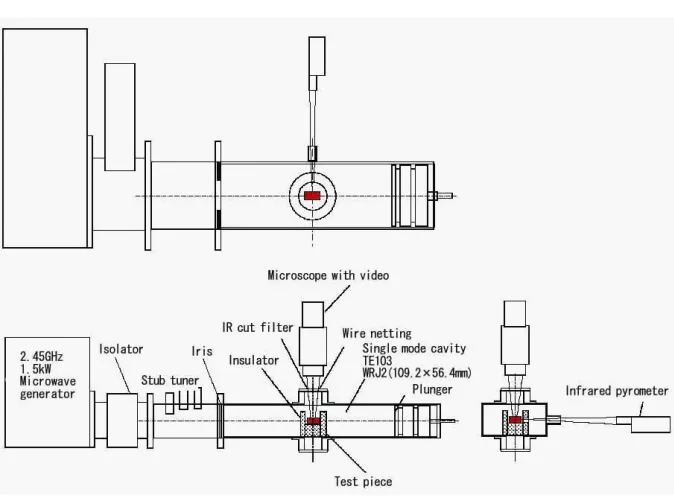
The experiments were conducted in a single mode waveguide cavity (called a microwave furnace in this paper), which consisted of a WRJ-2 (109.1 × 56.4 × 149.3±5 mm) waveguide. One end of the cavity was closed by a movable reflector (plunger) and the other end was coupled to the microwave generator through a slotted plate (iris), as shown in Fig. 1. The test piece was placed at the electric field maxima in the cavity (Fig. 2). The volume of the test piece (11×11×6 t mm) was kept small to pre-vent disturbing the structure of electromagnetic field of the TE103mode in the cavity. When the test piece was inserted,
the cavity length was shortened by a few millimeters to maintain the overall dielectric constant. An insulator made of alumina-silica fiberboard surrounded the porcelain test piece (Fig. 3). Microwave absorption of the insulator is much smaller than that of the porcelain. The temperature of the test piece was measured with an infrared pyrometer. Infrared heating was compared with microwave heat-ing. The infrared furnace was a reverberator with IR illu-minators (called theIR furnacein this paper), as shown in Fig. 4. The test piece (10×6×5 t mm) was about half the volume of the test piece for the microwave experiments. The alumina container (Fig. 5) held the test piece in the fur-nace, and the temperature of the test piece was measured using a thermocouple.
3. Microwave Heating for Porcelain
The porcelain test pieces were composed of kaolin, quartz, and feldspar powder, as shown in Table 1, which contributed their respective characteristics of adhesion, ag-gregation, and solvency. Calcined, i.e., incompletely-densified, porcelain bodies were prepared as test pieces. The volume and supplied microwave energy were 1.2 g andc
2009 The Japan Society of Plasma
Fig. 1 Device of single mode cavity and microscope with video forin-situobservations.
Table 1 Components of porcelain.
Components SiO2 Al2O3 Na2O Fe2O3 TiO2 CaO MgO K2O
Analysis
value (%) 70.8 23.8 1.26 0.28 0.08 0.36 0.39 2.9
Fig. 2 Distribution of the electromagnetic field in the microwave cavity.
80 watts, respectively.
Changes in the microscopic structures of test pieces in the microwave and IR furnaces, as shown in Figs. 6 and 7, were observed through a high resolution digital video camera. When the temperature measured with an infrared pyrometer reached 900 degrees Celsius, the liquid phase appeared and the diffusive flow spread over the test piece
Fig. 3 Test piece and insulator in form of — alumina-silica fiber container (50×40×50 h mm outside, 20×20×30 h mm inside).
Observa-tion after cooling showed uniform structures over the en-tire cross section of the test pieces in both the microwave and IR furnaces.
The heating curve (Fig. 8) showed variation in the heating rate at 900 degrees Celsius in the microwave fur-nace. The breaking point corresponds to the endothermal reactions [2] at which the glass phase is generated, which further reacts with the solid components. Since the melt-ing point of the feldspar is the lowest among the porce-lain components, and as feldspar most strongly absorbs
Fig. 4 Detail of the infrared furnace.
Fig. 6 In-situmicroscopic observations of the microwave sintering of porcelain. The dis-tance between pores is reduced as the temperature increases. The focal length of the objective lens and the magnification are 60 mm and 200 x, respectively. (a) At 890 degrees Celsius the liquid phase appears and spreads over the test piece rapidly within a few seconds; thus, starting the shrinking process. (b) At 1060 degrees Celsius, the distance between two pores decreases. (c) At 1210 degrees Celsius, the distance between two pores decreases even greatly, and finally completing the shrinking process.
Fig. 7 In-situmicroscopic observations of the IR sintering process of porcelain, which is the same as for microwave sintering. At (a) 950, (b) 1060, and (c) 1200 degrees Celsius.
microwave energy, the liquid phase is considered to be that of feldspar, which fills the boundaries of the quartz [3, 4]. The most important observation is that the temperature of 900 degrees Celsius is approximately 220 to 250 degrees below the melting point of feldspar. This can be explained by selective heating of complex materials in a microwave.
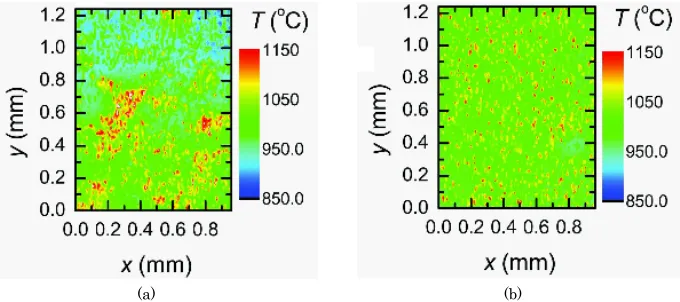
In-situ observations showed fine hot spots in the mixed components, as shown in Fig. 9. The temperatures used did not heat the powder uniformly. Infrared pyrom-eter indicated the average temperature in a 2 mm view-ing circle. Feldspar reached a higher temperature than its surroundings at 900 degree Celsius, which also required a large latent heat on melting. This is why the heating rate hit a breaking point. Feldspar contains sodium atoms in
Fig. 8 Heating curves with microwave. It takes 24 seconds to heat from 700 to 1330 degrees Celsius with microwaves.
Fig. 9 Hot spots seen byin-situmicroscopic observations of the microwave sintering pro-cess. The microwave generates fine hot spots in mixed components of porcelain and clay. Hot spots are porcelain particles that contain sodium glass as a major ingredient. (a) The average porcelain particle size is 250-500µm. (b) The average particle size of porcelain is 4µm.
Table 2 Heating rates and required energy for the microwave and IR furnace. The required energies are normalized by the weight ratio. The IR furnace requires more energy, and takes longer time than the microwave furnace.
Microwave heating IR heating
Supplied energy 80 W 200 W
Heating weigt
Sample 1.2 g 0.5 g
Container 1.8 g
Total 1.2 g 2.3 g
Process time
700-1330 degree Celcius 24 sec 2 min 20 sec
Normalized average heating rate
700-1330 degree Celcius 26.25 degree C/sec 10.50 degree C/sec
Required Energy 8 k Joules 28 k Joules
its crystal structure that dissolve into the glass matrix just above the melting point. Because sodium behaves as an ion conductor in glass, the microwave heating rate again increases, making the heating curve concave with respect to time. Thus, sodium influences the excess heating of the glass matrix under microwave irradiation [5]. Further investigation is needed to understand the relationship be-tween sodium and microwave heating.
The microwave heating behavior was compared with that of IR. A test piece weighing 2.8 g (the test piece 0.5 g, and the alumina container 2.3 g) is heated in an IR fur-nace at 200 watts. With IR heating, the breaking point did not appear at 900 degrees Celsius, and the tempera-ture curve moved smoothly to saturation at 1300 degrees Celsius, drawing a convex curve with respect to time. The breaking point was not as clear as in microwave heating.
processing took five minutes.
Sintering behavior in both the processes was almost identical, involving shrinking, displacement, and disap-pearance of the pores. The porcelain was sintered by mi-crowave heating similar to that in conventional heating. However, the mechanisms of energy transmittance differ between microwave and IR. Microwave energy in the sam-ple is converted to kinetic energy directly and volumetri-cally, and the components are heated selectively. On the other hand, the IR energy converts to kinetic energy on the sample surface and transmits into the materials by ther-mal conduction. Although the melting point of feldspar remains the same whether heated by microwave or IR, the average temperature of the mixed components in the mi-crowave furnace is lower than that in the IR furnace. The liquid phase diffuses into the pores between the solid par-ticles, and thermal energy is transferred from hot liquid to solid particles through liquid-solid contact. Thus, suggest-ing a possible mechanism for the lower temperature sinter-ing with microwaves.
The energy supplied to the furnaces, the heating weights, and process times are listed in Table 2. Mi-crowave furnace required 8 k Joules, and IR furnace re-quired 28 k Joules, after normalizing by the weight ratio. The heating rates were 26.25 degrees C/sec in the mi-crowave furnace and 10.50 degrees C/sec in the IR furnace. IR furnace thus requires more energy and longer time than microwave furnace. Observation of diffusive flows during liquid phase sintering at microscopic scales and measure-ment of the heating rates confirms that porcelain sintering with microwaves is rapid and volumetric.
4. Conclusion
Thesein-situexperiments showed that porcelain could
be sintered by microwaves volumetrically and rapidly. These observations are the first to show the shrinking and melting processes of porcelain during microwave and IR heating on a microscopic scale. The experiments clearly revealed the differences in energy transfer mechanisms be-tween the microwave and IR furnace. The electromagnetic energy flows from the microwave generator into the vol-ume of compacted porcelain powders, undergoing these processes sequentially: producing feldspar particle melt, feldspar formation of liquid sodium glass, diffusion of the liquid phase into the pores, and finally heating of solid components (quartz and kaolin) by thermal conduction. IR light, on the other hand, is absorbed on the surface of the compacted powders and transmitted into the compacted powders by thermal conduction.
Rapid and volumetric sintering by microwave can be energy saving, low on CO2emission, distortion
decrement-ing, finally leading to low cost sintering of ceramics. The environmental load will be reduced by sintering with mi-crowaves.
[1] M. Satoet al., Ceramic Transaction111, 277 (2001). [2] K. Hamano,Fine Ceramics Hand Book(Asakurasyobou,
1984) p.303 [in Japanese].
[3] H. Takashima, Practical Chemistry of Ceramics (Utida Rokakuho Publishing Co., Ltd, 1996) p.41 [in Japanese]. [4] Ceramic Society of Japan,Ceramics Chemistry(Ceramic
Society of Japan, 1974) p.96 [in Japanese].