*Corresponding author’s e-mail: [email protected] ASM Sc. J., 12, 2019
https://doi.org/10.32802/asmscj.2019.360
Assessment of Effectiveness of Emergency
Response Time during Landslide Event in
Malaysia
Mohamad Fazli Sardi1,2* and Khamarrul Azahari Razak1,3
1UTM RAZAK Faculty of Technology and Informatics, Universiti Teknologi Malaysia (UTM),
54100 UTM Kuala Lumpur, Malaysia
2Malaysia Civil Defence Force, Prime Minister’s Department, Jalan Padang Tembak,
50556 Kuala Lumpur, Malaysia
3
Disaster Preparedness and Prevention Center, Malaysia-Japan International Institute of Technology (MJIIT),
University Teknologi Malaysia (UTM) 54100 UTM Kuala Lumpur, Malaysia
The number of landslide disaster is increasing in Malaysia, and its impact is significant to livelihoods, socio-economic, physical and environmental assets of people and businesses. Historically, as recorded by Malaysia Public Work Department, a total of 440 landslides in Malaysia for the period 1973 to 2007, while more landslides are not properly reported and recorded. Emergency Response Planning (ERP) with right decision at the ‘initial stage’ of an emergency plays a major role in reducing disaster impact. Response from the rescue team was varied subjected to underlying risk, hill-slope geomorphological processes and characteristics of each landslide. Many ERP elements should be considered, e.g. data on specialised equipment and organisations must be updated. This paper provides a better insight into the effective emergency response preparedness in Malaysia. This study investigates the level of preparedness of the rescue team and the community towards landslide-prone area. Analysis of emergency response time based on the Malaysia Civil Defence Force (MCDF) experienced recorded from the classical and recent landslide in Hulu Kelang Selangor. The landslide was caused by multiple internal and external factors, which mainly induced by inadequate design of retaining structures and slopes. So far, 28 historical landslide events were reported in the Hulu Kelang area from 1990 to 2011 with 21 cases of them were triggered by rainfall. The results are promising concerning emergency response time and its effectiveness. This study also addresses the issues and challenges of disaster preparedness and awareness carried out by relevant stakeholders especially in the context of landslide emergency response. Several best practices of the effective emergency response are critically reviewed and presented. As a conclusion, this study shows that an effective emergency response preparedness is crucial for supporting an effective early warning system coupled to enhanced public awareness and preparedness with structured training programs.
Keywords: landslide; response time; ERT; emergency; Malaysia Civil Defence Force
I. INTRODUCTION
The rapid development of the urban area has increased the exposure and vulnerability of the people and assets. It also made the appropriate slope failure preventive
ASM Science Journal, Volume 12, 2019
2 hillslope areas is Hulu Kelang (or also known as Ulu Klang). It is a state constituency in Gombak district in Selangor and known with its landslide occurrences in the past (Sew and Chin, 2006; Faisal, 2000; Huat et al., 2012; Lee et al., 2014; Saadatkhah et al., 2015). The area was subjected to a total of reported 28 historical landslides from 1990 to 2011; with 21 cases of them were identified as potentially triggered by intense rainfall. This study is in-line with the Priority 4 of Sendai Framework for Disaster Risk Reduction 2015-2030 on the enhancement of the preparedness for the effective response, and also the National Slope Master Plan 2017-2023 (Revised in 2016) (PWD, 2017; Jaapar, 2006).
II. STUDY AREAS
A. Historical Records and Landslide Parameters
Based on the data sources from the Majlis Perbandaran
Ampang Jaya (MPAJ), the Slope Engineering Branch,
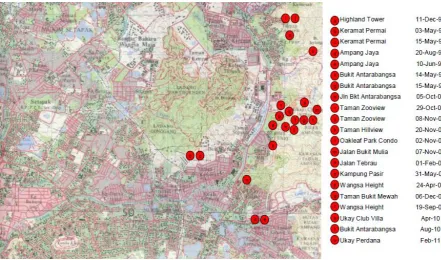
Public Work Department (PWD), and previous studies by (Lee et al., 2014; Samah, 2007; Mariappan et al., 2011), a total of 28 historical landslides were reported in the Hulu Kelang area from 1990 to 2011. About 21 cases were
identified as potentially triggered by rainfall. Figure 1shows the specific locations of these rainfall-induced landslides. They were generally scattered all over the developed parts of the Hulu Kelang area implying hillside development has caused disturbance to the ecosystem, and hence the stability of the natural slopes.
Based on the rainfall data from Department of Irrigation and Drainage and Malaysian Meteorology Malaysia in the past 22 years (from 1990 to 2011), Hulu Kelang area received an average annual rainfall of about 2,440 mm. The rainfall distributions in Malaysia are characterised by two monsoon seasons, namely the Southwest Monsoon from late May to September and the Northeast Monsoon from November to March. However, the highest rainfall normally occurs during the transition period between the monsoon seasons or known as the inter-monsoon season (METMalaysia, 2017). Normally, April and May receive the highest rainfall amount and followed by October and November. January is normally the driest month throughout a year (Desa and Niemczynowicz, 1996). However, this pattern is subjected to changes in climate and extreme events.
ASM Science Journal, Volume 12, 2019
3 Figure 2 summarises the month of occurrences of the 21 landslide events in Hulu Kelang area from 1990 to 2011. The landslide occurrences showed good agreements with the rainfall characteristics as discussed earlier. Over 60% of the landslides occurred within April, May, October, and
November, while no landslide has been reported in January. These observations signified the importance of correlating the initiations of landslide occurrences in Hulu Kelang area with rainfall infiltrations.
Figure 2. Landslide Occurrence in Hulu Kelang Area Between 1990 to 2011
In this study, we used two case studies in Malaysia, namely:-
1. Classical Incident - Highland Tower, Taman Hillparks, Hulu Klang, Selangor in
1993
Highland Towers tragedy was involving one of the three blocks of condominiums in Taman Hillview, Hulu Klang, Selangor, on 11 December 1993. Highland Towers was a three-block condominium with 12 levels called Blocks One, Two and Three. It was the first and the worst since Malaysia’s independence, with about 48 people dead and two injured.
MCDF Dang Wangi District Operations Control Center (DOCC) had received an emergency call at 1:40 pm and had activated a rescue team to the scene with staff strength of six peoples. When they arrived at the scene, a chaotic situation observed and the Fire & Rescue Department’s personal have also arrived at the scene. In the early stages of the operation, limited effort of
search and rescue (SAR) work can be done as the number of victims trapped under the rubble was unknown. Besides that, this was the first experience for the rescue team facing such a situation, without having the know-how in the disaster emergency and limited SAR equipment. Emergency calls were received by the MCDF Control Center for Malaysia Emergency Response System (MERS), 999, about the landslide, occurred in Bukit Antarabangsa. A rescue team from DOCC Dang Wangi, consisting eight members rushed to the scene for the initial survey and rescue operation. Rescue work was assisted by MCDF Special Forces (Pasukan Khas
Pertahanan Awam, PASPA) who has expertise in
ASM Science Journal, Volume 12, 2019
4 2. Latest Incident - Taman Bukit Utama &
Taman Bukit Mewah, Bukit Antarabangsa, Hulu Klang, Selangor in 2008
2008’s Bukit Antarabangsa landslide happened on December 6. Four people were killed and 15 others injured in addition to 14 bungalows destroyed in the landslide in Taman Bukit Mewah and Taman Bukit Utama at 3:50 am. The event took place about 1.5 miles from the Highland Towers tragedy on December 11, 1993.
III. METHODS
A. Malaysia Civil Defence Department (MCDF) Experiences
Malaysia Civil Defence Department (MCDF) has enhanced their system operation based on the disaster management work carried out with efficiently, effectively and in accordance with the procedures as outlined by Civil Defence Standard Operating Procedures (SOP). The purpose of the SOP is to serve as guidelines to the officers and members of the MCDF in pursuing a common work process of other agencies involved in emergency and disaster management in the country. This SOP is used in duties include handling of the disaster and emergency at the Federal, State and District level. The task operation covers disasters and emergencies such as landslides, building collapses, flooding, open fires, coastal rescue, emergency medical services, terrorism, riots and other forms of action, which shall be taken by the rescue and emergency responders.
A series of past tragedy and landslide reports lead to the investigation to enhance the effectiveness of Civil Defence SOP which designed to meet the actual operating situation. It is also to improve our quality of services during disaster operations, particularly landslides. Besides, some collective perceptions on readiness
and preparedness of particular respondents were observed and analysed. This analysis helps in enhancing and enriching the quality of service delivery both in terms of Civil Defence training or operations.
Review or analysis of high-risk areas to landslides should be carried out by the authorities. It allows preventive, and early preparation can be taken by the department or agency related to such local authority. In addition, the public should able to know in advance the risks faced and take necessary actions. Besides that, the rescue team can improve their response time in the event of landslides. The reaction is an immediate action taken by the department or agency managing disaster rescue such as:
Search and rescue / evacuation;
Emergency medical services and health;
Preparation of evacuation centres;
Provision of food; and
Rehabilitation/provision of water, electricity and other basic amenities.
Nowadays, MCDF is facing more challenges due to complexity disaster or emergency incidents. Therefore, emergency administrators seek appropriate methods to enhance system performance. One component scrutinised is the response time (RT) interval between call recipients and arrival on scene. While reducing RTs may improve survival, this remains speculative and unreported (Blackwell and Kaufman, 2002). A critical factor in the effectiveness of any emergency response agency is the ability of the personnel and equipment mobilises to the scene of the emergency promptly (Basu et al., 2017).
ASM Science Journal, Volume 12, 2019
5 commonly-used measure of Emergency Medical Service (EMS) quality (Bailey and Sweeney, 2003; Tijssen et al., 2015; Wilde, 2013). The National Fire Protection Association (NFPA) recommended, at least 90 per cent of EMS calls, Basic Life Support (BLS) services should reach the scene of a medical incident within four minutes (McCoy et al., 2013).
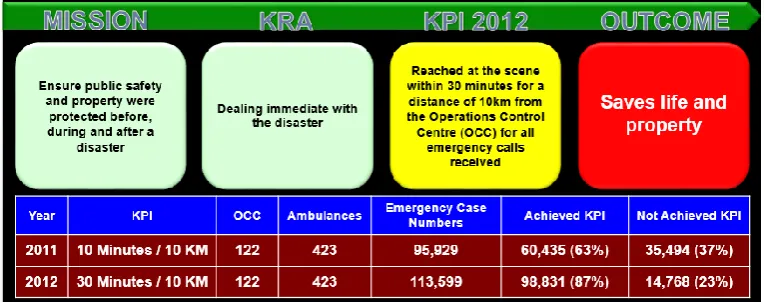
The performance of MCDF Emergency Response Time (ERT) is measured by the achievement of Key Performance Index (KPI) (Sardi, 2012). In 2011, KPI of ERT set to 100%: ‘reached the scene, not more than 10 minutes for a distance of 10 kilometres from the Malaysia Emergency Response System (MERS) 999
Operations Control Center (OCC)’ (JPAM, 2012). The statistics obtained in 2011 found that the performance obtained is at the level of 63% which failed to reach the target of 100% (Figure 3). A high KPI of ERT resulted in high disagreement for poor performance. The department was later set a new KPI, to 30 minutes for ERT (JPAM, 2013). This option is based on the observation of random achievements from the previous year. The statistics in 2012 indicated a significant increase in the achievement of KPI ERT up to 87%, but it is still not 100% achieved. Despite the reduction action for KPI ERT in 2012, it does not reflect the reasonable results and better achievement.
Figure 3. MCDF KPI’s Achievement on Emergency Response Time (2011-2012)
Based on the MCDF’s record for Hulu Klang area, a total of 32 cases of landslides was successfully
addressed from 1990 to 2013. Every case of landslide disaster has its characteristics to be faced by rescue teams to save lives and property. It has also matured MCDF in terms of improving the quality of service delivery operations with the addition of assets and logistics and has many competent members. Besides that, continuous training and awareness program among the people, especially who are involved directly with this kind of disaster were seriously main focus of MCDF to let them be a first responder during the incident. MCDF outline some kind of training for public, especially those exposed directly to the
risk of landslides such as community based disaster and emergency training, first aid training,
evacuation drills and many other types of training given to provide awareness to the public and also know the early warning sign due to the event (JPAM, 2014).
ASM Science Journal, Volume 12, 2019
6 their unique variables that have similarities such as geographical area, rainfall and monsoon
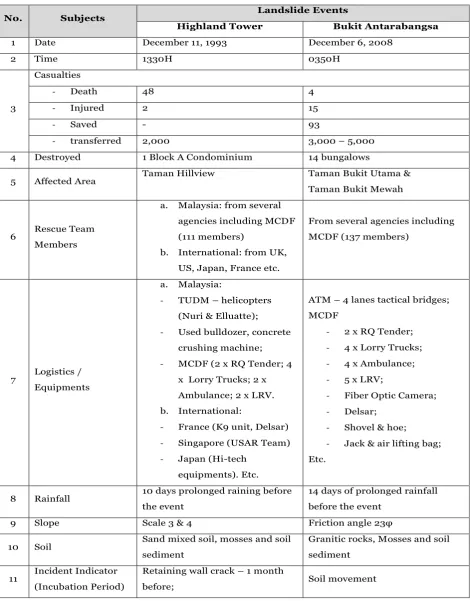
season. Table 1 shows the landslide overview of this Hulu Kelang study cases.
Table 1. An Overview of Landslides in Hulu Kelang Compiled by MCDF
No. Subjects Landslide Events
Highland Tower Bukit Antarabangsa
1 Date December 11, 1993 December 6, 2008
2 Time 1330H 0350H
3
Casualties
- Death 48 4
- Injured 2 15
- Saved - 93
- transferred 2,000 3,000 – 5,000
4 Destroyed 1 Block A Condominium 14 bungalows
5 Affected Area Taman Hillview Taman Bukit Utama &
Taman Bukit Mewah
6 Rescue Team
Members
a. Malaysia: from several
agencies including MCDF (111 members)
b. International: from UK, US, Japan, France etc.
From several agencies including MCDF (137 members)
7 Logistics / Equipments
a. Malaysia:
- TUDM – helicopters
(Nuri & Elluatte);
- Used bulldozer, concrete crushing machine;
- MCDF (2 x RQ Tender; 4
x Lorry Trucks; 2 x Ambulance; 2 x LRV.
b. International:
- France (K9 unit, Delsar)
- Singapore (USAR Team)
- Japan (Hi-tech
equipments). Etc.
ATM – 4 lanes tactical bridges; MCDF
- 2 x RQ Tender;
- 4 x Lorry Trucks;
- 4 x Ambulance;
- 5 x LRV;
- Fiber Optic Camera;
- Delsar;
- Shovel & hoe;
- Jack & air lifting bag;
Etc.
8 Rainfall 10 days prolonged raining before
the event
14 days of prolonged rainfall
before the event
9 Slope Scale 3 & 4 Friction angle 23φ
10 Soil Sand mixed soil, mosses and soil
sediment
Granitic rocks, Mosses and soil
sediment
11 Incident Indicator (Incubation Period)
Retaining wall crack – 1 month
ASM Science Journal, Volume 12, 2019
7
IV. RESULTS AND ANALYSIS
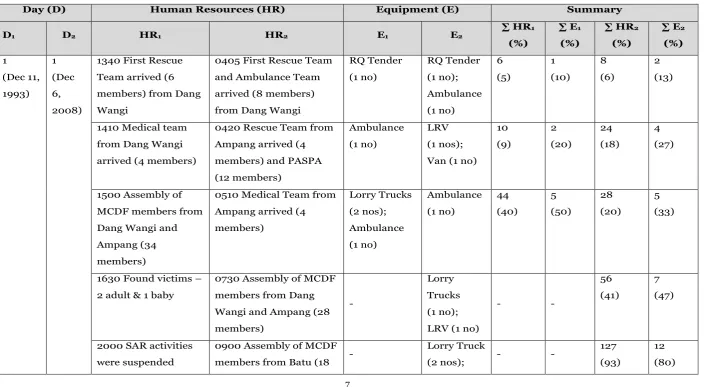
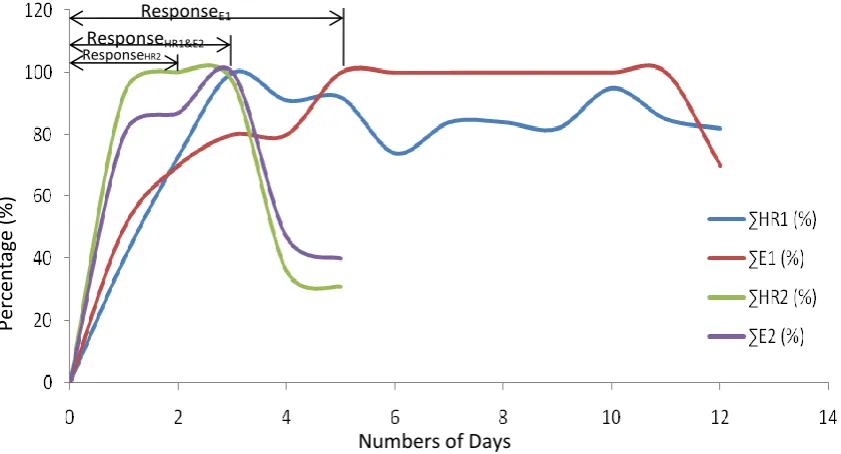
Table 2 summarised the MCDF resources deployment in the emergency response to the landslide events for two case studies. The percentage of
personnel and equipment based on the maximum number of MCDF personnel’s and equipment deployed is given in Figure 4.
Table 2. Summary of Chronology of MCDF Emergency Response to the Landslide Case Studies
Day (D) Human Resources (HR) Equipment (E) Summary
D1 D2 HR1 HR2 E1 E2
∑ HR1
(%)
∑ E1
(%)
∑ HR2
(%)
∑ E2
(%) 1 (Dec 11, 1993) 1 (Dec 6, 2008)
1340 First Rescue Team arrived (6 members) from Dang Wangi
0405 First Rescue Team and Ambulance Team arrived (8 members) from Dang Wangi
RQ Tender (1 no) RQ Tender (1 no); Ambulance (1 no) 6 (5) 1 (10) 8 (6) 2 (13)
1410 Medical team from Dang Wangi arrived (4 members)
0420 Rescue Team from Ampang arrived (4 members) and PASPA
(12 members)
Ambulance (1 no)
LRV (1 nos); Van (1 no)
10 (9) 2 (20) 24 (18) 4 (27)
1500 Assembly of MCDF members from Dang Wangi and Ampang (34 members)
0510 Medical Team from Ampang arrived (4 members) Lorry Trucks (2 nos); Ambulance (1 no) Ambulance (1 no) 44 (40) 5 (50) 28 (20) 5 (33)
1630 Found victims – 2 adult & 1 baby
0730 Assembly of MCDF members from Dang Wangi and Ampang (28 members)
-
Lorry Trucks (1 no); LRV (1 no)
- -
56 (41)
7 (47)
2000 SAR activities were suspended
0900 Assembly of MCDF members from Batu (18 -
Lorry Truck
(2 nos); - -
127 (93)
ASM Science Journal, Volume 12, 2019
8 members); Cheras (21 members); Hulu Langat (32 members)
LRV (1 no); Van (2 nos)
1700 Found 4 death body’s; 15 injured; 93 saved; and 3,000-5,000 evacuated
- - - -
2000 SAR activities were
suspended - - - -
2 (Dec 12, 1993)
2 (Dec 7, 2008)
0700 MCDF
Responder reported duty: Dang Wangi (38 members); Ampang (21 members); Cheras (8 members); Hulu Langat (12 members).
0700 MCDF Responder reported duty: PASPA (12 members); Dang Wangi (41 members); Ampang (32 members); Cheras (27 members); Hulu Langat (25 members).
RQ Tender (1 no); Lorry Trucks (2 nos); Ambulance (2 nos)
RQ Tender (2 no); Lorry Trucks (4 nos); Ambulance (3 nos); LRV (4 nos)
79 (71)
5 (50)
137 (100)
13 (87)
0840 evacuation orders for other 2 blocks
1000 ATM installed tactical bridge
Lorry Trucks
(2 nos) -
81 (73)
7
(70) - -
0900 RAMF used a helicopter for surveillance
1430 use of an excavator,
bulldozer - - - -
1600 US & UK SAR Team arrived.
2000 SAR activities were
suspended - - - -
2000 SAR activities
ASM Science Journal, Volume 12, 2019 9 3 (Dec 13, 1993) 3 (Dec 8, 2008) 0700 MCDF Responder reported duty: Dang Wangi (41 members); Ampang (28 members);
Cheras (15 members); Hulu Langat (27 members);
0700 MCDF Responder reported duty: PASPA (16 members); Dang Wangi (48 members); Ampang (26 members); Cheras (25 members); Hulu Langat (18 members). RQ Tender (2 no); Lorry Trucks (4 nos); Ambulance (2 nos) RQ Tender (2 no); Lorry Trucks (4 nos); Ambulance (4 nos); LRV (5 nos)
111 (100) 8 (80) 133 (97) 15 (100)
0800 France SAR Team arrived with K9 Units and Delsar.
1400 Found a dead dog
- - - -
2000 SAR activities were suspended
1600 SAR operation were stop, but document search continues.
- - - -
1630 Tactical bridge completion; and electricity recovered - - - - 4 (Dec 14, 1993) 4 (Dec 9, 2014) 0700 MCDF Responder reported duty: Dang Wangi (38 members); Ampang (24 members);
Cheras (18 members); Hulu Langat (21 members);
0700 MCDF Responder reported duty: PASPA (4 members); Dang Wangi (22 members); Ampang (15 members); Cheras (8
members). RQ Tender (2 no); Lorry Trucks (4 nos); Ambulance (2 nos) RQ Tender (2 no); Lorry Trucks (2 nos); Ambulance (1 nos); LRV (2 nos)
101 (91) 8 (80) 49 (36) 7 (47)
2000 SAR activities were suspended
2000 SAR activities were
ASM Science Journal, Volume 12, 2019
10 5
(Dec 15, 1993)
5 (Dec 10, 2014)
0700 MCDF
Responder reported duty: Dang Wangi (42 members); Ampang (31 members); Cheras (11 members); Hulu Langat (18 members)
0700 MCDF Responder reported duty: PASPA (2 members); Dang Wangi (28 members); Ampang (13 members).
RQ Tender (2 no); Lorry Trucks (4 nos); Ambulance (2 nos); LRV (2 nos)
RQ Tender (1 no); Lorry Trucks (2 nos); Ambulance (1 nos); LRV (2 nos)
102 (92)
10 (100)
43 (31)
6 (40)
0900 use of an excavator, bulldozer and concrete breaker machine
1000 Residents are allowed to take personal
items - - - -
1530 Found 6 death body
2000 All activities were
stop. - - - -
2000 SAR activities
were suspended - - - -
6 (Dec 6, 1993)
0700 MCDF
Responder reported duty: Dang Wangi (32 members); Ampang (23 members); Cheras (8 members);
Hulu Langat (19 members)
RQ Tender (2 no); Lorry Trucks (4 nos); Ambulance (2 nos) ;
-
82 (74)
10 (100)
LRV (2 nos)
2000 SAR activities
were suspended - - - -
ASM Science Journal, Volume 12, 2019
11 (Dec 17,
1993)
Responder reported duty: Dang Wangi (32 members); Ampang (25 members);
Cheras (12 members); Hulu Langat (24 members);
(2 no); Lorry Trucks (4 nos); Ambulance (2 nos) ; LRV (2 nos)
(84) (100)
1800 SAR Operation
stop - - - -
8 (Dec 18, 1993)
0700 MCDF
Responder reported duty: Dang Wangi (38 members); Ampang (21 members); Cheras (13 members); Hulu Langat (21 members);
RQ Tender (2 no); Lorry Trucks (4 nos); Ambulance (2 nos) ; LRV (2 nos)
-
93 (84)
10 (100)
1140 Found 6 death
body - - - -
2000 SAR activities
were suspended - - - -
9 (Dec 19, 1993)
0700 MCDF
Responder reported duty: Dang Wangi (40 members); Ampang (17
members); Cheras (14 members); Hulu
RQ Tender (2 no); Lorry Trucks (4 nos); Ambulance (2 nos) ; LRV (2 nos)
-
91 (82)
ASM Science Journal, Volume 12, 2019
12 Langat (20
members);
1620 Found 3 death body
- - - -
2000 SAR activities were suspended
- - - -
10 (Dec 20, 1993)
0700 MCDF
Responder reported duty: Dang Wangi (38 members); Ampang (27 members);
Cheras (17 members); Hulu Langat (23 members)
RQ Tender (2 no); Lorry Trucks (4 nos); Ambulance (2 nos) ; LRV (2 nos)
-
105 (95)
10 (100)
1710 Found 25 death
body - - - -
2000 SAR activities
were suspended - - - -
11 (Dec 21, 1993)
0700 MCDF
Responder reported duty: Dang Wangi (39 members); Ampang (25 members);
Cheras (14 members); Hulu Langat (16 members)
RQ Tender (2 no); Lorry Trucks (4 nos); Ambulance (2 nos) ; LRV (2 nos)
-
94 (85)
10 (100)
ASM Science Journal, Volume 12, 2019
13 were suspended
12 (Dec 22, 1993)
0700 MCDF
Responder reported duty: Dang Wangi (39 members); Ampang (26 members); Cheras (11 members); Hulu Langat (15 members);
RQ Tender (1 no); Lorry Trucks (4 nos); LRV
(2 nos) -
91 (82)
7 (70)
1400 Operations stop - - - -
ASM Science Journal, Volume 12, 2019
14 The response indicates the time lag between Cases 1 and 2 (Figure 4). The maximum numbers of MCDF responder were 111 (∑ HR1) for Case 1
on Day 3; and 137 (∑ HR2) for Case 2 on Day 2.
Meanwhile the maximum number of MCDF equipment was 10 (∑E1): on Day 5; and 15 (∑E2): on Day 3 for each case, respectively. It means that 72 hours’ response time for MCDF personals reached their maximum numbers for Case 1,
while only 48 hours response time for Case 2. Deployment of response time for MCDF equipment was 120 hours and 72 hours for each case respectively. This result shows the need for some improvement of response time for MCDF during landslide disaster. It clearly showed a decrease response time by 34% for deployment of personals and 41% for deployment of equipment.
Figure 4. Deployments of MCDF Personals and Equipment
Following the Highland Tower incident in 1993, MCDF management has developed and mobilised their personnel to form an emergency hotline to facilitate the delivery of emergency and disaster information to take appropriate action quickly and efficiently. Later, on May 20, 1995, Emergency Hotline 991 was launched as a sign of MCDF commitment in providing 24-hour emergency assistance to public. The main objectives are to provide civil protection to the people; to protect and preserve the property and the environment, and to improve their standard of living with harmony and social of the people.
Emergency Hotline 991 was first launched in Kuala Lumpur as the onset of emergency and
rescue services who work 24 hours - then followed by Penang, Ipoh, Johor Bahru and Kuching. Since then, Emergency Hotline 991 service-oriented of emergency response speed has served more thorough in the case of disasters, accidents and emergencies throughout the country. Asset additions and member recruitment expansion have been increasing since the launch of the Emergency Hotline 991. By 2000, Emergency Hotline 991 that operates 24 hours a day has fully operated in all 14 states offices and six district offices as a front based for MCDF services. It proves a strong commitment to the delivery services of MCDF close to the people. Starting October 1, 2007, Emergency Hotline ResponseHR1&E2
Numbers of Days
P
erc
entag
e
(%
)
ResponseE1
ASM Science Journal, Volume 12, 2019
15 999 was introduced to the Malaysian community to combine all the emergency numbers 991 (MCDF), 994 (FRD) and 999 (Police and Hospital) into a single emergency number involving agency of the Malaysia Civil Defence Department (MCDF), Royal Malaysian Police (RMP – Police), Ministry of Health Malaysia (MOH - Hospital) and the Fire and Rescue Department (FRD) for integrating data management, the number of agency force and the use of an integrated system to enhance the delivery of emergency services among agencies on the procedures with a standardized service to coincide with the government through the motto "One Malaysia, One Number". Two MCDF call centre for the Malaysian Emergency Response System (MERS) was fully operated in 2008, and in 2012 the system was expanded in the state of Negeri Sembilan, Melaka, Johor, Pahang, Penang, Sabah and Sarawak. This system was able to identify all calls made since the caller's number appeared and retained for record. It helps avoid dropouts when an emergency call is made while monitoring the prank calls. Each prank call can be fined up to RM50,000.00 or imprisonment for one year or both, under Section 233 of the Communications and Multimedia Act 1998.
Meanwhile, Civil Defence Special Forces
(Pasukan Khas Pertahanan Awam, PASPA) was
officially launched on August 15, 2008, by Deputy Home Minister. PASPA was established to create a team of specialists in search and rescue operations. This team has special expertise such as urban search and rescue, combat water rescue, HAZMAT, water rescue, advanced rescue diver and more. PASPA special expertise is able to stand tall with rescuers from other agencies as Special Malaysia Disaster Assistance and Rescue Team (SMART) from NSC; and Special Tactical Operation & Rescue Malaysia (STORM) from Fire & Rescue Department. During the landslide at Bukit Antarabangsa on December 6, 2008,
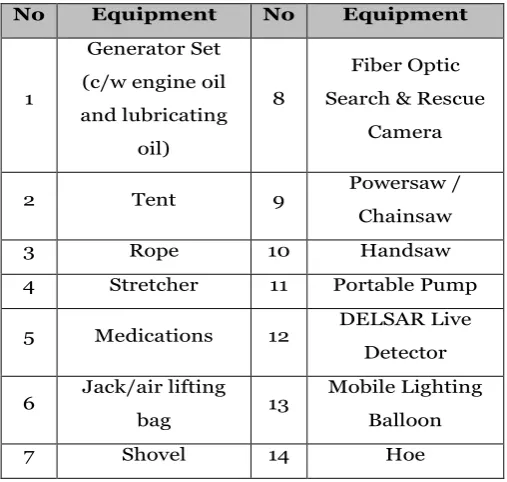
PASPA was moved to the scene along with some special equipment such as search and rescue life detector, fibre optic camera and other advanced equipment. In relation to that, the proposed list of basic equipment, which may be used by rescuers as standard equipment during the landslide rescue operations, as shown in Table 3.
Table 3. Proposed Lists of Basic Equipments for Rescuer during Landslide Event
No Equipment No Equipment
1
Generator Set (c/w engine oil and lubricating
oil)
8
Fiber Optic Search & Rescue
Camera
2 Tent 9 Powersaw /
Chainsaw
3 Rope 10 Handsaw
4 Stretcher 11 Portable Pump
5 Medications 12 DELSAR Live Detector
6 Jack/air lifting
bag 13
Mobile Lighting Balloon
7 Shovel 14 Hoe
ASM Science Journal, Volume 12, 2019
16
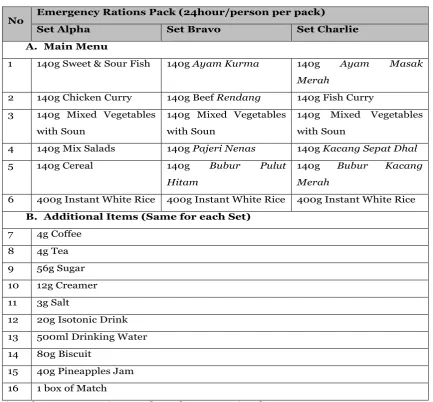
Table 4. Proposed MCDF Emergency Rations Pack
No Emergency Rations Pack (24hour/person per pack)
Set Alpha Set Bravo Set Charlie
A. Main Menu
1 140g Sweet & Sour Fish 140g Ayam Kurma 140g Ayam Masak Merah
2 140g Chicken Curry 140g Beef Rendang 140g Fish Curry 3 140g Mixed Vegetables
with Soun
140g Mixed Vegetables with Soun
140g Mixed Vegetables with Soun
4 140g Mix Salads 140g Pajeri Nenas 140g Kacang Sepat Dhal
5 140g Cereal 140g Bubur Pulut
Hitam
140g Bubur Kacang Merah
6 400g Instant White Rice 400g Instant White Rice 400g Instant White Rice
B. Additional Items (Same for each Set)
7 4g Coffee
8 4g Tea
9 56g Sugar
10 12g Creamer 11 3g Salt
12 20g Isotonic Drink
13 500ml Drinking Water
14 80g Biscuit
15 40g Pineapples Jam
16 1 box of Match
* Selection of emergency rations set depends on operational management.
This positive development shows the efficiency of the services provided by MCDF due to handling the emergencies events in providing the best service to the people. The continuous improvement process is expected by integrated scientific research for improving the quality of MCDF services delivery and increasing the level of competence of its force members. Besides that, the welfare of its members is reserved by the knowledge supplied of rescue skills for improving their competence, willingness of the management to provide the latest and modern rescue equipment and providing food needs in an emergency case. This study also demonstrates the efficiency of the services provided by MCDF for handling the emergencies and providing the best
services to the people in a changing environment.
V. CONCLUSION AND
RECOMMENDATION
ASM Science Journal, Volume 12, 2019
17 shown that a well rehearses ERP and the right decision at the ‘initial stage’ of an emergency can reduce its impact and prevent substantial damages and losses. Many elements of an ERP are common to all circumstances, and these elements, in particular, should be known and practised by all. Data on specialised equipment and organisations must be updated. It is a valuable aid for disaster planning and communication.
When emergencies occur, the minimisation of loss and damage of people, property and environment can be achieved through the proper implementation of an appropriate standard SOP or ERP. This situation is shown by results of a comparison of two cases of landslides previously addressed by MCDF. It greatly enhances the following response activities: (i) save lives and prevent injuries; (ii) contain and minimise damage to property; (iii) effective command and control; (iv) fast and systematic response; (v) quick return to normalcy; and (vi) it is statutory requirement. Disaster sites are not training ground for rescuers, but it always a good lesson learned for better actions soon.
Moreover, MCDF highlighted PASPA as one of the main rescue teams in any SAR operations such as landslides, building collapses and other. With the expertise of this team, it improves the efficiency and effectiveness of ERP with other agencies. PASPA has specific exposure-related training and operations both locally and abroad and provided with the latest high-tech operations equipment and state-of-the-art technology. MCDF is also able to increase competence of its members; the use of latest and modern emergency equipment and systems; and developing infrastructure for better future. With the concept of ‘MCDF near the hearts of the
people' as driven the Civil Defence services,
MCDF can enhance the contribution to society. Some characteristics of human response to a disaster area as follows (Ehrenreich, 2001):
i) Denial and inactivity - People normally
ignore the possibility of a disaster such as a landslide. When it strikes, denial and disbelief will result as in ‘this cannot be happening to me’;
ii) Confusion - In the immediate aftermath of
the disaster there is confusion and growing awareness of the resulting death, damage and injury;
iii) Anger and irritability - Survivors become
irrationally angry and will ventilate their anger on rescue workers, medical staff and authorities;
iv) Dependency - Dependency and the need for
ASM Science Journal, Volume 12, 2019
18 which facilitates the review and updating process of the plans with the local knowledge and community empowerment.
I. REFERENCES
[1] Bailey, ED & T, Sweeney 2003, ‘Considerations in
Establishing Emergency Medical Services
Response Time Goals’, Prehospital Emergency
Care, vol. 7, no. 3, pp. 397-399.
[2]Basu, R, R, Aggarwal, & A, Jana 2017, ‘An
Integrated Framework for Allocation of New
Emergency Response Facilities in Developing
Nations’, Process Integration and Optimization for
Sustainability, vol. 1, no. 2, pp. 121-134.
[3]Blackwell, TH & JS Kaufman 2002, ‘Response
Time Effectiveness: Comparison of Response Time
and Survival in an Urban Emergency Medical
Services System’, Academic Emergency Medicine,
vol. 9, no. 4, pp. 288-295.
[4]Desa, M & J Niemczynowicz 1996, ‘Spatial
variability of rainfall in Kuala Lumpur, Malaysia:
long and short term characteristics’, Hydrological
Sciences Journal, vol. 41, no. 3, pp. 345-362.
[5]Ehrenreich, JH 2001, Coping with disasters. A
guide book to psychosocial intervention, Centre for
psychology and society, New York, pp. 35-42.
[6]Faisal, H 2000, ‘Unsaturated tropical residual soils
and rainfall induced slope failures in Malaysia. in
Unsaturated soils for Asia’, in Proceedings of the
Asian Conference on Unsaturated Soils, 18-19 May
2000, Singapore, AA Balkema.
[7]Huat, LT, F, Ali, and AS, Ibrahim 2012, ‘An
investigation on one of the rainfall-induced
landslides in Malaysia’, Electronic Journal of
Geotechnical Engineering, vol. 17, pp. 435-449.
[8]Jaapar, A 2006, A Framework of a National Slope
Safety System for Malaysia, University of Hong
Kong.
[9]JPAM 2013, Laporan Pengoperasian Angkatan
Pertahanan Awam Malaysia 2012, Jabatan
Pertahanan Awam Malaysia (JPAM).
[10] JPAM 2012, Laporan Pengoperasian Angkatan
Pertahanan Awam Malaysia Tahun 2011, Jabatan
Pertahanan Awam Malaysia (JPAM).
[11] JPAM 2015, Panduan Kecemasan dan Pengurusan
Bencana, Jabatan Pertahanan Awam Malaysia
(JPAM).
[12] JPAM 2014, Pelan Strategik Angkatan
Pertahanan Awam Malaysia 2015-2020, Jabatan
Pertahanan Awam Malaysia (JPAM).
[13] Lee, ML, et al. 2014, ‘Rainfall-induced landslides in
Hulu Kelang area, Malaysia’, Natural Hazards, vol.
70, no. 1, pp. 353-375.
[14] Mariappan, S, et al. 2011, Remedial Measures
Adopted for Slope Failure at Bukit Antarabangsa,
Malaysia, Enecal Consultants Sdn Bhd, Jabatan
Kerja Raya, Mohd Asbi & Associates, Kuala
Lumpur, Malaysia.
[15] McCoy, CE, et al. 2013, ‘Emergency Medical
Services Out-of-Hospital Scene and Transport
Times and Their Association With Mortality in
ASM Science Journal, Volume 12, 2019
19 Trauma Center’, Annals of Emergency Medicine,
vol. 61, no. 2, pp. 167-174.
[16] METMalaysia 2017, Malaysia's Climate, Malaysian
Meteorological Department (MetMalaysia).
[17] PWD 2017, Revised National Slope Master Plan
2017-2023, Jabatan Kerja Raya Malaysia.
[18] Saadatkhah, N, A, Kassim, & LM Lee 2015,
‘Susceptibility assessment of shallow landslides in
Hulu Kelang area, Kuala Lumpur, Malaysia using
analytical hierarchy process and frequency ratio’,
Geotechnical and Geological Engineering, vol. 33,
no. 1, pp. 43-57.
[19] Samah, FA 2007, ‘Landslides in the Hillside
Development in the Hulu Klang’, in Klang Valley
Post-Graduate Seminar Semester, vol. 2.
[20] Sardi, MF 2012, Kajian Pencapaian Prestasi
Pasukan Kecemasan JPAM Terhadap Penetapan
Petunjuk Prestasi Utama (KPI) Ambulance
Emergency Response Time (AERT), Institut Tadbir
Awam (INTAN) Bukit Kiara.
[21] Sew, IDGS & ITY Chin 2006, Landslides: Case
Histories, Lessons Learned And Mitigation
Measures, Landslide, Sinkhole, Structure Failure:
MYTH or SCIENCE.
[22] Swaroop, M, et al. 2013, ‘Pre-hospital transport
times and survival for hypotensive patients with
penetrating thoracic trauma’, Journal of
Emergencies, Trauma, and Shock, vol. 6, no. 1, pp.
16-20.
[23] Tijssen, JA, et al. 2015, ‘Time on the scene and
interventions are associated with improved survival
in pediatric out-of-hospital cardiac arrest’,
Resuscitation, vol. 94(Supplement C), pp. 1-7.
[24] Wilde, ET 2013, ‘Do emergency medical system
response times matter for health outcomes?’,