1410
Brain Emulation Machine Model For Communication
Lakshita Aggarwal, Deepak Chahal, Latika Kharb
ABSTRACT:Artificial intelligence revolves around our lives in each way. It is merely the act of intelligence of humans to make their m achines that smart and intelligent so that machines start behaving like a man and even more intelligently. Machines were made in history for reducing human labour but now in recent civilizations machines serve the dual purpose resulting in reducing manual and mental labour both for humans. AI plays great role from the computations till the reminders for daily routine tasks. It interacts with the outer environment making the devices to act intelligently. AI has entered in each and every place the sensor networks are bringing a changing phase from virtual reality to the reality especially in areas such as healthcare, military, forecasting seismic activity in volcanoes, smart cities, remote monitoring, cloud services and many more. These sensors and intelligent devices with the integration of IoT even have entered in the utilities such as smart phones, gadgets and many more. This paper basically focuses on the aspects of AI, independent machine models which just take pixels of input data and process those pixels to produce the relevant output. It also focuses on how the brain emulate the images and how hierarchical answering of requests occur by understanding their relevant meanings to produce a positive reply for the same. The focus is given on content rather than context making it a relevant information transforming it from the raw data sets enabled in communication and networking. In the paper, we have also used a simulator software to simplify the concept of how to generate and analyze images in a efficient manner.
KEYWORDS:ARTIFICIAL INTELLIGENCE,MACHINE,PIXEL,ALGORITHMS,COMMUNICATION,NEURONS
————————————————————
1.
I
NTRODUCTIONArtificial intelligence seems to be constantly moving around us. It is the human intelligence or the way through which we process the intelligence of humans and the machine i.e. how humans and machines should interact to produce smart & cognitive results. Artificial Intelligence is recognized as one of the most innovative and polishing fields of study in today's world as it depicts the user as a magic happening [1]. Whenever we solve a problem even in the game of chess lots of smart structures, smart people thinks in terms of smart minded thinkers or in the champions of chess mentality to achieve the targets. The process of building applications has been a journey and it varies depending on one's application requirements and purpose [ 2]. AI is feeding the data into machines and using those raw data sets it processes and produces the results using those facts and figures. So, the urgent need of an hour is to shift the pace not only from playing games but to the high and efficient intelligent devices to even get the understanding of the words we speak and not to map the things into machine then the machine process but also machines should be empowered enough so that they map the image or high level words to produce the correct results as we our future is growing at a fast rate. Humans are growing so as our machines should also be empowered enough to do so. We need machines that could map the intelligence of the human not just in manual labor but also in mental labor. We need to put large data sets into machines which is a cumbersome job as we cannot feed our machines with all types of data. It had been even a great challenge for AI to feed every type of fact, figures, and raw sets to process and come up with the results. Because, we cannot verbally communicate with machines as we humans make understand things to each other using verbal communication. Machines require data to be fed into it. Artificial Intelligence (AI) has a long tradition as a scientific field, with tremendous achievements accomplished in the decades behind us [3].
2.
A
SPECTS OFAI
Aspects in AI are viewed as a spectrum of principle to be described as a machine can be made to simulate the
functionalities and send signals. A focus is made on machines as machines cannot be understood by verbal communication it forms abstractions and concepts. We believe that several questions are raised by this investigation, and areas for future research are presented [4]. It solves the varied area of problems for solving human problem and improve themselves.
o Simulating higher functions of the human brain as human brain sends signals in the form of neural transmission.
o Programming a computer to use natural language as we cannot communicate with machines in the form of verbal communication so we need some programming language to interact with the computers.
o Arranging hypothetical neurons in a way so that they can form concepts to interact with the machines.
o Analyze the problem complexity.
o Work for self improvement.
o Define only external behavior and does not define the internal functionality of the machine.
o Random response and embedding creativity in machines.
3.
I
NDEPENDENT MACHINE MODELFigure 1:Independent Machine Model
Layer 1: we add pixels into model then first layer identifies the simple edges and blocks. After passing from one stride to the other it calculates edges + blocks after max pooling. Layer 2: Then, next layer combines colors + edges + blocks dealing with more complex textures in producing the input to the next layer after max pooling.
Layer 3: In this layer, after max pooling numerical and data driven cases are considered to analyze the object parts specifically the broader and outer parts like face of a dog, car, butterfly etc.
Layer 4: In the last layer we deal with the object classes where the machines from its raw data of pixels is able to identify the object as a whole.
Initially, people use the neuron-vision to analyse the object or they manually feed the raw data into machines using which the people itself identify the object. But, now the entire process of visualization has changed. Visualizations of the models using the data from only the pixels provides supervised form of learning where we just provide pixels to the data and they manipulate those pixels and comes up with the correct results.
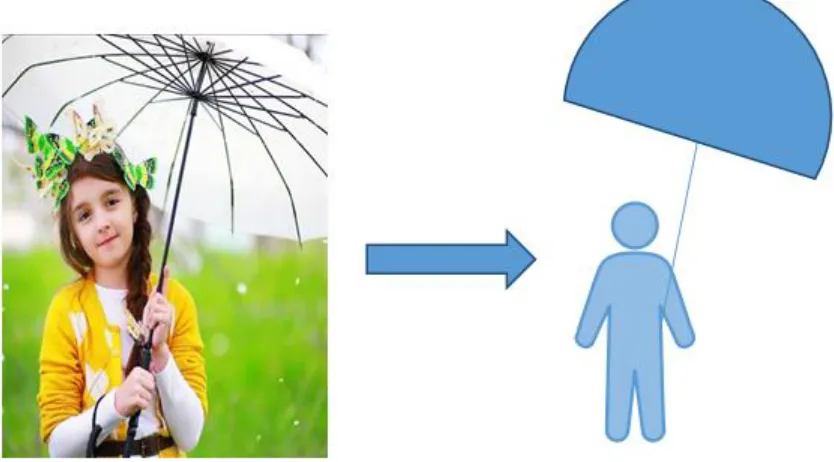
Figure 2: Image Visualization
After, passing from all the four layers of model the machine itself produces the result as ― the girl holding the umbrella in hand‖ this is a supervised learning where the machines draws input from the image itself and computes the desired output without feeding the raw data into machine. This will enable to produce quick relation with visual aid in machines as like in human brain with neuron transmission of signals within a body. It will help to map the signals independently. It will bring industrial revolution, in late 19th century computers entered the era which helped in stop and go
1412 night sleeps. Machine learning allows us to put knowledge
into computers by examining raw data sets, facts and figures. It uses deep learning algorithms to improve the accuracy of image, speech recognition methods to improve
the results produced so as to find the correct output by machine as like humans.
4.
H
OWB
RAINE
MULATES?
Figure 3: Brain Emulation Process
Brain receives neural signals from the receptors to which it responds with the reply further passing it to the specific organ. The main purpose is to understand how the human brain works neuroscientists are constantly working on statistics that how human brain functions in order to create a machine that has all the capabilities of a human being. A machine that is self – learned that it could learn like humans and master the skills. All mammals especially the humans have CNS (Central Nervous System) i.e. brain to perform all the tasks in a human body. The ultimate goal is to create a machine which could understand like humans and exhibit human – like intelligence and behaviours associated with it. Firstly, many computers arranged in parallel combination with each other receive the input of the data to be processed like an image then that image is pre-processed in the second step where it scans the sample image obtained fix it on a scanner and slice the image into many parts knowing as 2-dimensional scan where it fix and slice the image to obtain required results. Then, in the third step it is assumed that computers also process the image as the human brain identifies each and every image. As like human brain interprets each cell individually we make our computers that powerful they also see all minute details in a image to model each cell. The interpretation of each brain cell type occurs after which the emulation of complete image is done producing the acquired results or the correct interpretation of the image.
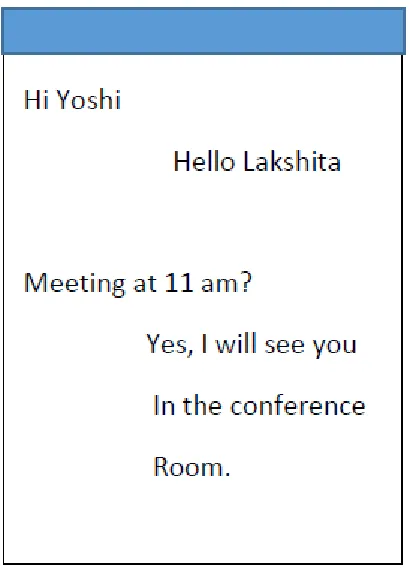
It uses deep learning algorithms to interpret the message to be send in reply by giving the appropriate suggestions to the request made from which the user can choose the
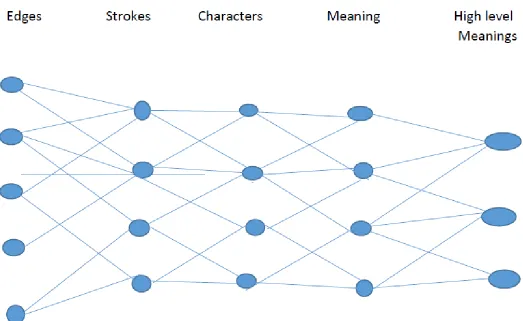
answer in reply to be made. It uses hierarchy of representations to interpret the message correctly by examining: Edges, Strokes, Characters, Meanings, High level meaning.
Figure 5: Message Based Suggestions using Deep Learning Algorithm
Messages are read and images are read by partitioning into different edges, strokes, characters and then their meanings are interpreted from which high level meanings are understood. Higher areas in visual hierarchy are observed and their meanings are understood.
Table 1:Visual Hierarchy Pattern
Algorithm makes the mapping of vertices of message differently to analyse the meanings of the data for producing an acquitted response. As our brain analyses each message differently. Hierarchy of representation is produced so as our vertices are mapped with different characters and their high level meanings are interpreted to
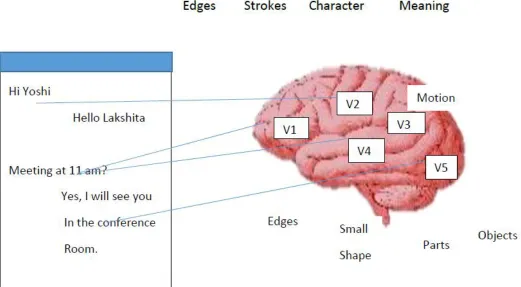
1414 Figure 6: How CNS does interpretation of messages?
This message is interpreted by deep learning theorems in a manner by splitting the message into individual units. These units are further analysed as edges then the small parts are identified then its further classification with the objects are done which identifies meanings and their context with the environment to produce the reply. This helps in communication of message independently via brain cells and then by AI signals to transmit the message independently. Networks are established which helps in the transfer of message receiving the stimulus responding the receptors to produce a response.
5.
A
C
ASES
TUDY:
S
IMULATINGI
MAGES FROMB
RAIND
ATABASEResearch in artificial intelligence, as well as in economics and other related fields, generally proceeds from the premise that each agent has a defined identity, well-defined preferences over outcomes, and well-well-defined beliefs about the world [7].In this section, we have chosen a case study of 'BrainWeb', as a solution to validation problem of analysis of medical image data especially
related to Brain. As we all know, due to the increasing interest in the quantitative analysis of medical problems, image data is growing vastly, so the need for the validation of such techniques is also increasing. Here, we have discussed a solution to the validation problem, in the form of a Simulated Brain Database (SBD) which contains a set of realistic MRI data volumes produced by an MRI simulator These data can be used to evaluate the performance of various methods of image analysis [8]. Custom MRI Simulations [9] allows you to run your own custom MRI simulation (on server) with any of several pulse sequences and source digital phantoms, and arbitrary values of the acquisition artifacts. In our paper, we have used simulations that are based on an anatomical model of normal brain, to serve as the basis for any analysis procedure. In this pre-computed simulated brain database (SBD), the parameter settings are fixed to 3 modalities, 5 slice thicknesses, 6 levels of noise, and 3 levels of intensity non-uniformity [10].
Output:1
Modality=T1, Protocol=ICBM, Phantom_name=normal, Slice_thickness=1mm, Noise=3%, INU=20%
1416 Output:2
Modality=T2, Protocol=ICBM, Phantom_name=normal, Slice_thickness=1mm, Noise=3%, INU=20%
Output:3
Modality=PD, Protocol=ICBM, Phantom_name=normal, Slice_thickness=1mm, Noise=3%, INU=20%
5.4 Evaluation
The anatomical model used to generate simulated brain MRI data consist of a set of 3-dimensional "fuzzy" tissue membership volumes, one for each tissue class (white matter, grey matter, cerebrospinal fluid, fat, ...). The voxel values in these volumes reflects the proportion of tissue present in that voxel, in the range [0,1]. The volumes are defined at a 1mm isotropic voxel grid in Talairach space, with dimensions 181x217x181 (XxYxZ) and start
coordinates -90,-126,-72 (x,y,z)
[https://brainweb.bic.mni.mcgill.ca/brainweb/anatomic_ms.h tml]. In addition to the fuzzy tissue membership volumes, a
1418
6.
C
ONCLUSIONSAt the same time, the same task can often be solved by different methods, using different approaches related to different artificial intelligence technologies. Thus, it is necessary to select the optimal technology, the most suitable for content processing of information on individual procedures [11].We conclude by coming to the solution that AI will really help in making our devices smart and intelligent so that they prove to be ubiquitous for mankind. It would definitely increase the business sizes and scale of economic growth which would cater with the productivity of data in real time sensing devices. It provides transformational benefits from one to all. It makes the things actuate the life by bringing real application of technology to life. AI is able to communicate with the things connected with the internet especially humans. It is closely related with pervasive technologies by blending the processing computation and actual reality to the life. AI is the paradigm to transform everyday real life objects into intelligent devices to communicate with each other and the people well. It is a middleware platform that integrate in a transparent manner as it transforms the data from sensors into actuators and transform artificial intelligence into real life needs reducing the human effort.
R
EFERENCES[1]. R. Dasoriya, J. Rajpopat, R. Jamar and M. Maurya, "The Uncertain Future of Artificial Intelligence," 2018 8th International Conference on Cloud Computing, Data Science & Engineering Noida,
2018, pp. 458-461.doi:
10.1109/CONFLUENCE.2018.8442945
[2]. Kharb, L. A Perspective View on Commercialization of Cognitive Computing. In 2018 8th International Conference on Cloud Computing, Data Science & Engineering, IEEE. [3]. V. M. Petrović, "Artificial Intelligence and Virtual
Worlds – Toward Human-Level AI Agents," in IEEE Access, vol. 6, pp. 39976-39988, 2018. doi: 10.1109/ACCESS.2018.2855970
[4]. Abdellatief, M., Sultan, A. B. M., Ghani, A. A. A., & Jabar, M. A. (2013). A mapping study to investigate component-based software system metrics. Journal of systems and software, 86(3), 587-603. [5]. Lo, A. W. (2019). Comment on Michael I. Jordan’s
―Artificial Intelligence—The Revolution Hasn’t Happened Yet‖. Harvard Data Science Review. [6]. Song, H., Triguero, I. & Özcan, E. Programming
Artificial Intelligence (2019) 8:143. https://doi.org/10.1007/s13748-019-00185-z [7]. Bhhatarai, B., Walters, W. P., Hop, C. E., Lanza,
G., & Ekins, S. (2019). Opportunities and challenges using artificial intelligence in ADME/Tox. Nature materials, 18(5), 418.
[8]. H. Zhao, X. Xu, S. Chen and B. Luo, "Segmentation of Brain MR Images Based on T-Mixture Model," 2009 3rd International Conference on Bioinformatics and Biomedical Engineering,
Beijing, 2009, pp. 1-4.doi:
10.1109/ICBBE.2009.5163370
[9]. https://www.mcgill.ca/bic/software/brainweb-mri-simulator
[10]. https://en.datatang.com/en/index