The Effect Of Internal Control
Weakness On Investment Efficiency
Lee Jaehong, Sangmyung University, South Korea Cho Eunjung, Ph.D., Yonsei University, South Korea
Choi Hyunjung, Sungkyul University, South Korea
ABSTRACT
This paper examines whether material weak ness in internal accounting control is negatively associated with investment efficiency in Korea. Since internal accounting control weakness drives poor accounting qualit y and poor accounting quality exacerbates information asymmetry between firms and outside capital suppliers, managerial investment cannot be monitored effectively which result in over- and/or under- investment. Since internal accounting system is closely related to corporate governance, weak internal accounting control is often associated with poor corporate governance, and this control environment mak es it hard to monitor managerial opportunistic behavior, causing abnormal investment such as over- and/or under- investment.
We find that firms with internal accounting control weak ness tend to mak e over - and under- investment. We also find the number of weak ness in internal accounting control is negatively related to investment efficiency. In addition, three types of qualified review opinion - overall company level weak ness, account-specific weak ness and disclaimer review opinion due to scope limitation - are differentially affected to investment efficiency; disclaimer review opinion is present the most severe problem in interna l accounting control that drives over- and under- investment. Our findings suggest weak internal accounting control provides poor monitoring to manager and cannot restrain managerial inefficient investment decision.
Keywor ds: Investment Efficiency; Over-Investment; Under-Investment; Information Asymmetry
I. INTRODUCTION
n this paper, we examine the relation between internal accounting control weakness and investment efficiency among Korean firms. According to Internal Accounting Management System Sample Criteria in Korea, material weakness is “a significant deficiency, or combination of significant deficiencies that results in more than reasonably possible that a material misstatement of the annual or interim financial statement will not be prevented or detected”. Internal accounting management system is one of internal control system, which is designed and operated by all members of the firm including manager and board of directors to enhance reliability of financial reporting.
Investment activity is a crucial driver for business growth and future outcome of a company. Generally, large amounts of resources are spent for capital investment and thus sometimes the life of companies depends on the degree of investment efficiency. If firms make over-investment, they even take negative net present value project, which will lead to exacerbating of liquidity and profitability, and in this reason even companies’ business could be threatened at times. If firms make under-investment, they don’t invest even they have positive net present value opportunity, resulting that long-term growth of company cannot be guaranteed. In this paper, we consider both over- and under-investment as inefficient investment behavior, i.e. discrepancy from optimal level of investment, and hereafter we can also mention them as abnormal investments.
positive relation between internal accounting control and accounting quality (Doyle et al. 2007). In addition, prior studies argue that accounting quality is positively related to investment efficiency (Biddle & Hilary 2006; McNichols & Stubben 2008; Biddle et al. 2009). They use accounting quality as a proxy for information asymmetry, suggesting higher quality of financial reporting enhance monitoring from outside investor which lead to mitigating information asymmetry.
In addition, weak internal accounting control often related to poor corporate governance (Krishinan & Visvanathan 2007; Ge & McVay 2005). Prior research shows that corporate governance can serve as monitoring system to mitigate over-investment (Ferreira & Matos 2008; Jensen 1986) or reduction in external financing costs (Anderson et al. 2004; Chang et al. 2009), which may help to mitigate under-investment.
Hence, internal accounting control weakness may cause investment inefficiency through lower accoun ting quality and poor corporate governance. Based on this reasoning, we hypothesize that internal accounting control weakness is associated with either higher over-investment or higher under-investment, or both.
Using 5,388 samples that listed on KOSDAQ during 2006 to 2010, we find that weak internal accounting control is positively related to inefficient investment. This finding suggests that firms with internal accounting control weakness cannot monitor their manager effectively, thus their investment ac tivities are more likely to deviate from optimal investment level. Further, we examine whether the number of internal accounting weakness presents seriousness of control deficiency and it may vary among types of qualified review opinion for internal accoun ting control. The results indicate that the number of weakness in internal accounting control is positively related to both over- and under-investment, implying higher number of weakness shows existence of more severe problem in internal accounting control and thus, abnormal investment cannot be prevented under this control environment. In addition, among three types of qualified review opinion ‒ overall company level weakness, account -specific weakness and disclaimer review opinion due to limitation of sco pe ‒, disclaimer review opinion shows the most serious problem in their internal accounting control, resulting in over- and under-investment.
Our paper makes two primary contributions. First, we extend the literature on investment efficiency by providing direct link between internal accounting control and investment inefficiency. Prior studies document higher accounting quality enhances investment efficiency by using accounting quality as a proxy for information asymmetry. In this paper, we shows internal accounting weakness can be another proxy for information asymmetry that is related to investment efficiency. In addition, we provide further evidence that the degree of internal control problem may vary according to the number of weakness and the types of qualified review opinion in the aspect of investment inefficiency.
Second, our findings provide implications for investors that since internal accounting control weakness actually related to investment inefficiency, investors should be more cautious to invest in such firms.
This paper is organized as follows: in Section 2, we discuss related theory and existing literature on the topic and develop the hypotheses. In Section 3, we discuss the sample selection and research design. Section 4 explains the results of the study and Section 5 concludes the paper.
II. THEORY AND HYPOTHES ES
2.1 Internal Control Weakness
Doyle et al. (2007) investigate the relation between internal control weakness and accrual quality using a sample of 705 companies that disclosed material weakness in the internal control over financial reporting from 2002 to 2005. They find that firms with weakness in internal control are likely to have lower accruals quality proxied by weaker mapping of accruals into cash flows. Ashbaugh -Skaife et al. (2008) shows that firms reporting internal control deficiencies have lower quality accruals as measured by accrual noise and absolute abnormal accruals relative to firms not reporting internal control problems. These researches imply that firms with internal control weakness are more likely to have errors in their financial reporting result in lower accounting quality.
Since the internal accounting control system include control environment such as board of directors, audit committee and manager, they are responsible for the system. Krishinan & Visvanathan (2007) investigate the relation between corporate governance and internal control weakness. They find that firms report internal control weakness are more likely to have frequent audit committee meeting, lesser proportion of ‘financial experts’ in the audit committee, and more likely to changes auditor. Therefore, we can assume that internal control weakness is related to poor corporate governance.
2.2 Capital Investment Efficiency and Accounting Quality
Modigliani & Miller (1958) propose that investment level is independently determined apart from financing and dividend decision under the assumption that a capital market is in a state of perfect competition. In the neo -classical framework, firms invest until the marginal benefit of capital investment equals the marginal cost (Yoshikawa 1980; Hayashi 1982). However, since the market is in state of imperfection, the literature suggests the possibility that firms may depart from this optimal level and either over-or under-invest. Prior research reports that the market imperfection is mainly caused by information asymmetry between managers and outside suppliers of capital. They suggest moral hazard and adverse selection as two primary imperfections caused by the existence of information asymmetry and these imperfections can cause the capital investment inefficiency.
Jensen (1986) argues that managers have incentives to consume perquisites and to grow their firms beyond the optimal size since they want to enlarge companies’ resources under their control (Blanchard et al. 1994; Stulz 1990). Therefore, managers are sometimes prone to make investments that are not necessarily in the best interests of shareholders for maximizing their personal welfares (Jensen & Meckling 1976). This principal-agent problem (moral hazard) can lead to over- or under-investment depending on the capital resources (Biddle et al. 2009). If firms have ample resources to invest, the natural tendency to over-invest of managers will bring exces s investment. However, capital suppliers are likely to notice this problem and to limit capital, this will lead to under-investment (Stiglitz & Weiss 1981; Lambert et al. 2007).
In the adverse selection theory, if managers are better informed than invest ors about a firm’s future outcome, they will attempt to increase capital issuance to sell stocks at excessive price. This try of managers can lead two results. If they are successful, they may over-invest these proceeds (Baker et al. 2003). However, if inv estors act rationally by rationing capital, managers will under-invest due to lack of proceeds.
The discussion above shows that information asymmetries between managers and outside capital suppliers can cause moral hazard and adverse selection problem, resulting in departure from its optimal level of investment (over- or under-investment). With these theoretical background, recent body of literature examines relation between accounting quality and firm-level capital investment efficiency (Biddle & Hilary 2006; McNichols & Stubben 2008; Biddle et al. 2009; Chang et al. 2009). In these researches accounting quality is used as information asymmetry proxy, meaning higher accounting quality can reduce information asymmetry.
investment inefficiency into over- and under-investment and investigate whether the accounting quality can enhance investment efficiency. They find that higher accounting quality is related to both lower over- and under-investment.
2.3 Hypothesis Developme nt
Agency theory describes the natural conflict between shareholders and managers. The conflict arises because individuals act for maximizing their own utility, suggesting that managers do not always act in the best interest of shareholders (Jensen & Meckling 1976). With this agency theory, inefficient investment (either over- or under-investment) are made when information asymmetry between managers and capital supplier are greater. One means to resolve this conflict is reduce information asymmetry through monitoring, and one obvious monitoring system is financial reporting quality that is disclosed to outside information user. Since higher-quality financial reporting increases shareholder ability to monitor managerial investment activities, it can be associated with investment efficiency by reducing moral hazard. In addition, high -quality financial reporting also operates to reduce adverse selection through the reduction in external financing costs and through the reduction in the likelihood that a firm obtains excess funds because of temporary mispricing. Chang et al. (2009) show that firms with better financial reporting have more flexibility to raise capital.
As we discussed above, a weak internal accounting control means poor quality of accounting earnings. In this case, financial reporting could not play a role of reducing either moral hazard or adverse selection problem incurred from information asymmetry between firms and outside capital supplier. For example, El-Mahdy & Park (2014) reports that internal control deficiencies increase information asymmetry in the secondary loan market. Ashbaugh -Skaife et al. (2009) argue that firms with internal control deficiencies more likely to have higher idiosyncratic risk, systematic risk, and cost of equity. Therefore, firms with internal accounting control weakness more likely to engage in abnormal (over- or under-investment) investment.
Apart from agency theory, the relation between a weakness of internal accounting control and inefficient investment can be supported by the aspect of corporate governance. Since corporate governance such as board of directors, audit committee, shareholders and managers are a part of control environment who is responsible to the internal accounting control system, internal control weakness is related to poor corporate governance (Krishinan & Visvanathan 2007; Ge & McVay 2005). Prior research shows that corporate governance can serve as monitoring system to prevent manager’s opportunistic investment and mitigate over-investment (Ferreira & Matos 2008; Jensen 1986). Anderson et al. (2004) show that greater board independence and board size decre ase cost of debt financing and fully independence audit committees, bigger audit committee size and meeting frequency are associated with lower cost of debt and yield spread, which may help to mitigate under-investment. Park & Kwon (2012) argue that foreign ownership can effectively monitor manager’s investment decision and enhance investment efficiency, resulting in reducing over- and under-investment. Given these possibilities, we expect that poor corporate governance of firms with internal control weakness will make abnormal (over- and/or under-investment) investment decision.
Based on the discussion above, we expect that a weak internal accounting control is related to over -and/or under-investment. Specifically, we set our first hypothesis as below.
Hypothesis 1a. Firms with internal accounting control weakness are more likely to engage in over-investment.
Hypothesis 1b. Firms with internal accounting control weakness are more likely to engage in under-investment.
Hypothesis 2a. The number of internal accounting control weakness is positively related to over-investment.
Hypothesis 2b. The number of internal accounting control weakness is positively related to under-investment.
As for the character of ‘weakness’, we secondarily consider the reason of weakness in internal accounting control. While a material weakness is the most severe type of internal control deficiency, within the weakness classification the severity of internal control problems varies substantially. Doyle et al. (2007) find that the internal control weakness relate to overall-company level have more severe influence to reducing financial accounting quality since those weakness are relate to more fundamental prob lems such as the control environment or the overall financial reporting process. Jiang et al. (2009) finds that auditors more consider overall-company level weakness in internal control rather than account-specific weakness for performing audit opinion. We partition the internal control weakness into three types – overall-company level weakness, account-specific weakness, and disclaimer of review opinion by auditor due to limitation of review scope. If firms do not provide sufficient document to auditor necessary for performing review procedure for the purpose of concealing the flaws of the company, auditors can disclaim giving review opinion for the internal accounting control. Choi & Koh (2011) argue that firm’s control deficiency will be greater for firms with disclaimer of review opinion due to the limitation of scope. If seriousness of internal control weakness varies among the reason of weakness, we can expect that the reason of internal control weakness is differentially related to investment inefficiency.
Hypothesis 3a. Firms with account-specific internal accounting control weakness, overall company level weakness and disclaimer of review opinion in internal control is more likely to engage in over-investment.
Hypothesis 3b. Firms with account-specific internal accounting control weakness, overall company level weakness and disclaimer of review opinion in internal control is more likely to engage in under-investment.
III. RESEARCH DESIGN AND SAMPLE DESCRIPTION
3.1 Measurement of Abnormal Investment (Over- and Under- Investment)
This study defines inefficient investment as an investment amount that departs from optimal level based on the firm’s investment opportunities. We measure investment inefficiency as abnormal investme nt. In this study, we adopted McNichols & Stubben’s (2008) model, which modifies Tobin’s Q and controls for asset growth, the level of past investment, and the variation in the relationship between investment and Tobin’s Q. Specifically, this model includes asset growth at the beginning of the year to control for the possibility that growth firms are more likely to invest. The past investment is another control variable to capture a firm-specific component to investment decision and to add a change component to the model because the abnormal investment is estimated from the residual investment which is measured incremental to the persistent portion of the previous year’s investment. Finally, to allow for variations across firms in the same industry-year given the relationship between investment and Tobin’s Q, McNichols & Stubben (2008) augmented traditional Tobin’s Q model by including incremental coefficients for quartiles of Tobin’s Q.
t t t t t t t t t INV GROWTH CFO QRT Q QRT Q QRT Q Q INV
1 7 6 5 1 4 1 3 1 2 1 10 - _ 2 _ 3 _ 4
(1)
where
INV = Capital expenditure
= Cash outflows from investing activity1 / total assets;
1
Q_QRT2 (Q_QRT3, Q_QRT4) = Q × an indicator variable for partitioning Tobin’s Q into quartiles (1 if Q belongs to the second (third, fourth) quartile of its industry -year distribution and 0 otherwise);
CFO = Cash flows from operations / total assets;
GROWTH = Ln(total assets / total assets at the beginning of the year)
In this study, the dependent variables that served as proxies for abnormal investment were the absolute value of residuals obtained from estimating equation (1). Moreover, we divide abnormal investment into over-investment, which includes only positive residuals, and under-investment that includes negative residuals obtained from the model.
3.2 Regression Models
To test the hypotheses, we specified regression models linking the extent of over- or under- investment to test and control variables as follows:
t t t t t t t t t t t INDdummy YEARdummy ROA SIZE LEV FCF orRIC orAIC CIC NIC IC XINV
24 15 14 6 5 4 3 1 2 10 ( , , )
(2) t t t t t t t t t t t INDdummy YEARdummy ROA SIZE LEV FCF orRIC orAIC CIC NIC IC XINV
24 15 14 6 5 4 3 1 2 10 ( , , )
(3)
where
XINV = an absolute value of abnormal investment estimated from McNichols & Stubben (2008) model
= residuals from equation (1);
+XINV = if abnormal investment≥0, then an absolute value of abnormal investment
if abnormal investment<0, then 0;
-XINV = if abnormal investment<0, then an absolute value of abnormal investment
if abnormal investment≥0, then 0;
IC = an indicator variable that equals one when review on internal accounting control is non -qualified and zero otherwise;
NIC = the number of material weakness on internal accounting control;
AIC = an indicator variable that equals one when the weakness on internal accounting control is accounting-specific material weakness and zero otherwise;
CIC = an indicator variable that equals one when the weakness on internal accounting control is company -level material weakness and zero otherwise;
DI C = an indicator variable that equals one firms with disclaimer review opinion on internal accounting control review due to limitation of scope and zero otherwise;
= (net profit + depreciation – change in PPE – change in net working capital) / total assets;
LEV = total liabilities / total assets;
SIZE = ln (total sales);
ROA = net income / lagged total assets.
The dependent variables that served as proxies for abnormal investment were the residuals obtained from estimating equation (1), as in McNichols & Stubben (2008) model. We measured the level of abnormal investment (XINV) by modifying traditional Tobin’s Q model. To test Hypothesis 1, we included the independent variable IC in equation (2), (3) to see whether weakness on internal accounting control affects firm’s abnormal investment behavior.
We included several control variables that may influence the lev el of abnormal investment. Previous studies have suggested that managers have an incentive to engage in abnormal investment to expand their firm’s business beyond some optimal level and obtain perquisites when the firm has substantial cash flows (Jensen 1986; Blanchard et al. 1994; Richardson 2006; Biddle et al. 2009). Therefore, we included the level of free cash flows (FCF) as a control variable. We controlled for the debt ratio (LEV) because Myers (1977) reported that firms with a high leverage ratio are likely to reduce their investing activity as a result of a debt -overhang problem. In addition, many studies have found that larger and more profitable firms tend to prefer financial stability and conservative management and thus are likely to prevent managers from engaging in abnormal investment for empire building (Lang & Lundholm 1993; Biddle & Hilary 2006). In this regard, we controlled for firm size (SIZE) and profitability (ROA). Finally, we included industry and year dummies to control for differences in year and industry characteristics.
To test Hypothesis 2 and 3, we substitute the number of internal accounting control weakness (NIC) and the reason of internal accounting control weakness for independent variable (IC) in estimation model (2), (3). As for the reason of internal accounting control weakness, overall company level weakness (CIC), account-specific weakness (AIC) and disclaimer of review opinion (DIC) are considered as independent variables.
3.3 Sample Selection
The sample consists of firms listed on the KOSDAQ market during the period from 2006 to 2010 that satisfied following criteria: (1) non-financial companies with fiscal year-end of December 31 (2) companies that review result for internal accounting control are available from Korean Financial Supervisory Service (FSS)’s DART system. (3) companies with financial statements available from the KIS-Value database of Korea Investors Services (KIS). In addition, to eliminate the effect of outlier bias, the top and bottom 1% of independent and dependent variables are winsorized.
IV. EMPIRICAL RESULTS
4.1 Univariate Tests
Table 1. Descriptive Statistics
Over-investment (+XINV) Under-investment (-XINV)≤
Var. Mean S TD MIN Median MAX Mean S TD MIN Median MAX
XINV 0.0246 0.0349 0.0000 0.0104 0.1476 0.0136 0.0118 0.0000 0.0117 0.0606 IC 0.0207 0.1425 0.0000 0.0000 1.0000 0.0136 0.1161 0.0000 0.0000 1.0000 NIC 0.0272 0.2099 0.0000 0.0000 3.0000 0.0175 0.1645 0.0000 0.0000 3.0000 CIC 0.0043 0.0659 0.0000 0.0000 1.0000 0.0016 0.0404 0.0000 0.0000 1.0000 AIC 0.0131 0.1137 0.0000 0.0000 1.0000 0.0076 0.0872 0.0000 0.0000 1.0000 DIC 0.0065 0.0807 0.0000 0.0000 1.0000 0.0060 0.0773 0.0000 0.0000 1.0000 FCF 0.0631 0.2922 -0.9881 0.0712 1.4032 0.0416 0.2917 -0.9881 0.0501 1.4032 LEV 1.0217 1.0801 0.0296 0.7151 7.4570 0.9136 1.1414 0.0296 0.5694 7.4570 SIZE 24.8024 1.0393 21.4146 24.8543 27.1843 24.6147 1.0836 21.4146 24.6249 27.1843 ROA 0.0047 0.1704 -0.7644 0.0329 0.6171 0.0107 0.1541 -0.7644 0.0328 0.6146
Variable definitions:
+XINV = if abnormal investment≥0, then an absolute value of abnormal investment if abnormal investment<0, then 0;
-XINV = if abnormal investment<0, then an absolute value of abnormal investment if abnormal investment≥0, then 0;
IC = an indicator variable that equals one when review on internal accounting control is qualified and zero otherwise;
NIC = the number of material weakness on internal accounting control;
AIC = an indicator variable that equals one when the weakness on internal accounting control is accounting-specific material weakness and zero otherwise;
CIC = an indicator variable that equals one when the weakness on internal accounting control is overall company-level material weakness and zero otherwise;
DIC = an indicator variable that equals one firms with disclaimer review opinion on internal accounting control review due to limitation of scope and zero otherwise;
FCF = free cash flows / total assets;
= (net profit + depreciation – change in PPE – change in net working capital) / total assets;
LEV = total liabilities / total assets;
SIZE = ln (total assets);
ROA = net income / lagged total assets.
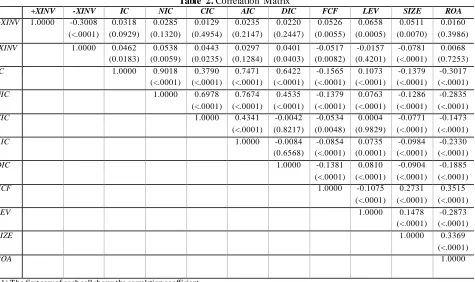
Table 2. Correlation Matrix
+XINV -XINV IC NIC CIC AIC DIC FCF LEV SIZE ROA
+XINV 1.0000 -0.3008 0.0318 0.0285 0.0129 0.0235 0.0220 0.0526 0.0658 0.0511 0.0160
(<.0001) (0.0929) (0.1320) (0.4954) (0.2147) (0.2447) (0.0055) (0.0005) (0.0070) (0.3986)
-XINV 1.0000 0.0462 0.0538 0.0443 0.0297 0.0401 -0.0517 -0.0157 -0.0781 0.0068
(0.0183) (0.0059) (0.0235) (0.1284) (0.0403) (0.0082) (0.4201) (<.0001) (0.7253)
IC 1.0000 0.9018 0.3790 0.7471 0.6422 -0.1565 0.1073 -0.1379 -0.3017
(<.0001) (<.0001) (<.0001) (<.0001) (<.0001) (<.0001) (<.0001) (<.0001)
NIC 1.0000 0.6978 0.7674 0.4535 -0.1379 0.0763 -0.1286 -0.2835
(<.0001) (<.0001) (<.0001) (<.0001) (<.0001) (<.0001) (<.0001)
CIC 1.0000 0.4341 -0.0042 -0.0534 0.0004 -0.0771 -0.1473
(<.0001) (0.8217) (0.0048) (0.9829) (<.0001) (<.0001)
AIC 1.0000 -0.0084 -0.0854 0.0735 -0.0984 -0.2330
(0.6568) (<.0001) (0.0001) (<.0001) (<.0001)
DIC 1.0000 -0.1381 0.0810 -0.0904 -0.1885
(<.0001) (<.0001) (<.0001) (<.0001)
FCF 1.0000 -0.1075 0.2731 0.3515
(<.0001) (<.0001) (<.0001)
LEV 1.0000 0.1478 -0.2873
(<.0001) (<.0001)
SIZE 1.0000 0.3369
(<.0001)
ROA 1.0000
1) T he first row of each cell shows the correlation coefficient. 2) Numbers in the parentheses are p-values.
3) See T able 1 for variable definitions.
4.2 Test of Hypothesis 1
Table 3. Internal Control Weakness and Firm’s Abnormal Investment
H1: Dependent Variable: Over-investment & Under-investment (+XINV, -XINV)
t t t t t t t t INDdummy YRdummy ROA SIZE LEV FCF IC XINV or XINV 21 11 10 6 5 4 3 1 2 1 0 ) (
Variables (1)+XINV (2)-XINV
Estimate t-stat. Estimate t-stat.
Intercept -0.0100 -0.81 0.0295 5.04***
IC 0.0080 2.12** 0.0039 2.22**
FCF 0.0041 2.35** -0.0020 -2.40**
LEV 0.0015 3.34*** 0.0000 0.15
SIZE 0.0008 1.68* -0.0006 -2.75***
ROA 0.0025 -0.71 0.0042 2.56**
Industry dummy Included Included
Year dummy Included Included
Adjusted 𝑅2 0.017 0.043
F-stat. 2.83*** 7.89***
# of observations 2,780 2,608
1) Notes: *, **, *** represent significance at the 10, 5, and 1 percent levels, respectively. 2) See T ABLE 1 for definition for other variables.
4.3 Test of Hypothesis 2
Regression results for hypothesis 2a and 2b are reported in Table 4. Hypothesis 2a and 2b predicts that the number of internal accounting control weakness is positively related to over-investment (2a) and under-investment (2b), respectively. Specifically, column (1) in Table 4 presents the regression result with over-investment sample which tests for hypothesis 2a and Column (2) is the regression result with under-investment sample testing hypothesis 2b. In both columns, the coefficients of NIC are significantly positive; (0.0052, t=1.97) for over-investment sample and (0.0035, t=2.70) for under-investment sample, supporting hypothesis 2a and 2b, respectively. This suggests that the number of internal accounting control weakness reflects the seriousness of weak internal accounting control, leading to investment inefficiency. The results for control variables are the same as in table 3.
Table 4. The Number of Internal Control Weakness and Firm’s Investment Efficiency H2: Dependent Variable: Over-investment & Under-investment (+XINV, -XINV)
t t t t t t t t INDdummy YRdummy ROA SIZE LEV FCF NIC XINV or XINV 21 11 10 6 5 4 3 1 2 1 0 ) (
Variables (1)+XINV (2)-XINV
Estimate t-stat. Estimate t-stat.
Intercept -0.0096 -0.78 0.0295 5.06***
NIC 0.0052 1.97** 0.0035 2.70***
FCF 0.0040 2.32** -0.0020 -2.39**
LEV 0.0015 3.41*** 0.0000 0.20
SIZE 0.0008 1.65* -0.0006 -2.77***
ROA 0.0023 0.67 0.0044 2.67***
Industry dummy Included Included
Year dummy Included Included
Adjusted R2 0.010 0.043
F-stat. 2.79*** 8.03***
# of observations 2,780 2,608
4.4 Test of Hypothesis 3
Table 5 presents the results on the types of qualified review opinion on internal accounting control and firms’ over- and under-investment, testing for hypothesis 3a and 3b. Column (1) shows regression result on over-investment sample testing hypothesis 3a, and column (2) shows result for under-investment sample to test hypothesis 3b. We include three types of qualified review opinion for the internal accounting control weakness − overall company level weakness (CIC), account-specific weakness (AIC), and disclaimer opinion due to limitation of scope (DIC) − in model (2) and (3). Specifically, in column (1), we observed that only DIC is significantly positive (0.0114, t=1.96), indicating that firms with disclaimer review opinion due to limitation of scope are more likely to make over -investment.
Table 5. Different Types of Qualified Opinion and Firm’s Investment Efficiency H3: Dependent Variable: Over-investment & Under-investment (+XINV, -XINV)
t t t t t t t t t t ε INDdummy β YRdummy β ROA β SIZE β LEV β FCF β DIC β AIC β CIC β α XINV or XINV + Σ + Σ + + + + + + + + = ) + ( 23 13 12 8 7 6 5 1 4 3 2 1 0
Variables (1)+XINV (2)-XINV
Estimate t-stat. Estimate t-stat.
Intercept 0.0107 0.82 0.0100 1.65*
CIC -0.0037 -0.35 0.0107 2.12**
AIC 0.0060 1.08 0.0017 0.71
DIC 0.0114 1.96** 0.0053 2.04**
FCF 0.0057 2.37** -0.0025 -3.00***
LEV 0.0175 6.19*** -0.0000 -0.48
SIZE -0.0001 -0.36 -0.0001 0.56
ROA 0.0093 2.49** 0.0029 1.82*
Industry dummy Included Included
Year dummy Included Included
Adjusted 2
R 0.018 0.041
F-stat. 3.67*** 6.95***
# of observations 2,780 2,608
1) Notes: *, **, *** represent significance at the 10, 5, and 1 percent levels, respectively. 2) See T ABLE 1 for definition for other variables.
This suggests that, among three types of qualified review opinion for the internal accounting control, disclaimer review opinion is more closely related to severe internal accounting control problem, which driv es over-investment. In column (2), the coefficients of CIC and DIC show significantly positive values (CIC: 0.0107, t=2.12, DIC: 0.0053, t=2.04), respectively. This shows a greater possibility of under-investment for firms with overall company level weakness and disclaimer review opinion. In both test results, disclaimer review opinion drive over- and under-investment. But, overall company level weakness is only related to under-investment and account-specific weakness does not cause any inefficiency in investment. This means that account-specific weakness can be “audit around” (Doyle et al. 2007), and thus the internal accounting weakness regarding account -specific weakness can be resolved easily, meaning not much severe information asymmetry. Overall compa ny level is only related to under-investment. Generally, under-investment is less harmful to the firm and hard to be detected by outside investors compared to over-investment, thus the level of information asymmetry caused by overall company level weakness is enough to incur under-investment. However, since over-investment can be easily detected and is much more depending on outside capital funding, the marginal level of information asymmetry for preventing over-investment is much higher than that of under-investment. Thus, over-investment is only driven by the most significant weakness, disclaimer of review opinion, which means extreme information asymmetry cause over-investment. However, under-investment can be more easily driven by not much severe internal accounting control weakness, i.e., overall company level weakness.
V. SUMMARY AND CONCLUSION
investment inefficiency. Since internal accounting control weakness tends to produce poor accounting quality, the information asymmetry between firms and capital supplier cannot be mitigated, resulting in over- and/or under-investment. In addition, since internal accounting system include s corporate governance, weak internal accounting control is often related to poor corporate governance, and thus managerial investment cannot be monitored effectively causing abnormal investment. The results show a positive relation between internal accoun ting control weakness and the incidence of over- and/or under-investment. In addition, the magnitude of internal accounting weakness is positively related to both over- and under-investment. In the analysis of different types of qualified review opinion, we find disclaimer review opinion indicates the most severe control problem which causes extreme information asymmetry between firms and outside capital suppliers. These results suggest that monitoring system for firms with internal accounting control weakness may not be operate effectively, thus managerial investment activities cannot be monitored by investors, resulting in investment inefficiency.
Our paper adds to literature on investment efficiency by using internal accounting control weakness as a pro xy of information asymmetry, whereas several other papers use accounting quality to proxy for information asymmetry. In addition, we provide evidence that the degree of the influence of internal control problem on investment efficiency may vary according to the number of weakness and the types of qualified review opinion. Finally, our results warn investors to be cautious for investing in such firms, showing that internal accounting control weakness is actually related to investment inefficiency.
ACKNOWLEDGEMENTS
"This work was supported (in part) by the Yonsei University Research Fund of 2014. "
AUTHOR BIOGRAPHIES
Lee Jaehong, Assistant Professor, Sangmyung University, Department of Business Administration. Email: [email protected]
Cho Eunjung, Ph.D., School of Business , Yonsei University. Email: [email protected] (corresponding author)
Choi Hyunjung, Assistant Professor, College of Social Sciences , Sungkyul University. Email: [email protected]
REFERENCES
Anderson, R. C., S. A. M ansi and D. M . Reeb. (2004). Board charateristics, accounting report integrity, and the cost of debt.
Journal of Finanial & Economics 37(3), 315-342.
Ashbaugh-Skaife, H., D.W. Kollins and W. R. Kinney Jr. (2008). The Effect of SOX Internal Control Deficiencies and Their Remediation on Accrual Quality. The Accounting Review 83(1), 217-250.
Ashbaugh-Skaife, H., D.W. Kollins, W. R. Kinney Jr. and R. LaFond. (2009). The Effect of SOX Internal Control Deficiencies on Firm Risk and Cost of Equity. Journal of Accounting Research 47(1), 1-43.
Baker, M ., J. Stein and J. Wurgler. (2003). When does the market matter? Stock prices and the investment of equity -dependent firms. Quarterly Journal of Economics 118, 969-1005.
Biddle, G. and G. Hilary. (2006). Accounting Quality and Firm-Level Capital Investment. The Accounting Review, 81, 963-982. Biddle, G., G. Hilary, and R. Verdi. (2009). How Does Financial Reporting Quality Relate to Investment Efficiency? Journal of
Accounting and Economics, 48, 112-131.
Blanchard, O., F. Lopez-de-Silanez and A. Shleifer. (1994). What Do Firms Do with Cash Windfalls? Journal of Financial Economics, 36, 337-360.
Chang, X., S. Dasgupta, and G. Hillary. (2009). The Effect of Auditor Quality on Financing Decisions. The Accounting Review,
84, 1085-1117.
Choi, H. J., and Y. S. Koh. (2011). The Effect of Auditors’ Internal Control Opinions on Auditor’s Opinion of Financial Statement. The Study of Korean Accounting and Auditing 54, 535-567.
Doyle, J. T., W. Ge and S. M cVay. (2007). Accural Quality and Internal Control over Financial Reporting. The Accounting Review 82(5), 1141-1170.
El-M ahdy, D. and M . Park. (2014). Internal control quality and information asymmetry in the secondary loan market. Review of quantitive finance & Accounting 43(4), 683-720.
Ferreira, M . and P. M atos. (2008). The colors of investors’ money: the role of institutional investors around the world. Journal of Financial Economics 88, 499-533.
Ge, W. and S. M cVay. (2005). The Disclosure of M aterial Weakness in Internal Control after the Sarbanes-Oxley Act.
Accounting Horizons 19(3), 137-158.
Hayashi, F. (1983). Tobin’s M arginal q and Average q: A Neoclassical Interpretation. Econometrica, 50, 213-224.
Jensen, M . (1986). Agency Cost of Free Cash Flow, Corporate Finance, and Takeovers, American Economics Review, 76, 323-329.
Jensen, M . C. and W. H. M eckling. (1976). Theory of the Firms: M anagerial Behavior, Agency Costs and Ownership Structure.
Journal of Financial and Economics 3(4), 305-360.
Jiang, W., K. Rupley, and J. Wu. (2009). Internal Control Deficiencies and the Issuance of Going Concern Opinions. Research in Accounting Regulation 22, 40-46.
Krishinan, G. V. and G. Visvanathan. (2007). Reporting Internal Control Deficiencies in the Post -Sarbanes- Oxley Era: The Role of Auditors and Corporate Governance. International Journal of Auditing 11, 73-90.
Lambert, R., C. Leuz and R. Verrecchia. (2007). Accounting information, disclosure, and the cost of capital. Journal of Accounting Research 45, 385–420.
Lang, M . and R. Lundholm. (1993). Cross-sectional Determinants of Analysts’ Ratings of Corporate Disclosures. Journal of Accounting Research, 31, 246-271.
Lee, M . G., S. C. Lee and S. J. Chang. (2008). The Effects of Internal Accounting Control System on Audit Hours and Audit Fees. Korean Journal of Taxation and Accounting 9(2), 73-104.
M cNichols, M . and S. Stubben (2008). Does Earnings M anagement affect Firms’ Investment Decisions? The Accounting Review,
83, 1571-1603.
M odigliani, F. and M . M iller. (1958). The Cost of Capital, Corporation Finance and the Theory of Investment. The American Economic Review, 48, 261-297.
M yers, S. (1977). Determinants of Corporate Borrowing. Journal of Financial Economics, 5, 147-176.
Park, J. H and D. H. Kwon. (2012). The impact of foreign ownership on the investment efficiency. Korean Accounting Review
37(3), 277-307.
Richardson, S. (2006). Over-investment of Free Cash Flow. Review of Accounting Studies, 11, 159-189.
Stiglitz, J. and A. Weiss. (1981). Credit rationing in markets with imperfect information. American Economic Review 71, 393– 410.