High-purity
Platinum
for
Microelectronics
By G.
T.
Murray
Materials Research Corporation, Orangeburg, New York
The introduction of the transistor has had
an impact on the electronic industry of
gigantic proportions. Those associated with the development and rise of transistorised electronics are keenly aware of the stringent purity requirements placed on the silicon and germanium semiconductor materials. For most impurity elements, the concentrations
must be less than one part per billion and for
many, less than one part in xoll host atoms.
The need for high purity semiconductor materials was the primary impetus for develop- ment of ultrapurification techniques such as the zone refining process.
The current revolution in electronics has
been brought about by the incorporation of
the transistor element with the entire circuit on the same silicon wafer or chip. These “integrated circuits” consist of intercon- nected circuit elements (resistors, capacitors,
conductors, amplifiers, etc.) in the form of
thin films inseparably associated on the same substrate, and in a minute space such that as
many as 600 individual circuits can be pro-
duced on an area the size of a silver dollar.
A variety of metals are utilised for inte-
grated circuit components. Although the purity required may not be as demanding as that for the silicon substrate, many metallic components are either in direct contact with
the silicon or separated by only thin (< I O - ~ C ~ )
layers of oxides (or other metal layers) such
that diffusion of certain impurity elements
into the silicon must be guarded against. Of particular significance are the alkali metals, which in concentrations of one part per million, can destroy the electrical properties of the device. Consequently, high purity en-
hances device yield and reliability. Since
there are between IOO to zoo manufacturing
steps in the process, the attainment of a satis-
factory overall yield is a major problem. Platinum is used in integrated circuit fabri-
cation as an intermediate layer between an
interconnecting gold layer and a protective silicon nitride layer. The platinum prevents the diffusion of gold into the silicon nitride and subsequently into the silicon layer. I n addition, a thin (0.05 micron) platinum layer
is initially sputtered on the silicon wafer and
reacted to form a platinum silicide layer on the terminal ends of the wafer. This platinum
silicide forms a good low-resistance ohmic
contact to the silicon. A completed mono-
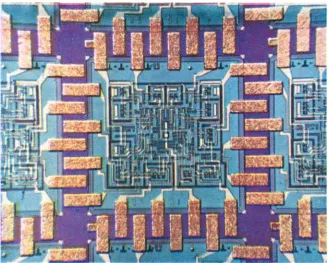
lithic integrated circuit is depicted in Fig. 1,
and a layered section is shown in Fig. 2.
Purification
A wide variety of processes are used to
purify metals. Since most metals occur in nature in the form of compounds such as oxides or sulphides, generally the first step
is to separate the metal from the non-metal
by some type of a reduction process. Beyond
that, further purification may include chemi- cal precipitation from solution, chemical vapour deposition, distillation or sublimation processes and electrolyses.
The ultimate in purity for most metals has been attained by a liquid phase technique called zone refinement. The zone melting process was originally developed by Pfann and his co-workers at Bell Telephone Labora-
tories (I, 2). It was first applied to silicon and
Fig. 1 A completed beam-lead monolithic integrated circuit. Each polished silicon wafer
150-2OOy thick can hold of the order of 600 integrated circuits. (Courtesy of Western
Electric Eng., December 1967.)
opment. In this process purification is
dependent on the difference in solubility of
the impurity elements between the liquid and
solid phase. A molten zone is made to move
very slowly (e.g., z in/h) along a bar of metal.
Those impurity elements more soluble in the liquid than in the solid tend to move with the liquid. (Most impurity elements are more soluble in the liquid phase.) By moving this zone a number of times in one direction, im-
purity elements are piled up at one end of the
bar. This end section is removed and dis- carded (or in the case of platinum used for applications where purity is less important).
It has been shown (2) that the solute con-
centration C , in the solid a t a distance x from
the starting end after one zone pass is a func- tion of the initial concentration, C,, the molten zone length 1, and the effective distribution
coefficient k as follows :
C,:C,=r- (I-k) exp [-kx/l]
The distribution coefficient is a function of
the ratio of the solubility of the impurity element in the solid to that in the liquid. Metals and semiconductors were first zone refined by placing a suitable bar in a long boat or crucible. Later the floating-zone technique
was introduced (3), in which the metal was
suspended in a vertical position and the
molten zone was held in place by the metal’s own surface tension. This somewhat limited the diameter of bar that could be refined but had the distinct advantage that the material being refined did not come into contact with a crucible and thus could not become con- taminated by the latter.
The Electron Beam Heat
Source
Several types of heat sources have been employed to achieve the molten zone, the most common being induction heating, resistance wire wound furnaces, radiation
heating and electron bombardment. The
Fig. 2 Cross section of part of a crystalline silicon wafer after deposition of platinum. Typically there are between 100 and 200 stages i n the complete process of integrated circuit manufacture. (Courtesy of Western Electric Eng., December 1967.)
melting-point metals. I n this technique,
electrons which are emitted from an annular filament surrounding the rod material are
accelerated toward the rod by virtue of a
high d.c. potential. The kinetic energy of the
electrons is converted to thermal energy on striking the target, Electron bombardment offers two principal advantages over the other techniques, namely the low power required and the ease of control of the molten zone
configuration. For example, less than 1 kW is
required to produce a molten zone in a +-inch
diameter platinum rod, compared to 5 to
10 kW for typical induction units. By use of
electrostatic focusing shields the electrons can be confined to a small region, and thereby pro- duce a small well-controlled molten zone which is especially desirable for the mainten- ance of a floating type zone. This molten zone is made to move slowly along the length of the rod specimen. In order to maintain the electron beam, the entire operation must be
conducted in a vacuum of 10-4 torr or less.
Although this may be a disadvantage for a
few high vapour pressure metals, the high vacuum required plays a major role in the purification process for most electron beam
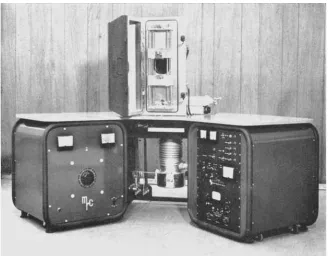
floating zone operations. An electron beam
system is shown in Fig. 3.
The Role
of
the
Vacuum
System
In addition to purification by zone melting
per se, in vacuum melting purification also
occurs by :
( a ) degassing, i.e., the removal of oxygen,
nitrogen and hydrogen, as well as
CO
or CO, formed by side reactions of
oxygen with carbon;
(b) vacuum distillation of high vapour
pressure elements.
The removal of gaseous elements takes place initially by virtue of the change in solubility in the liquid with the partial
pressure of the same elements in the sur-
rounding media. This was experimentally
verified for partial pressures of a few hundred
millimetres of mercury by the early experi-
ments of Seiverts (4) leading to the well-
known relationship
S C
dir-
where S=the solubility of gas in the liquid
phase, and
P=the partial pressure of the same
gas in the surrounding media.
Fig. 3 A n electron beam float-zone refiner. The platinum rod is given three vertical zone-refining passes at a zoning speed of three inches per hour
presence or absence of any stirring action that solute. To a first approximation, the degree
might enhance the gas atom transport in the of purification is dependent on the ratio of
liquid phase, and on the composition of the the vapour pressure of solute to that of the
starting material. solvent. In addition to this ratio, it is essen-
Vacuum distillation is a purification process tial that the vapour pressure of the solute be
based on the preferential evaporation of high relative to its partial pressure in the
Mass Spectrographic Analysk of Three-pass Zone-refined Platinum
Content Element (weight) ( w m ) Li <0.0002
Be i o . 0 2
€3 0.0003
C 10.0
H* 1.5
0, 10.0
N? 3.0
F <0.003
Na <0.06
M g 10.06
Al 7.0
Si 7.0
P 0.002
S 0.2
Cl 0.4
K 0.1
Ca 0.05
s c <0.03
T i 2.5
Content Element (weight)
V 0.25
Cr 2.5
Mn 0.6
Fe 3.0
c o 0.3
Ni 2.5
c u 0.05 Zn 0.05
Ga 0.01
Ge t o . 0 0 4
AS 0.01
Se <o.003
Br 0.008
Rb i o . 0 1
Sr <0.003 Y < O . O I
21 2.5
Nb 1 . 0 Ma t o . 3
(ppm)
Content Element (weight)
(ppm)
Ru 0 . 3
Rh 15.0
Pd 0.6
Ag 0.012
Cd <0.025
I n 0.03
Sb i o . 0 0 4
Sn 0.08
T e i o . 0 0 8
I <0.002
CS 10.002
Ba <0.003 La 10.002
Ce to.002
Pr 10.002
Nd <O.OI
Sm eo.01
Eu <0.005
Gd < O . O I
T b < o m 3
Content Element (weight)
DY <O.Ol
Ho i o . 0 0 3
Er i o . 0 0 8
T m <0.003
Yb i 0 . 0 6
Lu i 0 . 0 0 3
Hf 0.05
T a i 5 . 0
W 5.0
Re <0.02
CIS i O . 0 8
Ir 0 . 3
Au i 0 . 3
( p p d
i o . 1 5
Hg T1 < O . I S
Pb ( 0 . 6
Bi ~ 0 . 0 6
T h <a.o7
immediate vicinity of the molten surface. As the solute content at the liquid/vapour inter- face becomes diminished, a concentration gradient is set up within the liquid. At this time, and this may occur very early in the melting operation, material transport in the liquid phase becomes the rate-controlling process. Thus, providing the vapour pres- sures are favourable and that the pumping speed of the vacuum system is sufficient to maintain a low partial pressure of the solute element, purification should proceed at a rate dependent on the solute diffusivity in the liquid state.
Resulting Purity
An electron beam floating-zone refiner is
shown in Fig. 3. Platinum purified in this
unit at Materials Research Corporation is
zone melted in a nominal 10-6 torr vacuum
system. T h e metal rod of
+
to +inch diameteris given three zone passes at a zoning speed
of 3 inches per hour. It has been found that
most of the purification by the degassing and vacuum distillation mechanism occurs during the first zone pass. For appreciable purifica-
tion by zone melting per se, a minimum of
three zone passes should be utilised. Although zoning beyond three passes is beneficial, it has
been found that three passes is a good com-
promise between purity and cost of process- ing.
A detailed analysis of a three-pass zone-
refined platinum bar is given in the table. The residual concentration of the interstitial
gases -hydrogen, oxygen and nitrogen
-
isvery low. The content of the other metals of
the platinum group and of gold and silver
has been reduced to very small proportions
in general. Platinum of the purity indicated
in the table is now very satisfactory for use in
microelectronic applications and the zone refining technique described in this article gives good results.
References
I W. G. Pfann, “Zone Melting”, Metall. Rev.,
z W. G. Pfann, “Zone Melting”, John Wiley &
3 H. C. Theuerer, Tram. Metall. SOC. A I M E ,
4 A. Seiverts, 2. phys. Chem., 1911, 77, 591
1957>2,29
Sons, New York, 1958
1956, 206, 1316
Rhodium-Platinum
Thermocouples for
Incinerator Control
The disposal of the ever-increasing volumes of household and trade refuse is presenting local authorities with a considerable problem. Incineration under controlled conditions is a practical solution being adopted by a number
of authorities (I). At Middleton, Lancashire,
Motherwell Bridge Taco1 Ltd has installed for the local Corporation the first incinerator
of an advanced design which can handle
60 tons of refuse per day at the rate of 8
tons per hour.
Incoming refuse is fed from a hopper to the incinerator grate, which consists of six rollers arranged in descending order at an
angle of 30”. Each roller is made up into a
unit 8 feet wide and 5 feet in diameter from
interlocking grate bar segments between
which gaps allow fan-forced combustion air
to pass. The rollers slowly rotate and refuse
is dried and ignited as it falls from one roller to the next until it finally leaves the grate as fine ash and clinker. Incinerator temperature
is monitored and maintained at 900°C by a
Petite QIZ indicator/controller fed with
signals from a duplex platinum : 10 per
cent rhodium-platinum thermocouple in the roof of the combustion chamber.
After leaving the last roller the ash and clinker is quenched in a submerged belt
conveyor and is passed on for disposal. The
hot flue gases pass via a dust extractor to a
150 foot chimney. A second duplex plati-
num : 10 per cent rhodium-platinum
thermocouple monitors the flue gas tem- perature at the entrance to the dust extractor and passes a signal to control the introduc-
tion of cooling air to the gas stream.