Conformal (In)Equality
Young-HwanHyun1,?,YoonbaiKim1,??, andSeokcheonLee2,???
1Department of Physics and Institute of Basic Science, Sungkyunkwan University, Suwon 16419, Republic of Korea
2The Research Institute of Natural Science, Gyeongsang National University, Jinju 52828, Republic of Korea
Abstract.The current accelerating expansion of the Universe is explained either by dark energy or by modified gravity theories. Both of them can explain exactly the same back-ground evolution of the Universe, however this degeneracy may be broken when the observation of large scale structure formation is taken into account. Two observables are parameterized by the so-called dark energy equation of state,!and the growth index pa-rameter,γ. From these observed parameters, one may reconstruct the model parameters of the so-called scalar-tensor gravity theory, one of the modified gravity theories. Espe-cially, the scalar-tensor gravity theory is described both in Jordan frame and in Einstein frame. If cosmological observations are interpreted in one frame, then all of the observ-ables should also be interpreted in that frame. This explicitly shows conformal inequality of cosmological observables.
1 Introduction
Cosmological observations support the current Universe in the phase of accelerating expansion. In the theory side, two descriptions compete. One is to adopt general relativity as the correct gravity theory and introduce the dark energy (DE) in addition to the known matter components. The other is to invoke modified gravity theories (MG) and tries to replace the DE with the modifications of the Friedmann equations as an ejective dark energy.
In this manuscript, we shall deal with one of the simplest but long-standing MG, the so-called scalar-tensor gravity (STG) which is natural in the viewpoint of string theory. When the evolution of the Universe is depicted in the context of STG, two model functions are introduced. Comparison to the observable quantities determines these two theoretically introduced functions which specifically are reconstructed in terms of the DE equation of state (EOS),![1, 2] and the growth index parameter (GIP),γ[3].
Once STG is considered, the question on the frame-dependence should be addressed. Since no conformal symmetry is possessed in STG coupled to matter fields even at the classical level, ev-ery conformal transformation from a chosen frame defines a new frame, which results in the set of infinitely-many physically-distinctive frames. Theoretically favored frames are two extremes, i.e., the Einstein frame (EF) and the Jordan frame (JF). The question on the frame that “where we live (now)”
?e-mail: [email protected] ??e-mail: [email protected]
has been a long-standing debate, it seems beyond our scope at the present stage. Instead, we explicitly show that some cosmological observables are frame-dependent and if one obtains model parameters in one frame, then one should interpret all the other observables in that frame.
For this purpose, we express two functions of STG in both the JF and the EF in terms of frame-independent observable parameters, the redshiftzin the next section. We show the physical (in)equalities of cosmological observables in two frames such as the Hubble parameter,Hand the e↵ective DE EOS,!. Thus, we show explicitly that one should keep using the only one frame for
probing cosmological observables.
2 Reconstruction of Model Functions
We begin this section with the action of the STG in the JF [4]
S = 1
16⇡G⇤ Z
d4xp−g"F(φ)R− rµφr
µφ−2U(φ)
#
+Sm(gµ⌫, m), (1)
whereG⇤is the bare gravitational coupling constant di↵erent from the Newton’s constant,gµ⌫ is the
JF metric,F(φ) is dimensionless function of scalar fieldφ,U(φ) is its potential, andSm(gµ⌫) is the
matter action for m representing any matter field. F(φ) is required to be positive definite to ensure
attractive nature of gravity. However its specific functional form and that ofU(φ) are not determined
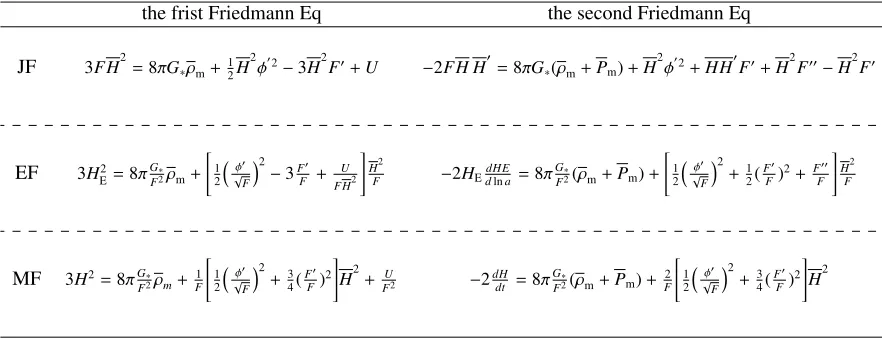
yet but should be restricted by observations. In this manuscript, all the physical variables in the JF are denoted by bars on top of them. We summarize the Friedmann equations in both frames in table 1. In this tableH ⌘dlna/dtmeans the Hubble parameter in the JF,⇢mandPmdefine the matter energy
density and the pressure, respectively. They are conserved quantities by the Bianchi identity. We also introduce the so-called mis-interpreted frame where the Hubble parameter is defined byH=dlna/dt
which is not the observable quantity. Some of literatures use this quantity to interpret the Hubble parameter in the EF and this is mis-interpreted [5].
the frist Friedmann Eq the second Friedmann Eq
JF 3FH2=8⇡G⇤⇢m+12H2φ02−3H2F0+U −2FH H0=8⇡G
⇤(⇢m+Pm)+H2φ02+HH0F0+H2F00−H2F0
EF 3H2
E=8⇡GF⇤2⇢m+ "
1 2
⇣φ0
p
F
⌘2 −3F0
F +FHU2
#
H2
F −2HEddHElna =8⇡GF⇤2(⇢m+Pm)+ "
1 2
⇣φ0
p
F
⌘2
+12(FF0)2+FF00
#
H2 F
MF 3H2=8⇡G⇤
F2⇢m+F1
" 1 2
⇣φ0
p
F
⌘2
+34(FF0)2
#
H2+FU2 −2dHdt =8⇡FG⇤2(⇢m+Pm)+F2 "
1 2
⇣φ0
p
F
⌘2
+34(FF0)2
# H2
Table 1.Friedmann equations in JF, EF, and mis-interpreted frame (MF). Primes mean the di↵erentiation with
has been a long-standing debate, it seems beyond our scope at the present stage. Instead, we explicitly show that some cosmological observables are frame-dependent and if one obtains model parameters in one frame, then one should interpret all the other observables in that frame.
For this purpose, we express two functions of STG in both the JF and the EF in terms of frame-independent observable parameters, the redshiftzin the next section. We show the physical (in)equalities of cosmological observables in two frames such as the Hubble parameter,H and the e↵ective DE EOS,!. Thus, we show explicitly that one should keep using the only one frame for
probing cosmological observables.
2 Reconstruction of Model Functions
We begin this section with the action of the STG in the JF [4]
S = 1
16⇡G⇤ Z
d4xp−g"F(φ)R− rµφr
µφ−2U(φ)
#
+Sm(gµ⌫, m), (1)
whereG⇤is the bare gravitational coupling constant di↵erent from the Newton’s constant,gµ⌫ is the
JF metric,F(φ) is dimensionless function of scalar fieldφ,U(φ) is its potential, andSm(gµ⌫) is the
matter action for m representing any matter field. F(φ) is required to be positive definite to ensure
attractive nature of gravity. However its specific functional form and that ofU(φ) are not determined
yet but should be restricted by observations. In this manuscript, all the physical variables in the JF are denoted by bars on top of them. We summarize the Friedmann equations in both frames in table 1. In this tableH ⌘dlna/dtmeans the Hubble parameter in the JF,⇢mandPmdefine the matter energy
density and the pressure, respectively. They are conserved quantities by the Bianchi identity. We also introduce the so-called mis-interpreted frame where the Hubble parameter is defined byH=dlna/dt
which is not the observable quantity. Some of literatures use this quantity to interpret the Hubble parameter in the EF and this is mis-interpreted [5].
the frist Friedmann Eq the second Friedmann Eq
JF 3FH2=8⇡G⇤⇢m+12H2φ02−3H2F0+U −2FH H0=8⇡G
⇤(⇢m+Pm)+H2φ02+HH0F0+H2F00−H2F0
EF 3H2
E=8⇡GF⇤2⇢m+ "
1 2
⇣φ0
p
F
⌘2 −3F0
F +FHU2
#
H2
F −2HEddHElna =8⇡FG⇤2(⇢m+Pm)+ "
1 2
⇣φ0
p
F
⌘2
+12(FF0)2+FF00
#
H2 F
MF 3H2=8⇡G⇤
F2⇢m+1F
" 1 2
⇣φ0
p
F
⌘2
+34(FF0)2
#
H2+FU2 −2dHdt =8⇡FG⇤2(⇢m+Pm)+F2 "
1 2
⇣φ0
p
F
⌘2
+34(FF0)2
# H2
Table 1.Friedmann equations in JF, EF, and mis-interpreted frame (MF). Primes mean the di↵erentiation with
respect to lna.
The evolution equations for the background and the matter perturbation in the flat Friedmann-Lemaitre-Robertson-Walker (FLRW) metric are given by [6]
⌦m(z) = ⌦m0
⌦m0+(1−⌦m0)(1+z)3(!0+!a)e−3!az/(1+z) (2) H2(z)
H20
= ⌦m0(1+z)3+(1−⌦m0)(1+z)3(1+!0+!a)e−3!az/(1+z), (3)
H0(z)
H(z) = −(1+z)
H,z
H =−
3 2
"
1+!(z) (1−⌦m0)(1+z)
3(!0+!a)e−3!az/(1+z)
⌦m0+(1−⌦m0)(1+z)3(!0+!a)e−3!az/(1+z)
#
, (4)
!(z) = −1+2(1+z)(1
+z)φ
2
,z
F0 +(1+z)
F,z z
F0 +
⇣
2+(1+z)H,z
H
⌘F,z
F0 −2(
F
F0−1)
H,z
H
(1+z)2φ
2
,z
F0+6(1+z)
F,z
F0 −6(
F
F0 −1)+
2U F0H20
H20 H2
(5)
φ,z p
F0 = −
s
−FF0,z z−(11+z)⇣2+(1+z)H,z
H ⌘F,z
F0 +
2 (1+z)
H,z
H F
F0 −3
⌦m(z)
(1+z)2 (6)
F,z
F0 =
3 (1+z)−2
H,z
H −
P,z
P !F
F0, (7)
F,z z
F0 =
h 3
(1+z) −2
H,z
H −
P,z
P i2
−(1+3z)2 −2hH,z
H i
,z−
hP,z
P i
,z
! F
F0 , (8)
where ¯H0 ⌘H¯(¯z=0), subscriptzmeans the di↵erentiation with respect to redshift which related to F,z=−F0/(1+z) and DE EOS is parametrized as the so-called CPL parametrization
!(z)=!0+!a z
1+z. (9)
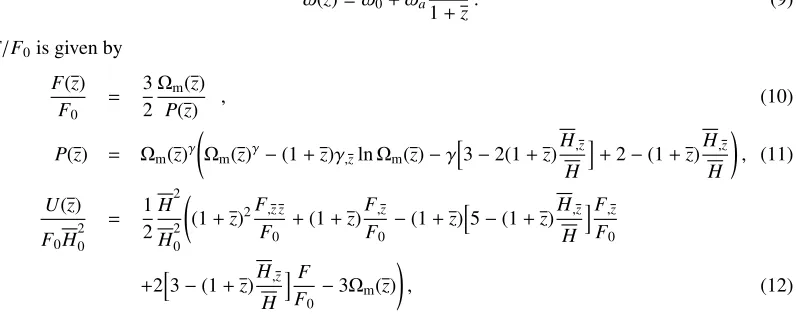
F/F0is given by F(z)
F0 =
3 2
⌦m(z)
P(z) , (10)
P(z) = ⌦m(z)γ ⌦m(z)γ−(1+z)γ,zln⌦m(z)−γ
h
3−2(1+z)H,z
H i
+2−(1+z)H,z
H !
, (11)
U(z)
F0H20
= 1
2
H2
H20 (1+z)
2F,z z
F0 +(1+z)
F,z
F0 −(1+z)
h
5−(1+z)H,z
H iF,z
F0
+2h3−(1+z)H,z
H i F
F0 −3⌦m(z)
!
, (12)
where GIF is given byγ=γ0+γa(1+zz) and we express all observables in terms of frame-independent
variable, redshiftz=z.
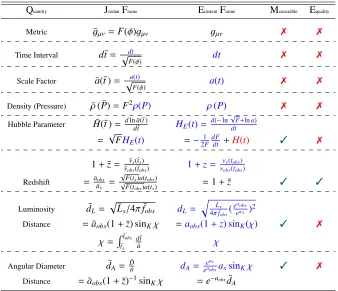
We summarize the frame-(in)dependent quantities in table 2. As shown, the redshift,zis a frame-independent measurable quantity. Thus, if one express frame-dependent observables, the Hubble parameter, (luminosity distance, angular diameter distance) in terms ofz, then one can compare mea-sured quantities between two frames.
Table 2.Frame-(in)dependence of (im)measurable quantities. In measurable column,7-marks mean unmeasurable and3-marks denote measurable. In equality columns,7-mark imply inequality and3-marks
mean equality.
Quantity JordanFrame EinsteinFrame Measurable Equality
Metric g¯µ⌫=F(φ)gµ⌫ gµ⌫ 7 7
Time Interval dt¯= pdt
F(φ) dt 7 7
Scale Factor a¯(¯t)= pa(t)
F(φ) a(t) 7 7
Density (Pressure) ⇢¯( ¯P)=F2⇢(P) ⇢(P) 7 7
Hubble Parameter H¯(¯t)= dln ¯dat¯(¯t) HE(t)=d(−ln
p
F+lna)
dt
= pFHE(t) =−21FdFdt +H(t) 3 7
1+¯z= ¯⌫s(¯ts) ¯
⌫obs(¯tobs) 1+z=
⌫s(tobs)
⌫obs(tobs)
Redshift = a¯obs ¯
as =
pF(t s)a(tobs) p
F(tobs)a(ts) =1+z¯ 3 3
Luminosity d¯L=
p¯
Ls/4⇡f¯obs dL=
q
Ls 4⇡fobs(
e↵obs e↵s )2
Distance =a¯obs(1+z¯) sinKχ =aobs(1+z) sinK(χ) 3 7
χ=Rt¯t¯obs
s
dt¯ ¯
a χ
Angular Diameter d¯A= D✓¯ dA=eeaobsas assinKχ 3 7 Distance =a¯obs(1+¯z)−1sinKχ =e−aobsd¯A
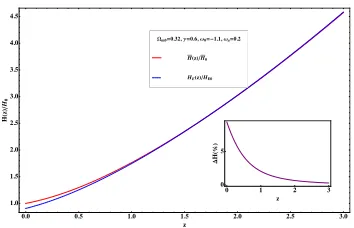
and the large scale structure formation provide! =−1.1+0.2 z
1+z andγ =0.6 [7]. The solid line describes theH/H0 in the JF and the dashed line depicts the HE/HE0 in the EF. The di↵erence of
Hubble parameters between two frames is as large as 9 % at present. We also show the evolutions of DE EOSs in both frames at Fig. 2. The solid line and the dashed line describe that of the JF and of the EF, respectively. The JF EOS is exactly same as the measured one,! =! =−1.1+0.21z+z as
Table 2.Frame-(in)dependence of (im)measurable quantities. In measurable column,7-marks mean unmeasurable and3-marks denote measurable. In equality columns,7-mark imply inequality and3-marks
mean equality.
Quantity JordanFrame EinsteinFrame Measurable Equality
Metric g¯µ⌫ =F(φ)gµ⌫ gµ⌫ 7 7
Time Interval dt¯= pdt
F(φ) dt 7 7
Scale Factor a¯(¯t)= pa(t)
F(φ) a(t) 7 7
Density (Pressure) ⇢¯( ¯P)=F2⇢(P) ⇢(P) 7 7
Hubble Parameter H¯(¯t)= dln ¯dat¯(¯t) HE(t)= d(−ln
p
F+lna)
dt
= pFHE(t) =−21FdFdt +H(t) 3 7
1+z¯= ⌫¯s(¯ts) ¯
⌫obs(¯tobs) 1+z=
⌫s(tobs)
⌫obs(tobs)
Redshift = a¯obs ¯
as =
pF(t s)a(tobs) p
F(tobs)a(ts) =1+z¯ 3 3
Luminosity d¯L=
p¯
Ls/4⇡f¯obs dL=
q
Ls 4⇡fobs(
e↵obs e↵s )2
Distance =a¯obs(1+z¯) sinKχ =aobs(1+z) sinK(χ) 3 7
χ=R¯t¯tobs
s
d¯t
¯
a χ
Angular Diameter d¯A =D✓¯ dA=eeaobsas assinKχ 3 7 Distance =a¯obs(1+z¯)−1sinKχ =e−aobsd¯A
and the large scale structure formation provide! = −1.1+0.2 z
1+z andγ = 0.6 [7]. The solid line describes theH/H0 in the JF and the dashed line depicts the HE/HE0 in the EF. The di↵erence of
Hubble parameters between two frames is as large as 9 % at present. We also show the evolutions of DE EOSs in both frames at Fig. 2. The solid line and the dashed line describe that of the JF and of the EF, respectively. The JF EOS is exactly same as the measured one,! = ! =−1.1+0.21+zz as
expected. However, the EF EOS di↵ers from that of the JF 0%(z=1.4)δ!30%(z=0).
0.0 0.5 1.0 1.5 2.0 2.5 3.0 1.0
1.5 2.0 2.5 3.0 3.5 4.0 4.5
z
H
H
z
Lê
H0
0 1 2 3 0
5
z
D
H
H
%
L
HEHzLêHE0
HHzLêH0
Wm0=0.32,g=0.6,w0=-1.1,wa=0.2
Figure 1.Evolutions of Hubble parameter both in the JF and in the EF. The solid line and the dashed line depictH2/H20andH2
E/HE02 , respectively.
0.0 0.5 1.0 1.5 2.0 2.5 3.0
-1.10
-1.05
-1.00
-0.95
-0.90
-0.85
-0.80
z
w
H
z
L
wEHzL
wHzL
Wm0=0.32,g=0.6,w0=-1.1,wa=0.2
Figure 2. Evolutions of DE EOS both in the JF and in the EF. The solid line and the dashed line depict!and!E, respectively.
3 Conclusions
In this manuscript, we explicitly show how to reconstruct the model functions in scalar-tensor gravity theory from the observed parameters,!andγ. Thus, if observational measurements on both
parame-ters are very accurate, then the dynamics of model functions is determined. From this reconstruction, one can compare the Jordan frame cosmological observables like Hubble parameter and luminosity function with those in the Einstein frame. We explicitly show that the cosmological observables are frame-dependent under conformal transformation. Thus, one should choose a frame first before anal-ysis of any observable and should keep using the same frame in the interpretation of other observable quantities. This demonstrates the explicit conformal inequality for cosmological observables.
Acknowledgments
SL and YK are supported by Basic Science Research Program through the National Research Foun-dation of Korea (NRF) funded by the Ministry of Science, ICT and Future Planning (Grant No. NRF-2017R1A2B4011168 and NRF-2016R1D1A1B03931090, respectively).
References
[1] M. Chevallier and D. Polarski, Int. J. Mod. Phys. D10, 213 (2001) [arXiv:gr-qc/0009008].
[2] E. V. Linder, Phys. Rev. Lett.90, 091301 (2003) [arXiv:astro-ph/0208512].
[3] S. Lee and K.-W. Ng, Phys. Rev. D82, 043004 (2010) [arXiv:0907.2108].
[4] G. Esposito-Far`ese and D. Polarski, Phys. Rev. D63, 063504 (2001) [arXiv:gr-qc/0009034].
[5] T. Chiba and M. Yamaguchi, J. Cosmol. Astropart. Phys.1310, 040 (2013) [arXiv:1308.1142]. [6] S. Lee, J. Cosmol. Astropart. Phys.1103, 021 (2011) [arXiv:1012.2646].