*Corresponding author, E-mail: [email protected]
EFFECT OF CIPC TREATMENT ON KEEPING AND PROCESSING ATTRIBUTES
DURING SHORT TERM STORAGE
ASHIV MEHTA1, BRAJESH SINGH2 AND R. EZEKIEL2
1Central Potato Research Station, Post Bag No. 1, Model Town P.O., Jalandhar 144 003, Punjab. 2Central Potato Research Institute, Shimla 171 001, Himachal Pradesh
Received on 31st Aug., 2010, Revised and Accepted on 02nd March, 2011 SUMMARY
Indigenous non-refrigerated storage methods are used in India for short-term storage of potatoes (Solanum tuberosum L.) to avoid distress sale. Use of isopropyl N-(3-chlorophenyl) carbamate (CIPC) was evaluated in potato heaps on nine potato cultivars. Single spray application of a commercial formulation of CIPC 50% a.i. (Oorja, UPL, Mumbai) @ 20 mg a.i. kg-1 tubers significantly reduced sprouting (by 95.6%), sprouting index (by 80.2%), sprout weight (by 98.8%) and total losses in potatoes (by 29.8%) up to 90 days of storage. Stored potatoes fetched market rates comparable to cold stored potatoes which were 54.3% higher than the rates at harvest. Contents of reducing sugars in treated potatoes decreased and chip colour improved after storage. Cultivars, Kufri Chipsona-1, Kufri Jyoti, Kufri Lauvkar, Kufri Surya and Kufri Chandramukhi were suitable for table and processing purposes whereas Kufri Pushkar, Kufri Bahar, Kufri Pukhraj and Kufri Badshah were found suitable only for table purpose. Stored potatoes were safe for human consumption as the CIPC residue levels in peels (0.81-3.85 mg kg-1 fresh tuber weight) were far below the permissible limit.
Key words: CIPC, heap, potato, processing quality, sprout inhibition, storage losses
INTRODUCTION
In the major potato (Solanum tuberosum L.) growing areas of India, the crop is harvested at the beginning of the summer in February-March. Seasonal production patterns, limited alternative market outlets (e.g., processing) and inadequate cold storage capacity often result in market gluts and heavy price reduction during the main harvesting months. Prices start increasing from April-May and are almost double in July-August (Pandey et al. 2007). Farmers use indigenous storage practices like heaps, pits and trenches to hold some of their produce for short terms to get higher prices, but the tubers must be desprouted before marketing (Dahiya et al. 1997).
processing potatoes (Mehta et al. 2007). For successful adoption of a technology, its suitability over a wide range of varieties is essential. This investigation was therefore, designed to evaluate nine commercial potato varieties varying widely in storability and processing quality for their suitability after storage for processing into chips. The CIPC residues during storage were also analyzed in different potato parts as a matter of health concern.
MATERIALS AND METHODS
The experiments were conducted at Central Potato Research Station, Jalandhar during March to June, 2007 and 2008. Nine varieties varying widely in dormancy period and processing quality, were selected for this study (Table 1). Kufri Lauvkar has the shortest dormancy period of five weeks after harvest followed by Kufri Bahar, Kufri Pukhraj and Kufri Badshah (6-7 weeks), Kufri Chandramukhi, Kufri Chipsona-1 and Kufri Jyoti (8 weeks) and Kufri Pushkar and Kufri Surya (9-10 weeks) (Mehta and Kaul 1997, Mehta et al. 2006). Kufri Chipsona-1 with low tuber reducing sugar content was developed exclusively for processing whereas, the varieties viz. Kufri Jyoti, Kufri Lauvkar and Kufri Surya are still being extensively used in the organized and unorganized sector of potato processing industry in India. The other five varieties are popular table varieties grown in different agro-climatic regions of India. Among the varieties, first six (Table 1)are good keepers while last three are average keepers.
Seed tubers weighing 45-60 g were planted in the field on 8 and 9 October, 2006 and 2007, respectively. Fertilizers were applied at the recommended dose of 150 kg N, 80 kg P2O5 and 100 kg K2O/ha. Half the nitrogen was applied at planting and the remaining half at earthing up stage. All the other recommended cultural practices were followed for raising the crop. Crop was dehaulmed at maturity and harvested after 25-30 days of skin curing. The harvested tubers were kept in covered heaps for 15-20 days for wound healing and curing. Undamaged and apparently healthy large sized potatoes (>70 g) were selected.
For treatment, potatoes (8 quintals of each variety) were spread in thin layers on the ground under a thatched roof made of straw (Sarkanda) and bamboos supported
on a wooden beam at a height of 10ft. Perforated plastic pipes of 4-6 inches diameter were placed in the centre at the base to facilitate the removal of accumulated carbon dioxide. CIPC (trade name Oorja, United Phosphorus Limited, Mumbai, 50 % a.i.) was uniformly sprayed in commercial grade methanol @ 40 ml tonne-1 to get concentration of 20 mg kg-1 a.i. on tubers during first week of March, 2007 and 2008. Spraying process was repeated with each layer of tubers and after the treatment, the potatoes were collected in the shape of a conical heap and then covered with 1.5 to 2 feet thick layer of rice straw (pural). Heaps of untreated control potatoes raised with all recommended pre- and post harvest measures were laid nearby under the same shed. 10 kg of potatoes with three replications in each treatment packed in nylon bags were also placed in all heaps. Methanol spray alone did not show any effect on sprouting behaviour and biochemical constituents of tubers in a preliminary study (Mehta 2005), therefore data on control potatoes with methanol spray has not been included in this study.
The maximum and minimum temperatures and relative humidity were recorded daily during the storage period in heaps. Final observations on number of sprouted tubers, sprout weight (g kg-1 tuber weight), loss in weight due to tuber rotting and total weight loss (physiological + pathological + sprout loss) were recorded in potatoes stored in bulk as well as in the nylon bags after 90 days of storage (DOS). Percent sprouting was calculated on number basis and each tuber having at least one sprout measuring 0.2 cm or more in length was recorded as sprouted. Tubers with slight evidence of decay were weighed to represent loss due to tuber rotting. Sprouting Index (SI) was recorded on 50 tubers per treatment after storage (Mehta 2005). Both at 0 and 90 days of storage, tubers were assessed for reducing sugars, sucrose, total phenols and free amino acids as per the standard methods (Mehta and Singh 2004).
All the estimations were done in three replicates and the data was statistically analyzed using completely randomized design through MSTAT C software (Gomez and Gomez 1984). CIPC residues were analyzed (Ezekiel
et al. 2003c) in potato peel and cortex separately with the help of HPLC equipment (LaChrom, Dermstadt, Germany).
RESULTS AND DISCUSSION
Storage environment: Storage in heap reduced the diurnal variation in temperatures while maintaining a high relative humidity (RH). Mean minimum-maximum temperatures during March to June ranged between
18-30oC inside the heap compared to 14-43oC in the ambient (Fig. 1). RH inside the heap remained continuously high (60-92%) compared to lower levels of 38 to 78%in the ambient (Fig. 2).
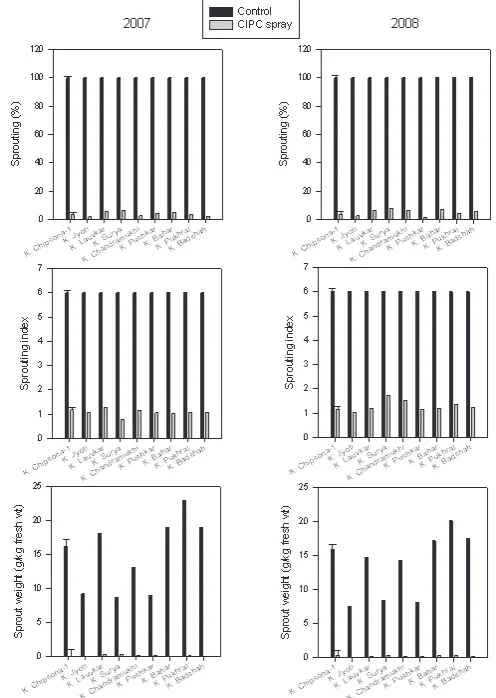
Sprouting, sprouting index and sprout weight: Untreated (control) tubers of all the cultivars had 100% sprouting in both the years. While with CIPC treatment, sprouting was reduced to 3.90% after 90 DOS in 2007 and 4.97% in 2008 (Fig. 3). Sprouting index in treated tubers was also reduced to 1.08 and 1.29 in 2007 and 2008, respectively as compared to control tubers (6.0). Mean sprout growth remained remarkably suppressed (by 96.4-99.5%) in different cultivars in CIPC treatment compared to control (Fig. 3). This is consistent with
Fig. 1. Ambient and heap temperature (minimum and maximum) during the storage period
Fig. 2. Ambient and heap relative humidity (minimum and maximum) during the storage period
Fig. 3. Sprouting parameters as affected by CIPC treatment under heap storage (error bars represent SEm value of variety x treatment interaction at 36 degrees of freedom
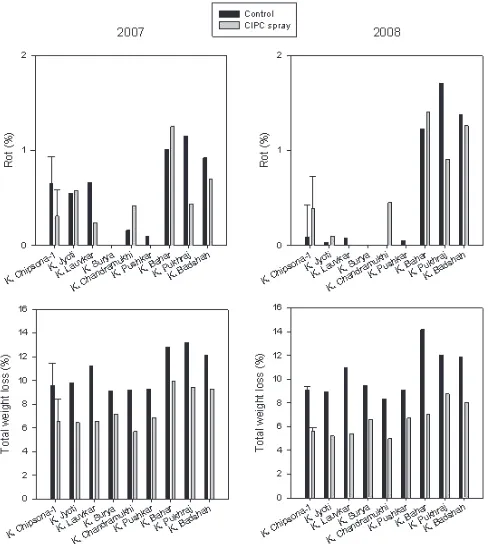
under ambient temperature storages without sprout suppression (Mehta and Kaul 1997). Single spray application of CIPC was effective in all the cultivars in both the years and significantly reduced total weight loss (by 33.5%) with maximum reduction recorded in cv Kufri Lauvkar (46.2%). Though evaporative and respiratory losses were not separately quantified in this study, higher total losses in the control tubers were likely attributable to higher evaporative losses because of 100 times more permeability of sprouts as compared to tuber skin (Booth and Shaw 1981). A significant positive correlation (r=0.693*) between weight loss and sprout weight in tubers under ambient temperature storage is also reported (Mehta and Kaul 1997)
Total losses in CIPC treatment recorded at 90 DOS remained less than 10% in all the cultivars including Kufri Bahar, Kufri Pukhraj and Kufri Badshah, which are considered average keepers (Mehta et al. 2007) and the potatoes maintained tissue turgor. When weight loss approaches 10%, tubers become increasingly flaccid and unacceptable for marketing as it results in higher peeling losses (Booth and Shaw 1981). The CIPC treated potatoes of all the cultivars appeared firm whereas the control (untreated) potatoes with multiple sprouts had a shriveled appearance. There was no need to desprout the tubers before marketing and treated potatoes after storage fetched 54.3 % higher market price than the price at harvest (the price at harvest in 1st week of March was Rs. 350 quintal-1 and after storage it was Rs. 540 quintal-1 in June in Jalandhar (Punjab) vegetable market). The price of heap stored potatoes was comparable to the price of potatoes stored in refrigerated cold stores maintained at 2-4oC (Rs. 538 quintal-1). Normal cold storage rent varies from Rs. 100-120 quintal-1 of potatoes whereas, on-farm storage in heaps is much less expensive (Rs. 20-25 quintal-1).
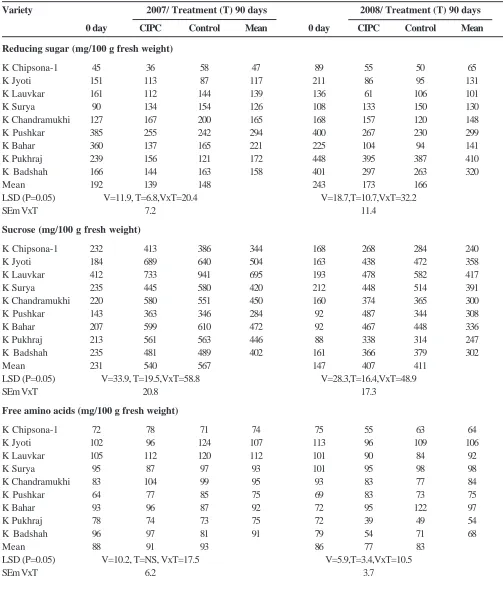
Processing quality of stored potatoes: Mean content of reducing sugars was higher at 0 day of storage in 2008 (243mg 100 g-1 fresh weight) compared to 2007 (192mg 100 g-1 fresh weight) (Table 1). This may be due to increased invertase activity under low temperature conditions during the crop growth, particularly in the months of December and January (Marwaha 1998). Reducing sugars decreased during storage and were earlier findings using CIPC dust (1 % a.i.) (Mehta and
Kaul 1991), CIPC fog (Mehta et al. 2008) and CIPC spray (Mehta et al. 2010) under non-refrigerated storage conditions. CIPC treatment was effective in all the cultivars including Kufri Lauvkar which has the shortest dormancy period and shows profuse sprout growth under high temperature storage (Mehta and Kaul 1997).
Loss due to rotting: The proportion of rotted tubers after storage in untreated heaps was 0.55 % (mean of nine cvs), mainly attributable to soft rot (Erwinia carotovora) and charcoal rot (Macrophomina phaseolina). CIPC treatment had no effect on rotting in tubers during both the years (Fig. 4).
Fig. 4. Rot incidence and weight loss as affected by CIPC treatment under heap storage (error bars represent SEm value of variety x treatment interaction at 36 degrees of freedom in particular set of data)
Table 1. Effect of CIPC spray on processing attributes of potatoes under heap storage
Variety 2007/ Treatment (T) 90 days 2008/ Treatment (T) 90 days
0 day CIPC Control Mean 0 day CIPC Control Mean
Reducing sugar (mg/100 g fresh weight)
K Chipsona-1 45 36 58 47 89 55 50 65
K Jyoti 151 113 87 117 211 86 95 131
K Lauvkar 161 112 144 139 136 61 106 101
K Surya 90 134 154 126 108 133 150 130
K Chandramukhi 127 167 200 165 168 157 120 148
K Pushkar 385 255 242 294 400 267 230 299
K Bahar 360 137 165 221 225 104 94 141
K Pukhraj 239 156 121 172 448 395 387 410
K Badshah 166 144 163 158 401 297 263 320
Mean 192 139 148 243 173 166
LSD (P=0.05) V=11.9, T=6.8,VxT=20.4 V=18.7,T=10.7,VxT=32.2
SEm VxT 7.2 11.4
Sucrose (mg/100 g fresh weight)
K Chipsona-1 232 413 386 344 168 268 284 240
K Jyoti 184 689 640 504 163 438 472 358
K Lauvkar 412 733 941 695 193 478 582 417
K Surya 235 445 580 420 212 448 514 391
K Chandramukhi 220 580 551 450 160 374 365 300
K Pushkar 143 363 346 284 92 487 344 308
K Bahar 207 599 610 472 92 467 448 336
K Pukhraj 213 561 563 446 88 338 314 247
K Badshah 235 481 489 402 161 366 379 302
Mean 231 540 567 147 407 411
LSD (P=0.05) V=33.9, T=19.5,VxT=58.8 V=28.3,T=16.4,VxT=48.9
SEm VxT 20.8 17.3
Free amino acids (mg/100 g fresh weight)
K Chipsona-1 72 78 71 74 75 55 63 64
K Jyoti 102 96 124 107 113 96 109 106
K Lauvkar 105 112 120 112 101 90 84 92
K Surya 95 87 97 93 101 95 98 98
K Chandramukhi 83 104 99 95 93 83 77 84
K Pushkar 64 77 85 75 69 83 73 75
K Bahar 93 96 87 92 72 95 122 97
K Pukhraj 78 74 73 75 72 39 49 54
K Badshah 96 97 81 91 79 54 71 68
Mean 88 91 93 86 77 83
LSD (P=0.05) V=10.2, T=NS, VxT=17.5 V=5.9,T=3.4,VxT=10.5
Variety 2007/ Treatment (T) 90 days 2008/ Treatment (T) 90 days
0 day CIPC Control Mean 0 day CIPC Control Mean
Total phenol (mg/100 g fresh weight)
K Chipsona-1 35 54 50 46 39 46 58 48
K Jyoti 76 94 87 86 77 88 105 90
K Lauvkar 65 88 121 91 58 64 66 63
K Surya 71 90 95 85 67 89 91 82
K Chandramukhi 62 85 74 74 61 66 101 76
K Pushkar 58 76 85 73 46 64 69 60
K Bahar 56 111 101 89 30 76 80 62
K Pukhraj 40 36 46 40 38 78 80 66
K Badshah 46 53 43 47 56 46 66 56
Mean 56 76 78 52 69 80
LSD (P=0.05) V=5.9, T=3.4,VxT=10.2 V=7.4,T=4.2,VxT=12.4
SEm VxT 3.6 4.41
Chip colour score
K Chipsona-1 2.8 1.7 2.2 2.2 2.8 1.8 2.2 2.3
K Jyoti 6.2 3.2 3.3 4.2 5.8 3.2 2.5 3.8
K Lauvkar 4.7 2.8 2.8 3.4 4.8 2.3 2.3 3.2
K Surya 5.5 3.7 3.8 4.3 4.3 3.3 3.2 3.6
K Chandramukhi 6.8 3.2 4.2 4.9 6.8 3.3 5.7 5.3
K Pushkar 8.8 6.7 7.5 7.7 7.8 6.3 5.8 6.7
K Bahar 7.3 5.7 5.3 6.1 7.5 5.8 6.8 6.7
K Pukhraj 7.7 7.2 7.3 7.4 8.2 7.3 7.3 7.6
K Badshah 6.8 7.2 7.2 7.1 7.2 6.7 6.2 6.7
Mean 6.3 4.6 4.9 6.1 4.5 4.7
LSD (P=0.05) V=0.3, T=0.3,VxT=0.6 V=0.3, T=0.3,VxT=0.6
SEm VxT 0.2 0.2
always low after 90 DOS in both the treated and untreated tubers during the two years. This could be due to the reconditioning effect of high temperature under heap storage compared to refrigerated storages (Dogras
et al. 1991). A higher rate of starch resynthesis and respiration during storage is also known to be responsible for this kind of decrease (Hughes and Fuller 1984). Reducing sugar values were generally lower in Kufri Chipsona-1 as compared to other cultivars during both the years. The level of reducing sugars in potato tuber is an important factor affecting colour of processed products (Roe et al. 1990) due to Maillard reaction with free amino acids at higher frying temperatures (Habib and Brown 1957) and the contents of reducing sugars should be below 0.2% of tuber fresh weight for producing acceptable quality chips (Ezekiel et al. 2003b).
By the end of storage in 2007 all cultivars except Kufri Pushkar had acceptable reducing sugar concentrations in treated and untreated potatoes, whereas in 2008, the concentration was unacceptable in Kufri Pushkar, Kufri Pukhraj and Kufri Badshah.
potatoes up to 90 days under heap storage by inhibiting sprout growth, maintaining tissue turgor and reducing total storage losses. The treatment was effective in potato cultivars varying widely in dormancy periods. Farmers can store their produce on-farm for short-term and get remunerative prices by selling potatoes of Kufri Chipsona-1, Kufri Jyoti, Kufri Lauvkar, Kufri Surya and Kufri Chandramukhi to the processing industries and the rest of four cultivars namely Kufri Pushkar, Kufri Bahar, Kufri Pukhraj and Kufri Badshah as table potatoes.
As commercial facilities for potato storage under intermediate temperatures (10-12oC) are still uncommon in India, potatoes for table purposes are generally stored along with seed potatoes in refrigerated stores maintained at 2-4oC, which results in low temperature sweetening. Short term on-farm storage can maintain good flavour of table potatoes, improving the farmers’ sale price while incurring lower storage cost.
ACKNOWLEDGEMENTS
We are thankful to Head, CPRS, Jalandhar for providing facilities, Mr. YK Gupta for assistance and Mr. Raj Kumar for statistical analysis. Supply of ‘Oorja’ sample gratis, by Mr. VK Singh, Marketing Manager, UPL, Mumbai, India is thankfully acknowledged.
REFERENCES
Booth, R.H. and Shaw, R.L. (1981). Principles of Potato
Storage. International Potato Centre, Lima, Peru.
Dahiya, P.S., Khatana, V.S. and Ilangantileke, S.G. (1997). Producer Storage Practices for Potatoes in Malwa Region, Madhya Pradesh, India. Working Paper No. 1997-10, Social Science Department, International Potato Centre, Lima.
Dogras, C., Simos, A. and Promakelis, C. (1991). Sugar content and dry matter in potatoes stored under fluctuating
temperatures in non refrigerated stores in Greece. Potato
Res. 34: 389- 396.
EPA. (1996). Registration eligibility decision.
EPA-739-R-96-023, Environmental Protection Agency.
Ezekiel, R., Singh, B. and Kumar, D. (2003a). A reference chart
for potato chip colour for use in India. J. Indian Potato
Assoc. 30: 259-265.
did not show any consistent effect over cultivars and years on the sucrose concentration of stored potato tubers.
Mean free amino acid (FAA) content of tubers decreased in CIPC treated potatoes during storage in 2008 (Table 1). Increased proteolytic enzyme activity and de novo synthesis of a proteinase enzyme on dormancy release are thought to be controlling the FAA pool size (Suh et al. 1990). Though amino acids are important substrates in the Maillard reaction, their concentration could rarely be a limiting factor. In both the years total phenol contents in tubers increased during storage (Table 1) due to a probable decrease in polyphenol oxidase activity (Weaver et al. 1978). Phenolic compounds are involved in enzymatic discoloration of tubers on peeling and exposure to air due to oxidation by polyphenol oxidase enzyme (Sweeny and Simandale 1968).
Chip colour of treated potatoes improved during storage in heaps in both the years except in Kufri Badshah during 2007 (Table 1). Cultivars differed significantly in chip colour which was highly acceptable in treated tubers of Kufri Chipsona-1, Kufri Jyoti, Kufri Lauvkar, Kufri Surya and Kufri Chandramukhi after storage whereas rest of four cultivars could not produce acceptable chips and these were suitable only for table purpose. The lighter chip colour after storage in heaps vs. before storage in the two years, attributable to the corresponding decrease in reducing sugars is in agreement with earlier research (Mehta et al. 2008, Mehta et al. 2010)
The residues of CIPC in the peel (0.81-3.85 mg kg-1 fresh tuber weight) were approximately 10-20 times higher than the residues in the cortex of tubers (data not included). The levels were far below the permissible limits of 10 and 30 mg kg-1 of whole tubers, as recommended by the European Union and the US Environmental Protection Agency, respectively (EPA 1996, Kleinkopf et al. 2003) and the potatoes were safe for human consumption.
Ezekiel, R., Mehta, Ashiv, Kumar, D. and Das, M. (2003b). Potato Storage. In: S.M.P. Khurana, J.S. Minhas and S.K. Pandey (eds.), The Potato Production and
Utilization in Sub-Tropics, pp 323-335. Mehta
Publishers, New Delhi.
Ezekiel, R., Singh, B., Kumar, D. and Paul, V. (2003c). Processing quality and CIPC residues in potatoes stored
at 10-12oC in commercial cold stores applying CIPC.
Indian J. Plant Physiol. (Special issue): pp. 489-494.
Gomez, K.A. and Gomez, A.A. (1984). Statistical Procedures for Agricultural Research. John Wiley and Sons, New York (USA).
Habib, A.T. and Brown, H.D. (1957). Role of reducing sugars
and amino acids in the browning of chips. Food Tech.
11: 85-89.
Hughes, J.C. and Fuller, T.J. (1984). Fluctuations in sugars in
cv. Record during extended storage at 10oC. Potato Res.
27: 229-236.
Kleinkopf, G.E., Oberg, N.A. and Olsen, N.L. (2003). Sprout inhibition in storage: Current status, new chemistries
and natural compounds. Amer. Potato J. 80: 317-327.
Marwaha, R.S. (1998). Evaluation of Indian and exotic cultivars
for processing into French fries. J. Indian Potato
Assoc. 25: 61-65.
Mehta, Ashiv (2005). Commercial potential of CIPC for sprout
suppression in potatoes under heap storage. Potato J.
32: 203-204.
Mehta, Ashiv and Ezekiel, R. (2003). Evaluation of non-refrigerated storage methods for short term on-farm storage
of potatoes. J.Indian Potato Assoc. 30: 291-300.
Mehta, Ashiv and Kaul H.N. (1991). Effect of sprout inhibitors
on potato tubers (Solanum tuberosum L.) stored at
ambient and reduced temperatures. Potato Res. 34:
443-450.
Mehta, Ashiv and Kaul, H.N. (1997). Physiological weight loss in potatoes under non refrigerated storage:
Contribution of respiration and transpiration. J. Indian
Potato Assoc. 24: 106-113.
Mehta, Ashiv and Singh, S.P. (2004). Biochemical composition and chipping quality of potato tubers
during storage as influenced by fertilizer application. J.
Food Sci. Tech. 41: 542-546.
Mehta, Ashiv, Kaul, H.N. and Ezekiel, R. (2001). Farmers’ storage practices for potatoes in North-western plains. J. Indian Potato Assoc. 28: 149-151.
Mehta, Ashiv, Singh, S.V., Pandey, S.K. and Ezekiel, R. (2006). Storage behaviour of newly released potato cultivars
under non-refrigerated storage. Potato J. 33: 158-161.
Mehta, Ashiv, Ezekiel, R., Singh, B., Kumar, D. and Pandey, S.K. (2007). Modified heap and pit storage for table and
processing potatoes. Tech. Bull. 82. Central Potato
Research Institute, Shimla, India.
Mehta, Ashiv, Singh, B., Ezekiel, R. and Kumar, D. (2008).
Storage of table and processing potatoes (Solanum
tuberosum) with isopropyl N-(3-chlorophenyl)
carbamate fog under heap storage. Indian J. Agric. Sci.
78: 343-346.
Mehta, Ashiv, Singh, B., Ezekiel, R. and Kumar, D. (2010). Effect of CIPC on sprout inhibition and processing quality of potatoes stored under traditional storage
systems in India. Potato Res. 53: 1-15.
Pandey, N.K., Pandit, Arun, Chandran, K.P. and Pandey, S.K. (2007). Potato Statistics: India and World. Tech. Bull. 81. Central Potato Research Institute, Shimla, India.
Pressey, R. (1969). Role of invertase in the accumulation of sugars
in cold stored potatoes. Amer. Potato J. 14: 269-290.
Roe, M.A., Faulks, R.M. and Belsten, J.L. (1990). Role of reducing sugars and amino acids in fry colour of chips from potatoes grown under different nitrogen regimes. J. Sci. Food Agric. 52: 207-214.
Suh, S.G., Peterson, J.E., Stiekema, W.J. and Hannapel, D.J. (1990). Purification and characterization of 22 Kilo Dalton
potato tuber proteins. Plant Physiol. 94: 40-45.
Sweeny, J.P. and Simandale, P.A. (1968). Enzymatic browning and free tyrosine in potatoes affected by pentachloro
benzene. J. Agric. Food Chem. 16: 25-27.
Uppal, D.S. and Verma, S.C. (1990). Changes in sugar content and invertase activity in tubers of some Indian potato varieties stored at low temperature. Potato Res. 33: 119-123.
Weaver, M.L., Timm, H., Nonaka, M., Sayre, R.N., Nag, K.C. and Whitehand, L.C. (1978). Potato composition III. Tissue selection and its effect on total nitrogen, free amino acid, nitrogen and enzyme activity (polyphenolase, monophenolase, peroxidase and