PUBLIC-PRIVATE RELATION IN TWO MAJOR
STATION REDEVELOPMENTS
Ganiyu Aremu Adesope
MPhil Town Planning
(December 1993)
UCL
U N I V E R S I T Y C O L L E G E L O N D O N
ProQuest Number: 10016719
All rights reserved
INFORMATION TO ALL USERS
The quality of this reproduction is dependent upon the quality of the copy submitted.
In the unlikely event that the author did not send a complete manuscript
and there are missing pages, these will be noted. Also, if material had to be removed, a note will indicate the deletion.
uest.
ProQuest 10016719
Published by ProQuest LLC(2016). Copyright of the Dissertation is held by the Author.
All rights reserved.
This work is protected against unauthorized copying under Title 17, United States Code. Microform Edition © ProQuest LLC.
ProQuest LLC
789 East Eisenhower Parkway P.O. Box 1346
« N i v t K ^ i i T
Public-Private Relations In Two Major Station Redevelopments
ACKNOWLEGEMENT
This to express my profound gratitude to the Commission for the European Communities
for granting me a fellowship award for an M. Phil, degree (Town Planning) at the University
College London. The advice, as well as the unreserved assistance and kind co-operation,
from my Thesis Supervisor -Michael Edwards- have immensely and positively contributed
to the quality of the thesis.
In Paris, I express my gratitude to Professor. Vincent Renard of Ministère de Science et
de la Recherche, Mme. Françoise Py-Mokrane of the Service Technique de I’ Urbanisme,
Mr. André Buannic of Direction de I’ Aménagement (SNCF) and Ms. Bruneau of the
Agence ATM, whose material and professional contribution have been very helpful.
In London my gratitude goes to the London Borough of Camden and the entire staff of its
Planning Department, particularly Messrs Bob West and John-Simons, for their assis
tance. Equally, I will like to thank Michael Parkes and the King’s Cross RailwayLands
Development Group for their support, in the form of documents, while gathering informa
tion for the thesis.
Finally, I express my sincere gratitude to my wife for her endurance, understanding and
kind support without which it would have been very difficult for me to undergo the
Public-Private Relations in Two Major Station Redevelopments
ABSTRACT
In UK, in recent years, the need for the public and private sectors of the economy to
jointly finance development projects (inner-city/urban renewal projects; social infrastruc
ture projects; etc.) that once were apparently the reserve of the public sector, has been
demonstrated by the increasing inability of Governments to continue acting as the major
or sole project financiers. The introduction of policies and practices aimed at attracting
more private sector participation in development project implementation, therefore, be
came inevitable. These “new” measures, however, seem to put some constraints on the
public sector establishments, thereby limiting their scope of partnership with the private
sector.
In France, on the other hand, government policies and established practices encourage
public-private sector institutions which specialise in funding and managing joint develop
ment projects.
This thesis examines the relations between the public and private sectors in both countries
using major railway termini redevelopment proposals -one in London and the other in
Paris-as cParis-ase studies.
It concludes that smooth implementation of joint-venture or partnership projects appears to
depend on:
* a clear policy framework at national/regional level;
* pulling together and mobilising the resources of the participating and interested parties
or individuals;
* the availability and regular flow of counterpart funds from the participating bodies -public
or/and private;
* the formation of project planning and management team to ensure smooth
project-design and implementation; and
* proposes measures for improving public-private relations in implementing inner-city
Public-Private Relations In Two Major Station Redevelopments
TABLE OF CONTENTS
Acknow ledgem ent
Abstract
Table of Contents
List of Abbreviations
List of Illustrations
List of Tables
I
II
III
vlll
Ix xlv
Chapter One
INTRODUCTION
1.1
PART ONE
1.2
Why King’s Cross and Austerlitz?
1.11
1.12
King’s Cross
Austerlitz
Organisation and Scope of Thesis
2
5
5 6
8
PART TWO
Chapter Two
PLANNiNG AND INNER CFTY DEVELOPMENT
11
2.1
Definitions
11
2 .2
inner City Development
12
2 .3
Negotiated Agreements
19
2 .3 1 Circular 22/83 21
2 .3 2 Circular 1/85 21
2 .3 3 Circular 16/91 (Pfennng&CorrpensslbnAcL1991) 22
2 .3 4 Section 106 Agreement 24
2 .4
City Challenge Approach
24
Public-Private Relations in Two Major Station Redevelopments
Chapter Three
IV
EVOLUTION OF DEVELOPMENT ON THE RAILWAY LANDS
27
3.1
Imperial London
27
3. 11 King’s Cross/St. Paneras 28
3 .2
Issues and Policies
38
3. 21 Greater London Development Plan 1976 38
3 . 2 2 GLDP Alterations 1984 39
3 . 2 3 The Borough Plan 1987 40
3 . 2 4 Community Planning Brief (1988) 42
3 . 2 5 Northern Part of the Railway Lands 44
3 . 2 6 People’s Brief (1990) 45
3 . 2 7 Camden UDP (draft 1992) 46
3 . 2 8 Planning Policy Guidance 49
3 . 2 9 Landuse Policy 50
3 .3
Policy Conclusion
50
Chapter Four
THE PROJECT
4.1
Site Description
4 . 1 1 Existing Development
4 . 1 2 Description of Proposed Development
4 .2
Principal Features of the Development
4 .3
Environmental Statement
4. 3 1 Projects Requiring Envt. Assessment
4 . 3 2 LBC’s Appraisal Report
4.4
The Successive Planning Applications
4. 4 1 The Revised Applications
4 . 4 2 Outstanding Issues
53
53
54
55
56
67
68
70
71
73
Public-Private Reiations In Two Major Station Redevelopments
Chapter Five
PROGRESS ON THE PLANNING APPLICATIONS
82
5.1
BR/LRC Outline Planning Applications
82
5 .2
Other Studies
84
5 .3
Recommendations to the PT & E Committee
86
5 .4
Summary Recommendations
90
5 .5
'Minded to Grant Permission “ Resolution
92
5 .6
Further Progress on the LRC/BR OPA
93
5. 6 1 Situation Report (December 1992) 93
5 . 6 2 Situation report (February 1993) 97
Chapter Six
KING’S CROSS RAILWAYS BILL AND WORKS
104
6.1
Alternative Schemes
106
Chapter Seven
INFRASTRUCTURE REQUIREMENTS
116
7.1
LRC/BR Scheme
116
7. 1 1 Cost Estimates 117
7 .2
British Railways’ Works
120
Public-Private Relations In Two Major Station Redevelopments
PART THREE
Chapter Eight
WHY FRANCE, WHY AUSTERLITZ
123
8.1
France
123
8. 1 1 Mixed Economy Companies 126
8 . 1 2 Eurodisneyland Experience 127
Chapter Nine
ZONE
d’AMENAGEMENT
CONCERTE
d’AUSTERLHZ-TOLBIAC-MASSENA”
134
9.1
The Site
134
9.2
Poiicies
136
9.3
The Raii Works
139
9 .4
Project Description
143
9. 4 1 Major Fioorspace Requirements 145
9.5
Proposed Development
146
9.6
Major Development Elements
151
9.7
Project Cost
157
9 .8
Resistance/Opposition From Pressure Groups
159
9. 8 1 Commission of Enquiry 160
9 . 8 2 Judgement of the Tnbunai Administiath/e de Paris 160
Public-Private Relations In Two Major Station Redevelopments
PART FOUR
Chapter Ten
TOOLS AND DYNAMICS FOR PUBLIC-PRIVATE RELATIONS IN
DEVELOPMENT OPERATIONS
167
10.1
Policies
167
1 0 . 1 1 Legal Agreement and Obligations 169
1 0 . 1 2 Partnership Approach 169
1 0 . 1 3 Decentralisation of Pianning Machinery 171
1 0 . 1 4 Reguiation to Promote Land Suppiy 172
10.2
Summary Analysis
173
10.3
Potentials of City Challenge Approach
174
C O NC LU SIO N
176
APPENDIX I
182
*
Tentative Guidelines for an Alternative Funding Mechanism
182
*
Project Funding: Government’s Private Finance initiative
188
(Source: “Practice”, Journal of the RIBA, May 1993, Issue No 95, p.7)
APPENDIX ii
189
*
E nvironmentai statement (S pecified information)
189
BIBLIOGRAPHY
196
Public-Private Relations In Two Major Station Redevelopments
VIII
LIST OF ABBREVIATIONS
B R : British Railway
0 A Z : Central Activity Zone
D o E : Department of Environment
D L R : Docklands Light Railway
D T p : Department of Transport
E A : Environmental Assessment
EEC: European Economic Community
ft2 : square feet
G D 0 : General Development Order
GLC: Greater London Council
IMF: International Monetary Fund
ITS ; Internal Transit System
KXRLG: King’s Cross Railway Lands Group
LBC: London Borough of Camden
LRC: London Regeneration Consortium
L P A : Local Planning Authority
LPAC: London Planning Advisory Committee
LRT: London Regional Transport
m^: square metre
N E D 0 : National Economic Development Council
NFC: National Freight Corporation
OPA: Outline Planning Application
PT&E: Planning Transport and Employment
RER: Paris Regional ExpressTrain
SERPLAN: South-east Regional Plan
SNCF: French Railways
S O SE : Secretary of State for Environment
STUSC: Somers Town urban Studies Centre
TGV: High Speed Train
Public-Private Relations In Two Major Station Redevelopments
IX
LIST OF ILLUSTRATIONS
Chapter 3
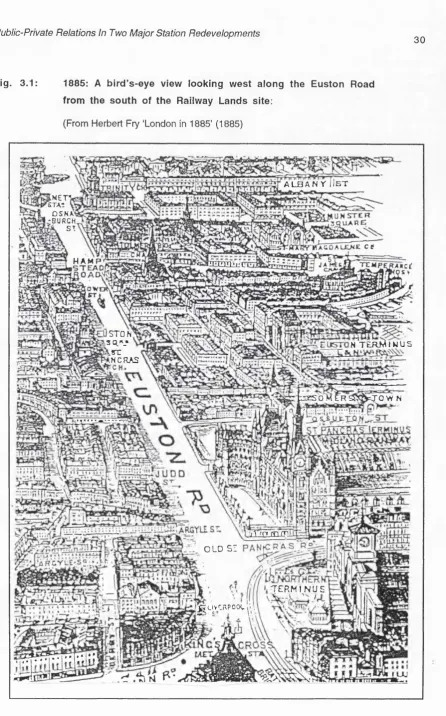
Fig. 3.1: 1885: A bird's eye view looking west along Euston Road from the south of the Railway Lands site: (Source - Herbert Fry, 'London 1885', 1885; London Borough of Camden, 'King's Cross Railway Lands History', 1989,
p.11).. .. .. .. .. .. p.30
Fig. 3.2: King’s Cross Agencies: (Source - Michael Edwards, 1992, Lecture notes, MPhil. Town Planning: “Implementation and Development”, Bartlett
School, UCL. London) .. .. p.34
Fig. 3.3: Aerial view of King's Cross and the main Railway Termini: (Source - London Regeneration Consortium Pic, No. 4,1990, p.2; Julie Sexton,
'Redevelopment and Benefits of Planning Gain', 1992, p .2 )... p.35
Fig. 3.4: King's Cross (Larger) Railway Lands: (Source - London Borough of Camden, The King’s Cross Railway Lands: A Community Planning Brief,
January 1988, p.3).. .. .. p.36
Fig. 3.5: Land Ownership Plan: (Source - London Regeneration Consortium Pic, 'Proposals for the King's Cross Development Area: Master Planning
Operational Requirements', 1988, p.115) .. p.37
Fig. 3.6: King's Cross in its London context: (Source - London Regeneration
Consortium Pic, 'King's Cross Outline Planning Application: Environmental
Statement', Oct. 1989. p.1.0/8) .. p.51
Fig. 3.7: King's Cross Special Policy Area in its Borough context: (Source - London Borough of Camden, 'UDP Consultation Draft, 1992', 1992, p.33)...p.52
Chapter 4:
Fig. 4.1:
Fig. 4.2:
Fig. 4.3:
Potential redevelopment sites: (Source - Compiled by author with
reference to his definition of development) .p.62
Development site plan: (Source - King's Cross Railway Lands Group,
'Peoples Brief: Full Report', 1990, p.9) .. p.63
Public-Private Relations In Two Major Station Redevelopments
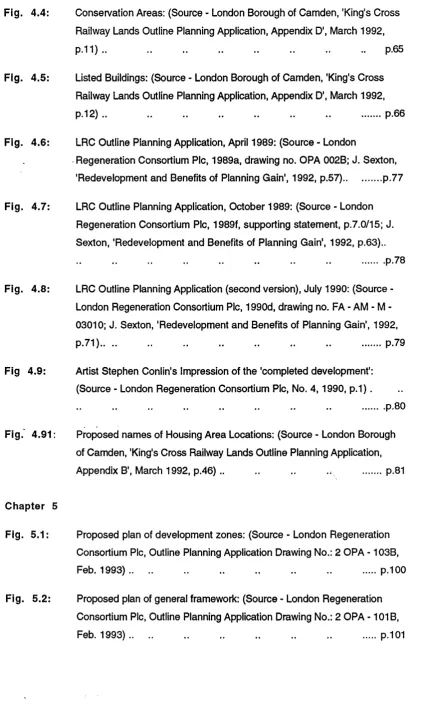
Fig. 4.4: Conservation Areas: (Source - London Borough of Camden, 'King's Cross Railway Lands Outline Planning Application, Appendix D', March 1992,
P »11^.# f t f t a . a a a t a t a a PtS5
Fig. 4.5: Listed Buildings: (Source - London Borough of Camden, 'King's Cross Railway Lands Outline Planning Application, Appendix D', March 1992,
p. 1 2) a a a a a a a a a a a a a a P.SG
Fig. 4.6: LRC Outline Planning Application, April 1989: (Source - London
Regeneration Consortium Pic, 1989a, drawing no. OPA 002B; J. Sexton, 'Redevelopment and Benefits of Planning Gain', 1992, p.57)... p.77
Fig. 4.7: LRC Outline Planning Application, October 1989: (Source - London Regeneration Consortium Pic, 1989f, supporting statement, Pt7t0/15; J. Sexton, 'Redevelopment and Benefits of Planning Gain', 1992, p.63)tt
f a a t f t f t a t a a a a a a a a a a a a a P a 78
Fig. 4.8: LRC Outline Planning Application (second version), July 1990: (Source -London Regeneration Consortium Pic, 1990d, drawing no. FA - AM - M - 03010; Ja Sexton, 'Redevelopment and Benefits of Planning Gain', 1992, P a 71 ) a a a a a a a a a a a a a a a a a a a a a a a P a 79
Fig 4.9: Artist Stephen Conlin's Impression of the 'completed development': (Source - London Regeneration Consortium Pic, No. 4,1990, p .1 ).
a a a a a a a a a a a a a a a a a a a a a a a a
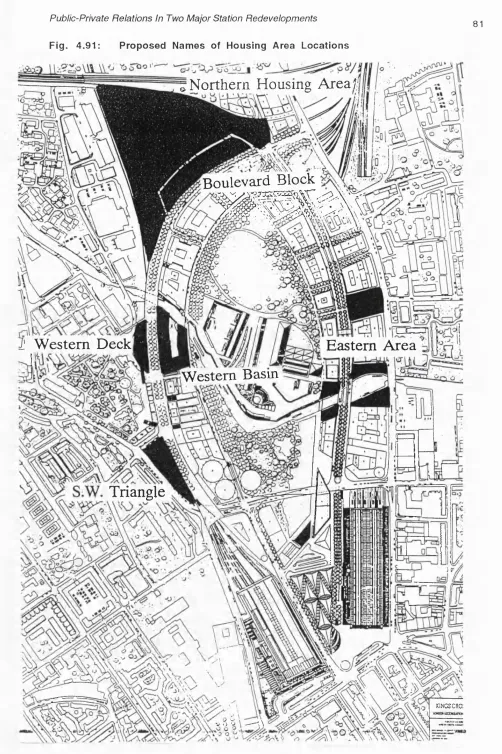
Fig. 4.91 : Proposed names of Housing Area Locations: (Source - London Borough of Camden, 'King's Cross Railway Lands Outline Planning Application,
Appendix B', March 1992, p.46).. p.81
Chapter 5
Fig. 5.1 : Proposed plan of development zones: (Source - London Regeneration Consortium Pic, Outline Planning Application Drawing No.: 2 OPA - 103B,
Feb. 1993) aa . . a . aa P a 1 O Ù
Public-Private Relations In Two Major Station Redevelopments
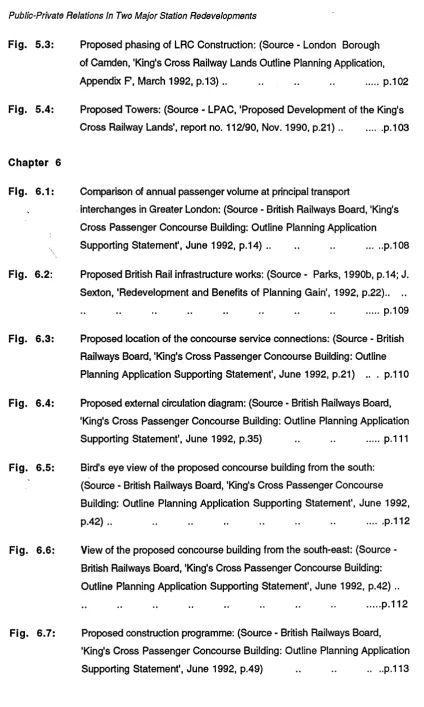
Fig. 5.3: Proposed phasing of LRC Construction: (Source - London Borough of Camden, 'King's Cross Railway Lands Outline Planning Application,
Appendix F, March 1992, p.13).. .... p.102
Fig. 5.4: Proposed Towers: (Source - LPAC, 'Proposed Development of the King's Cross Railway Lands', report no. 112/90, Nov. 1990, p.21)...p. 103
Chapter 6
Fig. 6.1 : Comparison of annual passenger volume at principal transport
interchanges in Greater London: (Source - British Railways Board, 'King's Cross Passenger Concourse Building: Outline Planning Application Supporting Statement', June 1992, p.14) .. ...p.108
Fig. 6.2: Proposed British Rail infrastructure works: (Source - Parks, 1990b, p.14; J. Sexton, 'Redevelopment and Benefits of Planning Gain', 1992, p.22).. ..
.. .. .. .. .. .. .. .. ... . 1
Fig. 6.3: Proposed location of the concourse service connections: (Source - British Railways Board, 'King's Cross Passenger Concourse Building: Outline Planning Application Supporting Statement', June 1992, p.21) .. . p.110
Fig. 6.4: Proposed external circulation diagram: (Source - British Railways Board, 'King's Cross Passenger Concourse Building: Outline Planning Application
Supporting Statement', June 1992, p.35) .... p.111
Fig. 6.5: Bird's eye view of the proposed concourse building from the south: (Source - British Railways Board, 'King's Cross Passenger Concourse Building: Outline Planning Application Supporting Statement', June 1992,
p.42) .. .. .. . ... ...p' 112
Fig. 6.6: View of the proposed concourse building from the southeast: (Source -British Railways Board, 'King's Cross Passenger Concourse Building: Outline Planning Application Supporting Statement', June 1992, p.42)
.. .. .. .. .. .. .. ... p .112
Fig. 6.7: Proposed construction programme: (Source - British Railways Board,
'King's Cross Passenger Concourse Building: Outline Planning Application
Supporting Statement', June 1992, p.49) .. ..p.113
Public-Private Relations In Two Major Station Redevelopments
Chapter 8
Fig. 8.1:
Fig. 8.2:
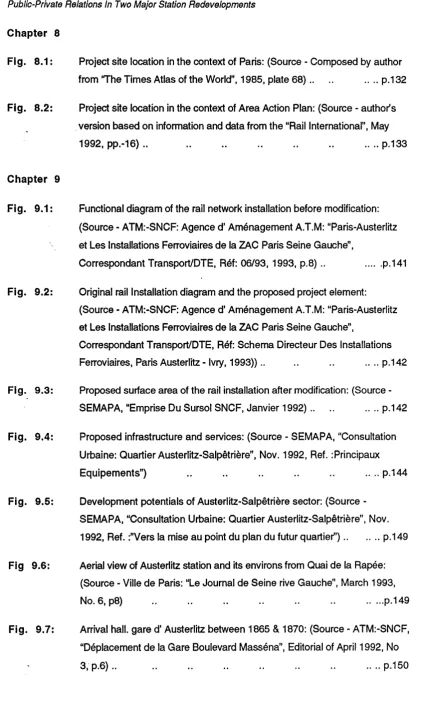
Project site location in the context of Paris: (Source - Composed by author from T h e Times Atlas of the World”, 1985, plate 68).. .... p.132
Project site location in the context of Area Action Plan: (Source - author’s version based on information and data from the "Rail International”, May
1992, pp.-IG) .. .. .. p.133
XII
Chapter 9
Fig. 9.1 : Functional diagram of the rail network installation before modification: (Source - ATM:-SNCF: Agence d’ Aménagement A.T.M: “Paris-Austerlitz et Les Installations Ferroviaires de la ZAC Paris Seine Gauche”,
Correspondant Transport/DTE, Réf: 06/93, 1993, p.8) .. ...p. 141
Fig. 9.2: Original rail Installation diagram and the proposed project element:
(Source - ATM:-SNCF: Agence d’ Aménagement A.T.M: “Paris-Austerlitz et Les Installations Ferroviaires de la ZAC Paris Seine Gauche”,
Correspondant Transport/DTE, Réf: Schema Directeur Des Installations Ferroviaires, Paris Austerlitz - Ivry, 1993)).. .... p.142
Fig. 9.3: Proposed surface area of the rail installation after modification: (Source -SEMAPA, “Emprise Du Sursol SNCF, Janvier 1 9 9 2 ) . . . . .. .. p.142
Fig. 9.4: Proposed infrastructure and services: (Source - SEMAPA, “Consultation Urbaine: Quartier Austerlitz-Salpêtrière”, Nov. 1992, Ref. : Principaux
Equipements”) .. .. p.144
Fig. 9.5: Development potentials of AusterlitzSalpêtrière sector: (Source -SEMAPA, “Consultation Urbaine: Quartier Austerlitz-Salpêtrière” , Nov. 1992, Ref. :”Vers la mise au point du plan du futur quartier” ) ...p.149
Fig 9.6: Aerial view of Austerlitz station and its environs from Quai de la Râpée: (Source - Ville de Paris: “Le Journal de Seine rive Gauche”, March 1993,
No. 6, p8) .. ...p.149
Fig. 9.7: Arrivai hall, gare d’ Austerlitz between 1865 & 1870: (Source - ATM:-SNCF, “Déplacement de la Gare Boulevard Masséna”, Editorial of April 1992, No
Public-Private Relations In Two Major Station Redevelopments
Fig. 9.8: Artist’s impression of Austerlitz station after the operation: (Source - Ville de Paris: “Le Journal de Seine rive Gauche”, March 1993, No. 6, p7)
.. «. # # .. .. . # . . . . .1
Fig. 9.91 : Work progress on the Bibliothèque (Source - Site photography by Author,
April 23, 1993) .. .. .. .. .. p.152
Fig. 9.92: Architect Perrault’s model of the bibliothèque: (Source - Etablissement Publique de la Bibliothèque de France, Editorial on the new library, c.
1993, p.1).. .. .. .. .. p.152
Fig. 9.93: Model height of the bibliothèque in relation to the development: (Source-Pholography by Author, at the Exhibition office of the French National
Library, April 23,1993) .. .. .. .. .. p.153
Fig. 9.94: Model of the bibliothèque in relation to the ZAC: (Source - Courtesy of
Bruneau, ATM:-SNCF, April, 1993) .. .. p.153
Fig. 9.95: Architect Arretche-Karasinski’s design of the proposed pont de Charles de Gaulle (Source - ATM:-SNCF, October 1992, Editorial No 4, pp.2-3)
.. .. .. .. «. .. .. .... p. 1
Fig. 9.96: Proposed RER and Underground station of Masséna: (Source - SNCF, “La Nouvelle Gare de Masséna”, special editorial, 1992, pp.2-3)... p.155
Fig. 9.97: Proposed infrastructure alignment under the decked land: (Source -ATM:-SNCF, “Déplacement de la Gare Boulevard Masséna”, Editorial of
April 1992, No 3, p .4 ).. .. .. .. .. p.155
Fig. 9.98: Work progress on site, April 23,1993: (Source - Site photography by
Author, April 23, 1993) .. .. .. p.161
Fig. 9.99: Relationship of the development with the rive droite and the rest of Paris in the future: (Source - “Le Journal de Seine rive Gauche”, Nov. 1990, No.
2, p.2) .. .. .. .. ..p.163
Fig. 10: King’s Cross Project: decision delayed further: (Source - “Camden
Citizen”, The News Paper of Camden Council, May 1993, Issue No 27, p.3)
.. .. .. .. .. .. .. . ... .1 ^3^5
Public-Private Relations in Two Major Station Redevelopments
LIST OF TABLES
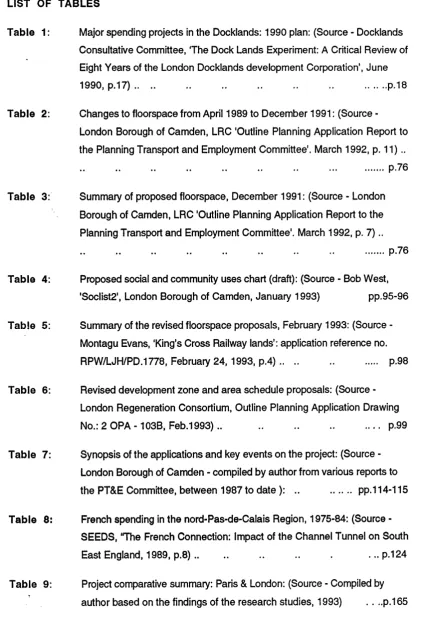
Table 1 : Major spending projects in the Docklands: 1990 plan: (Source - Docklands Consultative Committee, The Dock Lands Experiment: A Critical Review of Eight Years of the London Docklands development Corporation’, June
1990, p.17) .. .. .. .. .. p.18
Table 2: Changes to fioorspace from April 1989 to December 1991 : (Source
-London Borough of Camden, LRC 'Outline Planning Application Report to the Planning Transport and Employment Committee'. March 1992, p. 11)..
.. .. .. .. .. .. .. ... ... p.7^5
Table 3: Summary of proposed fioorspace, December 1991 : (Source - London Borough of Camden, LRC 'Outline Planning Application Report to the Planning Transport and Employment Committee'. March 1992, p. 7)..
.. .. .. .. .. .. .. .. ... p.7^5
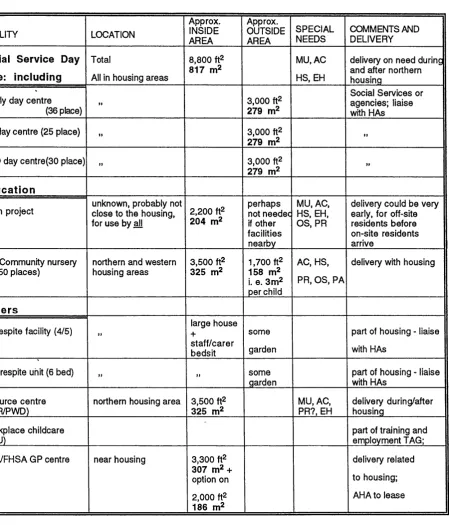
Table 4: Proposed social and community uses chart (draft): (Source - Bob West, 'Soclist2', London Borough of Camden, January 1993) pp.95-96
Table 5: Summary of the revised fioorspace proposals, February 1993: (Source -Montagu Evans, ‘King’s Cross Railway lands’: application reference no. RPW/LJH/PD.1778, February 24, 1993, p .4 )... p.98
Table 6: Revised development zone and area schedule proposals: (Source -London Regeneration Consortium, Outline Planning Application Drawing
No.: 2 OPA - 103B, Feb.1993).. p.99
Table 7: Synopsis of the applications and key events on the project: (Source -London Borough of Camden - compiled by author from various reports to the PT&E Committee, between 1987 to date ): .. pp.114-115
Table 8: French spending in the nordPasdeCalais Region, 197584: (Source -SEEDS, ‘The French Connection: Impact of the Channel Tunnel on South
East England, 1989, p.8) .. .. ... p.124
Table 9: Project comparative summary: Paris & London: (Source - Compiled by author based on the findings of the research studies, 1993) .. ..p.165
Public-Private Reiations In Two M ajor Station Redevelopments
Public-Private Relations In Two Major Station Redevelopments
INTRODUCTION
In recent times, the need to encourage private-public partnership in major inner city rede
velopment has become stronger. In the UK, the need for this approach has been demon
strated at the peak of the economic recession of the 1970s which forced the government
to reconsider its direct role in urban development and infrastructure provision projects
and implementation. Governments subsequently imposed restrictions on public spend
ing and borrowing. From 1979, the Thatcher and Major Governments introduced various
planning policies and programmes - “Leverage Planning”, “Enterprise Zones", “Urban
Development Corporations", “City Challenge", etc., that were all designed to attract
private sector participation. However, the stock market crash of October 1987, which
signified the reappearance of the economic recession, further put into doubt the effec
tiveness of the private sector-led approach in the implementation of inner city redevelop
ment projects. Since the beginning of the 1990s, on-going large scale developments ran
into cash-flow problems while the commencement of newly approved ones have either
been delayed or their scope reduced.
In France, however, there is a strong tradition of co-operation and understanding be
tween the private and public sector in the redevelopment of French inner cities. The
French National Railways (SNCF) is one of the Agencies that has often played a vital role
in this process and has equally achieved remarkable success.
I have, therefore, chosen the study of a type of urban development project which is of the
greatest interest and significance: the redevelopment of city-centre railway termini.
The largest cities of Europe typically have a ring of railway termini around the
central areas - indeed this ring of stations is often the effective definition of the
edge of the centre.
The revival of rail travel linked with the High Speed Train (TGV) is a factor
Public-Private Reiatiàns In Two Major Station Redevelopments
Most large cities are short of central developable land, especially of large sites in
unified ownerships. Railway stations and their related lands and goods yards are
often the only available exceptions.
Railway station redevelopment often shows up the tensions which relate to the
expansion of the central business district in the inner city or inner ring of non
central parts of the city.
Railway stations often provide accessibility or locational values that attract
speculative developments
The state railways of western Europe have thus increasingly engaged in redevelopment
schemes linked to stations. An additional impetus for some of them has been their need
to make profits or enlist new kinds of investors as their traditional source of money - the
central government’s grants, loans and subsidies - has been reduced.
In parallel, pressures from government to replace the traditional public funding of infras
tructure and urban redevelopment by increased private sector participation or market-led
approach, have produced models (in the UK) which have had their “failures” or whose
effectiveness were not evaluated before their replacement.
The railway station redevelopments in UK and France are similar in many respects but also
differ in important ways. These differences and similarities have been addressed in the
thesis, in three ways, viz.;
I: the framework of public-private relations in urban development:
* in the UK, the transition from public to private investment and
provisions; deregulation with the creation of UDCs, EZs; a very
broad definition of public spending subject to tight control.
* in France, the stronger survival of state initiative and investment;
Public-Private Relations In Two Major Station Redevelopments
Etablissement Publique d’ Aménagement, Sociétés d’
Economie Mixte, Caisse de Dépôt et de Consignations, etc.
* differences in the financing rules for railways.
I i : strategic planning framework:
* London Plans: The planning framework is through the 33
Borough Plans (up till 1991); Unitary Development Plans -UDPs-
(from 1992) all of which were produced with the presumption in
favour of development, and in accordance with the DoE Strategic
Guidance, Planning Policy Guidance and Government Circulars;
LPAC; separation of land use and transport planning, etc. The
London Planning Advisory Committee is a recognised Agency
that advises both the central and local governments on planning
issues, but its proposals or advice are not legally binding. Thus,
London has 33 Boroughs with independent local planning
authorities, that produce their UDPs in accordance with
the Secretary of State’s Strategic Guidance.
* City of Paris, in contrast, has a strong Regional Authority and
Paris City Government each with specified functions, and
selectively clear plans at regional and city level.
iii: local government structure and responsibilities; planning procedures and
negotiations, etc.
London: responsibility for granting planning permission for the
redevelopment of the King’s Cross Railway Lands, despite its
scope, scale and size, lies with the London Borough of Camden
Public-Private Relations In Two Major Station Redevelopments
Paris: the institutional framework in France (following the
decentralisation of 1983) empowers the Metropolitan City (i.e.
the Conseil de Ville de Paris) to determine planning applications
for developments of such magnitude as the Austerlitz-Tolbiac-
Masséna.
1.1: WHY KING’S CROSS AND AUSTERLITZ?
1.11: King’s Cross
The stratégie location and key connections of the site; the scale, scope and size of the pro
posed project, and the proposal to transform the site to an international nodal point, are all
the motivating factors. It was considered by developers and land owners in 1988, as a po
tential site for a highly profitable and speculative development:
“It is easy to see why King's Cross seems so attractive. Here was a site four times larger than Broadgate, and twice as large even as Canary Wharf, the prime business centre in the Docklands; it was also ideally placed between the City of London and the West End . It is not surprising that in the subsequent months (following the
news of the plan in 1987), it was repeatedly referred to in superlatives as the 'most exciting and challenging development opportunity presently being contemplated in Britain', if not one of the most significant inner city development sites in the world.”
(Hunter, 1990, pp. 128-129)
It is observed that King’s Cross is outside all the special zones (e.g. UDC, EZ) and this is a
good indication of planning in the “normal” condition of government (local
government)/developer relation. Furthermore, the strategic location of Kings Cross as a
Special Policy Area, in the UDP of the London Borough of Camden, is a good justification
for conducting a study on the site.
Other Railway Termini, in the city, would have been interesting to look at but almost all of
them have been redeveloped or their redevelopment (except Paddington Station) is in
Public-Private Relations In Two Major Station Redevelopments
-it was in the Belgian term of that name that Napoleon Bonaparte, the French Warrior, was
defeated by the British Army, in 1815 -but redevelopment, mostly commercial, have already
taken place. The only remaining terminus with a sizeable stock of land (but not as big as the
King’s Cross) is Paddington Station. Perhaps the lessons that emerge from the thesis
could be useful for the redevelopment of the station.
1.12: Austerlitz
Like King’s Cross, the strategic location of the site; the scale, scope and size of the
redevelopment, and the proposal to transform the site to the largest International TGV
Station with key connections, and the Government’s policy to use the development as part
of their strategy for attracting development towards the east of Paris, look very interesting.
Other factors that contrast with practices in UK are:
* different kind of planning framework - regional and local (with much more
certainty in negotiation);
* different government approach to the French Railways day-to-day running
and investment climate. The SNCF can easily raise funds from the capital
market to finance developments. In the UK the British Railways, like any
other public agency, is restricted in its borrowing.
* different government structure: strong Regional and Paris City
governments compared with London.
different rules for public/private partnerships through special agencies:
* In the UK (Healey and Nabarro, 1990) there were attempts to free-
up the land market, most especially through the release of public
lands; the effective end of regional policy and its replacement by
urban initiatives - Enterprise Zones, Urban Development
Public-Private Relations In Two Major Station Redevelopments
etc.; the reduction of the role of the government as a major
financier and developer.
In France, there were attempts to co-ordinate development of
public land for projects of “general interest” through special
agencies (Mixed Economy Companies). Governments play an
active role as financier and developer to attract private investment.
Austerlitz is a good example because:
i: its location in Paris is very similar to King’s Cross in London;
ii: the timing of the project is about the same as King’s Cross;
iii: its scale and size are comparable.
I could have looked more closely at other cases, especially the Eurodisney
which is veiy interesting, but that project is not directly comparable with
King’s Cross for two reasons:
i: its location (in the deep suburbs of Paris) is not similar to King’s
Cross;
ii: its timing and realisation are not relevant to King’s Cross; but it
demonstrates consistency and continuity in governments’ policies,
and these make a brief summary of it very relevant.
The Montparnasse Station redevelopment would have also been a good case
study but the operation was completed years ago. Like Paddington Station in
London, the remaining major stations awaiting redevelopment, in Paris, are the
Gare du Nord/Gare de I’ Est (the proposed future Northern TGV station (s) for Paris
Public-Private Relations In Two Major Station Redevelopments
1.2: ORGANISATION AND SCOPE OF THE THESIS
This thesis, is mainly concerned with the public-private relations in the redevelopment
proposals and the negotiations that led to the arrangements on these two major station
redevelopment projects, and attempts to make comparative analysis and draw conclu
sions that are intended to contribute to the existing planning achievement and
methodology in the UK.
The thesis recognises that the redevelopment proposals for the King’s Cross Railway
Lands include plans for infrastructure and services that could be regarded as functioning
at four intèr-related levels, namely:
i: those that facilitate the operation of local activities;
ii: those that are London-wide and that facilitate movements in the metropolis;
iii: those that are national in scope and operational in the context of the United
Kingdom; and
iv: those that are (potentially) international.
The research focuses mainly on the local (on-site) aspect of the project proposals within
the context of the existence of the other factors (ii-iv) highlighted above and also takes
cognisance of the incredibly long series of negotiations, activities and events which the
proposals have generated. Thus, the thesis attempts to present a chronological repre
sentation of these events, in order to enhance a ciear and better understanding of the
enormous problems which the projects have encountered. It also demonstrates that the
key difference in the Austerlitz project is the different role of the state and its clear com
mitment and control.
The study of King’s Cross will exclude elements of the proposed Channel Tunnel Rail
Link works on and off the site, except in so far as they provide a context in which a
proposal could be made that the locality be transformed to function as an international
nodal point. In order words, the emphasis is on the on-site redevelopment proposals, not
Public-Private Relations In Two Major Station Redevelopments
In addition, I would like to emphasise further that most of the work and resources are cen
tred on the Kings Cross and, within the scope and extent of the resources which the
materials and data from France could possibly be obtained, it has not been possible to
give an equal or step-by-step comparison of the two case studies.
The aim of the thesis, therefore, is to examine the public-private relations in the redevel
opment proposals of two urban renewal projects related to railway termini in London and
Paris, by examining:
i: processes in public-private relations and planning procedures;
ii: the function and role of public institutions and relevant agencies
responsible for development; and
iii: what lessons can be learnt from the two case studies and blended with the
potentially good home policies, to improve upon the public-private
Public-Private Relations In Two Major Station Redevelopments ^
g
Public-Private Relations In Two Major Station Redevelopments
Chapter Two
PLANNING AND INNER CITY DEVELOPMENT
This chapter reviews the main trends in government policy towards urban development, re
ferring briefly to the London Docklands which is the outstanding case of “special” measures
adopted in this field. It then describes the growth of negotiated agreements which have in
creasingly been the basis for public-private relationship outside the special areas. It con
cludes by outlining the most recent phase of policy -the competitive “City Challenge”
approach. This brief provides a context in which the proposed redevelopment of King’s
Cross since the late 1980s can be situated.
2.1: DEFINITIONS
Section 57 (1) of the 1990 Act provides that Planning permission is required for the
carrying out of any development of land. Such permission, depending upon the nature of
the development, may either be granted expressly by a Local Planning Authority or the
Secretary of State for Environment, or be deemed to be granted by statue or order.
Section 55 (1) of the Town and Country Planning Act, 1990, provides that deve lop
ment may take one or two forms, namely:
* the carrying out of building, engineering, mining or other operations in, on, over,
or under land;
* the material change of use.
The 1991 Act amends s. 55 of the Act by extending the definition of development to
include all building. Thus a new sub-s. (1 A) of section 55 provides that:
For the purpose of this Act “building operations” include:
* demolition of buildings;
* rebuilding;
Public-Private Relations In Two Major Station Redevelopments ^2
* structural alterations of or additions to buildings; and
* other operations normally undertaken by a person carrying on business as
a builder.
The 1991 Act also gives the Secretary of State power to make directions enabling him to
provide that the demolition of particular types of building is not to constitute development.
Collins Cobuild English Dictionary (1990) further defines development as the process of
making an area or water more useful or profitable, while the infrastructure of something
such as a country, society, or organisation is defined as the basic structure on which it is
built, such as the facilities, services and equipment that are needed for it to function
properly’.
Infrastructure is a term which over the years has been applied to an increasing range of
the services required to support land development. Rowan-Robinson and Lloyd (1988)
defined it as 'all the supporting services required to enable land development to take
place in a socially acceptable way’.
2.2: INNER CITY DEVELOPMENT
The post war era (with the exception of the period between late 1947 and November 2,
1954, when the 100% betterment tax and the building licence requirements constituted
the bases for granting planning permission) up till 1967 (Marriot 1969), witnessed a devel
opment (property) boom in which public and private sector agencies entered into separate
or joint development ventures, often involving large scale projects such as town centre re
development. ‘Joint projects involve a negotiated development package, usually com
bining the authorities' land assembly and infrastructure powers, with the developers’
market expertise and funding’ (Marsh, 1989). According to Marriot, the Local Authorities,
through their councillors and officials, saw partnership with the developers as a convenient
method of financing civic improvements. ‘Their other intention was that once private de
velopers were brought in on a large scale to tap a profitable commercial vein, other munici
Public-Private Relations In Two Major Station Redevelopments
the LPAs were concerned or preoccupied with the provision of social housing and
infrastructure through negotiated agreements (or inducements), developers were preoc
cupied with the speculative gains likely to accrue from such negotiations. The implication,
Marriot observed, was that ‘it was easy for the objective to stray from the strict considera
tions of planning and aesthetics’.
Prior to the Thatcher Administration in 1979, the responsibilities of the local governments
extended from large scale planning to refuse collection, and from education and housing
to providing other essential infrastructure and services. They managed to raise funds via
various charges, rents, rates, etc., and enjoyed grants, loan sanctions and technical sup
port from the central government (particularly between 1935 and 1975), to finance both
recurrent expenditures and the implementation of capital projects. They were, indeed,
operating as ‘an arm of a welfare state’.
The financial crises of the late 1960s (Brindley et al 1989), aggravated by the oil crisis of
1973 (with the 1970s turning into a period of deep and prolonged economic recession)
killed off most remaining plans for large scale development and urban renewal pro
grammes. The acceleration of decline, particularly in the manufacturing industries, had a
dramatic effect on particular localities while some cities and towns experienced growth
and new patterns of employment. For instance, areas such as the West Midlands suffered
from the collapse of the key sectors of manufacturing, including the machine tool, engi
neering and car industries. ‘The industrial base of Birmingham shrank by a third; in
Sheffield in 1971, there were 139,000 people employed in manufacturing industry; ten
years later the number had declined to 90,000 and by 1987 it had collapsed to 58,000’.
Further attempts to stem this decline by successive governments, through regional aid
programmes and state development projects, throughout the 1970s, were not very suc
cessful (Brindley et al, 1989; see also Lawless, 1981).
Consequently, the State’s direct role in development was adversely affected. The plan
ning. system, with its dependence on economic growth for project implementation was
further disabled. As the crisis deepened, ‘the Keynesian philosophy of public-sector led
Public-Private Relations In Two Major Station Redevelopments
recovery has been supplanted by the rigid orthodoxies of the “new right”. Under direct
pressure from the IMF, the contraction in the finances, and therefore the power, of the
public sector began in the mid 1970s’ (Ambrose, 1986). The Thatcher administration that
was ushered in from 1979, implemented the IMF demands - ‘deregulation and market-
based solutions to virtually all problems,’ and introduced measures based on the principle
that competition and not government intervention should decide economic growth. This
policy actually marked the end of an era of “welfare state” and was linked with the policy of
maintaining a high exchange rate of the pound sterling throughout the 1980s.
Meanwhile, the decline of the manufacturing sectors continued unhindered while the
service sectors and some high tech industries grew and expanded considerably.
In response to the new economic sectors, speculative property developers cashed in to
produce new commercial floorspace mostly in new and prime locations. The develop
ment boom of the late 1980s seems to indicate the effect of these policies in several
urban areas of the UK there has been a dramatic increase in the development
pipeline of Central London office space, M25 office and business space, and retail space’
(Olsberg, 1990; see also Espinet and Wright, 1990).
The London Borough of Camden (1987), in their Written Statement on the
‘unemployment and industrial decline’ in the Borough declares:
“some aspects of life in Camden have dramatically changed since 1979. The population and number of working residents has been falling fast; the total economically active fell by 22% between 1971-1981, while unemployment has more than trebled since the Borough Plan was originally adopted in 1979. This is largely accounted for by the poor performance of the national economy, structural changes in industry affecting the types of jobs available, and the continued decline of manufacturing industry. The traditional manufacturing jobs that remain are threatened by new uses able to pay high rents, whilst there is a trend towards small-scale, specialist firms (often ‘high-tech’ or craft based) which require new skills.”
In contrast to those areas of decline, Bristol and the surrounding M4 turned into a growth
corridor. Although their traditional manufacturing base declined, the service sector indus
Public-Private Relations In Two Major Station Redevelopments
tries expanded considerably giving rise to newer activities based on electronics and high
technologies. In effect, Brindley et al (1989 ) argued that the evolution of these new form
of activities has dictated the need for restructuring the economic base of inner city indus
trial areas in UK and for new forms and styles of planning that would meet the need of dif
ferent localities, bring about patterns of development desired by various interests and
match the political rhetoric of those interests.
The work of Hodge (1987) and, Hambleton and Hoggett (1987) demonstrated that the
1980s constituted a crisis period for the local governments; ‘it is possible to see how this
crisis reflects wider tensions in the society, in the economy, in the culture, and above all,
in politics'. They also established the threat to which the continued existence of “the local
government as an independent, innovative and separate tier of government" was ex
posed. This invariably meant government taking away decisions from the councillors and
creating a competitive market-oriented society. At the same time, funds or grants from the
central government to the local governments were either diminishing, or drying up.
Coupled with this financial restriction, local authorities were also made to divest their role
in developments relating to housing provision, hence a shift of civic responsibilities to the
private sector (Grover 1990). The trend was noticeable in the landed property market in
which property development was seen by the government as an important supply side
measure necessary to encourage economic growth (particularly in the depressed areas),
whilst the ‘Thatcherite urban Policy" intensified efforts to attract private sector develop
ment interest into inner city areas and drastically reduced the capability of the local author
ities to carry out any development. In addition, developers were also to be involved in the
provision of infrastructure where increased demand for transport or services was ex
pected as a result of the proposed development. (Olsberg, 1990; see also Solesbury,
1990).
The introduction of the “Leverage Planning” model in 1979 (Brindley et al 1989), was
about the first attempt by the new Government of Thatcher to use public investment to
stimulate the weak or flagging private market in land and property development. The tradi
Public-Private Relations In Two Major Station Redevelopments
tional partnership between the public and the private sector of the post war era, was the
practice of the public sector clearing sites and providing physical infrastructure to support
private sector investment, as well as, effectively subsidising development schemes that
might not otherwise have gone ahead. Through the New Towns Act of 1946, the imple
mentation of the ‘New Towns Development Projects - a massive public sector investment
programme - with the private sector distinctly playing a subordinate role’, had been based
on this tradition.
Furthermore, the essential ingredient of leverage planning was to use public investment
to stimulate the release of a greater volume of private sector investment. This included
subsidies to private sector development, either directly through low-cost land sales or
indirectly through infrastructure investment, as well as, a flexible, even entrepreneurial,
attitude to development proposals. The emergence of the Enterprise Zones and the
Urban Development Corporations (UDCs) were the direct result of the model. In addition,
land users and businesses in the Zone were exempted from rates and other key taxes.
‘Subsidies in the form of Urban Development Grant (UDG) were also available to support
conversion, improvement or redevelopment schemes in which a substantial proportion of
the cost has been met by the firm itself (Brindley et al 1989).
Thus, the Urban Development Corporations, established through the Local Government
Planning and Land Act of 1980 (partly modelled on the New Town Development
Corporations of 1946), saw “Leverage” as one of the principal approaches to regenerat
ing declining urban areas. The London Docklands Development Corporation and the
Merseyside Development Corporation in Liverpool, were the first generation of such
approach. They were empowered through the Act to:
* acquire and dispose of lands;
* invest and build;
* decide on matters relating to development control, particularly, the processing
of planning applications and granting of planning permissions, in their
designated areas, and
Public-Private Relations In Two Major Station Redevelopments
* were not accountable whatsoever to any local authority in their designated areas.
They were to prepare and market development sites which often involved major reclama
tion works and the provision of suitable infrastructure, thereby ‘turning large areas of
worthless and derelict land into viable propositions for speculative property developers’
(Brindley et al, 1989). Studies conducted by CLES (1990, p.55) showed that some of the
UDCs ‘ were assisting retail, offices and leisure development on land formerly used for in
dustry ', a policy which contributed to the property boom, particularly speculative devel
opment. The Docklands Consultative Committee (DCC, 1990) noted that the LDDC, in
promoting the Docklands as a potential “Wall Street on W a te f, in the later 80s, targeted
marketing specifically at the financial sector and the speculative developer. The implica
tion, according to DCC, was that ‘whereas the LDDC was envisaging 4-8 million ft^ of
offices on the Isle of Dogs prior to 1986, the figure had leapt to 25 million ft^ by late
1988; development had run ahead of infrastructure, as well as contributed to the over
heated property market’, which signalled the stock market crash of October 1987. The
resurgence of the recession, meant that by January 1989, 42% of the already completed
commercial property at Isle of Dogs remained unoccupied, while rents began to fall. (DCC
1990; see also Savills 1989).
Further implication of the slump was that the Canary Wharf developer’s obligation to con
tribute the sum of £400 million to transport infrastructure provision, (the proposed Jubilee
Line Extension) also ran into problems. Prior to the crash, Olympia & York, the major de
veloper at the Docklands, had been able to contribute a sum of £68 million to the £150
million cost of the Docklands Light Railway City extension to Bank station. Whereas,
through “pump priming”, ‘the £77 million cost of the initial DLR was publicly funded, while
the Government funding of the £220 million cost of the Limehouse Link section of the
Docklands Highway (aimed at further attracting market-led development to the site) and
the £500,000 aid to the Thames line riverbus in February 1989, are indicative of the sup
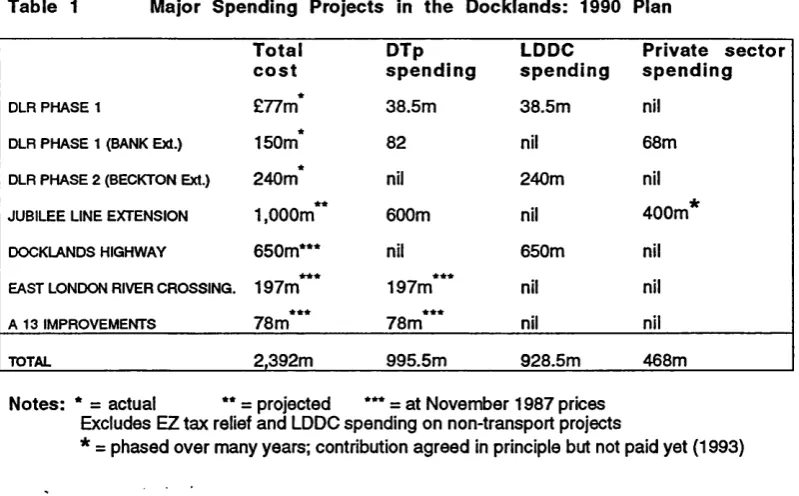
port for high profile public transport’ (DCC 1990). The following is a breakdown of the
projected counterpart funding requirements for infrastructure provision. The question
Public-Private Relations In Two Major Station Redeveiopments
here is. to what extent has the leverage planning succeeded in ‘pump priming’ the much
needed contribution and obligation from the private sector?.
Table 1 Major Spending Projects in the Docklands: 1990 Plan
T o ta l DTp LDDC P rivate s e c to r
c o s t s p e n d in g sp e n d in g s p e n d in g
DLR PHASE 1 £77m* 38.5m 38.5m nil
DLR PHASE 1 (BANK Ext.) 150m* 82 nil 68m
DLR PHASE 2 (BECKTON Ext.) 240m* nil 240m nil
JUBILEE LINE EXTENSION 1,000m** 600m nil 400m *
DOCKLANDS HIGHWAY 650m*** nil 650m nil
EAST LONDON RIVER CROSSING. 197m*** 197m nil nil
A 13 IMPROVEMENTS 78m 78m*** nil nil
TOTAL 2,392m 995.5m 928.5m 468m
Notes: * = actual ** = projected *** = at November 1987 prices Excludes EZ tax relief and LDDC spending on non-transport projects
* = phased over many years; contribution agreed in principle but not paid yet (1993)
18
Furthermore, the range of measures introduced to decentralise the public service and
“deregulate” the planning system, coupled with the restrictions placed on public sector
borrowing and the economic functions of local authorities, and above all, accompanied by
the abolition of the Greater London Council (GLC) and the Metropolitan Counties in 1986,
brought about considerable constraints in financing local economic initiatives and manag
ing or maintaining the existing infrastructure and services. The poll tax system, expectedly
a major source of revenue earning for local authorities (although abolished with effect
from April 1, 1993 and replaced with the council tax system), did not generate adequate
financial resources for local authorities’ recurrent expenditures, let alone capital projects
because the central government restricted what local government could spend by
“capping” the tax they could collect and tightened loan sanction control on their borrow
ing. This was made even worse by the resurgence of the recession. The use of planning
agreements to seek community benefits or facilities (‘planning gain’) from developers,
eventually assumed a much more important dimension than ever before, while the intro
Public-Private Relations In Two Major Station Redevelopments
of limited and scarce resources, is yet to record measured success. Above all, negotiated
agreements were seen as a means of providing the needed facilities without raising taxes.
2.3: NEGOTIATED AGREEMENTS
Within the context of section 52 of the Town and Country Planning Act of 1971 :
A local planning authority may enter into an agreement with any person interested in land in their area for the purpose of restricting or regulating the development or the use of land, either permanently or during such period as may be prescribed by the agreement; and any such agreement may contain such incidental and consequential provisions (including provisions of a financial character) as appear to the local authority to be necessary or expedient for the purpose of planning agreement.
Jowell (1977) and Henry (1982), categorised ‘gains’ into two types:
i: Amenity Gain: Benefits based upon traditional land use considerations,
involving concessions by a developer that would not be available through normal
requirements such as application s or conditions. This might include matters such
as extinguishing existing user rights, the rehabilitation of property, specification
of a particular use, including the provision of public open space.
ii: Social and Economic Gain: Attempts to include purposes other than the
traditional land use and amenity considerations. This might be specification of a
particular use where the use is required to create employment (e.g. industry in a
residential development), the attempt to obtain a ‘ social mix ’ (e.g. council
housing in an office development ) or other forms of social or economic
‘engineering’ through development control.
The latter form of ‘gain’ had been the subject of much debate such that it had been di
vided further into two forms: ‘acceptable’ and ‘unacceptable’ :
The acceptable gain includes infrastructure provisions and the provision of
community buildings or services, but only where the agreement is made to
overcome what might be the legitimate ground for refusing planning permission
Public-Private Relations In Two Major Station Redevelopments
altogether but, for some technical or legal reasons, cannot form the subject
matter of a valid planning condition; while
The unacceptable gain includes contributions to schemes not related to the
development, the surrender of legal rights, etc. (Henry 1982, pp.18-19).
Henry observed that the official policy of the Greater London Council (although abolished
in 1986) required office permissions that would prima facie be allowable to be assessed
on the basis of the degree of benefit to the community by way of ‘residential accommoda
tion buildings, etc’. Citing the London Borough of Camden as an example, he further
demonstrates that at the local level, policies become even more forthright in expecting
‘gains’ to be offered by developers. The Camden Plan - Plan for Camden”, March 1977
provides:
“Redevelopment will be considered where gains in residential accommodation will be achieved or where the provision of new dwellings will contribute to the community either in terms of providing a greater variety of sizes of units or to the provision of ancillary services, or in the improvement to the general housing or environmental conditions.”
“The Council will encourage private developers to provide residential and community uses within mixed developments and will give preference to those proposed developments containing an increase in residential accommodation.”
In setting out where offices would be allowed, the Plan provides that in the rest of the
Borough no increase in office floor space ‘will normally be permitted’ except:
“iii) where substantial planning advantages can be obtained such as : (a) provision of public open space
(b) redevelopment of areas of poor layout or design
(c) conservation of buildings or places of historic or architectural interest (d) provision of new residential accommodation in conjunction with the
development.”
Similarly, the London Borough of Camden (1987), in analysing the measures adopted to
slow down the rate of unemployment and industrial decline in the Borough, clarified:
Public-Private Relations In Two Major Station Redevelopments
“Borough Plan Policies have, nevertheless, scored some notable successes - for exam
ple, since 1979 for every square metre of industrial floor space lost, there has been a gain
of three square metres resulting from planning permissions given. The review of Policies
aims to build on such successes”.
Since 1981 the use of Planning Gain has attracted much debate and concern. The lack of
a standard definition of the term and the scope of the powers of the local authorities to
negotiate planning agreements, constituted the centre of the issue. The publication of
the Planning Advisory Group (1981) and the contribution of the Royal Town Planning
Institute to the debate on the publication, led the DoE to recognise the importance of
providing an acceptable definition, ‘against which to assess the legitimacy of both Local
authorities’ demands and developers’ offers’ (Debenham Tewson & Chinnocks, 1990).
2.31: C ircu lar 22/83: “Planning Gain: Obligations And Benefits Which Extend
Beyond The Development for Which Planning Permission Has Been Sought” was then
produced in August 1983. The Circular, amongst other directives, attempted to restrict
the use of Section 52 Agreements and outlined the circumstances where a planning
agreement may be appropriate:
a wholly unacceptable development should not, of course, be permitted just because of extraneous benefits offered by the development. If however, an application is considered acceptable when assessed against the relevant planning policies and other material considerations, it may be reasonable, depending upon the circumstances, either to impose conditions on the grant of the planning permission or to seek an agreement with the developer which would be associated with any permission granted.
2.32: Circular 1/85: provides that “unless a condition fairly and reasonably relates to
development to be permitted, it will be ultra vires”. Marsh (1989) while citing the case of
Bradford City Metropolitan Council vs. Secretary of State (1986,278 EG 1473), observed
that although many local planning authorities used the test of reasonableness as a basis
for discussion, the guidelines were obviously open to widely differing interpretations,
thus rendering the scope for negotiation between the parties very wide. Marsh estab
Public-Private Relations In Two Major Station Redevelopments
lished further that since 1983, the practice of bargaining has increased with a trend
reflecting the strength of the developer* s position in negotiation and, of the economic
and political constraints placed on local planning authorities, many of whom consider
planning gain to be the only financial means available to them to meet local needs.
On the issue of planning gain for transport investment, Olsberg (1990, p. 15) demon
strated the desirability of seeking contributions from developers towards infrastructure in
vestment and emphasised that this should be seen as part of the general policy of en
couraging more private sector involvement in the provision of these facilities’.
2.33: C ircu lar 16/91 (Planning and C om pensation Act 1991)
(a): Definition o f “ Planning Gain” : The Government, in its understanding of the
enormous and wide range of problems that the term ‘planning gain’ embodies, came up
with the following definitions:
The term “planning gain” has no statutory significance and is not found in the Planning Acts. The whole planning process is intended to operate in the public interests, in that it is chiefly aimed at securing economy, efficiency and amenity in the development and use of land. This is achieved through the normal process of development plan preparation and the exercise of development control. In granting planning permission, or in negotiations with developers and other interests that lead to the grant of planning permission, the local planning authority may seek to secure modifications or improvements to the proposals submitted for their approval. They may grant permissions subject to conditions, and where appropriate they may seek to enter into planning obligation with a developer regarding the use or development of the land concerned or other land or buildings. Rightly used, planning obligations may enhance development proposals.
By these means the local planning authority can aim to ensure that new
development or redevelopment is facilitated while having regard to the interest of the local environment and other planning considerations. The term “planning gain” has come to be used very loosely to apply both to this normal and legitimate operation of the planning system and also to attempts to extract from developers payments in cash or in kind for purposes that are not directly related to the development but are sought as “the price of planning permission”. Equally, the