University of Pennsylvania
ScholarlyCommons
Publicly Accessible Penn Dissertations
2017
Secure Diagnostics And Forensics With Network
Provenance
Ang Chen
University of Pennsylvania, [email protected]
Follow this and additional works at:https://repository.upenn.edu/edissertations
Part of theComputer Sciences Commons
This paper is posted at ScholarlyCommons.https://repository.upenn.edu/edissertations/2219 For more information, please [email protected].
Recommended Citation
Chen, Ang, "Secure Diagnostics And Forensics With Network Provenance" (2017).Publicly Accessible Penn Dissertations. 2219.
Secure Diagnostics And Forensics With Network Provenance
Abstract
In large-scale networks, many things can go wrong: routers can be misconfigured, programs can be buggy, and computers can be compromised by an attacker. As a result, there is a constant need to perform network diagnostics and forensics. In this dissertation, we leverage the concept of provenance to build better support for diagnostic and forensic tasks. At a high level, provenance tracks causality between network states and events, and produces a detailed explanation of any event of interest, which makes it a good starting point for investigating network problems.
However, in order to use provenance for network diagnostics and forensics, several challenges need to be addressed. First, existing provenance systems cannot provide security properties on high-speed network traffic, because the cryptographic operations would cause enormous overhead when the data rates are high. To address this challenge, we design secure packet provenance, a system that comes with a novel lightweight security protocol, to maintain secure provenance with low overhead. Second, in large-scale distributed systems, the provenance of a network event can be quite complex, so it is still challenging to identify the problem root cause from the complex provenance. To address this challenge, we design differential
provenance, which can identify a symptom event’s root cause by reasoning about the differences between its provenance and the provenance of a similar “reference” event. Third, provenance can only explain why a current network state came into existence, but by itself, it does not reason about changes to the network state to fix a problem. To provide operators with more diagnostic support, we design causal networks – a
generalization of network provenance – to reason about network repairs that can avoid undesirable side effects in the network. Causal networks can encode multiple diagnostic goals in the same data structure, and,
therefore, generate repairs that satisfy multiple constraints simultaneously. We have applied these techniques to Software-Defined Networks, Hadoop MapReduce, as well as the Internet’s data plane. Our evaluation with real-world traffic traces and network topologies shows that our systems can run with reasonable overhead, and that they can accurately identify root causes of practical problems and generate repairs without causing collateral damage.
Degree Type
Dissertation
Degree Name
Doctor of Philosophy (PhD)
Graduate Group
Computer and Information Science
First Advisor
Andreas Haeberlen
Keywords
Subject Categories
SECURE DIAGNOSTICS AND FORENSICS WITH
NETWORK PROVENANCE
Ang Chen
A DISSERTATION in
Computer and Information Science
Presented to the Faculties of the University of Pennsylvania in Partial Fulfillment of the Requirements for the
Degree of Doctor of Philosophy
2017
Andreas Haeberlen, Associate Professor of Computer and Information Science Supervisor of Dissertation
Lyle Ungar, Professor of Computer and Information Science Graduate Group Chairperson
Dissertation Committee:
Boon au Loo, Associate Professor of Computer and Information Science (Chair) Zachary G. Ives, Professor of Computer and Information Science
Vincent Liu, Assistant Professor of Computer and Information Science
SECURE DIAGNOSTICS AND FORENSICS WITH NETWORK PROVENANCE
COPYRIGHT
2017
Ang Chen
Licensed under a Creative Commons Attribution 4.0 License.
To view a copy of this license, visit:
Acknowledgments
First and foremost, I thank my advisor, Andreas Haeberlen, for taking me under his
wing. Andreas has been a wonderful advisor to me, providing a constant source of wisdom, guidance, and support over the five years of my Ph.D. journey. Were it not
for his mentorship, I would not be here today.
I also thank my dissertation committee members, Boon au Loo, Zack Ives,
Vincent Liu, and Wenchao Zhou. In addition to providing valuable feedback on this dissertation, they have also given me much helpful advice over the years.
I am very grateful for Boon’s mentorship on research, life, and beyond. His en-couragement and support have been instrumental in my journey. Likewise, I thank
Wenchao for being a close mentor and friend to me.
is dissertation would not have been possible without my collaborators, whom
I am fortunate to have worked with, including Andreas Haeberlen, Boon au Loo, Micah Sherr, Wenchao Zhou, Linh i Xuan Phan, Clay Shields, as well as fellow
students Yang Wu, Hanjun Xiao, Brad Moore, Mingchen Zhao, Yuankai Zhang, Tavish Vaidya, Chirag Shah, Bob DiMaiolo, Max Demoulin, and Akshay Sriraman.
I have also greatly enjoyed the enlightening discussions with Zack Ives, Val Tannen, Rajeev Alur, Joe Devietti, Mayur Naik, Ani Nekova, Chris Callison-Burch, Dave
Walker, and Jennifer Rexford. Moreover, I wish to thank my mentors and collabo-rators before Penn: Rocky Chang, Edmond Chan, Xiapu Luo, Peng Zhou, Weichao
Li, Daoyuan Wu, Ka Pui Mok, Wai Ting Fok, Byron Gao, Zhaohui Cai, Chunwu Yu, and Jingsong Cui.
e companions at CIS@Penn have made this journey full of fond memories, for which I thank Yang Wu, Hanjun Xiao, Mingchen Zhao, Antonis Papadimitriou,
Arjun Narayan, Yifei Yuan, Chen Chen, Yang Li, Behnaz Arzani, Meng Xu, Nimit Singhania, Steven Wu, Nathan Dautenhahn, Kevin Tian, and Wenrui Meng. My
I wish to thank Micah Sherr, Jennifer Rexford, Vincent Liu, and T. S. Eugene
Ng for their support in my job search, as well as many others whom I cannot even list here exhaustively.
I am extremely grateful to have Tenth Presbyterian Church and Tenth Interna-tional Fellowship as my spiritual home in Philadelphia, and to walk closely with my
mentors and companions – Rev. Enrique Leal, Rev. Bruce McDowell, Rev. Carroll Wynne, Rev. Jinan Zhang, Lani and Steve Shade, Joe and Yoon Park, Nasrat
Ghat-tas, Yang He, Yige Zhou, Yi-Lin Chiang, Stephen Russell, Xiaoping Chen, Antonis Papadimitriou and enia Karavasili, Guiyun Zhang and Biao Zuo, Darryl John,
Saki and Charinet Georganas, Jerry Joyce, Evangeline Sim, Martin and Machiko Whittaker, Teng Zhang, Yingchun Liu, Ping Wei, Marie Liu, Russ Pfeifer, Candy
Chen, Hung Bui, Qianhui Lin, Robert Johnson, Randall Drain, Nick Lamelza, and Tom Jackson. I also thank Yongquan Yan and Yingting Jiao for their friendship, and
Sr. Mary Ann McIntyre, M.S.B.T., Rev. Doh Chun Ning, and Fr. Dan Joyce, S.J., for their spiritual direction and prayers.
I thank my parents for their love, support, and encouragement. ey have taught me by example the value of hard work and persistence. Although they are half the
world away, they have always been there for me.
Last but not least, it is my tremendous blessing to have known and married my
wife, Xin, who has made this long journey worthwhile. Words cannot express how thankful I am to have her always by my side. I am deeply indebted to Xin for her
ABSTRACT
SECURE DIAGNOSTICS AND FORENSICS WITH NETWORK
PROVENANCE
Ang Chen
Andreas Haeberlen
In large-scale networks, many things can go wrong: routers can be misconfig-ured, programs can be buggy, and computers can be compromised by an attacker.
As a result, there is a constant need to perform network diagnostics and forensics. In this dissertation, we leverage the concept of provenance to build better support
for diagnostic and forensic tasks. At a high level, provenance tracks causality be-tween network states and events, and produces a detailed explanation of any event
of interest, which makes it a good starting point for investigating network problems. However, in order to use provenance for network diagnostics and forensics,
sev-eral challenges need to be addressed. First, existing provenance systems cannot pro-vide security properties on high-speed network traffic, because the cryptographic
operations would cause enormous overhead when the data rate is high. To address this challenge, we design secure packet provenance, a system that comes with a novel
lightweight security protocol, to maintain secure provenance with low overhead. Second, in large-scale distributed systems, the provenance of a network event can be
quite complex, so it is still challenging to identify the root cause of a problem from the complex provenance. To address this challenge, we design differential
prove-nance, which can identify a symptom event’s root cause by reasoning about the dif-ferences between its provenance and the provenance of a similar “reference” event.
To provide operators with more diagnostic support, we design causal networks – a
generalization of provenance – to reason about network repairs that can avoid unde-sirable side effects in the network. Causal networks can encode multiple diagnostic
goals in the same data structure, and, therefore, generate repairs that satisfy multi-ple constraints simultaneously. To validate these techniques, we have applied them
to Software-Defined Networks, Hadoop MapReduce, as well as the Internet’s data plane. Our evaluation with real-world traffic traces and network topologies shows
that our systems can run with reasonable overhead, and that they can accurately iden-tify root causes of practical problems and generate repairs without causing collateral
Contents
Acknowledgements v
Abstract vii
List of Tables xii
List of Figures xv
1 Introduction 1
1.1 A provenance-based approach . . . 3 1.2 esis . . . 5
1.3 Contributions . . . 6
2 Background 9
2.1 Network diagnostics and forensics . . . 9 2.2 Provenance . . . 13
2.3 Network provenance . . . 14
3.1 Overview . . . 21
3.2 e provenance graph . . . 24
3.3 e SPP protocol . . . 28
3.4 Case studies . . . 37
3.5 Implementation . . . 39
3.6 Evaluation . . . 40
3.7 Deployment . . . 51
3.8 Related Work . . . 57
3.9 Conclusion . . . 58
4 Differential Provenance 59 4.1 Overview . . . 62
4.2 Differential Provenance . . . 68
4.3 e DiffProv algorithm . . . 73
4.4 Implementation . . . 82
4.5 Evaluation . . . 83
4.6 Related Work . . . 95
4.7 Conclusion . . . 96
5 Causal Networks 97 5.1 Overview . . . 99
5.2 Intent-based network repair. . . 104
5.3 e NetGenie algorithm . . . 113
5.4 Evaluation . . . 116
5.5 Related Work . . . 122
5.6 Conclusion . . . 124
List of Tables
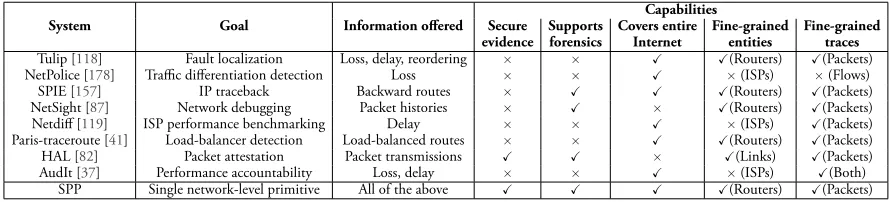
3.1 Comparison between SPP and some existing diagnostic and forensic
primitives. . . 34
3.2 Hardware cost for hashing and building MHTs. . . 43 3.3 Several applications we built with SPP, and the lines of code (LoC)
they required. e code can be found in the appendix. . . 49
4.1 Number of vertexes returned by five different diagnostic techniques;
for SDN4, the two rounds of DiffProv are shown separately. Diff-Prov was able to pinpoint the “root causes” with one or two
ver-texes in each case, while the other techniques return more complex
5.1 Repairs generated based on individual intents rarely satisfy the
op-erator’s overall intent, whereas NetGenie can generate effective re-pairs for all of our scenarios. An X/Y entry means that X rere-pairs
were generated for the intent in that column, and Y of them satis-fied the entire intent. Scenarios SDN2 and SDN3 only contain two
individual intents. e ‘Naïve’ column shows the probability that a random combination of repairs for e1–e3 individually will satisfy
List of Figures
1.1 An example network with two routers that run a routing protocol.
Alink(@X,Y,C) (route(@X,Y,C)) representation means that there
is a link (route) between X and Y with the cost of C. e routing
protocol computes network routes from links. . . 3
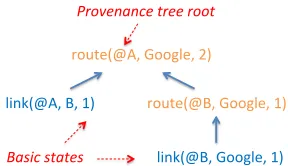
1.2 An example provenance tree that describes why there is a route
be-tweenA andGooglewith a cost of 2.. . . 4
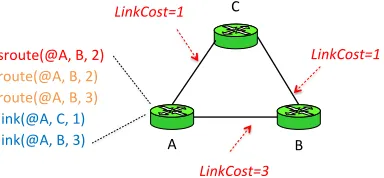
2.1 Another example network with a shortest-path routing protocol. . 14 2.2 e rules for shortest-path routing. . . 15
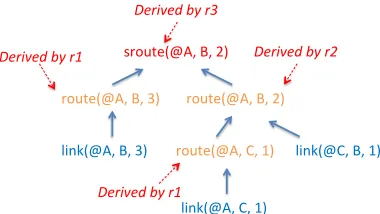
2.3 e provenance tree of the statesroute(@A,B,2). . . 16
3.1 Data flow in the commitment protocol. . . 29
3.2 Computation cost of SPP’s commitment protocol, normalized to the power of one core. e cost of hashing dominates. (e other
bars are too low to see.) . . . 42 3.3 Computation cost for different packet sizes in the two traces with
3.4 Bandwidth consumption of SPP’s commitment protocol, as a
frac-tion of the raw link capacity. . . 45
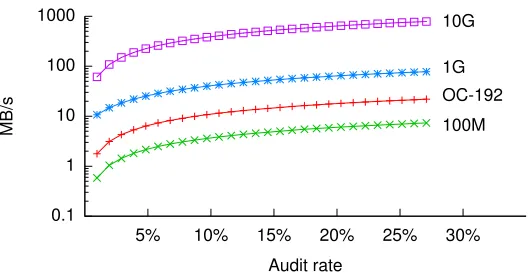
3.5 Data rates for different auditing ratesϕ. . . 46
3.6 Computation cost for answering queries. . . 48
3.7 Code for tracing a packet’s traversed path. . . 50
4.1 Example scenario (SDN debugging).. . . 62
4.2 An example provenance tree . . . 63
4.3 Provenance trees for P′ (a) and P (b) from Figure 5.1. Each circle corresponds to a box in Figure 4.2, but the details have been omitted for clarity. Although the two full trees have some common subtrees (green), most of their vertexes are different (red). Also shown is the single vertex in (a) that represents the root cause of the routing error that affectedP′. . . 63
4.4 Pseudocode of the DiffProv algorithm. e , , , and functions are explained in Sec-tions 4.3.2, 4.3.4, 4.3.5, and 4.3.6 respectively. e , , and functions are introduced to estab-lish equivalence between corresponding tuples in TG and TB (Sec-tion 4.3.3). . . 72
4.5 A simplified example showing the differential provenance for a one-step derivation. A(1,2), A(2,2) are the seeds; equivalent fields are underlined, and differences are boxed. Differential provenance transformsB(1,2,3)intoB(1,2,4)to align this derivation. . . 74
4.6 Logging rate for different traffic rates. . . 88
4.7 Logging rate with different packet sizes at 1Gbps. . . 89
4.9 Decomposition of DiffProv’s reasoning time. For SDN4, we have
stacked its two rounds together. . . 92
5.1 An example SDN network. . . 100
5.2 An example diagnostic intent. . . 101
5.3 e workflow of intent-based diagnostics. . . 102
5.4 Algorithms for constructing causal networks, and for finding repairs. 105 5.5 An example causal network constructed from a repair intent. . . . 108
5.6 Pseudocode of the NetGenie algorithm. . . 113
5.7 Syntax of the Aladdin language. . . 114
5.8 e size of snapshots grows (mostly) linearly with the number of flow entries in the network. . . 120
5.9 e repair generation speed for different scenarios. NetGenie re-turns an answer within one minute in all cases. . . 122
5.10 A decomposition of NetGenie’s reasoning latency. . . 123
7.1 Code for tracing a received packet’s reverse path. . . 149
7.2 Code for identifying the node that dropped a packet. . . 149
7.3 Code for attesting to the transmission of a packet. . . 149
7.4 Code for identifying the link on a path with the highest delay. . . 150
1
Introduction
Distributed systems have become critical infrastructure in our life. ey enable
many important network services, including online banking, video streaming, and electronic medical records, and they interconnect a wide range of devices,
rang-ing from desktop computers, mobile phones, to Internet-of-rang-ings devices, such as networked printers and cameras. Over time, these systems have also grown in
size and complexity – commercial data centers typically consist of tens of thousands of servers [19], and even campus networks can have hundreds of thousands of ac-cess control list rules and forwarding entries [101]. Moreover, due to the advent of Software-Defined Networks (SDN), today’s distributed systems are also highly
dynamic, as their configurations can be constantly changed by software controllers. In such large-scale, complex systems, many things can go wrong. As the many
routes to a large portion of the Internet and caused disconnectivity for two hours. In
a more recent case, Amazon’s S3 storage service went down for more than four hours simply due to a mistyped command, bringing down 150,000 websites with it [3]. ese outages are very costly – major data centers can lose half a million dollars in a five-minute outage [1], and Amazon’s typo command alone was estimated to have caused an overall economic loss of $150 million [2].
To respond to these problems, network operators need to perform diagnostics –
understanding why a symptom event came about, e.g., why a packet was misrouted, identifying the problem root cause, e.g., a certain misconfigured flow entry, and
rolling out a fix to bring the network back to a good state. Unfortunately, this can be quite challenging due to the complexity of today’s distributed systems. Blindly
digging through system logs and configurations is no easier than finding needles in a haystack. Operators’ jobs would be easier if there is a way to understand the causal
relations between network events. However, this is not straightforward in a com-plex network, because it requires reasoning about the interplay between a myriad
of factors in the network, and problems can happen due to seemingly “off-path” causes [162]. e difficulty in reasoning about causality also complicates the net-work repair process, because pushing out a configuration change has netnet-work-wide effects and may accidentally cause damage. In fact, there is no shortage of
“death-by-recovery” incidents from major data centers [62,72,129].
Adding to this complexity, problems can also happen due to adversarial attacks,
ranging from brute-force Denial-of-Service (DoS) attacks [26] to vulnerability ex-ploits [61] to subtle side channel [164] or covert channel attacks [49]. Handling attacks is even trickier, because attackers may lie about their actions and plant false data to cover their tracks [10]. erefore, we also need the ability to perform
net-workforensicsto track down attackers. Forensic techniques need to be robust even in
A" B"
link(@B,"Google,"1)" link(@A,"B,"1)"
link(@B,"A,"1)"
route(@X,"Y,"cost)":9"link(@X,"Y,"cost)"
route(@B,"Google,"1)" route(@B,"A,"1)"
route(@A,"B,"1)" route(@A,"Google,"2)"
route(@X,"Y,"cost)":9"route(@X,"Z,"cost1),"link(@Z,"Y,"cost2),"cost=cost1+cost2" Rou$ng'protocol:'
Figure 1.1: An example network with two routers that run a routing protocol. A link(@X,Y,C)(route(@X,Y,C)) representation means that there is a link (route) be-tween X and Y with the cost of C. e routing protocol computes network routes from links.
1.1
A provenance-based approach
Over the years, researchers have proposed many systems to implement different diag-nostic and forensic tasks [118,110,37,157,113,41,98,99,162,64,80,119,135], but they tend to be point solutions that address specific problems. For instance, IC-ING [135] proposes to extend the Internet architecture so that users can validate network paths that packets have taken, NetReview [80] proposes to allow network domains to audit each other, detect BGP problems, and attribute the problems to
misbehaving domains, Paris-traceroute [41] aims to uncover load-balanced paths in the Internet, and Netdiff [119] aims to measure and compare performance differ-ences of ISPs. Each of these tasks represents an important goal. However, many of the existing solutions tend to be problem-specific – solutions developed for one
task rarely help with other tasks. As a result, in order to address all identified prob-lems, it is necessary to deploy all solutions, which can be cumbersome and costly.
Moreover, sometimes, the proposed solutions may require extensions that are in-compatible with each other.
link(@B,)Google,)1)) link(@A,)B,)1)) route(@B,)Google,)1))
route(@A,)Google,)2))
Provenance)tree)root)
Basic)states)
Figure 1.2: An example provenance tree that describes why there is a route between Aand Googlewith a cost of 2.
At a high level, provenance tracks causality between network states and events in
the form of a directed graph, where vertexes represent network states and events, and edges represent causality. Consider the network in Figure 1.1 as a simplified
example, which consists of two routers (each with its local routing table), two links, and a server. When applied to this scenario, provenance would track the causality
between routes and links, based on how the routing protocol executes.
Such tracked causality can be helpful for diagnostics and forensics, because it
can explain why a certain network state or event came about – for instance, how a particular route was computed. A user can ask provenance queries, e.g., about a
certain route, and the provenance system would return itsprovenance tree, where the root represents the event of interest, its children represent the direct causes, until we
arrive at the leaves in the tree, which represent basic states and events in the network. Figure1.2shows an example provenance tree forroute(@A,Google,2), or the route
betweenAandGoogle with a cost of2, in the example network in Figure1.1. Since network provenance only tracks the relevant factors for a particular diagnostic task,
operators can safely leave out any irrelevant factors. For instance, to understand why the route was computed, an operator can narrow down her focus to the nodes
present in the route’s provenance tree.
explains why a certain expected network event failed to happen. However, there are
at least three challenges that have not been addressed in previous work. First, basic provenance does not provide the security and privacy properties needed for Internet
diagnostics and forensics, where networks span multiple domains, carry high-speed data, and could even be compromised. SNP [180] is a useful starting point for secur-ing provenance data, but it does not scale to high-speed traffic on the Internet’s data plane, nor does it provide the privacy properties needed in multi-domain setting.
Second, existing work has mostly focused on maintaining network provenance, but not how to leverage it for root-cause analysis. In a large-scale distributed system, the
provenance of an event of interest can be quite complex [169]. erefore, having the provenance data is not enough, as operators still face the challenge of identifying
a concise “root cause” from the complex provenance. Last but not least, provenance by itself only explains how a current network state came into existence, but it does
not reason about potential ways of changing the network state tofixa problem while avoiding undesirable side effects caused by the change.
1.2
Thesis
In this dissertation, we argue that network provenance can be a powerful tool that
en-ables better support for network diagnostics and forensics, and we demonstrate this by developing novel techniques and systems that address the identified challenges.
First and foremost, in order to use provenance for Internet diagnostic and forensic tasks, we need to capturesecure provenance data in high-speed networks. is requires
addressing two challenges: a) overhead, and b) privacy. Since the Internet’s data plane has very high data rates, capturing secure provenance on the data plane can
lead to substantial computation and storage overheads. Moreover, since there is often a need to perform diagnostics and forensics across domains, the diagnostic process
necessary security and privacy properties.
Second, although having a practical provenance system can be helpful, the abil-ity to capture provenance is only a starting point. In large-scale distributed systems,
the provenance of an event of interest can also be quite complex: in many SDN scenarios, for instance, typical provenance trees can contain hundreds or even
thou-sands of tuples [169]. Operators still need additional help in digesting the collected provenance when performing diagnostics. erefore, we need to develop techniques
to process the provenance data andidentify the root cause of a network problem. Ultimately, network operators need to find a repair to fix network problems.
Provenance by itself merely explains why the current network state came into exis-tence, but it does not offer support to reason about repairs, or changes, to the current
state. is step is challenging because the repair process can have network-wide ef-fects – it is necessary to ensure that a repair not only just fixes the symptom at hand,
but also does not cause undesirable side effects elsewhere in the network. erefore, we need to develop techniques that generatehigh-quality network repairs that avoid
collateral damage to the network.
1.3
Contributions
In Chapter2, we start by discussing related work on network diagnostics and foren-sics, and introduce more background on network provenance. We then address the
challenges identified above and make the following contributions:
1. In Chapter 3, we presentsecure packet-level provenance, a system that can pro-vide security and privacy properties on high-speed Internet traffic.
Our key insight is that many identified diagnostic and forensic tasks share a
We show that SPP can support a wide range of diagnostic and forensic tasks
in the Internet. Using software and hardware prototypes, we also demonstrate that SPP has low computation, storage and bandwidth overheads.
2. In Chapter 4, we present differential provenance, a technique to identify the root causes of network problems from complex provenance data.
Our key insight is that network problems are often anomalies rather than the
norm, so we typically have “working” and “non-working” instances ready avail-able – for instance, a packet that was misrouted, and a similar packet that was
routed correctly. When such “reference” events exist, it is often effective to reason about the differences between the provenance of the symptom event
and of the reference event to identify the root causes.
We present an algorithm that can generate differential provenance, and a sys-tem called DiffProv that implements the algorithm. Our evaluation in the
context of SDNs and Hadoop MapReduce demonstrates that DiffProv can identify problem root causes very accurately.
3. In Chapter 5, we propose causal networks – a generalization of provenance – that can generate network repairs while avoiding undesirable side effects.
Our observation is that network operators often expect a successful repair to
satisfy multiple constraints – for instance, the repair should make a server re-ceive DNS traffic, and another server to rere-ceive HTTP traffic. Existing
prove-nance systems only reason about individual events, not complex goals that in-volve multiple events. We add support for this capability by generalizing
net-work provenance to causal netnet-works, which can encode multiple constraints in a single data structure, and be used to generate network repairs that satisfy
complex diagnostic goals simultaneously.
algo-rithm. Our evaluation shows that NetGenie can generate repairs for SDNs
without causing collateral damage.
2
Background
In this chapter, we discuss related work on network diagnostics and forensics in
Section2.1, and we then provide more background on provenance in Section 2.2, as well as its applications in distributed systems in Section2.3.
2.1
Network diagnostics and forensics
Over the years, many researchers have considered the problem of network diagnostics and forensics, and addressed a variety of challenges in this space.
2.1.1 Network diagnostics
Many debuggers have been proposed for diagnosing distributed systems. Like
packets and send them to centralized NetSight servers. e servers can then answer
diagnostic queries on what happened to a particular packet. SDN traceroute [28] considers the problem of performing traceroutes without causing the network state
to change upon the probe traffic. CherryPick [161] also traces packets in SDNs, and it aims to reduce the tracing overhead by only recording a small number of
traversed links that can represent an end-to-end path. OFRewind [171] provides a record-and-replay technique in SDNs that can generate traces that are temporally
consistent in split forwarding architectures such as OpenFlow. X-Trace [66] is a tracing framework that can tag network operations with task identifiers, and trace
the requests across different layers of a distributed system.
Debugging can also be done by dynamic testing, such as in ATPG [174], BUZZ [63], DEMi [150], and MCS [151]. ATPG [174] can generate a mini-mal set of test packets that can exercise all rules in a network for testing purposes.
BUZZ [63] can generate test cases for stateful networks with context-dependent policies, and help uncover policy violations. MCS [151] can identify a minimal sequence of inputs in SDNs that triggers a certain bug. DEMi [150] uses delta debugging to minimize faulty execution traces in distributed systems.
Statistical learning can also be an effective approach to diagnostics. NetMedic [97] uses an inference-based approach to find likely root causes based on historical
be-haviors of system components. PeerPressure [167] applies Bayesian estimation to configurations collected from a large number of machines in order to diagnose
2.1.2 Network forensics
Researchers have also worked on different aspects of network forensics. Source authentication and path validation systems are one class of forensic techniques.
AIP [34] uses self-certifying addresses to detect and prevent spoofed network traf-fic. Passport [113] can verify whether a certain packet originated from a particular source domain. SPIE [157] can trace a packet’s traversed path and determine the source of spoofed traffic. HAL [82] can attest to the transmission of a particular packet. ICING [135] not only authenticates the source addresses of network traffic, but also validates its traversed paths.
Performance accountability systems can help verify the SLA of service providers. Argyraki et al. [36] propose that, whenever a packet is dropped, the corresponding network component generates a feedback report (a “packet obituary”) that is sent back to the source; previous hops remember each packet for a short while and add
some path information when they see an obituary pass by. A later system, AudIt [37], adds the security features but drops the per-packet granularity in favor of aggregate
delay and loss rates. Network Confessional [38] provides similar properties, but allows individual domains to tune the amount of statistics reporting.
Researchers have also proposed solutions to address specific kinds of network mis-behaviors. For instance, Liberatore et al. [111] investigate the problem of child porn trafficking and propose to enhance the evidence of child porn possession by tagging application-level data with forensic tags, Glasnost [58] and NetPolice [178] perform end-to-end measurements to detect traffic differentiation, and Web Tripwires [145] introduces self-checks into web pages to detect in-flight modifications.
2.1.3 Verification and synthesis
Recently, there has been an active line of research that uses verification and synthesis techniques to ensure the correctness of networks before deployment, in contrast to
Verification can eliminate bugs for certain types of networks. Anteater [120], Header Space Analysis [101], NetPlumber [100], VeriFlow [102], and Libra [175] can perform static analysis on data planes and detect violation of a high-level
specifi-cation. Batfish [65] can derive data planes that would emerge from a set of configu-rations, and check whether desirable properties hold on these data planes.
Con-figChecker [31] and FlowChecker [30] convert network rules into Boolean for-mulas and check network invariants on them. Flowlog [137], NetKAT [35], and Kinect [104] are new domain-specific languages for programming SDNs.
Although verification can be a powerful technique, a full verification of complex
networks is still hard to achieve, and most existing verification efforts are restricted to stateless networks [101, 100, 102, 35]. Diagnostics and forensics, however, is a less ambitious goal – it does not aim to prevent problems from happening, and in return, these techniques are oftentimes applicable to more complex networks, even
distributed systems in general. Moreover, verification does not obsolete diagnostics, as they are orthogonal problems – if the verification process finds a violation, one
still needs to (manually) identify the root cause and roll out a fix.
e goal of synthesisis to produce a network that satisfies a high-level
specifica-tion. For instance, NetEgg [173] can synthesize SDN policies from from example scenarios, Condor [149] can synthesize network topologies that satisfy high-level requirements expressed in a Topology Description Language, [123] can synthesize network updates and their correct ordering. Like network verification, synthesis is
also restricted to relatively simple types of networks, and it requires a human oper-ator to explicitly write down her specification. Network diagnostics, on the other
2.2
Provenance
Now that we have provided a high-level overview on the literature on network
diag-nostics and forensics, we turn to introduce more background on provenancein this section.
e concept of provenance was first developed in the database community [47] to describe the origin and history of data. Over time, several notions of provenance
have been proposed [52], including why-provenance, where-provenance, and how-provenance, and they capture different aspects of the data lineage. Why-provenance
associates a query result with a set of database tuples that it has been computed with. One of its applications is to address the “view deletion” problem – finding a
set of input data items to delete, so that a result tuple in a particular view can be deleted [48]. How-provenance is a further generalization, as it also captures how the result tuple came about following the query execution steps. It has been used, for instance, in data sharing systems to assign trust to tuples according to how they
have been computed [75]. Different than why-provenance and how-provenance, where-provenance does not describe how a result tuple was computed, but rather
where a particular data field has been copied from. One example application of where-provenance is to propagate annotations from source data items to a particular
view [44].
Over the years, provenance has become a rich problem domain in the database
community. Green et al. [74] lay the theoretical foundation of provenance as a semiring algebraic structure, and Amsterdamer et al. [32] further extend the struc-ture to semimodules to capstruc-ture aggregate queries. Meliou et al. [125,124,126] use provenance to analyze how to make a particular query answer appear or disappear,
A" B"
link(@A,"C,"1)"
route(@A,"B,"3)" route(@A,"B,"2)"
C"
link(@A,"B,"3)"
sroute(@A,"B,"2)" LinkCost=1+ LinkCost=1+
LinkCost=3+
Figure 2.1: Another example network with a shortest-path routing protocol.
In fact, provenance has found its use in many other application domains beyond
databases. In an operating systems context, LPM [43] maintains provenance in the Linux kernel and uses it for data loss prevention. For storage systems, PASS [132] leverages provenance to detect system changes and to perform intrusion detection, and Muniswamy-Reddy et al. [133] further extend PASS for cloud storage systems. On mobile platforms, Quire [57] tracks provenance on Android to defend against confused deputy attacks. For distributed systems, SPADE [69] is a middleware for cross-platform provenance collection, and ExSPAN [183] uses network provenance to explain why a certain network state came into existence.
2.3
Network provenance
is dissertation is particularly related to network provenance [183], which uses a
declarative networking model [115] that views networks and distributed systems as
databases, and network events and states as database tuples. Here, a distributed system consists of a set of nodes that are interconnected by a network, and they
communicate with each other by sending and receiving messages. Each node has a set of states, or tuples, that are stored in a database. For instance, BGP routers would
have arouterelation, and an entryroute(@X,Y,C)in the relation would mean that router X has a path to router Y with cost C. e symbol@ describes the distributed
r1: route(@S,D,C) :- link(@S,D,C)
r2: route(@S,X,C) :- route(@S,X,C1), link(@X,D,C2), C=C1+C2 r3: sroute(@S,D,MIN<C>) :- route(@S,D,C)
Figure 2.2: e rules for shortest-path routing.
exists a link with a cost of C between two routers can be represented by a tuple
link(@X1,X2,C). ere is also a set of extensional tuples that are derived from the
intensional tuples; for instance, a one-hop route route(@X1,X2,C) can be derived from a direct linklink(@X1,X2,C). In Figure2.1, we show an example network that
is slightly more complex than our earlier example in Figure1.1.
e nodes run a distributed protocol that specifies how tuples should be derived
when and where; derived tuples can also be sent and received via the network as mes-sages. e distributed protocol can be written as a set of declarative rules in Network
Datalog (NDlog) [115], which is a Datalog variant with an extension that specifies tuple locations with the @ symbol. NDlog rules are of the form q:-p1,p2,···,pk,
which means that the head tupleq(i.e., the conclusion) should be derived whenever the body tuples p1through pk (i.e., the predicates) are all present.
For instance, consider the shortest-path routing protocol shown in Figure 2.2
with three rules. e first rule, r1: route(@S,D,C) :- link(@S,D,C), describes
that whenever there is a link fromStoD with the costC, a one-hop route fromSto
D with the same cost should be derived. e second rule, r2: route(@S,D,C)
:-route(@S,X,C1),link(@X,D,C2), C=C1+C2, describes that a route fromStoDwith
a cost of Ccan be derived by a route fromSto an intermediate hop Xwith a cost of
C1, together with a direct link from X to D with a cost of C2, where C=C1+C2. e
final rule,r3: sroute(@S,D,MIN<C>) :- route(@S,D,C), describes that the shortest
distance fromStoDis obtained by aggregating all routes between them and picking the minimum cost.
inser-link(@A,)C,)1)) link(@A,)B,)3))
route(@A,)B,)2))
sroute(@A,)B,)2)) Derived'by'r3'
Derived'by'r1'
route(@A,)B,)3))
route(@A,)C,)1)) link(@C,)B,)1)) Derived'by'r2' Derived'by'r1'
Figure 2.3: e provenance tree of the statesroute(@A,B,2).
tions and deletions. An execution is always triggered by the insertion or deletion of
base tuples, which are entries in the intensional relations, or external events, e.g., a
network operator installs a new configuration, a packet arrives at a border router,
etc. ey will then trigger a set of NDlog rules, and generate additionalderived tu-ples in the extensional relations, e.g., a new configuration results in a routing table
update, a received packet gets forwarded to the next hop, etc. NDlog programs are executed using pipelined semi-naïveevaluation [115], where each received tuple can be immediately processed. We also assume that, after a set of updates, the system eventually stabilizes and converges to a fixedpoint.
is declarative model makes provenance very easy to see. For instance, Fig-ure2.3shows the provenance tree of the routing statesroute(@A,B,2)on the nodeA
in Figure2.1. It can be interpreted as follows. e shortest-path routing protocol has derived a routing state sroute(@A,B,2) from route(@A,B,2) and route(@A,B,3)
using the rule r3. erefore, the provenance of sroute(@A,B,2) is simply the ex-istence of the statesroute(@A,B,2)androute(@A,B,3), as well as the execution of
the ruler3. In turn, the provenance of the stateroute(@A,B,2)is the application of rule r2 on the states route(@A,C,1)and link(@C,B,1), where nodeC is the
inter-mediate hop betweenA and B. Finally, the provenance of the states route(@A,B,3)
and route(@A,C,1) is the application of r1 on the basic states link(@A,B,3) and
on network provenance by tackling a set of challenges in maintaining and querying
provenance in a distributed setting, and showing that network provenance is prac-tical for a range of distributed protocols, such as BGP and Chord. DTaP [182] further adds a temporal dimension in the provenance data, because network states – unlike traditional database tuples – tend to be short-lived. SNP [180] addresses challenges that arise due to adversaries in distributed systems that may corrupt or fabricate provenance data. Y! [169] uses counterfactual reasoning to explain why a missing event in a distributed system failed to happen. Meta provenance [168] generalizes the notion of provenance to capture both data and program code to
re-pair SDN controller software. Chen et al. [51] propose a technique to compress distributed provenance data for storage savings. is dissertation is related to these
work on network provenance, and indeed, builds on some of the above projects; but it addresses several open challenges in network provenance, as we have explained in
3
Secure Packet Provenance
Diagnostics and forensics were not among the top priorities for the original design of
the Internet [53], and as a result, the architecture offers relatively little direct support for them. At the interdomain level, the only features that are likely to be available
are ICMP and a few IP header options, and even these are often disabled [81] or implemented inconsistently [153]. us, when an operator encounters a problem that is not limited to her own network (such as bad performance on a given path), there is relatively little tool support; the best option is still often to post a message
to a mailing list like NANOG, or to call other operators on the phone.
Over the years, a variety of diagnostic and forensic challenges have been
which is difficult to diagnose without network-level support.
In the absence of direct support from the network, most existing work takes one of the following two approaches. e first is to approximate the missing
functional-ity by creatively “abusing” a feature that exists for some other purpose (such as cer-tain header options [153] or ICMP responses [41]). is is often surprisingly effec-tive, but it typically relies on underspecified behavior and/or idiosyncrasies of certain router implementations, which can diminish data quality and require an enormous
amount of ingenuity to work around (e.g., [153, 98]). e second approach is to extend the architecture with a new feature of some kind (e.g., [135, 34]), such as a new protocol, header field, etc. Such extensions provide a “clean” solution for the problem at hand, but deploying new features in the entire network is extremely
difficult – so difficult, in fact, that hardly any of the proposed solutions have been widely deployed so far. To make matters worse, existing proposals typically focus on
solving one particular problem and do not help with any of the other diagnostic and forensic problems that have been identified; thus, a comprehensive solution would
require deploying all of the proposed extensions in combination. Given the ISPs’ reluctance to make major changes to the network, this seems unrealistic.
In this chapter, we ask the following question: If ISPs were willing to deploy
only one new primitive in the network to help with diagnostics and forensics, what
should that primitive be? Our key observation is that, while the existing solutions seem very different at first glance,they all essentially answer variants of the same
ques-tion: “What were the causes and/or effects of a given past event in the network?”. If
the network could remember recent events (such as packet transmissions) and the
corresponding causes and effects, even for a short amount of time, many forensic problems would be easy to solve. For instance, reverse traceroute [98] could locate the source of packet drops simply by following packets on their way from the sender to the receiver (and potentially back), and note the point at which they no longer
instance, WhyHigh [110] could find the source of high latencies by inspecting the differences between packet transmission and arrival times, and Netdiff [119] could calculate the throughput on each path segment to find the bottleneck. However,
this processing could be done at the edge without further changes to the core. ere is one additional feature that some forensic systems require: the ability to
prove the correctness of a given answer [80, 180, 113, 34, 135]. is is necessary
because attackers may falsify evidence to cover their tracks [109]. Although the strength of proofs and the properties being proven sometimes vary, in essence they are all concerned with the presence or absence of particular entries in our hypothetical
ledger: for instance, the PoPs in ICING [135] essentially correspond to a chain of entries that connects a packet to a particular sender, the signatures in Passport [113] and AIP [34] correspond to the beginning of this chain, and the logs in SNP [180] correspond to causal connections along the chain.
is commonality suggests that it may be possible to deploy asingleprimitive in the network, once and for all, and then re-implement the previously proposed
diag-nostic and forensic systems as “applications” on top of it, without further changes to the network core. In this chapter, we propose one specific candidate for such a
primitive that we call secure packet provenance (SPP). SPP is based on the concept of data provenance from the database literature [47], which has already been used for diagnostics and forensics in other contexts, such as operating systems [89] and distributed systems [180, 183, 170]. However, as we show experimentally in Sec-tion 4.5, existing solutions would be completely overwhelmed with the high data rates at the network data plane. SPP solves this problem by avoiding cryptographic
operations on the fast path and by relying mostly on ephemeral state; as a result, it outperforms the state-of-the-art secure provenance system by several orders of
mag-nitude.
plemented a concrete protocol that could provide SPP in the Internet. Other than
a small link-layer header, our protocol does not require any changes to the current data plane and can be implemented efficiently in hardware. (We demonstrate this
with a NetFPGA prototype that runs at 10 Gbps.) We also used SPP to approxi-mate six different diagnostic primitives from the literature, and we show that with
SPP, each primitive can be implemented with just a few lines of code. Our main contributions are:
• Two architectural insights: that a single shared primitive can support a wide variety of diagnostic and forensic tasks, and that provenance is a good candidate
for such a primitive (Section5.1);
• the definition of a secure provenance model for the Internet’s data plane (Sec-tion3.2);
• SPP, a concrete protocol for maintaining secure provenance (Section 5.3);
• case studies showing that SPP can approximate a number of existing diagnostic systems (Section3.4);
• software and hardware prototypes (Section4.4); and
• an experimental evaluation, as well as proof-of-concept implementations of six
diagnostic primitives on SPP (Section4.5).
We discuss deployment strategies and their implications in Section 3.7, and we
present related work in Section4.6.
3.1
Overview
Diagnostics and forensics were not among the top priorities for the original
Inter-net [53], as it was small in scale and experimental in nature. But today’s Internet, with its broad range of applications, has attracted problems of all kinds [144, 110,
thumbnail images [16] are serving as evidence; due to the lack of reliable forensics, innocent users have been falsely accused of wrongdoings [160, 16,22]. We believe that it is time to add better support for diagnostics and forensics.
3.1.1 Goal: A single primitive
ere is a rich body of work on diagnostic and forensic systems that solve specific variants of this problem, typically by extending the Internet in one way or
an-other [110, 34, 38, 41, 58, 59, 82, 87, 113, 98, 118, 130, 135, 145, 148, 157,
159,178]. However, the resulting variety of problem-specific, mutually incompati-ble extensions represents a challenge for widespread deployment. Hence, rather than trying to improve any individual one of these systems, we ask: Is there a single
prim-itive that could be added to the Internet to solve a wide range of diagnostic and forensic
challenges? Such a primitive would not necessarily match the efficiency of the more
specialized solutions, since a shared primitive would need to provide a strict super-set of the functionalities of the individual primitives; but it could certainly be more
efficient than deploying all of them together. Moreover, if so many existing diagnos-tic and forensic systems are based on some variant of this primitive, we have good
reasons to believe that it will be useful for solving future, as-yet-unknown foren-sic challenges as well – which is a key requirement for any possible addition to the
network architecture.
In this chapter, we propose secure packet provenance as a candidate for such a
primitive. At a high level, provenance [47] tracks how data flows through the net-work by recording each event, e.g., the transmission of a packet, or the installation
of a new route, and its direct causes and effects. With this information, any event of interest can be explained by recursively looking up the causes of the event until a
provenance even in adversarial settings.
3.1.2 Challenges
Intuitively, maintaining a secure provenance graph for the Internet would be suffi-cient for diagnostics and forensics, since it contains a complete and accurate
descrip-tion of what happened, why, when, and where. However, two key challenges need to be solved to make this approach practical.
Challenge #1: Overhead. A complete provenance graph of the entire Internet data plane would quickly consume any amount of space that could realistically be
pro-vided. We propose to solve this by keeping the full provenance only very briefly, and by offering a way to save (and later authenticate) any parts of the graph that
are relevant for ongoing diagnostic and forensic tasks. To keep the computational overhead low, our proposed solution relies mostly on cryptographic primitives that
can work at high speeds, such as hashing, and it applies several optimizations, such as batching.
Challenge #2: Privacy. Collecting all the provenance in a central location would be a privacy disaster. Our proposed solution avoids this by distributing the graph,
and by allowing each network-level component to keep the part of the graph that pertains to itself. Also, we do not allow “global” queries of the form “show me all the
packets that Bob sent” – users can only explore the provenance graph hop by hop, starting from a vertex they already know about. In effect, users can only query the
provenance of packets they have already seen in their entirety. Moreover, we allow ISPs to restrict the visibility of their own subgraph; for instance, an ISP might permit
its local admins to see its complete provenance, including routing policies and link statuses, but it might limit queriers from other domains to only forwarding-related
3.2
The provenance graph
We begin by defining the data model for the provenance information we wish to
provide. A common way to represent the provenance is as aprovenance graph[183] – a DAG in which each vertex represents an event and edges connect causes to effects.
In this graph, the explanation of an event is simply the tree that is rooted as the corresponding vertex.
3.2.1 What is the right layer?
For a single provenance model to work for heterogeneous networks, it needs to be detailed enough to encode useful debugging information, but also general enough
to abstract away hardware-specific features. We observe that this challenge resembles that of the original Internet, which needed to interconnect a variety of different
net-work types and protocols. e answer in the original design was IP’s “narrow waist”, which was itself universal but permitted diversity at layers above and below. us, if
our provenance model captures the network’s operation at the IP layer, it will form a basis that different networks could agree on. As we will show in Section3.2.4,
op-erations on other layers can still be encoded as extensions to the IP-level provenance graph.
Network model: We model the network as a graph whose nodes are IP-capable
devices. Each node has a number of ports, which can be connected to ports on other nodes using links. Nodes can transmit packets on their ports to some or all of the
nodes that are connected to the corresponding (unicast or multicast) link. erefore, this model not only includes routers and middleboxes, but also end hosts. Packets
can be lost or corrupted in transmission, and nodes can mutate, duplicate, or drop any packet. Moreover, each node has a set of rules that decide how packets should
3.2.2 The provenance graphG
For clarity, we define the provenance graphG:= (V,E) from the perspective of a hy-pothetical global observer that can observe every single event in the network – i.e.,
every time a packet is sent or received, a link goes up or down, and a rule is inserted or deleted. Gis a DAG and contains one vertex for each event, as well as a directed
edge(v1,v2)wheneverv2causally depends onv1. Vertexes can have multiple
incom-ing edges; for instance, a node might send a packet on a particular port because a)
it received the packet earlier, b) it had a rule that matched the packet and specified this port, and c) the link on that port was up. Specifically, we define six vertex types,
using a provenance model similar to the one from DTaP [182]:
• When a linkl goes up/down on nodeN at timet, add a vertex (N,t,l) /
(N,t,l).
• When a nodeN adds/removes a ruler at timet, add a vertex (N,t,r) / (N,t,r).
• When a node N receives a packet p on port P at time t, insert a vertex
v:=(N,p,P,t) toV; also, find the vertexv1:=(N,t,l) for the linkl
that is currently connected toP, and add an edge(v1,v)to E.
• When a nodeNsends a packetpon portPat timet, add a vertexv:=(N,p,P,t)
toV. If p is sent because a packet p′ was previously received by N at timet′
on port P′ and is forwarded to port P because of a rule r, find the vertexes
v2:=(N,t′′,r) and v3 :=(N,p′,P′,t′) in V and add edges (v2,v)
and(v3,v)to E.
Gis, in effect, a complete chronicle of everything that happened in the network: in
principle, it is possible to “replay” the entire execution of the network in simulation. us, if a question can be answered in this very detailed simulation, it must also be
at the subtree that is rooted at it, the leaves of which are the “root causes” that, in
conjunction, have caused eto occur. Later, we will describe adistributed algorithm that maintains a close approximation of Gwithout assuming a central entity. is
is based on the observation that each vertexv∈Ghas a natural “home”: the nodeN
that appears as the first entry will store the vertexv.
3.2.3 Querying and evidence
We allow users to examine the graphGwith a query primitive (v) that returns
v’s adjacent vertexes in G. us, users could start with a vertex they know (say,
the transmission or arrival of a packet at their local node) and explore the graph by invoking recursively. However, recall thatG is distributed, and that each
node stores the vertexes that pertain to it. So a malfunctioning or compromised node could fabricate or destroy vertexes that it stores locally. To prevent this, nodes
are required to store not only the vertexes themselves, but also evidence to prove that the adjacent vertexes exist. e evidence ev of a vertex v can be thought of
as a statement that is signed by the “home” node of v saying that v is a part of G. Conceptually, nodes exchange evidence whenever they add an edge toGbetween two
of their vertexes. us, each node can use the evidence to prove to any third-party that the other end of the edge must exist inG.
Hence, we augment the query primitive with evidence. (v,ev) returns two
sets of vertexes: all the predecessors and successors ofvinG. Each returned vertexv′
is accompanied with evidence that 1)v′is inV, and that 2) the relevant edge ((v′,v)
for predecessors and (v,v′) for successors) is in E. As before, users can use
3.2.4 Extensions
e above data model only captures IP-level provenance. But as we discussed in Section3.2.1, operations above and below the IP layer can be encoded as extensions
to this basic provenance graph to support richer diagnostic and forensic capabilities. Below, we briefly sketch two examples.
Control-plane diagnostics: In the basic provenance model from Section 3.2.2,
changes to link statuses and rules are “root causes” that cannot be explained fur-ther. However, it would be easy to add more entries to the TELs to further explain
the provenance of these events. For instance, NetReview [80] already records a type of secure provenance for the BGP control plane; this provenance could be integrated
with the IP-level model to further explain the vertexes. Provenance tools that do not understand the new vertex types in the TEL could simply ignore them and
continue to treat the vertexes as basic events in the provenance graph.
Summarizations: To enable longer-term forensic queries, it could be useful to have a less detailed but smaller version of the IP-level provenance graph (say, a flow-level
version); thus, the detailed version could be discarded after a few seconds, while the aggregated version could remain available for hours, or even days. Our basic model
can accommodate such extensions by having routers commit to the basic graph and its summarizations simultaneously. As long as both endpoints of a link generate the
summarizations in the same way (e.g., by using the same sampling technique), they can verify correctness exactly as in the basic IP-level version.
Visualization: To help operators to better understand the diagnostic results, the
evidence can be displayed using provenance visualizers such as NetTrails [181].
3.2.5 DoesGreveal too much information?
End users might be concerned that could be used to spy on their traffic.
evidence for an adjacent vertex. So, in order to access the provenance of a packet p
that was sent from A to B, the querier must have some evidence of p’s existence – which is only available at the senderA, the recipient B, and the ASes along the path,
all of whom have already seenpin its entirety. us, there are only two cases: 1) the querier already knows that pexists, and what exactly it contains; in this case,
will reveal where pcame from, where it went, and what exactly happened along the way. Or 2) the querier does not yet know that pexists; in this case, the querier learns
nothing from because the invocation will fail.
ISPs could have similar concerns about the topology and the configuration of
their own infrastructure. But the Internet’s topology can already be learned in great detail today [153], so G does not reveal much additional information – it merely
reduces the effort that is needed to obtain it. Moreover, networks can protect policy-related information by hiding certain vertexes: each node can implement its own
policy to decide which vertexes should be hidden. For instance, a network may want to reveal and vertexes only to its own admins, and hide them from
users in other domains. us, each querier is presented with aviewof the provenance graph, and can explore only the parts that are visible to her. To preserve usability,
our provenance model prescribes that the and vertexes be included in any view. erefore, queries with a restricted view, e.g., inter-domain queries, can
only trace packet paths from the returned and vertexes; queries with an admin’s view, e.g., intra-domain queries, can additionally learn why, i.e., from the
and vertexes.
3.3
The SPP protocol
Rule table epoch buffer
incoming packets NIC buffer
H
forwarding
M
ac=on buffer
epoch buffer
H
MHT
MHT COMMIT COMMIT
Figure 3.1: Data flow in the commitment protocol.
3.3.1 Assumptions and threat model
We design SPP based on the following assumptions:
• ere is a hash functionH(·)that is pre-image resistant and collision resistant.
• Each nodei has a key pairπi/σi that can be used to sign messages. A nodei’s
signatures cannot be forged without knowingi’s private keyσi.
• If a link i→ jexists, then j has a back channel for sending a small number of messages back toi.
e first assumption could be satisfied, e.g., by SHA-256. e second assumption could be satisfied with a small extension to the RPKI. e third assumption holds
trivially for all bidirectional links; for other links, it could be satisfied by using a different link for the back channel.
reat model: We assume that nodes can fail or be compromised by a Byzantine
attacker, i.e., we make no special assumptions about the affected nodes, other than that they cannot break cryptographic keys. In particular, these nodes can drop, alter,
3.3.2 Commitment protocol
e purpose of the commitment protocol (illustrated in Figure 3.1) is to generate evidence for the provenance graph. e protocol runs between the two endpoints
A and B of each link A→B; bidirectional links run two separate instances of the
protocol, and nodes with multiple ports run separate instances for each local port.
By this protocol, A would be able to prove that the packets it has sent have been received by B, and B would be able to prove that the packets it has received were
indeed sent byA. is is done as follows.
Sender: A uses its local timer to divide time into epochs of some fixed length, e.g.,
100ms, and both A and B maintain a small number of epoch buffers in which they
record information about the packets they have sent or received. A begins a new epoch Ei by sending a message (i) toB. After that, whenever A sends a
packet pto B,Aappends the hashH(p)to the buffer and then prepends an index j
of packet in the epoch buffer as a small extra header before p. AendsEi by sending
message (i,n) toB, wherenis the total number of packets it has sent toB
in this epoch.
Receiver: Bhas meanwhile forwarded each packet as usual, but it has also recorded
in its own epoch buffer the hashes of all the packets it has received correctly – i.e., without link-layer errors or CRC mismatches – fromA; moreover, B has identified
any missing index numbers (by looking for gaps in the sequence of numbers) and has recorded these in a small separate buffer M, so it can later report them to A.
WhenA’s message arrives,Bcomputes a Merkle Hash Tree [127] (MHT) over the hashes in the epoch buffer, extracts the top-level hash h0, writes an entry
sB :=(A→ B,i,h0) to its tamper-evident log (see Section 3.3.3), and
returns a message (i,aB, (aB,sB),M) back toA. aB is anauthenticator
Agreement: WhileBis working on its commitments,Acontinues to forward
pack-ets, and it records the corresponding hashes in other epoch buffers to avoid being stalled. However, once the message arrives, A locates the corresponding
buffer, removes the packets with sequence numbers in M, and then computes a MHT over it in the same way as B, which should yield the same top-level hash
h0. Athen records an entrysA:=(A→B,i,h0,aB,(aB,sB))in its
local tamper-evident log and returns a (i, aA, (aA,sA)) message to B,
which records a (i,aA, (aA,sA)) entry in its log. At this point, A and B
have agreed on the set of packets that have been sent over the link in this epoch, and
they both hold evidence of this fact (the authenticators and hash chains) in their re-spective logs. Note that this does not attempt to make packet transmissions reliable,
but merely enables the endpoints to agree on the set of correctly transmitted packets.
Actions: Nodes not only have to remember each packet they received, but also what happened to it, so that it can be tracked down a path. SPP represents this
information as 1) a time offset to the beginning of the epoch to indicate the time when the packet was received; 2) a set of links to which the packet was forwarded
(i.e., to capture both unicast and multicast protocols), if any; and 3) for each such link, a list of rule identifiers and mutations that were applied. Such information is
collected inaction buffersthat are “parallel” to the epoch buffers. e nodes commit to their actions by building an MHT over the action buffer, just as it does for the
epoch buffers; and the top-level hashha0is recorded in an entry (A→B,i,ha0)
in its tamper-evident log, just after the entry.
SPP uses the action buffers to produce the vertexes that link a (p)
vertex to its (p′i)vertex. is is crucial because some nodes can apply mutations
to packets in transit: for instance, a NAT will change the port numbers and IP addresses in the header, and many routers will decrement the TTL field. In these