Nonlin. Processes Geophys., 16, 525–532, 2009 www.nonlin-processes-geophys.net/16/525/2009/ © Author(s) 2009. This work is distributed under the Creative Commons Attribution 3.0 License.
Nonlinear Processes
in Geophysics
Return-current formation in the electron beam – plasma system
M. Karlick´y and M. B´arta
Astronomical Institute, Academy of Sciences of the Czech Republic, 251 65 Ondˇrejov, Czech Republic Received: 4 May 2009 – Revised: 19 July 2009 – Accepted: 20 July 2009 – Published: 23 July 2009
Abstract. Using a 3-D electromagnetic particle-in-cell model an evolution of the electron distribution function in the beam-plasma system with the return current is computed. It was found that the resulting electron distribution func-tion depends on the magnetic field assumed along the beam-propagation direction. While for small magnetic fields the electron distribution function becomes broad in the direction perpendicular to the beam propagation due to the Weibel (fil-amentation) instability and the return current is formed by a shifted bulk distribution, for stronger magnetic fields the dis-tribution, especially on the return current side, is extended in the beam-propagation direction. To understand better the instabilities influencing the mentioned processes, the disper-sion diagrams are computed and discussed.
1 Introduction
It is commonly believed that electron beams accelerated in solar flares bombard dense layers of the solar atmosphere where they are decelerated and produce hard X-ray emis-sions (Brown et al., 1990). The electron beams with the estimated fluxes ofFE=109–1012ergs s−1cm−2 carry huge electric currents that have to be neutralized by the return cur-rents (Hoyng et al., 1978; van den Oord, 1990). There are two analytical concepts of the return current: (a) the return current is formed by all background plasma electrons hav-ing the same drift velocity – the Maxwell electron distribu-tion is shifted in the velocity space compared to the protons (e.g. Karlick´y and Henoux 1992), and (b) Rowland and Vla-hos (1985) proposed that the return current is formed by so-called runaway electrons. Formation of the return current has two physical aspects: (a) electric charge effects at the front
Correspondence to: M. Karlick´y ([email protected])
of the electron beam and (b) electromagnetic effects of the beam electric current (van den Oord, 1990).
Return-current effects on the dynamics of nonthermal electron beams and the heating of the flare atmosphere have been described and studied by Emslie (1980), Karlick´y et al. (1990), Karlick´y and Henoux (1992), and Zharkova et al. (1995). In the papers by Karlick´y and Henoux (2002), Henoux and Karlick´y (2003), Karlick´y et al. (2004), ˇStep´an et al. (2007) it was proposed that the polarization and en-hanced intensities of the chromospheric optical lines can be explained by a formation of the return current at chromo-spheric layers. It was found that the resulting intensities and polarization are very sensitive to the form of the electron dis-tribution function (with the return current), especially in the range of the excitation and ionization energies of these lines. Furthermore, the return current modifies the electron distri-bution function in the low corona and influences the intensi-ties of the EUV and soft X-ray lines observed during solar flares (see Dzifˇc´akov´a and Karlick´y, 2008).
In all the above mentioned papers the return current have been considered on time scales (seconds) much longer than those for the formation of the return current, and thus vari-ous approximations of the return current have been used. But now a much more detailed knowledge of the electron distri-bution function in the beam-plasma system is demanded, not only in the solar flare research, but everywhere the electron beams are studied.
526 M. Karlick´y and M. B´arta: Return-current formation
Fig. 1. The electron distribution functions in the whole
numeri-cal box (the crosses meansf (vz), dot-dashed line meansf (vx) or f (vy)) at four different times: at the initial state (a), atωpet=40
(b), at ωpet=100 (c), and ωpet=200 (d). The line in the part a) atv/c=0.666 means the monoenergetic electron beam (the δ-function). In the initial state the magnetic field corresponding to the ratioωce/ωpe=0.1 is considered.
Remark: The Weibel instability in the sense as used in these papers is also designated as the filamentation instability (Bret et al., 2005; Bret, 2009).
2 Model
For our study we used a 3-D (3 spatial and 3 velocity com-ponents) relativistic electromagnetic PIC code (Buneman, 1993). The system size isLx=451,Ly=451andLz=6001 (where1is the grid size).
We initiated a spatially homogeneous electron-proton plasma with the proton-electron mass ratio mp/me=16. (For comparison we made also some computations with mp/me=100.) This is unrealistic and it was chosen to shorten the proton skin depth and computations. Nevertheless, the ratio is still sufficient to separate the dynamics of elec-trons and protons well. The electron thermal velocity is vT e=0.06c(the corresponding temperature isTe=21.4 MK), wherecis the speed of light. In all models, 160 electrons and 160 protons per cube grid were used. The plasma frequency isωpe=0.05, and the electron Debye length isλD=0.61. The electron and proton skin depths areλce=101andλci=401, respectively.
Fig. 2. The electron distribution functions in the whole
numeri-cal box (the crosses meansf (vz), dot-dashed line meansf (vx) or f (vy)) at four different times: at the initial state (a), atωpet=40
(b), atωpet=100 (c), andωpet=200 (d). The line in the part a) at v/c=0.666 means the monoenergetic electron beam. In the initial state the magnetic field corresponding to the ratioωce/ωpe=0.7 is considered.
Then, we included one monoenergetic beam (homoge-neous in the whole numerical box). To keep the total current to be zero in these models in the initial states, we shifted the background plasma electrons in the velocity space accord-ing to the relationvD=−vbnb/ne, wherevbis the velocity of the electron beam, nband ne are the beam and background plasma densities (for this type of initiation, see also Niemiec et al., 2008). The beam velocity was chosen to bevb/c=2/3 (in thezdirection). The ratio of the beam and plasma densi-ties was taken asnb/ne=1/8.
Because we wanted to know an effect of the magnetic field, we varied the ratio of cyclotron and electron-plasma frequencies. The periodic boundary conditions were used.
All computations were performed on the parallel computer OCAS (Ondrejov Cluster for Astrophysical Simulations), see http://wave.asu.cas.cz/ocas.
3 Results of 3-D PIC simulations
M. Karlick´y and M. B´arta: Return-current formation 527
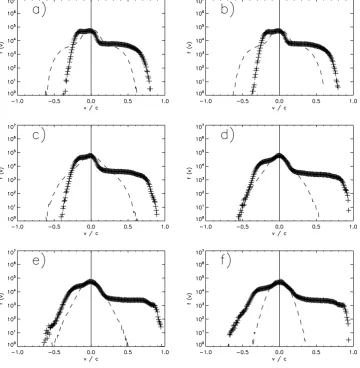
Fig. 3. The electron distribution functions in the whole numerical box (the crosses meansf (vz), dashed line meansf (vx)orf(vy)) at ωpet=200 in dependence on the magnetic field expressed through the ratioωce/ωpe=0.0 (a), 0.1 (b), 0.5 (c), 0.7 (d), 1.0 (e), and 1.3 (f), respectively.
propagation direction. As can be seen here due to the beam-plasma instability (Michailovskij, 1975) the plateau on the distribution functionf (vz)(in the beam propagation direc-tion) on the beam side is formed. Simultaneously, the distri-bution functionsf (vx)andf (vy), i.e. the distribution func-tions in the perpendicular direcfunc-tions to that of the beam prop-agation, are strongly heated. It is due to the Weibel insta-bility (1959) (see also the paper by Nishikawa at al., 2006). The return current in this case is characterized by a broad and shifted bulk of the distribution function.
In a further example, we increased the magnetic field strength to that corresponding to the ratio of the electron-cyclotron and electron-plasma frequency ωce/ωpe=0.7. A time evolution of the electron distributions in this case is shown in Fig. 2.
To see in more detail how the magnetic field influ-ences the resulting electron distribution function (at the time
ωpet=200), Fig. 3 presents the distribution functions for six values of the ratio of the cyclotron and electron-plasma frequencies (ωce/ωpe=0.0, 0.1, 0.5, 0.7, 1.0, and 1.3). It is evident that with an increase of the ratioωce/ωpethe role of the Weibel (filamentation) instability is more and more re-duced, the distribution functions in the perpendicular direc-tion to that of the beam propagadirec-tion f (vx)andf (vy)are less heated. On the other hand, the problem of the return current formation becomes more and more one-dimensional and more extended tail on the return current side is formed (compare Fig. 3a and f) (see also Karlick´y et al., 2008 and Karlick´y, 2009).
528 M. Karlick´y and M. B´arta: Return-current formation
Fig. 4. The electron distribution functions in the whole
numeri-cal box (the crosses meansf(vz), dot-dashed line meansf(vx) or f(vy)) atωpet=200 for two different beam velocities (vb/c=2/3 (a and b),vb/c=1/3 (c and d)) and two different ratioωce/ωpe=0 (a and c),ωce/ωpe=1.3 (b and d).
Table 1. The estimated growth rates for the two-stream and
fila-mentation instabilities in dependance on the magnetic field.
ωce/ωpe γt wo/ωpe γf il/ωpe
0.0 0.11 0.23
0.5 0.14 0.15
1.3 0.21 0.08
Now, to understand better what instabilities are dominant in the evolution of the systems under study, we made the di-agnostics as follows:
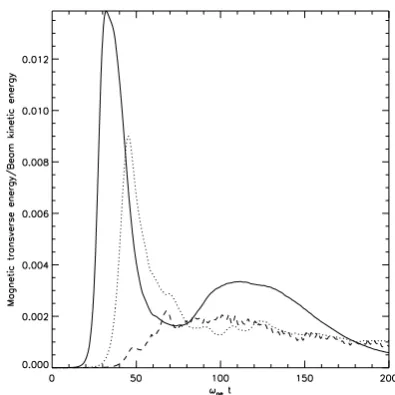
In Figs. 5 and 6 we compare the time evolution of the electric field energy in the whole numerical box in the z-coordinate (the electrostatic wave energy) and the magnetic field energy in the perpendicular direction to that of the beam propagation for three values of the ratioωce/ωpe=0, 0.5, and 1.3. As seen here, while the role of the two-stream instability increases with the increase of the magnetic field, the impor-tance of the Weibel (filamentation) decreases. It is due to the fact that the magnetic field stabilizes the beam against per-pendicular perturbations. Using results presented in Figs. 5 and 6 we estimated the growth rates of both the instabilities and results are summarized in Table 1. For comparison the growth rate of the cold beam – plasma instability is given by the relation (Michailovskij, 1975):
Fig. 5. The electric field energy in the z-coordinate for three values
of the ratioωce/ωpe=0 (full line), 0.5 (dotted line), and 1.3 (dashed line).
Fig. 6. Magnetic field energy in the perpendicular direction to the
beam propagation for three values of the ratioωce/ωpe=0 (full line), 0.5 (dotted line), and 1.3 (dashed line).
γ /ωpe= √
3(nb/ne)1/3/24/3 (1)
M. Karlick´y and M. B´arta: Return-current formation 529
Fig. 7. Examples of the structure of the electric current (jxcomponent) (the full and dashed contours mean positive or negative values) at ωpet=40 for two values of the ratioωce/ωpe=0 (left panel) and 1.3 (right panel). The y- and z-coordinates are in grids.
530 M. Karlick´y and M. B´arta: Return-current formation
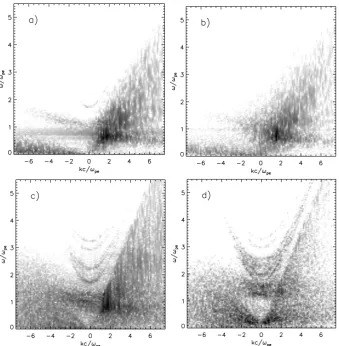
Fig. 9. The dispersion diagrams for the electric fieldEz(a and c) andEx(orEy) (b and d) forkparallel to the magnetic field and electron beam propagation (z-coordinate) in the time intervalωpet=0–200 for two values of the ratioωce/ωpe=0.0 (a and b) and 1.3 (c and d). The mass ratiomi/me=100.
In all cases presented in Figs. 5 and 6, first, the energies exponentially increase (linear phase of instabilities) and then after their saturation they decrease (nonlinear phases). In Fig. 6 it is interesting to see that the magnetic field energy has a second maximum in the nonlinear phase of the Weibel (filamentation) instability.
Generally the saturation maxima of the magnetic field en-ergies (Fig. 6) are much lower than those of the electric field energies (Fig. 5). Nevertheless, it is interesting that for low values of ωce/ωpe=0 and 0.5 the magnetic field energies grow earlier than the electric field energies. Both the men-tioned instabilities compete and interact in the studied sys-tems. Another evidence of the presence of the Weibel (fila-mentation) instability is the formation of structured electric currents, see Fig. 7, where an example of such a structure in the model with zero magnetic field (left panel) is compared with the case with no such a structure (right panel) (see sim-ilar structures in the paper by Nishikawa et al., 2003).
Because in our systems the velocity of the shifted Maxwell distribution of background plasma electrons vD is greater than the thermal velocity, the return current can be unstable even for the Buneman instability. Furthermore, there exist further instabilities which can play a role in the studied sys-tem, see the extended analysis by Bret (2009). In later phases of evolution of the system even electrostatic double layers can be generated and thus influencing a transport of energetic electrons through the plasma (Lee et al., 2007, 2008).
M. Karlick´y and M. B´arta: Return-current formation 531 more separated, or the change ofmi/mecauses that the
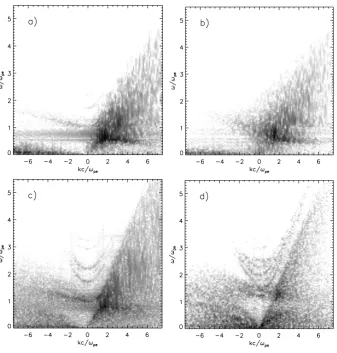
max-imum growing modes are better fitted with chosen numerical grids. The strongest wave modes generated are the Lang-muir waves, see the black feature close toω/ωpe∼0.8 and kc/ωpe∼1.5 (a crossing of the Langmuir and beam branches) in agreement with the resonance condition:ωpe≈kvb, where vb is the beam velocity (see Figs. 8a and 9a). In the cases with the magnetic field the electromagnetic branches ap-peared (see Figs. 8c, d, 9c, and d at the frequencies greater ωpe). Some wave energy is accumulated also in low fre-quency waves (ω/ωpe≤1) (Figs. 8d and 9d). Even it looks that the whistler waves are generated, see branches in the re-gionω/ωpe≤1 andkc/ωpe∼(−3–3) in Fig. 9d.
4 Conclusions
The presented results show that the beam-plasma system with the return current is under play of many instabilities: two-stream, Weibel (filamentation), current-driven and so on in agreement with the analysis made by Bret (2009) and Lee et al. (2007, 2008). Due to these instabilities the electron distribution function and return current evolve. While the two-stream instability is important in all presented cases, the filamentation instability is reduced for the strong magnetic field (ωce/ωpe≈1). On the other hand, for weak magnetic fields (ωce/ωpe≤0.1) the filamentation instability strongly heats the electrons in the direction perpendicular to that of the beam propagation. Simultaneously, the distribution func-tion of the return current changes from that with the extended tail (for strong magnetic fields) to the return current formed by a broad and shifted bulk of the electron distribution func-tion (for weak magnetic fields). Furthermore it was found that for the cases with strong magnetic field also low fre-quency modes are generated (whistlers?). But a disentan-gling of these modes and understanding of their roles in the studied processes need more sophisticated models.
Finally, we can conclude that the found variations of the distribution functions should influence the intensities of EUV and soft X-ray lines formed in the fully ionized plasma in the coronal parts of solar flares.
Acknowledgements. This research was supported by the Center
for Theoretical Astrophysics, Prague and by Grant IAA300030701 of the Grant Agency of the Academy of Sciences of the Czech Republic. The author thanks to all three referees for constructive comments that improved the paper.
Edited by: J. B¨uchner
Reviewed by: K.-I. Nishikawa and another anonymous referee
References
Bret, A.: Weibel, two-stream, filamentation, oblique, Bell, Bune-man, Which one grows faster?, Astrophys. J., 699, 990–1003, 2009.
Bret, A., Firpo, M.-C., and Deutsch, C.: Characterization of the ini-tial filamentation of a relativistic electron beam passing through a plasma, Phys. Rev. Lett., 94, 115002–115005, 2005.
Brown, J. C., Karlick´y, M., MacKinnon, A. L., and van den Oord, G. H. J.: Beam heating in solar flares – electrons or protons?, Astrophys. J. Suppl. Ser., 73, 343–348, 1990.
Buneman, O.: TRISTAN, in Computer Space Plasma Physics, edited by: Matsumoto, H. and Omura, Y., Terra Scientific Publ. Comp., Tokyo, 305–322, 1993.
Dzifˇc´akov´a, E. and Karlick´y, M.: Influence of the return current on the EUV and X-ray flare line emissions, Sol. Phys., 250, 329– 338, 2008.
Emslie, A. G.: The effect of reverse currents on the dynamics of nonthermal electron beams in solar flares and on their emitted X-ray bremsstrahlung, Astrophys. J., 235, 1055–1065, 1980. Hededal, C. B. and Nishikawa, K.-I.: The influence of an ambient
magnetic field on relativistic collisionless plasma shocks, Astro-phys. J., 623, L89–L92, 2005.
H´enoux, J. C. and Karlick´y, M.: First detection of return currents in solar flares by spectropolarimetry with THEMIS, Astron. Astro-phys., 407, 1103–1113, 2003.
Hoyng, P., Knight, J. W., and Spicer, D. S.: Diagnostics of solar flare hard X-ray sources, Sol. Phys., 58, 139–148, 1978. Karlick´y, M.: Electron beam-plasma interaction and the
return-current formation, Astrophys. J., 690, 189–197, 2009.
Karlick´y, M. and H´enoux, J. C.: Return current losses in pulse beam heating of the solar atmosphere, Astron. Astrophys., 264, 679– 685, 1992.
Karlick´y, M. and H´enoux, J. C.: Impact H-alpha line polarization and return current, Astron. Astrophys., 383, 713–718, 2002. Karlick´y, M., Alexander, D., Brown, J. C., and MacKinnon, A.
L.: Return current and collisional effects in nonthermal electron beams with pulsed injection, Sol. Phys., 129, 325–341, 1990. Karlick´y, M., Kaˇsparov´a, J., and Heinzel, P.: Collisional excitation
and ionization of hydrogen by return current in solar flares, As-tron. Astrophys, 416, L13–L16, 2004.
Karlick´y, M., Nickeler, D. H., and B´arta, M.: Particle-in-cell simu-lations of return current in solar flares, Astron. Astrophys., 486, 325–329, 2008.
Lee, K. W., B¨uchner, J., and Elkina, N.: Current driven low-frequency electrostatic waves in the solar corona: Linear theory and nonlinear saturation, Phys. Plasmas., 14, 112903–112908, 2007.
Lee, K.W., B¨uchner, J., and Elkina, N.: Collisionless transport of energetic electrons in the solar corona at current-free double lay-ers, Astron. Astrophys., 478, 889–895, 2008.
Michailovskij, A. B.: Teorija plazmennych neustojchivostej, Atom-izdat, Moskva, 1975 (in Russian).
Niemiec, J., Pohl, M., Stroman, T., and Nishikawa, K.: Production of magnetic turbulence by cosmic rays drifting upstream of su-pernova remnant shocks, Astrophys. J., 684, 1174–1189, 2008. Nishikawa, K.-I., Hardee, P. E., Richardson, G., Preece, R., Sol, H.,
532 M. Karlick´y and M. B´arta: Return-current formation
J.: Acceleration mechanics in relativistic shocks by the Weibel instability, Astrophys. J., 642, 1267–1274, 2006.
Rowland, H. L. and Vlahos, L.: Return currents in solar flares – Collisionless effects, Astron. Astrophys., 142, 219–224, 1985. ˇStep´an, J. A., Kaˇsparov´a, J., Karlick´y, M., and Heinzel, P.:
Hy-drogen Balmer line formation in solar flares affected by return currents, Astron. Astrophys., 472, L55–L58, 2007.
van den Oord, G.H.: The electrodynamics of beam/return current systems in the solar corona, Astron. Astrophys., 234, 496–518, 1990.
Weibel, E. S.: Spontaneously growing transverse waves in a plasma due to an anisotropic velocity distribution, Phys. Rev. Lett., 2, 83–84, 1959.