34
©IJRASET: All Rights are Reserved
A Review on Coverage Problems in Wireless Sensor
Networks
Yogesh Kumar1, Anil Kumar Pandey2
1
M.Tech Scholar, GD-RCET, Bhilai, Chhattisgarh, India
2
Assistant Professor, GD-RCET, Bhilai, Chhattisgarh, India
Abstract: A Wireless Sensor Network (WSN) is utilized to screen an area for events. Every node in the WSN has a detecting range and a correspondence range. The detecting coverage of a sensor node is the area controlled by the detecting scope of the sensor node. Detecting coverage of the network is the aggregate coverage of the sensor nodes in a WSN. Sufficient number of
sensor nodes should be sent to guarantee satisfactory coverage of a region. In this paper, we examine different researches for the coverage advancement conventions and present review on coverage issues in setting of wireless sensor networks.
Keywords: Wireless sensor network, coverage, Barrier Coverage.
I. INTRODUCTION
A wireless sensor network comprises of an expansive number of circulated sensor hubs agreeably observing the physical world. A WSN gives another class of PC frameworks and grows individual’s capacity to remotely cooperate with the physical world. Uses of wireless sensor networks incorporate ecological and natural surroundings observing, accuracy horticulture, resource following, in the case of estimating whether, military and surveillance framework. A wireless sensor network comprises of countless hubs. These hubs are portrayed by having a constrained vitality as a rule provided by a battery. Sensor hubs can be set on foreordained positions or arbitrarily conveyed. The sensor hubs convey by means of inherent reception apparatuses over RF signals.
The sensors nodes are conveyed with the goal that they can detect an occasion happening in the earth and can send the detected information to the base station. There are two sorts of announcing system utilized in light of use, [1] event driven and on-request. In the occasion driven announcing, the detailing procedure is work with receptive convention and process is activated by at least one sensor hubs in the region which identify an occasion and report it to the checking station. In the on-request report, the detailing procedure is utilized the proactive convention in which ask for started from the base station, and sensor hubs send their information because of a demand [2].
A standout amongst the most dynamic areas of research in wireless sensor networks is that of coverage. Coverage is a principal look into issue in WSN on the grounds that it can be considered as the measure of QoS of detecting capacity for a sensor network. For instance, in a use of woods checking, one might need to know how well the network can watch or identify or sense a given area and what the odds that a fire beginning in a particular area of the forest will be distinguished in a particular time span [1].
Coverage in wireless sensor networks is generally characterized as a measure of how well and for to what extent the sensors network can watch and control the characterized physical space [3]. It can be thought of as a measure of the nature of administration. Notwithstanding coverage, it is vital for a sensor network to look after availability. Network can be characterized as the capacity of the sensor hubs to achieve the information sink. On the off chance that there is no accessible course from a sensor node to the information sink then the information gathered by that hub can't be prepared. Every hub has a correspondence extend which characterizes the area in which another hub can be situated keeping in mind the end goal to get information. This is separate from the detecting range which characterizes the area a hub can watch. The two territories might be equivalent however are frequently extraordinary.
Our significant concentrate in the paper is on the coverage. In this paper, author for the most part concentrate on coverage issues with regards to static WSNs (networks in which sensor hubs try not to move once they are sent.)
II. COVERAGE PROBLEM
35
©IJRASET: All Rights are Reserved
A. Blanket/Area/Region Coverage
The primary objective of the sensor network in the area coverage is to cover (screen) an area (the gathering of all space point with in the sensor field) what's more, each point of the area required to be secured [4]. The coverage relies on the prerequisite of the applications that it needs a full area coverage or partial area coverage. In the full area coverage and partial area coverage required number of sensors is unique.
B. Full Coverage
A couple of the application require a full area coverage in WSNs. This sorts of utilization needs each area ought to be secured by no less than one sensor node (I-Coverage) or by k-sensor hubs where k>1 (K-Coverage).Types of full coverage are:
C. Simple Coverage
[image:2.612.235.395.246.407.2]In WSNs it is required to guarantee full coverage of the secured area while conveying the base number of sensor node. In simple coverage the quantity of sensor hub has been kept as least as could reasonably be expected by guaranteeing coverage and connectivity.
Fig. 1. Simple Coverage
D. Multiple Coverage
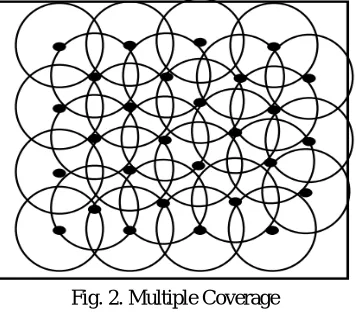
At the point when simple coverage expanded by numerous hubs covering single point area then it is called as different coverage. A few applications are disseminated identification, versatility following insight framework, basic area checking require numerous coverage.
Multiple coverage required in light of the fact that simple coverage will deliver certain information misfortunes notwithstanding when a solitary hub disappointment happens.
Fig. 2. Multiple Coverage
E. Partial Coverage
[image:2.612.226.404.494.650.2]36
[image:3.612.234.392.77.194.2]©IJRASET: All Rights are Reserved
Fig. 3. Partial Coverage
F. Point/Target Coverage
The point coverage conspire concentrates on deciding sensor hubs correct positions where ensure proficient coverage application for a predetermined number of in mobile points (targets) [4]. The fundamental objective of point coverage is to cover an arrangement of point (target) with known area that require to be checked. Numerous uses of WSN require just seeing of a specific point and not the entire area. In this manner, there is an expect of covering specific point just by at minimum one sensor hub. Watching just specific points will grow the execution of network. A better coverage and availability can be given unquestionably by utilizing some sensor hubs at point of intrigue (PoI). The PoI can be either fixed or mobile.
G. Fixed/Static PoI
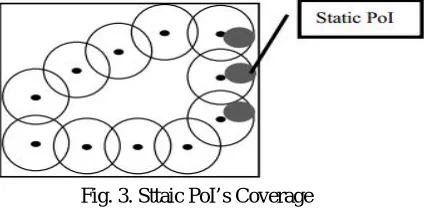
On the off chance that some position is show for a PoI, at that point it is said to be fixed or static PoI. A static PoI is anything but difficult to screen and cover, in light of the fact that there will be a prior learning will be accessible about its position. An case of static PoI observing shows in fig. 4.
[image:3.612.208.420.388.492.2]In this illustration sensor hubs don't just cover the PoI yet in addition keep up the network with the sink to report identify the occasions.
Fig. 3. Sttaic PoI’s Coverage
H. Barrier Coverage
Barrier coverage manages the shot figuring of development of items in the targeted area. The possibilities or likelihood can be dictated by development rate of protest and detecting powers of the sensors for every single point on the way taken after by the protest [9]. Barrier coverage is too known as range coverage. Case of such applications including development recognition are the arrangement of sensors along worldwide fringes to distinguish illicit interruption, around woodlands to identify the spread of woods fire around a concoction manufacturing plant, to distinguish the spread of deadly chemicals, and on both sides of a gas pipeline to distinguish potential harm. Barrier coverage can be delegated weak k-barrier and strong k-barrier coverage [10].
Fig. 4. Full Barrier Coverage
I. Weak K-barrier Coverage
This kind of coverage ensured that any target crossing a region alongside orthogonal way is recognized by at any rate k sensors [9].
J. Strong K-barrier Coverage
37
©IJRASET: All Rights are Reserved
III. LITERATURE SURVEY
In this segment, we survey the existing literature on WSN technique for coverage problems.
[1], Wireless sensor networks have an extensive variety of utilizations. Detecting coverage and correspondence coverage are two basic nature of administration. In this paper, author exhibit our work on vitality productive detecting coverage and correspondence. Author plan a few plans for detecting coverage subject to various prerequisites and limitations separately. Author likewise propose a telecom correspondence convention with high vitality effectiveness and low inertness for extensive scale sensor networks in light of the Small World network hypothesis. Recreation and analysis comes about demonstrate that our plans and convention have great execution.
[2], Energy productive is basic issue for wireless sensor networks (WSNs). LEACH accomplishes network vitality adjust through arbitrarily choosing group heads intermittently. In this paper, author propose progressive system tree steering in light of LEACH (HT-LEACH). The algorithm characterizes three expressions in each round: group development, chain of command tree directing arrangement and unfaltering state. In the second expression, pecking order tree directing is worked in bunch heads. Reenactment has been done in MATLAB and the outcomes demonstrate that the proposed algorithm has a superior execution in adjusting nodes vitality.
[3], In wireless sensor networks, the power asset of every sensor node is limited. Minimizing vitality dispersal and augmenting network lifetime are vital issue in the outline of directing conventions for sensor networks. This paper proposes another enhanced bunch algorithm of LEACH convention which is planned to adjust the vitality utilization of the whole network and broaden the lifetime of the network.
[4], Various WSN applications utilize progressive steering convention for directing detected information to the sink. Drain is one of the broadly utilized various leveled, disseminated bunching convention in WSN. In LEACH, Non-Cluster head Nodes choose to join a bunch head in light of Received Signal Strength (RSS) of getting HELLO parcels from CHs making it powerless against HELLO Flood assault. A PC class foe node can communicate parcels publicizing it as group head with higher flag quality, all sensor nodes will choose it as bunch head and send join bundle into it, believing that the foe is in their range and in this manner, the entire network will be in a mess. Existing answers for discovery of HELLO surge assault are either cryptographic which are less reasonable as far as memory and battery control, or non-cryptographic which includes sending the test bundle for recognition. This builds correspondence overhead as the vitality required for transmission of the parcel is much more than the vitality required for preparing/figuring. In light of these certainties, a non-cryptographic answer for HELLO surge assault recognition is proposed in this paper in which the no. of times the test bundle is transmitted is incredibly diminished. The reenactment comes about demonstrated discovery of foe nodes with insignificant correspondence overhead as the quantity of test bundles sent for identification is lessened from 20-35 to 10-14 (approx.).
[5], wireless sensor network (WSN) is a network comprises of expansive number of low power sensor nodes. Drain is a less vitality versatile grouping chain of importance convention. The fundamental objective of bunch based sensor networks is to diminish framework delay and lessen vitality utilization. Drain is a bunch based convention for small scale sensor networks which accomplishes vitality productive, versatile directing and reasonable media access for sensor nodes. Numerous changes are done in wireless sensor network. Security is exceptionally basic in wireless sensor network. This paper depicts LEACH convention, their points of interest, disservices and so forth. The paper is composed as takes after: In segment I, contains presentation, segment II contains portrayal of LEACH convention, and area III contains writing survey.
38
©IJRASET: All Rights are Reserved
[7], Wireless sensor networks contain the stage of a wide scope of uses identified with security framework, surveillance, military, medicinal services, and natural observing. The sensor coverage issue has gotten loads of consideration, being significantly determined by late research in moderate and proficient coordinated electronic gadgets. This issue is based on a key inquiry: How well do the sensors watch the physical space? The coverage idea is liable to an extensive variety of elucidations because of an assortment of sensors and their applications. Diverse coverage definitions have been proposed in light of the example of sensor organization and sort of question be secured and additionally on other sensor network properties, for example, network availability and least vitality utilization.
[8], Wireless Sensor Networks (WSN) are networks of regularly little, battery-fueled, wireless gadgets, outfitted with on-board handling, correspondence, and detecting capacities. Particularly wireless sensor network experiences unnecessary bundle misfortune, over hearing, retransmission of the parcels because of node versatility and steady vitality dispersal. A present strategy for directing and information transmission does not assess advancing the transmission through Energy Balancing. There are a few power and vitality mindful algorithms that claim to adjust for the vitality misfortunes. The principle central of the vast majority of the strategies is to course the bundles through the most elevated vitality nodes which prompt snappy battery seepage of those node. In this manner the network lifetime diminishes. In this task author have proposed a special convention for Network lifetime change by altering the Leach convention. The key of the convention is to build up a group based directing where bunch heads ought to be chosen in light of greatest coverage and ought to have adequate vitality to draw out the correspondence. Groups are progressively framed and changed with transmission. The strategy is contrasted and traditional LEACH. Result demonstrates that the proposed framework accomplishes high information conveyance with expanded lifetime.
[9], Wireless sensor networks have pulled in a great deal of consideration as of late. Such situations may comprise of numerous modest nodes, each fit for gathering, putting away, and handling natural data, and speaking with neighboring nodes through wireless connections. For a sensor network to work successfully, sensors must keep up both detecting coverage and network availability. This issue has been examined both of which achieve a comparable conclusion that coverage can suggest network as long as sensors' correspondence ranges are no not as much as twice their detecting ranges. In this paper, without depending on this strong supposition, author explore the issue from an alternate point and build up a few essential and adequate conditions for guaranteeing coverage and availability of a sensor network. Henceforth, the outcomes essentially sum up the outcomes. This work is likewise a noteworthy expansion of our prior work [Huang and Tseng 2003; Huang et al. 2004], which delivers how to decide the level of coverage of a given sensor network, yet does not consider the network availability issue. Our work is the primary work permitting a self-assertive connection between detecting reaches and correspondence separations of sensor nodes. Author create decentralized answers for deciding, or notwithstanding altering, the levels of coverage and availability of a given network. Changing levels of coverage and availability is fundamental when sensors are excessively sent, and author approach this issue by putting sensors to rest mode and tuning their transmission powers. This outcomes in delayed network lifetime.
[10], Due to constrained vitality of Wireless Sensor Networks (WSNs), directing assumes a vital part in enhancing vitality proficiency. The low-vitality versatile bunching order (LEACH) convention is a traditional answer for chop down vitality cost, however it ignores lingering vitality of sensor nodes and long-run correspondence which causes low network coverage and high vitality utilization. To stay away from these deficiencies, author set forward a matrix based vitality proficient directing convention (GEERP) which concentrates on three changes: vitality utilization, vitality effectiveness and network coverage.
IV. CONCLUSION
Coverage in a wireless sensor network can be thought of as how well the wireless sensor network can screen a specific field of intrigue. This paper reviewed the kinds of coverage with various sorts of arrangement procedures for every coverage types. This review will help the reader to pick up information of various coverage required by the utilization of WSNs.
REFERENCES
[1] W. Heinzelman, A. Chandrakasan, H. Balakrishnan, “Energy efficient communication protocol for wireless sensor networks”, in: Proceeding of the Hawaii International Conference System Sciences, Hawaii, January 2000.
[2] Bao Zhenshan, Xue Bo, Zhang Wenbo. “HT-LEACH: An Improved Energy Efficient Algorithm Based on LEACH”, International Conference on Mechatronic Sciences, Electric Engineering and Computer (MEC), 2013.
[3] Lalita Yadav, Ch. Sunitha, “Low Energy Adaptive Clustering Hierarchy in Wireless Sensor Network (LEACH)”, International Journal of Computer Science and Information Technologies, Vol. 5 (3), 2014.
[4] Shikha Magotra, Krishan Kumar, “Detection of HELLO flood Attack on LEACH Protocol”, International Advance Computing Conference (IACC),IEEE,2014. [5] Reenkamal Kaur Gill, Priya Chawla and Monika Sachdeva, “Study of LEACH Routing Protocol for Wireless Sensor Networks”, International Conference on
39
©IJRASET: All Rights are Reserved
[6] Khushbu Babbar, Kusum Lata Jain and G.N. Purohit, “Implementation Of Energy Efficient Coverage Aware Routing Protocol for Wireless Sensor Network using Genetic Algorithm”, International Journal in Foundations of Computer Science & Technology (IJFCST), Vol.5, No.1, January 2015.
[7] Richa Singh, “Energy Efficient Coverage for Mobile Sensor Network”, International Journal of Computer Applications (0975 – 8887) Volume 55– No.2, October 2012
[8] Nandakishor Sirdeshpande and Vishwanath Udupi, “Lifetime Maximization Using Modified Leach Protocol for Energy Efficient Routing In Wireless Sensor Networks”, The International Journal Of Engineering And Science (IJES), Volume- 2, Issue- 2, Pages- 17-2, 2013
[9] Chi-Fu Huang, Yu-Chee Tseng, and Hsiao-Lu Wu, “Distributed Protocols for Ensuring Both Coverage and Connectivity of a Wireless Sensor Network” ACM Journal Name, Vol. V, No. N, M 20YY, Pages 1–22.