242
INTERNATIONAL JOURNAL OF PHARMACEUTICAL, CHEMICAL AND BIOLOGICAL SCIENCES
Available online at www.ijpcbs.com
DESIGN AND DEVELOPMENT OF FAST DISSOLVING TABLETS
OF GLICLAZIDE BY SOLID DISPERSIONS TECHNIQUE
Syed Shariff Miyan1, Mohammed Khaleel2, Vazir Ashfaq Ahamed3
and H. Mohammed Yakhoob4
1,3Department of pharmaceutics, M.M.U. College of pharmacy, Ramanagara, Karanataka, India. 2,4 Department of pharmaceutical chemistry, M.M.U. College of pharmacy, Ramanagara,
Karanataka, India.
INTRODUCTION
Tablets are the most widely used dosage forms because of the conveniences in terms of self-administration, compactness, stability, and ease in manufacturing. However, geriatric, bedridden and pediatric patients felt difficulty in swallowing conventional tablets. To overcome this drawback, innovative drug delivery systems known as fast dissolving tablets have developed. A tablet which can rapidly disintegrate or dissolved in saliva is an attractive and patient-oriented
pharmaceutical preparation. The concept of rapid disintegrating drug delivery system emerged from the desire to provide patients with conventional mean of taking their medication. Difficulty in swallowing (Dysphagia) is a common problem especially in elderly and pediatrics, because of the physiological changes associated with these groups of patients [1]. Other categories
that experience problems using conventional oral dosage forms includes the nauseated, mentally ill, and non co-operative patients, those with motion
Research Article
ABSTRACT
The aim of present investigation was to prepare fast dissolving tablets of a hypoglycemic drug Gliclazide. The solubility of poorly soluble drug was enhanced by preparing solid dispersions of the drug with PEG 6000 in various concentrations. The optimized solid dispersions (Drug: PEG-6000, 1:2 ratio) were further kneaded with suitable proportions of superdisintegrants such as; Crosscarmellose, Sodium starch glycolate and Crosspovidone. Fast dissolving tablets of Gliclazide was prepared by direct compression method. The pre-compressive parameters for the blends and post-compressive parameters for the prepared tablets were evaluated. All formulations showed desired pre and post-compressive characteristics. Short term accelerated stability study was performed for optimized formulation and found no evidence of physical and chemical changes. FT IR study showed no evidence of drug-excipient interaction. The optimized formulation was found to be FDT6. It was concluded that fast dissolving tablets of Gliclazide can be prepared by solid dispersions of drug with PEG-6000 and combination of two superdisintegrants provide complete and better dissolution within in shorter period of time. Hence effective diabetic treatment anywhere, and anytime particularly for geriatric, pediatric, mentally ill, bedridden and patients who do not have easy access to water.
sickness, sudden episodes of allergic or asthma attack where an ultra-rapid onset of action is required [2]. The tablets that can
rapidly dissolve or disintegrate in the oral cavity have attracted a greater deal of attention [3]. The potential advantages such
tablets include, administration without water, anywhere, anytime lead to their suitability to geriatric, pediatric, mentally ill, the bedridden and patients who do not have easy access to water. The benefit of such formulations includes patient compliance, rapid onset of action and increased extent of bioavailability.
Before preparing fast dissolving tablets an effort to increase dissolution of drug is often needed. Methods available to improve dissolution include salt formation, micronization and addition of solvent or surface active agents. Solid dispersion is one of such methods and it involves a dispersion of one or more active ingredients in an inner carrier or matrix in solid state prepared by melting, dissolution in solvent or melting-solvent method etc. Solid dispersion technology has been successfully been used for improving the solubility of the poorly soluble drugs and hence bioavailability of such drugs [4-7].
The solubility of Gliclazide can be successfully enhanced by preparing solid dispersion of the drug with 4000, PEG-6000 and PVP K-30 through fusion method and solvent evaporation techniques [8-9].
Superdisintegrants such as Sodium starch Glycolate (SSG), Crosspovidone (CP) and Crosscarmellose sodium (CC) were extensively used to fabricate mouth dissolving tablets. Subliming agents such as Menthol, Camphor, mannitol, Urea etc, were included in the blend as subliming agent. The tablets were prepared and exposed to vacuum to produce highly porous tablets which may either dissolve in the buccal cavity or get dispersed in the mouth for quicker, better and total release of the medicament for absorption [10-12].
Gliclazide is a second generation sulphonylurea used as hypoglycemic agent in the treatment of non-insulin dependent diabetes mellitus (type 2). Chemically it is N-(hexahydroxycyclopenta(C)Pyrro-2(1H)-ylcabamoyl)-4-methylbenzene
sulphonamide. It is a secretogogue which
stimulates the secretion of insulin from beta cells of pancreas. It is practically insoluble in water that’s how limited bioavailability. Biological half-life is 6-8 hours [13].
Gliclazide is available as conventional and modified release tablets under brand names; Diabend (Bal Pharma), Diamicron (Serdia), Dianorm (Micro labs), Gliclaz (Khandelwal) and Glycigon (Aristo labs) etc.
MATERIALS AND METHODS
Materials: Gliclazide was obtained as a gift
sample from Aristo labs, India, Sodium starch Glycolate, Crosspovidone,
Crosscarmellose sodium and Pre-gelatinized starch was obtained from Micro labs, India. PEG-6000, Camphor, Methanol, magnesium stearate, purified Talc and other chemicals were analytical grade and were procured from SD fine chemicals and Qualigen’s fine chemicals, India.
Method
Preparation of solid dispersions
Calculated quantity of drug was dissolved in chloroform and mixed with the solution of PEG-6000 prepared in ethanol. The mixture was stirred with a glass rod for 15 minutes and evaporated to dryness for 48 hours in a desiccator (fused calcium chloride was used) at room temperature to remove the solvent. The lump so obtained was powdered in a mortar. The powder was passed through sieve no#60. The powder was stored in a screw capped amber colour vial until used.
from the tablets was performed under vacuum at 700C for 8 hours See table 1.
EVALUATION FOR PRE-COMPRESSIVE PARAMETERS [14]
1. Bulk Density
Blends were poured gently through a glass funnel into a graduated cylinder at exactly to 10 ml mark. Excess blend was removed using a spatula and the weight of the cylinder with blend required for filling the cylinder volume was calculated. The cylinder was then tapped over hard wooden slab from a height of 2.0cm until the time when there was no more decrease in the volume. Both loose bulk density and tapped bulk density.
a) Loose bulk Density
Loose bulk Density =
b) Tapped bulk Density
Tapped bulk Density =
Hausner’s factor and Carr’s compressibility indices were calculated by using following equations;
2) Hausner’s factor
Hausner’s factor =
3) Carr’s Compressibility Index
Percent Carr’s Index = × ×100
4) Angle of Repose
For determination of angle of repose (ө), the blends were poured through a funnel, which was fixed at a position such that its lower tip was at a height of exactly 2.0 cm above the surface. The blends were poured till the time when upper tip of the pile surface touched the lower tip of the funnel. The tan-1 of the (height of the pile/radius of
its base) gave the angle of repose. The results of pre-compressive parameters are given in Table 2.
Tan θ = h / r or θ= tan-1 [h/r]
EVALUATION FOR POST-COMPRESSIVE
PARAMETERS15-17
(a) Thickness and diameter
Thickness and diameter of each tablet was measured using a calibrated dial caliper. Mean and standard deviation of thickness and diameter was calculated.
(b) Weight variation test
Twenty tablets were taken and their weight was determined individually and collectively on a digital weighing balance. The average weight of each tablet was determined from the sum of weight of twenty tablets. Mean and standard deviation (S.d) of weight was calculated from each batch.
(c) Hardness test
Hardness was determined by randomly selecting six tablets from each batch, using a Monsanto Hardness Tester. A mean of S.d values were calculated for each batch.
(d) Friability test
Six tablets were randomly selected from each batch and the pre-weighed tablets were rotated at 25 rpm for 4 minutes using a Roche Friabilator. The tablets were de-dusted and re-weighed using digital weighing balance and the percentage weight loss was calculated by using the equation;
F = ( ) ( )
( ) × 100
(e) Wetting time and water absorption ratio
Where, Wa and Wb were the weights of the
tablet after and before the tests. (f) Disintegration time
Disintegration time was measured in 900 ml 0.1N HCl maintained at 37±0.5o C by USP
24 method (without disc). The disintegration time of 6 individual tablets was recorded and the experiment was performed in triplicate, mean of S.d was calculated.
(g) Drug content estimation9
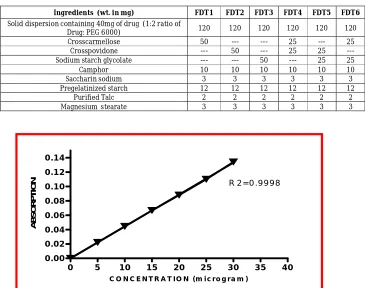
(i) Standard solution: 100 mg of pure Gliclazide was dissolved in little quantity of Methanol in a volumetric flask and then the volume was made to 100ml mark with Methanol and sonicated for 10 minutes. The above solution will give 1mg/ml solution of Gliclazide which was further diluted with Methanol to produce a series of concentrations ranging between 5-30µg/ml. Absorbance was measured using spectrophotometer at 226 nm against Methanol as blank. Standard calibration curve was plotted as absorbance against concentration.
(ii) Sample solution
20 tablets from each batch were randomly selected, weighed accurately and then finely powdered in a mortar. To a powder equivalent to 10mg of Gliclazide about 50ml of Methanol was added and dissolved with the aid of shaker for 15 minutes; sufficient quantity of Methanol was added to produce 100 ml in a volumetric flask, mixed well and filtered using membrane filter.
1ml of the above filtrate was further diluted to 10 ml using Methanol and mixed well. The absorbance of the resulting solution (10µg/ml) was measured at the 226nm using blank in the reference cell. The total content of drug in the solution was calculated with the help of standard graph. The above experiment was done in triplicate (n=3) and mean was taken. The results of post compressive parameters are shown in Table 3.
(h) In-vitro dissolution studies
The release of drug from fabricated tablets was determined using USP dissolution testing apparatus type II (paddle method; Electrolabs, India). The dissolution test was
performed using 900 ml of 0.1N HCl (PH 1.2)
at 37 ± 0.5°C at the paddle speed of 50 rpm. A sample (10 ml) solution was withdrawn from the dissolution apparatus at different time intervals and the samples were replaced with same quantity of fresh dissolution medium. The samples were filtered through a 0.45μm membrane filter and appropriately diluted to produce suitable concentration with 0.1N HCl. Absorbance of these solutions was measured at 226nm using a Shimadzu UV-1700 double beam spectrophotometer. This experiment was performed in triplicates (n=3) and mean was calculated. Cumulative percentage drug release was calculated with the help of standard calibration curve
(see figure 1). The cumulative percent drug
release from the tablets is shown in figure 2 and table 4.
(i) Accelerated stability studies19-20
Short term accelerated stability study was performed for the prepared FDT formulation to investigate stability of formulation in terms of physical and chemical changes. The stability study involved storing the prepared formulation for a period of 3 months at 400 C ± 20C and
75% 5% RH. The tablets were evaluated periodically at 0, 15, 30, 45, 60, 75 and 90 days for any physical and chemical changes.
(j) Drug-Excipient compatibility studies To establish drug-excipients compatibility, binary powder mixtures were prepared in 1:1 ratios with excipients. The binary mixtures were ground in a mortar and screened.
i. Assay
After specific time period the mixture were subjected to assay.
ii. FT-IR study
The FT IR spectra were recorded using FT IR Spectrophotometer (Shimadzu 8400S, Japan). Gliclazide and the blend of optimized formulation were previously ground and kneaded with potassium bromide, compressed in to pallets by applying a pressure of 5 tons with the help of hydraulic press. Each sample was scanned at a resolution of 1cm–1 from 4500
RESULT AND DISCUSSION
In the present investigation the solubility of poorly water soluble Gliclazide was enhanced by preparing solid dispersion with PEG-6000 (solvent evaporation method). Appropriate quantity of solid dispersion was blended with superdisintegrants. After adding filler, sublimating agent, sweetener, glident and lubricating agent; FDTs were prepared by direct compression method.
Pre-compressive parameters
The values for angle of repose were found in the range of 27.360 to 29.43°.
Loose bulk and tapped densities of the blend was found as 0.237 to
0.246 and 0.268 to 0.283
respectively.
Carr’s index of the prepared blends falls in the range of 17.20 to
19.55% and this is also supported
by Hausner’s factor values which were in the range of 1.153 to 1.242.
Hence the prepared blends possessed good flow properties and can be used for manufacturing of tablets (see table 2).
Post-compressive parameters
All the tablets were prepared under similar experimental conditions. All the formulations exhibited white color, odorless, flat shaped with almost smooth surfaces (but formed fine pores on all surfaces when subjected to vacuum drying).
The average weight of the FDTs prepared by direct compression method was 199.38 to 201.40 mg (before sublimation of camphor).
Hardness of prepared FDTs was between 3.4 to 3.8 kg/cm2.
The percent friability of formulations was found to be 0.64 to 0.88 (less than 1.0%) and thus hardness and friability of all formulations were within acceptable limits.
The disintegration time is very important and it is desired to be less than 1 minute. The quick disintegration may assist quick swallowing and drug absorption in
buccal cavity, thus greater bioavailability of the drug. Disintegration time of prepared FDTs was found in the range of 22 to 27 seconds. The above finding suggested that, a combination of Crosscarmellose sodium (CC) and sodium starch glycolate (SSG) in appropriate concentrations showed least time for disintegration.
Wetting time is the indicator for the ease of disintegration of the tablet in buccal cavity. It was observed that wetting time of tablets was in the range of 22 to 26 seconds. It was found that the nature and combination of the superdisintegrants(s) present affected the wetting of the tablets. The formulation containing combination of CC with SSG (FDT6) took less time while tablets containing CP alone (FDT2) took more time for wetting.
Assay for the prepared formulations was performed to determine drug content uniformity and it was found between 96.32 to 99.66% (see table 3).
In vitro dissolution study
In vitro dissolution study was performed by
using 0.1N HCl as dissolution medium using USP dissolution apparatus type II at a paddle speed of 50rpm. At the end of 40 minutes the cumulative percentage drug release from various FDT was found to be
84.22%, 83.12%, 82.22%, 89.65%, 94.43%
and 98.44% from FDT1, FDT2, FDT3, FDT4, FDT5 and FDT6 respectively. This clearly indicated that the superdisintegrants present alone released lower amount of drug compare to the tablets containing double disintegrants (see table 4 and figure
2). The formulation FDT6 which contained
double superdisintegrants released maximum drug when compared to other formulations. With reference to type and combination of superdisintegrants present, the order of maximum release of drug from the FTDs was as follows;
Short term accelerated stability study: was performed for the optimized formulation and the results of short term stability studies indicated that there were no major changes in the physical properties such as colour, odour, texture and disintegration time. Drug content was found under acceptable limits.
Drug-excipient interaction study:
Drug-excipient interaction study was performed using FT IR spectrophotometer (Shimadzu 8400S, Japan) the pressed pellets of kneaded mixture of drug and excipients was prepared and scanned; there was no evidence of interaction of excipient with the drug. The FT IR spectra of pure drug and optimized formulation (FDT6) see
figure 3 and 4.
CONCLUSION
The present investigations showed that, fast dissolving tablets of Gliclazide can be
successfully prepared by using solid dispersions of the drug with PEG 6000 and then blending with suitable proportions of superdisintegrants such as; Crosscarmellose sodium (CC) and sodium starch glycolate (SSG). After direct compression, sublimation of camphor provides highly porous tablets which can disintegrate quickly to provide effective dissolution within shorter period of time. In view of the data of all forms of evaluation studies, the optimized formulation was found to be FDT6. In vivo studies are required to correlate in vitro release data and to access the taste of fabricated fast dissolving tablets of Gliclazide.
ACKNOWLEDGEMENT
The authors wish to thank; Aristo labs and Micro labs, India for providing gift samples of Gliclazide and superdisintegrants for the present research work.
Table 1: showing composition of fast dissolving tablets of Gliclazide
Fig. 1: standard calibration curve of Gliclazide in Methanol at 226 nm
Ingredients (wt. in mg) FDT1 FDT2 FDT3 FDT4 FDT5 FDT6
Solid dispersion containing 40mg of drug (1:2 ratio of
Drug: PEG 6000) 120 120 120 120 120 120 Crosscarmellose 50 --- --- 25 --- 25
Crosspovidone --- 50 --- 25 25 --- Sodium starch glycolate --- --- 50 --- 25 25 Camphor 10 10 10 10 10 10 Saccharin sodium 3 3 3 3 3 3 Pregelatinized starch 12 12 12 12 12 12
Purified Talc 2 2 2 2 2 2 Magnesium stearate 3 3 3 3 3 3
0 5 1 0 1 5 2 0 2 5 3 0 3 5 4 0 0 .0 0
0 .0 2 0 .0 4 0 .0 6 0 .0 8 0 .1 0 0 .1 2 0 .1 4
R 2 = 0 .9 9 9 8
C O N C E N T R A T I O N ( m i c r o g r a m )
A
B
S
O
R
P
T
IO
Table 2: showing pre-compressive parameters of the blend,( n=3)
Table 3: showing post-compressive parameters of prepared fast dissolving tablets, (n=3)
Table 4: showing dissolution profile of prepared fast dissolving tablets
D IS S O L U T IO N P R O F IL E
0 1 0 2 0 3 0 4 0
0 2 0 4 0 6 0 8 0 1 0 0
M D T 1 M D T 2 M D T 3 M D T 4 M D T 5 M D T 6
T I M E I N M I N U T E S
C U M U L A T IV E % D R U G R E L E A S E
Fig. 2: showing cumulative percent drug release from prepared FDTs
Formulation code
Angle of repose (ө)
Loose Bulk density(g/ml)
Tapped Bulk
density(g/ml) Carr’s index (%)
Hausner’s
factor Drug content (%) FDT1 FDT2 FDT3 FDT4 FDT5 FDT6
27.360.04 28.460.01 29.430.06 28.300.08 29.220.04 29.26±0.02
0.2450.020 0.2390.008 0.2460.002 0.2450.004 0.2370.005 0.240±0.004
0.2810.003 0.2830.007 0.2800.007 0.2680.004 0.2730.002 0.282±0.02
18.110.88 17.201.20 18.500.80 19.551.14 18.461.02 18.88±1.11 1.186±0.04 1.190± 0.20 1.202± 0.24 1.224± 0.04 1.242± 0.12 1.153± 0.02
97.441.40 95.550.28 98.191.70 95.551.43 96.661.34 98.89±1.17
Formulation code
Average weight Hardness (Kg/cm2)
Disintegration time (sec)
Weight
variation % Friability
Wetting time(sec) Drug content (%) FDT1 FDT2 FDT3 FDT4 FDT5 FDT6 201.40±0.8 199.38±0.2 200.10±0.2 199.50±0.8 200.82±0.4 199.42±0.2 3.4±0.24 3.4±0.08 3.5±0.18 3.8±0.42 3.6±0.26 3.8±0.11 24±2.20 27±2.14 23±0.04 26±2.64 23±0.04 22±0.82 C o m p li es 0.64±0.06 0.65±0.04 0.65±0.05 0.88±0.23 0.78±0.34 0.67±0.22 23±0.36 26±0.50 25±0.63 26±0.27 24±0.25 22±0.98
97.881.50 96.320.18 97.841.20 96.551.43 98.661.34 98.33±0.64
Sampling time in Minutes
Cumulative percent drug release data for prepared FDTs ± sd Formulation Codes
FDT 1 FDT 2 FDT 3 FDT 4 FDT 5 FDT6
Fig. 3: Showing FT IR spectra of pure drug Gliclazide
Fig. 4: Showing FT IR spectra of the kneaded blend of optimized formulation (FDT 6)
REFERENCES
1. Lindgreen S and Janzon L. Dysphagia: Prevalence of swallowing complaints and clinical finding. Med Clin North Am 1993;77:3-5.
2. Kaushik D, Dureja S and Saini TR. Mouth Dissolving Tablets- A Review. Indian Drugs 2003;41:187-93. 3. Kuchekar BS, Badhan AC and
Mahajan HS. Mouth dissolving tablets: A novel drug Delivery system. Pharm Times 2003;35:7-9 4. Modi A and Tayade P. Enhancement
of Dissolution Profile by Solid
Dispersion (Kneading) Technique. AAPS PharmSciTech. 2006;7(3). 5. Marin MT, Margarit MV
and Salcedo GE. Characterization and solubility study of solid dispersions of flunarizine and polyvinylpyrrolidone. Farmaco. 200 2;57:723-727
6. Chiou WL and Riegelman S. Pharmaceutical applications of solid dispersion systems. J Pharm Sci.1971;60:1281-1302.
Polyethylene glycol 6000 fast-release tablets from solid dispersions: Solid-state characterization, dissolution behavior, and formulation parameters. AAPS PharmSciTech. 8(4):21-228.
8. Gopal Venkatesh Shavi, Averineni Ranjith Kumar and Yogerndra Nayak Usha. Enhanced dissolution and bioavailability of Gliclazide using solid dispersion technique. International Journal of Drug Delivery. 2010:2:49-57.
9. Biswal S and Sahoo J. Enhancement of Dissolution rate of Gliclazide using Solid dispersion with Polyethylene glycol 6000; AAPS PharmaSciTech. 2008; 9(2):563-570.
10. Shailesh Sharma. New Generation of Tablet: Fast Dissolving Tablet; available online; http// www. Pharmainfo.net.
11. Koizumi K, Watanabe Y, Morita K, Utoguchi N and Matsumoto M. New method of preparing high-porosity rapidly saliva soluble compressed tablets using mannitol with camphor, a subliming material, International Journal of Pharmaceutics. 1997;152(1):127-131.
12. Gohel M, Patel M, Amin A, Agrawal R, Dave R and Bariya N. Formulation design and optimization of mouth dissolve tablets of nimesulide using vacuum drying technique, AAPS PharmSciTech. 2004;5(3):10-15. 13. www.webhealthcentre.com.
14. Yoshio K, Masazumi K, Shuichi A and Hiroaki N., Evaluation of rapidly disintegrating tablets manufactured by phase transition of sugar alcohols. J Control Release. 2005;105(1-2):16-22.
15. Abdelbary G, Eouani C, Prinderre P, Joachim J, Reynier J and Piccerelle P. Determination of the in-vitro disintegration profile of rapidly disintegrating tablets and
correlation with oral disintegration. Int J Pharm. 2005;292:29-41. 16. Kuchekar BS, Mahajan S and
Bandhan AC. Mouth dissolve tablets of sumatriptan, Indian Drugs. 2004;41(10): 592-598.
17. Lalla JK and Mamania HM. Fast dissolving rofecoxib tablets, Indian J Pharm Sci. 2004;59(4):23-26. 18. Stability testing of active
pharmaceutical ingredient and finished pharmaceutical product; available at; www.who.org (accessed in 2009).