Facial Aging Databases, Techniques and
Effects of Aging: A Survey
Mohammed Abdul Waheed #1, Ibtesaam Sanam*2
#
Associate professor, * PG Student
Department of Computer Science & Engg, Visvesvaraya Technological University VTU Centre for PG Studies, Kasnoor road, Kalaburagi, India.
Abstract: The facial aging databases promises results are shown on face recognition researches. Nevertheless, face recognition and retrieval across age remains tough and is still challenging. Facial aging represents the accumulation of changes over time Cross-Age Reference Coding (CARC) and a brand new big-scale dataset for face recognition and retrieval throughout age called Cross-Age Celebrity Dataset (CARD). One of the challenges in computerized face recognition is to achieve temporal invariance. In this Paper, we present a comprehensive evaluation of literature on cross age face recognition starting with the biological consequences of aging , it provides a survey of techniques, effects of aging on overall performance evaluation and facial aging databases. Evaluation of the impact of aging on the performance of age-invariant face recognition system is an vital measurement. We also study a 3D aging modelling technique for Face Recognition. It also presents a unique and efficient facial image representation primarily based on Local Binary Pattern (LBP) texture features.
Keywords: Face Recognition, Age invariant face recognition, 3D aging, Facial aging, Local binary pattern.
I. INTRODUCTION
Face related issues (e.g., face detection, face recognition) are significant but challenging, and that they have drawn several computer vision researchers' attention for many years. For matching faces, there are four key factors that negotiate the accuracy: pose, illumination, expression, and aging[9]. By taking advantage of widely existing celebrity images on the web, a new approach is to deal with this problem with a distinct angle from prior works. Rather than modelling the aging process with sturdy constant assumptions, we have tendency to adopt a data driven approach and introduce a novel coding method known as CARC. Our assumption is that if two people look alike when they are young, they may conjointly look similar when they both grow older.
other literatures such as[10] they did not take into account the age variation. The proposed method is basically dissimilar because we have a tendency to incorporate the age information of the reference set into the coding framework.
The challenges are mainly due to huge facial appearance variations in a subject and similarities among subjects. A few of the face recognition applications where age compensation is needed embody deals with identifying missing people screening and problems for multiple enrolment detection. These three situations have two common characteristics: i) significant age difference between probe and gallery images and ii) inability to obtain a user’s face image to update the template. Face recognition accuracy is sometimes restricted by massive intra class variations caused by factor like pose, lighting, expression, and age[15]. Due to the
increasing effects of both biological and
environmental factors, facial aging affects every individual differently.
II. RELATED WORK
problem. Wright et al.[18] propose to use thin illustration derived from training images for face recognition. The tactic is established to be sturdy against occlusions for face recognition. Recently, Chen et al.[4] use a high dimensional version of LBP and accomplish near-human performance on the LFW dataset. Compared with the other published approaches, the proposed method for aging modeling has the subsequent features:
3D aging modeling: We tend to use a pose correction stage and model the aging pattern more logically in the 3D domain. Taking into consideration that the aging may be a 3D process, 3D modeling is best suited to capture the aging patterns. We’ve given away a way to build a 3D aging model given a 2D face aging database. The proposed method is our solely viable substitute to structure a 3D aging model directly as no 3D aging database is presently out there.
Separate modelling of shape and texture
changes: We’ve compared three different
modelling methods, namely, shape
modelling only, separate shape and texture modelling, and combined shape and texture modelling. We have shown that the separate modelling is better than combined modelling method, given the FG-NET database as the training data.
Evaluation by means of a state-of-the-art commercial face matcher, FaceVACS: All of the preceding studies on facial aging have used PCA-based matchers. We have used a
state of- the-art face matcher to
approximation of our aging model. The proposed method can thus be helpful in
practical applications requiring age
correction process. Despite the fact that we have evaluated the proposed method only on one specific face matcher, it can be used directly in conjunction with any other 2D face matcher.
Diverse Databases: We have used FG-NET
for aging modelling and evaluated the aging model on three distinct databases, FG-NET ,
MORPH, and BROWNS. We have
determined substantial performance
enhancements on all the three databases. This depicts the effectiveness of the proposed aging modeling method.
III. TYPES OF DATABASES
Databases play a fundamental role in research for benchmarking the face recognition algorithms. Several face datasets are presented, but only some of them are particularly designed to address the Aging problem.
FERET
Previously released face databases such as FERET comprise slight age variations. The database have a total of 1199 subjects that includes 14,126 images and 365 duplicate sets of images.
FG-NET aging database
The FG-NET aging database have a total of 82 different subjects (6–18 images per subject) that includes 1002 images collected by mainly scanning photographs of the subjects by means of ages ranging between newborns to 69 years old subjects.
MORPH
MORPH is much larger database than FG-NET. It comprises two sets; Album 1 and Album 2. Album 1 is relatively smaller than Album 2, and have a total of 1690 face images of 625 individuals in the age range 15–68 years. The images in MORPH stand for an adverse population regarding age, gender, and ethnicity.
Cross-age celebrity database (CACD)
An additional publicly accessible large scale face aging dataset is collected[4] Named CACD. It has a total of 163,446 images of 2000 subjects. This dataset consist of celebrity images across 10 years from 2004 to 2013. The images are collected from Google Image Search with celebrity name and year as keywords.
IV. FACTORS INFLUENCING FACIAL AGING
Table 1- Factors affecting aging
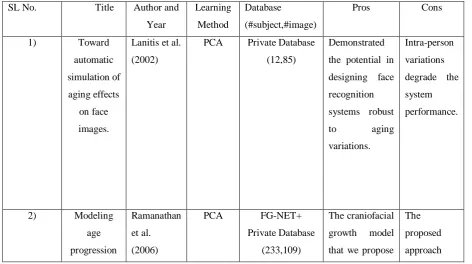
The critical review of the discussed topic “Facial Aging Databases, Techniques and Effects of Aging” in
different papers are shown in the table.
Table 2- Facial Aging using different techniques in different papers from [1] to [7]
SL No. Title Author and
Year
Learning
Method
Database
(#subject,#image)
Pros Cons
1) Toward
automatic
simulation of
aging effects
on face
images.
Lanitis et al.
(2002)
PCA Private Database
(12,85)
Demonstrated
the potential in
designing face
recognition
systems robust
to aging
variations.
Intra-person
variations
degrade the
system
performance.
2) Modeling Ramanathan PCA FG-NET+ The craniofacial The
SL.No. Factors Caused by Affected Area
1)
Environmental Influences
i. Age changes
ii. General exposure to the
elements, such as wind and arid air.
iii. Smoking
iv. Dehydration
Facial aging
Skin
Facial wrinkles
Grayish cast to the complexion.
2) Innate
Changes
i. Changes in the bony support
structure of the face and subsequent changes in the musculature.
ii. Gravity
iii. Hyperdynamic facial
expressions.
Upper lip, Nose and Ear.
3) Hard tissue
facial age changes
Morphological changes
i. Remodelling of bone
ii. Morphological modifications iii. Photoaging (i.e., skin aging
due to solar radiations)
Horizontal changes
i. Craniofacial skeletal change.
ii. Cranial horizontal changes.
Vertical changes
i. Increase in age
Head and Face
Head, Face and Neck.
Skin
Human variation due to
sex, ancestry and environmental influences.
Head circumference and
head length.
in young
faces
is unique for
each individual.
lacks
textural
model and
does not
account for
textural
variations.
3) Automatic
Face
Estimation
Based on
Facial Aging
Pattern
X.Geng et
al.
(2007)
PCA FG-NET
(10,10)
Proposes an
automatic age
estimation
method named
AGES.
Face images
under all
possible pose
and
illumination
conditions
are not
always
available in
reality.
4) Cross-Age
Reference Coding for
Age-Invariant
Face
Recognition
and Retrieval
Chen et al.
(2014)
Linear
Projection
And
cosine
FG-NET
(82,1002)
MORPH
(13618,55134)
Achieve high
accuracy in face
recognition
across age.
Performance
is not
improved.
5) A
Longitudinal Study of Automatic
Face Recognition
Anil K. Jain
Et al.
(2015)
COTS
matcher
FG-NET
(82,1002)
MORPH
(317,1585
Multilevel statistical models were used to estimate populationmean trends in genuine scores, particularly with respect to increasing
elapsed time
between two
face images.
Studying the stability of the impostor
distribution
6) Aging face
recognition:
a
hierarchical
learning
model based
on local
patterns
selection
Li et al.
(2016)
Universal
subspace
analysis
MORPH
Album 2
A two-level
hierarchical
learning model
for aging face
recognition.
facial
appearance
is subject to
significant
change
during the
aging
process.
7) Age
invariant
face
recognition
and retrieval
by coupled
auto-encoder
networks
Xu et al.
(2017)
Non
linear
Factor
analisis
FG-NET
(82,1002)
Through CAN,
we can
nonlinearly
separate
identity feature
to be
age-invariant from
one given face
image
face
recognition
problems
with other
variations
like
expression,
illumination
and pose
V. CONCLUSION
In this paper, we have a tendency to propose a replacement approach for age-invariant face recognition and retrieval known as Cross-Age Reference Coding. After surveying certain papers, we can map low-level feature into an age-invariant reference space. Experimental results show that the proposed method can outperform state-of-the-art methods on each MORPH and CACD datasets and attain high accuracy in face recognition across age. We also additionally bring in a large-scale face dataset, Cross-Age Celebrity Dataset, for the aim of face recognition with age variation. This study showed that there are certain obvious, generally agreed upon skeletal and soft tissue age-related shape, size, and configuration changes in individuals in excess of the course of the adult lifespan. We’ve also a 3D facial aging model and simulation method for age-invariant face recognition. The extension of shape modelling from 2D to 3D domain offers extra capability of compensating for pose and, potentially, lighting variations. Our results clearly show that facial images are often seen as a composition of micro patterns such
REFERENCES
[1] Lanitis A, Taylor CJ, Cootes TF (2002) Toward automatic simulation of aging effects on face images. IEEE Trans Pattern Anal Mach Intell.
[2] N. Ramanathan and R. Chellappa, “Modeling Age Progression in Young Faces,” Proc. IEEE CS Conf. Computer Vision and Pattern Recognition, vol. 1, pp. 387-394, 2006.
[3] X. Geng, Z.-H. Zhou, and K. Smith-Miles, “Automatic Age Estimation Based on Facial Aging Patterns,” IEEE Trans. Pattern Analysis and Machine Intelligence , Dec. 2007. [4] Chen B, Chen C, Hsu W (2014) Cross-Age Celebrity Dataset
(CACD).
[5] Best-Rowden L, Jain AK (2015) A longitudinal study of automatic face recognition .
[6] Li Z, Gong D, Li X, Tao D (2016) Aging face recognition: a hierarchical learning model based on local patterns selection. IEEE Trans Image Process.
[7] Xu C, Liu Q, Ye M (2017) Age invariant face recognition and retrieval by coupled auto encoder networks. Neurocomputing
[8] Geng X, Zhou Z-H, Smith-Miles K (2007) Automatic age estimation based on facial aging patterns. IEEE Trans Pattern Anal Mach Intell
[9] Jain, A.K., Klare, B., Park, U.: Face matching and retrieval in forensics applications. IEEE MultiMedia, 20 (2012) [10] Kumar, N., Berg, A.C., Belhumeur, P.N., Nayar, S.K.:
[12] Chen, D., Cao, X., Wen, F., Sun, J.: Blessing of dimensionality: High-dimensional feature and its efficient compression for face verification. (2013).
[13] Albert AM, Ricanek K, Patterson E (2007) A review of the literature on the aging adult skull and face: implications for forensic science research and applications. Forensic Sci Int . [14] N. Ramanathan, R. Chellappa, and S. Biswas. Computational
methods for modeling facial aging 2009.
[15] P.J. Phillips, W.T. Scruggs, A.J. O’Toole, P.J. Flynn, K.W. Bowyer, C.L. Schott, and M. Sharpe, “FRVT 2006 and ICE 2006 Large-Scale Results,” Technical Report NISTIR 7408, Nat’l Inst. of Standards and Technology, Mar. 2007. [16] Singh M, Nagpal S, Singh R, Vatsa M (2014) On
recognizing face images with weight and age variations. [17] Wang, D., Hoi, S.C., He, Y., Zhu, J.: Retrieval-based face
annotation by weak label regularized local coordinate coding. In: Proceedings of the 19th ACM international conference on ACM (2011)
[18] Wright, J., Yang, A.Y., Ganesh, A., Sastry, S.S., Ma, Y.: Robust face recognition via sparse representation. Pattern Analysis and Machine Intelligence, IEEE Transactions on 31(2), 210{227 (2009)
[19] A. Lanitis, C.J. Taylor, and T.F. Cootes, “Toward Automatic Simulation of Aging Effects on Face Images,” Apr. 2002. [20] Chen B-C, Chen C-S, Hsu WH (2014) Cross-age reference