R E S E A R C H
Open Access
Speeding up the Consensus Clustering
methodology for microarray data analysis
Raffaele Giancarlo
1*, Filippo Utro
2Abstract
Background:The inference of the number of clusters in a dataset, a fundamental problem in Statistics, Data Analysis and Classification, is usually addressed via internal validation measures. The stated problem is quite difficult, in particular for microarrays, since the inferred prediction must be sensible enough to capture the inherent biological structure in a dataset, e.g., functionally related genes. Despite the rich literature present in that area, the identification of an internal validation measure that is both fast and precise has proved to be elusive. In order to partially fill this gap, we propose a speed-up ofConsensus(Consensus Clustering), a methodology whose purpose is the provision of a prediction of the number of clusters in a dataset, together with a dissimilarity matrix (the consensus matrix) that can be used by clustering algorithms. As detailed in the remainder of the paper,
Consensusis a natural candidate for a speed-up.
Results:Since the time-precision performance ofConsensusdepends on two parameters, our first task is to show that a simple adjustment of the parameters is not enough to obtain a good precision-time trade-off. Our second task is to provide a fast approximation algorithm forConsensus. That is, the closely related algorithmFC (Fast Consensus) that would have the same precision asConsensuswith a substantially better time performance. The performance ofFChas been assessed via extensive experiments on twelve benchmark datasets that
summarize key features of microarray applications, such as cancer studies, gene expression with up and down patterns, and a full spectrum of dimensionality up to over a thousand. Based on their outcome, compared with previous benchmarking results available in the literature,FCturns out to be among the fastest internal validation methods, while retaining the same outstanding precision ofConsensus. Moreover, it also provides a consensus matrix that can be used as a dissimilarity matrix, guaranteeing the same performance as the corresponding matrix produced byConsensus. We have also experimented with the use ofConsensusandFCin conjunction with
NMF(Nonnegative Matrix Factorization), in order to identify the correct number of clusters in a dataset. Although
NMFis an increasingly popular technique for biological data mining, our results are somewhat disappointing and complement quite well the state of the art aboutNMF, shedding further light on its merits and limitations.
Conclusions:In summary,FCwith a parameter setting that makes it robust with respect to small and medium-sized datasets, i.e, number of items to cluster in the hundreds and number of conditions up to a thousand, seems to be the internal validation measure of choice. Moreover, the technique we have developed here can be used in other contexts, in particular for the speed-up of stability-based validation measures.
Background
Microarray technology for profiling gene expression levels is a popular tool in modern biological research. It is usually complemented by statistical procedures that sup-port the various stages of the data analysis process [1].
Since one of the fundamental aspects of the technology is its ability to infer relations among the hundreds (or even thousands) of elements that are subject to simultaneous measurements via a single experiment, cluster analysis is central to the data analysis process: in particular, the design of (i) new clustering algorithms and (ii) new inter-nal validation measures that should assess the biological relevance of the clustering solutions found. Although both of those topics are widely studied in the general data * Correspondence: [email protected]
1
Dipartimento di Matematica ed Informatica, Universitá di Palermo, Via Archirafi 34, 90123 Palermo, Italy
Full list of author information is available at the end of the article
mining literature, e.g., [2-9], microarrays provide new chal-lenges due to the high dimensionality and noise levels of the data generated from any single experiment. However, as pointed out by Handl et al. [10], the bioinformatics lit-erature has given prominence to clustering algorithms, e. g., [11], rather than to validation procedures. Indeed, the excellent survey by Handl et al. is a big step forward in making the study of those validation techniques a central part of both research and practice in bioinformatics, since it provides both a technical presentation as well as valu-able general guidelines about their use for post-genomic data analysis. Although much remains to be done, it is, nevertheless, an initial step.
Based on the above considerations, this paper focuses on data-driven internal validation measures, particularly on those designed for and tested on microarray data. That class of measures assumes nothing about the structure of the dataset, which is inferred directly from the data.
In the general data mining literature, there is a great proliferation of research on clustering algorithms, in particular for gene expression data [12]. Some of those studies concentrate both on the ability of an algorithm to obtain a high quality partition of the data and on its performance in terms of computational resources, mainly CPU time. For instance, hierarchical clustering and K-means algorithms [13] have been the object of several speed-ups (see [14-16] and references therein). Moreover, the need for computational performance is so acute in the area of clustering for microarray data that implementations of well known algorithms, such as K-means, specific for multi-core architectures are being proposed [17]. As far as validation measures are concerned, there are also several general studies, e.g., [18], aimed at establishing the intrinsic, as well as the relative, merit of a measure. However, for the special case of microarray data, the experimental assessment of the “fitness” of a measure has been rather ad hoc and studies in that area provide only partial comparison among measures, e.g., [19]. Moreover, contrary to research in the clustering literature, the performance of validation methods in terms of computational resources, again mainly CPU time, is hardly assessed both in abso-lute and relative terms.
In order to partially fill the gap existing between the general data analysis literature and the special case of microarray data, Giancarlo et al. [20] have recently pro-posed an extensive comparative analysis of validation measures taken from the most relevant paradigms in the area: (a) hypothesis testing in statistics, e.g., [21]; (b) sta-bility-based techniques, e.g., [19,22,23] and (c) jackknife techniques, e.g., [24]. These benchmarks consider both the ability of a measure to predict the correct number of clusters in a dataset and, departing from the current
state of the art in that area, the computer time it takes for a measure to complete its task. Since the findings of that study are essential to place this research in a proper context, we highlight them next:
(A) There is a very natural hierarchy of internal vali-dation measures, with the fastest and less precise at the top. In terms of time, there is a gap of at least two orders of magnitude between the fastest,WCSS [6], and the slowest ones.
(B) All measures considered in that study have severe limitations on large datasets with a large number of clusters, either in their ability to predict the correct number of clusters or to finish their execution in a reasonable amount of time, e.g, a few days.
(C) Although among the slowest,Consensus [19] displays some quite remarkable properties that, accounting for (A) and (B), make it the measure of choice for small and medium sized datasets. Indeed, it is very reliable in terms of its ability to predict the correct number of clusters in a dataset, in particular when used in conjunction with hierarchical cluster-ing algorithms. Moreover, such a performance is stable across the choice of basic clustering algo-rithms, i.e., various versions of hierarchical clustering and K-means, used to produce clustering solutions.
It is also useful to recall that, prior to the study of Giancarlo et al., Consensus was already a reference point in the area of internal validation measures, as we outline next.
(D) Monti et. al. [19] had already established the excellence of theConsensus methodology via a comparison with the Gap Statistics [21]. In view of that paper, the contribution by Giancarlo et al. is to give indication of such an excellence with respect to a wider set of measures, showing also its computa-tional limitations. Moreover, Monti et al. also showed that the methodology can be used to obtain dissimilarity matrices that seem to improve the per-formance of clustering algorithms, in particular hier-archical ones. Additional remarkable properties of that methodology, mainly its ability to discover“ nat-ural hierarchical structure”in microarray data, have been highlighted by Brunet et al. [25] in conjunction withNMF, a very versatile pattern discovery techni-que that has received quite a bit of attention in the computational biology literature, as discussed in the review by Devarajan [26].
area. We limit ourselves mentioning that they appear in work prior to that of Monti et al. for the assess-ment of cluster quality for microarray data analysis [27] and that there are stability-based internal valida-tion methods, i.e., [22,23,28-31], that use essentially the same algorithmic strategy of Consensusto col-lect information about the structure present in the input dataset, as briefly detailed in the Methods section.
One open question that was made explicit by the study of Giancarlo et al. is the design of a data-driven internal validation measure that is both precise and fast, and capable of granting scalability with dataset size. Such a lack of scalability for the most precise internal validation measures is one of the main computational bottlenecks in the process of cluster evaluation for microarray data analysis. Its elimination is far from tri-vial [32] and even partial progress on this problem is perceived as important.
Based on its excellent performance and paradigmatic nature,Consensusis a natural candidate for the inves-tigation of an algorithmic speed-up aimed at reducing the mentioned bottleneck. To this end, here we propose FC, which is a fast approximation of Consensus. Indeed, we show, experimentally, thatFCis at least an order of magnitude faster thanConsensus when used in conjunction with hierarchical clustering algorithms or partitional algorithms with a hierarchical initialization. As discussed in the Conclusions section, the net effect is a substantial reduction in the time gap existing between the fastest measures, i.e., WCSS, and the most precise ones, i.e.,ConsensusandFC. Moreover, based on our study, several conclusions of methodological value are also offered. In the remainder of this paper, we concen-trate onConsensusandFC as internal validation mea-sures. The part regarding their ability to produce good dissimilarity matrices that can be used by clustering algorithms is presented in the Supplementary File at the supplementary material web site [33].
Results and Discussion
Experimental setup Datasets
We use twelve datasets, each being a matrix in which a row corresponds to an element to be clustered and a column to an experimental condition. Since the aim of this study is to assess the performance ofFCboth with respect toConsensusand to other internal validation measures, a natural selection consists of the following two groups of datasets.
The first one, referred to asBenchmark 1, is com-posed of six datasets, each referred to as Leukemia, Lym-phoma, CNS Rat, NCI60, PBM and Yeast. They have
been widely used for the design and precision analysis of internal validation measures, e.g., [10,11,22,24,34], that are now mainstays of this discipline. Indeed, they seem to be a de facto standard, offering the advantage of making this work comparable with methods directly related to FC. In particular, by using them we are able to use the entire experimentation by Giancarlo et al. in order to assess the performance of FC relative to other validation measures. The second group, referred to as Benchmark 2, is composed of six datasets, taken from Monti et al., that nicely complement the datasets in Benchmark 1. Their selection allows for a direct comparison of the performance of FC with Consen-sus on datasets that were originally used for its vali-dation. Each of those datasets is referred to as Normal, Novartis, St. Jude, Gaussian3, Gaussian5 and Simu-lated6, the last three being artificial data.
Since all of the mentioned datasets have been widely used in previous studies, we provide only a synoptic description of each of them in the Supplementary File, where the interested reader can find relevant references for a more in-depth description of them. However, it seems appropriate to recall some of their key features here. The datasets inBenchmark 1have relatively few items to classify and relatively few dimensions (at most 200 hundred-see the Supplementary File). However, it is worth mentioning that Lymphoma, NCI60 and Leuke-mia have been obtained by Dudoit and Fridlyand and Handl et al., respectively, via an accurate statistical screening of the three relevant microarray experiments that involved thousands of conditions (columns). That screening process eliminated most of the conditions since there was no statistically significant variation across items (rows). It is also worth pointing out that the three mentioned datasets are quite representative of microarray cancer studies. The CNS Rat and Yeast data-sets come from gene functionality studies. The fifth one, PBM, is a dataset that corresponds to a cDNA with a large number of items to classify and it is used to show the current limitations of existing validation methods that have been outlined in (B) in the Background sec-tion. Indeed, those limits have been established with PBM as input. In particular, when given toConsensus as input, the computational demand is such that all experiments were stopped after four days, or they would have taken weeks to complete.
microarrays are all cancer studies that preserve their high dimensionality even after statistical screening, as opposed to the analogous datasets inBenchmark 1.
We also mention that all datasets have a “gold solu-tion”, i.e., a partition of the data into a number of classes known a priori or that has been validated by experts. A technical definition of gold solution is reported in the Supplementary File. Here we limit our-selves to mention that we adhere to the methodology reported in Dudoit and Fridlyand.
Clustering algorithms and dissimilarity matrices
We use hierarchical, partitional clustering algorithms [13] andNMF when viewed as a clustering algorithm. In particular, the hierarchical methods used are Hier-A (Average Link), Hier-C (Complete Link) and Hier-S (Single Link). We use each of K-means andNMF, both of them in the version that starts the clustering from a random partition of the data, with acronyms K-means-R and NMF-R, and in the version where each takes, as part of its input, an initial partition produced by one of the chosen hierarchical methods. For K-means, the acronym for those latter versions are K-means-A, K-means-C and K-means-S, respectively. An analogous notation is fol-lowed for NMF. Following Giancarlo et al., all of our algorithms use Euclidean distance in order to assess the similarity of single elements to be clustered. The inter-ested reader will find a detailed discussion about this choice in Giancarlo et al.. SinceNMFis relatively novel in the biological data mining literature, it is described with considerable detail in the Supplementary File, for the convenience of the reader.
Hardware
All experiments for the assessment of the precision of each measure were performed in part on several state-of-the-art PCs and in part on a 64-bit AMD Athlon 2.2 GHz bi-processor with 1 GB of main memory run-ning Windows Server 2003. All the timing experiments reported were performed on the bi-processor, using one processor per run. The use of several machines for the experimentation was deemed necessary in order to com-plete the full set of experiments in a reasonable amount of time. Indeed, as detailed later, some experiments would require weeks to complete execution on PBM, the largest dataset we have used. Indeed, we anticipate that some experiments were stopped after four days, because it was evident that they would have taken weeks to complete. We also point out that all the Oper-ating Systems supervising the computations have a 32 bits precision.
Consensus and its parameters
It is helpful for the discussion to highlight, here, some key facts about Consensus, deferring the detailed description of the procedure to the Methods section.
For a given number of clusters,Consensuscomputes a certain number of clustering solutions (resampling step), each from a sample of the original data (subsam-pling). The performance of Consensus depends on two parameters: the number of resampling stepsHand the percentage of subsampling p, where pstates how large the sample must be. From each clustering solution, a corresponding connectivity matrix is computed: each entry in that matrix indicates whether a pair of elements is in the same cluster or not. For the given number of clusters, the consensus matrix is a normalized sum of the corresponding Hconnectivity matrices. Intuitively, the consensus matrix indicates the level of agreement of clustering solutions that have been obtained via inde-pendent sampling of the dataset.
Monti et al., in their seminal paper, set H= 500 and p= 80%, without any experimental or theoretical justifi-cation. For this reason and based also on an open problem mentioned in [20], we perform several experi-ments with different parameter settings ofH andp, in order to find the “best” precision-time trade-off, when Consensus is regarded as an internal validation measure.
In order to assess a good parameter setting for Con-sensus, using the hierarchical algorithms and K-means, we have performed experiments with H= 500, 250, 100 andp= 80%, 66%, respectively, on the Bench-mark 1 datasets, reporting the precision values and times. The choice of the value of pis justified by the results reported in [22,23]. Intuitively, a value of p smal-ler then 66% would fail to capture the entire cluster structure present in the data.
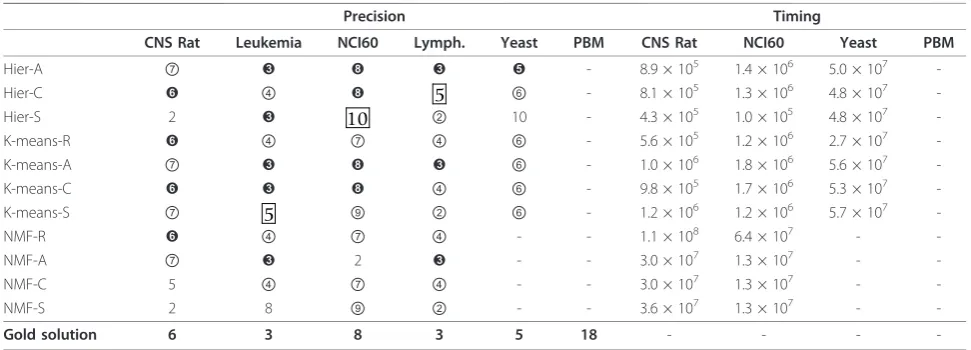
Forp= 80%, the precision results reported in the cor-responding tables at the supplementary material web site show that there is very little difference between the results obtained for H = 500 and H = 250. That is in contrast with the results forH= 100, where many pre-diction values are very far from the gold solution for the corresponding dataset, e.g., the Lymphoma dataset. Such a finding seems to indicate that, in order to find a con-sensus matrix which captures well the inherent structure of the dataset, one needs a sensible number of connec-tivity matrices. The results for a subsampling value of p = 66% confirms that the number of connectivity matrices one needs to compute is more relevant than the percentage of the data matrix actually used to com-pute them. Indeed, although it is obvious that a reduc-tion in the number of resampling steps results in a saving in terms of execution time, it is less obvious that for subsampling valuesp = 66% and p= 80%, there is no substantial difference in the results, both in terms of precision and of time. Therefore, a proper parameter setting for Consensus seems to beH = 250 andp= 80%. In regard to NMF, we have used only that para-meter setting for our experiments. For later use, we report in Table 1 part of the results of the experiments with the parameter setting H = 250 and p = 80%. Indeed, as for timing results, we report only the ones for CNS Rat, NCI60, PBM and Yeast datasets since the ones for Leukemia and Lymphoma are comparable to those obtained for CNS Rat and NCI60 and therefore
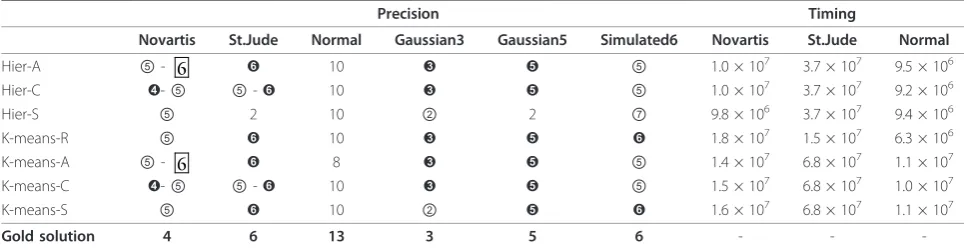
are redundant. As for the Benchmark 2 datasets, we have experimented only with the parameter settingH= 250 and p= 80%. For each dataset and each algorithm, the predictions have been derived in analogy with the ones for datasets inBenchmark 1. The relevant figures and tables are at the supplementary material web site, again organized in analogy with the criteria described for Benchmark 1. For later use, we report the table here as Table 2. For the artificial datasets, we do not report the timing results since the experiments have been performed on a computer other than the AMD Athlon.
From our experiments, in particular the ones on the Benchmark 1datasets, several conclusons can be draw. A simple reduction in terms of Hand pis not enough to grant a good precision-time trade-off. Even worse, although the parameter setting H= 250 and p = 80% grants a faster execution ofConsensuswith respect to the original setting by Monti et al., the experiments on the PBM dataset were stopped after four days on all algorithms. That is, the largest of the datasets used here is still“out of reach”ofConsensuseven with a tuning of the parameters aimed at reducing its computational demand. Such a finding, together with the state of the art outlined in the Background section, motivates our interest in the design of alternative methods, such as fast heuristics.
RegardingNMF, its inefficiencies compound with those of Consensus; that is, the relatively large number of
Table 1 Results for Consensus with H = 250 and p = 80% on theBenchmark 1datasets
Precision Timing
CNS Rat Leukemia NCI60 Lymph. Yeast PBM CNS Rat NCI60 Yeast PBM
Hier-A ⑦ ➌ ➑ ➌ ➎ - 8.9 × 10⁵ 1.4 × 10⁶ 5.0 × 10⁷
-Hier-C ➏ ④ ➑ 5 ⑥ - 8.1 × 10⁵ 1.3 × 10⁶ 4.8 × 10⁷
-Hier-S 2 ➌ 10 ② 10 - 4.3 × 10⁵ 1.0 × 10⁵ 4.8 × 10⁷
-K-means-R ➏ ④ ⑦ ④ ⑥ - 5.6 × 10⁵ 1.2 × 10⁶ 2.7 × 10⁷
-K-means-A ⑦ ➌ ➑ ➌ ⑥ - 1.0 × 10⁶ 1.8 × 10⁶ 5.6 × 10⁷
-K-means-C ➏ ➌ ➑ ④ ⑥ - 9.8 × 10⁵ 1.7 × 10⁶ 5.3 × 10⁷
-K-means-S ⑦ 5 ⑨ ② ⑥ - 1.2 × 10⁶ 1.2 × 10⁶ 5.7 × 10⁷
-NMF-R ➏ ④ ⑦ ④ - - 1.1 × 10⁸ 6.4 × 10⁷ -
-NMF-A ⑦ ➌ 2 ➌ - - 3.0 × 10⁷ 1.3 × 10⁷ -
-NMF-C 5 ④ ⑦ ④ - - 3.0 × 10⁷ 1.3 × 10⁷ -
-NMF-S 2 8 ⑨ ② - - 3.6 × 10⁷ 1.3 × 10⁷ -
-Gold solution 6 3 8 3 5 18 - - -
connectivity matrices needed by Consensus and the well-known slow convergence ofNMF for the computa-tion of a clustering solucomputa-tion, since connectivity matrices are obtained from clustering solutions. The end-result is a slow-down of one order of magnitude with respect to Consensus used in conjunction with other clustering algorithms. As a consequence, NMF and Consensus can be used together on a conventional PC only for relatively small datasets. In fact, the experiments for Yeast and PBM, the two largest datasets inBenchmark 1with which we have experimented, were stopped after four days. An analogous outcome was observed for the experiments on all of the microarray datasets in Benchmark 2.
FC and its parameters
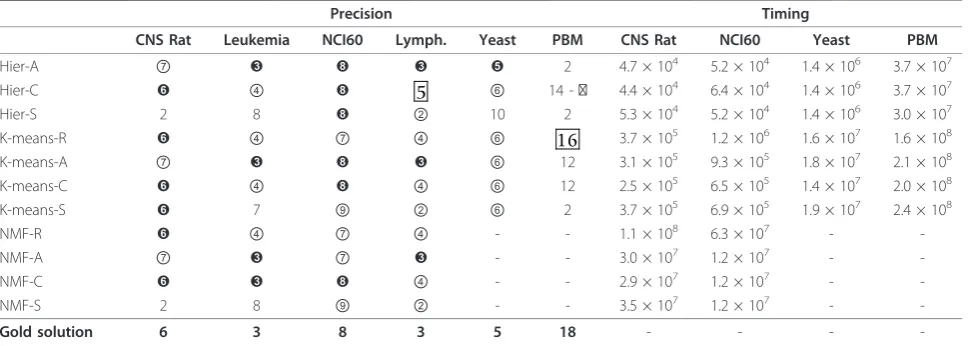
In analogy with Consensus, the precision and time performances of FC depend onH and p. In order to validate this measure, we repeat verbatim the experi-ments that have been performed here for Consensus. The relevant information is in the Figures and Tables section of the supplementary material web site and it follows the same organization as the one described for Consensus. Again, we find that the“best” parameter setting isH= 250 and p= 80% also forFC. The tables of interest are reported here as Table 3 and 4 and they are used for the comparison withConsensus.
Consider Table 1 and 3. Note that, in terms of preci-sion,FCandConsensusprovide identical predictions on the Lymphoma and Yeast datasets, while their pre-dictions are quite close on the CNS Rat dataset. More-over, in terms of time, note that FC is faster then Consensus by at least one order of magnitude on all hierarchical algorithms and K-means-A, K-means-C and K-means-S. In particular,FCis able to complete execu-tion on the PBM dataset, as opposed to Consensus, with all of the mentioned algorithms. It is also worthy of notice that Hier-C and K-means-R also provide, for the PBM dataset, a reasonable estimate of the number
of clusters present in it. Finally, the one order of magni-tude speed-up is preserved with increasing values of H. That is, as H increases the precision of both Con-sensusandFCincreases, but the speed-up ofFC with respect to Consensus is preserved (see the timing results reported at the supplementary material web site forH= 500, 250, 100 andp= 80% on the Benchmark 1datasets). It is somewhat unfortunate, however, that those quite substantial speed-ups have only minor effects when one uses NMF as a clustering algorithm, which is a clear indication that the time taken byNMF to converge to a clustering solution accounts for most of the time performance ofFCin that setting, in analogy withConsensus.
Consider now Table 2 and 4. Based on them, it is of great interest to notice that, on the datasets of Bench-mark 2, there is no difference whatsoever in the
predic-tions between Consensus and FC. Even more
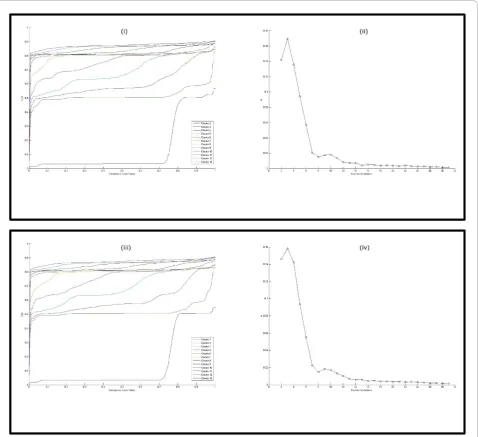
remarkably, by analyzing the Δ and the CDF curves from which the predictions are made (see Methods sec-tion), one discovers that the ones produced by Con-sensusandFCare nearly identical (see Figs. M1-M24 at the supplementary material web site). However, on the microarray datasets inBenchmark 2,FC is at least one order of magnitude faster thanConsensus, with exactly the same algorithms indicated for Benchmark 1. NMF results to be problematic also on the Bench-mark 2datasets.
Comparison ofFCwith other internal validation measures It is also of interest to compareFCwith other validation measures that are available in the literature. We take, as reference, the benchmarking results reported in Giancarlo et al., since for the Benchmark 1 datasets the experimental setup is identical to the one used here. As mentioned in the Background section, that bench-marking accounts for the three most widely known families of validation measures: namely, those based on (a) hypothesis testing in statistics; (b) stability-based
Table 2 Results for Consensus with H = 250 and p = 80% on theBenchmark 2datasets
Precision Timing
Novartis St.Jude Normal Gaussian3 Gaussian5 Simulated6 Novartis St.Jude Normal
Hier-A ⑤- 6 ➏ 10 ➌ ➎ ⑤ 1.0 × 10⁷ 3.7 × 10⁷ 9.5 × 10⁶
Hier-C ➍-⑤ ⑤-➏ 10 ➌ ➎ ⑤ 1.0 × 10⁷ 3.7 × 10⁷ 9.2 × 10⁶
Hier-S ⑤ 2 10 ② 2 ⑦ 9.8 × 10⁶ 3.7 × 10⁷ 9.4 × 10⁶
K-means-R ⑤ ➏ 10 ➌ ➎ ➏ 1.8 × 10⁷ 1.5 × 10⁷ 6.3 × 10⁶
K-means-A ⑤- 6 ➏ 8 ➌ ➎ ⑤ 1.4 × 10⁷ 6.8 × 10⁷ 1.1 × 10⁷
K-means-C ➍-⑤ ⑤-➏ 10 ➌ ➎ ⑤ 1.5 × 10⁷ 6.8 × 10⁷ 1.0 × 10⁷
K-means-S ⑤ ➏ 10 ② ➎ ➏ 1.6 × 10⁷ 6.8 × 10⁷ 1.1 × 10⁷
Gold solution 4 6 13 3 5 6 - -
techniques and (c) jackknife techniques, in particular, the Gap Statistics for category (a);CLEST[22], Model Explorer [23] and Consensusfor category (b) and FOM for category (c). Moreover, there are also included G-Gap, an approximation of the Gap Statistics, and one extension of FOM, referred to as Diff-FOM. In addition, that study takes into account two classical measures as WCSSand the KL (Krzanowski and Lai index) [35]. In the Supplementary File, a short description is given of the measures relevant to this discussion.
Using the Benchmark 1 datasets, Giancarlo et al. show there is a natural hierarchy, in terms of time, for those measures. Moreover, the faster the measure, the less accurate it is. From that study and for completeness, we report in Table TI13, at the supplementary material web site, the best performing measures, with the addi-tion ofFC. From that table, we extract and report, in Table 5 the fastest and best performing measures -again, with the addition of FC. Consistent with that study, we report the timing results only for CNS Rat,
Leukemia, NCI60 and Lymphoma. As is self-evident from that latter table, FCwith Hier-A is within a one order of magnitude difference in speed with respect to the fastest measures, i.e., WCSS and G-Gap. Quite remarkably, it grants a better precision in terms of its ability to identify the underlying structure in each of the benchmark datasets. It is also of relevance to point out thatFCwith Hier-A has a time performance comparable to that of FOM, but again it has a better precision per-formance. Notice that, none of the three just-mentioned measures depends on any parameter setting, implying that no speed-up will result from a tuning of the algorithms.
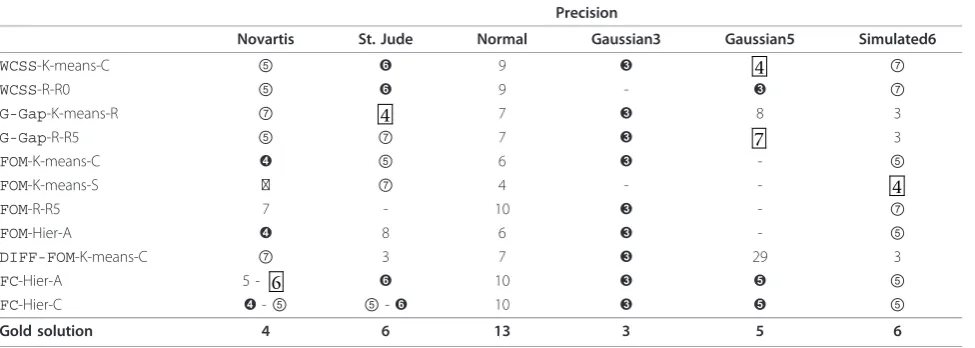
For completeness and in order to even better assess the precision merits ofFC with respect to the measures considered in Table TI13, we have performed experi-ments also on the Benchmark 2datasets. The timing results are not reported since the experiments have been performed on computers other than the AMD Athlon. Since most of the methods in that table predict
Table 3 Results forFCwith H = 250 and p = 80% on theBenchmark 1datasets
Precision Timing
CNS Rat Leukemia NCI60 Lymph. Yeast PBM CNS Rat NCI60 Yeast PBM
Hier-A ⑦ ➌ ➑ ➌ ➎ 2 4.7 × 10⁴ 5.2 × 10⁴ 1.4 × 10⁶ 3.7 × 10⁷
Hier-C ➏ ④ ➑ 5 ⑥ 14 -⑰ 4.4 × 10⁴ 6.4 × 10⁴ 1.4 × 10⁶ 3.7 × 10⁷
Hier-S 2 8 ➑ ② 10 2 5.3 × 10⁴ 5.2 × 10⁴ 1.4 × 10⁶ 3.0 × 10⁷
K-means-R ➏ ④ ⑦ ④ ⑥ 16 3.7 × 10⁵ 1.2 × 10⁶ 1.6 × 10⁷ 1.6 × 10⁸
K-means-A ⑦ ➌ ➑ ➌ ⑥ 12 3.1 × 10⁵ 9.3 × 10⁵ 1.8 × 10⁷ 2.1 × 10⁸
K-means-C ➏ ④ ➑ ④ ⑥ 12 2.5 × 10⁵ 6.5 × 10⁵ 1.4 × 10⁷ 2.0 × 10⁸
K-means-S ➏ 7 ⑨ ② ⑥ 2 3.7 × 10⁵ 6.9 × 10⁵ 1.9 × 10⁷ 2.4 × 10⁸
NMF-R ➏ ④ ⑦ ④ - - 1.1 × 10⁸ 6.3 × 10⁷ -
-NMF-A ⑦ ➌ ⑦ ➌ - - 3.0 × 10⁷ 1.2 × 10⁷ -
-NMF-C ➏ ➌ ➑ ④ - - 2.9 × 10⁷ 1.2 × 10⁷ -
-NMF-S 2 8 ⑨ ② - - 3.5 × 10⁷ 1.2 × 10⁷ -
-Gold solution 6 3 8 3 5 18 - - -
-A summary of the results forFCwithH= 250 andp= 80%, on all algorithms and on theBenchmark 1. datasets. The table legend is as in Table 1.
Table 4 Results forFCwith H = 250 and p = 80% on theBenchmark 2datasets
Precision Timing
Novartis St.Jude Normal Gaussian3 Gaussian5 Simulated6 Novartis St.Jude Normal
Hier-A ⑤- 6 ➏ 10 ➌ ➎ ⑤ 4.0 × 10⁵ 1.6 × 10⁶ 3.4 × 10⁵
Hier-C ➍-⑤ ⑤-➏ 10 ➌ ➎ ⑤ 3.9 × 10⁵ 1.4 × 10⁶ 3.3 × 10⁵
Hier-S ⑤ 2 10 ② 2 ⑦ 4.4 × 10⁵ 1.5 × 10⁶ 3.4 × 10⁵
K-means-R ⑤ ➏ 10 ➌ ➎ ➏ 1.4 × 10⁷ 5.9 × 10⁶ 2.0 × 10⁶
K-means-A ⑤- 6 ➏ 8 ➌ ➎ ⑤ 5.5 × 10⁶ 3.2 × 10⁷ 5.4 × 10⁶
K-means-C ➍-⑤ ⑤-➏ 10 ➌ ➎ ⑤ 6.5 × 10⁶ 3.2 × 10⁷ 2.1 × 10⁶
K-means-S ⑤ ➏ 10 ② ➎ ➏ 7.8 × 10⁶ 4.9 × 10⁷ 2.1 × 10⁶
Gold solution 4 6 13 3 5 6 - -
k* based on the identification of a“knee” in a curve (in analogy with theΔcurve ofConsensus), the relevant figures are reported at the supplementary material web site. Table TI16, at the supplementary material web site, summarizes the results. We extract from Table TI16 the same measures present in Table 5 and report them in Table 6. Again,FCis among the most precise.
The results outlined above are particularly significant since (i) FOM is one of the most established and highly-referenced measures specifically designed for microarray data; (ii) in purely algorithmic terms,WCSSandG-Gap, are so simple as to represent a“lower bound” in terms of the time performance that is achievable by any data-driven internal validation measure. In conclusion, our experiments show that FCis quite close in time perfor-mance to three of the fastest data-driven validation
measures available in the literature, while also granting better precision results. In view of the fact that the for-mer measures are considered reference points in this area, the speed-up ofConsensusproposed here seems to be a non-trivial step forward in the area of data-dri-ven internal validation measures.
Conclusions
FC is an algorithm that guarantees a speed-up of at least one order of magnitude with respect toConsensus, when used in conjunction with hierarchical clustering algorithms or with partitional algorithms with a hier-archical initialization. Remarkably, it preserves what seem to be the most outstanding properties of that mea-sure: the accuracy in identifying structure in the input dataset and the ability to produce a dissimilarity matrix
Table 5 Summary of results for the fastest measures on theBenchmark 1datasets
Precision Timing
CNS Rat Leukemia NCI60 Lymphoma Yeast CNS Rat Leukemia NCI60 Lymphoma
WCSS-K-means-C ⑤ ➌ ➑ 8 ④ 1.7 × 10³ 1.3 × 10³ 5.0 × 10³ 4.0 × 10³
WCSS-R-R0 ⑤ ④ ➑ ➌ ④ 1.2 × 10³ 8.0 × 10² 4.1 × 10³ 3.0 × 10³
G-Gap-K-means-R ⑦ ➌ 4 ④ ⑥ 2.4 × 10³ 2.0 × 10³ 8.3 × 10⁴ 8.4 × 10³
G-Gap-R-R5 ⑤ ④ 2 ② ④ 1.2 × 10³ 8.0 × 10² 4.5 × 10⁴ 3.2 × 10³
FOM-K-means-C ⑦ 8 ➑ ④ ④ 1.9 × 10⁴ 9.4 × 10⁴ 5.5 × 10⁵ 2.6 × 10⁵
FOM-K-means-S ➏ ➌ ➑ 8 ④ 2.9 × 10⁴ 1.0 × 10⁵ 7.1 × 10⁵ 3.6 × 10⁵
FOM-R-R5 ➏ ➌ ⑦ 5 ➎ 3.9 × 10³ 3.7 × 10⁴ 2.1 × 10⁵ 7.6 × 10⁴
FOM-Hier-A ⑦ ➌ ⑦ 6 ⑥ 1.6 × 10³ 7.5 × 10³ 5.1 × 10⁴ 1.8 × 10⁴
DIFF-FOM-K-means-C ⑦ ➌ ⑦ ④ 3 1.9 × 10⁴ 9.4 × 10⁴ 5.5 × 10⁵ 2.6 × 10⁵
FC-Hier-A ⑦ ➌ ➑ ➌ ➎ 5.9 × 10⁴ 2.7 × 10⁴ 7.0 × 10⁴ 6.8 × 10⁴
FC-Hier-C ➏ ④ ➑ 5 ⑥ 5.9 × 10⁴ 2.7 × 10⁴ 6.5 × 10⁴ 6.7 × 10⁴
Gold solution 6 3 8 3 5 - - -
-A summary of the best performing measures taken from the benchmarking of Giancarlo et al., with the addition ofFC, withH= 250 andp= 80%. The table legend is as in Table 1. Consistent with that study, we report only the timing results for CNS Rat, Leukemia, NCI60 and Lymphoma, since for the Yeast and PBM datasets the experiments have been performed on a computer other than the AMD Athlon.
Table 6 Summary of results for the fastest measures on theBenchmark 2datasets
Precision
Novartis St. Jude Normal Gaussian3 Gaussian5 Simulated6
WCSS-K-means-C ⑤ ➏ 9 ➌ 4 ⑦
WCSS-R-R0 ⑤ ➏ 9 - ➌ ⑦
G-Gap-K-means-R ⑦ 4 7 ➌ 8 3
G-Gap-R-R5 ⑤ ⑦ 7 ➌ 7 3
FOM-K-means-C ➍ ⑤ 6 ➌ - ⑤
FOM-K-means-S ➍ ⑦ 4 - - 4
FOM-R-R5 7 - 10 ➌ - ⑦
FOM-Hier-A ➍ 8 6 ➌ - ⑤
DIFF-FOM-K-means-C ⑦ 3 7 ➌ 29 3
FC-Hier-A 5 - 6 ➏ 10 ➌ ➎ ⑤
FC-Hier-C ➍-⑤ ⑤-➏ 10 ➌ ➎ ⑤
Gold solution 4 6 13 3 5 6
that can be used to improve the performance of cluster-ing algorithms. For this latter point-see the Supplemen-tary File. Moreover, the speed-up does not seem to depend on the numberHof resampling steps.
In terms of the existing literature on data-driven inter-nal validation measures, we have that, by extending the benchmarking results of Giancarlo et al.,FCis only one order of magnitude away from the fastest measures, i.e., WCSS, yet granting a superior performance in terms of precision. AlthoughFCdoes not close the gap between the time performance of the fastest internal validation measures and the most precise, it is a substantial step forward towards that goal. For one thing, its time per-formance is comparable with that of FOM and with a better precision, a result of great significance in itself, given the fact that FOM is one of the oldest and most prestigious methods in the microarray data analysis area. Furthermore, some conclusions that are of interest from the methodological point of view can also be drawn. The idea of“approximating”an internal valida-tion measure to achieve a speed-up, introduced by Gian-carlo et al. and applied here to Consensus, seems to lead to significant improvements in time performance with minor losses in predictive power. As detailed in the Methods section, the technique we have developed here, although admittedly simple, can be used in other con-texts, where a given number of clustering solutions must be computed from different samples of the same dataset. That is a typical scenario common to many sta-bility-based validation measures, i.e., [22,23,28,29,31,36].
Unfortunately, FC, when used in conjunction with NMF, is almost as slow as Consensus. Those experi-ments provide additional methodological, as well as pragmatic, insights affecting both clustering and pattern discovery in biological data. Indeed, although the work by Brunet et al. uses Consensusin conjunction with NMF in order to identify the number of clusters in a dataset, our experiments show that both Consensus andFChave a better prediction power when used with Hier-A and Hier-C than when used withNMF. In view of the steep computational price one must pay, the use of NMFwithConsensus andFCdoes not seem to be justified. Indeed, the major contribution given by Brunet et al. in their seminal paper is to show that NMF can give a succinct representation of the data, which can then be used for pattern discovery. Our work shows that, as far as clustering and validation measures go, choices more convenient than NMF are possible: it is somewhat reductive to consider NMF as a clustering algorithm.
In summary,FCwith a parameter setting, i.e,H= 250 andp= 80%, that makes it robust with respect to small and medium-sized datasets, i.e, number of items to cluster in the hundreds and number of conditions up to a
thousand, seems to be the internal validation measure of choice. It remains open to establish a good parameter set-ting for datasets with thousands of elements to cluster. Given the current state of the art, addressing such a ques-tion means to come-up with an internal validaques-tion mea-sure able to correctly predict structure when there are thousands of elements to classify. A task far from obvious, given that all measures in the benchmarking by Giancarlo et al. have serious limitation in their predictive power for datasets with a number of elements in the thousands.
Methods
Consensus
Consensus is a stability-based technique, which is best presented as a procedure taking as inputSub, H,D, A, kmax. The resampling schemeSubis a means of sam-pling from one dataset in order to build a new one. In our experiments, the resampling scheme extracts, uni-formly and at random, a given percentagepof the rows of the dataset D. Finally, His the number of resampling steps,Ais the clustering algorithm and kmaxis the max-imum number that is considered as candidate for the “correct” numberk* of clusters inD.
Procedure Consensus(Sub,H,D,A,kmax)
(1)For 2≤k≤kmax, initialize to empty the setM of connectivity matrices and perform steps(1.a) and
(1.b).
(1.a) For 1 ≤ h ≤ H, compute a perturbed data matrix D(h) using resampling scheme Sub; cluster the elements inkclusters using algorithm AandD (h)
. Compute a connectivity matrixM(h)and insert it intoM.
(1.b)Based on the connectivity matrices inM, com-pute a consensus matrix ( )k .
(2)Based on thekmax- 1 consensus matrices, return a prediction fork*.
As for the connectivity matrixM(h), one hasM(h)(i,j) = 1 if itemsiandjare in the same cluster and zero otherwise. Moreover, we also need to define an indicator matrixI(h) such thatI(h)(i,j) = 1 if itemsiandjare both inD(h)and zero otherwise. Then, the consensus matrix ( )k is defined as a properly normalized sum of all connectivity matrices in all perturbed datasets:
( )
( )
( )
k
h
h h
h M
I
=
∑
∑
(1)estimate the real number k* of clusters present in D. Here we limit ourselves to present the key points, since the interested reader can find a full discussion in Monti et al.. Letnbe the number of items to cluster,m=n(n -1)/2, and {x1,x2, ...,xm} be the list obtained by sorting the entries of the consensus matrix. Moreover, let the empiri-cal cumulative distributionCDF, defined over the range [0, 1], be:
CDF c
l i j c
m i j ( )
{ ( , ) } =
∑
< ≤
wherecis a chosen constant in [0, 1] andlequals one if the condition is true and it is zero otherwise. For a given value of k, i.e., number of clusters, consider the CDFcurve obtained by plotting the values ofCDF(xi), 1≤i≤m, with the use of the corresponding consensus matrix. In an ideal situation in which there arekclusters and the clustering algorithm is so good to provide a per-fect classification, such a curve is bimodal, with peaks at zero and one. Monti et al. observe and validate experi-mentally that the area under the CDF curves is an increasing function ofk. That result has also been con-firmed by the experiments in Giancarlo et al.. In particu-lar, for values of k ≤ k*, that area has a significant increase, while its growth flattens out fork >k*. For instance, with reference to Figure 1 one sees an increase in the area under theCDFs fork= 2, ..., 13. The growth rate of the area is decreasing as a function ofkand it flat-tens out fork≤k* = 3. The point in which such a growth flattens out can be taken as an indication ofk*. However, operationally, Monti et al. propose a closely associated method, described next. For a givenk, the area of the correspondingCDFcurve is estimated as follows:
A k xi xi CDF x
i m
i
( )=
[
− −]
( )
=
∑
12
Again,A(k) is observed to be an increasing function of k, with the same growth rate as theCDFcurves. Now, let
Δ( )
( ) ,
( ) ( )
( ) .
k
A k k
A k A k
A k k
=
=
+ − >
⎧ ⎨ ⎪
⎩⎪
2 1
2
be the proportion increase of theCDFarea as a func-tion ofkand as estimated by A(k). Again, Monti et al. observe experimentally that:
(i) For eachk≤k*, there is a pronounced decrease of theΔcurve. That is, the incremental growth ofA(k) decreases sharply.
(ii) Fork >k*, there is a stable plot of theΔ curve. That is, fork>k*, the growth of A(k) flattens out.
From this behavior, the“rule of thumb”to identify k* with the use of the Δ curve is: take ask* the abscissa corresponding to the smallest non-negative value where the curve starts to stabilize; that is, no big variation in the curve takes place from that point on. An example is given in Figure 1.
A few remarks are in order. From the observations outlines above, one has that, the value of the area under theCDF is not very important. Rather, its growth as a function of k is key. Moreover, experimentally, the Δ curve is non-negative. Such an observation has been confirmed by Giancarlo et al. However, there is no theo-retic justification for such a fact. Even more importantly, the growth of theCDFcurves also gives an indication of the number of clusters present in D. Such a fact, together with the use of theΔcurve, contributes to the quality of the prediction since A(k) is only an approxi-mation of the real area under theCDFcurve and it may give spurious indications that can be “disambiguated” with the use of the CDFcurves. It is quite remarkable that there is usually excellent agreement in the predic-tion between theΔcurve and theCDFcurves. For con-venience of the reader, we recall here that many internal validation methods are based on the identification of a “knee” in a suitably defined curve, e.g.,WCSSand FOM, in most cases via a visual inspection of the curve. For specific measures, there exist automatic methods that identify such a point, some of them being theoretically sound [21], while others are based on heuristic geo-metric observations [20,37]. ForConsensus, the identi-fication of a theoretically sound automatic method for the prediction ofk* is open and it is not clear that heur-istic approaches will yield appreciable results.
also worth noticing that each of thekmax×Hclustering solutions needed is computed from a distinct dataset. As is shown in the next section, this leads to inefficien-cies, in particular in regard to agglomerative clustering algorithms, such as the hierarchical ones. Indeed, their ability to quickly compute a clustering solution withk clusters from one with k+ 1, typical of these methods, cannot be used withinConsensus because, for eachk, the dataset changes. The same holds true for divisive methods.
FC
Intuitively, a large number of clustering solutions, each obtained via a sample of the original dataset, seem to be required in order to identify the correct number of clus-ters. However, there is no theoretic reason indicating that those clustering solutions must each be generated from a different sample of the input dataset, as Con-sensus does. Based on this observation, we propose to perform, first, a sampling step to generate a data matrix D(h), which is then used to generate all clustering
solutions forkin the range [2,kmax]. In terms of code, that implies a simple switch of the two iteration cycles in steps (1) and (1.a) of theConsensusprocedure. In turn, and with reference to the discussion at the end of the subsection regarding Consensus, that switch allows us to obtain a speed-up since costly computa-tional duplications are avoided when the clustering algo-rithm Ais hierarchical. Indeed, once the switch is done, it becomes possible to interleave the computation of the measure with the level bottom-up construction of the hierarchical tree underlying the clustering algorithms. Specifically, only one dendogram construction is required rather than the repeated and partial construc-tion of dendograms as in the Consensus procedure. Therefore, we use, in full, the main characteristic of agglomerative algorithms briefly discussed in the subsec-tion regarding Consensus.FC is formalized by the fol-lowing procedure:
Procedure FC(Sub, H, D, A, kmax)
(1)For 1 ≤h≤H, compute a perturbed data matrix D(h)using resampling schemeSub;.
(1.a) For 2≤k≤kmax, initialize to empty the setM (k)
of connectivity matrices and cluster the elements in kclusters using algorithm AandD(h). Compute a connectivity matrixM(h, k).
(2) For 2 ≤ k ≤ kmax, based on the connectivity matrices in M, compute a consensus matrix ( )k .
(3) Based on thekmax -1 consensus matrices, return a prediction fork*.
The “rule of thumb” one uses to predictk*, viaFC, is the same as forConsensus. An example is reported in Figure 1(iii)-(iv). It is worth pointing out that both the CDFs andΔcurve shapes for FCclosely track those of the respective curves forConsensus.
Finally, although the idea behindFC is simple, it has a general applicability that goes beyond the speed-up of Consensus. Indeed, as discussed earlier, all other stabi-lity-based methods available in the literature follow the same strategy for the construction of a large number of clustering solutions. Therefore, theFC speed-up applies also to them, although we have experimented only with Consensussince it seems to be the best, in terms of precision, in this category of measures.
Availability
All software and datasets involved in our experimentation are available at the supplementary material web site. The software is given in a jar executable file for a Java Run Time environment. It works for Linux (various versions– see supplementary material web site), Mac OS X and Win-dows operating systems. Minimal system requirements are specified at the supplementary material web site, together
with instructions and the binaries of K-means, hierarchical methods andNMFare also provided.
Acknowledgements
Part of this work is supported by Italian Ministry of Scientific Research, FIRB Project“Bioinfomatica per la Genomica e la Proteomica”, FIRB Project
“Algoritmi per la Scoperta ed il Ritrovamento di Patterns in Strutture Discrete, con Applicazioni alla Bioinformatica”. The authors would also like to thank Davide Scaturro for providing them K-means and hierarchical clustering algorithms and for contributions during the initial discussions that led to this research. Moreover, the authors are also deeply indebted to Chiara Romualdi for discussions relating to this research and to Margaret Gagie for comments on earlier versions of this manuscript.
Author details
1Dipartimento di Matematica ed Informatica, Universitá di Palermo, Via
Archirafi 34, 90123 Palermo, Italy.2IBM T.J. Watson Research Center,
Yorktown Yeights, NY, USA.
Authors’contributions
RG and FU contributed equally to the design of the new algorithm, to the experimental methodology and to the write-up of the manuscript. FU implemented the algorithm and performed the experiments. RG directed the research. Both authors have read and approved the manuscript. This research by FU was conducted while in the Dipartimento di Matematica ed Informatica, Universitá di Palermo, Italy.
Competing interests
The authors declare that they have no competing interests.
Received: 29 September 2010 Accepted: 14 January 2011 Published: 14 January 2011
References
1. Speed TP:Statistical analysis of gene expression microarray dataChapman & Hall/CRC; 2003.
2. Everitt B:Cluster AnalysisLondon: Edward Arnold; 1993.
3. Hansen P, Jaumard P:Cluster Analysis and Mathematical Programming.
Mathematical Programming1997,79:191-215.
4. Hartigan JA:Clustering AlgorithmsJohn Wiley and Sons; 1975.
5. Jain AK, Murty MN, Flynn PJ:Data Clustering: a Review.ACM Computing Surveys1999,31(3):264-323.
6. Kaufman L, Rousseeuw PJ:Finding Groups in Data: An Introduction to Cluster AnalysisNew York: Wiley; 1990.
7. Mirkin B:Mathematical Classification and ClusteringKluwer Academic Publisher; 1996.
8. Rice JA:Mathematical Statistics and Data AnalysisWadsworth; 1996. 9. Hastie T, Tibshirani R, Friedman J:The Elements of Statistical Learning
Springer; 2003.
10. Handl J, Knowles J, Kell DB:Computational Cluster Validation in Post-genomic Data Analysis.Bioinformatics2005,21(15):3201-3212. 11. Shamir R, Sharan R:Algorithmic Approaches to Clustering Gene
Expression Data.InCurrent Topics in Computational Biology.Edited by: Jiang T, Smith T, Xu Y, Zhang MQ. Cambridge, Ma.: MIT Press; 2003:120-161. 12. D’haeseleer P:How Does Gene Expression Cluster Work?Nature
Biotechnology2006,23:1499-1501.
13. Jain A, Dubes R:Algorithms for Clustering DataEnglewood Cliffs: Prentice-Hall; 1988.
14. Seal S, Comarina S, Aluru S:An Optimal Hierarchical Clustering Algorithm For Gene Expression Data.Information Processing Letters2004,93:143-147. 15. Borodin A, Ostrovsky R, Rabani Y:Subquadratic Approximation Algorithms
for Clustering Problems in High Dimensional Space.Machine Learning 2004,56:153-167.
16. Frahling G, Sohler C:A fast K-means Implementation Using Coresets.
Proceedings of the Twenty-Second Annual Symposium on Computational
GeometryNew York, NY, USA: ACM; 2006, 135-143.
17. Kraus J, Kestler H:A highly efficient multi-core algorithm for clustering extremely large datasets.BMC Bioinformatics2010,11.
19. Monti S, Tamayo P, Mesirov J, Golub T:Consensus Clustering: A resampling-based Method for Class Discovery and Visualization of Gene Expression Microarray Data.Machine Learning2003,52:91-118.
20. Giancarlo R, Scaturro D, Utro F:Computational cluster validation for microarray data analysis: experimental assessment of Clest, Consensus Clustering, Figure of Merit, Gap Statistics and Model Explorer.BMC Bioinformatics2008,9:462.
21. Tibshirani R, Walther G, Hastie T:Estimating the Number of Clusters in a Dataset via the Gap Statistics.Journal Royal Statistical Society B2001, 2:411-423.
22. Dudoit S, Fridlyand J:A Prediction-based Resampling Method for Estimating the Number of Clusters in a Dataset.Genome Biology2002,3. 23. Ben-Hur A, Elisseeff A, Guyon I:A Stability Based Method for Discovering Structure in Clustering Data.Seventh Pacific Symposium on Biocomputing ISCB; 2002, 6-17.
24. Yeung K, Haynor D, Ruzzo W:Validating Clustering for Gene Expression Data.Bioinformatics2001,17:309-318.
25. Brunet JP, Tamayo P, Golub T, Mesirov J:Metagenes and molecular pattern discovery using matrix factorization.Proc. of the National Academy of Sciences of the United States of America2004,101:4164-4169. 26. Devarajan K:Nonnegative Matrix Factorization: An Analytical and
Interpretative Tool in Computational Biology.PLoS Computational Biology 2008,4:1-12.
27. Dudoit S, Fridlyand J:Bagging to improve the accuracy of a clustering procedure.Bioinformatics2003,19(9):1090-1099.
28. Levine E, Domany E:Resampling Method for Unsupervised Estimation of Cluster Validity.Neural Computation2001,13:2573-2593.
29. Roth V, Lange T, Braun M, Buhmann J:A Resampling Approach to Cluster Validation.Proc 15th Symposium in Computational Statistics2002, 123-128. 30. Bertoni A, Valentini G:Model order selection for bio-molecular data
clustering.BMC Bioinformatics2007,8.
31. Bertrand P, Mufti GB:Loevinger’s measures of rule quality for assessing cluster stability.Computational Statistics & Data Analysis2006,50:992-1015. 32. Klie S, Nikoloski Z, Selbig J:Biological Cluster Evaluation for Gene
Function Prediction.Journal of Computational Biology2010,17:1-18. 33. Supplementary material web site.[http://www.math.unipa.it/~raffaele/
suppMaterial/speedUp/].
34. Di Gesú V, Giancarlo R, Lo Bosco G, Raimondi A, Scaturro D:Genclust: A Genetic Algorithm for Clustering Gene Expression Data.BMC Bioinformatics2005,6:289.
35. Krzanowski W, Lai Y:A Criterion for Determining the Number of Groups in a Dataset Using Sum of Squares Clustering.Biometrics1985,44:23-34. 36. Bertoni A, Valentini G:Randomized maps for assessing the reliability of
patients clusters in DNA microarray data analyses.Artificial Intelligence in Medicine2006,37:85-109.
37. Salvador S, Chan P:Determining the number of clusters/segments in hierarchical clustering/segmentation algorithms.Tools with Artificial Intelligence, 2004. ICTAI 2004. 16th IEEE International Conference on2004, 576-584.
doi:10.1186/1748-7188-6-1
Cite this article as:Giancarlo and Utro:Speeding up the Consensus Clustering methodology for microarray data analysis.Algorithms for Molecular Biology20116:1.
Submit your next manuscript to BioMed Central and take full advantage of:
• Convenient online submission
• Thorough peer review
• No space constraints or color figure charges
• Immediate publication on acceptance
• Inclusion in PubMed, CAS, Scopus and Google Scholar
• Research which is freely available for redistribution