Using The “Baccalaureate Essentials”
To Create Context:
Evaluation Of An Innovative Approach
Brooke A. Flinders, Miami University, USAABSTRACT
The “Essentials of Baccalaureate Education for Professional Nursing Practice” (American Association of Colleges of Nursing, 2008) seek to communicate standards that will prepare graduates to function within a complex healthcare system. The document highlights concepts from patient-centered care to evidence-based practice (Commission on Collegiate Nursing Education). A service-learning experience was facilitated for junior-level nursing students and they were asked to reflect on their learning outcomes using the nine “essentials” as a guiding framework. Themes were identified within the nine sub-categories and through overall analysis. By using standardized disciplinary outcomes to develop a sense of the “bigger picture” for students, it is possible to help them make connections between theory and practice.
Keywords: Baccalaureate; Nursing Education; Service-learning; Reflection
INTRODUCTION
ne on-going challenge for nurse educators lies in helping our students make connections between theory and practice. Students need assistance in understanding their clinical experiences in a broader context because so often it is difficult for them to move out of a task-oriented mindset. By using professional standards to create a common language and to clarify disciplinary context, students can be encouraged to understand that nursing is more than the tasks they may happen to complete at the bedside.The four goals of this activity were: 1) to introduce students to the American Association of Colleges of Nursing’s “Baccalaureate Essentials” (2008), 2) to assist students in framing a service-learning project inthe context of the “Baccalaureate Essentials”, 3) to assist students in making connections, between theory and clinical practice, and 4) to give students an opportunity to discuss theirreflection activities in small groups, comparing and contrasting their own observations with those of others. This innovative approach to student reflection has been evaluated for trends and effectiveness.
METHODS
In this pilot study, thirteen students participated in a required service-learning program (FOCUS) during eight weeks of a clinical course in OB/Women’s Health (Fall, 2011). They were oriented to the course in week one, were oriented to an evidence-based curriculum in week two, participated in an on-campus “practice session” in week three, and spent the next four weeks implementing the STI and pregnancy prevention program with teens in a community-based setting. The reflective assignment required an in-depth look at the nine “Baccalaureate Essentials” and a free writing activity that discussed how each of the essentials could be connected to their service-learning experiences. During their eighth week, the students completed a reflection activity and came together for a “wrap-up” session to discuss their experiences and their reflective work.
The first step, in analyzing the service-learning reflections was to identify nodes using the coding system of NVivo. Word counts were performed and the top ten coded words were identified as participants, patient, presentation, education, girls, group, practice, care, information, and health. These nodes were referenced between 20 and 36 times (Figure 1). In each of the nine Baccalaureate (BSN) Essential categories, themes were reviewed and
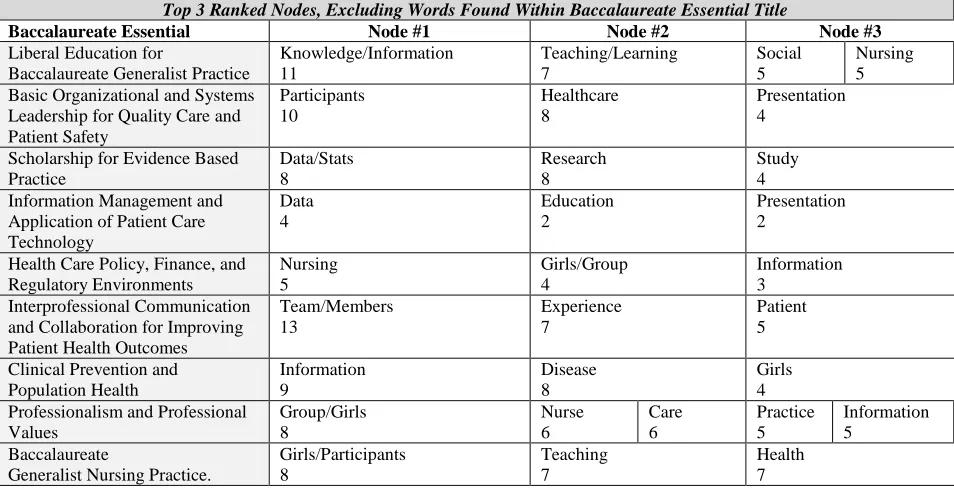
all cited words, which were found in the essential titles, were excluded in order to prevent false trends. The top three coded nodes for each essential were summarized and ranked (Table 1), in order to determine key factors that students associated with meeting each BSN essential standard. Finally, the reflective papers were reviewed for representative comments for each of the nine essentials: 1) liberal education for baccalaureate generalist nursing practice, 2) basic organizational and systems leadership for quality care and patient safety, 3) scholarship for evidence-based practice, 4) information management and application of patient care technology, 5) health care policy, finance, and regulatory environments, 6) interprofessional communication and collaboration for improving patient health outcomes, 7) clinical prevention and population health, 8) professionalism and professional values, and 9) baccalaureate generalist nursing practice.
FINDINGS
Coding Summaries
Figure 1: Top Ten Coded Words In All Nine BSN Essential Categories
Table 1: Top Three Ranked Nodes, Excluding Words Within Baccalaureate Essential Title
Top 3 Ranked Nodes, Excluding Words Found Within Baccalaureate Essential Title
Baccalaureate Essential Node #1 Node #2 Node #3
Liberal Education for
Baccalaureate Generalist Practice
Knowledge/Information 11 Teaching/Learning 7 Social 5 Nursing 5 Basic Organizational and Systems
Leadership for Quality Care and Patient Safety Participants 10 Healthcare 8 Presentation 4
Scholarship for Evidence Based Practice Data/Stats 8 Research 8 Study 4 Information Management and
Application of Patient Care Technology Data 4 Education 2 Presentation 2
Health Care Policy, Finance, and Regulatory Environments Nursing 5 Girls/Group 4 Information 3 Interprofessional Communication and Collaboration for Improving Patient Health Outcomes
Team/Members 13 Experience 7 Patient 5
Clinical Prevention and Population Health Information 9 Disease 8 Girls 4 Professionalism and Professional
Values Group/Girls 8 Nurse 6 Care 6 Practice 5 Information 5 Baccalaureate
Generalist Nursing Practice.
Reflection Samples
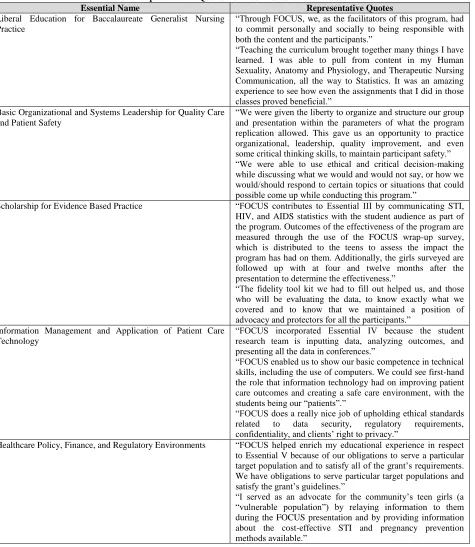
Representative student quotes have been selected to capture overall student-identified impacts (Table 2).
Table 2: Representative Quotes For Each Baccalaureate Essential
Essential Name Representative Quotes
Liberal Education for Baccalaureate Generalist Nursing Practice
“Through FOCUS, we, as the facilitators of this program, had to commit personally and socially to being responsible with both the content and the participants.”
“Teaching the curriculum brought together many things I have learned. I was able to pull from content in my Human Sexuality, Anatomy and Physiology, and Therapeutic Nursing Communication, all the way to Statistics. It was an amazing experience to see how even the assignments that I did in those classes proved beneficial.”
Basic Organizational and Systems Leadership for Quality Care and Patient Safety
“We were given the liberty to organize and structure our group and presentation within the parameters of what the program replication allowed. This gave us an opportunity to practice organizational, leadership, quality improvement, and even some critical thinking skills, to maintain participant safety.” “We were able to use ethical and critical decision-making while discussing what we would and would not say, or how we would/should respond to certain topics or situations that could possible come up while conducting this program.”
Scholarship for Evidence Based Practice “FOCUS contributes to Essential III by communicating STI, HIV, and AIDS statistics with the student audience as part of the program. Outcomes of the effectiveness of the program are measured through the use of the FOCUS wrap-up survey, which is distributed to the teens to assess the impact the program has had on them. Additionally, the girls surveyed are followed up with at four and twelve months after the presentation to determine the effectiveness.”
“The fidelity tool kit we had to fill out helped us, and those who will be evaluating the data, to know exactly what we covered and to know that we maintained a position of advocacy and protectors for all the participants.”
Information Management and Application of Patient Care Technology
“FOCUS incorporated Essential IV because the student research team is inputting data, analyzing outcomes, and presenting all the data in conferences.”
“FOCUS enabled us to show our basic competence in technical skills, including the use of computers. We could see first-hand the role that information technology had on improving patient care outcomes and creating a safe care environment, with the students being our “patients”.”
“FOCUS does a really nice job of upholding ethical standards related to data security, regulatory requirements, confidentiality, and clients’ right to privacy.”
Healthcare Policy, Finance, and Regulatory Environments “FOCUS helped enrich my educational experience in respect to Essential V because of our obligations to serve a particular target population and to satisfy all of the grant’s requirements. We have obligations to serve particular target populations and satisfy the grant’s guidelines.”
Interprofessional Communication and Collaboration for Improving Patient Health Outcomes
“FOCUS contributed to my education because effective communication was a key element to the entire process. Our group, as a whole, had to collectively and cohesively come together to respectfully communicate our thoughts, opinions and ideals. I felt that we were able to do this really well. As a result of this dynamic, we were able to effectively communicate our presentation to the girls very well. It enabled us to articulate information to the students, connect with them, and provide them with an individualized experience. The teens remained engaged, shared thoughts, stories, and opinions, and that is what we want in a clinical setting as well.”
Clinical Prevention and Population Health “The teenage girls were our population. We had to collaborate to make sure we placed proper emphasis on health promotion and disease prevention. This was done by teaching them about STI’s, as well as contraceptive methods. All topics, such as diseases, STI’s, and contraceptives, were explained in ample detail to help the participants plainly understand the risk and benefits.”
“The entire program is about using information and communication technologies in preventive care. During this clinical experience, I was able to educate teen girls on the importance of gynecological health screenings and immunization against infectious disease, such as Human Papilloma Virus (HPV). Information was presented on how to talk with a partner regarding the use of contraception, how to say “no” to sex, and how the effects of drinking alcohol can influence sexual behavior.”
Professionalism and Professional Values “FOCUS contributed to my education in this essential by allowing me to communicate optimal health and wellness standards to teens. The environment, while relaxed, was very professional and boundaries remained intact. I felt that our group was very respectful of the teens and vice versa. Everything was kept confidential and their privacy was protected. It was a safe environment for them to share their thoughts and feelings.”
“I felt another key aspect of professionalism that everyone brought to the group was that we all maintained accountability for our actions and responsibilities during the FOCUS program. We upheld the standard of respect for all the participants and their privacy, as well as showing care and concern for their issues.”
Baccalaureate Generalist Nursing Practice. “Focus provided a structurally sound program that gave the participants evidence-based information to empower them to live a life of health and wellness. Because of the sensitivity of the content, combined with the age of the participants, we had to use all of our skills to successfully deliver this content so that the desired outcomes of this program would be achieved.” FOCUS allowed me the opportunity and the challenge to use my skill of delivering evidence-based information in an appropriate way for my clients (or the participants). To achieve this, I had to use compassion, integration of my knowledge, ethics, safety, and respect for all the girls and the rich diversity they brought to this group.”
CONCLUSION
making connections between theory and clinical practice, and 4) to give students an opportunity to discuss their reflection activities in small groups, comparing and contrasting their own observations with those of others.
Introduction To The Essentials
Students expressed an overwhelming appreciation for the exposure to the Baccalaureate essentials. None of the thirteen participating students reported knowing about the “essentials” before the assignment. They stated that this reflection helped them make sense of their course curriculum and noted that much of their undergraduate work did, in fact, fit into the framework. By becoming aware of expected disciplinary standards, students realized that they could examine their own strengths and weaknesses to determine areas to improve in during their senior year.
Framing An Experience
Students found that it was possible to relate this single, service-learning experience to all nine of the “essentials”. Because this reflective assignment was done in addition to a more traditional service-learning reflection activity, students were encouraged to move past their personal learning outcomes to understanding their experience within a disciplinary context.
Making Connections between Theory and Clinical Practice
Because they spent time examining their community-based project in terms of nursing standards, students began to expand their definition of the profession. The students rated their experiences positively in the impact areas (Callister and Hobbins-Garbett, 2000) of personal satisfaction, critical thinking, preparedness for practice, awareness of unmet community needs, and professional development with a mean score of 4.72 on a 5-point likert scale.
Small Group Discussions
The guided small group discussion, which occurred after the written assignments were complete, allowed the clinical group to consider the BSN essentials at a deeper level. In addition to providing structure for the discussion, this approach encouraged participation from all students as they had each been given a chance to think and prepare for the discussion ahead of time. Finally, it allowed the stronger students to “tease out” some of the less obvious connections between their service-learning and the BSN essentials. Students took part in rich conversation about professional development and considered the possibility of using their knowledge of disciplinary context to perform better in their first nursing interviews.
This innovative method of introducing the “Baccalaureate Essentials” to undergraduate students was successful in meeting all four original goals. Participants became familiar with the document, they were able to effectively evaluate their clinical experience within a broader disciplinary context, they made connections between their theory-based courses and their practice, and they were prepared to discuss their conclusions in a small-group format.
Next steps could include evaluation of the assignment with larger groups of students, to compare undergraduate reflections at different levels of their curriculum (for example, juniors versus seniors), or to evaluate the reflections when used with other types of clinical experiences.
ACKNOWLEDGMENT
AUTHOR INFORMATION
Brooke Flinders is a graduate of Miami University and Frontier School of Midwifery and Family Nursing. After practicing as a nurse-midwife, Brooke began a tenure-track position in Miami University’s Department of Nursing, in 2007. Her passion for women’s health and undergraduate education has merged into a program, funded by the U.S. Department of Health and Human Services, for over two million dollars. This service-learning program, in collaboration with the Hamilton YWCA, involves evidence-based STI and teenage pregnancy prevention strategies, and is being implemented, using third year nursing students as community educators. E-mail: [email protected]
REFERENCES
1. American Association of Colleges of Nursing (2008). Essentials of baccalaureate education for professional nursing practice. Retrieved from:www.aacn.nche.edu/education/essentials.htm
2. Callister, L.C., Hobbins-Garbett, D. (2000). “Enter to learn, go forth to serve”: Service learning in nursing education. Journal of Professional Nursing, 16 (3), 177-183.