79
Optimizing Neutron Moderation Absorption Using
Artificial Neural Network
K. Hema
Abstract: Neutron interactions with matter can be either scattering or absorption reactions. Scattering can result in a change in the energy and direction of motion of a neutron but cannot directly cause the disappearance of a free neutron. Absorption leads to the disappearance of free neutrons as a result of a nuclear reaction with fission or the formation of a new nucleus and another particle or particles such as protons, alpha particles and gamma photons. Most materials have an absorption cross section that varies inverse with neutron velocity. Artificial neural network technique would be a perfect tool to determine the impact parameters from the experimental observables. One has only to train the network by theoretical simulations and then to feed the trained net- work with experimental observables in order to obtain the impact parameter as the output of the network. Feed-forward networks have proven to be valuable tools for data analysis (classification of events, particle identification, function approximation, pattern recognition). The advantages of feed-forward nets are: the highly parallel algorithm, the flexibility because of their trainability, the capability to solve high-dimensional problems and the deterministic behavior.
Index Terms: Neutron Moderation, Neutron Absorption, Artificial Neural Network, Optimized Simulated Algorithm, MATLAB Optimization and Control. ————————————————————
1
I
NTRODUCTIONThe principle of operation of power plant utilizing uranium fission is simple enough. If one neutron causes a fission that produces more than one new neutron, the number of fissions may increase tremendously with the release of enormous amounts of energy. It is a question of probabilities. Neutrons produced in the fission process may escape entirely from the uranium, may be captured by uranium in a process not resulting in fission, or may be captured by an impurity. Thus the question of whether a chain reaction does or does not go depends on the result of a competition among four processes:
• Escape,
• Non-fission capture by uranium, • Non-fission capture by impurities, • Fission capture.
If the loss of neutrons by the first three processes is less than the surplus produced by the fourth, the chain reaction occurs; otherwise it does not. Evidently any one of the first three processes may have such a high probability in a given arrangement that the extra neutrons created by fission will be insufficient to keep the reaction going. For example, should it turn out that process (2) non-fission capture by uranium--has a much higher probability than fission capture, there would presumably be no possibility of achieving a chain reaction.
1.1 Use of Moderator to reduce non-fission capture
For the probability both of fission capture and of non-fission capture depends on the speed of the neutrons. Unfortunately, the speed at which non-fission capture is most probable is intermediate between the average speed of neutrons emitted in the fission process and the speed at which fission capture is most probable. The characteristics of a good moderator are that it should be of low atomic weight and that it should have little or no tendency to absorb neutrons. Lithium and boron are excluded on the latter count. Helium is difficult to use because it is a gas and forms no compounds. The choice of moderator therefore lay among hydrogen, deuterium, beryllium, and carbon.
Fig. 1- Slow neutrons are absorbed with high possibility by 235U. The temporal excited nucleus decays into different
fission fragments emitting fast neutrons
2 Neutron Moderation and Diffusion
In materials containing atoms of low atomic mass, neutrons of all energies can lose a significant fraction of their energy in a single elastic collision and such materials are referred to as moderators. In heavy nuclei appreciable energy loss in a collision is only possible at high energies where inelastic scattering can occur. The neutron dose rate from a point source of fast neutrons falls off with distance r approximately as exp(−Σremr)/4πr2, where Σrem depends on the medium where Σ has been defined earlier. This macroscopic cross-section is called the removal cross-cross-section and since all interactions tend to remove energy from the beam its value is ______________________________
• K.HEMA is currently pursuing PhD degree program in
electric power engineering Chennai Deemed University, India, PH-09899800799.
80
not too different from the total macroscopic cross-section (NσnT) of the material, but is slightly lower. This exponential fall off is only approximate and holds less well for media in which hydrogen is the principal fast neutron attenuator.[5] In the slowing-down region the average number of collisions, , to slow a neutron from energy E1 to energy E2 is equal to ln (E1/E2)/ξ, where ξ is the average change per collision in the logarithm of the energy[2]. At energies below that at which scattering becomes entirely elastic, ξ is independent of energy and is approximately equal to 2/(A + ). The spatial distribution of neutrons of energy E2 which have slowed down from a point source of energy E1 is of the form exp(−r2/4τ)2 where τ
is referred to as the Fermi Age and is the mean square distance a neutron migrates in slowing down from E1 to E2. It is given by:
where D is the diffusion coefficient and equal to (3ΣnT − 3bΣnn)− 1 and b is the average value of cos Ψ where Ψ is the angle of scatter of a neutron in a collision. The root mean square distance a neutron travels from the position where it is thermalized to the point where it is absorbed is the thermal diffusion length, L, and is equal to (4/π)1/4(Dth/ΣnA)1/2 where Dth is the value of the diffusion coefficient averaged over the thermal neutron spectrum and ΣnA is assumed to have a l/υ
dependence and is evaluated at an energy kTn where Tn is the temperature of the medium. At small neutron flux as in a nuclear reactor, a single neutron is captured by a nucleus. For example, when natural gold (197Au) is irradiated by neutrons, the isotope 198Au is formed in a highly excited state, and quickly decays to the ground state of 198Au by the emission of
γ rays. In this process, the mass number increases by one. This is written as a formula in the form 197Au+n → 198Au+γ, or in short form 197Au (n,γ)198Au. If thermal neutrons are used, the process is called thermal capture. The isotope 198Au is a beta emitter that decays into the mercury isotope 198Hg. In this process the atomic number rises by one.
Fig.2- Thermal Capture
2.1 Neutron Absorption
Neutron absorption takes place as a result of neutron-induced nuclear processes, which destroys the neutrons, emitting secondary radiation as a result. In most cases, the absorption cross section of thermal neutrons is inversely proportional to the neutron velocity; i.e. proportional to the corresponding wavelength, λ. As the neutron energy increases, the neutron cross section of most isotopes decreases. For example the Boron isotope 10B is responsible for the majority of the neutron absorption. Boron-containing materials can be used as neutron shields to reduce the activation of objects close to
a reactor core.[2]
Fig.3 – Neutron Energy Vs Absorption Cross Section
Since neutrons have no charge, they only interact with the nucleus of an atom, not with the electrons. The most common type of neutron-induced reaction is the neutron capture reaction (see figure 2). This occurs most often when a thermal energy neutron (<1 eV) is completely captured in the nucleus, creating an isotope of the atom. The next most common interaction occurs from low energy neutrons, where a neutron fuses with the nucleus. In this way, a compound nucleus forms in an excited state. The excited compound nucleus will very quickly decay to a more stable state through emission of one or more gamma rays (also known as prompt gamma rays). The new state of the compound nucleus yields a radioactive nucleus, which will beta decay into an excited state of another radioactive nucleus, which will then decay by emission of one or more gamma rays (also known as characteristic delayed gamma rays).[4]
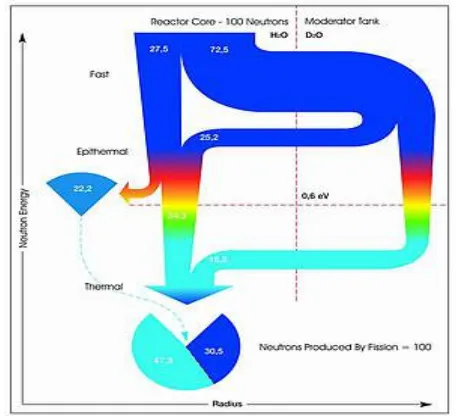
Fig. 4- The neutron energy decreases vertically from top to bottom the horizontal part of the figure means inside and outside the central canal. Arrows getting smaller mean neutron
losses because of absorption and leakage.
81
neutrons leave the compact core at once, getting into the moderator tank. Out of these 72,5 neutrons 25,2 neutrons are reflected back into the uranium zone at once by means of the heavy water D2O. The other neutron stay in the D2O or moderator tank, get moderated und build up the high thermal neutron flux density because of the very low absorption of the heavy water D2O. 18,3 thermal neutrons diffuse back into the fuel element, get absorbed and contribute to the nuclear fission by means of the emission of 30,5 new fission neutrons. The remaining approx. 27,5+25,2 fast neutrons in the uranium zone get moderated by the light cooling water H2O and lead to 47,3 new fission neutrons. Together with the 22,2 new fission neutrons from nuclear fission by neutron of middle energies 100 new fission neutrons are totally produced. This means that the nominal thermal power is constant.
3 Artificial Neural Approach
An artificial neuron it is a mathematical abstraction of the working of a biological neuron. The input signals are pondered multiplying them for the corresponding weight that would correspond in the biological version of the neuron to the strength of the synaptic connection; the pondered signals arrive to the neuronal node that acts as a summing of the signals; the output of the node is denominated net output, and it is calculated as the summing of the pondered entrances plus a b value denominated gain. The net output is used as entrance to the transfer function providing the total output or answer of the artificial neuron. Multilayer perceptron has an input layer, an output layer, and a layer in between, not connected directly to the input or the output, and so hidden layer. Each unit in the hidden layer and the output layer is like a perceptron unit. These units in the input layer serve to distribute the values they receive to the next layer, and so do not perform a weighted sum or threshold[1].The basic processing function of every node in the MNN is the sigmoid function, which has the following form:
O =___1____ 1+e-λ (net)
whereas λ > 0 λ is called steepness constant. The net function is the summation of weights multiplied by the corresponding inputs. The net fuction can be expressed by the following form:
net = 1∑n Wi Xi.
The learning rule parameters of MNN have three layers; input, hidden, and output are shown as follows:
I number of inputs nodes; J number of hidden nodes K number of outputs nodes; η the learning speed constant h hidden layer outputs ; w output weights
RMS Root Mean Square of error; O outputs v hidden layer weights ; d the desired P number of patterns; X inputs
The Error Back Propagation Training Algorithm has the following sequence steps:
Step 1:η > 0, Emax chosen. Weights W and V are initialized at small random values, W is (KxJ) and V is (JxI).
Step 2: Training step starts here. Input is presented and the
layer’s output is computed.
h j = f ( v j t x) for j= 1,2,3,….. J and ok = f (w k t h) for k = 1, 2, 3…. K
Step 3: Error Value is computed:
E ← 1⁄2 (d k –o k)k +E
Step 4: Error signal vectors ∆ο and ∆y of both output and hidden layer are computed.
Vector ∆O is (Kx1) and ∆y is (Jx1).
The error signal term of output layer is ∆Ok =0.5 (d k –o k) (1 – ok2) for k = 1,2,3…. K
The error signal term of the hidden layer is ∆yj = (1 – hj ) k=1ΣK ∆OK wkj for j= 1,2,3,….. J
Step 5: Output layer weights will be adjusted as:
wkj ← wkj + η∆Ok hj for k = 1,2,3…. K and for j= 1, 2, 3,….. J
Step 6: Hidden layer weights will be adjusted as:
vji ← vji + η∆yj xi for j= 1,2,3,….. J and i= 1,2,3,…….I.
Step 7: If p < P then p ← p+1, and go to step 2; otherwise, go
to step 8.
Step 8: The training cycle is completed. For max E < E terminate the training session. Output weights W, V and E. If E > E, then E ← 0, p ← 1, and initiate the new training cycle by going to step 2.
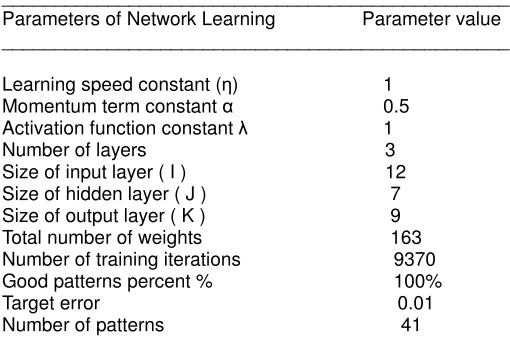
Table -1 Network Laerning Parameters & Value
________________________________________________ Parameters of Network Learning Parameter value ________________________________________________
Learning speed constant (η) 1
Momentum term constant α 0.5 Activation function constant λ 1
Number of layers 3
Size of input layer ( I ) 12
Size of hidden layer ( J ) 7
Size of output layer ( K ) 9
Total number of weights 163
Number of training iterations 9370
Good patterns percent % 100%
Target error 0.01 Number of patterns 41
3.1 Experimental Setup
82 Fig.5- Absorption Spectra
4 Simulated Annealing Optimization:
At the starting temperature of the neutron moderation, there is globally searched for the area with the global optimum. When cooling down, the optimization focuses more locally in this area. The simulated annealing starts with initial parameters and a goal function. From this point, the optimization parameters are randomly varied. With the new parameters the goal function is evaluated. [2] Depending on how good the new goal function is in comparison with the old one and depending on the temperature, there is a probability that the new parameters are accepted [3].Even if the goal function becomes worse, they can be accepted. Assuming that is looked for a maximum, the probability that the new parameters j are accepted after the parameters i is:
p = 1 if fj - fi ≥ 0 efj –fi /T(t) if fj - fi ≤ 0
In which f is the function to be maximized. The temperature decreases during the optimization process, therefore the probability of accepting a worse goal function also decreases. The temperature may not decrease too fast, because this gives a risk of being stuck in a local maximum.
Tt+1 =αT(t)
Where α is between 0 and 1.
The following Algorithm helps in simulating the annealed Optimization:
.
Yes No
Yes
5 Optimization and Control using MATLAB
1 % simulated annealing with MATLAB 2
3 % determination of some parameters 4 no grps=247; % number of energy groups 5 n int=104; % total number of intervals 6 alpha=0.02; % part of goal function 7
8 % determination of first solution 9 d(1)=0; %starting point
10 d(2)=100; %cm thickness U+H2O 11 d(3)=20; %cm Fe
12 d (4) =10.4; %cm AlF3 13 d (5) =10; %cm Cd 14 d (6 ) =1; %cm Pb 15 for j=1:6
16 dist (j)=sum(d(1:j)); 17 end
18
19 % calculate flux and goalfunction by first solution
20 run ('csas calc'); % calculate macroscopic cross sections
Input and Access Initial
Estimate Initial Temperature
Generate New Solution
Access New Solution
Accept New Solution
Update
Adjust Temperature
Terminate
83
21 run ('basic calc'); % calculate some extra parameters such as grid, etc.
22 run ('xsdrn calc'); % calculate neutron flux 23 run ('calc flux'); % read and process flux data
24 run ('calc goal'); % calculate goal function from fluxdata 25
26 % set some parameters for optimisation 27 m=500; % number of optimization steps 28 beta=0.08; % solution changing parameter 29 T=200; % starting temparature
30 g=0.99; % temperature multiplication factor
31 gamma rand=2.5e�4; % boundary value for gammarays 32 fast rand=1e�3; % boundary value for fast neutrons 33 results=zeros (9,m ); % empty matrix for results 34
35 % first result
36 results (:,1)=[goal; part; gamma; fast; zeros(2,1); d(3:6)']; 37
38 % optimization loop 39 for l=2: m
40 % variate solution randomly 41 var=rand (1,4).*2.*beta+(1- beta); 42 d (3:6)=d(3:6).*var;
43 for j=1:6
44 dist (j)=sum(d(1:j)); 45 end
46 % calculate flux and determine goal function by new solution
47 run ('xsdrn calc'); 48 run ('calc flux'); 49 run ('calc goal'); 50
51 % verify boundary conditions
52 if gamma>gamma rand j fast>fast rand 53 d (3:9)=d(3:9)./var;
54 results(:,l)=[results(1:5,l-1);0;2;d(3:9)']; 55 else
56 % decide if the new solution is accepted 57 if goal>results (1,l-1);
58 results(:,l)=[goal; ratio; part; gamma; fast; 1;0; d(3:9)']; 59 else
60 c=exp (-(results (1,l-1)-goal)/(0.02*T)); 61 if c<rand
62 d (3:9)=d(3:9)./var;
63 results(:,l)=[results(1:5,l-1);c;1;d(3:9)']; 64 else
65 results(:,l)=[goal; ratio; part; gamma; fast; c;-1;d(3:9)']; 66 end
67 end 68 end
69 % adjust temperature 70 T=g*T;
71 end 72
73 % saving results
74 dlm write ('results. txt' ,results);
In the lines 3 to 6 some input parameters are set which will be used in the calculation In lines 8-24 the first solution is determined and the flux and goal function for that solution is calculated. For that calculation two separate scripts are executed. The lines 26 to 36 are used to set some parameters for the optimization: number of steps, temperature, and The
Final step in the loop is to adjust the temperature.
Fig.6- Neutron Flux Vs Optimization Steps
6 Conclusion
If the moderator consisted of materials that do not absorb neutrons and was of infinite size, the neutrons would come into thermal equilibrium with the moderator energy spectrum. The apparent cross-section of these targets is much smaller for fast neutrons than it is for slower neutrons. As a result, an intense neutron flux and a fuel rich in fissile elements are both needed to compensate for this lower probability.Thus the slowing down of neutrons in moderators by measuring the time distribution of neutrons, with respect to flux, absorption cross section, scattering cross section , neutron resonance can be optimized with the help of neural approach, where the training parameters for neutron absorption can be modeled together with the induced fission as one single reaction, yielding a certain number of new neutrons (zero in the case of absorption). To use this approach the first-collision probability, p, needs to be changed to be the probability of either absorption of fission. Extensive simulation tests show that satisfied results can be achieved with the proposed approach. It presents a new idea to estimate the nuclear reactor's reactivity for a nuclear power plant. In this paper, artificial neural network are used to estimate the total reactivity of the nuclear reactor moderation process by taking advantage of neural network's nonlinear mapping ability. Evolutionary Algorithm can be combined with the neural approach for better optimized results.
R
EFERENCES[1]. Neural computing theory and practice. Van Nostrand Reinhold.
http://www.epa.gov/ttn/caa/t3/reports/eurtc1.pdf
[2]. "Nuclear Power in the USA". World Nuclear Association June 2008
84
[4]. HO. Menlove, lE. Stewart, S.Z. Qiao, T.R Wenz, and G.P.D. Verrechia, "Neutron Collar Calibration and Evaluation for Assay of LWR Fuel Assemblies Containing Burnable Neutron Absorbers",
LosAlamosNationalLaboratoryreportLA-11965-MS(ISPO-323).
[5]. M. Reginatto, “What can we learn about the spectrum of high-energy stray neutron fields from Bonner sphere measurements?” Radiation Measurements, vol. 44, no. 7-8, pp. 692–699, 2009