A STUDY ON THE ENGINEERING
PROPERTIES OF EXPANSIVE SOIL
STABILIZED WITH HIGH VOLUME
RICE HUSK ASH
Satyanarayana.P.V.V
Professor, Department of Civil engineering, Andhra university, Visakhapatnam, Andhra Pradesh, India
Pavan Bharadwaj.Ch, Naresh Patrudu.P Surya Mani Kantha.A
Graduate Students, Post graduate student, Department of Civil Engineering, Andhra University Visakhapatnam, Andhra Pradesh, India
ABSTRACT:
Structures found on expansive soils subjected to distress under moisture variations in foundation soils. soil stabilization is one of the technique to controls moisture migration. In this connection RHA has been selected a stabilizer to study engineering properties of expansive soils. Tests like plasticity ,compaction, and strength were performed. From the test results it is identified that addition of RHA decreases plasticity and improves strength characteristics. Addition of 30% RHA makes the expansive soil non-plastic, non-swelling and attain CBR of 8% and at 40% it attained Angle of shearing resistance (Ø) is 36o and CBR as 10.
Key words: CBR, Expansive soil, Plasticity, Rice husk ash.
1.0 INTRODUCTION:
Expansive soils in India are popularly named as Black Cotton Soils which are spread over Deccan Plateau region. These are rich in Maharashtra, Madhya Pradesh, Gujarat, Andhra Pradesh, Karnataka and some parts of Tamilnadu. These soil possess volume change characteristics when they have moisture variations. These are strong in dry seasons and soft in wet seasons. Katti(1979)10 has given properties of Black cotton soils which have Liquid limit 40%-100%, Plastic limit 20%-60%, Differential Free Swell index 20%-100%.Structures located on these soils subjected to differential settlements due to moisture variations (Bala Subramanyam et.al 1989)2.However these soils easily available at low cost and frequently used for construction purposes (Bell 1988)3.Soil stabilization is one of the techniques to control volume characteristics by addition of stabilizers like cement, lime and Industrial wastes like Fly Ash, Rice Husk Ash etc and improvement in volume change characteristics can be studied in terms of Index properties, Swell and Strength properties.
Rice Husk Ash is an agricultural waste which is obtained by burning of Rice Husk which is abundantly available in India by cultivation of paddy crop one of the staple food. Rice Husk Ash is dominated by siliceous materials which is nearly 67%-70% of the total composition ( Oyepola and Abdullah 2006)14. Some of the researchers Brookers (2009)4 studied effect of Rice Husk Ash on Expansive soils in terms of sub grade and sub bases for highway projects. Yadu et.al (2011)19 studied Rice Husk Ash on Expansive soils in terms of CBR, Atterberg limits and Unconfined compressive strength. Vamsi mohan et al (2012)18 studied Performance of Rice Husk Ash Bricks .Satyanarayana.P.V.V et.al (2003 )16 studied effect of Rice husk Ash on Expansive soils as construction materials like sub grade, bricks etc. Krishan rao.C.V (2004)5 et al studied effect of flyash and lime on expansive soil as road and embankement material. Muntohar A.S and Hantoro G (2000)12 studied Influence of Rice Husk Ash and Lime on Engineering Properties of a Clayey Sub grade. Ali M, Sreenivasulu V (2004)1 studied An Experimental Study on the Influence of Rice Husk Ash and Lime on Properties of Bentonite Koteswara, R. D., Pranav, P. R. T., and Anusha, M., (2011)11, “Stabilization of Expansive Soil with Rice Husk Ash, Lime and Gypsum An Experimental Study.
2.0. Materials:
To study the effect of RHA on expansive soil, which is obtained from delta areas of Godavari River in Bhimavaram, Andhra Pradesh, India and RHA was collected from Tekkali, Srikakulam district of Andhra Pradesh, India.
2.1. Black cotton soil:
Expansive soils in India are popularly known as Black cotton soils, the collected soil was dried and pulverized into the required sizes and tested for properties like gradation ,compaction, strength as per IS2720 and the results are shown in table-1 and fig-1
Table 1-Geotechnical properties of Black cotton soil
Fig.1 Gradation distribution curve of Expansive soil
From the test results it is identified that it contains fines(less than 75µm) of 95% .shows it is of alluvial origin and contains 55% of silt and 46% as clay particles. The presence of fines contributed for high liquid limit ( wL )
of 74% and plasticity index of 45% and classified as CH soil based on IS:1498-1970.It also exhibited high swelling characteristics with FSI as 100 and swell pressure as 90kpa.It exhibited very low strength values under soaking condition in terms of CBR as 1% .
0 20 40 60 80 100 120
0.0001 0.001 0.01 0.1
% F
in
er
Grain size (mm)
Geotechnical properties Values
Gravel (%) 0
Sand (%) 4
Fines (%) 96
a) Silt 50
b) Clay 46
Liquid Limit (%) 74
Plastic Limit (%) 29
Plasticity Index (IP) 45
IS Classification CH
Optimum moisture content (OMC) (%) 26 Maximum dry density (MDD) (g/cc) 1.52 California bearing ratio (%) (CBR Soaked) 1.0
Angle of shearing resistance (Ø) 15
2.2Rice Husk Ash:
Rice husk Ash(RHA) was collected from Tekkali, Srikakulam, Andhra Pradesh. The collected Rice husk ash was dried and subjected to various geo-technical characterizations such as gradation, compaction, strength, permeability etc., and the test results are shown in table -2 and Fig 2.
Table 2-Geotechnical properties of RHA
Fig-2 Compaction curve of RHA Table -3 Chemical properties of RHA
0.4 0.5 0.6 0.7 0.8
0 10 20 30 40 50 60
Dr
y
density
g/cc
water content %
Property Values
Gravel sizes (%) 0
Sand sizes (%) 84
Fines (%) 16
a. Silt sizes (%) 16
b. Clay sizes(%) 0
Liquid Limit (%) NP
Plastic Limit (%) NP
I.S Classification SM
Specific gravity 1.8
Optimum moisture content (OMC) (%) 38 Maximum dry density (MDD) (g/cc) 0.7 Angle of Shearing Resistance 36 California bearing ratio (CBR) (%) 8 Coefficient of uniformity (Cu) 9.14 Coefficient of curvature (Cc) 1.75 Volume of RHA for a mass of 10g 35cc
Chemical Compound Percentage
SiO2 97.69
Al2O3 0
Fe2O3 0.22
CaO 0.29
MgO 0
Fig.1. and Fig.2.SEM for RHA particle
From the test results of Rice husk ash the following identifications are made. Majority of Rice husk ash particles are under fine sand range and of angular shape with rough surface texture. The gradation also shows it comes under zone IV. Based on BIS it is classified as poorly graded sandy nature with non-plastic and incompressible fines are named as (SP) with Cu=9.74 and Cc= 1.75
Compaction characteristics of Rice husk ash under standard Proctor test have OMC of 38% and MDD of 0.7 g/cc. From the compaction curve it can be seen that Rice husk ash attained lower densities for wide variation in moisture contents. Regarding strength characteristics it has an angle of shearing resistance (Ø) as 36 degrees under un-drained condition and CBR of 8% and has good drainage characteristics with coefficient of permeability as 3.4 * 10-3cm/sec .RHA attained low densities due to low specific gravity, porous nature and distribution of uniform size of particles.
Chemical analysis of Rice Husk Ash was carried out using Scanning Electron Microscope (SEM) we observed silica(SiO2) is the major compound of 97% and oxides of calcium, iron, potassium, sodium as minor
compounds.
3.0 Results and Discussion:
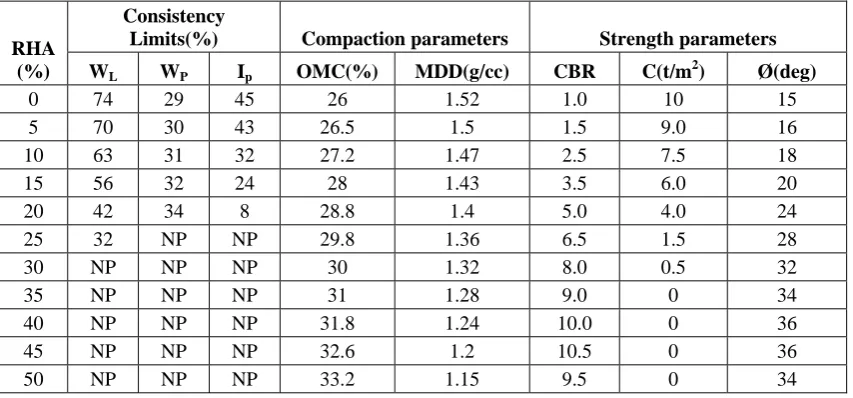
To study the effect of RHA on expansive soil, various % of RHA i.e. 5,10,15,….50% of dry weight of soil were added and effectively mixed and tested for characteristics like plasticity, compaction, strength and swell as per IS:2720 results are shown in table-4 and fig-3(a),fig-3(b), fig-3(c),fig-3(d), fig-3(e),fig-3(f).
Table -4 Variation of Geotechnical properties with RHA
RHA (%)
Consistency
Limits(%) Compaction parameters Strength parameters
WL WP Ip OMC(%) MDD(g/cc) CBR C(t/m2) Ø(deg)
0 74 29 45 26 1.52 1.0 10 15
5 70 30 43 26.5 1.5 1.5 9.0 16
10 63 31 32 27.2 1.47 2.5 7.5 18
15 56 32 24 28 1.43 3.5 6.0 20
20 42 34 8 28.8 1.4 5.0 4.0 24
25 32 NP NP 29.8 1.36 6.5 1.5 28
30 NP NP NP 30 1.32 8.0 0.5 32
35 NP NP NP 31 1.28 9.0 0 34
40 NP NP NP 31.8 1.24 10.0 0 36
45 NP NP NP 32.6 1.2 10.5 0 36
3.1 Graphs
Fig-3(a) : Consistency Limits Fig-3(b): RHA(%) Vs OM Fig-3(c): RHA (%)Vs MDD
Fig-3(d): RHA(% )Vs CBR Fig-3(e) : RHA(%) Vs C Fig-3(f): RHA(%) Vs Φ
From the consistency test data it is identified that liquid limit values are decreasing, plastic limit values are increasing and plasticity index values are decreasing with increasing the percentage of Rice Husk Ash up to 25% and further increasing it became a non plastic. The decrease in liquid limit is due to the decrease in diffused double layer by replacement of clay particles by RHA particles. Increase in plastic limit is due to development of shear resistance at inter particle level, and the soil-RHA matrix requires high moisture content to roll.
From the compaction test data it is identified that with increasing the percentage of RHA, OMC values are increasing and MDD values are decreasing. At lower percentage of RHA this phenomenon is steady; at higher percentage it is rapid. The increase in OMC is due to the development of flocculated structure which resists the compaction effort requires more water to mobilize and offers low dry densities and nature of RHA particles in soil-RHA matrix.
CBR test data shows that the increase in percentage of RHA increases the CBR values. The increased CBR values are due to the development of shear resistance generated against penetration.
From the shear test data it is identified that with increasing percentage of RHA, cohesion values are decreasing and angle of shearing resistance values are increasing. The decreased cohesion and increased angle of shearing Resistance are due to replacement of fines by RHA particles.
4.0. APPLICATIONS:
From the test results it can be seen that RHA is a non plastic, porous and light weight material with high strength values ( CBR =8 and Φ= 36o
) can be used as fill material and embankment material in place of expansive soils with very low strengths under soaking (CBR=1) When Black Cotton soils stabilized with 30-40% of RHA attained non-swelling, non-plastic with high CBR values of 8-10, can be used as sub grade material for high volume traffics. High CBR values reduces the total crest thickness and also reduce the cost of construction. It is identified that good shear strength parameter C=0.5-1.5 t/m2 and Φ= 32-36 degrees can be effectively used as embankment and fill material.
5.0. CONCLUSIONS:
Rice Husk Ash is an agricultural industrial waste of light weight, porous and high volume material with high
0 20 40 60 80
0 5 10 15 20 25 30
water content (%)
RHA % PER VS WL PER VS WP 0 10 20 30 40
0 10 20 30 40 50 60
OMC ( % ) RHA % 0 0.5 1 1.5 2
0 10 20 30 40 50 60
MDD (g/cc) RHA % 0 2 4 6 8 10 12
0 10 20 30 40 50 60
CBR (%) RHA % 0 2 4 6 8 10 12
0 10 20 30 40 50 60
Cohesion( t/m 2) RHA % 0 20 40
0 10 20 30 40 50 60
Shearing
resistance(degrees)
6.0. REFERENCES:
[1] 1. Ali M, Sreenivasulu V (2004). “An Experimental Study on the Influence of Rice Husk Ash and Lime on Properties of Bentonite”,
Proceedings of Indian Geotechnical Conference, Warangal (India) pp-468-471.
[2] 2. Balasubramaniam, A. S., Bergado, D. T., Buensuceso Jr, B. Rand Yong, W. C. (1989). Strength and deformation
[3] characteristics of lime-treated soft clays. Geotech. Eng.,
[4] 3. Bell, F.G. (1988). Stabilization and treatment of clay soils withlime. Part 1. Basic principles. Ground Engineering, 21,
[5] 10–15.
[6] 4.Brooks, R. M., (2009), “Soil Stabilization with Fly ash and Rice Husk Ash”, International Journal of Research and Reviews in
Applied Sciences, Volume 1, Issue 3, pp. 209-217.
[7] 5. C V Krishna rao P.V.V Satyanarayana, R Rama Rao (2004),”Utilization of Lime fly Ash Stabilized Expansive Soil in Roads and
Embankments “Conference Indian Geotechnical Conference Volume 1 Issue 1 Pages 465-467
[8] 6. IS 2720: Part 4 : 1985 Methods of Test for Soils-Part 4:Grain Sieve Analysis.
[9] 7. IS 2720: Part 10 : 1991 Methods of Test for soils: Part 10 Determination of Unconfined compressive strength.
[10] 8. IS 2720: Part 13 : 1986 Methods of Test for Soils-Part 13 : Direct Shear Test.
[11] 9. IS 2720: Part 16 : 1987 Methods of Test for Soil-Part 16: Laboratory Determination of CBR.
[12] 10. Katti,R.k.(1979), “Search for solutions to problems in black cotton soils, “First TGS annual lecture, Indian
Geotech.Journal,No.1,vol.95
[13] 11. Koteswara, R. D., Pranav, P. R. T., and Anusha, M., (2011), “Stabilization of Expansive Soil with Rice Husk Ash, Lime and
Gypsum –An Experimental Study”, International Journal of Engineering Science and Technology, Vol. 3 No. 11, pp. 8076 – 8085.
[14] 12. Muntohar A.S and Hantoro G (2000), “Influence of Rice Husk Ash and Lime on Engineering Properties of a Clayey Sub grade”,
Electronic Journal of Geotechnical Engineering, Vol.5.
[15] 13. Noor M , Abdol Aziz A, Suhadi R(1990), “ Effects of cement Rice Husk Ash mixtures on compaction, strength and durability of
Melaka series Lateritic soil” , Journal of Institution of Engineers Malaysia, 47:61-64.
[16] 14. Oyetola E. B., Abdullahi M., (2006), “The Use of Rice Husk Ash in Low-Cost Sandcrete Block Production”, Leonardo Electronic
Journal of Practice and Technologies, 8, p. 58-70.
[17] 15. Sabat A.K and Nanda R.P. (2011), “Effect of marble dust on strength and durability of Rice Husk Ash stabilized Expansive soil”,
International Journal of Civil and Structural Engineering, Vol. 1, No. 4,pp-939-948.
[18] 15. Satyanarayana P.V.V, Rama Rao R (2003), “ Use of Rice Husk Ash ,Lime and Gypsum in strengthening Sub grade and Sub base
in low cost Roads” , National Conference on modern cement concrete and Bituminous roads . Dec 18-2003, pp-374-378.
[19] 16. Sharma R.S, Phani Kumar B.R and Rao B.V (2008), “ Engineering Behaviour of a Remoulded Expansive Clay Blended with
Lime, Calcium Chloride and Rice Husk Ash”, Journal of Materials in Civil Engineering, ACSE,Vol.20,No.8, pp.509-515.
[20] 17 .Vamsi mohan N, Satyanarayana P.V.V, Srinivas Rao K (2012), “Performance of Rice Husk Ash Bricks”, International Journal of
Engineering Research and Applications. ISSN: 2248-9622. Pp:1906-1910.
[21] 18. Yadu, L., Tripathi, R. K., Singh, D., (2011), “Comparison of Fly Ash and Rice Husk Ash Stabilized Black Cotton Soil”,