Animals #1 Practice Test
Modified True/False
Indicate whether the statement is true or false. If false, change the identified word or phrase to make the statement true.
____ 1. All animals are heterotrophs. _________________________
____ 2. Animal cells lackcell membranes. __________________________
____ 3. More than 95% of animals are invertebrates.
____ 4. Worms and insects are both vertebrates. _________________________
____ 5. The notochord in a chordate embryo has nerves branching from it at intervals.
____ 6. Feedback inhibition helps to maintain homeostasis.
____ 7. Many small aquatic animals rely on diffusion to transport oxygen, nutrients, and waste products into and out of their cells. _________________________
____ 8. An animal species that has evolved the adaptation of changing color with the seasons likely produces gametes with diploid genes.
____ 9. The circulatory system delivers metabolic wastes to the excretory system for processing and elimination.
____ 10. Animals rely on positive feedback mechanisms to maintain homeostasis.
____ 11. Biologists have hypothesized that echinoderms are closely related to chordates because both groups are deuterostomes. _________________________
____ 12. The hollow nerve cord develops from the endoderm.
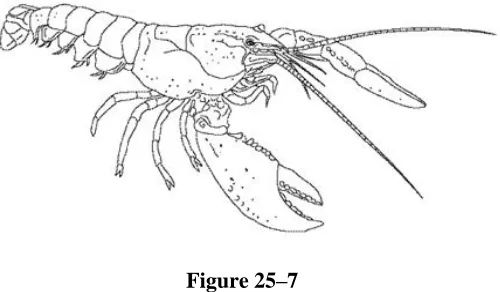
Figure 25–7
____ 15. The ventral side of an animal is its upper side.
____ 16. Animals with skeletons were more numerous in the Cambrian Period than in earlier periods. _________________________
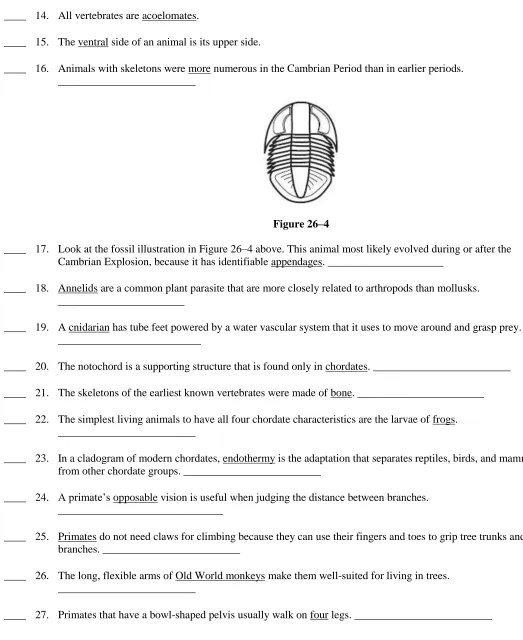
Figure 26–4
____ 17. Look at the fossil illustration in Figure 26–4 above. This animal most likely evolved during or after the Cambrian Explosion, because it has identifiable appendages. _____________________
____ 18. Annelids are a common plant parasite that are more closely related to arthropods than mollusks. _______________________
____ 19. A cnidarian has tube feet powered by a water vascular system that it uses to move around and grasp prey. __________________________
____ 20. The notochord is a supporting structure that is found only in chordates. _________________________
____ 21. The skeletons of the earliest known vertebrates were made of bone. _______________________
____ 22. The simplest living animals to have all four chordate characteristics are the larvae of frogs. _________________________
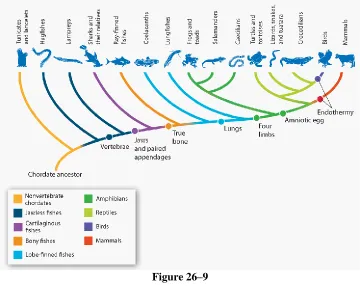
____ 23. In a cladogram of modern chordates, endothermy is the adaptation that separates reptiles, birds, and mammals from other chordate groups. _________________________
____ 24. A primate’s opposable vision is useful when judging the distance between branches. ______________________________
____ 25. Primates do not need claws for climbing because they can use their fingers and toes to grip tree trunks and branches. _________________________
____ 26. The long, flexible arms of Old World monkeys make them well-suited for living in trees. _________________________
____ 28. A hominine can use both hands to carry an object from one place to another because it does not need its hands for locomotion. ______________________
____ 29. Cro Magnons were an early group of Homo habilis that created elaborate tools from bones and antlers. _______________________
____ 30. Members of the genus Homo used tools. _________________________
Completion
Complete each statement.
31. Animal bodies are ____________________, which means that they are composed of many cells.
32. All animal cells contain a nucleus and membrane-bound _____________________.
33. Animals with backbones are called ____________________.
34. Unlike a vertebrate chordate, a nonvertebrate chordate adult lacks _________________.
35. _________________________ are not considered a clade because the organisms all lack a particular characteristic instead of sharing one.
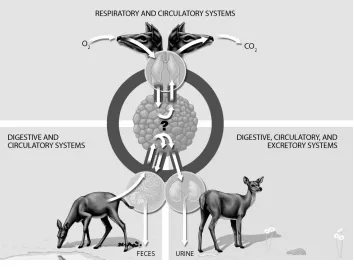
Figure 25–8
36. Look at the illustration in Figure 25–8 . In vertebrates, the system responsible for moving materials among the systems shown in the figure above is the ____________________ system.
38. The essential functions of an animal are necessary to maintain ______________________.
39. Sexual reproduction helps maintain ____________________ diversity in populations.
40. The front end of an organism is the ____________________ end.
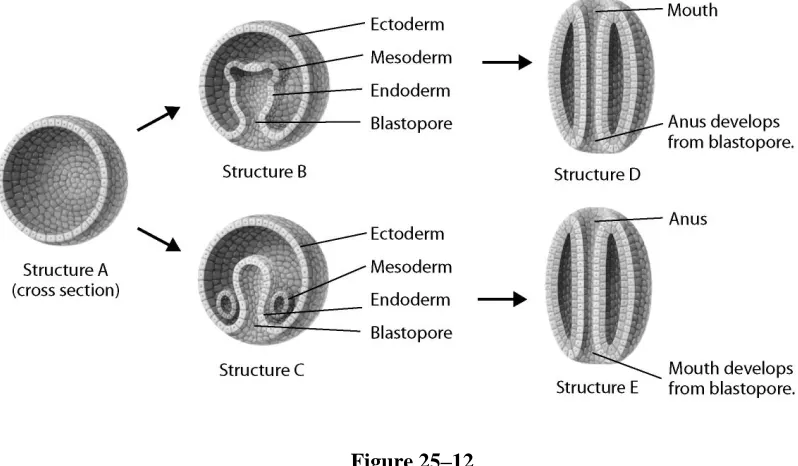
41. Depending on the phylum, the _____________________ develops into either the mouth or the anus of an animal.
42. The fact that appendages appear in several different vertebrate and invertebrate phyla indicates that the formation of ________________________ has evolved more than once.
43. __________________ occurs when segments specialize and fuse during development.
44. The ___________________ of animals is based on scientists’ current understanding of the evolutionary history of living species.
45. Different species within a phylum all have the same basic __________________.
46. ____________________ fossils are tracks and burrows made by animals whose bodies were not fossilized.
47. One of the differences between Cambrian animals and pre-Cambrian animals was the appearance of ____________________ such as antennae as Cambrian animals evolved.
48. ____________________ are a class of invertebrates that exhibit three germ layers, cephalization, and bilateral symmetry, but do not have coeloms.
49. Although they are radially symmetrical, echinoderms are more closely related to a human than to a jellyfish because they are ____________________.
50. The skull and skeletal structures of the earliest vertebrate, Myllokunmingia, are thought to have been made of ____________________.
51. The ancient chordates are thought to be most closely related to echinoderms because the embryos of chordates and echinoderms are ____________________.
52. Members of the chordate family tree share a common ____________________ ancestor.
53. An important adaptation in amphibians was the development of ____________________ to keep their skin moist when exposed to air.
54. Primates can display more complex behaviors than many other mammals because their brains have a well-developed ____________________.
Figure 26–5
56. Study the cladogram in Figure 26–5 above. A paleontologist would place a node for prehensile tails on the branch leading to ____________________.
57. Primates that walk on two feet use ____________________ locomotion.
58. Members of the species Homo ____________________ flourished in Europe from 200,000 to about 28,000 to 24,000 years ago.
59. The first hominine in the genus Homo was named Homo habilis because evidence indicates that members of the species used ____________________.
60. Species of Homo ____________________ found in Java suggest that this species of hominine spread rapidly after leaving Africa.
Short Answer
61. What two fundamental characteristics distinguish animals from plants?
62. What four characteristics are shared by both sponges and humans?
63. What is a heterotroph?
she classify it as a chordate? Explain your answer.
66. What is the purpose of a notochord?
67. What is the purpose of feedback inhibition?
68. Why don’t some small aquatic animals need a circulatory system?
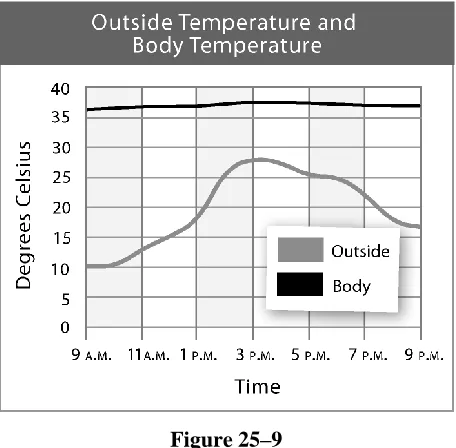
Figure 25–9
69. The graph in Figure 25–9 above compares an animal’s body temperature to the outside temperature during the day. How does this graph illustrate that the animal’s body is maintaining homeostasis?
70. What is bilateral symmetry?
71. What is an advantage of an animal with bilateral symmetry having sense organs and nerve cells concentrated at the anterior end of the body?
72. What are some characteristics of segmented animals?
73. What determines whether or not a body system is likely to remain in a phylum over the course of evolution?
74. What are six characteristics of the human body plan?
75. Why do you think that biologists use both the embryological development and the adult body plans to classify an animal?
76. Why are animal fossils more abundant from the Cambrian Period than from earlier periods?
78. Identify one way in which cnidarians and echinoderms differ from each other.
79. Ancient chordates are related to the ancestors of which group of invertebrates?
Figure 26–6
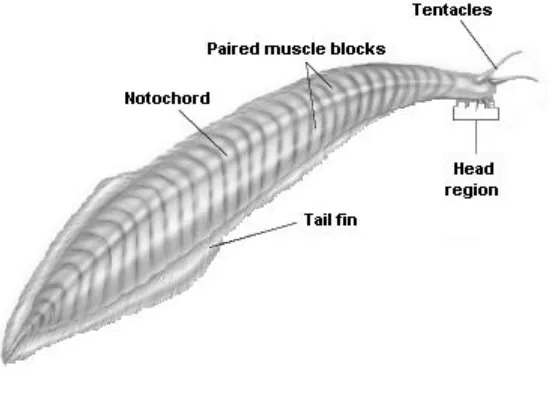
80. The illustration in Figure 26–6 above shows Pikaia, an early chordate. Pikaia was originally thought to be a worm. What features shown in the illustration above led scientists to reclassify it as a chordate?
81. What happened to the dinosaurs at the end of the Cretaceous Period?
82. A friend comes home from the pet store with a new pet that he says is a salamander. When you touch its back, the skin feels dry and scaly, so you tell your friend that his new pet is actually a lizard, not a salamander. Explain your reasoning.
83. Why is binocular vision important to a primate that moves through the branches of trees?
84. What adaptation of primates makes it possible for a gibbon to swing through the trees using its arms?
85. What geological force caused anthropoids to split into two groups 45 million years ago?
86. What is the difference between anthropoids and hominoids?
87. Paleontologist Stephen Jay Gould has stated that “mankind stood up first and got smart later.” What evidence supports that statement?
88. The fossil skull of Sahelanthropus has the broad face characteristic of hominines, but it has a brain the size of a chimpanzee’s. As a result, scientists have been unable to classify this fossil. Name two other pieces of fossil evidence that could help scientists classify Sahelanthropus as a hominine.
Figure 26–7
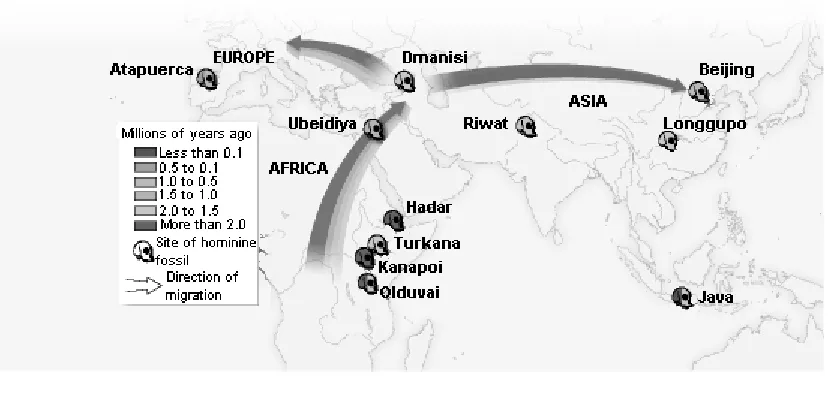
89. Study the map in Figure 26–7 above. Does this map illustrate the “out-of-Africa” model of Homo sapiens evolution or the multiregional model? Explain your answer.
90. Suppose you uncovered some hominine fossils and tools from a rock layer dating back about 26,000 years. How could you use the tools to determine whether the fossils most likely belonged to Homo neanderthalensis or Homo sapiens?
Other
Cnidarians
Arthropods
Roundworms
Flatworms
Levels of
Organization
Specialized cells, tissues
Specialized cells, tissues, organs
Specialized cells, tissues, organs
Specialized cells, tissues, organs
Body
Symmetry
Radial
Bilateral
Bilateral
Bilateral
Germ Layers
Two
Three
Three
Three
Body Cavity
Acoelom
True coelom
Pseudocoelom
Acoelom
Embryological
Development
—
Protostome
Protostome
Protostome
Segmentation
Absent
Present
Absent
Absent
Cephalization
Absent
Present
Present
Present
Annelids
Mollusks
Echinoderms
Chordates
Levels of
Organization
Specialized cells, tissues, organs
Specialized cells, tissues, organs
Specialized cells, tissues, organs
Specialized cells, tissues, organs
Body
Symmetry
Bilateral
Bilateral
Radial
(as adults)
Body Cavity
True coelom
True coelom
True coelom
True coelom
Embryological
Development
Protostome
Protostome
Deuterostome
Deuterosome
Segmentation
Present
Absent
Absent
Present
Cephalization
Present
Present
Absent
(as adults)
Present
Figure 25–10
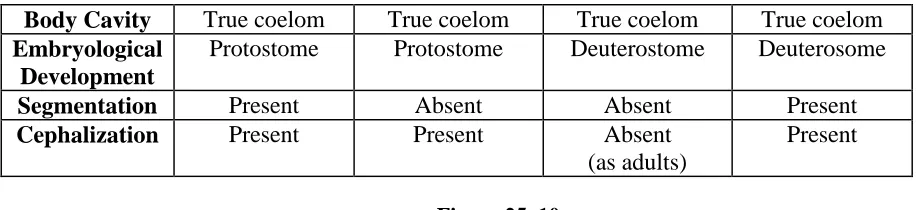
91. Interpret Tables According to Figure 25–10, which phylum has specialized cells and tissues, but does not have organs?
92. Interpret Tables Echinoderms are more closely related to chordates than to arthropods. What information in Figure 25–10 supports this statement?
93. Infer According to Figure 25–10, what other characteristic is shared by all phyla that have specialized cells, tissues, and organs? What conclusion can you draw about the relationship between this characteristic and organ development?
94. Interpret Tables An unusual worm is discovered in your schoolyard. Your science teacher determines that it is bilaterally symmetrical but cannot determine whether the worm is segmented. Based on the information in Figure 25–10, what other characteristic could your teacher use to determine what phylum the worm belongs to? Why?
95. Form a Hypothesis Based on the information in Figure 25–10, what hypothesis could you form about young echinoderms?
Figure 25–11
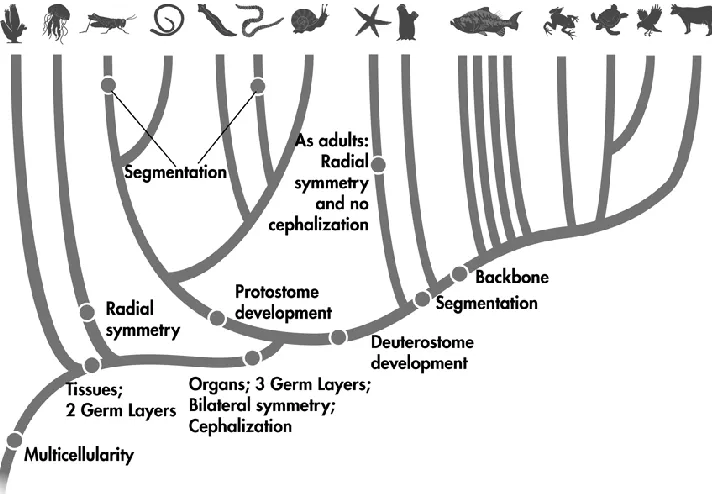
96. Interpret Visuals Which is the earliest phylum shown on the cladogram in Figure 25–11 to have a characteristic common to all animals? What is the characteristic?
97. Interpret Visuals Examine Figure 25–11. Are most of the phyla listed on the cladogram vertebrate or invertebrate phyla? Explain.
98. Interpret Visuals Which is the first phylum shown in the cladogram in Figure 25–11 to have bilateral symmetry? How do you know?
99. Compare and Contrast According to Figure 25–11, which characteristics are shared by cnidarians and echinoderms? Which characteristics are different? Explain.
Figure 25–12
101. Interpret Visuals Study Figure 25–12. Which tissue will become the digestive system in both types of animals?
102. Interpret Visuals Which structure in Figure 25–12 represents the early stages of a protostome?
103. Interpret Visuals Look at Figure 25–12. Explain the steps of embryological development that are shown in structures A, B, and D. Does this series of steps illustrate the development of a protostome or a deuterostome?
104. Predict The final step of embryological development shown in Figure 25–12 is the formation of the tube through the center of the embryo. What organ system will this tube become?
Figure 26–8
106. Apply Concepts What type of symmetry is exhibited by animal B in Figure 26–8?
107. Compare and Contrast How are the two animals in Figure 26–8 similar? How are they different?
108. Infer Which invertebrate in Figure 26–8 is likely to have lived during, but not before, the Cambrian Period? Explain your reasoning.
109. Compare and Contrast What phylum of invertebrates living today most closely resembles invertebrate A in Figure 26–8? Explain.
110. Infer Figure 26–8 shows artists’ conceptions of two extinct invertebrates from different periods in Earth’s history. Which invertebrate is representative of animals that lived before the Cambrian Period? Explain your reasoning.
USING SCIENCE SKILLS
Figure 26–9
111. Interpret Visuals According to Figure 26–9, which characteristic do birds and mammals share?
112. Interpret Visuals According to Figure 26–9, which group was the first one to have true bones?
114. Classify The Tiktaalik fossil found in Canada had fins with wrist bones. It also had both lungs and gills. According to Figure 26–9, there is no living group of vertebrates that has this combination of characteristics. If this animal were discovered alive today, how might you revise the cladogram of chordates to include it?
115. Interpret Visuals According to Figure 26–9, what are the major differences between jawless fishes and cartilaginous fishes?
Figure 26–10 illustrates the differences between the skulls and brain volumes of three extinct hominines.
Figure 26–10
116. Infer On the basis of the skulls shown in Figure 26–10, what can you infer about the primate features that these three species possessed?
117. Infer In each drawing in Figure 26–10, the shaded area inside the skull indicates the size of the brain. What does the relative size of the brain in these species suggest about the complexity of behavior that each species was capable of? Explain your reasoning.
118. Apply Concepts Rank the species shown in Figure 26–10 in order according to when they first appeared.
119. Compare and Contrast Compare the species shown in Figure 26–10 in terms of their relatedness to Homo sapiens.
120. Infer Study Figure 26–10. Besides the size of the brain area, which features do you think paleontologists use to identify hominine fossils? Why?
Essay
121. Worms, insects, birds, and dogs are all grouped together in Kingdom Animalia. Why do scientists place such diverse organisms in the same group?
Figure 25–13
123. Look at Figure 25–13. Describe the types of information that the cat and the rat are detecting about each other. What do you think each animal will do with this information?
124. Describe the characteristic of bilateral symmetry in animals. How does this body plan help an animal carry out essential functions?
125. Describe several advantages that an animal receives from having a body cavity.
126. Describe the relationships between cells, tissues, organs, and organ systems. Can organs and organ systems have more than one type of cell or tissue? Explain your answer.
127. How is the arrangement of the three germ layers in an embryo related to the arrangement of organ systems and tissues in an adult vertebrate?
128. Relate a sponge’s embryological development to its lack of tissues and organs.
129. Why should scientists consider both the adult body plan of an animal and its pattern of embryological development when classifying an animal? Use an example to support your explanation.
130. Should the development of a more complex body system in vertebrates be considered an improvement over the simpler body systems of invertebrates? Explain your answer.
131. The animals that existed before the Cambrian Period were probably very simple. Describe two ways in which these animals may have obtained nutrients.
133. Describe the features you would expect to find in an ancient chordate. What do you think it would look like?
134. Why do you think the Cenozoic Era is usually called the Age of Mammals?
Figure 26–11
135. Study the cladogram in Figure 26–11 above. Where you would place the following nodes: feather development, shelled egg development, and endothermy? Explain your answer.
136. The broad face of a primate promotes binocular vision. Suppose a monkey was born with an unusually narrow face. Explain how binocular vision works, and how that face structure might affect the monkey’s vision.
137. Compare and contrast New World monkeys and Old World monkeys.
Figure 26–12
139. Study the illustrations in Figure 26–12. Identify two features of the primate skeleton that are associated with bipedal locomotion, and contrast these features with their counterparts in a primate that is not bipedal.
Animals #1 Practice Test
Answer Section
MODIFIED TRUE/FALSE
1. ANS: T PTS: 1 DIF: L1
REF: p. 730 OBJ: 25.1.1 List the characteristics that all animals share. STA: UT.BIO.5.3.b BLM: knowledge
2. ANS: F, cell walls
PTS: 1 DIF: L1 REF: p. 730
OBJ: 25.1.1 List the characteristics that all animals share. STA: UT.BIO.5.3.b BLM: knowledge
3. ANS: T PTS: 1 DIF: L1
REF: p. 731 OBJ: 25.1.2 Differentiate between invertebrates and chordates. STA: UT.BIO.5.3.b BLM: comprehension
4. ANS: F, invertebrates
PTS: 1 DIF: L2 REF: p. 730
OBJ: 25.1.2 Differentiate between invertebrates and chordates. STA: UT.BIO.5.3.b BLM: comprehension 5. ANS: F, hollow nerve cord
PTS: 1 DIF: L2 REF: p. 731
OBJ: 25.1.2 Differentiate between invertebrates and chordates. STA: UT.BIO.5.3.b BLM: comprehension
6. ANS: T PTS: 1 DIF: L2
REF: p. 732 | p. 733
OBJ: 25.1.3 List and discuss the essential functions that animals perform in order to survive. STA: UT.BIO.3.2.b BLM: application
7. ANS: T PTS: 1 DIF: L2
REF: p. 733 | p. 734
OBJ: 25.1.3 List and discuss the essential functions that animals perform in order to survive. STA: UT.BIO.3.2.b BLM: comprehension
8. ANS: F, haploid
PTS: 1 DIF: L3 REF: p. 735
OBJ: 25.1.3 List and discuss the essential functions that animals perform in order to survive. STA: UT.BIO.3.2.b BLM: evaluation
9. ANS: T PTS: 1 DIF: L2
REF: p. 735
OBJ: 25.1.3 List and discuss the essential functions that animals perform in order to survive. STA: UT.BIO.3.2.b BLM: comprehension
10. ANS: F, negative
PTS: 1 DIF: L2 REF: p. 732
REF: p. 739 OBJ: 25.2.1 Discuss some trends in animal evolution. STA: UT.BIO.5.2.a | UT.BIO.5.3.a BLM: comprehension
12. ANS: F, ectoderm
PTS: 1 DIF: L3 REF: p. 738
OBJ: 25.2.1 Discuss some trends in animal evolution. STA: UT.BIO.5.2.a | UT.BIO.5.3.a BLM: synthesis
13. ANS: T PTS: 1 DIF: L2
REF: p. 738 | p. 739 OBJ: 25.2.1 Discuss some trends in animal evolution. STA: UT.BIO.5.2.a | UT.BIO.5.3.a BLM: analysis
14. ANS: F, coelomates
PTS: 1 DIF: L2 REF: p. 738
OBJ: 25.2.1 Discuss some trends in animal evolution. STA: UT.BIO.5.2.a | UT.BIO.5.3.a BLM: application
15. ANS: F, dorsal
PTS: 1 DIF: L1 REF: p. 738
OBJ: 25.2.1 Discuss some trends in animal evolution. STA: UT.BIO.5.2.a | UT.BIO.5.3.a BLM: knowledge
16. ANS: T PTS: 1 DIF: L1
REF: p. 753
OBJ: 26.1.1 Explain what fossil evidence indicates about the timing of the evolution of the first animals. STA: UT.BIO.5.2.a TOP: Foundation Edition
BLM: knowledge
17. ANS: T PTS: 1 DIF: L3
REF: p. 753
OBJ: 26.1.1 Explain what fossil evidence indicates about the timing of the evolution of the first animals. STA: UT.BIO.5.2.a TOP: Foundation Edition
BLM: analysis 18. ANS: F
Nematodes Roundworms
PTS: 1 DIF: L2 REF: p. 755 OBJ: 26.1.2 Interpret the cladogram of invertebrates.
STA: UT.BIO.5.3.a | UT.BIO.5.3.b | UT.BIO.5.3.c BLM: application 19. ANS: F, echinoderm
PTS: 1 DIF: L2 REF: p. 756 OBJ: 26.1.2 Interpret the cladogram of invertebrates.
STA: UT.BIO.5.3.a | UT.BIO.5.3.b | UT.BIO.5.3.c TOP: Foundation Edition BLM: application
20. ANS: T PTS: 1 DIF: L1
REF: p. 757 OBJ: 26.2.1 Describe the most ancient chordates. STA: UT.BIO.5.3.b TOP: Foundation Edition BLM: knowledge
PTS: 1 DIF: L2 REF: p. 757
OBJ: 26.2.1 Describe the most ancient chordates. STA: UT.BIO.5.3.b TOP: Foundation Edition BLM: comprehension
22. ANS: F, tunicates
PTS: 1 DIF: L1 REF: p. 758
OBJ: 26.2.2 Interpret the cladogram of chordates. STA: UT.BIO.5.3.b | UT.BIO.5.3.c TOP: Foundation Edition BLM: comprehension
23. ANS: F, the amniotic egg
PTS: 1 DIF: L2 REF: p. 762 | p. 767
OBJ: 26.2.2 Interpret the cladogram of chordates. STA: UT.BIO.5.3.b | UT.BIO.5.3.c TOP: Foundation Edition BLM: application
24. ANS: F, binocular
PTS: 1 DIF: L1 REF: p. 769
OBJ: 26.3.1 Identify the characteristics that all primates share. STA: UT.BIO.5.3.b TOP: Foundation Edition BLM: comprehension
25. ANS: T PTS: 1 DIF: L2
REF: p. 765 OBJ: 26.3.1 Identify the characteristics that all primates share. STA: UT.BIO.5.3.b BLM: application
26. ANS: F, New World monkeys
PTS: 1 DIF: L1 REF: p. 767
OBJ: 26.3.2 Describe the major evolutionary groups of primates. STA: UT.BIO.5.3.b | UT.BIO.5.3.c BLM: comprehension 27. ANS: F, two
PTS: 1 DIF: L2 REF: p. 767
OBJ: 26.3.3 Describe the adaptations that enabled later hominine species to walk upright. STA: UT.BIO.5.3.a | UT.BIO.5.3.b | UT.BIO.5.3.c BLM: analysis
28. ANS: T PTS: 1 DIF: L3
REF: p. 767
OBJ: 26.3.3 Describe the adaptations that enabled later hominine species to walk upright. STA: UT.BIO.5.3.a | UT.BIO.5.3.b | UT.BIO.5.3.c TOP: Foundation Edition BLM: application
29. ANS: F, sapiens
PTS: 1 DIF: L1 REF: p. 772
OBJ: 26.3.4 Describe the current scientific thinking about the genus Homo. STA: UT.BIO.5.2.a BLM: comprehension
30. ANS: T PTS: 1 DIF: L2
REF: p. 772 OBJ: 26.3.4 Describe the current scientific thinking about the genus Homo. STA: UT.BIO.5.2.a TOP: Foundation Edition
BLM: analysis
COMPLETION
PTS: 1 DIF: L1 REF: p. 730
OBJ: 25.1.1 List the characteristics that all animals share. STA: UT.BIO.5.3.b BLM: knowledge
32. ANS: organelles
PTS: 1 DIF: L2 REF: p. 730
OBJ: 25.1.1 List the characteristics that all animals share. STA: UT.BIO.5.3.b BLM: comprehension
33. ANS: vertebrates
PTS: 1 DIF: L1 REF: p. 730
OBJ: 25.1.2 Differentiate between invertebrates and chordates. STA: UT.BIO.5.3.b BLM: knowledge 34. ANS:
vertebrae
a vertebral column
PTS: 1 DIF: L2 REF: p. 731
OBJ: 25.1.2 Differentiate between invertebrates and chordates. STA: UT.BIO.5.3.b BLM: comprehension 35. ANS: Invertebrates
PTS: 1 DIF: L3 REF: p. 730
OBJ: 25.1.2 Differentiate between invertebrates and chordates. STA: UT.BIO.5.3.b BLM: comprehension 36. ANS: circulatory
PTS: 1 DIF: L1 REF: p. 734
OBJ: 25.1.3 List and discuss the essential functions that animals perform in order to survive. STA: UT.BIO.3.2.b BLM: application
37. ANS: receptors
PTS: 1 DIF: L2 REF: p. 733
OBJ: 25.1.3 List and discuss the essential functions that animals perform in order to survive. STA: UT.BIO.3.2.b BLM: comprehension
38. ANS: homeostasis
PTS: 1 DIF: L2 REF: p. 732
OBJ: 25.1.3 List and discuss the essential functions that animals perform in order to survive. STA: UT.BIO.3.2.b BLM: comprehension
39. ANS: genetic
PTS: 1 DIF: L2 REF: p. 735
OBJ: 25.1.3 List and discuss the essential functions that animals perform in order to survive. STA: UT.BIO.3.2.b BLM: comprehension
40. ANS: anterior
BLM: knowledge 41. ANS: blastopore
PTS: 1 DIF: L2 REF: p. 739
OBJ: 25.2.1 Discuss some trends in animal evolution. STA: UT.BIO.5.2.a | UT.BIO.5.3.a BLM: comprehension
42. ANS: limbs
PTS: 1 DIF: L3 REF: p. 740
OBJ: 25.2.1 Discuss some trends in animal evolution. STA: UT.BIO.5.2.a | UT.BIO.5.3.a BLM: application
43. ANS: Cephalization
PTS: 1 DIF: L2 REF: p. 740
OBJ: 25.2.1 Discuss some trends in animal evolution. STA: UT.BIO.5.2.a | UT.BIO.5.3.a BLM: comprehension
44. ANS: cladogram
PTS: 1 DIF: L3 REF: p. 742
OBJ: 25.2.2 Explain the differences among the animal phyla. STA: UT.BIO.5.2.a | UT.BIO.5.3.b BLM: comprehension
45. ANS: body plan
PTS: 1 DIF: L2 REF: p. 743
OBJ: 25.2.2 Explain the differences among the animal phyla. STA: UT.BIO.5.2.a | UT.BIO.5.3.b BLM: comprehension
46. ANS: Trace
PTS: 1 DIF: L1 REF: p. 752
OBJ: 26.1.1 Explain what fossil evidence indicates about the timing of the evolution of the first animals. STA: UT.BIO.5.2.a TOP: Foundation Edition
BLM: knowledge 47. ANS: appendages
PTS: 1 DIF: L2 REF: p. 753
OBJ: 26.1.1 Explain what fossil evidence indicates about the timing of the evolution of the first animals. STA: UT.BIO.5.2.a TOP: Foundation Edition
BLM: comprehension 48. ANS:
Flatworms Platyhelminthes
PTS: 1 DIF: L2 REF: p. 755 OBJ: 26.1.2 Interpret the cladogram of invertebrates.
STA: UT.BIO.5.3.a | UT.BIO.5.3.b | UT.BIO.5.3.c BLM: comprehension 49. ANS: deuterostomes
PTS: 1 DIF: L2 REF: p. 756 OBJ: 26.1.2 Interpret the cladogram of invertebrates.
50. ANS: cartilage
PTS: 1 DIF: L2 REF: p. 757
OBJ: 26.2.1 Describe the most ancient chordates. STA: UT.BIO.5.3.b TOP: Foundation Edition BLM: comprehension
51. ANS: deuterostomes
PTS: 1 DIF: L3 REF: p. 756 | p. 757
OBJ: 26.2.1 Describe the most ancient chordates. STA: UT.BIO.5.3.b TOP: Foundation Edition BLM: application
52. ANS: invertebrate
PTS: 1 DIF: L1 REF: p. 758
OBJ: 26.2.2 Interpret the cladogram of chordates. STA: UT.BIO.5.3.b | UT.BIO.5.3.c TOP: Foundation Edition BLM: knowledge
53. ANS: mucous glands
PTS: 1 DIF: L3 REF: p. 761
OBJ: 26.2.2 Interpret the cladogram of chordates. STA: UT.BIO.5.3.b | UT.BIO.5.3.c BLM: application
54. ANS: cerebrum cerebral cortex
PTS: 1 DIF: L1 REF: p. 765
OBJ: 26.3.1 Identify the characteristics that all primates share. STA: UT.BIO.5.3.b BLM: knowledge
55. ANS: Old World
PTS: 1 DIF: L1 REF: p. 766
OBJ: 26.3.2 Describe the major evolutionary groups of primates. STA: UT.BIO.5.3.b | UT.BIO.5.3.c BLM: knowledge 56. ANS: New World monkeys
PTS: 1 DIF: L3 REF: p. 767
OBJ: 26.3.2 Describe the major evolutionary groups of primates. STA: UT.BIO.5.3.b | UT.BIO.5.3.c TOP: Foundation Edition BLM: analysis
57. ANS: bipedal
PTS: 1 DIF: L1 REF: p. 767
OBJ: 26.3.3 Describe the adaptations that enabled later hominine species to walk upright. STA: UT.BIO.5.3.a | UT.BIO.5.3.b | UT.BIO.5.3.c BLM: knowledge 58. ANS: neanderthalensis
PTS: 1 DIF: L1 REF: p. 772
59. ANS: tools
PTS: 1 DIF: L2 REF: p. 770
OBJ: 26.3.4 Describe the current scientific thinking about the genus Homo. STA: UT.BIO.5.2.a TOP: Foundation Edition BLM: analysis
60. ANS: erectus
PTS: 1 DIF: L2 REF: p. 771
OBJ: 26.3.4 Describe the current scientific thinking about the genus Homo. STA: UT.BIO.5.2.a BLM: comprehension
SHORT ANSWER
61. ANS:
Animal cells do not have cell walls as plant cells do, and all animals are heterotrophs, obtaining energy by feeding on organic compounds from other organisms.
PTS: 1 DIF: L2 REF: p. 730
OBJ: 25.1.1 List the characteristics that all animals share. STA: UT.BIO.5.3.b BLM: analysis
62. ANS:
They are multicellular, heterotrophic, and eukaryotic, and their cells lack cell walls.
PTS: 1 DIF: L3 REF: p. 730
OBJ: 25.1.1 List the characteristics that all animals share. STA: UT.BIO.5.3.b BLM: synthesis
63. ANS:
A heterotroph is an organism that gets its nutrients and energy from other organisms.
PTS: 1 DIF: L1 REF: p. 730
OBJ: 25.1.1 List the characteristics that all animals share. STA: UT.BIO.5.3.b BLM: knowledge
64. ANS:
A vertebrate is a chordate that has a backbone. Most chordates are vertebrates, but there are a few aquatic animals that never develop a backbone with vertebrae.
PTS: 1 DIF: L1 REF: p. 730
OBJ: 25.1.2 Differentiate between invertebrates and chordates. STA: UT.BIO.5.3.b BLM: synthesis 65. ANS:
Yes, she can classify it as a chordate because it has a backbone. This means that the animal is a vertebrate. All vertebrates are chordates.
PTS: 1 DIF: L2 REF: p. 731
OBJ: 25.1.2 Differentiate between invertebrates and chordates. STA: UT.BIO.5.3.b BLM: evaluation 66. ANS:
OBJ: 25.1.2 Differentiate between invertebrates and chordates. STA: UT.BIO.5.3.b BLM: analysis 67. ANS:
Feedback inhibition occurs when a process or a product of a process limits the activity of the process itself. It helps regulate body processes to maintain homeostasis.
PTS: 1 DIF: L2 REF: p. 732
OBJ: 25.1.3 List and discuss the essential functions that animals perform in order to survive. STA: UT.BIO.3.2.b BLM: comprehension
68. ANS:
Materials can move efficiently through their bodies by diffusion.
PTS: 1 DIF: L2 REF: p. 734
OBJ: 25.1.3 List and discuss the essential functions that animals perform in order to survive. STA: UT.BIO.3.2.b BLM: comprehension
69. ANS:
The animal’s body is maintaining homeostasis because the animal’s body temperature changes very little, even though the outside temperature changes rises and falls several degrees over the course of the day. The relatively flat line for the animal’s body temperature shows feedback inhibition is working to keep its temperature within a very narrow range.
PTS: 1 DIF: L3 REF: p. 732
OBJ: 25.1.3 List and discuss the essential functions that animals perform in order to survive. STA: UT.BIO.3.2.b BLM: evaluation
70. ANS:
Bilateral symmetry is the type of symmetry in which only one imaginary plane can divide the body into two equal halves.
PTS: 1 DIF: L2 REF: p. 738
OBJ: 25.2.1 Discuss some trends in animal evolution. STA: UT.BIO.5.2.a | UT.BIO.5.3.a BLM: comprehension
71. ANS:
The anterior end of the body usually comes into contact with a new environment first in an animal with bilateral symmetry. A concentration of sense organs and nerve cells at the anterior end enables the animal to respond effectively.
PTS: 1 DIF: L2 REF: p. 740
OBJ: 25.2.1 Discuss some trends in animal evolution. STA: UT.BIO.5.2.a | UT.BIO.5.3.a BLM: comprehension
72. ANS:
Segmented animals are bilaterally symmetrical. Their bodies are divided into repeating parts, or segments. Typically, some of their body parts, such as legs and some internal organs, repeat on both sides of their bodies.
PTS: 1 DIF: L1 REF: p. 739
A body system most likely will remain in a phylum if animals with that system are able to survive and reproduce with that body system.
PTS: 1 DIF: L2 REF: p. 742
OBJ: 25.2.2 Explain the differences among the animal phyla. STA: UT.BIO.5.2.a | UT.BIO.5.3.b BLM: comprehension
74. ANS:
Humans are bilaterally symmetrical, are segmented, and show cephalization, and they have an internal skeleton, jointed legs, and front limbs that have evolved into arms.
PTS: 1 DIF: L3 REF: p. 741 | p. 742
OBJ: 25.2.2 Explain the differences among the animal phyla. STA: UT.BIO.5.2.a | UT.BIO.5.3.b BLM: application
75. ANS:
Biologists use both types of information because some characteristics of adult body plans are shared by multiple phyla. Embryological development patterns help further characterize an animal.
PTS: 1 DIF: L3 REF: p. 742
OBJ: 25.2.2 Explain the differences among the animal phyla. STA: UT.BIO.5.2.a | UT.BIO.5.3.b BLM: evaluation
76. ANS:
Some animals of the Cambrian Period had shells, skeletons, and other hard body parts, which are well preserved in fossils.
PTS: 1 DIF: L2 REF: p. 753
OBJ: 26.1.1 Explain what fossil evidence indicates about the timing of the evolution of the first animals. STA: UT.BIO.5.2.a TOP: Foundation Edition
BLM: comprehension 77. ANS:
Trochophores are the free-swimming larvae of annelids and mollusks. They are important because they show that annelids and mollusks are closely related.
PTS: 1 DIF: L1 REF: p. 756 OBJ: 26.1.2 Interpret the cladogram of invertebrates.
STA: UT.BIO.5.3.a | UT.BIO.5.3.b | UT.BIO.5.3.c TOP: Foundation Edition BLM: application
78. ANS:
Students should identify one of the following: Cnidarians have stinging tentacles around their mouths, but echinoderms do not. Not all cnidarians have skeletons, but all echinoderms do. Echinoderms have 5-part radial symmetry, but cnidarians are not limited to five parts. Echinoderms are deuterostomes, but cnidarians are neither deuterostomes nor protostomes.
PTS: 1 DIF: L2 REF: p. 754 | p. 756 OBJ: 26.1.2 Interpret the cladogram of invertebrates.
STA: UT.BIO.5.3.a | UT.BIO.5.3.b | UT.BIO.5.3.c TOP: Foundation Edition BLM: analysis
79. ANS: Echinoderms
TOP: Foundation Edition BLM: knowledge 80. ANS:
notochord and paired muscle blocks
PTS: 1 DIF: L2 REF: p. 757
OBJ: 26.2.1 Describe the most ancient chordates. STA: UT.BIO.5.3.b TOP: Foundation Edition BLM: analysis
81. ANS:
All of the dinosaurs died in a mass extinction at the end of the Cretaceous Period.
PTS: 1 DIF: L1 REF: p. 762
OBJ: 26.2.2 Interpret the cladogram of chordates. STA: UT.BIO.5.3.b | UT.BIO.5.3.c TOP: Foundation Edition BLM: knowledge
82. ANS:
Salamanders have moist skin with mucous glands. Dry scaly skin is a characteristic of reptiles. A lizard is a reptile.
PTS: 1 DIF: L3 REF: p. 761 | p. 762
OBJ: 26.2.2 Interpret the cladogram of chordates. STA: UT.BIO.5.3.b | UT.BIO.5.3.c BLM: synthesis
83. ANS:
Binocular vision provides depth perception, which is important for judging the locations of tree branches.
PTS: 1 DIF: L2 REF: p. 765
OBJ: 26.3.1 Identify the characteristics that all primates share. STA: UT.BIO.5.3.b BLM: comprehension
84. ANS:
The ability to rotate the arms in broad circles around a strong shoulder joint makes it possible for a gibbon to swing from tree to tree.
PTS: 1 DIF: L3 REF: p. 765
OBJ: 26.3.1 Identify the characteristics that all primates share. STA: UT.BIO.5.3.b TOP: Foundation Edition BLM: analysis
85. ANS:
continental drift
PTS: 1 DIF: L2 REF: p. 766
OBJ: 26.3.2 Describe the major evolutionary groups of primates. STA: UT.BIO.5.3.b | UT.BIO.5.3.c TOP: Foundation Edition BLM: application
86. ANS:
Anthropoids are the humanlike primates. This group includes monkeys, great apes, and humans. The
hominoid group is a subgroup of anthropoids that consists of gibbons, orangutans, gorillas, chimpanzees, and humans.
87. ANS:
Fossilized footprints of Australopithecus indicate that it walked bipedally, and fossilized skulls of Australopithecus show that it had a small brain compared to later species.
PTS: 1 DIF: L3 REF: p. 768
OBJ: 26.3.3 Describe the adaptations that enabled later hominine species to walk upright. STA: UT.BIO.5.3.a | UT.BIO.5.3.b | UT.BIO.5.3.c TOP: Foundation Edition BLM: evaluation
88. ANS:
Any two of the following: bowl-shaped pelvis, S-shaped spine, a spinal cord that exits at the bottom of the skull, arms shorter than legs, hands that do not touch the ground when walking, fossilized tracks showing bipedal locomotion, thigh bones that angle inward and located directly below body.
PTS: 1 DIF: L3 REF: p. 767
OBJ: 26.3.3 Describe the adaptations that enabled later hominine species to walk upright. STA: UT.BIO.5.3.a | UT.BIO.5.3.b | UT.BIO.5.3.c BLM: evaluation 89. ANS:
It illustrates the “out-of-Africa” model, because the arrows show that relatives and ancestors of Homo sapiens migrated north from Africa before spreading to Europe and across Asia. If it illustrated the multiregional model, there would be no arrows showing migration.
PTS: 1 DIF: L3 REF: p. 771
OBJ: 26.3.4 Describe the current scientific thinking about the genus Homo. STA: UT.BIO.5.2.a BLM: analysis
90. ANS:
If the tools were simple ones made of stone, the fossils most likely belonged to Homo neanderthalis. If the tools were more elaborate ones made from antlers and bone, the fossils most likely belonged to Homo sapiens.
PTS: 1 DIF: L2 REF: p. 772
OBJ: 26.3.4 Describe the current scientific thinking about the genus Homo. STA: UT.BIO.5.2.a TOP: Foundation Edition BLM: evaluation
OTHER
91. ANS: Cnidarians
PTS: 1 DIF: L1 REF: p. 738
OBJ: 25.2.1 Discuss some trends in animal evolution. STA: UT.BIO.5.2.a | UT.BIO.5.3.a BLM: comprehension
92. ANS:
Echinoderms are more closely related to chordates than to arthropods because echinoderms and chordates are both deuterostomes. Arthropods are protostomes.
PTS: 1 DIF: L2 REF: p. 739
OBJ: 25.2.1 Discuss some trends in animal evolution. STA: UT.BIO.5.2.a | UT.BIO.5.3.a BLM: application
have all three germ layers in order to form organs.
PTS: 1 DIF: L2 REF: p. 738
OBJ: 25.2.1 Discuss some trends in animal evolution. STA: UT.BIO.5.2.a | UT.BIO.5.3.a BLM: synthesis
94. ANS:
The teacher needs to determine what type of body cavity the worm has, because each phylum of worm has a different type of body cavity.
PTS: 1 DIF: L2 REF: p. 738
OBJ: 25.2.1 Discuss some trends in animal evolution. STA: UT.BIO.5.2.a | UT.BIO.5.3.a BLM: evaluation
95. ANS:
Young echinoderms do not have radial symmetry, and their sense organs are concentrated at one end (cephalization).
PTS: 1 DIF: L3 REF: p. 740
OBJ: 25.2.1 Discuss some trends in animal evolution. STA: UT.BIO.5.2.a | UT.BIO.5.3.a BLM: evaluation
96. ANS:
Sponges are the first phylum to show multicellularity, which is common to all animals.
PTS: 1 DIF: L2 REF: p. 742
OBJ: 25.1.1 List the characteristics that all animals share. STA: UT.BIO.5.3.b BLM: application
97. ANS:
Most are invertebrate phyla because the characteristic farthest to the right is “backbone”.
PTS: 1 DIF: L2 REF: p. 742
OBJ: 25.1.2 Differentiate between invertebrates and chordates. STA: UT.BIO.5.3.b BLM: application 98. ANS:
Arthropods are the first organisms to show bilateral symmetry because they are the first to appear on the cladogram after the introduction of bilateral symmetry.
PTS: 1 DIF: L2 REF: p. 742
OBJ: 25.2.1 Discuss some trends in animal evolution. STA: UT.BIO.5.2.a | UT.BIO.5.3.a BLM: application
99. ANS:
Cnidarians and echinoderms both have radial symmetry and lack cephalization. However, cnidarians only have 2 germ layers while echinoderms have three cell layers. Also, echinoderms are deuterostomes, while cnidarians are neither deuterostomes nor protostomes.
PTS: 1 DIF: L3 REF: p. 738 | p. 739 | p. 740
OBJ: 25.2.1 Discuss some trends in animal evolution. STA: UT.BIO.5.2.a | UT.BIO.5.3.a BLM: analysis
100. ANS:
PTS: 1 DIF: L3 REF: p. 742
OBJ: 25.2.2 Explain the differences among the animal phyla. STA: UT.BIO.5.2.a | UT.BIO.5.3.b BLM: evaluation
101. ANS: endoderm
PTS: 1 DIF: L1 REF: p. 738
OBJ: 25.2.1 Discuss some trends in animal evolution. STA: UT.BIO.5.2.a | UT.BIO.5.3.a BLM: application
102. ANS: Structure C
PTS: 1 DIF: L1 REF: p. 739
OBJ: 25.2.1 Discuss some trends in animal evolution. STA: UT.BIO.5.2.a | UT.BIO.5.3.a BLM: application
103. ANS:
Structure A shows that the zygote has developed into a hollow ball of cells called a blastula. Structure B shows that cells in the blastula have differentiated into three types of cells: endoderm, mesoderm, and ectoderm. The opening and pocket formed by the endoderm is called the blastopore. Structure D shows the embryo after the second opening has developed, while the mesoderm has completely lined the interior of the endoderm and ectoderm layers. This series of steps illustrates the development of a deuterostome.
PTS: 1 DIF: L2 REF: p. 739
OBJ: 25.2.1 Discuss some trends in animal evolution. STA: UT.BIO.5.2.a | UT.BIO.5.3.a BLM: analysis
104. ANS:
the digestive tract
PTS: 1 DIF: L2 REF: p. 739
OBJ: 25.2.1 Discuss some trends in animal evolution. STA: UT.BIO.5.2.a | UT.BIO.5.3.a BLM: analysis
105. ANS: Structure E
PTS: 1 DIF: L3 REF: p. 739
OBJ: 25.2.1 Discuss some trends in animal evolution. STA: UT.BIO.5.2.a | UT.BIO.5.3.a BLM: evaluation
106. ANS:
bilateral symmetry
PTS: 1 DIF: L2 REF: p. 753
OBJ: 26.1.1 Explain what fossil evidence indicates about the timing of the evolution of the first animals. STA: UT.BIO.5.2.a TOP: Foundation Edition
BLM: application 107. ANS:
OBJ: 26.1.1 Explain what fossil evidence indicates about the timing of the evolution of the first animals. STA: UT.BIO.5.2.a TOP: Foundation Edition
BLM: analysis 108. ANS:
A. It appears to have a skeleton, a complex body plan, and specialized appendages, which are features that first appeared during the Cambrian Period.
PTS: 1 DIF: L3 REF: p. 752
OBJ: 26.1.1 Explain what fossil evidence indicates about the timing of the evolution of the first animals. STA: UT.BIO.5.2.a TOP: Foundation Edition
BLM: application 109. ANS:
Arthropods, because they have an exoskeleton and specialized, jointed appendages, like invertebrate A.
PTS: 1 DIF: L3 REF: p. 755
OBJ: 26.1.1 Explain what fossil evidence indicates about the timing of the evolution of the first animals. STA: UT.BIO.5.2.a TOP: Foundation Edition
BLM: analysis 110. ANS:
B. It appears to be flat, plate-shaped, soft-bodied, and bilaterally symmetrical, like many other animals from that period.
PTS: 1 DIF: L3 REF: p. 752
OBJ: 26.1.1 Explain what fossil evidence indicates about the timing of the evolution of the first animals. STA: UT.BIO.5.2.a TOP: Foundation Edition
BLM: application 111. ANS:
endothermy
PTS: 1 DIF: L1 REF: p. 758
OBJ: 26.2.2 Interpret the cladogram of chordates. STA: UT.BIO.5.3.b | UT.BIO.5.3.c TOP: Foundation Edition BLM: application
112. ANS:
ray-finned fishes
PTS: 1 DIF: L1 REF: p. 758
OBJ: 26.2.2 Interpret the cladogram of chordates. STA: UT.BIO.5.3.b | UT.BIO.5.3.c TOP: Foundation Edition BLM: application
113. ANS:
Lungs were necessary in order for animals to obtain oxygen from air, since gills obtained oxygen through contact with water. Four limbs were necessary in order for animals to be able to move about on land. Animals needed to move in order to obtain food, water, and shelter.
PTS: 1 DIF: L2 REF: p. 761
OBJ: 26.2.2 Interpret the cladogram of chordates. STA: UT.BIO.5.3.b | UT.BIO.5.3.c TOP: Foundation Edition BLM: analysis
114. ANS:
PTS: 1 DIF: L2 REF: p. 758
OBJ: 26.2.2 Interpret the cladogram of chordates. STA: UT.BIO.5.3.b | UT.BIO.5.3.c TOP: Foundation Edition BLM: evaluation
115. ANS:
The major differences between jawless fishes and cartilaginous fishes are jaws and paired appendages.
PTS: 1 DIF: L2 REF: p. 759
OBJ: 26.2.2 Interpret the cladogram of chordates. STA: UT.BIO.5.3.b | UT.BIO.5.3.c TOP: Foundation Edition BLM: analysis
116. ANS:
The skulls show that all three species had eyes that faced forward. The skulls also indicate that all three species had relatively large brains. Because they were mammals, most of the brain would have consisted of cerebrum. A large cerebrum is another feature of primates.
PTS: 1 DIF: L2 REF: p. 765
OBJ: 26.3.1 Identify the characteristics that all primates share. STA: UT.BIO.5.3.b TOP: Foundation Edition BLM: application
117. ANS:
Homo neanderthalensis was probably capable of more complex behaviors than Homo erectus, which was probably capable of more complex behaviors than Australopithecus africanus. In mammals, most of the brain is taken up by the cerebrum, which is the center of complex behaviors. A larger cerebrum allows for more complex behaviors.
PTS: 1 DIF: L2 REF: p. 765
OBJ: 26.3.4 Describe the current scientific thinking about the genus Homo. STA: UT.BIO.5.2.a BLM: analysis
118. ANS:
Australopithecus africanus appeared first, then Homo erectus, then Homo neanderthalensis.
PTS: 1 DIF: L2 REF: p. 768 | p. 770 | p. 772 OBJ: 26.3.4 Describe the current scientific thinking about the genus Homo. STA: UT.BIO.5.2.a TOP: Foundation Edition BLM: analysis
119. ANS:
Homo erectus and Homo neanderthalensis are more closely related to Homo sapiens than is Australopithecus africanus, because both H. erectus and H. neanderthalensis are in the same genus as H. sapiens. Some students might note that if the multiregional model is correct, H. erectus is more closely related to H. sapiens than is H. neanderthalensis, because that model proposes that H. sapiens descended directly from H. erectus. If the out-of-Africa model is correct, it would be impossible to say whether H. erectus or H. neanderthalensis is more closely related to H. sapiens.
PTS: 1 DIF: L2 REF: p. 770 | p. 771 | p. 772 OBJ: 26.3.4 Describe the current scientific thinking about the genus Homo. STA: UT.BIO.5.2.a TOP: Foundation Edition BLM: analysis
120. ANS:
OBJ: 26.3.4 Describe the current scientific thinking about the genus Homo. STA: UT.BIO.5.2.a BLM: evaluation
ESSAY
121. ANS:
They are all animals. Like all members of the Kingdom Animalia, they share certain characteristics. All are multicellular, eukaryotic, and heterotrophic, and none have cell walls.
PTS: 1 DIF: L2 REF: p. 730
OBJ: 25.1.1 List the characteristics that all animals share. STA: UT.BIO.5.3.b BLM: analysis
122. ANS:
When your body temperature goes up, feedback inhibition causes your body to sweat. Sweat cools your skin as it evaporates. If your body gets too cold, feedback inhibition tells your body to stop sweating and start shivering to generate more heat.
PTS: 1 DIF: L2 REF: p. 732
OBJ: 25.1.3 List and discuss the essential functions that animals perform in order to survive. STA: UT.BIO.3.2.b BLM: synthesis
123. ANS:
The cat is processing visual information about the size and type of animal it sees, and determining the distance to the rat. It is also detecting and processing the scent of the rat, and listening to the sounds the rat makes. The rat is also detecting and processing information about the size and type of animal the cat is and how far away it is. At the same time, its nose is picking up the cat’s scent and its ears are picking up any sounds the cat makes. The cat will use the information it gathers to decide that the rat is prey. Its nervous system will send signals to its muscles that will let it attempt to catch the rat. The rat will use the information it gathers to decide that the cat is a predator. Signals sent to its muscles by its nervous system will be used to try to escape from the cat.
PTS: 1 DIF: L2 REF: p. 733
OBJ: 25.1.3 List and discuss the essential functions that animals perform in order to survive. STA: UT.BIO.3.2.b BLM: evaluation
124. ANS:
In animals with bilateral symmetry, only a single imaginary plane can divide the body into two equal halves. Bilateral symmetry allows for segmentation, in which segments can have external body parts on each side of the body, such as appendages. Animals with bilateral symmetry usually exhibit cephalization, or the
concentration of sense organs and nerve cells at the anterior end of the body. Animals with cephalization usually move with the anterior end of the body forward, so this end comes into contact with new parts of the environment first. This trait enables them to respond to the environment more quickly and in more
sophisticated ways than simpler animals can.
PTS: 1 DIF: L2 REF: p. 738
A body cavity is important because it provides a space in which internal organs can be suspended so that they are not pressed on by muscles or twisted out of shape by body movements. Body cavities also allow for specialized regions to develop, and they provide room for internal organs to grow and expand. In some animals, body cavities contain fluids involved in circulation, feeding, and excretion.
PTS: 1 DIF: L2 REF: p. 738
OBJ: 25.2.1 Discuss some trends in animal evolution. STA: UT.BIO.5.2.a | UT.BIO.5.3.a BLM: application
126. ANS:
Cells that become specialized are organized into tissues. Tissues with related functions are organized into organs. Organs with related functions are organized into organ systems. Organs and organ systems are made up of different types of cells and tissues. For example, muscle cells are organized into muscle tissue. Muscle tissue is found in muscles, but it is also found in most of the other organ systems, such as the respiratory, circulatory, digestive, and reproductive systems.
PTS: 1 DIF: L2 REF: p. 737
OBJ: 25.2.1 Discuss some trends in animal evolution. STA: UT.BIO.5.2.a | UT.BIO.5.3.a BLM: synthesis
127. ANS:
The outermost germ layer of the embryo is the ectoderm. The ectoderm develops into the structures that lie mostly along the outer edges of the body. These structures include the outermost layer of skin, nerves, and the sense organs. The mesoderm is the middle layer of the embryo. This layer develops into the structures in what can be considered the middle layer of the adult vertebrate—muscles, the circulatory system, the reproductive system, and the excretory system. The endoderm develops into the digestive and respiratory systems. These systems are located in the innermost part of the adult vertebrate.
PTS: 1 DIF: L3 REF: p. 738
OBJ: 25.2.1 Discuss some trends in animal evolution. STA: UT.BIO.5.2.a | UT.BIO.5.3.a BLM: synthesis
128. ANS:
Sponges do not develop tissues or organs because they do not develop germ layers as embryos. Germ layers are the embryological beginnings of cellular organization into tissues, which then organize further into organ systems as the embryo grows. Instead, some of the sponge’s cells become specialized to carry out the processes needed for the sponge to survive.
PTS: 1 DIF: L3 REF: p. 738
OBJ: 25.2.1 Discuss some trends in animal evolution. STA: UT.BIO.5.2.a | UT.BIO.5.3.a BLM: synthesis
129. ANS:
Many different phyla share the same pattern of embryological development, but very different body plans as adults. If scientists only considered embryological development patterns when classifying animals, many unrelated animals would be grouped together within phyla. For example, echinoderms and chordates both develop as deuterostomes as embryos. However, echinoderms are invertebrates that develop radial symmetry as adults, while most chordates are vertebrates with bilateral symmetry as adults. Echinoderms also lack segmentation and cephalization, which chordates have both.
PTS: 1 DIF: L3 REF: p. 742
OBJ: 25.2.2 Explain the differences among the animal phyla. STA: UT.BIO.5.2.a | UT.BIO.5.3.b BLM: evaluation
allows an animal to survive and reproduce successfully within an environment, it will remain within the phylum. For example, vertebrates have brains of different sizes and levels of complexity. Mammals have more complex brains than amphibians, fishes, reptiles, and birds, but mammals do not necessarily survive and reproduce better as a result of this difference. The simpler brains of the other animals allow them to survive and reproduce successfully as well. Animal groups with body systems that do not promote survival and successful reproduction become extinct.
PTS: 1 DIF: L3 REF: p. 742
OBJ: 25.2.2 Explain the differences among the animal phyla. STA: UT.BIO.5.2.a | UT.BIO.5.3.b BLM: evaluation
131. ANS:
Many of these animals must have absorbed nutrients from the surrounding water. Others may have had algae living within their bodies. Some of the food produced by the algae through photosynthesis may have been used as nutrients by the animals.
PTS: 1 DIF: L3 REF: p. 752 | p. 753
OBJ: 26.1.1 Explain what fossil evidence indicates about the timing of the evolution of the first animals. STA: UT.BIO.5.2.a BLM: synthesis
132. ANS:
Answers should include references to the following facts: Since trochophores are a larval stage, they would need to mature before they could be classified as either an annelid or mollusk. If the animal was an annelid, it would be a worm with a segmented body. The segments would look like a series of rings. If the animal was a mollusk, it would have a soft body with either an internal or external shell and a complex organ system.
PTS: 1 DIF: L2 REF: p. 755 | p. 756 OBJ: 26.1.2 Interpret the cladogram of invertebrates.
STA: UT.BIO.5.3.a | UT.BIO.5.3.b | UT.BIO.5.3.c TOP: Foundation Edition BLM: synthesis
133. ANS:
Answers should include the following facts: Ancient chordates would have evidence of a notochord, paired muscles arranged in a series, and a distinct head region. It most likely would resemble a Pikaia or
Myllokunmingia fossil, possibly with traces of fins and evidence of gills, since ancient chordates were aquatic.
PTS: 1 DIF: L3 REF: p. 757
OBJ: 26.2.1 Describe the most ancient chordates. STA: UT.BIO.5.3.b TOP: Foundation Edition BLM: synthesis
134. ANS:
Answers should use the following facts as support: Before the dinosaurs became extinct, DNA and fossil evidence suggest that mammals were primarily small rodents, primates, and hoofed mammals. At the end of the Cretaceous Period, the dinosaurs became extinct. By the beginning of the Cenozoic, mammals had evolved into three main groups based on their methods of reproduction and development—monotremes, marsupials, and placentals. During the Cenozoic, mammals underwent a long adaptive radiation, moved into new niches, diversified, and increased in size.
PTS: 1 DIF: L2 REF: p. 764
The node for shelled eggs should appear above “Reptilian ancestor,” because both modern reptiles and modern birds produce shelled eggs. This means that the shelled egg adaptation occurred before the first major branch in the cladogram. Since feather development most likely occurred between the appearance of
Saurischia and Archaeopteryx, this node should go on the main branch between these two groups because both Archaeopteryx and modern birds share this characteristic. Since birds are the only reptiles that can maintain their internal body temperature, the node for endothermy should go on the cladogram branch that leads directly to modern birds.
PTS: 1 DIF: L3 REF: p. 762 | p. 763
OBJ: 26.2.2 Interpret the cladogram of chordates. STA: UT.BIO.5.3.b | UT.BIO.5.3.c BLM: evaluation
136. ANS:
Binocular vision occurs when the field of view of one eye overlaps with the field of view of the other eye. For binocular vision to provide adequate depth perception, both eyes must face forward so that the fields of view can overlap. An unusually narrow face might have the effect of keeping the eyes from facing completely forward, so that the fields of view do not overlap at all, and this would limit the monkey’s depth perception.
PTS: 1 DIF: L3 REF: p. 765
OBJ: 26.3.1 Identify the characteristics that all primates share. STA: UT.BIO.5.3.b BLM: synthesis
137. ANS:
Both groups of monkeys are anthropoids, or humanlike primates. New World monkeys are found in Central and South America. They live almost entirely in trees and have long, flexible arms and long, prehensile tails. Old World Monkeys are found in Africa and Asia. They also spend time in trees but lack prehensile tails.
PTS: 1 DIF: L2 REF: p. 767
OBJ: 26.3.2 Describe the major evolutionary groups of primates. STA: UT.BIO.5.3.b | UT.BIO.5.3.c TOP: Foundation Edition BLM: analysis
138. ANS:
Anthropoids are humanlike primates. This group includes New World monkeys, Old World monkeys, and great apes, which are also called hominoids. Hominoids include gibbons, orangutans, gorillas, chimpanzees, and humans. Hominines are humans and their ancestors and extinct relatives, including the genera
Sahelanthropus, Orrorin, Ardipithecus, Australopithecus, Paranthropus, Kenyanthropus, and Homo.
PTS: 1 DIF: L3 REF: p. 766 | p. 767 OBJ: 26.3.2 Describe the major evolutionary groups of primates. STA: UT.BIO.5.3.b | UT.BIO.5.3.c TOP: Foundation Edition BLM: analysis
139. ANS:
Answers should include two of the following features described for each skeleton: In a bipedal primate, the skull sits atop an S-shaped spine, and the spinal cord exits at the bottom of the skull. The arms are shorter than the legs, so the hands do not touch the ground during walking. The pelvis is bowl shaped, and the thigh bones are angled inward, directly below the body. In a primate that is not bipedal, the skull sits atop a
C-shaped spine, and the spinal cord exits near the back of the skull. The arms are longer than the legs, so the hands touch the ground during walking. The pelvis is long and narrow, and the thigh bones are angled away from the pelvis.
PTS: 1 DIF: L2 REF: p. 767
140. ANS:
Scientists believe that Homo sapiens followed the “out-of-Africa” model of evolution because DNA evidence suggests that living humans share a common African ancestor that lived about 150,000 to 200,000 years ago. Additional DNA evidence has been found that shows a small subset of the African ancestors migrated out of northeastern Africa between 65,000 and 50,000 years ago. This is supported by fossils that have been found in Europe and Asia.
PTS: 1 DIF: L3 REF: p. 771