Emperor International Journal of Finance and Management Research [EIJFMR] Page 75
EVALUATION OF INTEGRATED CHILD
DEVELOPMENT SCHEME (ICDS) WITH
SPECIAL REFERENCE TO ERNAKULAM
DISTRICT
CHINNU MARIAM CHACKO Assistant Professor, Department of Economics
St. Thomas College, Kozhencherry M.G University, Kottayam -689 641
ANISH CHANDRAN Guest Lecturer, Department of Economics
St. Thomas College, Kozhencherry M.G University, Kottayam -689 641
Abstract
ICDS, the integrated child development services is the best expression towards Children. ICDS is India’s most
ambitious multi-dimensional welfare programme to reach
millions of children and women who are caught in the grip
of malnutrition, diseases, ignorance and poverty which
provide health, nutritional wellbeing, Psychological and
cognitive development. Household deprivation has strongly
influenced the malnutrition and health status among
pre-school children and women. It has been found that
37percent belonged to HDS II group and 63percent
belonged to HDS III group. On the basis of weight for age
classification, 50percent of preschool children indicated as
adequately nourished, 40percent were moderately
malnourished and 25percent and 10percent were severely
malnourished. One the basis of height for age basis,
40percent preschool children indicated as adequately
nourished, 41 percent moderately malnourished and
19percent severely malnourished. The findings of this study
stress on the women education on nutrition and health care,
thereby achieving an improvement in the nutritional status
of preschool children.
Keywords: Child development, deprivation, Health,
Nutrition, Welfare.
I. INTRODUCTION
Social security is the need for the day and the impact is different from country to country. Proper redistributive policies and implementation of social security measures would lead to the prosperity of the
country. India too, the concept of social security is to be defined in such a manner that it should be possible to assess growth and to monitor progress to all sections of society. Through many welfare schemes for children and women were implemented through various agencies and departments. A study conducted by the planning commission brought to light that the benefits reached only a small percent of the target group at local level.
Emperor International Journal of Finance and Management Research [EIJFMR] Page 76 school education is imparted to children in the age
group of 3-6years and nutrition and health education to women between 15-45years.
ICDS is today’s largest out reach for early childhood development, searching out to over 7.5crore young children below 6years of age ,around 1.67crore pregnant and breastfeeding mothers through 6722 projects and a network of 12.6lakh operational Aganwadis centres across the country over 25 lakh Aganwadis workers and helpers to constitute the core of these services. Kerala state, in which this scheme was first introduced in Vangara in Malapuram district in 1975.The number of programmes progressively increased since then and now the total number of projects sanctioned to Kerala is 163 covering the entire as a result of universalisation.
2. Evolution of child care services
Any national development that emphasise human development essentially begins with the welfare of children. Investments made in children’s health, nutrition and education help in reducing hunger and malnutrition, extending life expectancy and lowering death rate and school drop rate among them. Planners all over the world have recognised that access to minimum services for children is likely to ensure their optimal development and would help in shaping them into adults capable of contributing to economic and social development of nation.
3. Child in India
The child population comprises of 13.12% of the total population of the country as per Census 2011.A majority of them are raised in families living in extreme conditions of poverty and another factor is the infant mortality ,underweight continues to be very high. Owing to the interlocking problems of poverty of families, children growth in uncongenial environment characterised by non-availability of civic amenities, health care and lack of access to cognitive stimulation, skills and knowledge remain a
problem in India. Several intervention programmes and services therefore emerged during the last few decades in order safeguard and development of disadvantaged children both in Government and voluntary sectors. Independence ushered in a new era in the field of child welfare. It is marked with events, which bear testimony to the commitment that we have towards our children. Adequate provisions were made for the care and protection of children in constitution. In order to meet these obligation, welfare services have been provided at the national level as integral part of the country’s development plans. The first three five-year plans placed the major responsibility of child welfare services on voluntary organisations. The Central Social Welfare Board (CSWB) was set up as early 1953 to promote child welfare/development programmes by providing assistance to voluntary organisations. The experience of implementing various programmes sector-wise however, indicated the impact of these on children remained at best marginal.
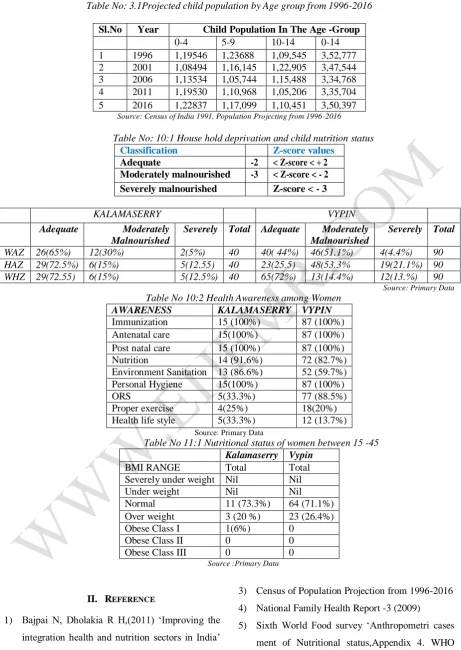
Table No 3:1
4. Integrated child development services
Emperor International Journal of Finance and Management Research [EIJFMR] Page 77 around 1.67crore pregnant and breastfeeding mothers
through 6722 projects and a network of 12.6lakh operational Aganwadis centres across the country over 25 lakh Aganwadis workers and helpers to constitute the core of these services
Beneficiaries
The programme beneficiaries are children below 6years: Pregnant and lactating mothers, women in the age group of 15-44 years and adolescent girls up to the age 18years for non –formal education and training on health.
Objectives
The main objectives of the scheme are to improve the nutrition and health status of the children aged between 0-6years,to lay the foundation for proper psychological, physical and social development of the child to reduce the incidence of mortality ,morbidity, malnutrition and school dropout: to achieve effective co-ordination of the policy and implementation among various departments to promote child development; to enhance the capacity of the mother to look after the health and nutrition of the child through proper nutrition and health conditions.
Services
Supplementary nutrition Immunization
Health check-ups and referrals
services
Non formal and Preschool Education Growth monitoring Promotion
5. Statement of the problem
ICDS, the integrated child development services is the best expression towards our children. India’s most ambitious multi-dimensional welfare programme to reach millions of children and women who are caught in the grip of malnutrition, diseases, ignorance and poverty which provide health, nutritional wellbeing, Psychological and cognitive development. It is a major social development
imitative of government has a wide recognition and international support. ICDS is being implemented in 11 blocks in Ernakulum District. In this context it is worthwhile to see whether the programme has achieved the expected objective especially with regard to nutrition and health to children and women. Every year Government is spending enormous amount for the promotion of ICDS. Therefore the present study hopes to reveal whether the huge investment made on ICDS is worthwhile especially in the case of nutrition and health among children and women.
Objectives
1. To analyse the relationship between household deprivation and social profile of household. 2. To examine the nutrition and health education
of women in ICDS between 15 to 45 years of age for enhancing health awareness.
7. Methodology
To assess the impact of the ICDS a sample group was drawn from the ICDS blocks of Ernakulum district. The initial step was a search into the primary sources and details regarding origin, objective, administrative mechanism has been gathered from secondary documents such as manuals, government’s publications, articles and internet etc. For the Primary study 2 ICDS blocks out of 11 in the district were randomly selected namely Kalamaserry and Vypin.
Emperor International Journal of Finance and Management Research [EIJFMR] Page 78 a. Tools
Assessment of nutritional status by anthropometry
There are mainly two approaches to measure the incidence of malnutrition namely Calorie/nutrition intake approach and Anthropometric. The present study focus on anthropometric approach, it is considered as more reliable measurement over calorie intake approach. It was used almost exclusively to estimate under nutrition among children under the age of six. Causes of malnutrition in children are complex, ranging from biological and social to environmental factors. In this context, the present study constructed a household deprivation score (HDS) based on the socio-economic status of household. The index of deprivation is based on simple measurement of deprivation of the households in three dimensions of deprivation: 1) basic economic assets; 2) basic amenities and 3) basic communications with the outside world.The anthropometric indices used with children (weight-for-height, height-for-age and weight-for-age) cannot be applied to adults. There is no internationally accepted anthropometry reference for adults, and the principles of a standardized growth curve are not applicable to adults. Consequently, an alternative measure is used For measuring malnutrition in adults is the body mass index (BMI).The anthropometric measurement by National Centre for Health Statistics (NCHS) and WHO standards (WHO, 1995) were used for the determination of nutritional status of preschool children. Standard deviation of scores (Z-scores) for weight-for-age (WAZ), height-for-age (HAZ) and weight-for-height (WHZ) were calculated. Literature Survey
The ICDS scheme is a long term development program for community and all efforts should be continued to strengthen to make it more successful. It serves as an excellent platform for several development initiatives in India. It serves the extreme
underprivileged communities of backward and remote areas of the country. It delivers services right at the doorsteps of the beneficiaries to ensure their maximum participation (K.Rajesh et.al). Malnutrition is currently one of the biggest challenges facing the modern world. According to the WHO Global database on child growth and nutrition, prevalence of malnutrition among under 5.Children in rural India fell over 70% in the late 1970s to below 50% at the end of the 1990s for both underweight and stunting measures. According to NFHS III survey Malnutrition has decreased only marginally from 47% in 1998 to 46% in 2005-2006 (A.Gupta). India has more hunger people than any country in the world. The global hunger index designates national levels of hunger as ‘alarming’ and India scores lower than many Sub-Saharan -Africa countries despite having a higher GDP. (B. Nirupam et.al) cites evidence regarding the hunger and malnutrition. Indeed India remains an enigma in global hunger, over 54%mof all childhood of deaths in related to malnutrition. In 2005-2006 about 44% children under 5 were under-weight and 48% were stunted due to chronic malnutrition due to the country size, there means India is home to 42% of the world’s underweight children and 31% of the world’s stunted children.
9. Analysis and interpretations
Emperor International Journal of Finance and Management Research [EIJFMR] Page 79 (WAD). The household deprivation score (HDS) is
based on six variables at the household level. The variables used for these dimensions are in a binary scale.They are:
Whether the household has a pucca or semi-pucca/kutcha house
Whether the household has some land Whether the household has electricity. Whether the household has drinking
water facilities in the residence
Whether there is at least one literate adult
member in the household
Whether the household has a radio, a
T.V, or newspapers.
Nutritional status of children and women Malnutrition directly and indirectly implicated in more than half of all children’s deaths all over the world. Those children who manage to survive, thousands are left chronically vulnerable to a variety of diseases and their intellectual abilities crippled for the rest of their lives. Such a situation places a huge economic burden on families and the country as a whole. Children in preschool stage require more attention, as this is the period of rapid growth and development, which makes them highly vulnerable to malnutrition. Malnutrition in this stage has far reaching consequences on child’s future by severely affecting child’s physical and mental development.
10. Measurement of under nutrition
The following are the commonly used indicators of under nutrition that are based on anthropometric data.
i) Weight-for-age: A child of a given age (in months) and sex is said to bemoderately undernourished when his or her weight (in kgs) falls below two standard deviations of the median in the reference population, and severely undernourished, when his or her weight falls below three standard deviations of the median.
ii) Height-for-age: Similarly, moderate and severe under nutrition can beascertained for a given age and sex by comparing the recorded observation on height (in cms) with that of the median for the reference population.
iii) Weight-for-height: Gender specific and age independent norms are availableon median weights for given heights. If the recorded weight for a given height is less than standard deviations (or 80%) of the median weight value of the reference population, the child is identified as moderately undernourished.
The three indices defined above capture different aspects of under nutrition. Low height-for-age can be taken as an indicator of poor environmental and social conditions and includes the effects of undernourishment since birth or even before birth. Low weight-for-height is a measure of current nutritional status. The indicator based on weight-for-age reflects long-term under nutrition as well as short-term or current under nutrition. Child nutritional status is possible to compute Z-scores of the three nutritional indices weight-for-age, height-for-age and weight-for-height
Table No: 10:1
Emperor International Journal of Finance and Management Research [EIJFMR] Page 80 recognised as adequately nourished and between 15
to 35 percent were moderately mal nourished in Weight for Age,Height for Age, Weight for height. In Vypin area Also only few were recognised as severely malnourished below 19 percent were recognised as severely malnourished with regard to Weight for Age, height for age and weight for height and above 45 percent children were adequately Nourished. But while comparing both Vypin and Kalamaserry areas, a small percent of children were more severely malnourished in Vypin than Kalamaserry, around 70 percent children were recognised as adequately nourished in Kalamaserry rather than Vypin and around 50 percent were moderately malnourished in Vypin than Kalamaserry. These results confirm that malnutrition is both a cause and consequences of economic status which is the key determinant of nutritional status.
Table No 10:2
Health awareness among mothers is an indicator of health and nutritional aspect. Almost everyone women were aware about immunization programmes, ante natal care and post natal care. 75 percent of mothers were known about ORS solutions and good hygienic practices .Iodized salt is used by 60 percent of mothers in the food pattern and 28 percent mothers take proper exercise and health life styles
Nutritional status of women from 15-45 years
The anthropometric indices used with children (height, height-for-age and weight-for-age) cannot be applied to adults. There is no internationally accepted anthropometry reference for adults, and the principles of a standardized growth curve are not applicable to adults. Consequently, an alternative measure is used for adults
Body Mass Index (BMI)
The most useful measure of malnutrition in adults is the body mass index (BMI)BMI is calculated by dividing the weight (in kilograms) by the height (in meters squared)Weight for height indices have
been used to assess the body composition of adults.BMI is the indicator for body composition.It has been shown to relate the body mass and the fat free mass,the two main components to body in addition to water and born.Inter and intra individual variation is due to changes in fat free mass or body mass.It has been argued that low BMI shows chronic energy deficiency (CED).BMI has also consistently shown to be much related to fat proportion, thus making it a valid indicator for both men and women. BMI Cut off Points
The cut off points applied to classify the individuals and to obtain the estimates of the proportion at the population at risk being weight deficiency or Obese were established by relating BMI values.
Table No 11:1
Body composition is directly affected by nutritional risks. Thus BMI index is a valid indicator for women to study body compositions. It has been found that 62 percent of women seem to have normal BMI index and 25 percent as overweight and 13 percent as Obese. BMI index is one of the useful measures of malnutrition in adults. The findings of this study stress on the women education on nutrition and health care, thereby achieving an improvement in the nutritional status of preschool children.
12. Policy implications: strategies to
combat malnutrition among children and
women.
Emperor International Journal of Finance and Management Research [EIJFMR] Page 81 care for the child and pregnant mother as well as
good hygiene practices. Girls are more at risk of malnutrition than boys because of their lower social status. Thus broad strategies should be adopted to reduce malnutrition in rural Kerala among Children and women are as follows.
a. Family based approach:
Malnutrition occurs largely due to inappropriate family practices related to diet, health care and hygiene/sanitation. The primary focus would be to strengthen family practices related to Infant and young child feeding (exclusive breastfeeding, appropriate complementary feeding), sick childcare with appropriate medical treatment and nutrition management, prevention of illnesses through immunization and hygiene/sanitation, appropriate cooking and dietary practices in the family, appropriate use of nutritional supplements and micronutrient supplements and diarrhoea management through ORT to be promoted within the family. This will be done through specially selected and trained family nutrition volunteers who will visit these families regularly and provide continuing support.
b. Local Community based approach
In order to support the family based counselling and behaviour, change communication, local community based approach will be taken up at theneighbourhood and community level to enable a positive environment to promote the appropriate family practices as acceptable social norms. All existing peer groups will be identified, such as mothers’ groups, neighbourhood Groups (NHGs), small help
Groups (SHGs), adolescent groups, youth groups, religious leaders and other community influencers. Peer group education activities will be conducted for these groups periodically on a continuing basis so that peer pressure is built up for sustaining appropriate family and community practices.
c. Social Marketing and Mass media based
approach
In order to support the family counselling and the local community based activities, mass media will be utilized to promote the same message and practices to provide an overall positive environment for behavioural change. d. Ensuring Quality Food through ICDS and
other food intervention programmes.
Government has been implementing a wide range of nutrition intervention programmes for achieving food and nutritional security at the household and individual levels. The important food-based interventions include integrated child development services (ICDS), Public distribution system (PDS), and Mid-day meal programmes (MDM). The performance of food-based interventions needs to be improved by making them more demand driven.
e Institutional approach
Emperor International Journal of Finance and Management Research [EIJFMR] Page 82 Table No: 3.1Projected child population by Age group from 1996-2016
Sl.No Year Child Population In The Age -Group
0-4 5-9 10-14 0-14
1 1996 1,19546 1,23688 1,09,545 3,52,777 2 2001 1,08494 1,16,145 1,22,905 3,47,544 3 2006 1,13534 1,05,744 1,15,488 3,34,768 4 2011 1,19530 1,10,968 1,05,206 3,35,704 5 2016 1,22837 1,17,099 1,10,451 3,50,397
Source: Census of India 1991, Population Projecting from 1996-2016
Table No: 10:1 House hold deprivation and child nutrition status
Classification Z-score values
Adequate -2 < Z-score < + 2 Moderately malnourished -3 < Z-score < - 2 Severely malnourished Z-score < - 3
KALAMASERRY VYPIN
Adequate Moderately
Malnourished
Severely Total Adequate Moderately
Malnourished
Severely Total
WAZ 26(65%) 12(30%) 2(5%) 40 40( 44%) 46(51.1%) 4(4.4%) 90 HAZ 29(72.5%) 6(15%) 5(12.55) 40 23(25.5) 48(53.3% 19(21.1%) 90 WHZ 29(72.55) 6(15%) 5(12.5%) 40 65(72%) 13(14.4%) 12(13.%) 90
Source: Primary Data Table No 10:2 Health Awareness among Women
AWARENESS KALAMASERRY VYPIN
Immunization 15 (100%) 87 (100%)
Antenatal care 15(100%) 87 (100%)
Post natal care 15 (100%) 87 (100%)
Nutrition 14 (91.6%) 72 (82.7%)
Environment Sanitation 13 (86.6%) 52 (59.7%)
Personal Hygiene 15(100%) 87 (100%)
ORS 5(33.3%) 77 (88.5%)
Proper exercise 4(25%) 18(20%)
Health life style 5(33.3%) 12 (13.7%) Source: Primary Data
Table No 11:1 Nutritional status of women between 15 -45 Kalamaserry Vypin
BMI RANGE Total Total
Severely under weight Nil Nil
Under weight Nil Nil
Normal 11 (73.3%) 64 (71.1%)
Over weight 3 (20 %) 23 (26.4%)
Obese Class I 1(6%) 0
Obese Class II 0 0
Obese Class III 0 0
Source :Primary Data
II. REFERENCE
1) Bajpai N, Dholakia R H,(2011) ‘Improving the integration health and nutrition sectors in India’ Working paper No-2, Columbia Global Centres South Asia, Columbia University.
2) Census Report of Indian Population (2011)
3) Census of Population Projection from 1996-2016 4) National Family Health Report -3 (2009)