Original Research Article
Type 2 diabetes mellitus and its determinants among adults in an urban
area of Kancheepuram district, Tamil Nadu
S. Gopalakrishnan*, M. Muthulakshmi
INTRODUCTION
Non communicable disease (NCD) are a major public health threat with an increasing burden on the Health Care Delivery System.1 Non-communicable diseases last for a longer duration and are a result of a combination of modifiable and non-modifiable risk factors such as genetic, physiological, environmental and behavioral factors.2 The current epidemic of non-communicable diseases in India is attributed to the increase in longevity
and lifestyle changes resulting from urbanization.3,4 Diabetes mellitus (DM) is one of the main chronic non-communicable diseases prevalent in India.5
Diabetes Mellitus is a global epidemic in the new millennium.6 Diabetes is a chronic disease that occurs either when the pancreas does not produce enough insulin or when the body cannot effectively use the insulin it produces.7 Diabetes mellitus is classified into four types:
ABSTRACT
Background: Type 2 diabetes mellitus (T2DM) is a modern day epidemic of epic proportions, affecting all strata of the society. The prevalence is becoming alarmingly high among younger age groups. The impact of this disease on physical, mental, social and economic wellbeing is huge and therefore warrants early detection and prevention. Aim of the study wasto estimate the prevalence and determinants of T2DM among the adult population in an urban area.
Methods: This cross sectional descriptive study was done in Anakaputhur, an urban area in Kancheepuram district. Based on 10.4% prevalence of T2DM, reported by the ICMR-INDIAB data (2011), the sample size was calculated to be 1680. Data was collected by convenient sampling method using a structured questionnaire from among the adult population. Fasting and postprandial plasma blood glucose was estimated. Data was analyzed using SPSS ver.16 software.
Results: Mean age of the participants was 44.2 years. Females constituted 51.1% and 19.4% were known hypertensives, 10.9% were smokers and 55.3% were overweight/obese. The prevalence of T2DM was found to be 21.2%. Around 20% of affected individuals were belonging to <45 years of age. Overweight and obesity were significantly associated with occurrence of diabetes mellitus.
Conclusions: This study has shown a high prevalence of Diabetes Mellitus. The associated determinants are found to be high and changing. This indicates that diabetes is resulting in an epidemiological and genetic transition of a disease of susceptibility. This necessitates the need for strategies for increasing the awareness, broad based screening, focused treatment and follow up.
Keywords: Macro-angiopathies, Modern epidemic, Non-communicable diseases
Department ofCommunity Medicine, Sree Balaji Medical College and Hospital, Bharath Institute of Higher Education and Research, Chennai, Tamil Nadu, India
Received: 21 February 2018
Accepted: 20 March 2018
*Correspondence:
Dr. S. Gopalakrishnan, E-mail: [email protected]
Copyright: © the author(s), publisher and licensee Medip Academy. This is an open-access article distributed under the terms of the Creative Commons Attribution Non-Commercial License, which permits unrestricted non-commercial use, distribution, and reproduction in any medium, provided the original work is properly cited.
1. Type 1 diabetes, which is caused by an autoimmune reaction, where the body’s defense system attacks the insulin-producing beta cells in the pancreas. As a result, the body can no longer produce the insulin it needs.
2. Type 2 diabetes, where the body is able to produce insulin but either this is not sufficient or the body is unable to respond to its effects (insulin resistance), leading to a build-up of glucose levels.
3. Gestational diabetes, women develop a resistance to insulin and subsequent high blood glucose levels during pregnancy.
4. Impaired glucose tolerance (IGT) and impaired fasting glucose (IFG): People whose blood glucose levels are high but not as high as those in people with diabetes.
People with IGT or IFG and gestational diabetics are at high risk of progressing to Type 2 diabetes, although this is not inevitable.7,8
Uncontrolled diabetes over a time leads to serious damage to the body, leading to micro and macro-angiopathies.7 An overwhelmingly serious problem is that diabetes mellitus often cannot be diagnosed until complications appear.9 Asian Indian phenotype with high insulin resistance, increased abdominal fat deposition, high genetic predisposition and high susceptibility to environmental insults, are at a higher risk of developing diabetes and its complications.10,11
Global prevalence of diabetes mellitus is about 9%.7,12 The prevalence of DM in India is found to be around 8.63%.8 However, the prevalence of DM in Tamil Nadu is found to be slightly higher at 10.4%.13 The prevalence of diabetes is expected to double by 2030 from 8.3 to 17.6% globally, excluding the high numbers of undiagnosed cases estimated as 175 millions.8,14-16 Around 51 million and 43 million of the diabetic population live in India and China respectively.17 The dramatic rise in the prevalence of diabetes mellitus and related disorders like obesity, hypertension and the metabolic syndrome could be related to the rapid changes in life style that has occurred in the last fifty years.8
Approximately 1.9% of the global disability adjusted life years (DALY) is attributed to diabetes.18 The International Diabetes Federation (IDF) estimates that 450 million people are living with diabetes, with 5.1 million dying from it annually worldwide.8,19 WHO projects that diabetes will be the seventh leading cause of death in 2030. In India, the risk of dying from NCDs was 26.1% in the year 2010. In 2015, an estimated 1.6 million deaths were directly caused by diabetes.19-22
Diabetes mellitus is becoming alarmingly high among all the age groups impacting on their physical, mental and social wellbeing warranting an early detection and prevention. India is now becoming the diabetes capital of the World.23 With this background; this study was
planned with an objective to estimate the prevalence and determinants of type 2 diabetes mellitus (T2DM) among the adult population in an urban area of Kancheepuram district, Tamil Nadu.
METHODS
Study method
This is a health center based descriptive cross sectional study carried out in Anakaputhur area of Kancheepuram District.
Study area and population
This study was carried out among the adult population, aged more than 18 years visiting the Urban Health Training Center, Anakaputhur, which is the urban field practice area of our Medical College. The total population in the field practice area is approximately 45,562, with an adult population of 34,657 (Males -16,129 and Females-18,528).
Study period
Study was carried out between October 2016 and March 2017.
Sample size and sampling method
The sample size was estimated using ICMR-INDIADIAB 2011 data, which showed that the prevalence of Diabetes as 10%.13 Based on this, the sample size was estimated using the formula 4pq/L2, where, prevalence (P) = 10%, Q = 90%, precision (L) = 15% of ‘P’ = 1.5. With 5% refusal rate, the estimated sample size was calculated as 1680. Convenient sampling method was used to carry out this study.
Data collection method
The following organogram gives a detailed picture of the data collection method used for this study.
Data collection
were known diabetics. The rest of the study participants, 1325 were screened for their diabetes status using Fasting and post-prandial plasma glucose.
The Indian Council of Medical Research (ICMR) guideline was used to identify the study participants with diabetes mellitus, impaired glucose tolerance (IGT) and impaired fasting glucose (IFG).24
Figure 1: Organogram of data collection.
Table 1: Diagnostic criteria of diabetes mellitus.
Normoglycemia Pre diabetes (IFG & IGT) Diabetes mellitus
Fasting glucose (<110 mg/dl)
Fasting glucose
(>110 mg/dl and <126 mg/dl)
Fasting glucose (>126 mg/dl)
2 hrs. post prandial glucose (<140 mg/dl)
2 hrs. Post Prandial Glucose (>140 mg/dl and <200 mg/dl)
2 hrs. Post Prandial Glucose (>200 mg/dl), symptoms of diabetes and casual plasma glucose concentration >200 mg/dl
Statistical analysis
Data collected was analyzed using SPSS Ver.16 software. Frequencies and percentage were calculated. Proportions were compared using Chi Square test to find out any association between the different variables studied.
Ethical considerations
The study was started after getting the ethical clearance from the Institutional Ethical Committee and after obtaining informed consent from the study participants.
RESULTS
The study on prevalence of diabetes mellitus and its determinants in an urban area was carried out among 1680 study subjects. However, the data of 46 study subjects were excluded from the analysis, due to
incomplete information. The study outcome showed interesting results which are described below:
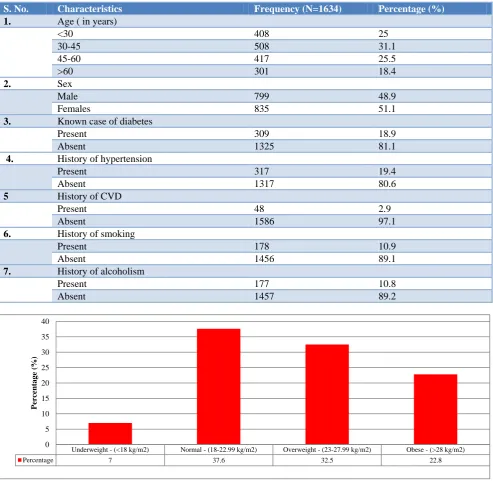
Background characteristics of the study population are shown in Table 2. The mean age of the participants is 44.2±15.9 years. Most of the participants, 56.6% belonged to 30-60 years of age. Females constituted 51.1% and 19.4% were known hypertensive. Nearly, 10.9% were smokers and 10.8% had history of consumption of alcohol.
Body mass index of the study participants is represented in Figure 2. Almost 32.5% of the study subjects were overweight and 22.8% were obese. Only 37.6% of the study subjects have a normal BMI.
The prevalence of T2DM is shown in Table 3. The prevalence of type 2 diabetes mellitus was found to be 21.2% (95% CI: 19.2 - 23.2) among the study population. Nearly, 26.3% suffered from impaired glucose tolerance
Sample Size 1680
Data Analyzed 1634
Known case of Diabetes - 309
Study Participants screened
1325
Normal 859
Pre-Diabetes 429
Newly Diagnosed Diabetes
37 Incomplete data
and almost 52.6% were found to be having normal random capillary blood glucose level.
Association between demographic factors and type 2 diabetes mellitus is represented in Table 4. It was found that overweight and obesity had statistically significant
association with the presence of diabetes mellitus (p<0.01). Whereas, other risk factors such as age, gender, history of hypertension, history of cardio vascular disease, history of smoking and history of alcoholism were not statistically associated with the presence of diabetes mellitus.
Table 2: Background characteristics of the study population.
S. No. Characteristics Frequency (N=1634) Percentage (%)
1. Age ( in years)
<30 408 25
30-45 508 31.1
45-60 417 25.5
>60 301 18.4
2. Sex
Male 799 48.9
Females 835 51.1
3. Known case of diabetes
Present 309 18.9
Absent 1325 81.1
4. History of hypertension
Present 317 19.4
Absent 1317 80.6
5 History of CVD
Present 48 2.9
Absent 1586 97.1
6. History of smoking
Present 178 10.9
Absent 1456 89.1
7. History of alcoholism
Present 177 10.8
Absent 1457 89.2
Figure 2: Body mass index of the study participants.
Table 3: Prevalence of type 2 diabetes mellitus.
S. No. Characteristics Frequency (N=1634) Percentage 95%CI
1. Normal 859 52.6 50.2 - 55.0
2. Pre-diabetic (IFG+IGT) 429 26.3 24.2 - 28.4
3 Diabetes mellitus (known DM +
newly diagnosed DM) 346 21.2 19.2 - 23.2
Underweight - (<18 kg/m2) Normal - (18-22.99 kg/m2) Overweight - (23-27.99 kg/m2) Obese - (>28 kg/m2)
Percentage 7 37.6 32.5 22.8
0 5 10 15 20 25 30 35 40
Perc
entag
e
(%
Table 4: Association between risk factors and type 2 diabetes mellitus.
S. No. Risk factors N
(1634)
Prevalence of DM (n=346)
Prevalence of DM (%)
Chi
square P value
1. Age (in years)
>45 773 178 23
3.01 0.082
<45 861 168 19.5
2. Gender
Males 799 154 19.3
3.4 0.066
Females 835 192 23
3. History of hypertension
Present 317 78 24.6
2.7 0.086
Absent 1317 268 20.3
4. History of cardio vascular diseases
Present 48 6 12.5
2.2 0.135
Absent 1586 340 21.4
5. History of smoking
Present 178 31 17.4
1.69 0.193
Absent 1456 315 21.6
6. History of alcoholism
Present 177 34 19.2
0.46 0.498
Absent 1457 312 21.4
7. Body mass index
Overweight and obese 905 170 18.8
6.9 0.008* Normal and underweight 729 176 24.1
*P value less than 0.05, Statistically Significant at 95% CI using Chi square test.
DISCUSSION
This study reflects diabetic status and its determinants among 1634 adults visiting the Urban Health Training Center, Anakaputhur, in Kancheepuram district, Tamil Nadu during the period between October 2016 and March 2017.
In this study, most of the participants (56.6%) belonged to 30-60 years of age. Females constituted 51.1% and 19.4% were known hypertensives. Nearly, 10.9% were smokers and 10.8% had history of consumption of alcohol. In a study conducted by Kinra et al, most of the participants (77%) belonged to 30-60 years of age group, which is similar to this study finding. It also stated that 14% had a history of smoking and 18% had a history of alcohol consumption, which was slightly high when compared to this study outcome.25 In a study by Bharati et al, 57.4% belonged to 20-60 years of age, 60.3% were females, which is also similar to the findings of this study. However, only 4.2% had a history of alcohol consumption and 32.6% gave a history of hypertension.6 Similar findings were also seen in studies conducted by Simon et al, Animaw et al, Kumar et al and Shaopeng et al.23,26-28
Almost 32.5% of the study subjects were found to be overweight and 22.8% were obese in this study. Only 37.6% of the study subjects have a normal BMI. A study done by Animaw et al, found that 9.3% were overweight and 2.1% were obese in their study area.27 In a study by
Kumar et al, 38.4% of the males and 39.6% of the females were overweight and 10.7% of the males and 9.4% of females were found to be obese.23
The overall prevalence of diabetes mellitus in this study was found to be 21.2%. Nearly, 26.3% of the study subjects were Pre-Diabetics, either they had impaired fasting glucose or impaired glucose tolerance. Similar result was seen in a study conducted in Kerala during 2017 by Simon C et al, where the prevalence of diabetes was found to be 18.7%.26 A study conducted by Singh A et al, in Amritsar showed a prevalence of 23.2%.29 Most other studies reported a much lower prevalence when compared to this study.
The prevalence of diabetes in most other studies like CURES-17 study by Mohan et al (15.5%), Ramachandran et al (12.1%), Kumar et al (10.6%), Tsirona S et al (10.68%), Anjana et al (10.4%), Rahman et all (Male – 9.4% and Female-8%), Bharati et al (8.4%), Aswathy et al (7.4%), Dar et al (6.3%), Shaopeng et al (6.2%) was found to be low when compared to the prevalence found in this study.13,23,30-34,6,17,28 A very low prevalence of 3.3% was reported by a study conducted in Ethiopia by Animaw et al.27 The high prevalence of DM in this study may be due to the study setting, since this was a health center based study and the prevalence recorded could be high.
this study. Age, gender, history of hypertension, history of cardio vascular disease, history of smoking and alcohol were not statistically associated with the prevalence of diabetes mellitus. In a study by Ramachandran et al, statistically significant association was found to be present between prevalence of diabetes and BMI, which was similar to this study finding. It also showed statistically significant association between prevalence of diabetes and age, waist hip ratio, family history of diabetes mellitus, monthly income and sedentary physical activity.31 Statistically significant association was present between prevalence of diabetes and age, hypertension and blood cholesterol levels in a study conducted by Bharati et al.6
In a recent study by Singh et al, statistically significant association was found to be present between prevalence of diabetes and age, hypertension, triglycerides and cholesterol.29 A study in Kerala, conducted by Aswathy et al, also showed a significant association between age, presence of co-morbidities and prevalence of diabetes. But gender was not statistically associated with prevalence of diabetes.34 In another study in Kerala, conducted by Simon et al, BMI was not statistically associated with prevalence of diabetes, which differed from this study. But, it showed a significant association with age, family history of diabetes and sedentary life style.26 In an Ethiopian study conducted by Animaw et al, a significant association was found between overweight, central obesity, hypertension and prevalence of diabetes.27 Study by Shaopeng et al, showed a statistically significant association between alcohol consumption and prevalence of diabetes.28
It can be found that there is statistically significant association existing between various risk factors and occurrence of diabetes mellitus in most of the similar studies conducted elsewhere. But the similar levels of association were not found in this study except for the body mass index. This needs to be investigated further to understand the epidemiological vagaries existing in our study area in this regard.
CONCLUSION
This study shows a high prevalence of diabetes mellitus (21.1%) among the study population. The identified prevalence can be a tip of the iceberg. There can be more people with undiagnosed or subclinical diabetes mellitus hidden in the community, who require regular screening, early diagnosis and prompt management. Moreover, the associated risk factors are also found to be on the rise. This indicates that diabetes is resulting in an epidemiological and genetic transition of disease susceptibility affecting a majority of the population. This necessitates the need for increased awareness creation, lifestyle modifications, broad based screening programs, focused treatment and follow up. These coordinated activities will help to reduce the diabetes burden among the vulnerable population in the long run.
ACKNOWLEDGEMENTS
The authors acknowledge the role played by the Medical Officer, the field staff and the Interns posted at the Urban Health Training Center, for their sincere and untiring effort to successfully carry out this study in the Field practice area.
Funding: No funding sources Conflict of interest: None declared
Ethical approval: The study was approved by the Institutional Ethics Committee
REFERENCES
1. STEPS: A framework for surveillance. The WHO STEP wise approach to Surveillance of non-communicable diseases (STEPS). Non-communicable Diseases and Mental Health, World Health Organization. Switzerland: Geneva.
Available at:
http://www.who.int/ncd_surveillance/en/steps_fram ework_dec03.pdf. Accessed on 8th Jan 2018. 2. WHO fact sheet – Non-Communicable Diseases.
2017. Available at: http://www.who.int/mediacentre/factsheets/fs355/en /. Accessed on 8th Jan 2018.
3. Reddy KS, Shah B, Varghese C, Ramadoss A. Responding to the threat of chronic diseases in India. Lancet. 2005;366(9498):1744-49.
4. Fall CH. Non-industrialized countries and affluence. Br Med Bull. 2001;60:33-50.
5. American Diabetes Association (ADA), Position Statement; Standards of Medical Care in Diabetes 2013. Diabetes Care. 2013;36(1):11–66.
6. Bharati DR, Pal R, Kar S, Rekha R, Yamuna TV, Basu M. Prevalence and determinants of diabetes mellitus in Puducherry, South India. J Pharm Bioallied Sci. 2011;3(4):513-8.
7. WHO Fact Sheet – Diabetes. 2017. Available at: http://www.who.int/mediacentre/factsheets/fs312/en /. Accessed on 8th Jan 2018.
8. IDF Diabetes Mellitus Atlas, 6th edition. Available at:
https://www.idf.org/component/attachments/attachm ents.html?id=813. Accessed on 8th Jan 2018. 9. American Diabetes Association. Standards of
medical care in diabetes—2006. Diabetes Care. 2006;29(Suppl 1):S4–42.
10. Ramachandran A, Snehalatha C, Mary S, Mukesh B, Bhaskar AD, Vijay V. The Indian Diabetes Prevention Programme shows that lifestyle modification and metformin prevent type 2 diabetes in Asian Indian subjects with impaired glucose tolerance (IDPP-1). Diabetologia. 2006;49(2):289-97.
12. Global Status Report on Non communicable Diseases: 2014 WHO. Pg: 243. Available at: http://apps.who.int/iris/bitstream/10665/148114/1/9 789241564854_eng.pdf. Accessed on 8th Jan 2018. 13. Anjana RM, Pradeepa R, Deepa M, Datta M, Sudha
V, Unnikrishnan R, et al. Prevalence of diabetes and pre-diabetes in urban and rural India: phase I results of the Indian Council of Medical Research– INdiaDIABetes (ICMR–INDIAB) study. Diabetologia. 2011;54:3022-7.
14. Guariguata L, Whiting DR, Hambleton I, Beagley J, Linnenkamp U, Shaw JE. Global estimates of diabetes prevalence for 2013 and projections for 2035. Diabetes Res Clin Pract. 2014;103(2):137–49. 15. Whiting DR, Guariguata L, Weil C, Shaw J. IDF Diabetes Atlas: Global estimates of the prevalence of diabetes for 2011 and 2030. Diabetes Res Clin Pract. 2011;94(3):311–21.
16. Beagley J, Guariguata L, Weil C, Motala AA. Global estimates of undiagnosed diabetes in adults. Diabetes Res Clin Pract. 2014;103(2):150–60. 17. Dar IH, Dar SH, Bhat RA, Kamili MA, Mir SR.
Prevalence of type 2 diabetes mellitus and its risk factors in the age group 40 years and above in the Kashmir valley of the Indian subcontinent. JIACM. 2015;16(3-4):187-97.
18. Murray CJ, Vos T, Lozano R, Naghavi M, Flaxman AD, Michaud C, et al. Disability-adjusted life years (DALYs) for 291 diseases and injuries in 21 regions, 1990-2010: a systematic analysis for the global burden of disease study 2010. Lancet. 2012;380(9859):2197–223.
19. Global status reports on non-communicable diseases 2010. WHO. Available at: http://www.who.int/nmh/publications/ncd_report_fu ll_en.pdf. Accessed on 8th Jan 2018.
20. Mathers CD, Loncar D. Projections of Global Mortality and Burden of Disease from 2002 to 2030. PLoS Med. 2006;3(11):e44.
21. Diabetes Action Now: an initiative of the World Health Organization and International Diabetes Foundation. Geneva: WHO; 2004. Available at: http://www.who.int/diabetes/actionnow/en/DANboo klet.pdf. Accessed on 8th Jan 2018.
22. Global Report on Diabetes: World Health Organization; Geneva: 2016. Available at: http://apps.who.int/iris/bitstream/10665/204871/1/9 789241565257_eng.pdf. Accessed on 8th Jan 2018. 23. Kumar M, Arya R, Shukla MK, Hasan J.
Community based cross sectional study on prevalence of risk factors of type 2 Diabetes Mellitus in adult population residing in urban area of Shahjahanpur, Uttar Pradesh. IAIM. 2017;4(10):216-20.
24. Section 3. Diagnostic criteria. Criteria for the diagnosis of Diabetes and Glucose tolerance. Available at: http://icmr.nic.in/guidelines_diabetes/ section3.pdf. Accessed on 8th Jan 2018.
25. Kinra S, Bowen LJ, Lyngdoh T, Prabhakaran D, Reddy KS, Ramakrishnan L, et al. Sociodemographic patterning of non-communicable disease risk factors in rural India: a cross sectional study. Bmj. 2010;341:c4974.
26. Simon C, Nair N, Binu J, Rajmohan P. Prevalence and Risk Factors of Type 2 Diabetes Mellitus among Adults in a Rural Area of Thrissur, Kerala. JMSCR. 2017;5(9):28303-10.
27. Animaw W, Seyoum Y. Increasing prevalence of diabetes mellitus in a developing country and its related factors. PLoS ONE. 2017;12(11):e0187670. 28. Shaopeng Xu, Qing Wang, Jie Liu, Bo Bian,
Xuefang Yu, Xiangdong Yu et al. The prevalence of and risk factors for diabetes mellitus and impaired glucose tolerance among Tibetans in China: a cross sectional study. Oncotarget. 2017;8(68):112467-76. 29. Singh A, Shenoy S, Sandhu JS. Prevalence of type 2
diabetes mellitus among urban sikh population of Amritsar. Indian J Community Med. 2016;41(4):263-7.
30. Mohan V, Deepa M, Deepa R, Shanthirani CS, Farooq S, Ganesan A et al. Secular trends in the prevalence of diabetes and impaired glucose tolerance in urban South India—the Chennai Urban Rural Epidemiology Study (CURES-17). Diabetologia. 2006;49(6):1175-8.
31. Ramachandran A, Snehalatha C, Kapur A, Vijay V, Mohan V, Das AK et al. High prevalence of Diabetes and Impaired Glucose Tolerance in India: National Urban diabetes Survey. Diabetologia. 2001;44(9):1094-101.
32. Tsirona S, Katsaros F, Bargiota A, Polyzos SA, Arapoglou G, Koukoulis GN. Prevalence and determinants of type 2 diabetes mellitus in a Greek, adult population. HORMONES. 2016;15(1):88-98. 33. Rahman MM, Rahim MA, Nahar Q. Prevalence and
risk factors of type 2 diabetes in an urbanizing rural community of Bangladesh. Bangladesh Med Res Counc Bull. 2007;33(2):48-54.
34. Aswathy S, Lohidas V, Nimitha P, Anish TS, Tinu N, Brian O. Prevalence and Social Determinants of Type 2 Diabetes in a Coastal Area of Kerala, India. J Endocrinol Diab. 2017;4(3):1-5.
Cite this article as: Gopalakrishnan S,