Connection of Reproductive Indices of High-Productive
Cows with Duration of their Dead-Wood Period
M.H. BAIMISHEV
1, S.P. EREMIN
2, K.V. PLEMIASHOV
3,
V.V. ZAITSEV
1*, H.B. BAIMISHEV
1and H.A. SAFIULLIN
11Samara State Agricultural Academy, Samara, Russia.
2Nizhny Novgorod State Agricultural Academy Nizhny Novgorod, Russia. 3Branch of Federal state budgetary scientific institution “Federal Research Center
Livestock - AUIAB Academician L. K. Ernsta”, S.-Petersburg, Russia. *Correspondent author E-mail: [email protected]
http://dx.doi.org/10.13005/bpj/1339
(Received: November 26, 2017; accepted: December 15, 2017)
ABSTRACT
It is possible to raise productivity of cattle only on the basis of continuation of studying the capacities of reproductive system in high-productive cows in interconnection with indices of their physiology. There were formed three groups of cows-analogues (according to age, term of in-calf state, ancestry). After cows’ calving on behalf of insemination terms’ correction after accouchement, duration of lactation and with the help of non-graded start, there were formed three groups of cows after the first lactation with the level of milk productivity 7000-8000 kg but they had different dead-wood period’s indices before the second calving. In the 1st group this index was 60 days, in the 2nd group – 80 days and in the 3rd one – 90 days. There were 30 animals in each group. It was noted that optimization of milk productivity’s level in cows was possible on behalf of duration increase of dead-wood period. It could serve as prophylaxis of postnatal complications in animals and decrease involution terms of genitals. It’s noted that recovery of cows’ reproductive capacities after calving also depends on the duration of dead-wood period. At cows’ yield of milk - 7000-8000 kg 80 days should be considered the optimal duration of dead-wood period. Given term promotes increase of reproductive capacities and getting viable litter from high-productive cows of Holstein breed. Only in this case high level of milk productivity is successfully combined with high level of adaptive capacities in animals and full realization of their genetic potential during the whole ontogenesis.
Keywords: High-productive cows, Dead-wood period, Reproductive indices, Reproductive capacity, the level of yields of milk.
INTRODUCTION
Industrial dairy cattle-breeding in Russia is the most dynamic and science-consuming branch which contributes greatly the provision of food safety of the country as the main producer of fine milk. Its
share in daily ration of the Russian people reaches 35% on behalf of consumption of different products which are made with its use1. The main factor
restraining the development of dairy cattle-breeding is low indices of band reproduction2,3.
This is an Open Access article licensed under a Creative Commons Attribution-NonCommercial-ShareAlike 4.0 International License (https://creativecommons.org/licenses/by-nc-sa/4.0/ ), which permits unrestricted Non Commercial use, distribution and reproduction in any medium, provided the original work is properly cited.
It is important to study capacities of high-productive cows’ reproductive system in the interaction with indices of their physiology during ontogenesis4,5,6 for the rise of cattle productivity. As
secretion of milk is impossible without calving in cows, then – normal state of reproductive function is the basis of effective lactation7.
Solving of the problem of intensification of animals’ reproduction mostly depends on the right organization of their keeping, feeding, veterinary control, diagnostics, treatment and prophylaxis on different stages of the reproductive cycle8. This
work is many-sided and must bear systematic character. Reproductive capacities mostly depend on conditions of the course of in-calf state, accouchement, postnatal period9,10.
It is necessary to insert some correction into the technology of cattle rehabilitation11,12 for rational
solving of the problem of reproduction, rise of cows’ milk productivity and receiving viable remount cubs. It will provide the increase of the yield of remount heifers with high genetic potential in productivity13,14.
There is some lowering of reproductive function and decrease of calves’ yield in the farms of the country on the whole. It economically harms the branch very much. Reproductive capacities of import cattle (Holstein breed) sharply decrease after the first calving what is mostly connected with the technology of intensive dairy production without reference to cows’ physiological state1. That’s why, the search
of biotechnological ways of cattle reproduction for working with high-productive animals is really necessary15,16.
The aim of the research is to find the ways for the increase of cows’ reproductive capacities and their productive macrobiosis in conditions of the intensive technology of milk production.
MATERIALS AND METHODS
The study was conducted in strict accordance with the ethical principles established by the European Convention for the Protection of Vertebrate Animals used for experimental and other scientific purposes (adopted in Strasbourg on March,
18th, 1986, and confirmed in Strasbourg on June,
15th, 2006).
The study used high-productive animals of Holstein breed at dairy complex “Kupinskoe” (Bezenchuk area, Samara region).
There were formed three groups of cows-analogues (according to age, term of in-calf state, ancestry). After cows’ calving on behalf of insemination terms’ correction after accouchement, duration of lactation and with the help of non-graded start there were formed three groups of cows after the first lactation with the level of milk productivity 7000-8000 kg but they had different dead-wood period’s indices before the second calving. In the 1st
group this index was 60 days, in the 2nd group – 80
days and in the 3rd one – 90 days. There were 30
animals in each group.
Biochemical indices of blood were studied according to standard methods for the control of metabolism state. Blood was taken from caudal vein 1.5-2 hours before feeding in 5 cows from every group 15 days before calving. All the applied methods were traditional. The content of common protein in blood serum was determined with the help of refractometer RPL-3 (Russia); separation and quantitative partition of protein fraction’s ratio in blood serum were conducted nephelometrically; the content of carotin was determined according to carr-price; the concentration of common calcium in blood serum was determined complex-metrically; the level of non-organic phosphorus, alkaline reserve and glucose concentration in blood were estimated by orthotoluidinic method.
Reproductive capacities of the examined groups of cows were studied according to the following indices: duration of accouchement course, postnatal period and recovery of cows’ reproductive capacity after calving (by method of timekeeping, rectal investigations and with the help of USI-apparatus KAIXIN-5200 VET).
Table 1: The course of calvings and after-calving period of the observed cows’ groups
Index Groups of animals
The 1st group The 2nd group The 3rd group
Quantity of animals 10 10 10
Duration of accouchement, hours 8.42±1.18 6.45±0.92 6.20±1.04
Duration of the expulsion of afterbirth, hours 5.20±1.07 2.78±0.45* 2.05±0.78*
Delay of afterbirth, % 20 -
-Postnatal complications, % 40 10
-The ending of uterus’ involution, d:
discharge of lochia 15.2±2.79 12.5±1.80 12.0±1.04
results of rectal investigations 28.0±0.42 21.6±1.62** 20.8±1.13**
Live weight of calves at birth, kg 34.6±2.58 36.3±1.84 36.8±2.12
Received calves 8 10 10
Table 2: Biochemical blood indices of the observed groups of cows
Index Groups of animals
control 1-experimental 2-experimental
15 days before calving
Common protein, g/l 71.15±1.91 73.14±2.57 72.12±1.11
Albumins, % 39.45±0.85 43.0±0.74 43.45±0.62*
Globulins, % 56.30±0.72 55.88±0.83 56.54±0.67
including:
á-globulins 15.55±0.34 13.91±0.48 13.82±0.52
â-globulins 15.45±0.34 12.61±0.98* 13.73±0.43*
ã-globulins 21.22±0.96 29.36±158* 29.00±1.13*
Common calcium, mmol/l 2.34±0.04 2.32±0.03 2.280.05
Inorganic phosphorus, mmol/g 0.65±0.08 1.43±0.13 1.45±0.11
Alkaline reserve, V%, ÑÎ2 44.13±1.96 47.45±2.03 47.91±1.89
Carotin, mg% 0.330±0.04 0.490±0.04** 0.520±0.03**
Glucose, mg% 64.5±0.72 71.3±0.42 79.7±0.26
zootechnics, with application of program complex MicrosoftExel 7. Reliability degree of the processed data are shown by corresponding symbols – p<0.05*;
p<0.01**; p<0.001***.
RESULTS
While conducting our research we established that duration of accouchement was in interaction with duration of service-period and dead-wood period. So, it was respectively less on 1.97 and 2.22 hours in the 2nd and 3rd groups than in the
1st group. It is, evidently, the result of better
morpho-functional state of cows’ genitals from the 2nd and 3rd
groups of animals (Table 1). The duration of expulsion of afterbirth in the groups was different: in the 1st
group – 5.20±1.07; in the 2nd group – 2.78±0.45;
in the 3rd group – 2.05±0.78 hours. Calculating the
duration of expulsion of afterbirth in animals from the control group we didn’t include cases of delay of afterbirth. The 1st group of animals was registered to
have one case of dead birth and one calf died in 1.5 hours after birth. In the first days the most profuse discharge were observed in cows with first calving from the 2nd and 3rd groups in comparison with the
control group. It, evidently, points at the increased contractile uterus’ capacity in animals from the 2nd
Table 3: Reproductive capacities of the examined groups of cows
Index Groups of animals
control 1-experimental 2-experimental
n = 28 n =30 n =30
Manifestation of the 1st sexual cycle after calving, days 40.6±4.26 26.5±2.18* 23.0±2.24**
Impregnation capacity according to ruts, including %: 39.3 66.6 70.0
In the first In the secondIn the thirdIn 17.8 23.4 20.0
all the consequent 4.2 6.6 6.6
7.1 -
-Conceived altogether, % 85.6 96.6 96.6
Interval between sexual cycles, days 29.7±3.76 22.1±2.14 21.8±3.08
Service-period, days 146.6±14.2 114.4±3.50* 113.9±2.18*
preparedness to calving. On the 4-5th day after
accouchement lochia acquired dark-cherry color, on the 10-12th day after accouchement lochia of
animals from the 2nd and 3rd groups became mucous
and lighten. We observed the same changes in 80% of animals from the 1st group on 3-4 days later
(Table 1).
The duration of lochia discharge in different groups was as follows: in the 1st group – 15.2±2.79
days; in the 2nd group – 12.5±1.80 days; in the 3rd
group – 12.0±1.04 days. We determined the ending of the uterus’ involution in the observed groups of animals with the help of rectal investigation of ovaries and uterus (the state of the uterus’ neck, consistency of uterine horns, their sizes, absence of discharge at uterus’ massage, absence of yellow body in ovaries). At the same time, it turned out that duration of uterus’ involution mostly depends on the duration of the dead-wood period. It also correlates with the duration of the accouchement which mostly depends on the preparedness of animals to calving.
Duration of the ending of uterus involution in different groups was as follows: in the 1st group
– 28.0±4.2; in the 2nd group – 21.6±1.62; in the
3rd group – 20.8±1.13 days. We also note that the
increase of duration of dead-wood period reduces the duration of accouchement course and postnatal period. It, evidently, influences positively the intrauterine development of newborn calves. Live weight of calves at birth differed in different groups. So, body mass of calves in the 1st group was equal
to 34.6±5.8 kg, what is less on 3.7 and 4.2 kg, respectively, than in the 2nd and 3rd groups.
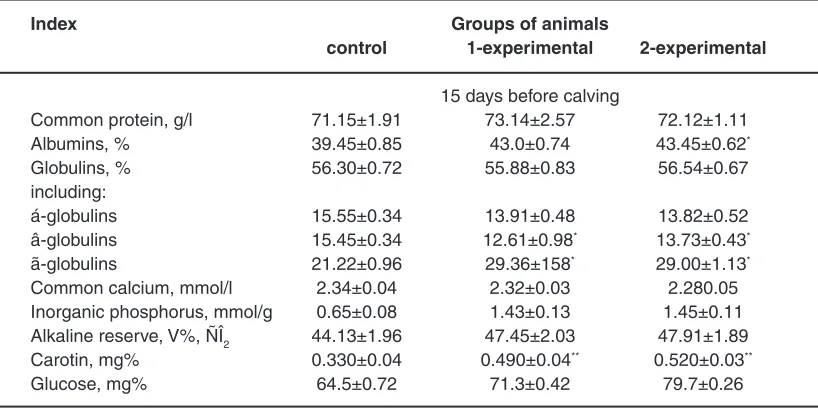
Considering postnatal complications as one of the main causes of metabolic processes’ disturbance in cows’ bodies, we should note that studying parameters of hemodynamic changes in the observed animals is rather interesting. In order to determine the connection between postnatal complications and metabolic processes in bodies of cows with different duration of dead-wood period, we studied biochemical blood analysis of the observed groups of animals 15 days before calving (Table 2).
The content of common protein before calving: in cows from the control group this index was lower on 1.99 g/l and on 0.97 g/l, respectively, than in animals from the 1st and 2nd experimental groups.
Cows from the control group were noted to have lowering of albumins’ content at the increased level of â-globulins.
The content of albumins in cows with durable lactation and service-period was less on 3.55% and 4.0%, respectively, than in the 1st and
2nd experimental groups of cows. The difference
was statistically reliable (p<0.05). The quantity of â-globulins before calving was more in cows from the control group than in cows from the 1st and
2nd experimental groups on 2.84% and 1.72%,
control group in comparison with the cows from the 1st and 2nd experimental groups on 8.14% and7.78%
(p<0.01).
The cows with prolonged service-period and durable lactation before calving were noted to have acidotic state what was certified by low alkaline reserve. The difference in comparison with the 1st
and 2nd experimental groups of animals was equal
to 3.32 V%, CO2 and 3.78 V%, CO2 (p<0.05).
The same regularity was established for the content of carotin in blood. The concentration of carotin in blood of cows from the control group was less in comparison with the animals from the 1st and
2nd experimental groups on 0.16 mg% and 0.19 mg%
(p<0.01), respectively, 15 days before calving.
The cows with durable lactation and service-period at 60.9 days’ dead-wood period were noted to have a downward trend of inorganic phosphorus’ level in blood, on average on 0.78; 0.80 mmol/l (p<0.05) in comparison with the animals from the 1st and 2nd experimental groups which had less
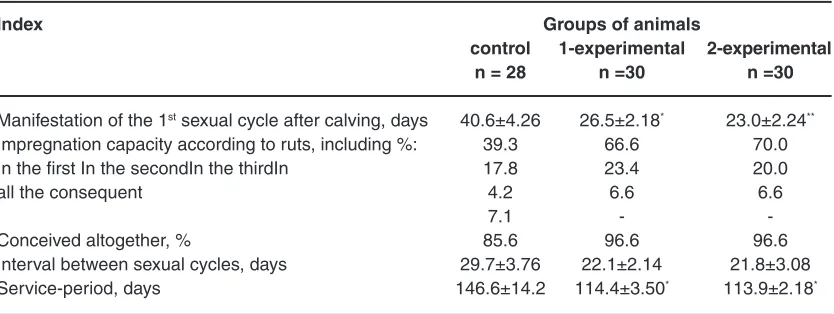
durable lactation and service-period but, at the same time, the duration of dead-wood period in them was on 19.6; 29.3 days longer, respectively, than in cows from the control group (Table 3).
Effectiveness of insemination differed in different groups of animals. So, impregnation of cows in the first insemination was equal to 39.3% in the control group, in the 1st experimental group
– 66.6%, in the 2nd experimental group – 70.0%.
In the control group 78.4% of animals conceived after the 4th insemination (6th-7th sexual cycle
after accouchement), 7.2% of cows – after 5th-6th
insemination. The animals from the 1st and 2nd
experimental groups (96.6%) conceived after 3 inseminations. The interval between sexual cycles was equal in the control group to 29.7±3.76 days what pointed at cacorhythmic state of sexual cycles in comparison with the animals from the 1st and
2nd experimental groups where just single cases of
cacorhythmic state of sexual cycles were noted.
The interval between sexual cycles composed in the 1st experimental group 22.1±2.14
days, in the 2nd experimental group – 21.8±3.08
days, what is less than in animals from the
control group on 7.6; 7.9 days. The duration of service-period composed in the control group of animals 146.6±14.2 days, what was on 22.2; 22.7 days longer, respectively, than in the 1st and 2nd
experimental groups.
DISCUSSION
Reproductive capacity of cows in conditions of intensive technology of milk production depends on dead-wood period’s duration. The duration of dead-wood period in 80 days provides curtailment of duration of accouchement course on 1.97 hours in comparison with the control group of cows what, evidently, is the result of better morpho-functional genitals’ state in the given group of cows before accouchement.
The authors agree with the opinion3 that the
level of feeding is not always the cause of low indices of cows’ reproductive function. High dairy productivity and prolonged duration of lactation influence much more. The duration of accouchement and the course of postnatal period are interconnected with the duration of dead-wood period. The dead-wood period in 60 days doesn’t, evidently, provide preparedness of animals to calving what influences negatively the recovery of cows’ reproductive capacities.
At the level of cows’ dairy productivity in 7000-8000 kg and more the recovery of reproductive capacity depends on the duration of dead-wood period. The increase of dead-wood period on 20 days raises recovery indices of cows’ reproductive capacity, the term of animals’ fruitful insemination shortens on 23 days, impregnation capacity in the first rut increases on 27.3% what co-ordinates with the opinion9 that the increase of cows’ impregnation
capacity in the first rut points at their preparedness in the course of dead-wood period.
Received results of investigations and analysis of literature19,20 indicate that in conditions
of intensive technology of milk production in high-productive cows the duration of dead-wood period must depend on the level of dairy productivity.
CONCLUSION
Optimization of cows’ reproductive capacity and the level of their dairy productivity on behalf of the dead-wood period’s duration provides the increase of animals’ reproductive capacities, prophylaxis of postnatal complications and decrease of genitals’ involution terms in comparison with the control values. The course of accouchement in these groups
of animals was quicker and without complications. Recovery of cows’ reproductive capacities after calving in animals from experimental groups also depends on the duration of dead-wood period. We found out that at yield of milk 7000-8000 kg the optimal index of dead-wood period is 80 days what promotes the increase of reproductive capacities and also getting of viable litter from high-productive import cows of Holstein breed. Optimization of dairy productivity level and dead-wood period’s duration provide the increase of adaptive properties in animals and high vitality of calves at birth will provide fuller realization of their genetic potential in periods of raising and exploitation.
REFERENCES
1. Tuchemsky, L.I., Efimov, D.N., Burduzha, O.I., Tulinova, O.V., Vasilieva, E.N. In the fair way of import substitution in dairy cattle breeding in the Russia federation. Dairy and beef cattle, 6 : 13-17 (2015)
2. Medvedev, IN. Vascular-platelet interaction in pregnant cows. Bulg. J. Agric. Sci, 23(2) : 310-314 (2017)
3. Zaitsev, V.V., Makurina, O.N., Molyanova, G.V., Savinkov, A.V., Uhtverov, A.M., Tarabrin, V.V. Hemostasis and Rheological Blood Features Dynamics of Black-many Coloured Lactating Cows at the Inclusion into their Ration of Antioxidant Lipisomal Preparation “Lipovitam-beta”. Biomedical & Pharmacology Journal, 10(2) : 759-766 (2017)
4. Glagoleva, T.I., Zavalishina, S.Yu. Aggregative Activity of Basic Regular Blood Elements and Vascular Disaggregating Control over It in Calves of Milk-vegetable Nutrition. Annual Research & Review in Biology, 12(6) : 1-7, 2017; doi:10.9734/ARRB/2017/33767 (2017) 5. Glagoleva, T.I., Zavalishina, S.Yu. Aggregation
of Basic Regular Blood Elements in Calves during the Milk-feeding Phase. Annual Research & Review in Biology, 17(1) : 1-7. doi: 10.9734/ARRB/2017/34380 (2017) 6. Glagoleva, T.I., Zavalishina, S.Yu. Physiological
Peculiarities of Vessels’ Disaggregating Control over New-Born Calves’ Erythrocytes. Annual Research & Review in Biology, 19(1) : 1-9. doi: 10.9734/ARRB/2017/37232 (2017)
7. Oshurkova, Ju.L., Medvedev, I.N., Fomina, L.L. Platelets’ Aggregative Properties of Ireshire Calves in the Phase of Dairy-vegetable Nutrition. Annual Research & Review in Biology, 16(4) : 1-6. doi: 10.9734/ ARRB/2017/35868 (2017)
8. Binelli, M., Pugliesi, G., Hoeck, V.V., Mesquita, F.S., Membrive, C.M.B. The role of proestrus on fertility and postovulatory uterine function in the cow. Animal Reproduction, 11(3) : 246-253 (2014)
9. Crespilho, A.M., Papa, F.O., Guasti, P.N., Novaes, J.L.C., Martins, A. The influence of insemination dose on pregnancy per fixed-time artificial insemination in beef cows is affected by semen extender. Animal Reproduction, 11(1) : 3-10 (2014)
10. Santos, J.E.P., Ribeiro, E.S. Impact of animal health on reproduction of dairy cows. Animal Reproduction, 11(3) : 254-269. (2014) 11. Zavalishina, S.Y. Restoration of Physiological
Activity of Platelets in New-Born Calves With Iron Deficiency. Biomed Pharmacol J, 10(2) : 711-716. doi: http://dx.doi.org/10.13005/ bpj/1160 (2017)
12. Zavalishina, S.Yu. Physiological Features of Hemostasis in Newborn Calves Receiving Ferroglukin, Fosprenil and Hamavit, for Iron Deficiency. Annual Research & Review in Biology, 14(2) : 1-8. doi: 10.9734/ ARRB/2017/33617 (2017)
A. Improving Productive and Reproductive Performance of Holstein Dairy Cows through Dry Period Management. Asian-Australasian Journal of Animal Sciences, 26(5) : 630-637 (2013)
14. Kutafina, N.V. Platelet Parameters of Holstein Newborn Calves. Annual Research & Review in Biology. 15(2) : 1-8. doi: 10.9734/ ARRB/2017/35214 (2017)
15. Wiltbank, M.C., Baez, G.M., Vasconcelos, J.L.M., Sartori, R., Pursley, J.R. The physiology and impact on fertility of the period of proestrus in lactating dairy cows. Animal Reproduction, 11(3) : 225-236 (2014) 16. Wood, P.D.P. Factors affecting the shape of
the lactation curve in cattle. Anim. Prod, : 307-316 (2009)
17. Kirst, E. Zu einigen Aspect en der Reproduction in industriemassiss produzierenden Milchviehanlagen. Tierzucirt : 224-227 (2009) 18. O s h u r ko va , Ju . L . , G l a g o l eva , T. I . Physiological activity of platelet aggregation in calves of vegetable feeding. Biomedical & Pharmacology Journal, 10(3) : 1395-1400 (2017)
19. Moretfi, P., Paltrinieri, S., Giordano, A., Ferrari, A., Minuti, A. Early postpartum hematologi cal changes in Holstein dairy cows. Animal Reproduction Science, 158 : 25-30. (2015) 20. Yotov, S.A., Atanasov, A.S., Georgiev, G.B.,