22
Nonlinear Analysis on Flutter of FGM Plates Using Ilyushin
Supersonic Aerodynamic Theory
Pham Hong Cong
1, 2, Dao Huy Bich
1, Nguyen Dinh Duc
1,*
1
Vietnam National University, Hanoi, 144 Xuan Thuy, Cau Giay, Hanoi, Vietnam
2
Centre for Informatics and Computing, Vietnam Academy of Science and Technology, 18 Hoang Quoc Viet, Cau Giay, Hanoi, Vietnam
Received 06 October 2014
Revised 22 January 2015; Accepted 10 March 2015
Abstract: This paper deals with an analysis on the supersonic flutter characteristics of Functionally Graded (FGM) plate under aerodynamic loads. Based upon the classical plate theory and the Ilyushin supersonic aerodynamic theory, the governing equations of FGM plates lying in the moving supersonic airflow are derived. The application of Galerkin method with an approximate two-terms Fourier expansion solution leads to a set of nonlinear auto-oscillation equations for determining the nonlinear flutter response and critical velocity. Numerical results are obtained by fourth-order Runge-Kutta method. The influences of the material properties, geometrical parameters and initial conditions on the supersonic flutter characteristics of FGM plate are investigated. The validation of present formulation is carried out.
Keywords: Nonlinear flutter response, critical velocity, functionally graded (FGM) plate, Ilyushin supersonic aerodynamic theory.
1. Introduction∗∗∗∗
Functionally Graded Materials (FGMs) are composite and microscopically in homogeneous materials with mechanical and thermal properties varying smoothly and continuously from one surface to the other. Typically, these materials are made from a mixture of metal and ceramic or a combination of different metals by gradually varying the volume fraction of the constituents. Due to the high heat resistance, FGMs have many practical applications, such as reactor vessels, aircrafts, space vehicles, defense industries and other engineering structures.
Suppose functionally graded (FGM) structures moving with supersonicvelocity V in the airflow or lying in the moving supersonic airflow with velocity V . When the velocity reaches a critical value, in the structures appears the elastic and aerodynamic phenomenon, in which the amplitude increases
_______
∗
continuously, so called flutter. The researchs of the flutter play important role in the safetly of flight vehicles with high speeds. Therefore flutter phenomena are to be considered and studied by many researchers.
In recent years, many investigations have been carried out on the flutter of FGM plates and shells.Nonlinear thermal flutter of functionally graded panels under a supersonic flow has been investigated by Sohn and Kim [1] using the first-order shear deformation theory. In [1], the first-order piston theory is adopted to represent aerodynamic pressures induced by supersonic airflows. Singha and Mandal [2] studied supersonic flutter characteristics of composite cylindrical panels using a 16-noded isoparametric degenerated shell element. Flutter of flat rectangular anisotropic plate in high mach number supersonic flow have been analyzed by Ramkumar and Weisshaar [3]. Prakash et al. [4] carried out a finite element study on the large amplitude flexural vibration characteristics of FGM plates under aerodynamic load. Ganapathi and Touratier [5] studied supersonic flutter analysis of thermally stressed laminated composite flat panels using the first-order high Mach number approximation to linear potential flow theory. Kouchakzadeh, Rasekh and Haddadpour [6] investigated panel flutter analysis of general laminated composite plates. In [7], Maloy, Shingha and Ganapathi analyzed a parametric study on supersonic flutter behavior of laminated composite skew flat panels. Prakash and Ganapathi [8] examined supersonic flutter characteristics of functionally graded flat panels including thermal effects using the finite element procedure. In [8], the aerodynamic force is evaluated by considering the first order high Mach number approximation to linear potential flow theory. Haddadpour et al. [9] investigated supersonic flutter prediction of functionally graded cylindrical. Recently, Navid Valizadeh et al. [10] studied flutter of FGM plates using NURBS with finite element analysis. Supersonic flutter prediction of functionally graded conical shells was considered by Mahmoudkhani et al. [11]. Shih-Yao Kuo [12] studied flutter of rectangular composite plates with varible fiber pacing applying the finite element method and quasi-steady aerodynamic theory.
Commonly in the considered studies the aerodynamic pressure load was used according to the supersonic piston theory.
The expression of nonlinear aerodynamic load obtained from the Ilyushin supersonic aerodynamic theory [13] was used in the works of Stepanov [14] and Oghibalov [15] for investigating supersonic flutter behavior of isotropic plates lying in the moving supersonic airflow.
The present paper deals with the formulation of a flutter problem of functionally graded plates lying in the moving supersonic airflow or conversely FGM plates moving with supersonic velocity in the airflow. This formulation is based on the classical plate theory and the Ilyushin nonlinear supersonic aerodynamic theory. Investigations on nonlinear flutter response of FGM plates and critical velocity are carried out.
2. Governing equations
moving supersonic airflow move with velocity V along direction x (Fig. 1), or conversely FGM plate moves with supersonic velocity in the airflow.
Fig. 1. Geometry of the FGM plate.
By applying a simple power-law distribution (P-FGM), the volume fractions of metal and ceramic,
m
V and Vc, are assumed as:
2
( ) ; ( ) 1 ( ),
2
N
c m c
z h
V z V z V z
h
+
= = −
(1)
where the volume fraction index N is a nonnegative number that defines the material distribution and can be chosen to optimize the structural response.
The effective properties Peff of the FGMs are determined by the modified mixed rules as follows:
eff( ) Prc c( ) Prm m( ).
P z = V z + V z (2)
In which Pr is asymbol forthe specific nature of the material such as elastic modulus E, massdensity ρ, and subscriptsmand cstand for the metal and ceramic constituents, respectively.
From Eqs. (1) and (2), the effective properties of the FGM plate can be written as follows:
[
( ), ( )] [
,] [
,]
2 ,2
N
m m cm cm
z h
E z z E E
h
ρ = ρ + ρ +
(3)
where
, ,
cm c m cm c m
E =E −E ρ =ρ −ρ (4)
and the Poisson ratio ν
( )
z is assumed to be constant ( )ν z =v.2.1. Nonlinear analysis on flutter of FGM plates
In the present study, the classical plate theory is used to obtain the motion and compatibility equations.
The train-displacement relations taking into account the von Karman nonlinear terms are [16]:
0
0
0
,
2
x x x
y y y
xy xy xy
z
ε ε χ
ε ε χ
γ γ χ
= +
with
2 2
0 0 0
2 2 2
2 2
1 w 1 w
; ; ,
2 2
; ; ,
x y xy
x y xy
u v u v w w
x x y y y x x y
w w w
x y x y
ε ε γ χ χ χ ∂ ∂ ∂ ∂ ∂ ∂ ∂ ∂ = + = + = + + ∂ ∂ ∂ ∂ ∂ ∂ ∂ ∂ ∂ ∂ ∂ = − = − = − ∂ ∂ ∂ ∂ (6)
where 0
x
ε and 0
y
ε are the normal strains, 0
xy
γ is the shear strain at the middle surface of the plate,
ij
χ are the curvatures, and , , wu v are displacement components corresponding to the coordinate directions
(
x y z, ,)
.From Eqs. (6) the geometrical compatibility equation can be written as: 2
2 0 2 0
2 0 2 2 2
2 2 2 2.
y xy
x w w w
y x x y x y x y
ε γ
ε ∂ ∂
∂ ∂ ∂ ∂
+ − = −
∂ ∂ ∂ ∂ ∂ ∂ ∂ ∂ (7)
Hooke's law for a plate is defined as follows:
(
)
(
)
2 ; 2 ; ,
1 1 2(1 )
x x y y y x xy xy
E E E
σ ε νε σ ε νε σ γ
ν ν ν
= + = + =
− − + (8)
The force and moment resultants of the plate can be expressed in terms of stress components across the plate thickness as
(
)
(
)
/ 2
/ 2
, 1, , , , .
h
i i i
h
N M σ z dz i x y xy −
=
∫
= (9)Inserting Eqs. (3), (5) and (8) into Eq. (9) gives the constitutive relations as
(
)
(
)
(
)
(
)
(
)
0 0 1 2 2 2 0 0 1 2 2 2 0 1 2 , 1 1 , 1 1 ,2 1 1
x x y x y
y y x y x
xy xy xy
E E N E E N E E N ε νε χ νχ ν ν ε νε χ νχ ν ν γ χ ν ν = + + + − − = + + + − − = + + + (10a)
(
)
(
)
(
)
(
)
(
)
0 0 3
2
2 2
0 0 3
2 2 2 0 3 2 , 1 1 , 1 1 ,
2 1 1
x x y x y
y y x y x
xy xy xy
2 1 2 3 3 3 1 1 ; ,
1 2 2( 1)
1 1 1
,
12 3 2 4( 1)
cm
m cm
m
cm
E h
E E h E E h
N N N
E h
E E h
N N N
= + = − + + + = + − + + + + (11)
For using later, the reverse relations are obtained from Eq. (10a)
(
)
(
)
(
)
0 0 2 2 1 1 0 2 1 1 1 ; , 2 1 .x x y x y y x y
xy xy xy
N N E N N E
E E N E E ε ν χ ε ν χ γ ν χ = − − = − − = + − (12)
The equations of motion are [16]:
2
1 2
2
1 2
2 2
2 2 2 2 2
1
2 2 2 2 2
,
,
w
2 2 ,
xy x
xy y
xy y
x
x xy y
N
N u
x y t
N N v
x y t
M M
M w w w
N N N q
x x y y x x y y t
ρ ρ ρ ∂ ∂ ∂ + = ∂ ∂ ∂ ∂ ∂ ∂ + = ∂ ∂ ∂ ∂ ∂ ∂ ∂ ∂ ∂ ∂ + + + + + + = ∂ ∂ ∂ ∂ ∂ ∂ ∂ ∂ ∂ (13)
where ρ1=ρmh+ρcmh/ (N+1).
The external force in this study is an aerodynamic pressure load q that is created by a supersonic airflow. It can be determined by the Ilyushin nonlinear supersonic aerodynamic theory as [13]:
2 2
1 1
w w w w w
2 ,
q B BV B V B V
t x t x x
∂ ∂ ∂ ∂ ∂ − = − − + ∂ ∂ ∂ ∂ ∂ (14) in which
(
)
1 2 1 ; , 4 p p B B V V ζ ζ ζ ∞ ∞ ∞ ∞ += = (15)
and p V∞, ∞the pressure and the sound velocity of the quiet airflow ( not excited ), V is the airflow
velocity on the surface structure, ζ is the Politrop index.
Inserting Eq. (14) into Eq. (13) yields:
2
1 2 ,
xy
x N
N u
x y ρ t
∂
∂ ∂
+ =
∂ ∂ ∂ (16a)
2
1 2,
xy y
N N v
x y ρ t
∂ ∂ ∂
+ =
2 2
2 2 2 2
2 2 2 2
2 2
2
1 2 1 1
2 2
w w w w w w
2 .
xy y
x
x xy y
M M
M w w w
N N N
x x y y x x y y
B BV B V B V
t t x t x x
ρ ∂ ∂ ∂ ∂ ∂ ∂ + + + + + ∂ ∂ ∂ ∂ ∂ ∂ ∂ ∂ ∂ ∂ ∂ ∂ ∂ ∂ = + − − + ∂ ∂ ∂ ∂ ∂ ∂ (16c)
Volmir’s assumption can be used in the dynamical analysis [17]. By taking the inertia 2
1 2 0
u t ρ ∂ → ∂ and 2
1 2 0
v t
ρ ∂ →
∂ into cosideration because u<<w v, <<w. The two equations (16a, 16b) are satisfied
by introducing the stress function:
2 2 2
2; ; 2.
x xy y
f f f
N N N
y x y x
∂ ∂ ∂
= = − =
∂ ∂ ∂ ∂ (17)
Putting Eqs. (6) and (12) into Eq. (10) then substituting the obtained result into Eq. (16c), using relations (17) we obtain
2
2 2 2
2
1 2 1 1
2 2 2 2
2 2 2 2
w w w w w w
2 w 2
w w
0,
w f
B BV B V B V D
t t x t x x x y x y
f f
y x x y
ρ ∂ + ∂ − ∂ − ∂ ∂ + ∂ + ∆∆ + ∂ ∂ ∂ ∂ ∂ ∂ ∂ ∂ ∂ ∂ ∂ ∂ ∂ ∂ ∂ ∂ − − = ∂ ∂ ∂ ∂ (18) where
(
)
2 1 3 2 2 1. 1
E E E D
E v
− =
−
Inserting Eqs. (12) and (17) into Eq. (7), we have: 2
4 4 4 2 2 2
4 2 2 4 2 2
1 1
2 .
f f f w w w
E x x y y x y x y
∂ ∂ ∂ ∂ ∂ ∂
+ + = −
∂ ∂ ∂ ∂ ∂ ∂ ∂ ∂
(19)
The two equations (18) and (19) are the basic equations for analysis of nonlinear flutter response of the FGM plate.
Four edges of the plate are simply supported and freely movable. The associated boundary conditions are
w 0, 0, 0, ,
w 0, 0, 0, .
xy x x
xy y y
N M N at x a N M N at y b
= = = = =
= = = = =
(20)
The approximate two-terms Fourier expansion solution of the system of Eqs. (18) and (19) satisfying the boundary conditions (20) can be written as
1 2
2
w W sin xsin y W sin xsin y,
a b a b
π π π π
1, 2
W W - the amplitudes which are functions dependent on time.
Substituting Eq. (21) into the compatibility Eq. (19), and solving the obtained equation, the stress function can be defined as:
1 2 3 4
5 6 7
2 2 4 2
s
2 2 2 2 2
sin sin s sin sin ,
y x x x x
f F co F cos F cos F cos cos
b a a a a
y x x x x y x x
F cos cos cos F F co
b a a a a b a a
π π π π π π π π π π π π π = + + + + + + (22) in which
(
)
(
)
2 2 2
2 2 2 2
1 1 1
1 2 1 2 2 2 1 3 2 2
2 2 4 2 2 4
2
1 1
4 2 1 2 5 8 2 6 4 4 6 2 8 1 2
2 2 2 2 4 4
2
1 1
6 2 1 2 7 8 2
1
W 2W ; W ; W ,
16 2 32 128
2 16 80 91
2
W W ; ,
9 81 720 1888 1280 256
328 365 80
5
W W ;
18 2 81 720
E b E a E a
F F F
a b b
E a b a a b b E a
F F W W
b b a b a b a b a
E a b a b b a E a
F F
b b a b
= + = = + + = − = + + + + + + = − = +
(
6 4 4 6 2 8)
1 2.1888a b 1280a b 256a W W
+ + +
(23)
Replacing Eqs. (21) and (22) into the equations of motion (18) and then applying Galerkin method yields:
2 2
1 1 1 2
1 0 0 1 0 1 0
2 1
2 2 2 2
2 2 3 2
1 2 1 2 1 1 2
11 12 13 14 15 16
4 2
W W W W
W W
4 4 3 3
W W W W W 0,
a a a
h h h h
B V BV B B VV B B VV
B B B B
l l l l l l W W
ρ τ τ τ τ ∂ ∂ ∂ ∂ + + − ∂ ∂ ∂ ∂ + + + + + + = (24a) 2 2
2 1 2
1 0 1 0 0
1 21 1
2 2 2
3 2
2 1 2 2 1 2
22 23 24 25
2
W W W
W W
4 3 4
W W W W W W 0,
a a
h h h
B V B B VV BV
l
B B B
l l l l
ρ τ τ τ ∂ ∂ ∂ − + + ∂ ∂ ∂ + + + + = (24b) in which
(
)
4 2 211 4 12
2 2 4 3
1 1 1
13 2 14 2 15 2 2 2
4 1
4 4 2
16
2 4 6 8
4 1
4 2 4
2
1 ; ,
4 3
8 224 1
; ; ,
9 45 64
16 80
91
720 1888 1280 256
2 81
5 328 80
365
a
h a h
a a a
h h h h a h
a h a a
a a a a
a h a a
D BV
l B l
B B B
B B V B B V E B
l l l
B B B B B B
E
B B B B
l
B B B B
E
B B B B
π π π π = + = = = = + + + = + + + + + + + 3 4 4 1 1 4 4
2 4 6 8
,
16 16
720 1888 1280 256
32 81
a
a h h
a a a a
E B E
B B B
B B B B
(
)
42 2
21 22 4
2 3 4 4
1 1 1
23 2 24 4 4
4 1
4 4 2
25
2 4 6 8
4 1
4 2 4
2 2
; 4 1 ,
3 4
64
; ,
45 4 64
16 80
91
720 1888 1280 256
2 81
5 328 80
365
720 1888
32 81
a
h a h
a a
h h a h
a h a a
a a a a
a h a a
a
BV D
l l B
B B B
B B V E B E
l l
B B B B
E
B B B B l
B B B B
E
B B B B
B π π π π π = − = + = = + + + = + + + + + + + + + 3 4 4 1 1 4 4
4 6 8
,
16 16
1280 256
a
a h h
a a a
E B E
B B B
B B B
π π + + + + 3 0 1 2
1 2 1 1
1 1
W W
W ; W ; ; / ; / ; / ; / ;
/ .
a h
V t
B b a B b h D D h E E h
h h a
h τ ρ ρ = = = = = = = = (25)
The system of motion equations (24) will be used to determine the nonlinear flutter response of FGM plates.
3. Numerical results and discussion
The problem is treated as thatof finding out solutions of Eqs. (24a) and (24b) (the dynamic responses) for different values of the airflow velocity and determining the value of velocity when appears the phenomenon such as the vibration amplitude is found to increase continuously during the consideration period. This value of velocity is called a critical flutter velocity and the instability of FGM plate happens.
3.1. Validation of the present formulation
To check the reliability of the approach in this paper, the parameters of the isotropic plate in [14, 15] are used:
6 2 3 3
0
2.10 / , 7.8.10 /
E kg cm ρ − kg cm
= =
and 1.4,p 1.014 kG2,V0 V 3.4 104cm s/ ,
cm
ζ = ∞= = ∞= ×
( )
( )
1( )
2( )
1 2
W 0 W 0
W 0 0.1, W 0 0, 0, 0.
τ τ
∂ ∂
= = = =
∂ ∂
The nonlinear flutter response of homogeneous isotropic plate is shown in Figure 2 with the velocity V =1000m s/ . In this case, the plate has unstable state . Comparing with the result recognized in the work [15] (Fig.17 of [15]), it can see that the good agreements are observed (figure 3).
Fig. 2. Nonlinear flutter response for isotropic plate in the present approach.
Fig. 3.Nonlinear flutter response for isotropic plate of Ilyushin [15].
3.2. Nonlinear flutter response. Critical supersonic velocity
The fourth-order Runge–Kutta method is used to solve Eqs. (24). In order to illustrate the present approach, we consider a ceramic-metal FGM plate that consists of aluminum (metal) and alumina (ceramic) with the material characteristics [8]:
9 2 3
9 2 3
380 10 / , 3800 / ,
70 10 / , 2702 / ,
0.3,
c c
m m
E N m kg m
E N m kg m
v
ρ ρ
= × =
= × =
=
and the characteristics of supersonic airflow [15] as following:
4 0
2
1.4,p 1.014 kG ,V V 3.4 10 cm s/ .
cm
ζ = ∞ = = ∞ = ×
(27)
with initial conditions of the plate:
( )
( )
( )
( )
1 2
1 2
W 0 0.01; W 0 0,
W 0 W 0
0; 0.
τ τ
= =
∂ ∂
= =
∂ ∂
(28)
Thus, the flutter critical velocity of FGM plate can be taken as VCritical=854.83m s/ .
Fig. 4. Nonlinear flutter response of FGM plate at V =800m s/ .
Fig. 5. Nonlinear flutter response of FGM plate at
854.83 / .
V = m s
Fig. 6.Nonlinear flutter response of FGM plate at V =900m s/ .
Fig. 7 shows the phase diagram
(
W /1 h)
τ
∂
∂ and
1 W
h in the case of instability (Fig. 6), the nature of
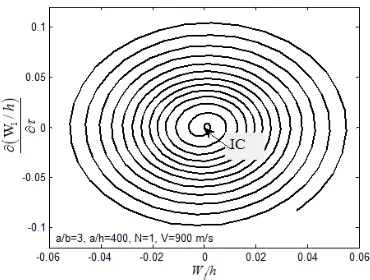
the instability phenomenon is evident in this phase diagram. It is observed that the phase diagram is found as a spiral schema derived from the IC (Initial Cycle) at
(
t=0)
(Fig.7), the IC is the top ofspiral, then it expands with increasing amplitude (divergence phenomenon). This phase diagram of the plate corresponds to an unstable state.Fig. 7. Phase diagram at V =900m s/ . Fig. 8.Effect of volume fraction index on nonlinear
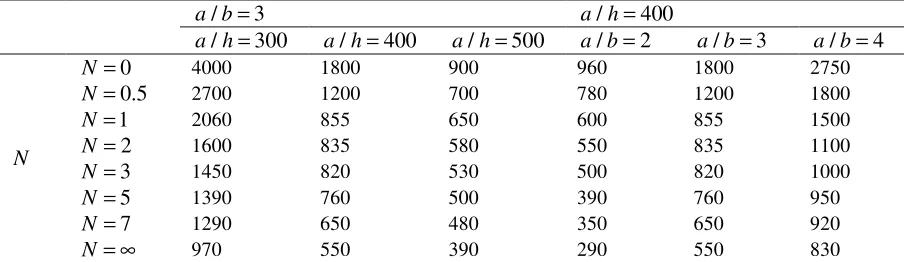
Effect of volume fraction index N on nonlinear flutter response of the FGM plate is shown in Fig. 8 and Tab. 1. As can see that increasing the volume fraction index N leads to reduce the critical
flutter velocity. This is clear because the elastic modulusof metal is much lower than that of creamic.
Table 1. Effect of the volume fraction index
( )
N and geometrical parameters on critical flutter velocity./ 3
a b= a h/ =400
/ 300
a h= a h/ =400 a h/ =500 a b/ =2 a b/ =3 a b/ =4 0
N = 4000 1800 900 960 1800 2750
0.5
N = 2700 1200 700 780 1200 1800
1
N = 2060 855 650 600 855 1500
2
N = 1600 835 580 550 835 1100
3
N = 1450 820 530 500 820 1000
5
N = 1390 760 500 390 760 950
7
N = 1290 650 480 350 650 920
N
N = ∞ 970 550 390 290 550 830
Figures 9, 10 and table 1show effect of geometrical parameters on nonlinear flutter response of FGM plate and critical flutter velocity
(
Vcritical)
.Fig. 9. Effect of a h/ ratio on nonlinear flutter response of FGM plate.
From the figure 9(a) finding that the ratio a h/ =300, /a h=400, /a h=500 respectively the velocity V =2060m s V/ , =1000m s V/ , =650m s/ ,the plate in the instable state (here is the critical velocity). In the case of a h/ =300with V =1000m s/ the plate is still in the steady state, increasing
2060 /
V = m s the plate turns into the instable state - figure 9(b). That shows the influence of ratio
/
a h on nonlinear flutter of FGM plate. Increasing the ratio a h/ will reduce the value of the flutter critical velocity
(
Vcritical)
, or make the plate more easily destroyed.The influence of the ratio a b/ on the nonlinear flutter of the plate is shown in figure 10. Figure 10(a) indicates that with the ratio a b/ =2, /a b=3, /a b=4 respectively the velocities
600 / , 1000 / , 1500 / ,
V = m s V = m s V = m s the plate is in the instable state (corresponding to the critical velocity). In the case of a b/ =4,V =1000m s/ the plate isstill in the steady state, increasing
1500 /
V = m s the plate turns into the instable state (Fig.10(b)). That shows the influence of the ratio
/
a b on the nonlinear flutter of the FGM plate. Consequently, increasing the ratio a b/ , the value of the critical velocity flutter
(
Vcritical)
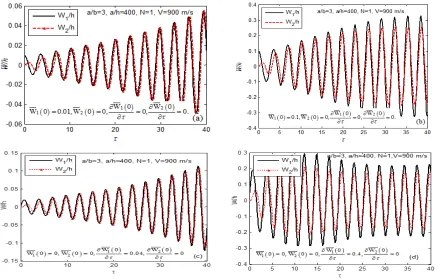
will increase.The influence of initial conditions on the nonlinear flutter is shown in figure 11. The results show that the different initial conditions lead to meet the nonlinear dynamic flutter and the different critical velocities.
Fig. 11. Effect of initial conditions on nonlinear flutter response of FGM plate.
The results in figure 11(a) and 11(b) present the effect of initial deflectionW (0) on nonlinear 1
Figure 11(c) is drawn with the value of the initial condition
( )
( )
1( )
2( )
1 2
0 0
0 0, 0 0, W 0.04, W 0
W W
τ τ
∂ ∂
= = = =
∂ ∂ the plate is in the instable state while figure 11(d) is
drawn to the initial condition
( )
( )
1( )
2( )
1 2
0 0
0 0, 0 0, W 0.4, W 0
W W
τ τ
∂ ∂
= = = =
∂ ∂ the plate is still in the
steady state. The figures 11(c) and 11(d) show significantly the effects of initial velocity on nonlinear flutter of the plate. Therefore, the velocity is one of the important factors which can be used to activly control the flutter of the FGM plates
4. Conclusions
The paper obtained some main results as the following
(i) The nonlinear governing equations for flutter analysis of FGM plates lying in the moving supersonic airflow based on the classical plate theory and the Ilyushin nonlinear aerodynamic theory are derived.
(ii) Using the stress function, the Galerkin method and an approximate two-terms Fourier expansion solution, the nonlinear differential auto-oscillation equations are solved for analysing supersonic flutter characteristics of FGM plates.
(iii) From numerical results, we can conclude that:
- The volume fraction index N increases, i.e. the ceramic material constituent decreases, then the critical velocity of the supersonic airflow decreases, the FGM plate is more easily instable.
- The goemetrical parameters importanly impact on the flutter of the FGM plates. Ratio /
a bincreases, the critical velocity of flutter increases and ratio a h/ increases, the critical velocity of flutter decreases.
- Initial conditions significantly effect on the nonlinear flutter response and the critical velocity of the FGM plate.
Acknowledgements
This paper was supported by Grant in Mechanics “Nonlinear analysis on stability and dynamics of functionally graded shells with special shapes”- code QG.14.02 of Vietnam National University, Hanoi. The authors are grateful for this support.
References
[2] M.K. Singha, Mukul Mandal, Supersonic flutter characteristics of composite cylindrical panels, J. Composite Structure, 82, 295-301, 2008.
[3] R.L. Ramkumar, T.A. Weisshaar, Flutter of flat rectangular anisotropic plate in high mach number supersonic flow, J. of Sound and Vibration, 50(4), 587-597, 1977.
[4] T. Prakash, M.K. Singha, M. Ganapathi, A finite element study on the large amplitude flexural vibration characteristics of FGM plates under aerodynamic load,International Journal of Non-Linear Mechanics, 47, 439-447, 2012.
[5] M. Ganapathi, M. Touratier, Supersonic flutter analysis of thermally stressed laminated composite flat panels, J. Composite Structures, 34, 241-248, 1996.
[6] M.A. Kouchakzadeh, M. Rasekh, H. Haddadpour, Panel flutter analysis of general laminated composite plates, J. Composite Structure, 92, 2906-2915, 2010.
[7] Maloy K. Shingha, M. Ganapathi, A parametric study on supersonic flutter behavior of laminated composite skew flat panels, J. Composite Structures, 69, 55-63, 2005.
[8] T. Prakash, M. Ganapathi, Supersonic flutter characteristics of functionally graded flat panels including thermal effects, J. Composite Structures, 72, 10-18, 2016.
[9] H. Haddadpour, S. Mahmoudkhani, H.M. Navazi, Supersonic flutter prediction of functionally graded cylindrical, J. Composite Structures, 83, 391-398, 2008.
[10] Navid Valizadeh, Sundararajan Natarajan, Octavio A. Gonzalez-Estrada, Timon Rabczuk, Tinh Quoc Bui, Stephane P.A. Bordas, NURBS-based finite element analysis of functionally graded plates: Static bending, vibration, buckling and flutter, J. Composite Structures, 99, 309-326, 2013.
[11] S. Mahmoudkhani, H. Haddadpour, H.M. Navazi, Supersonic flutter prediction of functionally graded conical shells, J. Composite Structure, 92, 377-386, 2010.
[12] Shih-Yao Kuo, Flutter of rectangular composite plates with varible fiber pacing, J. Composite Structure, 93, 2533-2540, 2011.
[13] A.A. Ilyushin, The law of plane cross sections in supersonicaerodynamics, J. of Applied Mathematics and Mechanics, 20 (6) (1956),(in Russian) .
[14] R.D. Stepanov. On the flutter problem of plates. Machinery and equipment. 2 (1960), (in Russian).
[15] P.M. Oghibalov, Problems of dynamics and stability of shells. Moscow University Press (1963), 164-174, (in Russian).
[16] J.N. Reddy, Mechanics of laminated composite plates and shells: theory and analysis. Boca Raton: CRC Press, (2004).