Measuring the Maturity Level of Core System Development Project in
a Financial Company Using CMMI-DEV
Kukuh Prasetyo
Business Information System, Gunadarma University, Jakarta Indonesia
ABSTRACT
The purpose of this study was to measure the maturity of the application development process in a finance company using CMMI For Development V 1.3, analyse and identify things that need to be considered by the organisation to improve the application development process. The method used in this study is qualitative by defining problems, collecting data by observation, interviews, and documentation studies and then analysing the process areas within the organisation with CMMI standards. The result of this measurement is the maturity level of the application development process in the organisation and process areas that require improvement. The conclusion shows the level of maturity for the organisation is level 1 because there are several specific objectives in the process area that have not been fulfilled so that it requires commitment from management and all stakeholders in the improvement process (LAS).
Keywords: CMMI For Development, Software Development, Finance Company.
1. INTRODUCTION
Implementation of information technology is an investment with targets generate efficiency from a competitive side between business competitors. This research source is a leading finance company in Indonesia that has an extensive range, finance companies related to managing financing for motor vehicles, electronic goods and household appliances. Finance-related companies are required to be able to improve the process within the organisation to be more effective and efficient, one of which is the core system which is able to become a media in helping and facilitating the business process of the company. The development process for core systems in finance companies is still facing problems such as inconsistencies in implementation, the same mistakes repeatedly occur, lack of detailed design, lack of control of documents, lack of control over the source code and others. These constraints have an impact on the results of the software system performance and the timeliness of the completion of software system development
projects so that this will affect the company's business performance and processes. Judging from the problems faced by related finance companies, the framework model that can be used to measure the quality of the software system development process is the CMMI (Capability Maturity Model Integration). It is expected that by applying CMMI, all the processes that occur in the development of core systems in finance companies become more standardized so that the constraints that arise in the development process of the core system can be minimised and can improve the effectiveness and efficiency of existing methods.
2. BASIC THEORY
2.1 Capability Mature Model Integration (CMMI)
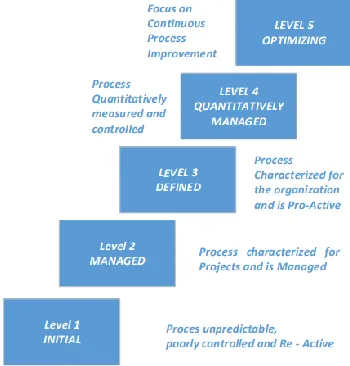
CMMI plays a variety of roles, a process development approach, a way to describe the characteristics of an active process, a set of essential elements of an effective method for one or more knowledge, a CMM process that assists in the definition and understanding of organisational processes. CMMI consists of five maturity levels, namely Initial, Managed, Defined, Quantitatively Managed, and Optimizing.
2.2 Five Maturity Levels (Five Maturity Levels)
CMMI consists of five maturity levels, namely Initial, Managed, Defined, Quantitatively Managed, and Optimizing.
Initial Stage (Level 1)
At maturity level 1, the process is usually ad-hoc and chaotic. Organisations typically do not provide a stable environment to support the process.
Managed Stage.(Level 2)
correctly and the operations that have been carried out have been planned, measured and controlled.
Stage Defined (Level 3)
At this stage, processes have been well characterised and understood, and are explained by the standards, procedures, tools and methods available. The collection of standard operations of the organisation, which is the basis of maturity level 3, is established and improved over time. These conventional processes are used to build consistency within the organisation.
Quantitatively Managed Stage (Level 4)
At maturity level 4, organisations and projects build quantitative goals for process quality and performance and use them as criteria for process management.
Optimising Stage (Level 5)
At this stage, an organisation continually improves its processes based on the quantitative understanding of the common causes of process variation.
Fig. 1. Five CMMI Maturity Levels.
3. RESEARCH METHOD
The research procedure is a general description to guide the writer in conducting research. The method of this study includes several stages described as follows:
Fig. 2. Research Framework.
In measuring the maturity of the application development process using CMMI for development v 1.3 at a finance company, there are several stages of activities starting from the problem definition, determining the CMMI presentation method, identifying the project sample, measuring the process maturity level with CMMI and the SCAMPI method, analysis and identification measurement results for the purpose of improvement by the organization in order to improve the application development process and discuss the results of the research conducted.
4. DISCUSSION
4.1 Determination of Project Samples
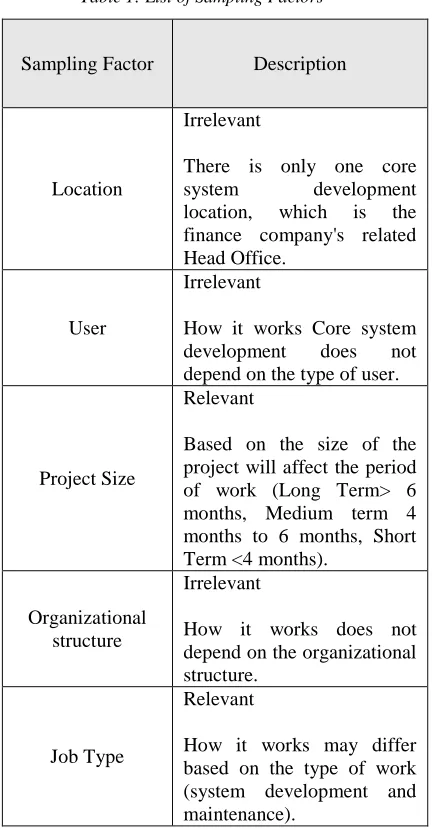
Table 1: List of Sampling Factors
Sampling Factor Description
Location
Irrelevant
There is only one core
system development
location, which is the finance company's related Head Office.
User
Irrelevant
How it works Core system development does not depend on the type of user.
Project Size
Relevant
Based on the size of the project will affect the period of work (Long Term> 6 months, Medium term 4 months to 6 months, Short Term <4 months).
Organizational structure
Irrelevant
How it works does not depend on the organizational structure.
Job Type
Relevant
How it works may differ based on the type of work (system development and maintenance).
4.2 Mapping Projects with Sampling Factor
After the sampling of the relevant factors is known, the project mapping can then be carried out on the sampling of the relevant factors. When the research was conducted, there were 25 projects (September-December) in the development process by the company. The results of the identification analysis of subgroups are shown in the following table:
Table 2: Subgroup based on Sampeling Factor
Zise Job Type Project
Long-term System Development 4
Long-term Maintenance 6
Short-term System Development 8
Short-term Maintenance 7
For details of calculating the number of project samples from the four subgroups, can be seen in the following table:
Table 3: Subgroups and Number of Samples
Subgroups Number of Projects in subgroups (units) Calculatio n Results from the formula (Decimal) Number of Projects for samples (unit) Long Term
Application Developmen t 4 (4x4)/25= 0,64 1 Long-term,
Maintenance 6 (4x6)/25=
0,8 1 Short-term, Driving Application 8 (4x8)/25= 1,28 1 Short-term.
Maintenance 7 (4x7)/25=
1,12 1
4.3 Process Overview
Fig. 3. System Development Process.
4.3 Analysis and Identification of Measurement
Results
Based on the measurement of the application development process on level 2 maturity and level 3 maturity, the results can be seen in the following table:
Table 4: Area Process Measurement Results
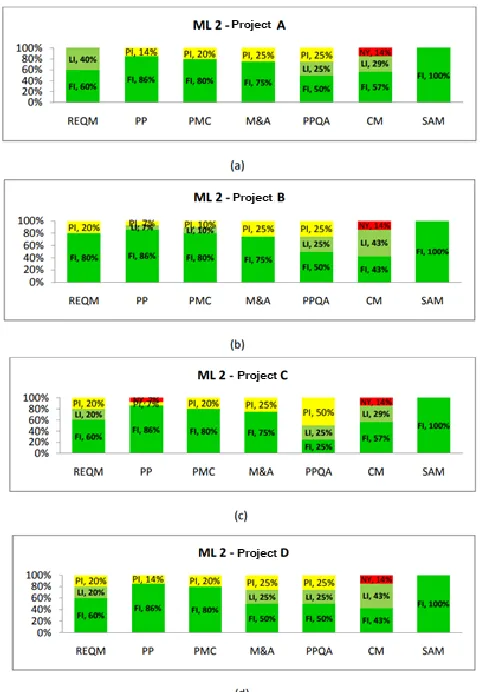
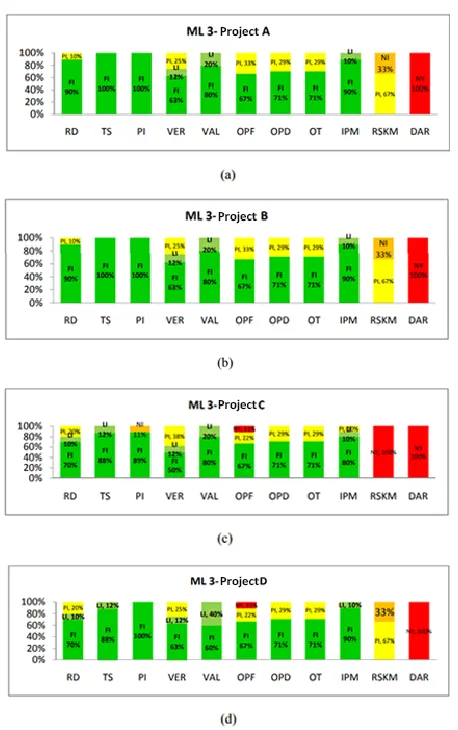
The measurement results obtained above are converted to per cent by dividing the Specific practices according to the SCAMPI criteria received by the specific number of methods in the CMMI area process, then multiplied by 100%. The converted results to per cent are shown in the graph which can be seen in Figure 4 which is the result of the measurement of level 2 maturity and figure 5 which is the result of maturity level 3 measurement. The results of the four measurements until the project development of the related finance company core system can be seen in the following figure:
Fig. 4. Measurement Results on Maturity Level 2.
Fig. 5. Measurement Results on Maturity Level 3.
Measurement results on Maturity Level 3 also indicate that there is still a need for improvements in the RD, TS, VER, VAL, OPF, OPD, OT, IPM, RSKM, DAR areas. The lack of management of risk management plans and changing needs is a weakness in the Requirement Development (RD) process area. In projects A and B the process area of TS and PI has gone well with the implementation of each specific practice. In the VER process area, it is necessary to improve the management of the verification work environment documentation, and periodically review each work product. Management of organisational assets in the Knowledge Management System is also a weakness so that specific practices in the OPF, OPD, OT process areas cannot work correctly. Whereas for the RSKM process area in each project A, B, C, D has a significant weakness related to the management and development of risk management and for the DAR process area requires more attention because each specific practice has not been implemented both in projects A, B, C, and D.
5. CONCLUSIONS
Based on the results of measuring the core system development process in a finance company, the following conclusions can be drawn:
1. Maturity levels for the Core Development Project process in related finance companies are level 1 because there are several specific objectives in level 2 and 3 areas that have not been fulfilled.
2. CMMI for Development v 1.3 can identify things that need to be improved by the finance company involved in the core system development process. In this measurement, there are 17 process areas from 18 process areas on Maturity Level 2 & 3 that still need improvement
3. To correct weaknesses in the core system development process in finance companies related to the following steps must be taken:
Require commitment from management and all stakeholders in the improvement process.
It is necessary to prioritise the improvement of the Risk Management process and Decision Analysis and Resolution at level 3 which can be started along with the specific fulfilment of practices that are lacking in other process areas.
Measuring Using CMMI for
DEVELOPMENT V1.3 periodically to find out Maturity Level after process improvement.
REFERENCES
[1]Chrissis, Mary Beth, Mike Konrad, dan Sandy Shrum. (2011). CMMI for Development Third Edition. Addison-Wesley Professional.
[2]CMMI Product Team. (2011). CMMI for Development, Version 1.3. Carnegie Mellon.
[3]John Dooley.(2011). Software Development and Professional Practice 1st editon.
[4]Satrio, S., & Lumban, G. F. (2014). Measurement of Capability Maturity Model Integration Implementation Impact for Application Development Process Improvement in Telkomsigma. International Journal of Software Engineering and Its Applications Vol.8, No.9, , 103-124.
[5]SCAMPI Upgrade Team. (2011). Standard CMMI® Appraisal Method forProcess Improvement (SCAMPISM) A,Version 1.3: Method Definition Document. Carnegie Mellon.
Software Engineering and Applications, 2012, 5, 777-788.
[7]Rastogi, P., & Jatain, A. (2015). Mapping of a Software Maintenance Project to CMMI Model: An Industrial Perspective. International Conference on ―Computing for Sustainable Global Development , 4311-4314. [8]Weiliang Zhou dan Yaping Li. (2012). Research on