© Global Society of Scientific Research and Researchers
http://ijcjournal.org/
A Survey on Obstacles Avoidance Mobile Robot in Static
Unknown Environment
A. shitsukane
a*, W. Cheriuyot
b, C. Otieno
c, M. Mvurya
da,b,cJKUAT , P.O. Box 62,000 – 00200 Nairobi, Kenya
dTUM, P.O.Box 90420-80100, Mombasa , Kenya
aEmail: [email protected]
bEmail: [email protected]
cEmail: [email protected]
dEmail: [email protected]
Abstract
Autonomous mobile robots have in recent times gained interest from many researchers. This is due to wide
range of mobile robot application. Numerous robots especially in navigation, obstacle avoidance and path
following are currently under development. A reliable collision avoidance methodology is needed for effective
navigation. Normally robots are fitted with transducers such as ultrasonic sensors, infrared and cameras for
detecting environment. Various methods have been established in the past years to resolve navigational
problems associated with mobile robots. They include fuzzy logic, potential fields, genetic algorithm, neural
network and vision base approaches. Fuzzy logic demonstrates to be an appropriate tool for handling uncertainty
that emerge from imprecise knowledge during route finding.
Keywords: Mobile robot; Obstacle avoidance; Static environment; Autonomous navigation.
1.Introduction
Autonomous robot navigation constitutes one of the major trends in robotics research. This is inspired by
existing gap between available technology and new application demands. Existing industrial robots have low
flexibility and autonomy: normally, these robots implement pre-programmed sequences of procedures in highly
controlled environments, and are not able to function in new situations or to face unpredicted states. Studies and
applications by means of non-analytical techniques of computing e.g.
---
fuzzy logic, neural networks and evolutionary computation paradigms have confirmed to be effective and
potential for smart control of composite systems. Specifically, fuzzy logic has demonstrated to be an appropriate
tool for handling uncertainty and knowledge representation [1, 2,3]. A clear market is emerging for strictly
autonomous robots. Potential applications include service robots that are intelligent for offices, factory floors
and hospitals; robots operating in hazardous or areas that cannot be accessed easily; domestic robots for
housework or entertainment and semi-autonomous vehicles to support disabled people in the society. However,
the biggest challenge is path finding and motion control. Path planning can be categorized into global and local
planning methods [4]. In global planning technique, the mobile robot prerequisite is that environment should be
entirely known and stationary. Contrary local path planning robot need the surroundings to be partly known or
totally unknown. The autonomous robot make use of received sensory information in the course of its local
navigation [5]. Set of actions are activated to make wanted performance [6]. Robot navigation methods can also
be classified as model based method [7,8],fuzzy logic based method [9,10, 1] and reactive method based on
neural networks [11, 12].
2.Related studies
Obstacle avoidance robot has been a subject of attention for decades; numerous algorithms have been suggested
to tackle this challenging issue. This section discus literature related to obstacle avoidance robot in static
unknown environment.
2.1. Approaches of robot navigation and obstacle avoidance
Various methods have been established in the past years to resolve navigational problems associated with
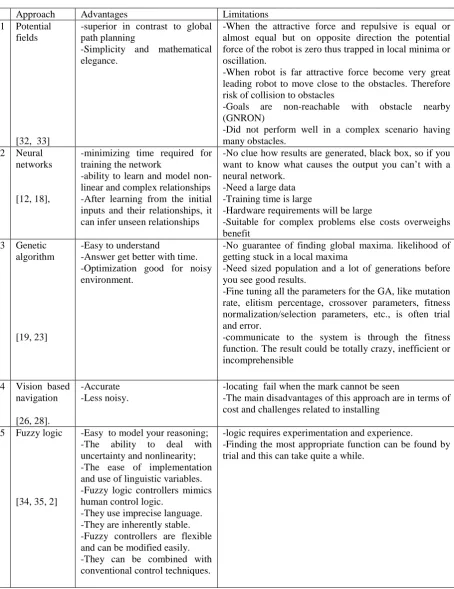
mobile robots, comparison matrix is shown in table 1. More researchers are keen to develop novel efficient
techniques that can offer smooth and ideal collision free path. Different methodologies for navigation and
obstacle avoidance are reviewed next.
2.1.1. Potential fields based
Potential fields’ method has been appreciated for many years among researchers as one of capable technique in
controlling mobile autonomous robot. Studies proposed potential field methods for navigation of mobile robot
putting forward essential limitations of the robot [13]. They explained that potential field technique can be used
elegantly and easily for navigation of autonomous robot. Comparison between theoretical and experimental
results of their proposed method was presented for evaluation. It showed that the method was positive though it
could not efficiently deal with environmental ambiguity.
Numerical potential field technique for route planning in robotics was discussed [14]. In the study they
explained that the method was superior in contrast to global path planning technique since a global path planner
needed additional computational time. This algorithm solved a variety of path planning problems.
Artificial potential field integrating fuzzy logic was proposed as an efficient approach for mobile robot
techniques into a common control scheme improved performance of resultant hybrid controller. An
omnidirectional mobile robot was designed to validate efficacy of the proposed control system. However, this
paradigm did not perform well in a complex scenario having many obstacles.
A multi objective optimization problem was modeled for an autonomous robot navigation based on three
objectives, reducing distance to the goal, maximizing distance between robot and obstacle that was nearer, and
maximization of travelled distance. The concept was simulated by three altered obstacles alignments and 10
routes of diverse nature to demonstrate robustness and capability [15].
Sumo, a direction finding robot in dynamic environments with moving targets and static obstacles was presented
[16]. Potential field method was used aimed at planning velocity and robot direction to reach target within
shortest possible time. They designed a hybrid controller making use of potential field with mamdani fuzzy
logic to acquire essential variables for defining velocity and direction. In validating performance simulations
were done using MATLAB. Results exposed that hybrid technique overcame local minima difficult in static or
dynamic environment. In a similar manner [18] potential functions for path planning of mobile robot were used
in different environments. The major drawback was existence of local minima. The technique only considered
immediate best course of action, thus robot got stuck in a local minimum of the potential field function rather
than heading towards the global minimum. When the robot is far away, attractive force become very great
leading robot to move too close to the obstacles. Therefore risk of collision to obstacles.
2.1.2. Neural networks
Many researchers have used artificial neural network (ANN) method for path finding in mobile robot
navigation. Studies in [12] employed ANN to prototype a complex relationship involving inputs and outputs of
a controller. They proposed a common method to infer data from several types of two dimensional distance
sensors and a neural network set of rules to carry out navigation task. The approach was applied on different
types of range sensors and robot platforms. The method contributed significantly in minimizing time required
for training the network.
A combination of fuzzy logic and spiking neural networks approach in solving difficulties of navigation in
known environment was presented [13]. Simulation results demonstrated challenges in implementing hybrid
design for robots working together.
Radial basis function neural compensator for autonomous mobile robot finding direction was implemented [14].
They used kinematic inverse dynamic controller for their proposed study. They claimed that their adaptive
controller was efficient enough in terms of tracking. Demonstrations validated results through various
navigational exercises.
Indirect adaptive tracking control of a non-holonomic mobile robot using neural network was presented [15].
Controller performance was verified using simulation results that showed inconsistency in obstacle avoidance.
trajectory which the leader generated and follower robot tracked [16]. Authors [17]. Research on reactive
anti-collision scheme of surface vehicle using neural network. This study described the architecture of neural
autonomous surface vehicle for tracking while avoiding collision as reliable for known environment.
Q-learning and neural network algorithm for static and dynamic obstacle avoidance motivated by high
computational time of traditional methods was proposed [18], their work enabled effective navigation of
a mobile robot with adjustable speeds while avoiding local minima. They presented a navigation mobile robot
steering in both static and dynamic obstacles, their results showed a mobile robot collision free trajectory with
uncertain workspace using neural networks. This method had disadvantage of being computationally intensive
and would require very powerful processors for practical applications.
2.1.3. Genetic algorithm based approach
Genetic algorithm (GA) is an evolutionary method, grounded on standard of natural selection and survival of the
fittest, it has been broadly put in use in various fields of science and research. GA is a search based algorithm
that attempts to find suitable individual by evolution of the original population. The greatness of GA lies in the
capability to handle nonlinear and complex multi objective problems [19]. Major disadvantages of this
algorithm are fast convergence and need for a large number of evolutions in order to reach a global solution.
In research of a knowledge based genetic algorithm for path planning of mobile robot a wheeled mobile obstacle
avoidance robot presented [20]. Similarly in study “Path Planning for Robot Navigation Based on Cooperative
Genetic Optimization” [21] proposed shortest path obstacle avoidance with computation efficiency using
cooperative genetics algorithm to mitigate collusion problems. The robot successfully avoided obstacle but too
much time was spend on training the model.
Path planning in static environment algorithm was presented in the study by [22].They experimented on using
GA in handling different types of tasks in static environments. Results showed that the proposed approach was
effective and efficient but lacked consistency.
A Motion Planning System for Mobile Robots using GA to find achievable path for mobile robot in
surroundings which had obstacles was proposed [23]. They implemented grid based environment prototype used
in indoor applications. The major drawback was need for a large number of evolutions to get solution.
Study developed improved genetic algorithm instead of a conventional genetic algorithm for global path
planning of multiple mobile robots. The advantages of the improved genetic algorithm was capability of guide
the mobile robots efficiently from the starting node to end node without any collision in the environment. [24]
A method of mobile robot route planning based on modified genetic algorithm to discover a viable path for a
mobile robot in dynamic environment was explained [25]. Simulation results demonstrated that the proposed
method achieved considerable improvements in comparison to basic GA
A novel vision based texture tracking method to guide autonomous vehicles in agricultural fields was presented
to perform various tasks on the farm. Evaluated results applauded this as a novel model [26]. A framework for
avoiding dynamic obstacles in the course of visual navigation using a mobile robot with wheels was designed
and validated [27]. Steering entailed following a pathway, characterized as an ordered set of significant pictures
captured by on-board camera in a training stage. The robot was capable to avoid stationary and dynamic
obstacles even those that were absent in teaching phase. The approach took explicitly into account velocity of
obstacles projected using Kalman-based observer. Velocities were used to predict positions of
obstacles.Machine vision centered obstacle avoidance method for robot by means of a camera was presented, it
accomplished obstacle escaping and path scheduling. The assembly of this system used a camera and two laser
projectors secured on the base. When robot got into strange environment, it stopped and captured images. The
system used simple image processing steps to distinguish obstacles [28].Work by [29] illustrated representation
and implementation of genuine methodology in scheme of planning path for a travelling robot using vision
devices. They gave various exercises that demonstrated usefulness of the technique. Studies by [30]proposed a
hybrid paradigm using visual potential field method for the robot navigation. In comparison with simple vision
based algorithm, performance demonstrated the capability of robot avoiding obstacle in complex environment.
The main disadvantage was need of keeping obstacles within the vision sensors region. In order to improve
coverage and reliability multiple cameras were to be installed. Finally, the cost of equipping mobile robot with
high performance navigation hardware was high.
2.1.5. Fuzzy logic based approach
Fuzzy logic uses extraordinary reasoning capability like a human being for making decision. The next section
give a review of prior work that relates to mobile robot navigation in previous decades.
Fuzzy Logic is an instrument for modelling ambiguous systems decision making by allowing common sense
reasoning in deficiency of detailed and precise information. It allows coming up with a confident deduction
using input data that is ambiguous, indeterminate, vague and noisy [31].
Table 1 highlight advantages and disadvantages of various methodologies. Based on above classification, fuzzy
logic model reacts swiftly and is good in dealing with sensor measurement errors. Robot response in fuzzy logic
is obtained from the quality of controller and inference type. Fuzzy logic demonstrates to be a suitable tool for
management of ambiguity that emerge from imprecise knowledge including measurement, process, model and
implementation uncertainty[36, 37, 38].
There are three categories of Fuzzy Logic techniques namely Tsukamoto, Takagi Sugeno Kang (TSK) and
Mamdani fuzzy inference systems. Comparison performance of TSK and Mamdani Fuzzy Logic models
evaluating performance of obstacle avoidance robot in navigation was done.
The controllers were simulated using MATLAB Fuzzy Logic toolbox. Performance was centered on smoothness
of motion created by controllers and memory consumed for application. Results demonstrates mamdani as a
reactive approaches which can be used for online path planning. Fuzzy logic controllers have emerged suitable
for mobile robot because of robustness and ability to handle uncertainties.
Table 1: Comparison of obstacle avoidance approaches
Approach Advantages Limitations
1 Potential fields
[32, 33]
-superior in contrast to global path planning
-Simplicity and mathematical elegance.
-When the attractive force and repulsive is equal or almost equal but on opposite direction the potential force of the robot is zero thus trapped in local minima or oscillation.
-When robot is far attractive force become very great leading robot to move close to the obstacles. Therefore risk of collision to obstacles
-Goals are non-reachable with obstacle nearby (GNRON)
-Did not perform well in a complex scenario having many obstacles.
2 Neural networks
[12, 18],
-minimizing time required for training the network
-ability to learn and model non-linear and complex relationships -After learning from the initial inputs and their relationships, it can infer unseen relationships
-No clue how results are generated, black box, so if you want to know what causes the output you can’t with a neural network.
-Need a large data -Training time is large
-Hardware requirements will be large
-Suitable for complex problems else costs overweighs benefit
3 Genetic algorithm
[19, 23]
-Easy to understand
-Answer get better with time. -Optimization good for noisy environment.
-No guarantee of finding global maxima. likelihood of getting stuck in a local maxima
-Need sized population and a lot of generations before you see good results.
-Fine tuning all the parameters for the GA, like mutation rate, elitism percentage, crossover parameters, fitness normalization/selection parameters, etc., is often trial and error.
-communicate to the system is through the fitness function. The result could be totally crazy, inefficient or incomprehensible
4 Vision based navigation
[26, 28].
-Accurate -Less noisy.
-locating fail when the mark cannot be seen
-The main disadvantages of this approach are in terms of cost and challenges related to installing
5 Fuzzy logic
[34, 35, 2]
-Easy to model your reasoning; -The ability to deal with uncertainty and nonlinearity; -The ease of implementation and use of linguistic variables. -Fuzzy logic controllers mimics human control logic.
-They use imprecise language. -They are inherently stable. -Fuzzy controllers are flexible and can be modified easily. -They can be combined with conventional control techniques.
-logic requires experimentation and experience.
3.Fuzzy logic system
The key features on Fuzzy logic base methods include construction of dynamic and smooth controllers
mechanisms starting with heuristic knowledge and qualitative models, unreliable, inaccurate vague information
and integrating symbolic reasoning with numeric processing [40]. The main components of fuzzy logic
controller are an inference engine and a set of linguistic IF- THEN rules that code actions of the mobile robot.
Major problem in making FLC is effective creation of fuzzy IF-THEN rules. Antecedent of a fuzzy rule base are
easy to produce , but a bit challenging to produce consequent parts without proficient knowledge in the rule
base [41]. Figure.1 shows a general fuzzy logic controller model.
Figure1: Fuzzy decision making controller
There are two connections between the fuzzy logic controller and the process under control, input and output
links. The inputs of FLC are interconnected to the process through sensors and the outputs are linked to the
process through actuators. The fuzzy logic controller consist of fuzzification, inference mechanism and
defuzzification which is achieved using information stored in the knowledge base [1,42,9,43].
3.1. Empirical evidence of fuzzy logics in mobile robots
Navigation systems for autonomous robots have got tremendous improvements using various artificial
intelligence techniques particularly fuzzy logic models [1].
In study of fuzzy logic approach for obstacle avoidance using arduino microcontroller board [44]. Authors
Utilized mobile platform and ultrasonic sensors mounted on a robot chassis, actuation was done by DC motors.
The robot was able to react to environment accordingly aided by gathered distance information. Same
methodology was demonstrated [34], however in their study ultrasonic sensors failed to detect some objects
examples were spheres and cylinders. The sonar sensor beam hit surface with oblique incidence and reflected
Subsequently similar work, was done using Sugeno weighted average method with assumption that the position
of the target and obstacles was known throughout the traverse [35].
Fuzzy logic control having a swarm of wheeled robot combined with wireless communication was designed [1].
Making use of a server for navigation and obstacle avoidance methods the mobile robot in an unknown active
environment intended to substitute workers in industrial setup. A swarm of mobile robots controlled wirelessly
were adopted. In comparison with line tracking currently used the wireless control was self-organizing flexible
and cost saving. Two fuzzy controllers were implemented, TFLC and OAFLC. There was need to investigate
delay time induced by wireless communication of the networked travelling robot.
In research on autonomous mobile robot in unknown environment, uncertainty caused by inaccuracy of sensors
are reflected in designing. The rules of the controller ought to be adjusted correctly to get better performance.
[2]
Study [32] used fuzzy logic to make a controller able for safe robot steering. The controller required information
about the robot features and performance in order to form its rule base that was stimulated from humanoid
capability in such scenario. A 153-fuzzy rule controller was used for Robot path following problem, while
additional fuzzy logic controller was used for Robot obstacle avoidance. Experimenting on MATLAB as a tool
for simulation the proposed fuzzy controllers was tested. Results demonstrated the idea as noble although the
system required large memory to implement the proposed rules.
In development of line following and efficient obstacle avoidance mobile robot in a static and dynamic
environment, fuzzy logic system was described. Various sensor and actuators were mounted on the robot for
detecting the surroundings and making verdicts consequently, heterogeneity of sensors provided not the same
accuracy and features. They suggested using multiple sensors mounted to improve design of the autonomous
mobile robot. Data fusion (complementary, redundant and cooperative) of sensor was used to improve
efficiency and robustness. E-puck robot was used with several sensors for monitoring the surrounding
environment.WEBOT simulator to model design and program the environments of the robot [43] .
Path planning module based on fuzzy logic for autonomous motion control was presented for reactive
navigation. The authors used stereo vision based modules to be able to maneuver complex unknown
environment. They adopted behavioral based control and every local navigational task was investigated in terms
of primitive performances. Using systematic style some fuzzy rules were omitted in critical situation in which
vision camera could intercede to unlock the mobile robot. The design control laws were experimentally tested
with success but had problems with inertia effect and they were focused on making an outdoor navigation in
unstructured and unknown terrain [37].
Research in guiding an autonomous robot in space of obstacles and improved path planning method that
involved image processing, path scheduling, cluster reduction and smoothing was employed. Fuzzy inference
was adopted to get collision free shortest distance condition. Robot performances and roles were made to
rough planned path. MATLAB simulation demonstrated the technique as successful and novel for obstacle
avoidance robot [45].
Type-2 fuzzy logic mobile robot control system was developed. Its sets were defined by membership functions
that were fuzzy and output processor of a type-2 fuzzy contained two components: type-reducer and defuzzifier.
To control the bearing of the mobile robot movement type-2 fuzzy logic controller processed output data. The
behavior was based on obstacle avoidance and corridor following. Results acquired demonstrated the
effectiveness of type-2 fuzzy logic controller and the capability to solving uncertainty problems [46]..
Obstacle avoidance robot was presented that utilized fuzzy logic controller. In the study, FLC was constructed
using sensorial data to control speed and turning angle. The result showed that fuzzy logic approach was
successfully applied to e-puck mobile robot to find safest path to the goal point. The e-puck mobile robot was
able to find the goal point successfully. The workspace environment was simulated by WEBOT Pro software
and surroundings consisted static obstacles [9].
Wheelchair that could avoid obstacle based on fuzzy controller and sonar sensors for the disabled and aged
people was proposed. The integration of ultrasonic sensors to avoid obstacle and fuzzy logic controllers to
generate speed for aiming the goal position was simulated using kinematics model of an electric wheelchair
board. An intelligent cooperative solutions concerning human and on-board programmed functions to drive
powered wheelchairs using fuzzy logic controller was commended [47] .
Mobile robot tracking straight and curved path controlled by fuzzy logic methodology was evaluated. Robot
velocity and steering angle were measured as controlled variables. Images of the path ahead was taken by
camera, vision system determined errors and necessary curvature path. Experimental results were encouraging
however in some occurrence the robot failed to maneuver curved path [48].
A study of hybrid approach based on multisensory information by fuzzy technique for navigation of autonomous
mobile robot to operate in real time with imprecise knowledge was presented. The mobile robot sent sensing
data via arduino board to control computer over wireless communication unit. The navigation improvements by
tuning fuzzy knowledge especially in extreme obstacle scenarios was demonstrated [49].
For the purpose of real time control methods [10] presented path control of autonomous mobile robot by means
of fuzzy logic enabled avoidance in static and dynamic obstacles. They critiqued mathematical methods that
require complex algorithm and large memory.
Researchers emphasized on implementation of human perception in mobile robot using fuzzy logic for collision
avoidance [50]. In industrial application it was projected to address the problem of path motion planning in
highly dynamic environment. On these grounds of human mind and its intelligent introducing perceptual
judgment, decision making to robots and giving them intelligence to overcome complex hurdles. They explained
the need of establishing a high efficiency rule set to avoid any collision.
in an environment was proposed. They deplored the tendency to use fuzzy logic algorithm for path tracking to
emulate human driving behavior. The method incorporated a fuzzy navigation paradigm, which controlled
piloting direction of the mobile robot for path tracking, and fuzzy velocity controller for advancing linear speed
of the mobile robot navigation. The inputs variables of the fuzzy system were generated by vision system of the
robot. A camera captured images of path ahead of the mobile robot. The vision scheme determined heading
error, lateral offset, and curvature of the path. Under these circumstances experiments on the robot as a
consequence successfully tracked the path showing the efficacy of the fuzzy steering controller on paths
containing curved sections [48].
4.Conclusion
A review of several investigations carried out on obstacles avoidance mobile robot in static unknown
environment revealed numerous approaches developed previously for path planning and control of mobile
robots. These approaches can be categorized either as global and local approaches or offline and online path
planning. In recent years, there has been a paradigm shift towards development of reactive approaches which
can be used for online path planning. Fuzzy logic controllers emerge as suitable for mobile robot navigation
because of robustness and ability to handle uncertainties.
5.Recommendation
Most studies on Fuzzy Logic Controllers for Obstacle Detection and Avoidance Robot are based on 3 input
sensors that result in sensors dead zone and difficulties in detecting some obstacles for optimum performance.
Uncertainty is caused by inaccuracy of sensors, tuning of the controller for better performance has got less
attention. We recommend Fuzzy logic controller for obstacle avoidance mobile robot and application of wider
detection angle to model and maintain uncertainties. Mamdani fuzzy Inference System controller that aggregate
sensor data from transducers for elimination of dead zone of sensors and revision of membership functions for
better performance is proposed as research area.
Acknowledgements
I would like to express my special appreciation and thanks to Catherine Dainty, Deylah, Daisy and Jairus
Wituka. Special thanks to my parents. God bless you all.
References
[1] M. Faisal, R. Hedjar, M. Al Sulaiman, and K. Al-Mutib, “Fuzzy logic navigation and obstacle
avoidance by a mobile robot in an unknown dynamic environment,” Int. J. Adv. Robot. Syst., vol. 10,
2013.
[2] R. Zhao, D. H. Lee, T. T. Li, and H. K. Lee, “Autonomous Navigation of a Mobile Robot in Unknown
[3] D. Wu, “Two differences between interval type-2 and type-1 fuzzy logic controllers: Adaptiveness and
novelty,” Stud. Fuzziness Soft Comput., vol. 301, pp. 33–48, 2013.
[4] A. Signifredi, B. Luca, A. Coati, J. S. Medina, and D. Molinari, “A General Purpose Approach for
Global and Local Path Planning Combination,” 2015 IEEE 18th Int. Conf. Intell. Transp. Syst., pp.
996–1001, 2015.
[5] U. Lee, S. Yoon, H. Shim, P. Vasseur, and C. Demonceaux, “Local path planning in a complex
environment for self-driving car,” 4th Annu. IEEE Int. Conf. Cyber Technol. Autom. Control Intell.,
pp. 445–450, 2014.
[6] M. Raulcezar and C. R. Lopes, “Obstacle avoidance for mobile robots: a Hybrid Intelligent System
based on Fuzzy Logic and Artificial Neural Network,” 2016 IEEE Int. Conf. Fuzzy Syst., pp. 1038–
1043, 2016.
[7] H. Maaref and C. Barret, “Sensor-based navigation of a mobile robot in an indoor environment,” Rob.
Auton. Syst., vol. 38, no. 1, pp. 1–18, 2002.
[8] S. S. Ge, S. Member, X. Lai, A. Al Mamun, and S. Member, “Planning Using Instant Goals,” vol. 35,
no. 2, pp. 240–254, 2005.
[9] S. H. A. Mohammad, M. A. Jeffril, and N. Sariff, “Mobile robot obstacle avoidance by using Fuzzy
Logic technique,” 2013 IEEE 3rd Int. Conf. Syst. Eng. Technol., pp. 331–335, 2013.
[10] H. Omrane, M. S. Masmoudi, and M. Masmoudi, “Fuzzy Logic Based Control for Autonomous
Mobile,” Comput. Intell. Neurosci., vol. 2016, pp. 1–10, 2016.
[11] N. Aamer and S. Ramachandran, “Neural Networks Based Addaptive Approach for Path Planning and
Obstacle Avoindance for Autonomous Mobile Robots (AMR),” Int. J. Reserach Comput. Appl. Robot.,
vol. 3, no. 12, pp. 66–79, 2015.
[12] S. H. Dezfoulian, D. Wu, and I. Ahmad, “A Generalized Neural Network Approach to Mobile Robot
Navigation and Obstacle Avoidance,” Intell. Auton. Syst. 12, vol. 193, pp. 25–42, 2013.
[13] Z. LAOUICI, M. Amine, and M. KHELFI, “Hybrid Method for the Navigation of Mobile Robot Using
Fuzzy Logic and Spiking Neural Networks,” no. November, pp. 1–9, 2014.
[14] F. G. Rossomando, C. Soria, and R. Carelli, “Adaptive neural dynamic compensator for mobile robots
in trajectory tracking control,” IEEE Lat. Am. Trans., vol. 9, no. 5, pp. 593–602, 2011.
[15] H. In, “Mobile Robot Trajectory Tracking Using Neural Networks,” no. December, 2009.
group of underactuated AUVs in horizontal plan,” Int. J. Control, vol. 87, no. 5, pp. 1076–1093, 2014.
[17] H. Eraqi, Y. EmadEldin, and M. Moustafa, “Reactive Collision Avoidance using Evolutionary Neural
Networks,” 2016.
[18] C. Wong, E. Yang, X. Yan, D. Gu, and W. Park, “Adaptive and Intelligent Navigation of Autonomous
Planetary Rovers – A Survey,” pp. 237–244, 2017.
[19] J. A. Herrera Ortiz, K. Rodrguez-Vázquez, M. A. Padilla Castaeda, and F. Arámbula Coso,
“Autonomous robot navigation based on the evolutionary multi-objective optimization of potential
fields,” Eng. Optim., vol. 45, no. 1, pp. 19–43, 2013.
[20] Yanrong Hu and S. X. Yang, “A knowledge based genetic algorithm for path planning of a mobile
robot,” IEEE Int. Conf. Robot. Autom. 2004. Proceedings. ICRA ’04. 2004, no. April, p. 4350–4355
Vol.5, 2004.
[21] Y. L. Hsu, Chen-chien, “Path Planning for Robot Navigation Based on Cooperative Genetic
Optimization,” 11th IEEE Int. Conf. Networking, Sens. Control, pp. 316–321, 2014.
[22] A.-T. Ismail, A. Sheta, and M. Al-Weshah, “A mobile robot path planning using genetic algorithm in
static environment,” J. Comput. Sci., vol. 4, no. 4, pp. 341–344, 2008.
[23] a. Tuncer, M. Yildirim, and K. Erkan, “A Motion Planning System for Mobile Robots,” Adv. Electr.
Comput. Eng., vol. 12, no. 1, pp. 57–62, 2012.
[24] F. Ahmed and K. Deb, “Multi-objective optimal path planning using elitist non-dominated sorting
genetic algorithms,” Soft Comput., vol. 17, no. 7, pp. 1283–1299, 2012.
[25] W. Yan-ping and W. Bing, “Robot path planning based on modified genetic algorithm,” 2010 2nd Int.
Conf. Futur. Comput. Commun., vol. 3, pp. V3-725-V3-728, 2010.
[26] A. English, P. Ross, D. Ball, and P. Corke, “Vision based guidance for robot navigation in agriculture,”
Proc. - IEEE Int. Conf. Robot. Autom., pp. 1693–1698, 2014.
[27] A. Cherubini, F. Spindler, and F. Chaumette, “Autonomous visual navigation and laser-based moving
obstacle avoidance,” IEEE Trans. Intell. Transp. Syst., vol. 15, no. 5, pp. 2101–2110, 2014.
[28] C. P. Tsai, C. T. Chuang, M. C. Lu, W. Y. Wang, S. F. Su, and S. L. Chang, “Machine-vision based
obstacle avoidance system for robot system,” ICSSE 2013 - IEEE Int. Conf. Syst. Sci. Eng. Proc., pp.
273–277, 2013.
[30] N. Ohnishi and A. Imiya, “Corridor navigation and obstacle avoidance using visual potential for mobile
robot,” Proc. - Fourth Can. Conf. Comput. Robot Vision, CRV 2007, pp. 131–138, 2007.
[31] B. Singh and A. K. Mishra, “Fuzzy Logic Control System and its Applications,” Int. Res. J. Eng.
Technol., vol. 2, no. 8, pp. 743–746, 2015.
[32] Carlos Erlan Olival Lima et al., “Velocity and direction planning in a sumo robot type using the
method of potential field with fuzzy systems,” 2013 16th Int. Conf. Adv. Robot., pp. 1–7, 2013.
[33] A. A. Ahmed, T. Y. Abdalla, and A. A. Abed, “Path Planning of Mobile Robot by using Modified
Optimized Potential Field Method,” Int. J. Comput. Appl., vol. 113, no. 4, pp. 6–10, 2015.
[34] X. Li and B. Choi, “Design of Obstacle Avoidance System for Mobile Robot using Fuzzy Logic
Systems,” Int. J. Smart Home, vol. 7, no. 3, pp. 321–328, 2013.
[35] S. Chaudhari and M. Patil, “Study and Review of Fuzzy Inference Systems for Decision Making and
Control,” pp. 88–92, 2014.
[36] J. Berisha, X. Bajrami, A. Shala, and R. Likaj, “Application of Fuzzy Logic Controller for obstacle
detection and avoidance on real autonomous mobile robot,” 2016 5th Mediterr. Conf. Embed. Comput.,
no. v, pp. 200–205, 2016.
[37] F. Abdessemed et al., “A hierarchical fuzzy control design for indoor mobile robot,” Int. J. Adv. Robot.
Syst., vol. 11, no. 1, 2014.
[38] A. Al-mayyahi and W. Wang, “07072684,” no. November, pp. 28–30, 2014.
[39] U. Farooq, K. M. Hasan, G. Abbas, and M. U. Asad, “Comparative analysis of zero order Sugeno and
Mamdani fuzzy logic controllers for obstacle avoidance behavior in mobile robot navigation,” Proc.
2011 Int. Conf. Work. Curr. Trends Inf. Technol. CTIT’11, pp. 113–119, 2011.
[40] I. Baturone, F. J. Moreno-Velo, V. Blanco, and J. Ferruz, “Design of embedded DSP-Based fuzzy
controllers for autonomous mobile robots,” IEEE Trans. Ind. Electron., vol. 55, no. 2, pp. 928–936,
2008.
[41] N. A. Korenevskiy, “Application of fuzzy logic for decision-making in medical expert systems,”
Biomed. Eng. (NY)., vol. 49, no. 1, pp. 33–35, 2015.
[42] W. A. S. Silva, R. A. L. Rabelo, and A. M. Santana, “Safe autonomous navigation with a
wall-following robot using interval Type-2 Fuzzy System in uncertain environments,” 2014 IEEE Int. Conf.
Syst. Man, Cybern., pp. 1222–1225, 2014.
integration of fuzzy logic system in static and dynamic environments .” In Proceedings of 2016 IEEE
Long Island Systems , Applications and Technology This material is posted here wit,” 2016.
[44] V. Yerubandi, Y. M. Reddy, and M. V. K. Reddy, “Navigation system for an autonomous robot using
fuzzy logic,” Int. J. Sci. Res. Publ., vol. 5, no. 2, pp. 5–8, 2015.
[45] K. Su and T. Phan, “Robot Path Planning and Smoothing Based on Fuzzy Inference,” 2014 IEEE Int.
Conf. Syst. Sci. ang Eng., 2014.
[46] P. Phokharatkul and S. Phaiboon, “Mobile robot control using type-2 fuzzy logic system,” Robot.
Autom. Mechatronics, 2004 IEEE Conf., vol. 1, pp. 296–299 vol.1, 2004.
[47] M. Njah and M. Jallouli, “Wheelchair Obstacle Avoidance based on Fuzzy Controller and Ultrasonic
Sensors,” IEEE Conf., 2013.
[48] E. Vans, G. Vachkov, and A. Sharma, “Vision Based Autonomous Path Tracking of a Mobile Robot
using Fuzzy Logic.”
[49] J. Lin, C. Y. Tasi, and K. H. Lin, “Hybrid Control Mode Based On Multi-Sensor Information by Fuzzy
Approach for Navigation Task of Autonomous Mobile Robot,” vol. 9, no. 4, pp. 438–445, 2015.
[50] B. K. Oleiwi, A. Mahfuz, and H. Roth, “Implementation of Human Perception in Mobile,” vol. 15, no.