Context-sensitive Access Control Model for
Business Processes
Goran Sladi´c, Branko Milosavljevi´c, and Zora Konjovi´c
Faculty of Technical Sciences, University of Novi Sad, Trg D. Obradovi´ca 6 21000 Novi Sad, Serbia
{sladicg, mbranko, ftn zora}@uns.ac.rs
Abstract. This paper focuses on problems of access control for business processes. The subject of the paper is a specification of the Context-sensitive access control model for business processes (COBAC). In order to efficiently define and enforce access control for different business pro-cesses, the COBAC model is based on the RBAC (Role-based Access Control) model which is extended with the following entities:context, busi-ness process,activityandresource category. By using a context-sensitive access control it is possible to define more complex access control poli-cies whose implementation by existing access control models for business processes is not possible or is very complicated. The COBAC’s context model can describe rich context information and can be easily extended for specific cases. The introduction of business process and activity en-tities has facilitated the definition of access control policies for business processes. The categorization of resources enables the definition of ac-cess control policies for whole resource categories, and thus, potentially, reduces the number of policies which need to be defined. The COBAC model is applicable in different business information systems, and sup-ports the definition of access control policies for both simple and complex business processes. The model is verified by a case study on a real busi-ness process.
Keywords:access control, RBAC, context-sensitive, workflow, business process.
1.
Introduction
Davenport and Short [14] define a business process as a set of logically related tasks performed to achieve a defined business outcome. The Workflow Refer-ence Model [26] extends the above definition by introducing the concept of a role, stating that a business process is a set of one or more linked procedures or activities that collectively realize a business objective or policy goal, normally within the context of an organizational structure which defines functional roles and relationships.
interchangeably; in this paper we will use them as synonyms. Workflow man-agement system (WfMS) is a system that completely defines, manages and executes workflows through the execution of software whose order of execu-tion is driven by a computer representaexecu-tion of the workflow logic [26]. Workflow management systems (WfMS) are widely used in enterprises to automate and facilitate their business processes. Because of the advantages of the workflow technology, many companies build their business on a WfMS platform. At the same time, the security is becoming more conspicuous. Secure workflows re-quire that only authorized users should be able to perform specific tasks. The set of authorized users is usually defined by the security policy of the workflow.
In the Role-based Access Control (RBAC) model, access to resources of a system is based on the role of a user in the system [17]. The basic RBAC model comprises the following entities:users,roles,permissionsandsessions, where permissions are composed ofoperationsapplied toobjects. In RBAC, permis-sions are associated to roles, and users are made members of roles [17]. A user’s interaction with the system is modeled by a session, where a user acti-vates a subset of the roles to which she/he is assigned. This greatly simplifies management of access rights, so the RBAC model has generated great interest in the security community. It is customary to use therole hierarchyto aggregate permissions, i.e. a role is assumed to inherit the permissions assigned to its parent roles in the hierarchy. In addition, the role hierarchy also determines the roles that are available to a user, i.e. a user assigned to a particular role can also activate any subordinate roles in the hierarchy.
information, while in the second case, extensions include wider range of context information in the access control decision.
The following features of a workflow access model should be included, in addition to standard ones, to successfully address different access control re-quirements:
– it should support access control at a task level,
– a user can have different privileges for different workflow instances, – during a time/workflow execution, a role can have different permissions, – during a time/workflow execution, different roles can be assigned or
unas-signed to a user, and
– assignment of roles to user and/or assignment of permissions to roles may depend on a context state (context information).
In this paper we propose the Context-sensitive access control model for
business processes(COBAC) that includes listed features. This model is based
on the RBAC model which is extended with the following entities:business
pro-cess, activity, context, andresource category. Our model is based on RBAC
because it simplifies role management and is the de facto access control model for commercial organizations. By using entitiesbusiness processandactivities in the model it is possible to efficiently define and enforce access control for differentbusiness processes(workflows). Since it is possible that access con-trol can be affected by different factors from the environment and the system, the COBAC model explicitly introduces the notion ofcontext.Categorizationof the resources enables the definition of access control policies for the whole resource category, and thus, potentially, reduces the number of policies which need to be defined.
The COBAC model is organized into two components: theCorecomponent defines core aspects of the model, and the Constraintcomponent introduces different constraints including static and dynamic separation of duties. In this paper we present theCorecomponent of the COBAC model.
The proof of concept for the proposed system is carried out through the implementation of a representative real-world case study – Employment pro-cedure for the Professor position at Faculty of Technical Sciences, University
of Novi Sad. While analyzing this business process we have identified some
of the security requirements that cannot be implemented using the standard RBAC model since implementation of those requirements depends on the enti-ties that are not part of RBAC. We have shown that it is possible to implement those requirements using the COBAC model.
2.
Related Work
In this section two groups of research are presented. The topic of the first group is research on RBAC-based access control models adopted for use in workflow systems. The second group reviews latest results on context-sensitive access control.
Many models for workflow access control are based on the RBAC model extended with the entity representing the workflow task.
Russello et al. [38] present Workflow-Based Access Control (WBAC), an ac-cess control mechanism that adapts the acac-cess rights of subjects to the actual tasks that they have to fulfill. The requirements of entities’ duties are expressed by means of workflows. WBAC ensures that entities can access the resources associated to a workflow task but only while such a task is active. The pa-per [54] introduces the TRBAC (Task-Role-Based Access Control) model which is based on RBAC and TBAC (Task-Based Access Control) [46] models. The TRBAC model is constructed by adding “Task” to the RBAC model. It’s cen-tral idea is that the user has a relationship with a permission through a role and a task. Permissions are assigned to tasks and tasks are assigned to roles. This model supports the task classification. The task can be classified accord-ing to the organization structure and characteristics of access control in enter-prise environment. They can be divided into two groups according to whether they belong to the workflow. Also, permissions can be divided into two groups: permissions on workflow tasks and permissions on workflow task instances. A similar model is presented by Oh and Park [35]. Their model is based on the classification of job functions. Three different types of tasks are identified:
workflow tasks used for workflow oriented job functions, non workflow tasks
Although the previously described access control models are extended for the use in workflow systems, they are not able to efficiently address all access control requirements that often occur in workflow systems, including those de-fined in Section 1. Therefore, the following researches, beside the notion of the taskintroduce some other concepts in their access control models to address some specific access control requirements.
A RBAC-based authorization workflow model which has a level request is proposed in [55]. The concept of the privilege in this model has the attributes of the time domain and the security level. It means that only in a certain period of time, a user with the security level greater than or equal to the security level of the privilege can implement some kind of operation. The proposed model could be used in the field that has the higher security requirements like mil-itary. Wainer et al. [50] propose a workflow access control model based on RBAC model extended with caseandorganization unit entities and appropri-ate relations. The entity caseis added to be able to refer to an instance of a process. Within organizations, and thus in workflow applications, the concept of a hierarchy of people/organizations is prevalent. While workflow systems as a rule include some form of organizational modeling capabilities, RBAC by itself does not have such a hierarchy modeled. Therefore, the RBAC model is ex-tended with theorganization unitentity. The importance of using an organiza-tion structure in workflow access control models is also noticed in [51]. Shafiq et al. [40] propose an architecture for the adaptive real-time workflow-based collaborative system. The authors indicate that a key security requirement for a real-time workflow system is to provide the right data to the right person at the right time. They use the Generalized Temporal Role-Based Access Control (GTRBAC) model [31] to capture the real-time dependencies of such workflow applications. Importance of the time factor in workflow access control models is also noticed in [21] [27] [56]. Leitner et al. [32] propose an extended RBAC model for adaptive workflow systems (AW-RBAC). This model enables workflow systems to enforce access control under all different kinds of workflow changes. Specifically, the AW-RBAC model enables the definition of permissions in order to perform authorized control and data flow changes, administrative modifica-tions and adaptamodifica-tions at the service level of a workflow system. In addition, access rights based on AW-RBAC can be specified in fine granularities based on the definition of constraints. Another research on access control for flexible workflows has been presented in [28]. It analyses how to realize the dynamic authorization relations of users, roles and permissions.
“Context is any information that can be used to characterize the situation of an entity. An entity is a person, place, or object that is considered relevant to the interaction between a user and an application, including the user and applications themselves”.
temporal constraints to access control is probably the most thoroughly analyzed in [4] [31], while the influence of geospatial constraints is presented in [5] [13].
By analyzing the previously mentioned access control models for workflows, we noticed that most of them are based on the RBAC model which is extended with some other concepts specific for business processes. Although the litera-ture recognizes a significant number of context-sensitive access control models, most workflow access control models only partially support context-sensitive access control, or do not support it at all. Most of models do not wholly sup-port all features, given in Section 1, identified as imsup-portant for workflow access control systems. COBAC, the model presented in this paper, has the following notable improvements over the aforementioned workflow access control mod-els:
– It is based on the RBAC model which is extended with the concept of busi-ness process and activity. By using the busibusi-ness process and the activity concepts it is possible to bind certain access control segments with activi-ties instead of binding them with the current session, and thus provide effi-cient definition of different policies and constraints in different business sys-tems. This ensures the independence of these segments from the number of sessions in which activities are executed. Since a business process can be viewed as an executing sequence of activities in our model, the roles are assigned to activities that they can execute, while the permissions (to ex-ecute operations on resources) needed for activity execution are assigned to the activity. Thus, efficient and fine-grained control of least privileges is achieved.
– The policies can be defined at the level of each specific process instance (activity instance) and thus satisfy different protection requirements that dif-ferent process instances may have. On the other hand, requiring the spec-ification of authorizations for each single process instance would make the authorization specification task too complex, therefore the COBAC model supports policy definition at the process (activity) definition level. The poli-cies defined at the process definition level will apply to all process instances. – Since the real-world business processes may have sophisticated access control requirements that depend on different factors from the environment, we extend the assignment relations in the COBAC model with the context-dependant condition and thus provide support for the context-sensitive ac-cess control. Also, we extend the notion of the role with the context infor-mation. In this way, the context can affects all segments of access control model.
– The proposed context model is developed using ontologies in order to de-scribe rich context information, to allow the semantic interoperability be-tween different context-aware systems and to be easily extended for spe-cific use cases.
3.
COBAC Model
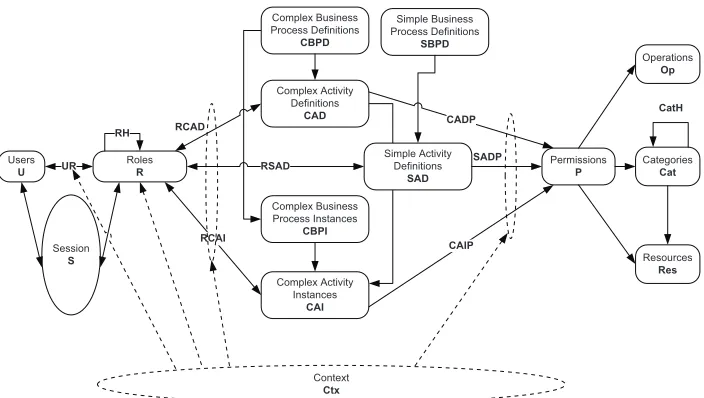
An overview of the basic concepts and their relations is presented in Figure 1. The solid lines are used to represent relations between the concepts, while the dashed lines are used to represent the influence of the context on the rela-tions/concepts. The given model is based on the standard RBAC model which is extended with the following concepts:business process,activity,contextand
resource category. In the proposed model the definition of the session is taken
from the standard RBAC model [17].
Users U
Roles R
Permissions P
Categories Cat
Resources Res Operations
Op Complex Business
Process Definitions CBPD
Complex Business Process Instances
CBPI
Simple Business Process Definitions
SBPD
Complex Activity Definitions
CAD
Simple Activity Definitions
SAD
Complex Activity Instances
CAI UR
RCAI RCAD
RSAD SADP
CADP
CAIP
CatH
Session S
Context Ctx RH
Fig. 1.The COBAC model
The reason for introducingbusiness process andactivityis to achieve the efficient use of the RBAC model in business processes, because certain ac-cess control aspects need to be defined for a particular proac-cess (definition or instance) or it’s activities (definition or instance). There are cases when a busi-ness process can be fully executed within a single user’s session, but there are also cases where the process execution is distributed across multiple users’ sessions. Therefore, it is necessary that an access control mechanism supports both of these cases.
We propose two types of business processes in the COBAC model: a
com-plex business processand asimple business process. A complex business
notification or create a report). A simple business process consists of only one activity. In the COBAC model activities are assigned to roles which are autho-rized to execute them. Although the use of two types of business processes may be inappropriate from the information security perspective since it can be viewed as unnecessary complexity, we decided to use this approach because of the model efficiency and the practical model implementation. Since simple busi-ness processes comprise a single activity, they do not require a workflow engine for execution and access control in this case can be optimized by omitting some steps and constraints verification which are necessary when the access control is performed for complex business processes.
Access control policies in the COBAC model can be defined for definitions and instances of business processes. If a policy is associated to a process defi-nition, it will be applied to all instances of that process, while policies associated to an instance will be applied only to that particular instance.
By analyzing different real-world business processes, we concluded that in the case of complex business processes it is necessary to support the process definition - CBPD (i.e. activity definition - CAD) and the process instance - CBPI (i.e. activity instance - CAI) level of policies, while in the case of simple business processes it is sufficient to support only policies at the process definition - SBPD (i.e. activity definition - SAD) level.
During an activity execution it may be necessary to access some resources. In order to execute an activity, proper permissions, required for the resources being accessed, must be assigned to that activity.
Since access control may be influenced by some other factors from a system and an environment, the COBAC model also includes the notion of acontext. By using context it is possible to define a context dependent constraint on as-signment relations and on a role activation. Thus, an asas-signment relation with such constraint will be established only if the context dependent constraint is fulfilled. A similar case applies to a role activation.
Electronic resource (primarily documents) categorization is a crucial and well-proven instrument for organizing large volumes of resources/information. By grouping too many discrete items into understandable categories, users can quickly eliminate what is irrelevant or not interesting, and just pay attention to what matters most [9] [10] [20] [44]. Therefore the COBAC model explicitly in-troduces resource category to support efficient access control administration by defining permissions not only at the level of resources but also on the level of categories (i.e. permission can be defined for theSentencecategory, or for
theSentence for Minorsubcategory, or for the concrete judgment document).
The COBAC model is independent of the categorization process. Resources may be classified according to their subjects or according to other metadata attributes (such as resource type, author, printing year etc.) using manual, au-tomatic or hybrid categorization process [10] [44]. The concrete installation can be adjusted to the existing resource categorization in the information system.
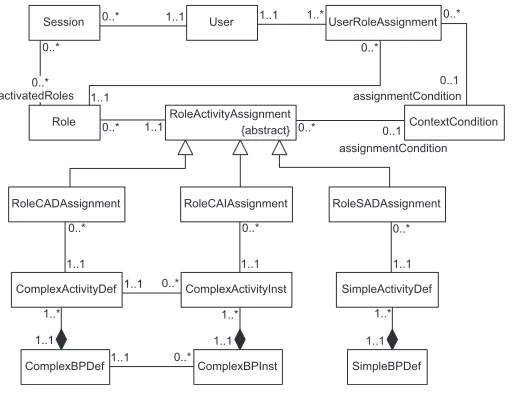
context condition (modeled with theContextConditionclass) is associated withUserRoleAssignment, then a role will be assigned to a user only if the condition is satisfied. The definitions of complex business processes are rep-resented by the ComplexBPDef class while complex process instances are represented by theComplexBPInstclass. The classComplexActivityDef
models complex activity definitions, while the class ComplexActivityInst
models complex activity instances.SympleBPDefandSimpleActivityDef
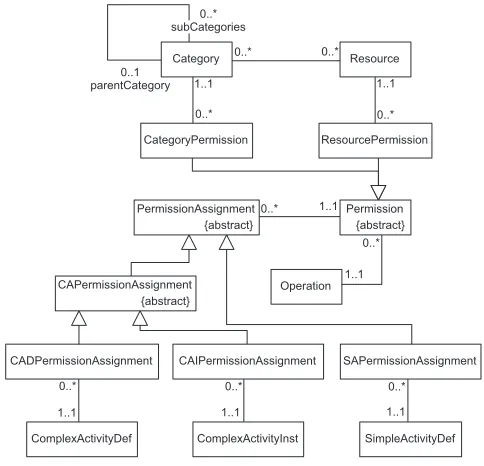
define simple business processes and simple activities. The assignments of ac-tivities to roles are modeled with theRoleActivityAssignment specializa-tions. Those assignment relations will be established only if the associated con-text conditions are satisfied. TheCategoryclass represents categories of re-sources that are modeled with theResourceclass. Operations executed on re-sources are defined using theOperationclass. A permission to execute a cer-tain operation can be defined at a resource and category level. The model de-fines permissions (Permission) for resources (ResourcePermission) and categories (CategoryPermission). A permission defined for a category ap-plies to all category’s resources and subcategories. The specializations of the
PermissionAssignmentclass represent assignments of privileges to activ-ities. The assignment of privileges to complex activities is defined using the
CAPermissionAssignment specializations (CADPermissionAssignment
and CAIPermissionAssignment), while the SAPermissionAssignment
class models assignment of permissions to simple activities.
1..1
0..* 0..* 0..1
assignmentCondition
0..*
1..1
0..*
1..1
0..*
1..1 1..1 1..*
1..1
0..*
0..*
0..1 assignmentCondition
1..1 1..*
1..1 1..*
1..1 1..*
1..1 0..*
1..1 0..*
0..* 1..1
0..*
0..* activatedRoles
ComplexActivityDef ComplexActivityInst SimpleActivityDef RoleActivityAssignment
{abstract}
RoleCADAssignment RoleCAIAssignment RoleSADAssignment
Role ContextCondition
User UserRoleAssignment
ComplexBPDef ComplexBPInst SimpleBPDef
Session
0..* 1..1
0..*
1..1 0..*
1..1 0..*
1..1
1..1 0..* 1..1
0..*
1..1
0..* 0..1
parentCategory 0..* subCategories
0..* 0..*
Permission {abstract}
ComplexActivityDef ComplexActivityInst SimpleActivityDef CAPermissionAssignment
{abstract}
SAPermissionAssignment PermissionAssignment
{abstract}
CADPermissionAssignment CAIPermissionAssignment Operation
Resource Category
CategoryPermission ResourcePermission
Fig. 3.Activity-permission assignment
In the rest of this section the complete description of the aforementioned models concepts is given. The basic terms used in the rest of the section are:
– U - set of users – R- set of roles
– S- set of users sessions
– CBP D- set of complex business process definitions – CAD- set of complex activities definitions
– CBP I- set of complex business processinstances – CAI- set of complex activities instances
– SBP D- set of simple business process definitions – SAD- set of simple activities definitions
– P- set of permissions – Op- set of operations – Res- set of resources – Cat- set of categories – C- set of constraints – Ctx- context
– CC- set of context conditions
3.1. The Model of Context
sup-ports rich representation of different contextual information. Second, it allows the necessary semantic interoperability between different context-aware sys-tems and also enables easy adjustment of the context model for use in different systems. Finally, it provides a high degree of inference making by providing ad-ditional vocabulary along with a formal semantics to define classes, properties, relations and axioms.
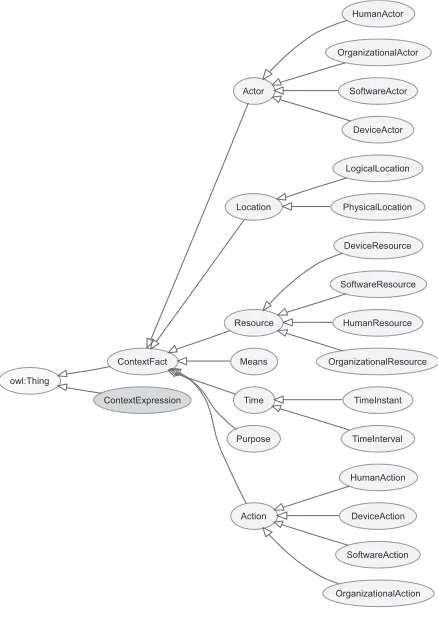
Basic entities of the context ontology are presented in Figure 4. This model definesdomain ontologyfor a context in business systems. Thedomain ontol-ogymodels only basic concepts and relations among them. When the COBAC model is used in the concrete case, thedomain ontologymodel should be ex-tended with the new concepts and relations which are specific for that case.
Two basic classes of the context model (see Figure 4) are ContextFact
andContextExpression. The classContextFactrepresents a basic context fact,
while the classContextExpressionrepresents the context expression. Different context facts can be classified asContextFactspecializations.
TheActorclass is used for representing different actors of events. Different
activities are modeled by theActionclass, and resources are modeled by the
Resourceclass. Location is described by theLocationclass. TheTimeclass is
used for modeling time factor in the model. Different purposes in this model are represented byPurposeclass, while means are described by theMeansclass. The context expression (class ContextExpression) represents a semantic binding of previously listed concepts, and it is based on 7 semantic dimensions (relations). Each aforementioned context fact creates one semantic dimension. Actually, the context expression describes events that took place and the condi-tions under which these events occurred. We extend five semantic dimensions defined in [2] [48] (“who”, “what”, “where”,“when” and “how”) with the notion
“why”which defines the purpose, and with the notion“related”which defines the
relation between different context expressions. We also define two specializa-tions of the“what”concept. The specialization“what action”is used for defining
the “what”relation with an action, while the specialization “what resource”is
used for defining the“what”relation with a resource.
LogicalLocation Actor
Location
owl:Thing
DeviceResource HumanActor
ContextFact
TimeInstant
HumanAction OrganizationalActor
SoftwareActor
PhysicalLocation
Resource
DeviceAction SoftwareResource
ContextExpression
SoftwareAction
OrganizationalAction TimeInterval HumanResource
Means
Time
DeviceActor
OrganizationalResource
Purpose
Action
Fig. 4.The context model
ctx:hasWhoPart a owl:ObjectProperty. ctx:hasWhatPart a owl:ObjectProperty.
ctx:hasWhatActionPart a owl:ObjectProperty; rdfs:subPropertyOf ctx:hasWhatPart. ctx:hasWhatResourcePart a owl:ObjectProperty; rdfs:subPropertyOf ctx:hasWhatPart. ctx:hasWhenPart a owl:ObjectProperty.
ctx:hasWherePart a owl:ObjectProperty. ctx:hasWhyPart a owl:ObjectProperty. ctx:hasHowPart a owl:ObjectProperty. ctx:isRelatedTo a owl:ObjectProperty,
owl:SymmetricProperty;
Listing 1.The context model relations
ctx:ContextExpression a owl:Class;
owl:equivalentClass[a owl:Class; owl:intersectionOf(
[a owl:Restriction; owl:allValuesFrom ctx:Actor; owl:onProperty ctx:hasWhoPart] [a owl:Restriction; owl:someValuesFrom ctx:Actor; owl:onProperty ctx:hasWhoPart] [a owl:Restriction; owl:allValuesFrom ctx:Action;
owl:onProperty ctx:hasWhatResourcePart]
[a owl:Restriction; owl:onProperty ctx:hasWhatPart; owl:someValuesFrom [a owl:Class; owl:unionOf (ctx:Action ctx:Resource)]] [a owl:Restriction; owl:someValuesFrom ctx:Event; owl:onProperty ctx:hasWhatPart] [a owl:Restriction; owl:allValuesFrom ctx:Event; owl:onProperty ctx:hasWhatPart] [a owl:Restriction; owl:allValuesFrom ctx:Means; owl:onProperty ctx:hasHowPart] [a owl:Restriction; owl:allValuesFrom ctx:Time; owl:onProperty ctx:hasWhenPart] [a owl:Restriction; owl:allValuesFrom ctx:Location; owl:onProperty ctx:hasWherePart] [a owl:Restriction; owl:allValuesFrom ctx:Purpose; owl:onProperty ctx:hasWhyPart] [a owl:Restriction; owl:allValuesFrom ctx:ContextExpression;
owl:onProperty ctx:isRelatedTo] )].
Listing 2.The context expression definition
Context Condition We define the context condition as a logical expression
which may consist of queries for searching context ontology (like SPARQL), context functions, logical operators {¬,∧,∨} and comparison operators{<,≤ , >,≥,=,̸=}. The context functions are used to retrieve some current informa-tion from a system, likewho is current user, orwhat activity is being currently
executed. The context expression defined in the EBNF notation is presented in
Listing 3.
ContextCondition ::= Query | Function
| ContextCondition BinaryOperator ContextCondition | UnaryLogicalOperator ContextCondition
| "("ContextCondition")" | "TRUE"
| "FALSE" | String | Number
BinaryOperator ::= ComparsionOperator|LogicalBinaryOperator ComparsionOperator ::= "<"|"<="|">"|">="|"=="|"!="
LogicalBinaryOperator ::= "&&"|"||" UnaryLogicalOperator ::= "!"
Query ::= "QUERY {" (String|Function){String|Function} "}" Function ::= "$$"Name"("[Param{","Param}]")$$"
Param ::= String|Number|Function|Query
Listing 3.EBNF notation for the context condition
The functionevalCond:CC → {⊤,⊥}verifies if the given context condition is satisfied.
From the setCC there are two specific conditions:σ (σ = T RU E) and σ¯
(σ¯ = F ALSE). The conditionσ is the condition which is always satisfied, i.e.
evalCond(σ) =⊤. The condition¯σis the condition opposite toσ, i.e. it is never satisfied,evalCond(¯σ) =⊥.
The context conditions are used for the assignment relations (a proper as-signment relation will be established if the assigned context condition is satis-fied) and for roles definition in order to enable/disable roles. A detailed explana-tion of the use of the context condiexplana-tion is given in the following secexplana-tions.
Variability of Context Condition From the viewpoint of the context condition
– slowly varying(session safe) context conditions are those conditions whose result is unchangeable during the user session.
– frequently varying (activity safe) context conditions are those conditions
whose result can be changed during the user session, but it is unchange-able during the execution of the activity.
– constantly varyingcontext conditions are those conditions whose result can
be changed during the user session or during the execution of the activity.
3.2. The model of Business Process
The i-th complex business process definition (cbpdi) is defined as the tuple:
cbpdi= (CADi, FBP Di), where:
– CADi- The set of complex activity definitions ofcbpdi, i.e.
CADi = {cadi1, cadi2,· · · , cadin}, where cadij is the definition of thej-th complex activity of thei-th complex business process, 1≤j ≤n, andnis a number of activity definitions ofcbpdi.
– FBP Di- The flow control relation which defines the execution order of
activ-ities from the setCADi.
The given model specifies three types of complex activities:
– start- The first (starting) activity of a complex business process. Invoking
this activity will initiate a new instance of a complex business process. Each complex business process definition must have exactly one activity of the start type.
– end- The last (ending) activity of a complex business process. Invoking this activity will end the current instance of a complex business process.
– regular- The regular activity which represents a part of the business logic
implemented by the business process.
The functiontypeOf:CADi→ {start, regular, end}determines the type of the complex activity.
The functioninstanceOfBP :CBP I →CBP Ddetermines the definition of the complex business process instance.
A similar function, instanceOfA : CAI → CAD, is used in the case of determining the definition of the complex activity instance.
The functionactivityDef Of :CAD→CBP Ddetermines the belonging of CADs to CBPDs:
activityDef Of(cad) =cbpdi|cbpdi= (CADi, FBP Di)∧cad∈CADi
Thek-th instance of thei-th complex business process (cbpik
i) is defined as a tuple:cbpiki = (CAIik, FBP Ik
i), where: – instanceOfBP(cbpiki) =cbpdi.
– CAIk
i - The set of complex activity instances of cbpiki., i.e.
CAIk
– FBP Ik
i - The flow control relation which defines execution order of activities
from the setCAIk i.
Similarly to theactivityDef Offunction, the functionactivityInstOf :CAI→ CBP I determines the belonging of CAIs to CBPIs:
activityInstOf(cai) =cbpii|cbpii= (CAIi, FBP Ii)∧cai∈CAIi
As noted before, thei-th simple business process (spdi) consists of a simple activity (sadi), e.g.spdi= (sadi).
3.3. The Model of User
LetU be the set of all users in the system, andS be the set of users’ sessions. The predicateusersSession(u, s)verifies if the sessions(s∈S) belongs to the useru(u∈U).
Various previous researches have identified that access control may depend on certain user’s properties. In the case of RBAC-based models, assignment of roles to a user can depend on user’s properties. The COBAC model supports this requirement by using context constraints in user-role assignment relation, where context constraints include some user’s properties.
3.4. The Model of Role
Similar to [4] [31], roles can be in one of the three states:
– disabled - A user can not activate such roles in her/his current session.
Disabledroles can change their state toenabled.
– enabled- A user can activate such roles in her/his current session. An
en-abledrole can switch to thedisabledoractivestate.
– active- This state applies to each user individually. If a user activates a role in her/his session, then that role changes state fromenabledtoactive, but only for that user. By deactivating a role, it changes the state fromactive
to enabledonly if the role was active in exactly one session of the user,
otherwise the role will continue to be in the activestate. From the active state, a role can also change the state todisabled.
Whether a role will be in theenabledordisabledstate depends on the cur-rent context state. Therefore, we define the role as a tuple :(rn, sc, sct)where:
– rn- The role name,
– sc- The context condition for enabling/disabling the role (state condition), and
Eachrncan exist in only one tuple:
∀t1= (rn1, sc1, sct1),∀t2= (rn2, sc2, sct2) :
rn1=rn2⇒sc1=sc2∧sct1=sct2∧t1=t2
If the conditionscis satisfied the role will be in thedisabledstate ifsct=dc, or in theenabledstate ifsct=ec. If the condition is not satisfied the role will be in the opposite state then defined bysct.
In the specific case, thesccondition is defined as the context condition which is always satisfied:(rn, σ, ec). This actually means that there is no context influ-ence to disabling/enabling a role. A role is alwaysenabled.
Although, it is possible to use the negation of the condition to accomplish role enabling/disabling effect, we used the context condition type to increase clarity of the specific role definition by explicitly stating if condition is used for enabling or disabling of the role.
To determine the role state we introduce the following predicates:
– disabled(r)- Verify if the role is disabled, – enabled(r)- Verify if the role is enabled, and
– active(r, u)- Verify if the roleris active for the useru.
The predicatedisabled(r)is true if the roleris disabled at the current context state:
disabled(r)⇐(r.sct=dc∧evalCond(r.sc))∨(r.sct=ec∧ ¬evalCond(r.sc))
The predicateenabled(r)is true if the roleris enabled at the current context state:
enabled(r)⇐(r.sct=ec∧evalCond(r.sc))∨(r.sct=dc∧ ¬evalCond(r.sc))
The predicateactive(r, u)is true if there is at least one session ofuin which the roleris active:
active(r, u)⇐usersSession(u, s)∧activeInSession(s, r)
where the predicate activeInSession(s, r)verifies whether the roleris active in the sessions.
3.5. User-Role Assignment
The proposed model supports two ways of assigning roles to users:staticand
dynamic.
In the case of thestatictype, a user is assigned roles for which there are assignment relations between them and the user. ThesRoleAssign(r, u, cc) re-lation definesstaticassignment of the rolerto the useruif the context condition
Some research identify cases when a predefined role-user relation is not satisfactory, and it is necessary to assign certain roles only to the users who satisfy certain conditions. This model of role assignment in the COBAC model is supported by the dynamic type of assignment. In this case a role can be assigned to any user if the assignment condition of the role is met.
The relationroleCondAssign(r, rac)defines therole assignment condition (rac∈CC) which should be fulfilled in order to assign the rolerto a user. This condition (rac) may contain any context data including some user’s properties. This way a user-role assignment depends on the user’s properties is supported. The dynamic role assignment is defined with the following predicate:
dRoleAssign(r)⇐roleCondAssign(r, rac)∧evalCond(rac)
If the predicatedRoleAssign(r) is satisfied, the roler will be assigned to the current user whose roles are loaded.
The predicateisRoleAssigned(u, r)verifies if the roler is assigned to the userr, regardless of the assignment type:
isRoleAssigned(r, u)⇐dRoleAssign(r)∨
(sRoleAssign(r, u, cc)∧evalCond(cc))
Ifcc=σ, it is acontext free static user-role assignmentand otherwise it is a context influenced static user-role assignment(cc̸=σ).
3.6. Role Hierarchy
The role hierarchy (RH) is defined as a partial order over the set of rolesR
(RH⊆R×R), i.e. as an inheritance relation, marked as≽, where if the roler1
inherits the roler2then standsr1≽r2.
The predicatecanObtainRole(u, r)verifies if the role rcan be assigned to the useruin the presence of the role hierarchy:
canObtainRole(u, rj)⇐isRoleAssigned(u, rj)∨
((ri≽rj)∧canObtainRole(u, ri))
The functionusersRoles :U → 2R determines all roles assigned to a user in the presence of the role hierarchy:
usersRoles(u) ={r|canObtainRole(u, r)}
3.7. Role-Activity Assignment
– The expressionrCADAssign(r, cad, cc)defines a relation which allows the role r ∈ R to execute the complex activity definition cad ∈ CAD if the context conditioncc∈CCis fulfilled.
– The expressionrCAIAssign(r, cai, cc)defines a relation which allows the roler∈Rto execute the complex activity instancecai∈CAIif the context conditioncc ∈ CC is fulfilled. Also, the type of thecaiactivity can not be
start, because it is meaningless to assign a privilege for an instance of
thestartactivity (cai ∈ CAI∧instanceOfA(cai) = cad∧typeOf(cad) ̸=
start). Thestarttype of activity is used only to initiate a new instance of the complex business process.
– The expressionrSADAssign(r, sad, cc)defines a relation which allows the roler∈Rto execute the simple activitysad∈SADif the context condition
cc∈CCis fulfilled.
Depending ifcc = σ there arecontext free static role-activity assignment andcontext influenced static role-activity assignment(cc̸=σ).
Verification if the roleris allowed to execute the complex activity instance
cai(cai∈CAI) is defined with the following predicate:
canExecCAI(r, cai)⇐(rCAIAssign(r, cai, cc)∧evalCond(cc))∨
(rCADAssign(r, cad, cc)∧evalCond(cc)∧instanceOfA(cai) =cad)
In a similar manner, the predicates for verification whether the roleris al-lowed to execute a complex activity definition or a simple activity definition are defined as follows:
canExecCAD(r, cad)⇐rCADAssign(r, cad, cc)∧evalCond(cc)
canExecSAD(r, sad)⇐rSADAssign(r, sad, cc)∧evalCond(cc)
A certain role can create a new complex business process instance if the role has permission to execute thestarttype activity of the process. The func-tionassignedCompP rocT oStartR → 2CAD determines allstarttype activities assigned to the given role:
assignedCompP rocT oStart(r) =
{cad|canExecCAD(r, cad)∧typeOf(cad) =start}
The functionassignedCompActT oExec:R→2CAIdetermines all complex activity instances which the role can execute. The role can execute the com-plex activity instance if the role has a permission to execute it (the predicate
canExecCAI(r, cai)) and if the complex activity instance is next in the order of execution. The order of execution is verified with thenextT oExecpredicate. This actually provides an order (sequence) of events, i.e. activities are executed in the order defined by a business process to which they belong to:
assignedCompActT oExec(r) =
The set of simple activities that the role can execute is the return value of the functionassignedSimpActT oExecR→2SAD:
assignedSimpActT oExec(r) ={sad|canExecSAD(r, sad)}
3.8. The Model of Permission
In order to improve the COBAC administration, resources can be organized into categories, where each resource can be classified into more categories. The relationassignCat(res, cat)classifies the resourceres∈Resinto thecat∈Cat
category.
Like roles, resource categories can also be hierarchically organized. The resource hierarchy is defined as a partial order over the categories set Cat
(CatH ⊆Cat×Cat), i.e. as inheritance relation, marked as≽cat, where if the categorycatiinherits the categorycatjthen standscati≽catcatj. All resources that belong to the categorycatialso belong to the categorycatj. The predicate
belongsT oCatverifies whether the resourceresbelongs to the categorycat:
belongsT oCat(res, catj)⇐assignCat(res, catj)∨
(cati≽catcatj∧belongsT oCat(res, cati)
A permission to execute a certain operation can be defined for resources and for categories. A permission defined for a category applies to all the cat-egory’s resources and subcategories. The resource permission is defined as:
rp= (res, op), res∈Res, op∈Op, while the category permission is defined as:
cp= (cat, op), cat∈Cat, op∈Op. LetRP be the set of all permissions defined for resources andCP be the set of all permissions defined for categories than:
P =RP∪CP.
In order to successfully execute a business process activity it is necessary to assign it the required permissions. In the COBAC model, the activity-permission assignment is specified with the following relations:
– cadP ermissionAssign(cad, p, cc)- The permissionp∈P is assigned to the complex activity definitioncad ∈ CAD if the context conditioncc ∈ CC is fulfilled,
– caiP ermissionAssign(cai, p, cc)- The permissionp∈P is assigned to the complex activity instancecai ∈ CAI if the context condition cc ∈ CC is fulfilled, and
– sadP ermissionAssign(sad, p, cc)- The permissionp∈Pis assigned to the simple activity definition sad ∈ SAD if the context condition cc ∈ CC is fulfilled.
Similary to the role-activity assignment, ifcc=σit is acontext free activity-permission assignmentand ifcc̸=σit is acontext influenced activity-permission
The functions which determine the privileges (defined for the corresponding operation) associated to a complex activity definition, complex activity instance or simple activity definition are defined as follows:
cadP ermission:CAD×Op→2P
cadP ermission(cad, op) ={p|p.op=op∧cadP ermissionAssign(cad, p, cc)}
caiP ermission:CAI×Op→2P
caiP ermission(cai, op) ={p|p.op=op∧caiP ermissionAssign(cai, p, cc)}
sadP ermission:SAD×Op→2P
sadP ermission(sad, op) ={p|p.op=op∧sadP ermissionAssign(sad, p, cc)}
The permissionp1iscontainedin the permissionp2(p1⊑p2) if:
– p1andp2are defined for the same operation and resource (p1=p2), or
– p1andp2are defined for the same operation and thep1 category is a
sub-category of thep2category, or
– p1 andp2are defined for the same operation and the p1 resource belongs
top2category.
This can formally be noted as follows:
p1⊑p2⇒(p1∈RP∧p2∈RP ∧p1.op=p2.op∧p1.res=p2.res)∨
(p1∈CP ∧P2∈CP∧p1.op=p2.op∧p1.cat≽cat p2.cat)∨
(p1∈RP∧p2∈CP ∧p1.op=p2.op∧belongsT oCat(p1.res, p2.cat))
If an activity possesses the permission p2, and if that activity needs the
permissionp1to execute a certain operation on a resource, than the activity will
be able to execute the operation only ifp1⊑p2.
4.
Access Control Enforcement
In this section, access control enforcement defined by the COBAC model with-out constraints enforcement is presented. The process of the access control enforcement is performed through four phases:
– role activation,
– creation of activity (task) list that a user can execute,
– verification if the user is allowed to perform the activity in the moment when she/he initiate execution of the given activity, and
– verification if it is allowed to access the required resources during the exe-cution of the activity.
while the conditions in the role-activity relations and in the activity-permission relations arefrequently varying.
Based on the previous assumptions, roles assigned to a user in here/his session are not changed during the session duration, but it is possible that privileges, to execute certain activities, assigned to those role arechanged.
4.1. Roles Activation
The first step in the roles activation is loading of the roles assigned to the user, and then, from the set of the loaded roles, thedisabledroles are removed. The algorithm for the activation of roles in this phase can be changed in order to meet the requirements of different systems. Algorithm 1 uses simple way of role activation where all roles assigned to the user are activated.
Algorithm 1An example of role activation
NAME: ActivateRoles INPUT: u∈U - user s∈S - session of u
OUTPUT: ARS - activated roles U RS := usersRoles(u)
for each r∈U RS do ifdisabled(r) then
removeFromSet(r, U RS)
ARS := activateAllRolesForSession(U RS, s)
4.2. Activity List Creation
The creation of the activity list for the user is the process of selection of activ-ities which are allowed to be executed by the user. The created activity list is represented as the tuple(SCP S, ECAS, ESAS)where:
– SCP S⊆CAD∧ ∀cad ∈SCP S, typeOf(cad) =start(Start Complex Pro-cess Set) represents the set of the complex activity definitions of the “start” type which user can execute, i.e. the user can create a new instance of the complex business process.
– ECAS⊆CAI(Execute Complex Activity Set) represent the complex
activ-ity instances set which user can execute.
– ESAS⊆SAD(Execute Simple Activity Set) represent the simple activities
set which user can execute.
Algorithm 2Activity list creation NAME: CreateActivityList INPUT: u∈U - user
ARS⊆R - active roles of user in session
OUTPUT: (SCP S, ECAS, ESAS) - user’s actitivty list
{Create Start Complex Process Set (SCPS)} SCP S := ∪r∈ARS assignedCompProcToStart(r)
{Create Execute Complex Activity Set (ECAS)} ECAS := ∪r∈ARS assignedCompActToExec(r)
{Create Execute Simple Activity Set (ESAS)} EAS := ∪r∈ARS assignedSimpActToExec(r)
order to be executed. The functionassignedCompActT oExec(r)determines all the complex activity instances which the rolercan execute. The setSCP Sis formed from simple activities which are assigned to the users active roles. The set of simple activities that the role can execute is return value of the function
assignedSimpActT oExec.
4.3. Verification of Privilege to Execute Action
When a user from the activity list selects an activity to execute, it is necessary to verify once more whether the user is allowed to execute that activity. The reason for this verification is the existence of thefrequently varyingcontext conditions which may be changed between the creation of activity list and the execution of the activity.
Verification whether it is allowed to execute a complex activity instance is presented in Algorithm 3. The user can execute the activity instance if she/he has an active role with a privilege to execute that activity (the predicate
canExecCAI). The similar algorithm is used for verification whether it is allowed to execute simple activities or to create a new process instance.
Algorithm 3Verification if it is allowed to execute an activity instance NAME: ExecOfComplexActivityAllowed
INPUT: cai∈CAI - complex activity instance to execute u∈U - user
ARS⊆R - active roles of user in session OUTPUT: result - result, can user execute taks
result:= false
for each r∈ARS do
ifcanExecCAI(r, cai) then return result :=true
4.4. Verification of Permission to Access to Resource
An activity can access to resources only if it has necessary permissions. Veri-fication if the complex activity instancecaican execute the operationopon the resourceresis presented in Algorithm 4. The activity instancecaican execute the operationopon the resource resif the permission that allows execution is
containedin the permission assigned to the instance (caiP ermission) or its
definition (cadP ermission). The similar algorithm is used for simple activities.
Algorithm 4Permission verification
NAME: CanExecOperation
INPUT: cai∈CAI - complex activity instance op∈Oper - operation
res∈Res - resource
OUTPUT: result - result, can operation be executed on resource
result:= false p := (res, op)
RP S := caiPermission(cai, p.op) ∪ cadPermission(instanceOfA(cai), p.op)
for each rp∈RP S do
ifp⊑rp∧evalCond(rp.cc) then return result :=true
return result
5.
A Case Study
The verification of the COBAC model is carried out through the analysis and implementation of the security segment of the workflow-based information sys-tem. The model is tested on the real-world business process - Employment procedure in the Professor position at Faculty of Technical Sciences, University
of Novi Sad. This process is implemented using a document-oriented workflow
system.
The process includes cases where user’s privileges depend on a current task/workflow instance being executed, and cases where access control deci-sion depends on the elements outside standard access control entities, pre-cisely it depends on the content of a document being involved in the executed workflow instance. We decided to choose this process as a case study be-cause it has security requirements that can not be fully implemented with ex-isting workflow access control models, but it is possible to implement them us-ing COBAC. Therefore, security requirements of this process are suitable to demonstrate full capacity of the COBAC model.
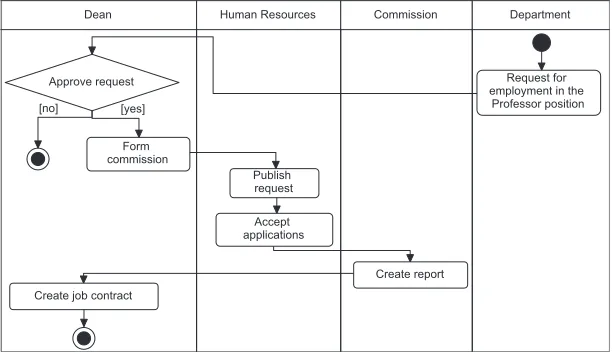
Commission analyzes accepted applications, ranks all candidates, and sug-gests the most suitable one. At the end, Dean creates a job contract for the candidate chosen byCommission.
Dean Human Resources Commission Department
[no] [yes]
Request for employment in the
Professor position Approve request
Publish request
Accept applications Form
commission
Create report
Create job contract
Fig. 5.The simplified version of the employment procedure process
Due to paper limitation and for better clarity, without the loss of generality, we will present two representative access control requirements and show how to implement them by COBAC.
The first requirement presented in this case study demonstrates the purpose of extending RBAC with the notion of activities. It proves that COBAC prototype can be used for “simple” access control requirements when context condition is not required.
The second requirement demonstrates the use of context conditions. It rep-resents the cases when certain roles are dynamically assigned to users based on the information contained in documents that participate in the workflow. Also, these roles will have the permissions to execute certain activities only for the specific process instances depending on users who acquire these roles. To the best of our knowledge this requirement cannot be implemented by any of the workflow access control models presented in Section 2 or its implementation can be overly complicated.
The proof of some other COBAC concepts can be found in [23]. The article [23] demonstrated the use of the COBAC prototype implementation for enforc-ing access control in workflow systems supportenforc-ing judicial processes.
Requirement 1 In order to form the commission, the Deanrole must be
must be assigned the permission to create, read and modify the document that represents the formal act of forming the commission.
Requirement 2 The roleCommission Memberis inappropriate to be statically
assigned to the users, but it is necessary to assign this role to the users selected
as the commission members by the dean. The roleCommission Membermust
be assigned the privilege to execute the activityCreate reportwith the condition that commission members can execute this activity only for the process instance for which they are selected. In order to create a report, the activityCreate report must have permissions to read received applications for this job position and to create, read and modify the document that represents the commission report.
By analyzing the roles that appear in the process we notice that it is not necessary to introduce a context condition for their enablement/disablement. Therefore, all roles are always enabled:sc=σ∧sct=ec. For this case study we used the role activation algorithm presented in Section 4.1, i.e. all roles assigned to the user are activated when a user logs in to the application.
Requirement 1 represents an example where a context condition is not re-quired for the implementation. Listing 4 shows the COBAC access control policy which represents the implementation of Requirement 1. The Deanrole has a privilege to execute the activity definition Form commission. This activity has the permissions to read, create and modify all documents that belong to the
Formed commissioncategory.
/* role-activity assignment */
CAD1 - activity definition set for the given process
cad ∈ CAD1 ∧ cad= Formed commission
r ∈ R ∧ r.rn=Dean cc ∈ CC ∧ cc=σ
rcdActivityAssign(r, cad, cc)
/* activity-permission assignment */ cat ∈ Cat ∧ cat= Formed commission opr ∈ Op ∧ opr= read document
opc ∈ Op ∧ opc= create documnet
opm ∈ Op ∧ opm= modify document pr ∈ CP ∧ pr= (cat, opr)
pc ∈ CP ∧ pc= (cat, opc)
pm ∈ CP ∧ pu= (cat, opm)
cadPermissionAssign(cad, pr, cc) cadPermissionAssign(cad, pc, cc) cadPermissionAssign(cad, pm, cc)
Listing 4.Access control policy for Requirement 1
Requirement 2 represents an example where it is needed to use a context condition in the requirement implementation. In order to define the required context conditions we extend the context model presented in Section 3.1 with information about the process and users (commission members).
@prefix ctx: <http://informatika.ftn.uns.ac.rs/cobac/context.owl#>.
@prefix ep: <http://informatika.ftn.uns.ac.rs/cobac/employ-prof-context.owl#>. @prefix rdfs: <http://www.w3.org/2000/01/rdf-schema#>.
@prefix xsd: <http://www.w3.org/2001/XMLSchema#>. @prefix owl: <http://www.w3.org/2002/07/owl#>.
ep:User a owl:Class; rdfs:subClassOf ctx:HumanResource, ctx:HumanActor. ep:hasUID a owl:DatatypeProperty; rdfs:domain ep:User; rdfs:range xsd:string.
Listing 5.The context model of a user
The given process is modeled by theEPProcesclass which is a subclass of
theSoftwareActorandSoftwareResourceclasses (see Listing 6). A process is
assigned an ID using thehasPIDrelation.
@prefix ctx: <http://informatika.ftn.uns.ac.rs/cobac/context.owl#>.
@prefix ep: <http://informatika.ftn.uns.ac.rs/cobac/employ-prof-context.owl#>. @prefix rdfs: <http://www.w3.org/2000/01/rdf-schema#>.
@prefix xsd: <http://www.w3.org/2001/XMLSchema#>. @prefix owl: <http://www.w3.org/2002/07/owl#>.
ep:EPProces a owl:Class; rdfs:subClassOf ctx:SoftwareActor, ctx:SoftwareResource. ep:hasPID a owl:DatatypeProperty; rdfs:domain ep:EPProces; rdfs:range xsd:string.
Listing 6.The context model of a process
Besides the aforementioned context entities, we also define a specializa-tion of the context expression - CommissionForProcess (see Listing 7). This specialization actually contains information who are the commission members for the given process instance. To define this class we introduce the relations
commissionMemberIsandforProcess(see Listing 7).
@prefix ctx: <http://informatika.ftn.uns.ac.rs/cobac/context.owl#>.
@prefix ep: <http://informatika.ftn.uns.ac.rs/cobac/ employ-prof-context.owl#>. @prefix rdfs: <http://www.w3.org/2000/01/rdf-schema#>.
@prefix owl: <http://www.w3.org/2002/07/owl#>.
ep:commissionMemberIs a owl:ObjectProperty; rdfs:subPropertyOf ctx:hasWhoPart. ep:forProcess a owl:ObjectProperty; rdfs:subPropertyOf ctx:hasWhatResourcePart.
ep:CommissionForProcess a owl:Class; rdfs:subClassOf ctx:ContextExpression; owl:equivalentClass[a owl:Class; owl:intersectionOf(
[a owl:Restriction; owl:allValuesFrom ep:User; owl:onProperty ep:commissionMemberIs] [a owl:Restriction; owl:someValuesFrom ep:User;
owl:onProperty ep:commissionMemberIs]
[a owl:Restriction; owl:allValuesFrom ep:EPProces; owl:onProperty ep:forProcess]
[a owl:Restriction; owl:someValuesFrom ep:EPProces; owl:onProperty ep:forProcess])].
Listing 7.TheCommissionForProcesscontext expression
where access control rights depend on context (in this case, data stored in doc-uments being handled by the workflow). Requirement 2 is implemented with the COBAC policy presented in Listing 8.
Since the commission members for each process instance are users se-lected by the dean for that specific process instance, the roleCommission Mem-beris inappropriate to be statically assigned to the users. Therefore the context condition for theCommission Member role assignment must be defined. The
roleCommission Memberwill be assigned to all users who satisfies the context
condition ccr. This context condition, beside necessary namespaces, defines a query which verifies whether there is an instance of the CommissionForPro-cesscontext expression, in context data, which assigns the current user as a commission member for any process instance. The identifier of the current user is retrieved using the context function$$currentUserID()$$.
The user who possesses theCommission Memberrole cannot execute the activityCreate reportfor all process instances, but only for process instances for which she/he has been appointed as a commission member. The privilege to execute the instance of the activityCreate reportis assigned to the role Com-mission Memberif the context conditionccrais satisfied. This condition requires that a user with the roleCommission Membermust be a commission member for the current process instance. It defines a query which verifies whether con-text data contains theCommissionForProcessinstance which assigns the cur-rent user as a commission member for the curcur-rent process instance. The query of the conditionccracontains context functions$$currentUserID()$$and
$$cur-rentProcessID()$$. The last one returns the identifier of the current process
instance.
The permissions to read received applications for this process instance and permissions to read, create and modify theCommission reportdocument are assigned to the instance of the activityCreate report(see Listing 8).
The appropriateCommissionForProcessinstance will be inserted into con-text data upon completion of theForm commissionactivity. After the condition is inserted, it will not be changed until current process instance is completed, when it will be deleted. Therefore we can assume that the both context condi-tions are at leastactivity safebecause their result is unchangeable during the execution of the activityCreate report.
/* dynamic user-role assignment */ CAIk
1 - activity instances of the k-th process instance
cai ∈ CAI1k ∧ cai= Create report r ∈ R ∧ r.rn=Commission Member ccr ∈ CC
ccr = QUERY {
PREFIX rdf: <http://www.w3.org/1999/02/22-rdf-syntax-ns#>. PREFIX ep: <http://informatika.ftn.uns.ac.rs/cobac/
employ-prof-context.owl#>. ASK ?X
WHERE { ?X rdf:type ep:CommissionForProcess. ?X ep:commissionMemberIs ?Y. ?Y ep:hasUID $$currentUserID()$$ }
roleCondAssign(r, ccr)
/* role-activity assignment */ ccra ∈ CC
ccra = QUERY {
PREFIX rdf: <http://www.w3.org/1999/02/22-rdf-syntax-ns#>.
PREFIX ep: <http://informatika.ftn.uns.ac.rs/cobac/employ-prof-context.owl#>. ASK ?X
WHERE {?X rdf:type ep:CommissionForProcess. ?X ep:commissionMemberIs ?Y. ?Y ep:hasUID $$currentUserID()$$ ?X ep:forProcess ?Z.
?Z ep:hasPID $$currentProcessID()$$ }
}
rciActivityAssign(r, cai, ccra)
/* activity-permission assignment */
doc1 ∈ Res ∧ doc1= Job application (for the k-th process instance)
doc2 ∈ Res ∧ doc2= Commission report (for the k-th process instance)
opr ∈ Op ∧ opr= read document
opc ∈ Op ∧ opc= create document
opm ∈ Op ∧ opm= modify document
p1r ∈ RP ∧ p1r= (doc1, opr)
p2r ∈ RP ∧ p2r= (doc2, opr)
p2c ∈ RP ∧ p2c= (doc2, opc)
p2m ∈ RP ∧ p2m= (doc2, opm)
ccp ∈ CC ∧ cc=σ
caiPermissionAssign(cai, p1r, ccp)
caiPermissionAssign(cai, p2r, ccp)
caiPermissionAssign(cai, p2c, ccp)
caiPermissionAssign(cai, p2m, ccp)
Listing 8.Access control policy for Requirement 2
Since this case study covers only one business process, the activity list in the prototype application will contain only activity instances of the given process which are allowed to be executed at the given time by the logged in user. The activity list is created as presented in Section 4.2.
6.
Conclusion
Beside standard features, the workflows access control should support task level access control with possibility to assign different roles to users and dif-ferent permissions to roles during process execution. In some cases, access control policies should be defined on a process definition (task definition) level, while in other cases they should be defined on a process instance (task in-stance) level. Also, access control may depend on different context factors, which may vary form process to process. In this paper we present the
Context-sensitive access control model for business processes(COBAC) that supports
these requirements.
Thecontext is used to handle access control requirements which depend on factors from the system and from the system’s environment. The categoriza-tionof the resources enables the definition of access control policies for whole resource category, and thus, potentially, reduces the number of policies which need to be defined.
The most notable features of the COBAC model are:
– It is based on the RBAC model which is extended with the concept of busi-ness process and activity in order to bind certain access control segments with activities instead of binding them with the current session, and thus provide efficient definition of different policies and constraints in different business systems. This ensures the independence of these segments from the number of sessions in which activities are executed. Also the business process and the activity provide a mechanism for the fine-grained control of least privileges.
– The policies can be defined at the level of each specific process instance (activity instance) and at the process (activity) definition level. The policies defined at the process definition level will apply to all process instances. – During the time/workflow execution, different roles can be assigned/
unassigned to a user and roles can have different permissions.
– The assignment relations in the COBAC model are extended with the context-dependant condition and thus provide support for the context-sensitive access control. Also, the notion of the role is extended with the context information. The proposed context model is developed us-ing ontologies.
– Resources in the COBAC model can be hierarchically organized thus low-ering the number of policies that need to be defined.
The COBAC model is verified on a real workflow system based on the ex-change of documents. The presented verification represents the proof of the proposed model practical value.