Modeling Service Oriented Architectures
In A Command and Control Context
Jim Solderitsch
Outline
Outline
Project Overview
Technology Background
Service Oriented Architecture (SOA) Enterprise Service Bus (ESB)
Modeling
Why Model?
Important C2 Domain Constraints and Concerns Tools
ESB Model Overview ESB Model Validation
Project Overview
Project Overview
ARCES: Applied Research for Computing Enterprise Services 18 month research project
Funding through Summer 2007
Villanova University (prime) and Gestalt, LLC
Customer: Air Force Electronic Systems Group (ELSG/KI), Hanscom AFB
Focused Tasks on:
SOA Modeling, initially focused on Gestalt Multi-Channel Service Oriented Architecture (MCSOA), later expanded to ESB fabric
Compression technologies in constrained operational conditions
Architectural issues such as service granularity, Community of Interest (COI) concerns, performance
Security, in particular NCES security plans and architectural guidelines Impact of SOA on DoD acquisition and governance practices
SOA Concepts
SOA Concepts
A service is a resource that performs one or more tasks. These tasks are well defined and are accessed through a well defined interface. SOA is a paradigm for organizing and utilizing distributed services that may be under the control of different ownership domains.
SOA provides a uniform means to offer, discover, interact with and use services to produce desired effects.
What is an ESB?
What is an ESB?
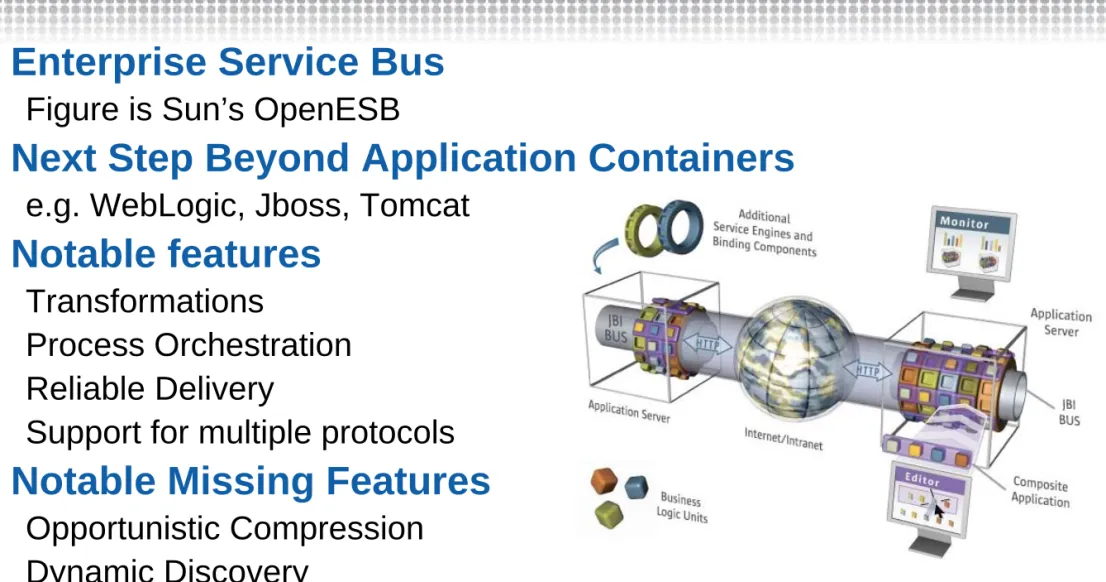
Enterprise Service Bus
Figure is Sun’s OpenESB
Next Step Beyond Application Containers
e.g. WebLogic, Jboss, Tomcat
Notable features
Transformations
Process Orchestration Reliable Delivery
Support for multiple protocols
Notable Missing Features
Opportunistic Compression Dynamic Discovery
Why Model?
Why Model?
Gain understanding of complex systems
Both as-is, and to-be systems
Simulate flow of events through system
Verify that system components operate as expected Perform what-if analysis of system in operation
Experiment with alternative system designs
Model system interactions where physically creating or
assembling systems is prohibitively expensive
For ARCES:
One research goal: Is SOA/ESB all that it’s cracked up to be?
•
Especially in a Command and Control ContextESB, SOA and Models in C2 Context
ESB, SOA and Models in C2 Context
C2 Systems, especially those touching the Edge, have
unique characteristics
Fragile Networks – availability and reduced bandwidth
Limited computing resources
Need to discover what resources are available NOW
•
Dynamic presence of resources: people and systems Cross-domain interaction requirements•
Various protocols, services and coalitions•
Ad hoc System of Systems behavior•
Un-anticipated usersNeed to maintain end-to-end security
Can SOA/ESB succeed in this environment?
Model Verification and Validation
Model Verification and Validation
Verification: Does model meet requirements?
ARCES defines model requirements in requirements document ARCES models described in design document
Independent model reviewer compares model as built to requirements and fills out verification document
Validation: Does model meet its intended purpose?
Model validation is essentially at attempt to assess model quality ARCES has spent considerable effort trying to define a process for validation
Use Cases form the core of ARCES approach to validating our models Compare model to actual implementation where possible
ARCES Modeling Technology
ARCES Modeling Technology
Commercial Tool: Extend
Published by Imagine That Inc.
PC and Mac Versions (current version is 6.0.7)
•
Version 7 in Beta Free Player componentIn use by many large corporations and government agencies Being used to model Service Oriented Architectures by Mitre
•
MESA – Modeling Environment for SOA Analysis•
Sponsored by DISA CTO officeOther tools exist
Villanova using Colored Petri Nets and a university toolset called CPN Competing Commercial tools exist as well (Opnet)
Rest of presentation will focus on using MESA/Extend to build and validate real SOA models
MESA Model Topology
MESA Model Topology
1. Nodes are circular shapes (computing resources)
2. Links are gray
rectangles (network characteristics)
3. Buttons on top left and center allow access to database tables and MESA design features
4. Global Arrays used to augment database are shown in upper right
5. Extend toolbar shown under menu bar
• Model topology independent of service definitions
1
2
3
4
5
Building MESA Models
Building MESA Models
1. Create Nodes
• Then use Extend graphical editor to wire them together
2. Edit Nodes
• E.g. define processor characteristics or network characteristics
3. Create Services
4. Edit Services
• E.g. define where service will execute
5. Each service is
contained in a MESA database table
• Actions include: request, wait, processing (delay), response, end (among others)
• Equation logic written in ModL (Java-like syntax) • Equation values affect
current and future actions
1
2
3
4
Controlling Network Bandwidth
Controlling Network Bandwidth
1. Double click Link Object
2. Set properties for outbound and inbound direction
3. Click Select to See and Edit Link
Properties 4. Link properties include • Bandwidth (bps) • Latency (ms) • Background Utilization • Error Rate • Availability
1
2
3
4
Model Calibration Support
Model Calibration Support
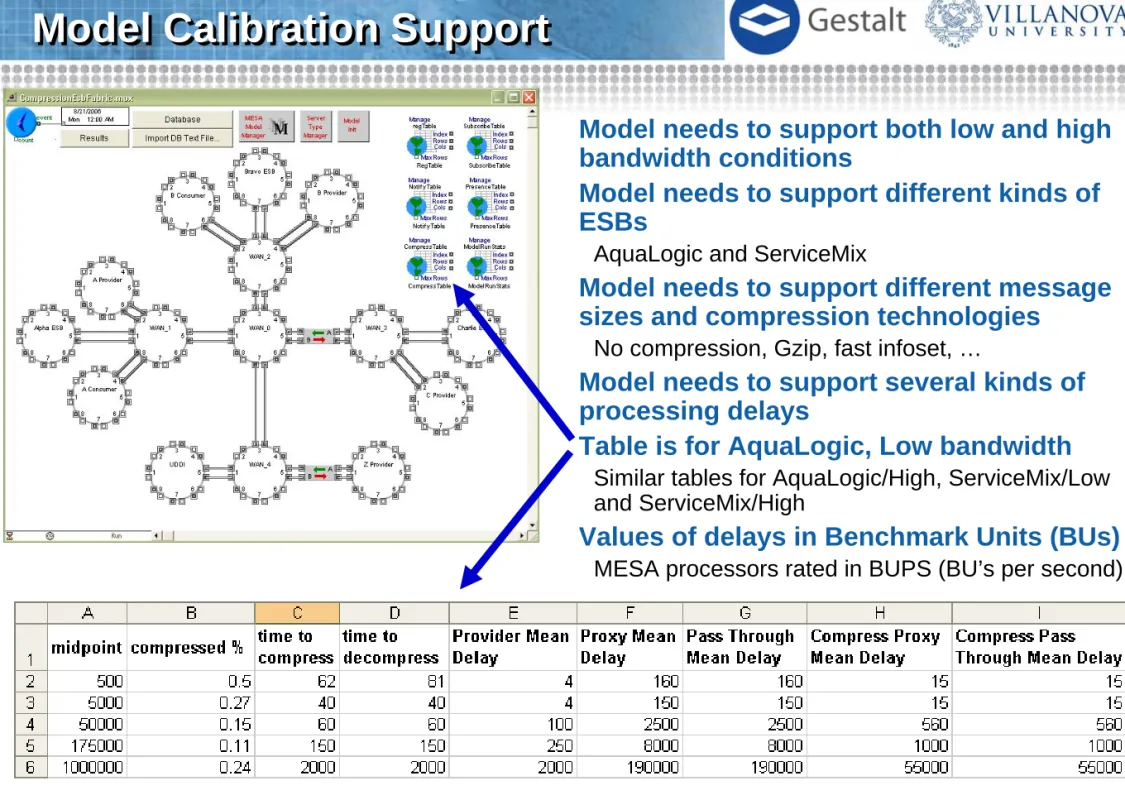
Model needs to support both low and high bandwidth conditions
Model needs to support different kinds of ESBs
AquaLogic and ServiceMix
Model needs to support different message sizes and compression technologies
No compression, Gzip, fast infoset, …
Model needs to support several kinds of processing delays
Table is for AquaLogic, Low bandwidth
Similar tables for AquaLogic/High, ServiceMix/Low and ServiceMix/High
Values of delays in Benchmark Units (BUs)
Model User Interface, Sample 1
Model User Interface, Sample 1
1. Control Message Size 2. Control Compression 3. Control number of simultaneous requests 4. Observe Statistical Summary • Low Bandwidth test 5. Observe Tabular Data • Computed Roundtrip Time (RTT) 6. Observe Graph
1
2
3
4
5
6
Model User Interface, Sample 2
Model User Interface, Sample 2
1. Compression option disabled 2. Same request and response sizes 3. High Bandwidth test • 6 minute model run like previous example • Nearly 25 times as many completions • 6 other simulation runs • mix of ESB types, bandwidth conditions, and compression settings
3
1
2
Sample Model Validation Raw Results
Sample Model Validation Raw Results
AquaLogic MESA model vs. experimental data Low band. With compression. Est. Avg. RTT
440 540 3940 8221 397229 442 543 3951 8173 392467 1 10 100 1000 10000 100000 1000000 0KB - 1KB 1KB - 10KB 10KB-100KB 100KB-214KB 1MB - 8MB
Message size range (KB)
Est. Avg. RTT (ms) (Logarithmic Scale)
MESA model Experimental data
One of 8 use cases:
AquaLogic ESB, Low
Bandwidth, with Compression
Other use cases:
AquaLogic ESB, Low
Bandwidth, No Compression AquaLogic ESB, High
Bandwidth, with Compression AquaLogic ESB, High
Bandwidth, No Compression 4 cases with ServiceMix ESB
5 Message Size Ranges 4 Replications of model and lab runs
Computed Avg. RTT for model and Lab runs
Plotted using Logarithmic Vertical Scale
Close agreement after model calibration.
95% Confidence Interval
95% Confidence Interval
Initially we stopped after simple comparison Dr. Averill Law recommended we perform Difference in Means statistical test 4 separate Lab and Model runsBecause 0 is well within Confidence Interval, we conclude that the model data is a reliable
approximation of real results
AquaLogic Low Bandwidth With Compression Difference between the Lab and Model data +/- CI
for the first 4 messages
2 3 10 -48 -400 -300 -200 -100 0 100 200 300 0 1 2 3 4
Uncompressed Message Size (KB)
D if fer e n ce i n A vg . R T T ( m s)
Difference between Lab and Model Avg. RTT X axis values:
1: 0KB – 1KB 2: 1KB – 10KB 3: 10KB–100KB 4: 100KB–214KB
Conclusions
Conclusions
Modeling and Simulation make good sense for C2 Information System analysis
Models can be built cost-effectively and when validated offer a dynamic exploration environment for decision makers
Modeling and Simulation are used throughout the DoD
•
Why not for information system design and analysis?MESA is an effective tool for modeling and simulation
ARCES has also produced a dynamic discovery model and an end-to-end security model in MESA
Security model has exposed flaws in protocol standards
Dynamic discovery model inspired discovery infrastructure design based on Atom protocol
The ARCES Project is reaching sunset status
Interested in reaching out to other programs for which this sort of predictive modeling makes sense