Toward Secure and Dependable
Storage Services in Cloud Computing
Cong Wang,
Student Member,
IEEE, Qian Wang,
Student Member,
IEEE,
Kui Ren,
Senior Member,
IEEE, Ning Cao, and Wenjing Lou,
Senior Member,
IEEE
Abstract—Cloud storage enables users to remotely store their data and enjoy the on-demand high quality cloud applications without the burden of local hardware and software management. Though the benefits are clear, such a service is also relinquishing users’ physical possession of their outsourced data, which inevitably poses new security risks toward the correctness of the data in cloud. In order to address this new problem and further achieve a secure and dependable cloud storage service, we propose in this paper a flexible distributed storage integrity auditing mechanism, utilizing the homomorphic token and distributed erasure-coded data. The proposed design allows users to audit the cloud storage with very lightweight communication and computation cost. The auditing result not only ensures strong cloud storage correctness guarantee, but also simultaneously achieves fast data error localization, i.e., the identification of misbehaving server. Considering the cloud data are dynamic in nature, the proposed design further supports secure and efficient dynamic operations on outsourced data, including block modification, deletion, and append. Analysis shows the proposed scheme is highly efficient and resilient against Byzantine failure, malicious data modification attack, and even server colluding attacks. Index Terms—Data integrity, dependable distributed storage, error localization, data dynamics, cloud computing.Ç
1
I
NTRODUCTIONS
EVERALtrends are opening up the era of cloudcomput-ing, which is an Internet-based development and use of computer technology. The ever cheaper and more powerful processors, together with the Software as a Service (SaaS) computing architecture, are transforming data centers into pools of computing service on a huge scale. The increasing network bandwidth and reliable yet flexible network connections make it even possible that users can now subscribe high quality services from data and software that reside solely on remote data centers.
Moving data into the cloud offers great convenience to users since they don’t have to care about the complexities of direct hardware management. The pioneer of cloud computing vendors, Amazon Simple Storage Service (S3), and Amazon Elastic Compute Cloud (EC2) [2] are both well-known examples. While these internet-based online services do provide huge amounts of storage space and customizable computing resources, this computing
platform shift, however, is eliminating the responsibility of local machines for data maintenance at the same time. As a result, users are at the mercy of their cloud service providers (CSP) for the availability and integrity of their data [3], [4]. On the one hand, although the cloud infrastructures are much more powerful and reliable than personal computing devices, broad range of both internal and external threats for data integrity still exist. Examples of outages and data loss incidents of noteworthy cloud storage services appear from time to time [5], [6], [7], [8], [9]. On the other hand, since users may not retain a local copy of outsourced data, there exist various incentives for CSP to behave unfaithfully toward the cloud users regarding the status of their outsourced data. For example, to increase the profit margin by reducing cost, it is possible for CSP to discard rarely accessed data without being detected in a timely fashion [10]. Similarly, CSP may even attempt to hide data loss incidents so as to maintain a reputation [11], [12], [13]. Therefore, although outsourcing data into the cloud is economically attractive for the cost and complexity of long-term large-scale data storage, its lacking of offering strong assurance of data integrity and availability may impede its wide adoption by both enterprise and individual cloud users.
In order to achieve the assurances of cloud data integrity and availability and enforce the quality of cloud storage service, efficient methods that enable on-demand data correctness verification on behalf of cloud users have to be designed. However, the fact that users no longer have physical possession of data in the cloud prohibits the direct adoption of traditional cryptographic primitives for the purpose of data integrity protection. Hence, the verification of cloud storage correctness must be conducted without explicit knowledge of the whole data files [10], [11], [12], [13]. Meanwhile, cloud storage is not just a third party data warehouse. The data stored in the cloud may not only be
. C. Wang is with the Department of Electrical and Computer Engineering, Illinois Institute of Technology, 1451 East 55th St., Apt. 1017 N, Chicago, IL 60616. E-mail: [email protected].
. Q. Wang is with the Department of Electrical and Computer Engineering, Illinois Institute of Technology, 500 East 33rd St., Apt. 602, Chicago, IL 60616. E-mail: [email protected].
. K. Ren is with the Department of Electrical and Computer Engineering, Illinois Institute of Technology, 3301 Dearborn St., Siegel Hall 319, Chicago, IL 60616. E-mail: [email protected].
. N. Cao is with the Department of Electrical and Computer Engineering, Worcester Polytechnic Institute, 100 Institute Road, Worcester, MA 01609. E-mail: [email protected].
. W. Lou is with the Department of Computer Science, Virginia Polytechnic Institute and State University, Falls Church, VA 22043.
E-mail: [email protected].
Manuscript received 4 Apr. 2010; revised 14 Sept. 2010; accepted 25 Dec. 2010; published online 6 May 2011.
For information on obtaining reprints of this article, please send e-mail to: [email protected] and reference IEEECS Log Number TSCSI-2010-04-0033. Digital Object Identifier no. 10.1109/TSC.2011.24.
accessed but also be frequently updated by the users [14], [15], [16], including insertion, deletion, modification, ap-pending, etc. Thus, it is also imperative to support the integration of this dynamic feature into the cloud storage correctness assurance, which makes the system design even more challenging. Last but not the least, the deployment of cloud computing is powered by data centers running in a simultaneous, cooperated, and distributed manner [3]. It is more advantages for individual users to store their data redundantly across multiple physical servers so as to reduce the data integrity and availability threats. Thus, distributed protocols for storage correctness assurance will be of most importance in achieving robust and secure cloud storage systems. However, such important area remains to be fully explored in the literature.
Recently, the importance of ensuring the remote data integrity has been highlighted by the following research works under different system and security models [10], [11], [12], [13], [14], [15], [16], [17], [18], [19], [20], [21], [22]. These techniques, while can be useful to ensure the storage correctness without having users possessing local data, are all focusing on single server scenario. They may be useful for quality-of-service testing [23], but does not guarantee the data availability in case of server failures. Although direct applying these techniques to distributed storage (multiple servers) could be straightforward, the resulted storage verification overhead would be linear to the number of servers. As an complementary approach, researchers have also proposed distributed protocols [23], [24], [25] for ensuring storage correctness across multiple servers or peers. However, while providing efficient cross server storage verification and data availability insurance, these schemes are all focusing on static or archival data. As a result, their capabilities of handling dynamic data remains unclear, which inevitably limits their full applicability in cloud storage scenarios.
In this paper, we propose an effective and flexible distributed storage verification scheme with explicit dy-namic data support to ensure the correctness and avail-ability of users’ data in the cloud. We rely on erasure-correcting code in the file distribution preparation to provide redundancies and guarantee the data dependability against Byzantine servers [26], where a storage server may fail in arbitrary ways. This construction drastically reduces the communication and storage overhead as compared to the traditional replication-based file distribution techniques. By utilizing the homomorphic token with distributed verification of erasure-coded data, our scheme achieves the storage correctness insurance as well as data error localization: whenever data corruption has been detected during the storage correctness verification, our scheme can almost guarantee the simultaneous localization of data errors, i.e., the identification of the misbehaving server(s). In order to strike a good balance between error resilience and data dynamics, we further explore the algebraic property of our token computation and erasure-coded data, and demonstrate how to efficiently support dynamic operation on data blocks, while maintaining the same level of storage correctness assurance. In order to save the time, computa-tion resources, and even the related online burden of users, we also provide the extension of the proposed main scheme to support third-party auditing, where users can safely
delegate the integrity checking tasks to third-party auditors (TPA) and be worry-free to use the cloud storage services. Our work is among the first few ones in this field to consider distributed data storage security in cloud comput-ing. Our contribution can be summarized as the following three aspects: 1) Compared to many of its predecessors, which only provide binary results about the storage status across the distributed servers, the proposed scheme achieves the integration of storage correctness insurance and data error localization, i.e., the identification of misbehaving server(s). 2) Unlike most prior works for ensuring remote data integrity, the new scheme further supports secure and efficient dynamic operations on data blocks, including: update, delete, and append. 3) The experiment results demonstrate the proposed scheme is highly efficient. Extensive security analysis shows our scheme is resilient against Byzantine failure, malicious data modification attack, and even server colluding attacks.
The rest of the paper is organized as follows: Section 2 introduces the system model, adversary model, our design goal, and notations. Then we provide the detailed description of our scheme in Sections 3 and 4. Section 5 gives the security analysis and performance evaluations, followed by Section 6 which overviews the related work. Finally, Section 7 concludes the whole paper.
2
P
ROBLEMS
TATEMENT2.1 System Model
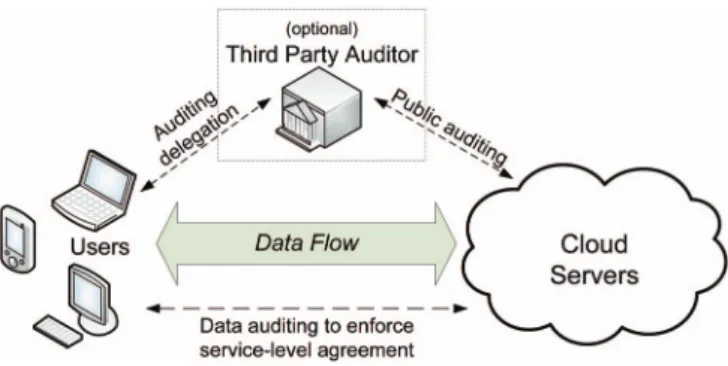
A representative network architecture for cloud storage service architecture is illustrated in Fig. 1. Three different network entities can be identified as follows:
. User: an entity, who has data to be stored in the cloud and relies on the cloud for data storage and computation, can be either enterprise or individual customers.
. Cloud Server (CS): an entity, which is managed by
cloud service provider (CSP) to provide data storage
service and has significant storage space and computation resources (we will not differentiate CS and CSP hereafter).
. Third-Party Auditor: an optional TPA, who has
expertise and capabilities that users may not have, is trusted to assess and expose risk of cloud storage services on behalf of the users upon request. In cloud data storage, a user stores his data through a CSP into a set of cloud servers, which are running in a Fig. 1. Cloud storage service architecture.
simultaneous, cooperated, and distributed manner. Data redundancy can be employed with a technique of erasure-correcting code to further tolerate faults or server crash as user’s data grow in size and importance. Thereafter, for application purposes, the user interacts with the cloud servers via CSP to access or retrieve his data. In some cases, the user may need to perform block level operations on his data. The most general forms of these operations we are considering are block update, delete, insert, and append. Note that in this paper, we put more focus on the support of file-oriented cloud applications other than nonfile applica-tion data, such as social networking data. In other words, the cloud data we are considering is not expected to be rapidly changing in a relative short period.
As users no longer possess their data locally, it is of critical importance to ensure users that their data are being correctly stored and maintained. That is, users should be equipped with security means so that they can make continuous correctness assurance (to enforce cloud storage service-level agreement) of their stored data even without the existence of local copies. In case that users do not necessarily have the time, feasibility or resources to monitor their data online, they can delegate the data auditing tasks to an optional trusted TPA of their respective choices. However, to securely introduce such a TPA, any possible leakage of user’s outsourced data toward TPA through the auditing protocol should be prohibited.
In our model, we assume that the point-to-point communication channels between each cloud server and the user is authenticated and reliable, which can be achieved in practice with little overhead. These authentica-tion handshakes are omitted in the following presentaauthentica-tion.
2.2 Adversary Model
From user’s perspective, the adversary model has to capture all kinds of threats toward his cloud data integrity. Because cloud data do not reside at user’s local site but at CSP’s address domain, these threats can come from two different sources: internal and external attacks. For internal attacks, a CSP can be self-interested, untrusted, and possibly mal-icious. Not only does it desire to move data that has not been or is rarely accessed to a lower tier of storage than agreed for monetary reasons, but it may also attempt to hide a data loss incident due to management errors, Byzantine failures, and so on. For external attacks, data integrity threats may come from outsiders who are beyond the control domain of CSP, for example, the economically motivated attackers. They may compromise a number of cloud data storage servers in different time intervals and subsequently be able to modify or delete users’ data while remaining undetected by CSP.
Therefore, we consider the adversary in our model has the following capabilities, which captures both external and internal threats toward the cloud data integrity. Specifically, the adversary is interested in continuously corrupting the user’s data files stored on individual servers. Once a server is comprised, an adversary can pollute the original data files by modifying or introducing its own fraudulent data to prevent the original data from being retrieved by the user. This corresponds to the threats from external attacks. In the worst case scenario, the adversary can compromise all the
storage servers so that he can intentionally modify the data files as long as they are internally consistent. In fact, this is equivalent to internal attack case where all servers are assumed colluding together from the early stages of application or service deployment to hide a data loss or corruption incident.
2.3 Design Goals
To ensure the security and dependability for cloud data storage under the aforementioned adversary model, we aim to design efficient mechanisms for dynamic data verifica-tion and operaverifica-tion and achieve the following goals:
1. Storage correctness: to ensure users that their data are indeed stored appropriately and kept intact all the time in the cloud.
2. Fast localization of data error: to effectively locate the malfunctioning server when data corruption has been detected.
3. Dynamic data support: to maintain the same level of storage correctness assurance even if users modify, delete, or append their data files in the cloud.
4. Dependability: to enhance data availability against Byzantine failures, malicious data modification and server colluding attacks, i.e., minimizing the effect brought by data errors or server failures.
5. Lightweight: to enable users to perform storage correctness checks with minimum overhead.
2.4 Notation and Preliminaries
. F—the data file to be stored. We assume thatFcan be denoted as a matrix ofmequal-sized data vectors, each consisting ofl blocks. Data blocks are all well represented as elements in Galois FieldGFð2pÞ for
p¼8or 16.
. A—The dispersal matrix used for Reed-Solomon coding.
. G—The encoded file matrix, which includes a set of n¼mþkvectors, each consisting oflblocks.
. fkeyðÞ—pseudorandom function (PRF), which is
defined asf:f0;1gkey!GFð2pÞ.
. keyðÞ—pseudorandom permutation (PRP), which
is defined as:f0;1glog2ð‘Þkey! f0;1glog2ð‘Þ. . ver—a version number bound with the index for
individual blocks, which records the times the block has been modified. Initially we assumeveris 0 for all data blocks.
. sver
ij —the seed for PRF, which depends on the file
name, block indexi, the server positionjas well as the optional block version numberver.
3
E
NSURINGC
LOUDD
ATAS
TORAGEIn cloud data storage system, users store their data in the cloud and no longer possess the data locally. Thus, the correctness and availability of the data files being stored on the distributed cloud servers must be guaranteed. One of the key issues is to effectively detect any unauthorized data modification and corruption, possibly due to server compromise and/or random Byzantine failures. Besides, in the distributed case when such inconsistencies are
successfully detected, to find which server the data error lies in is also of great significance, since it can always be the first step to fast recover the storage errors and/or identifying potential threats of external attacks.
To address these problems, our main scheme for ensuring cloud data storage is presented in this section. The first part of the section is devoted to a review of basic tools from coding theory that is needed in our scheme for file distribution across cloud servers. Then, the homomorphic token is introduced. The token computation function we are considering belongs to a family of universal hash function [27], chosen to preserve the homomorphic properties, which can be perfectly integrated with the verification of erasure-coded data [24], [28]. Subsequently, it is shown how to derive a challenge-response protocol for verifying the storage correctness as well as identifying misbehaving servers. The procedure for file retrieval and error recovery based on erasure-correcting code is also outlined. Finally, we describe how to extend our scheme to third party auditing with only slight modification of the main design.
3.1 File Distribution Preparation
It is well known that erasure-correcting code may be used to tolerate multiple failures in distributed storage systems. In cloud data storage, we rely on this technique to disperse the data fileFredundantly across a set ofn¼mþkdistributed servers. Anðm; kÞReed-Solomon erasure-correcting code is used to create k redundancy parity vectors from m data vectors in such a way that the originalmdata vectors can be reconstructed from anymout of themþkdata and parity vectors. By placing each of themþkvectors on a different server, the original data file can survive the failure of any k of themþkservers without any data loss, with a space overhead ofk=m. For support of efficient sequential I/O to the original file, our file layout is systematic, i.e., the unmodified m data file vectors together with k parity vectors is distributed acrossmþkdifferent servers.
Let F¼ ðF1; F2;. . .; FmÞ and Fi¼ ðf1i; f2i;. . .; fliÞTði2 f1;. . .; mgÞ. Here,T (shorthand for transpose) denotes that each Fi is represented as a column vector, and l denotes
data vector size in blocks. All these blocks are elements of GFð2pÞ. The systematic layout with parity vectors is
achieved with the information dispersal matrixA, derived from anm ðmþkÞVandermonde matrix [29]
1 1 . . . 1 1 . . . 1 1 2 . . . m mþ1 . . . n .. . .. . . . . .. . .. . . . . .. . m1 1 2m1 . . . mm1 mm1þ1 . . . mn1 0 B B B @ 1 C C C A;
where jðj2 f1;. . .; ngÞ are distinct elements randomly
picked fromGFð2pÞ.
After a sequence of elementary row transformations, the desired matrixAcan be written as
A¼ ðIjPÞ ¼ 1 0 . . . 0 p11 p12 . . . p1k 0 1 . . . 0 p21 p22 . . . p2k .. . .. . . . . .. . .. . .. . . . . .. . 0 0 . . . 1 pm1 pm2 . . . pmk 0 B B B @ 1 C C C A;
whereIis ammidentity matrix andPis the secret parity generation matrix with size mk. Note thatAis derived from a Vandermonde matrix, thus it has the property that anymout of themþkcolumns form an invertible matrix. By multiplyingFbyA, the user obtains the encoded file
G¼FA¼ ðGð1Þ; Gð2Þ;. . .; GðmÞ; Gðmþ1Þ;. . .; GðnÞÞ ¼ ðF1; F2;. . .; Fm; Gðmþ1Þ;. . .; GðnÞÞ; where GðjÞ¼ ðgðjÞ 1 ; g ðjÞ 2 ;. . .; g ðjÞ l Þ T ðj2 f1;. . .; ngÞ. As noticed, the multiplication reproduces the original data file vectors ofF and the remaining partðGðmþ1Þ;. . .; GðnÞÞarek parity vectors generated based onF.
3.2 Challenge Token Precomputation
In order to achieve assurance of data storage correctness and data error localization simultaneously, our scheme entirely relies on the precomputed verification tokens. The main idea is as follows: before file distribution the user precomputes a certain number of short verification tokens on individual vectorGðjÞðj2 f1;. . .; ngÞ, each token cover-ing a random subset of data blocks. Later, when the user wants to make sure the storage correctness for the data in the cloud, he challenges the cloud servers with a set of randomly generated block indices. Upon receiving chal-lenge, each cloud server computes a short “signature” over the specified blocks and returns them to the user. The values of these signatures should match the corresponding tokens precomputed by the user. Meanwhile, as all servers operate over the same subset of the indices, the requested response values for integrity check must also be a valid codeword determined by the secret matrixP.
Suppose the user wants to challenge the cloud serverst times to ensure the correctness of data storage. Then, he must precomputetverification tokens for eachGðjÞðj2f1;. . .; ngÞ, using a PRF fðÞ, a PRP ðÞ, a challenge key kchal, and a
master permutation keyKP RP. Specifically, to generate the
ith token for serverj, the user acts as follows:
1. Derive a random challenge value i of GFð2pÞ by
i¼fkchalðiÞ and a permutation key k
ðiÞ
prp based on
KP RP.
2. Compute the set ofrrandomly-chosen indices
fIq2 ½1;. . .; lj1qrg; where Iq¼kðiÞ
prpðqÞ:
3. Calculate the token as
vðijÞ¼X r q¼1 qi GðjÞ½I q; whereGðjÞ½Iq ¼g ðjÞ Iq: Note thatvðijÞ, which is an element ofGFð2pÞwith small
size, is the response the user expects to receive from serverj when he challenges it on the specified data blocks.
After token generation, the user has the choice of either keeping the precomputed tokens locally or storing them in encrypted form on the cloud servers. In our case here, the user stores them locally to obviate the need for encryption and lower the bandwidth overhead during dynamic data operation which will be discussed shortly. The details of token generation are shown in Algorithm 1.
Algorithm 1.Token Precomputation.
1: procedure
2: Choose parametersl; nand function f; ; 3: Choose the numbertof tokens;
4: Choose the numberrof indices per verification; 5: Generate master keyKP RP and challenge keykchal;
6: forvectorGðjÞ; j 1; ndo
7: forroundi 1; tdo
8: Derivei¼fkchalðiÞandk
ðiÞ prp fromKP RP. 9: ComputevðijÞ¼Prq¼1qi GðjÞ½kðiÞ prpðqÞ 10: end for 11: end for
12: Store all thevi’s locally.
13: end procedure
Once all tokens are computed, the final step before file distribution is to blind each parity blockgðijÞinðGðmþ1Þ;. . .;
GðnÞÞby
gðijÞ gðijÞþfkjðsijÞ; i2 f1;. . .; lg;
where kj is the secret key for parity vector GðjÞðj2 fmþ
1;. . .; ngÞ. This is for protection of the secret matrixP. We will discuss the necessity of using blinded parities in detail in Section 5.2. After blinding the parity information, the user disperses all thenencoded vectorsGðjÞðj2 f1;. . .; ngÞ across the cloud serversS1; S2;. . .; Sn.
3.3 Correctness Verification and Error Localization
Error localization is a key prerequisite for eliminating errors in storage systems. It is also of critical importance to identify potential threats from external attacks. However, many previous schemes [23], [24] do not explicitly consider the problem of data error localization, thus only providing binary results for the storage verification. Our scheme outperforms those by integrating the correctness verifica-tion and error localizaverifica-tion (misbehaving server identifica-tion) in our challenge-response protocol: the response values from servers for each challenge not only determine the correctness of the distributed storage, but also contain information to locate potential data error(s).
Specifically, the procedure of theith challenge-response for a cross-check over thenservers is described as follows:
1. The user reveals theias well as theith permutation
keykðiÞ
prpto each servers.
2. The server storing vector GðjÞðj2 f1;. . .; ngÞ aggre-gates thoserrows specified by indexkðiÞ
prpinto a linear combination RðijÞ¼X r q¼1 qi GðjÞ½kðiÞ prpðqÞ; and send backRðijÞðj2 f1;. . .; ngÞ.
3. Upon receiving RðijÞ’s from all the servers, the user takes away blind values inRðjÞðj2 fmþ1;. . .; ngÞby
RðijÞ RðijÞX r q¼1 fkjðsIq;jÞ q i; whereIq¼kðiÞ prpðqÞ:
4. Then, the user verifies whether the received values remain a valid codeword determined by the secret matrixP
Rð1Þi ;. . .; RðimÞP¼? Rðimþ1Þ;. . .; RðinÞ: Because all the servers operate over the same subset of indices, the linear aggregation of these r specified rows
ðRð1Þi ;. . .; RðinÞÞ has to be a codeword in the encoded file matrix (See Section 5.1 for the correctness analysis). If the above equation holds, the challenge is passed. Otherwise, it indicates that among those specified rows, there exist file block corruptions.
Once the inconsistency among the storage has been successfully detected, we can rely on the precomputed verification tokens to further determine where the potential data error(s) lies in. Note that each response RðijÞ is computed exactly in the same way as token vðijÞ, thus the user can simply find which server is misbehaving by verifying the followingn equations:
RiðjÞ¼? viðjÞ; j2 f1;. . .; ng:
Algorithm 2 gives the details of correctness verification and error localization.
Algorithm 2.Correctness Verification and Error Localization.
1: procedureCHALLENGE(i)
2: Recomputei¼fkchalðiÞ andk
ðiÞ
prpfromKP RP;
3: Sendfi; kðprpiÞgto all the cloud servers;
4: Receive from servers:
fRðijÞ¼Prq¼1qi GðjÞ½ kðprpiÞðqÞj1jng 5: forðj mþ1; nÞdo 6: RðjÞ RðjÞPr q¼1fkjðsIq;jÞ q i,Iq¼kðiÞ prpðqÞ 7: end for 8: ifððRð1Þi ;. . .; RðimÞÞ P¼¼ðRðimþ1Þ;. . .; RðinÞÞÞthan 9: Accept and ready for the next challenge.
10: else
11: for(j 1; n)do
12: ifðRðijÞ!¼vðijÞÞthan
13: returnserverjis misbehaving.
14: end if
15: end for
16: end if
17: end procedure
Discussion.Previous work [23], [24] has suggested using
the decoding capability of error-correction code to treat data errors. But such approach imposes a bound on the number of misbehaving serversbbyb bk=2c. Namely, they cannot identify misbehaving servers when b >bk=2c.1 However, our token-based approach, while allowing efficient storage correctness validation, does not have this limitation on the number of misbehaving servers. That is, our approach can
identify any number of misbehaving servers for b
ðmþkÞ. Also note that, for every challenge, each server only needs to send back an aggregated value over the
1. In [23], the authors also suggest using brute-force decoding when their dispersal code is an erasure code. However, such brute-force method is asymptotically inefficient, and still cannot guarantee identification of all misbehaving servers.
specified set of blocks. Thus, the bandwidth cost of our approach is much less than the straightforward approaches that require downloading all the challenged data.
3.4 File Retrieval and Error Recovery
Since our layout of file matrix is systematic, the user can reconstruct the original file by downloading the data vectors from the firstmservers, assuming that they return the correct response values. Notice that our verification scheme is based on random spot-checking, so the storage correctness assurance is a probabilistic one. However, by choosing system parameters ðe:g:; r; l; tÞ appropriately and conducting enough times of verification, we can guarantee the successful file retrieval with high probability. On the other hand, whenever the data corruption is detected, the comparison of precomputed tokens and received response values can guarantee the identification of misbehaving server(s) (again with high probability), which will be discussed shortly. Therefore, the user can always ask servers to send back blocks of the r rows specified in the challenge and regenerate the correct blocks by erasure correction, shown in Algorithm 3, as long as the number of identified misbehaving servers is less than k. (otherwise, there is no way to recover the corrupted blocks due to lack of redundancy, even if we know the position of misbehav-ing servers.) The newly recovered blocks can then be redistributed to the misbehaving servers to maintain the correctness of storage.
Algorithm 3.Error Recovery.
1: procedure
%Assume the block corruptions have been detected among
%the specifiedrrows;
%Assumeskservers have been identified misbehaving
2: Downloadrrows of blocks from servers;
3: Treatsservers as erasures and recover the blocks. 4: Resend the recovered blocks to corresponding
servers.
5: end procedure
3.5 Toward Third Party Auditing
As discussed in our architecture, in case the user does not have the time, feasibility, or resources to perform the storage correctness verification, he can optionally delegate this task to an independent third-party auditor, making the cloud storage publicly verifiable. However, as pointed out by the recent work [30], [31], to securely introduce an effective TPA, the auditing process should bring in no new vulnerabilities toward user data privacy. Namely, TPA should not learn user’s data content through the delegated data auditing. Now we show that with only slight modification, our protocol can support privacy-preserving third party auditing.
The new design is based on the observation of linear property of the parity vector blinding process. Recall that the reason of blinding process is for protection of the secret matrix P against cloud servers. However, this can be achieved either by blinding the parity vector or by blinding the data vector (we assumek < m). Thus, if we blind data vector before file distribution encoding, then the storage
verification task can be successfully delegated to third party auditing in a privacy-preserving manner. Specifically, the new protocol is described as follows:
1. Before file distribution, the user blinds each file block data gðijÞ in ðGð1Þ;. . .; GðmÞÞ by gðjÞ
i g
ðjÞ
i þ
fkjðsijÞ; i2 f1;. . .; lg, where kj is the secret key for data vectorGðjÞðj2 f1;. . .; mgÞ.
2. Based on the blinded data vectorðGð1Þ;. . .; GðmÞÞ, the user generateskparity vectors ðGðmþ1Þ;. . .; GðnÞÞvia the secret matrixP.
3. The user calculates the ith token for server j as previous scheme: vðijÞ¼ Pr q¼1 q i GðjÞ½Iq, where GðjÞ½I q ¼gð jÞ Iq andi¼fkchalðiÞ 2GFð2 pÞ.
4. The user sends the token setfvðijÞgf1it;1jng, secret matrixP, permutation and challenge keyKP RP, and
kchal to TPA for auditing delegation.
The correctness validation and misbehaving server iden-tification for TPA is just similar to the previous scheme. The only difference is that TPA does not have to take away the blinding values in the servers’ responseRðjÞðj2 f1;. . .; ngÞ but verifies directly. As TPA does not know the secret blinding keykjðj2 f1;. . .; mgÞ, there is no way for TPA to
learn the data content information during auditing process. Therefore, the privacy-preserving third party auditing is achieved. Note that compared to previous scheme, we only change the sequence of file encoding, token precomputation, and blinding. Thus, the overall computation overhead and communication overhead remains roughly the same.
4
P
ROVIDINGD
YNAMICD
ATAO
PERATIONS
UPPORTSo far, we assumed thatFrepresents static or archived data. This model may fit some application scenarios, such as libraries and scientific data sets. However, in cloud data storage, there are many potential scenarios where data stored in the cloud is dynamic, like electronic documents, photos, or log files, etc. Therefore, it is crucial to consider the dynamic case, where a user may wish to perform various block-level operations of update, delete, and append to modify the data file while maintaining the storage correctness assurance.
Since data do not reside at users’ local site but at cloud service provider’s address domain, supporting dynamic data operation can be quite challenging. On the one hand, CSP needs to process the data dynamics request without knowing the secret keying material. On the other hand, users need to ensure that all the dynamic data operation request has been faithfully processed by CSP. To address this problem, we briefly explain our approach methodology here and provide the details later. For any data dynamic operation, the user must first generate the corresponding resulted file blocks and parities. This part of operation has to be carried out by the user, since only he knows the secret matrix P. Besides, to ensure the changes of data blocks correctly reflected in the cloud address domain, the user also needs to modify the corresponding storage verification tokens to accommodate the changes on data blocks. Only with the accordingly changed storage verification tokens, the previously discussed challenge-response protocol can be carried on successfully even after data dynamics. In
other words, these verification tokens help to ensure that CSP would correctly execute the processing of any dynamic data operation request. Otherwise, CSP would be caught cheating with high probability in the protocol execution later on. Given this design methodology, the straightfor-ward and trivial way to support these operations is for user to download all the data from the cloud servers and recompute the whole parity blocks as well as verification tokens. This would clearly be highly inefficient. In this section, we will show how our scheme can explicitly and efficiently handle dynamic data operations for cloud data storage, by utilizing the linear property of Reed-Solomon code and verification token construction.
4.1 Update Operation
In cloud data storage, a user may need to modify some data block(s) stored in the cloud, from its current valuefij to a
new one,fijþfij. We refer this operation as data update.
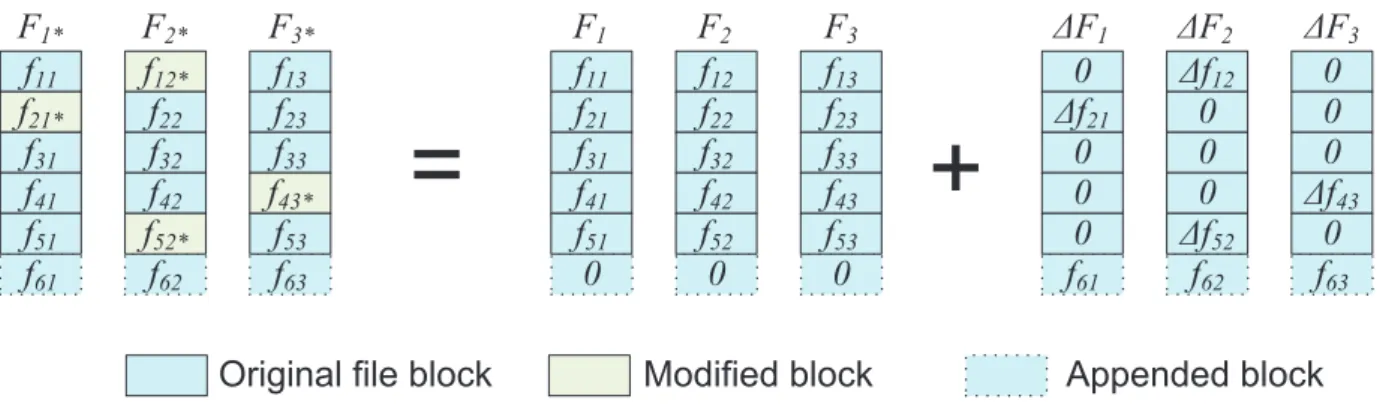
Fig. 2 gives the high level logical representation of data block update. Due to the linear property of Reed-Solomon code, a user can perform the update operation and generate the updated parity blocks by using fij only, without
involving any other unchanged blocks. Specifically, the user can construct a general update matrixFas
F¼ f11 f12 . . . f1m f21 f22 . . . f2m .. . .. . . . . .. . fl1 fl2 . . . flm 0 B B B B @ 1 C C C C A ¼ ðF1;F2;. . .;FmÞ:
Note that we use zero elements in F to denote the unchanged blocks and thus F should only be a sparse matrix most of the time (we assume for certain time epoch, the user only updates a relatively small part of file F). To maintain the corresponding parity vectors as well as be consistent with the original file layout, the user can multiply
FbyAand thus generate the update information for both the data vectors and parity vectors as follows:
FA¼Gð1Þ;. . .;GðmÞ;Gðmþ1Þ;. . .;GðnÞ
¼F1;. . .;Fm;Gðmþ1Þ;. . .;GðnÞ;
where GðjÞðj2 fmþ1;. . .; ngÞdenotes the update infor-mation for the parity vectorGðjÞ.
Because the data update operation inevitably affects some or all of the remaining verification tokens, after preparation of update information, the user has to amend those unused tokens for each vector GðjÞ to maintain the same storage correctness assurance. In other words, for all the unused tokens, the user needs to exclude every occurrence of the old data block and replace it with the new one. Thanks to the homomorphic construction of our verification token, the user can perform the token update efficiently. To give more details, suppose a block GðjÞ½I
s, which is covered by the
specific tokenvðijÞ, has been changed to GðjÞ½I
s þGðjÞ½Is,
whereIs¼kðiÞ
prpðsÞ. To maintain the usability of tokenv
ðjÞ
i , it is
not hard to verify that the user can simply update it byvðijÞ vðijÞþ s
i GðjÞ½Is, without retrieving other r1 blocks
required in the precomputation ofvðijÞ.
After the amendment to the affected tokens,2 the user needs to blind the update informationgðijÞfor each parity block inðGðmþ1Þ;. . .;GðnÞÞto hide the secret matrixPby
gðijÞ giðjÞþfkjðs
ver
ij Þ; i2 f1;. . .; lg. Here, we use a new
seedsver
ij for the PRF. The version numberverfunctions like
a counter which helps the user to keep track of the blind information on the specific parity blocks. After blinding, the user sends update information to the cloud servers, which perform the update operation as GðjÞ GðjÞþGðjÞ;
ðj2 f1;. . .; ngÞ.
Discussion.Note that by using the new seedsverij for the
PRF functions every time (for a block update operation), we can ensure the freshness of the random value embedded into parity blocks. In other words, the cloud servers cannot simply abstract away the random blinding information on parity blocks by subtracting the old and newly updated parity blocks. As a result, the secret matrixPis still being well protected, and the guarantee of storage correctness remains.
4.2 Delete Operation
Sometimes, after being stored in the cloud, certain data blocks may need to be deleted. The delete operation we are considering is a general one, in which user replaces the data block with zero or some special reserved data symbol. From this point of view, the delete operation is actually a special case of the data update operation, where the original data blocks can be replaced with zeros or some predetermined special blocks. Therefore, we can rely on the
2. In practice, it is possible that only a fraction of tokens need amendment, since the updated blocks may not be covered by all the tokens.
update procedure to support delete operation, i.e., by settingfij inF to befij. Also, all the affected tokens
have to be modified and the updated parity information has to be blinded using the same method specified in an update operation.
4.3 Append Operation
In some cases, the user may want to increase the size of his stored data by adding blocks at the end of the data file, which we refer as data append. We anticipate that the most frequent append operation in cloud data storage is bulk append, in which the user needs to upload a large number of blocks (not a single block) at one time.
Given the file matrix F illustrated in file distribution preparation, appending blocks toward the end of a data file is equivalent to concatenate corresponding rows at the bottom of the matrix layout for file F (See Fig. 2). In the beginning, there are only l rows in the file matrix. To simplify the presentation, we suppose the user wants to
append m blocks at the end of file F, denoted as
ðflþ1;1; flþ1;2;. . .; flþ1;mÞ (We can always use zero-padding
to make a row of m elements). With the secret matrixP, the user can directly calculate the append blocks for each parity server asðflþ1;1;. . .; flþ1;mÞ P¼ ðg
ðmþ1Þ
lþ1 ;. . .; g ðnÞ
lþ1Þ. To ensure the newly appended blocks are covered by our challenge tokens, we need a slight modification to our token precomputation. Specifically, we require the user to expect the maximum size in blocks, denoted as lmax, for
each of his data vector. This idea of supporting block append was first suggested by Ateniese et al. [14] in a single server setting, and it relies on both the initial budget for the maximum anticipated data size lmax in each
encoded data vector and the system parameter rmax¼ dr ðlmax=lÞe for each precomputed challenge-response
token. The precomputation of the ith token on server j is modified as follows: vi¼Prqmax¼1
q i GðjÞ½Iq, where GðjÞ½Iq ¼ GðjÞ½ kðprpiÞðqÞ; ½kð iÞ prpðqÞ l; 0; ½kðiÞ prpðqÞ> l; (
and the PRP ðÞ is modified as: ðÞ:f0;1glog2ðlmaxÞ
key! f0;1glog2ðlmaxÞ
. This formula guarantees that on average, there will berindices falling into the range of existinglblocks. Because the cloud servers and the user have the agreement on the number of existing blocks in each vectorGðjÞ, servers will follow exactly the above procedure when recomputing the token values upon receiving user’s challenge request.
Now when the user is ready to append new blocks, i.e., both the file blocks and the corresponding parity blocks are generated, the total length of each vector GðjÞ will be increased and fall into the range ½l; lmax. Therefore, the
user will update those affected tokens by adding si GðjÞ½Is to the old vi whenever GðjÞ½Is 6¼0 for Is> l,
where Is¼kðiÞ
prpðsÞ. The parity blinding is similar as introduced in update operation, and thus is omitted here.
4.4 Insert Operation
An insert operation to the data file refers to an append operation at the desired index position while maintaining the same data block structure for the whole data file, i.e., inserting a block F½j corresponds to shifting all blocks
starting with index jþ1 by one slot. Thus, an insert operation may affect many rows in the logical data file matrix F, and a substantial number of computations are required to renumber all the subsequent blocks as well as recompute the challenge-response tokens. Hence, a direct insert operation is difficult to support.
In order to fully support block insertion operation, recent work [15], [16] suggests utilizing additional data structure (for example, Merkle Hash Tree [32]) to maintain and enforce the block index information. Following this line of research, we can circumvent the dilemma of our block insertion by viewing each insertion as a logical append operation at the end of file F. Specifically, if we also use additional data structure to maintain such logical to physical block index mapping information, then all block insertion can be treated via logical append operation, which can be efficiently supported. On the other hand, using the block index mapping information, the user can still access or retrieve the file as it is. Note that as a tradeoff, the extra data structure information has to be maintained locally on the user side.
5
S
ECURITYA
NALYSIS ANDP
ERFORMANCEE
VALUATIONIn this section, we analyze our proposed scheme in terms of correctness, security, and efficiency. Our security analysis focuses on the adversary model defined in Section 2. We also evaluate the efficiency of our scheme via implementa-tion of both file distribuimplementa-tion preparaimplementa-tion and verificaimplementa-tion token precomputation.
5.1 Correctness Analysis
First, we analyze the correctness of the verification procedure. Upon obtaining all the response RðijÞs from servers and taking away the random blind values from RðijÞðj2 fmþ1;. . .; ngÞ, the user relies on the equation
ðRð1Þi ;. . .; RðimÞÞ P¼? ðRðimþ1Þ;. . .; RðinÞÞto ensure the storage correctness. To see why this is true, we can rewrite the equation according to the token computation:
Xr q¼1 qi gð1ÞI q ;. . .; Xr q¼1 qi gðImÞ q ! P ¼ X r q¼1 qi gðImþ1Þ q ;. . .; Xr q¼1 qi gðInÞ q ! ;
and, hence, the left-hand side (LHS) of the equation expands as LHS¼i; 2i;. . .; r i gð1ÞI1 gð2ÞI1 . . . gðIm1Þ gð1ÞI2 gð2ÞI2 . . . gðIm2Þ .. . .. . . . . .. . gð1ÞIr gð2ÞIr . . . gðImrÞ 0 B B B B B B @ 1 C C C C C C A P ¼i; 2i;. . .; r i gIðm1þ1Þ gðIm1þ2Þ . . . gðIn1Þ gIðm2þ1Þ gðIm2þ2Þ . . . gðIn2Þ .. . .. . . . . .. . gIðmrþ1Þ gðImrþ2Þ . . . gðInrÞ 0 B B B B B B @ 1 C C C C C C A ;
which equals the right hand side as required. Thus, it is clear to show that as long as each server operates on the same specified subset of rows, the above checking equation will always hold.
5.2 Security Strength
5.2.1 Detection Probability against Data Modification
In our scheme, servers are required to operate only on specified rows in each challenge-response protocol execu-tion. We will show that this “sampling” strategy on selected rows instead of all can greatly reduce the computational overhead on the server, while maintaining high detection probability for data corruption.
Supposenc servers are misbehaving due to the possible
compromise or Byzantine failure. In the following analysis, we do not limit the value of nc, i.e., ncn. Thus, all the
analysis results hold even if all the servers are compromised. We will leave the explanation on collusion resistance of our scheme against this worst case scenario in a later section. Assume the adversary modifies the data blocks inzrows out of thelrows in the encoded file matrix. Letrbe the number of different rows for which the user asks for checking in a challenge. Let X be a discrete random variable that is defined to be the number of rows chosen by the user that matches the rows modified by the adversary. We first analyze the matching probability that at least one of the rows picked by the user matches one of the rows modified by the adversary: Pr m¼1PfX¼0g ¼1 Qr1 i¼0ð1minflzi;1gÞ 1 ðlz l Þ r
. If none of the specified r rows in the ith verification process are deleted or modified, the adversary avoids the detection.
Next, we study the probability of a false negative result that there exists at least one invalid response calculated from those specified r rows, but the checking equation still holds. Consider the responses Rð1Þi ;. . .; RðinÞ returned from the data storage servers for the ith challenge, each response valueRðijÞ, calculated withinGFð2pÞ, is based onr
blocks on serverj. The number of responsesRðmþ1Þ;. . .; RðnÞ from parity servers is k¼nm. Thus, according to
proposition 2 of our previous work in [33], the false negative probability isPfr¼P r1þP r2, whereP r1¼ð1þ2
pÞnc1
2nc1 andP r2¼ ð1Pr1Þð2pÞk.
Based on above discussion, it follows that the probability of data modification detection across all storage servers is Pd¼Pmr ð1PfrÞ. Fig. 3 plots Pd for different values of
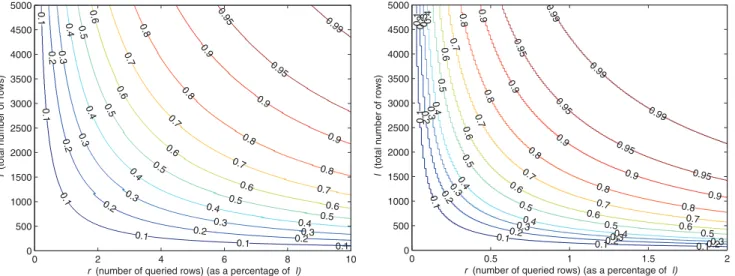
l; r; z while we set p¼16, nc¼10, and k¼5.3 From the
figure we can see that if more than a fraction of the data file is corrupted, then it suffices to challenge for a small constant number of rows in order to achieve detection with high probability. For example, if z¼1% of l, every token only needs to cover 460 indices in order to achieve the detection probability of at least 99 percent.
5.2.2 Identification Probability for Misbehaving Servers
We have shown that, if the adversary modifies the data blocks among any of the data storage servers, our sampling checking scheme can successfully detect the attack with high probability. As long as the data modification is caught, the user will further determine which server is malfunctioning. This can be achieved by comparing the response values RðijÞ with the prestored tokens vðijÞ, where j2 f1;. . .; ng. The probability for error localization or identifying misbehaving server(s) can be computed in a similar way. It is the product of the matching probability for sampling check and the probability of complementary event for the false negative result. Obviously, the matching probability isPbr
m¼1 Qr1
i¼0ð1minflz^i;1gÞ, wherez^z.
Next, we consider the false negative probability that RðijÞ¼v
ðjÞ
i when at least one of z^ blocks is modified.
According to [33, proposition 1], tokens calculated in GFð2pÞ for two different data vectors collide with
prob-ability Pbr
f ¼2p. Thus, the identification probability for
misbehaving server(s) isPbd¼Pbmr ð1PbfrÞ. Along with the
analysis in detection probability, if z¼1% of l and each
3. Note thatnc and k only affect the false negative probability Pfr.
However in our scheme, sincep¼16almost dominates the negligibility of
Pr
f, the value ofncandkhave little effect in the plot ofPd.
Fig. 3. The detection probabilityPdagainst data modification. We showPdas a function ofl(the number of blocks on each cloud storage server) and r(the number of rows queried by the user, shown as a percentage ofl) for two values ofz(the number of rows modified by the adversary). Both graphs are plotted underp¼16,nc¼10, andk¼5, but with different scale. (a)z¼1%ofl. (b)z¼10%ofl.
token covers 460 indices, the identification probability for misbehaving servers is at least 99 percent. Note that if the number of detected misbehaving servers is less than the parity vectors, we can use erasure-correcting code to recover the corrupted data, achieving storage dependability as shown at Section 3.4 and Algorithm 3.
5.2.3 Security Strength against Worst Case Scenario
We now explain why it is a must to blind the parity blocks and how our proposed schemes achieve collusion resistance against the worst case scenario in the adversary model.
Recall that in the file distribution preparation, the redundancy parity vectors are calculated via multiplying the file matrix F by P, where P is the secret parity generation matrix we later rely on for storage correctness assurance. If we disperse all the generated vectors directly after token precomputation, i.e., without blinding, mal-icious servers that collaborate can reconstruct the secret P
matrix easily: they can pick blocks from the same rows among the data and parity vectors to establish a set ofmk linear equations and solve for themkentries of the parity generation matrixP. Once they have the knowledge ofP, those malicious servers can consequently modify any part of the data blocks and calculate the corresponding parity blocks, and vice versa, making their codeword relationship always consistent. Therefore, our storage correctness challenge scheme would be undermined—even if those modified blocks are covered by the specified rows, the storage correctness check equation would always hold.
To prevent colluding servers from recovering P and making up consistently-related data and parity blocks, we utilize the technique of adding random perturbations to the encoded file matrix and hence hide the secret matrixP. We make use of a keyed pseudorandom function fkjðÞ with key kj and seed sverij , both of which has been introduced
previously. In order to maintain the systematic layout of data file, we only blind the parity blocks with random perturbations (We can also only blind data blocks and achieve privacy-preserving third party auditing, as shown in Section 3.5). Our purpose is to add “noise” to the set of linear equations and make it computationally infeasible to solve for the correct secret matrixP. By blinding each parity block with random perturbation, the malicious servers no longer have all the necessary information to build up the
correct linear equation groups and therefore cannot derive the secret matrixP.
5.3 Performance Evaluation
We now assess the performance of the proposed storage auditing scheme. We focus on the cost of file distribution preparation as well as the token generation. Our experiment is conducted on a system with an Intel Core 2 processor running at 1.86 GHz, 2,048 MB of RAM, and a 7,200 RPM Western Digital 250 GB Serial ATA drive. Algorithms are implemented using open-source erasure coding library Jerasure [34] written in C. All results represent the mean of 20 trials.
5.3.1 File Distribution Preparation
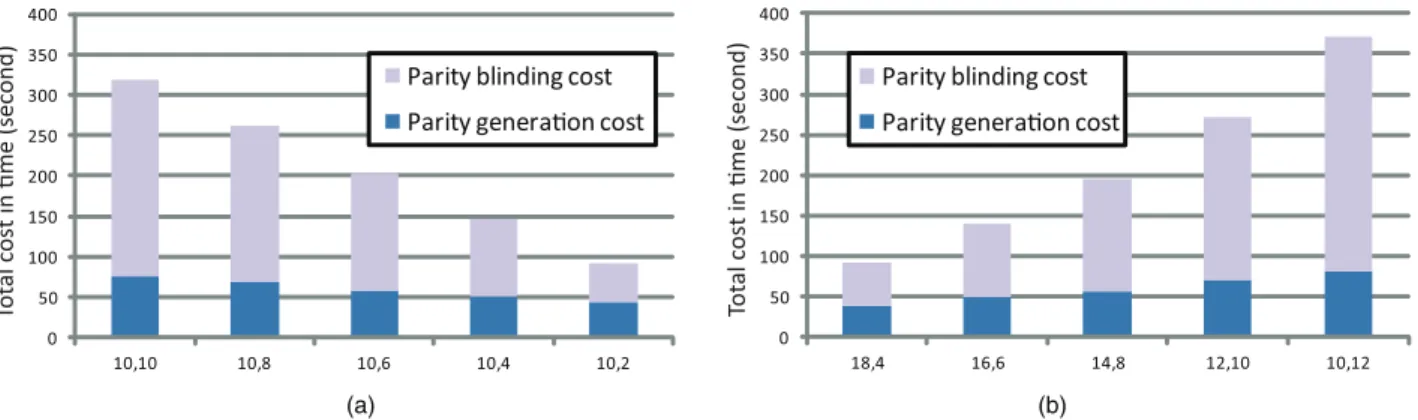
As discussed, file distribution preparation includes the generation of parity vectors (the encoding part) as well as the corresponding parity blinding part. We consider two sets of different parameters for the ðm; kÞ Reed-Solomon encoding, both of which work overGFð216Þ. Fig. 4 shows the total cost for preparing a 1 GB file before outsourcing. In the figure on the left, we set the number of data vectorsm constant at 10, while decreasing the number of parity vectorskfrom 10 to 2. In the one on the right, we keep the total number of data and parity vectorsmþkfixed at 22, and change the number of data vectors m from 18 to 10. From the figure, we can see the numberkis the dominant factor for the cost of both parity generation and parity blinding. This can be explained as follows: on the one hand, kdetermines how many parity vectors are required before data outsourcing, and the parity generation cost increases almost linearly with the growth ofk; on the other hand, the growth of k means the larger number of parity blocks required to be blinded, which directly leads to more calls to our nonoptimized PRF generation in C. By using more practical PRF constructions, such as HMAC [35], the parity blinding cost is expected to be further improved.
Compared to the existing work [23], it can be shown from Fig. 4 that the file distribution preparation of our scheme is more efficient. This is because in [23] an additional layer of error-correcting code has to be conducted on all the data and parity vectors right after the file distribution encoding. For the same reason, the two-layer coding structure makes the solution in [23] more suitable for static data only, as any
(a) (b)
Fig. 4. Performance comparison between two different parameter settings for 1 GB file distribution preparation. Theðm; kÞdenotes the chosen parameters for the underlying Reed-Solomon coding. For example, (10,2) means we divide file into 10 data vectors and then generate two redundant parity vectors. (a)mis fixed, andkis decreasing. (b)mþkis fixed.
change to the contents of fileFmust propagate through the two-layer error-correcting code, which entails both high communication and computation complexity. But in our scheme, the file update only affects the specific “rows” of the encoded file matrix, striking a good balance between both error resilience and data dynamics.
5.3.2 Challenge Token Computation
Although in our scheme the number of verification tokentis a fixed priori determined before file distribution, we can overcome this issue by choosing sufficient largetin practice. For example, whentis selected to be 7,300 and 14,600, the data file can be verified every day for the next 20 years and 40 years, respectively, which should be of enough use in practice. Note that instead of directly computing each token, our implementation uses the Horner algorithm suggested in [24] to calculate token vðijÞ from the back, and achieves a slightly faster performance. Specifically
vðijÞ¼X r
q¼1
riþ1q GðjÞ½Iq ¼ ðððGðjÞ½I1 i
þGðjÞ½I2Þ iþGðjÞ½I3. . .Þ iþGðjÞ½IrÞ i;
which only requires r multiplication and ðr1Þ XOR operations. With Jerasure library [34], the multiplication over GFð216Þin our experiment is based on discrete logarithms.
Following the security analysis, we select a practical parameter r¼460 for our token precomputation (see Section 5.2.1), i.e., each token covers 460 different indices. Other parameters are along with the file distribution preparation. Our implementation shows that the average token precomputation cost is about 0.4 ms. This is significantly faster than the hash function based token precomputation scheme proposed in [14]. To verify encoded data distributed over a typical number of 14 servers, the total cost for token precomputation is no more than 1 and 1.5 minutes, for the next 20 years and 40 years, respectively. Note that each token is only an element of fieldGFð216Þ, the extra storage for those precomputed tokens is less than 1MB, and thus can be neglected. Table 1 gives a summary of storage and computation cost of token precomputation for 1GB data file under different system settings.
6
R
ELATEDW
ORKJuels and Kaliski Jr. [10] described a formal “proof of retrievability” (POR) model for ensuring the remote data integrity. Their scheme combines spot-checking and error-correcting code to ensure both possession and retrievability
of files on archive service systems. Shacham and Waters [17] built on this model and constructed a random linear function-based homomorphic authenticator which enables unlimited number of challenges and requires less commu-nication overhead due to its usage of relatively small size of BLS signature. Bowers et al. [18] proposed an improved framework for POR protocols that generalizes both Juels and Shacham’s work. Later in their subsequent work, Bowers et al. [23] extended POR model to distributed systems. However, all these schemes are focusing on static data. The effectiveness of their schemes rests primarily on the preprocessing steps that the user conducts before outsourcing the data fileF. Any change to the contents of
F, even few bits, must propagate through the error-correcting code and the corresponding random shuffling process, thus introducing significant computation and communication complexity. Recently, Dodis et al. [20] gave theoretical studies on generalized framework for different variants of existing POR work.
Ateniese et al. [11] defined the “provable data posses-sion” (PDP) model for ensuring possession of file on untrusted storages. Their scheme utilized public key-based homomorphic tags for auditing the data file. However, the precomputation of the tags imposes heavy computation overhead that can be expensive for an entire file. In their subsequent work, Ateniese et al. [14] described a PDP scheme that uses only symmetric key-based cryptography. This method has lower overhead than their previous scheme and allows for block updates, deletions, and appends to the stored file, which has also been supported in our work. However, their scheme focuses on single server scenario and does not provide data availability guarantee against server failures, leaving both the distrib-uted scenario and data error recovery issue unexplored. The explicit support of data dynamics has further been studied in the two recent work [15] and [16]. Wang et al. [15] proposed to combine BLS-based homomorphic authentica-tor with Merkle Hash Tree to support fully data dynamics, while Erway et al. [16] developed a skip list-based scheme to enable provable data possession with fully dynamics support. The incremental cryptography work done by Bellare et al. [36] also provides a set of cryptographic building blocks such as hash, MAC, and signature functions that may be employed for storage integrity verification while supporting dynamic operations on data. However, this branch of work falls into the traditional data integrity protection mechanism, where local copy of data has to be maintained for the verification. It is not yet clear how the work can be adapted to cloud storage scenario where users no longer have the data at local sites but still need to ensure the storage correctness efficiently in the cloud.
TABLE 1
The Storage and Computation Cost of Token Precomputation for 1 GB Data File under Different System Settings
In other related work, Curtmola et al. [19] aimed to ensure data possession of multiple replicas across the distributed storage system. They extended the PDP scheme to cover multiple replicas without encoding each replica separately, providing guarantee that multiple copies of data are actually maintained. Lillibridge et al. [25] presented a P2P backup scheme in which blocks of a data file are dispersed acrossmþkpeers using anðm; kÞ-erasure code. Peers can request random blocks from their backup peers and verify the integrity using separate keyed cryptographic hashes attached on each block. Their scheme can detect data loss from free-riding peers, but does not ensure all data are unchanged. Filho and Barreto [37] proposed to verify data integrity using RSA-based hash to demonstrate uncheatable data possession in peer-to-peer file sharing networks. However, their proposal requires exponentiation over the entire data file, which is clearly impractical for the server whenever the file is large. Shah et al. [12], [13] proposed allowing a TPA to keep online storage honest by first encrypting the data then sending a number of precomputed symmetric-keyed hashes over the encrypted data to the auditor. However, their scheme only works for encrypted files, and auditors must maintain long-term state. Schwarz and Miller [24] proposed to ensure static file integrity across multiple distributed servers, using erasure-coding and block-level file integrity checks. We adopted some ideas of their distributed storage verification protocol. However, our scheme further support data dynamics and explicitly study the problem of misbehaving server identification, while theirs did not. Very recently, Wang et al. [31] gave a study on many existing solutions on remote data integrity checking, and discussed their pros and cons under different design scenarios of secure cloud storage services.
Portions of the work presented in this paper have previously appeared as an extended abstract in [1]. We have revised the paper a lot and add more technical details as compared to [1]. The primary improvements are as follows: First, we provide the protocol extension for privacy-preserving third-party auditing, and discuss the application scenarios for cloud storage service. Second, we add correct-ness analysis of proposed storage verification design. Third, we completely redo all the experiments in our performance evaluation part, which achieves significantly improved result as compared to [1]. We also add detailed discussion on the strength of our bounded usage for protocol verifica-tions and its comparison with state of the art.
7
C
ONCLUSIONIn this paper, we investigate the problem of data security in cloud data storage, which is essentially a distributed storage system. To achieve the assurances of cloud data integrity and availability and enforce the quality of dependable cloud storage service for users, we propose an effective and flexible distributed scheme with explicit dynamic data support, including block update, delete, and append. We rely on erasure-correcting code in the file distribution preparation to provide redundancy parity vectors and guarantee the data dependability. By utilizing the homo-morphic token with distributed verification of erasure-coded data, our scheme achieves the integration of storage
correctness insurance and data error localization, i.e., whenever data corruption has been detected during the storage correctness verification across the distributed servers, we can almost guarantee the simultaneous identi-fication of the misbehaving server(s). Considering the time, computation resources, and even the related online burden of users, we also provide the extension of the proposed main scheme to support third-party auditing, where users can safely delegate the integrity checking tasks to third-party auditors and be worry-free to use the cloud storage services. Through detailed security and extensive experi-ment results, we show that our scheme is highly efficient and resilient to Byzantine failure, malicious data modifica-tion attack, and even server colluding attacks.
A
CKNOWLEDGMENTSThis work was supported in part by the US National Science Foundation under grants 1054317, CNS-1116939, CNS-1156318, and CNS-1117111, and by an Amazon web service research grant. A preliminary version [1] of this paper was presented at the 17th IEEE International Workshop on Quality of Service (IWQoS ’09).
R
EFERENCES[1] C. Wang, Q. Wang, K. Ren, and W. Lou, “Ensuring Data Storage Security in Cloud Computing,”Proc. 17th Int’l Workshop Quality of Service (IWQoS ’09),pp. 1-9, July 2009.
[2] Amazon.com, “Amazon Web Services (AWS),” http://aws. amazon.com, 2009.
[3] Sun Microsystems, Inc., “Building Customer Trust in Cloud Computing with Transparent Security,” https://www.sun.com/ offers/details/sun_transparency.xml, Nov. 2009.
[4] K. Ren, C. Wang, and Q. Wang, “Security Challenges for the Public Cloud,”IEEE Internet Computing,vol. 16, no. 1, pp. 69-73, 2012.
[5] M. Arrington, “Gmail Disaster: Reports of Mass Email Deletions,” http://www.techcrunch.com/2006/12/28/gmail-disasterreports-of-mass-email-deletions, Dec. 2006.
[6] J. Kincaid, “MediaMax/TheLinkup Closes Its Doors,” http:// www.techcrunch.com/2008/07/10/mediamaxthelinkup-closes-its-doors, July 2008.
[7] Amazon.com, “Amazon S3 Availability Event: July 20, 2008,” http://status.aws.amazon.com/s3-20080720.html, July 2008.
[8] S. Wilson, “Appengine Outage,” http://www.cio-weblog.com/ 50226711/appengine_outage.php, June 2008.
[9] B. Krebs, “Payment Processor Breach May Be Largest Ever,” http://voices.washingtonpost.com/securityfix/2009/01/ payment_processor_breach_may_b.html, Jan. 2009.
[10] A. Juels and B.S. Kaliski Jr., “PORs: Proofs of Retrievability for Large Files,”Proc. 14th ACM Conf. Computer and Comm. Security (CCS ’07),pp. 584-597, Oct. 2007.
[11] G. Ateniese, R. Burns, R. Curtmola, J. Herring, L. Kissner, Z. Peterson, and D. Song, “Provable Data Possession at Untrusted Stores,”Proc. 14th ACM Conf. Computer and Comm. Security (CCS ’07),pp. 598-609, Oct. 2007.
[12] M.A. Shah, M. Baker, J.C. Mogul, and R. Swaminathan, “Auditing to Keep Online Storage Services Honest,” Proc. 11th USENIX Workshop Hot Topics in Operating Systems (HotOS ’07),pp. 1-6, 2007.
[13] M.A. Shah, R. Swaminathan, and M. Baker, “Privacy-Preserving Audit and Extraction of Digital Contents,” Cryptology ePrint Archive, Report 2008/186, http://eprint.iacr.org, 2008.
[14] G. Ateniese, R.D. Pietro, L.V. Mancini, and G. Tsudik, “Scalable and Efficient Provable Data Possession,”Proc. Fourth Int’l Conf. Security and Privacy in Comm. Netowrks (SecureComm ’08),pp. 1-10, 2008.
[15] Q. Wang, C. Wang, J. Li, K. Ren, and W. Lou, “Enabling Public Verifiability and Data Dynamics for Storage Security in Cloud Computing,” Proc. 14th European Conf. Research in Computer Security (ESORICS ’09),pp. 355-370, 2009.