Joint Discussion Paper
Series in Economics
by the Universities of Aachen · Gießen · Göttingen
Kassel · Marburg · Siegen
ISSN 1867-3678
No. 26-2010
Markus Jorra
The Effect of IMF Lending on the Probability of Sovereign
Debt Crises
This paper can be downloaded from
http://www.uni-marburg.de/fb02/makro/forschung/magkspapers/index_html%28magks%29 Coordination: Bernd Hayo • Philipps-University Marburg
Gießen Marburg Kassel Siegen Aachen Göttingen
MAGKS
Working Paper
The Effect of IMF Lending on the
Probability of Sovereign Debt Crises
Markus Jorra
∗October 14, 2010
This paper explores empirically how the adoption of IMF programs affects sovereign risk over the medium term. We find that IMF programs signifi-cantly increase the probability of subsequent sovereign defaults by approxi-mately 1.5 to 2 percentage points. These results cannot be attributed to en-dogeneity bias as they are supported by specifications that explain sovereign defaults and program participation simultaneously. Furthermore, IMF pro-grams turn out to be especially detrimental to fiscal solvency when the Fund distributes its resources to countries whose economic fundamentals are al-ready weak. Our evidence is therefore consistent with the hypothesis that debtor moral hazard is most likely to occur in these circumstances. Other explanations that point to the effects of debt dilution and the possibility of IMF triggered debt runs, however, are also possible.
Journal of Economic Literature Classification Codes: F33, F34, C25, C35
Keywords IMF programs, Sovereign defaults, Bivariate probit, International Financial Architecture
∗Justus Liebig University Giessen, Department of Economics and Business, Licher Straße 66,
35394 Gießen, Germany. Telephone: +49 641 99-22172. Telefax: +49 641 99-22179. E-mail: [email protected].
1. Introduction
When the banking panic of the years 2007/2008 endangered the stability of the world-wide financial system governments stepped in by providing a mixture of generous public guarantees and fiscal stimulus. Since then, the resulting large primary deficits and swollen debt burdens of many countries have brought sovereign risk back on the agenda of investors, policy makers and economists alike. Even among developed economies some countries - most notably Greece - experienced a dramatic loss of market confidence and saw the interest rates on their debt skyrocketing. In the search for a solution to the problem of looming debt crises politicians of the European Union (EU) turned towards the International Monetary Fund (IMF or Fund). Albeit its Articles of Agreement do not provide the IMF with an explicitly stated mandate to fight sovereign debt crises1 the Fund’s Executive Board answered the calls by approving a € 30 billion Stand-By Arrangement for Greece on May 09, 2010 which was supplemented by further EU loans. Spreads on Greece’s ten year government bonds relative to Germany’s, however, did not return to pre-crisis levels, a mere 0.5 percentage points in the average, measured from the introduction of the Euro in 2001 to the end of 2009. Instead, in August 2010 the spread averaged 8.5 percentage points, not far below its maximum of 10.4 recorded on the last trading day before the announcement of the rescue package.2
What has gone wrong? Surely, markets did not fail to realize that the exceptional large lending amount covers Greece’s estimated liquidity needs for an extended period. Are there therefore other reasons to expect that IMF program participation is detrimental to fiscal solvency over a longer horizon? Have previous IMF programs exerted a positive or a negative influence on sovereign risk? Only few authors have addressed these important questions explicitly, which is surprising in face of the vast literature on the economic effects of IMF interventions.3 Consequently, our paper aims to fill this gap by providing a first empirical study that relates program participation to actual default incidences.
Before turning to our empirical analysis it is useful to review the theoretical literature on the relationship between IMF interventions and sovereign risk. This literature identifies four channels through which the IMF’s presence alters the probability of subsequent sovereign defaults. These channels focus on the direct effects of liquidity provision, its 1An indirect mandate may be deduced from the Fund’s mission to help member countries with balance
of payment needs since these often coincide with sovereign debt service problems.
2Data on spreads refers to Reuters’ Ecowin Government Benchmarks.
influence on the governments’ adjustment effort and on the role of conditionality and seniority respectively. Our analysis, however, does not provide us with a clear-cut answer to the question whether we should expect default probabilities to rise or to decrease in the aftermath of IMF programs. Rather, the sign of the effect is disputed even at the level of the individual channels. Liquidity provisions for example may as well prevent (Fischer,1999) as trigger a run on sovereign debt (Zettelmeyer,2000). Furthermore, even if emergency lending successfully fends off looming liquidity crises, it will also change the incentives of local policy makers regarding their own adjustment effort. The strength of economic fundamentals partly determines whether this results in a more prudent or a laxer macroeconomic policy with corresponding consequences for long run sovereign risk (Corsetti et al., 2006; Morris and Shin, 2006). The IMF therefore typically links the disbursement of money to conditions which are designed to guarantee a sustainable policy path, their impact, however, is often impaired by a lack of compliance. Finally, its role as a de facto senior creditor enables the IMF to lend at lower interest rates which clearly benefits the sovereign debtor and private creditors alike (Saravia, 2010). Large additional amounts of official lending, however, also increase the risk of future solvency crises in the same way private lending does. A default on more junior private debt may therefore become more and not less likely (Boz, 2009).
While the specific characteristics of IMF lending programs affect sovereign risk in several ambiguous ways even less is known on the aggregate effect of program participation on the likelihood of sovereign debt crises. We therefore investigate the IMF-default relation-ship empirically using univariate and bivariate probit methods. Summarizing our main results, we find that IMF programs significantly increase the risk of subsequent sovereign defaults by approximately 1.5 to 2 percentage points. This finding can not be attributed to endogeneity bias since the results for a specification that explains sovereign defaults and program participation simultaneously strengthen our conclusions. Neither can the results be explained by a lack of compliance with IMF conditionality. Further empirical exercises show that the magnitude of the effect depends on economic fundamentals in a way consistent with economic theory. However, we do not find a default-risk reducing effect of IMF interventions in any of our specifications. Hence, we conclude that the adoption of an IMF program seems to be no good news at all for private long-term creditors.
The present paper is organized as follows: Section2reviews the theoretical and empirical literature on the relationship between IMF programs and sovereign debt crises. Our
empirical framework and our data basis are laid out in section 3. Section 4presents the results. The final section concludes.
2. Review of the Literature
2.1. IMF Interventions and Sovereign Defaults: Theory
A vast theoretical literature deals with the effects of international financial organiza-tions’ actions on the probability and magnitude of sovereign debt crises. This research highlights several channels through which the IMF might influence short and long-term sovereign risk in either a positive or a negative way.
The first channel focuses on the direct consequences of liquidity provision in the context of a debt run. Using models with multiple equilibria many researchers starting with Sachs (1984) show that self-fulfilling runs could lead to a default of an otherwise sol-vent sovereign debtor.4 Acting as an international lender of last resort whose liquidity
provision renders the search for inefficient sources of finance in the event of a run un-necessary the IMF may prevent the occurrence of those crises in the first place (Fischer, 1999). Subsequent research focuses on the question whether this conclusion still holds in a realistic setting with only limited IMF resources. As a result two starkly different po-sitions have emerged. Zettelmeyer (2000) argues that rescue packages which cover only a fraction of the potential liquidity needs might not only fail to eliminate the possibility of a crisis but even have counterproductive effects. In the worst case, the provision of the liquidity that is demanded by short term investors can be the trigger that leads to a debt run. Contrary to this viewCorsettiet al.(2006) offer a more positive assessment of limited IMF crisis lending using the framework of a global game. In their model official lending induces a greater fraction of lenders to roll over their debt which lowers the incidence of crises.
Second, programs designed to provide short term liquidity also influence the incentives of borrowing governments with regard to their policy stance. A moral hazard problem may especially arise if the IMF fails to differentiate between liquidity and solvency crises. In this case, sovereign debtors have the incentive to neglect necessary but painful policy 4Alesinaet al.(1990) andCole and Kehoe(1996,2000) provide other examples for open economy debt
adjustments and rely on official emergency lending instead which is often characterized by sizeable subsidy elements (Vaubel, 1983; Meltzer Commission, 2000). As a conse-quence an ongoing IMF program may increase rather than decrease sovereign risk in the medium and longer term if it is interpreted as a signal for further support. This effect, however, is far from clear-cut as the modern work on global games by Corsetti et al.
(2006) and Morris and Shin (2006) has shown. In their models, liquidity provision can as well induce debtor countries to undertake otherwise infeasible adjustment programs, convincing short-term creditors to stay and thereby improving the fate of long-term investors. This virtuous cycle, dubbed as ‘catalytic finance’, is most likely to work in an environment of neither too bad nor too good fundamentals. In other circumstances country leaders will see official funding as a substitute for their own adjustment effort and moral hazard will prevail.
A third strand of the literature points to the importance of conditionality in IMF pro-grams.5 Policy conditions that accompany lending programs may influence economic
outcomes either through their signalling function or by initiating policy improvements. Regarding the first point Marchesi and Thomas (1999) develop a model in which only productive countries choose to incur the short term costs associated with an IMF pro-gram. The participation decision therefore delivers an important signal to private in-vestors which may respond with a debt relief or - in more general terms - with improved capital market access for the debtor country. According to this line of argument we should thus expect a lower default probability of countries which participate in an IMF program (IMF program countries). Regarding the policy changes countries may be will-ing to accept constraints on their sovereignty because it is in their own best interest6 or
because they are bribed and/or forced to do so. If the conditions imposed were justified on economic grounds and enforcement is guaranteed crises should become less likely in either case. However, both qualifications have been questioned in the literature. As the argument between prominent economists on the merits of IMF induced policy changes during the Asian crisis documented byConway (2006) shows uncertainty still surrounds optimal policy design in times of crises (Bird, 2007). Even if the medicine prescribed by IMF conditionality is the right one its effectiveness is questionable when compliance is a major problem. With official compliance rates of 54% (IEO, 2007) the effect of conditionality on default probabilities is at least uncertain.
5Dreher(2009) provides a highly readable survey on the theory and the empirical evidence of IMF
conditionality.
6The resolution of time inconsistency problems is the leading example, seeSachs (1989), Diwan and
Fourth, the perceived seniority of IMF debt7 has the potential to influence the Fund’s lending decisions and the risk borne by private creditors. AsSaravia (2010) points out, seniority enables the IMF to provide larger amounts of new short-term debt at lower interest rates to fill the liquidity gap of sovereign debtors without risking its shareholders’ money. IMF lending thus reduces both, the probability of liquidity crises and - through the effect of lower interest rates - subsequent solvency crises. Overall, this leads to an improvement of the position of private creditors despite the dilution of their claims. Policy implications differ, however, if the assumption of a fixed demand for new financial resources is dropped. Boz (2009) analysis the effects of senior IMF lending in these circumstances invoking a ‘willingness to pay’ framework. Since liquidity considerations are absent in her model the only effect of a new official lending program is an increase in total debt that leads to higher debt service in the future making a subsequent default relativly more beneficial from the debtor’s point of view.
To sum up, IMF lending surely effects sovereign risk through several channels. The sign of the effect, however, is disputed even at the level of the individual channels. Much less is known on the relative strength of these channels and their potential interactions.8
Whether an IMF involvement decreases or increases the probability of a subsequent default is therefore ultimately an empirical question.
2.2. Empirical Evidence
While an investigation of the effects of IMF interventions on sovereign default probabili-ties has not yet been undertaken our research builds on the large empirical literature on the economic consequences of IMF programs. Since most earlier studies do not control for the problem of self-selection into IMF programs and a complete survey of this liter-ature is beyond the scope of this paper we focus instead on some recent contributions that are related to our own research agenda.9
IMF interventions may influence sovereign risk through their impact on economic growth 7The perception of seniority can be justified empirically since according to Zettelmeyer and Joshi
(2005) ‘. . . the Fund has virtually always been repaid in the past’.
8A rare example of a quantitative assessment of the combined effect of more than one channel is
Boz(2009). Accounting for the effects of seniority and conditionality in a calibrated model of the Argentinean economy she concludes that sovereign risk increases after the disbursement of IMF loans.
9The survey articles written byBird(2007) andSteinwand and Stone(2008) provide a more complete
and macroeconomic policy. The finding of a negative (Barro and Lee,2005;Dreher,2006) or at best insignificant (Atoyan and Conway, 2006) causal effect of IMF programs on economic growth is troublesome in this respect since most theoretical models of sovereign debt point to a higher incidence of crises in times of economic hardship. The evidence is somewhat more encouraging for other factors potentially influencing sovereign risk like budget deficits and money growth (Dreher, 2005).
A similar objective like ours is pursued in two recent papers that analyze the success of IMF interventions in terms of crises prevention, both reaching an overwhelmingly positive conclusion. Eichengreen et al. (2008) show that countries are less likely to suffer from sudden stops in the years following their participation in an IMF program. This effect is less positive for countries with weak fundamentals which are already on the brink of crisis. Dreher and Walter (2010) demonstrate that the IMF is also quite successful in resolving currency crises. The existence of an IMF program in the previous five years reduces the probability of a subsequent currency crises by 20 percentage points. Once in a crisis, however, program countries are more likely to devalue after a shorter period of defense.
Finally and more closely related to our study some authors provide evidence on the theoretical predictions of the catalytic finance literature. Mody and Saravia (2006) and Eichengreen et al. (2006) tackle this issue by studying the impact of IMF programs on sovereign borrowing costs using data from the primary market.10 In accordance with the
theoretical literature their evidence indicates that IMF programs improve the borrowing terms of countries whose debt burdens and foreign reserves are in an intermediate range. Market conditions worsen under a program if these conditions are not met, fitting nicely into the moral hazard view of IMF lending. Mody and Saravia (2006) further show that a large part of the catalytic effects can be attributed to IMF programs that turned precautionary, which means that the agreed lending lines have not been tapped. The authors stress that this finding is in line with their preferred view that IMF interventions act as a commitment device which does not rest on the actual disbursement of money. However, a more critical interpretation that points to the omission of a relevant variable influencing both the need for IMF resources and sovereign bond spreads is also possible (Cottarelli and Giannini, 2006).
Jensen(2004),Edwards(2006) andBird and Rowlands(2009) follow a different approach 10Ozler¨ (1993) represents an earlier study on this subject. Ignoring the problem of self-selection into
by looking at capital flows instead of spreads. A quite robust result from this research agenda is that IMF programs not only fail to encourage capital inflows but even lead to capital flight. Since this may be the result of an increased perception of sovereign risk and capital flight on its own renders successful future debt rollover less likely one would expect higher default rates in the years following an IMF program. Interestingly van der Veer and de Jong(2010) find that catalysis seems to work for countries that do not default in the years following an IMF intervention. In conjunction with the afore mentioned results this implies that later defaulters suffer from massive capital outflows while participating in an IMF program.
Our paper extends the literature by providing a direct investigation of the relationship between IMF programs and sovereign defaults. Looking at actual default incidences is warranted since as the discussion on the IMF loan to Greece in 2010 has shown -staving off default is a major policy objective. Information on the success of past IMF programs is therefore valuable from a political point of view. While spreads on sovereign bonds are surely informative in this dimension they always represent an mixture of the perceived default probability and the repayment conditional on default. Since both variables are likely to change after the start of a program our narrower focus on defaults allows us to disentangle those effects. Furthermore, even interest rates on bonds with longer maturities are partly driven by short term considerations. Our approach is thus better suited to analyze the long run consequences of IMF interventions.
3. Empirical Framework and Data
3.1. Empirical Framework
The goal of this paper is to analyze the medium and long run effects of IMF programs on sovereign risk. The literature on the determinants of sovereign defaults therefore provides a natural starting point for our own investigation. We followKohlscheen (2009) and Celasun and Harms (2010) in using a pooled probit framework for our baseline estimations employing dummy variables to indicate IMF interventions. We do not opt for a fixed effects estimation procedure since a consistent fixed effects probit estimator does not exist and the alternative use of a logistic distributional assumption still suffers from the drawback of a dramatically reduced sample size. This reduction results from
the required exclusion of all countries without a default incidence in the sample period since the fixed effect is a perfect predictor of no default for these countries (Kruger and Messmacher, 2004).11 Instead we decide on the utilization of cluster robust covariance matrices on the basis of a test for dynamic completeness offered byWooldridge(2002).12
An obvious objection against this approach points to the long acknowledged endogenous nature of IMF programs. Since IMF programs are partly designed to avert various forms of macroeconomic crises the finding of a positive association between IMF interventions and sovereign risk could reflect causality running from the latter to the former. Although this problem should be mitigated by the adoption of a large number of macroeconomic control variables and the use of lagged IMF intervention dummies these variables may still be correlated with the error term. Given the binary nature of our two variables of interest the preferred framework in this case is the recursive bivariate probit model.13
The bivariate probit model explicitly specifies the endogenous nature of the binary re-gressor of interest in a simultaneous equations context. In our case, let D and I denote the dummy variables indicating a sovereign default and the adoption of an IMF program, respectively. The model may then be written as
D∗ =x0β+γI+ε D= 1 ifD∗ >0 (1)
I∗ =z0δ+υ I = 1 ifI∗ >0 (2)
with the disturbances following a bivariate normal distribution
ε υ ! =N 0 1 ρ 0 , ρ 1 ! .
Equation (1) describes the ability and the willingness of a sovereign borrower to honor his debt as a function of his relationship with the IMF and other determinants summarized in the vector x. Considered in isolation this equation corresponds to the univariate probit model referred to in the first part of this paragraph with the coefficientγ as our 11The inclusion of institutional control variables with almost no time variation raises an additional
problem for every fixed effects estimator.
12This test is based on an artificial probit regression which includes the lagged residuum of the original
estimation equation as an additional regressor. The null hypothesis is that the coefficient on this new variable takes the value 0. A rejection of the null hypothesis is equivalent to a rejection of the assumption of dynamic completeness. Cluster robust standard errors are required in this case.
13SeeMarchesi (2003) for an application of this method to the interaction of IMF programs and debt
main object of interest. The desire of the sovereign borrower to participate in an IMF program and the willingness of the IMF decision-making bodies to implement one is modeled in equation (2). Although Wilde (2000) notes that parameter identification in this type of model does not require the variables in x and z to be different the theory and empirics of IMF program participation guides us to select some additional political and institutional variables in the second equation. Finally, the endogenous nature of IMF interventions is reflected in the correlation between the two error terms ε and υ. We would expect the estimate of the correlation coefficientρ to be positive if countries with a higher probability of default attract more IMF interventions even after controlling for the variables in x. We estimate all model parameters simultaneously by maximum likelihood.
3.2. Data
Our empirical analysis is based on an unbalanced panel of 57 developing and emerging economies with annual data from 1975 to 2008. Although country coverage is dictated by the availability of data on our main variables of interest the country list presented in
Appendix A seems to be broad enough to mitigate concerns of sample selection bias.14
We further restrict our sample by excluding the time span between the first incidence and the resolution of a default since the duration of a debt restructuring process may well be influenced by economic considerations other than the decision to enter the default status in the first place (Van Rijckeghem and Weder, 2009).
We followVan Rijckeghem and Weder(2009),Kohlscheen(2009) andCelasun and Harms (2010) in using actual incidences of sovereign defaults on foreign currency debt as re-ported by the rating agency Standard & Poor’s as our dependent variable. Standard & Poor’s defines a sovereign default ‘. . . as the failure to meet a principal or interest payment on the due date (or within the specified grace period) contained in the original terms of a debt issue’ (Standard & Poor’s, 2006). This approach identifies 60 credit events in our maximum sample. We decline the attempt to enrich the data by including periods with high spreads on sovereign bonds (Pescatori and Sy,2007), private defaults (Detragiache and Spilimbergo, 2001) or large IMF drawings (Manasse and Roubini, 2009). While the decision on the last two alternatives is obvious with regard to our
research focus the utilization of a market based indicator of sovereign distress is refused on the grounds of data limitations.15
Our main explanatory variable of interest – the existence of an IMF program – is mea-sured in three different ways. Our broadest indicator is a dummy variable which takes the value 1 if an IMF program was agreed on in at least one of the five preceding years. Since highly subsidized lending through the Structural Adjustment Facility (SAF) and the Poverty Reduction and Growth Facility (PRGF) is targeted at low income countries with little access to private capital markets it qualifies more as development assistance than as intervention in terms of the theoretical arguments laid out above (Barro and Lee, 2005). We therefore alternatively employ a more selective measure of IMF pro-grams which focuses on agreed Stand-by Arrangements (SBA) and on the Extended Fund Facility (EFF). Our third indicator finally marks new SBA and EFF programs with lending lines in excess of the participating country’s quota. This explicit focus on large programs can be justified in light of some of the theories discussed in subsection
2.1. On the one hand, large programs may be particular successful in reducing sovereign risk as most theories on liquidity crises agree that the effectiveness of IMF interventions increases with their size. Additionally one can argue that exceptional access to IMF re-sources renders further support in the nearby future less likely thereby reducing debtor moral hazard and sovereign risk (Dreher and Vaubel, 2004). On the other hand, the accumulation of large liabilities to the IMF may as well increase the probability of a future solvency crisis implying a default on more junior private debt.
We measure the adoption of an IMF program over a five year window because we want to account for both the direct and arguably fast working effect of liquidity provision and the more time consuming effects that influence default probabilities through changes in incentives and policy conduct. In a robustness exercise, however, we will also investigate whether our conclusions change if a different time horizon is considered.
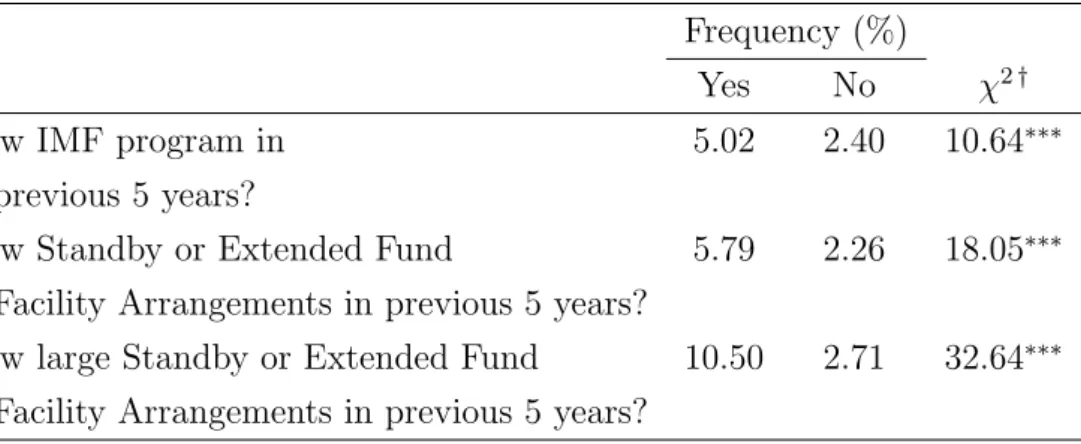
A first impression on the relation between our different indicators of IMF interventions and subsequent defaults can be gauged fromTable 1. This table shows the frequency of sovereign debt crises conditional upon the existence of an IMF program in the previous five years. The striking result from this exercise is that default frequencies of countries with an IMF involvement in the recent past exceed those without such treatment by a factor larger than two. This difference gets bigger when shifting our attention exclusively 15The EMBI Global which covers 41 countries is the broadest sovereign debt index available. Data
on SBA and EFF programs and especially on those where the agreed lending amount is large as defined above. The χ2 statistics reject the null hypothesis of independence between the frequency of sovereign debt crises and IMF programs in all cases implying that the differences are statistically significant. Obviously, correlation does not neces-sarily imply one-way causality. In the next section we will therefore investigate whether this positive association still holds after explicitly taking other determinants of sovereign debt crises and the endogeneity of IMF programs into account.
insert Table 1 here
Our choice of control variables in the single-equation framework and in the default equa-tion (1) of the bivariate probit model has been guided by the literature on sovereign debt crises and is especially close to the specification ofKohlscheen(2009). The set of covari-ates consists of the GDP growth rate, the ratios of debt service to exports and reserves to imports, the external debt to GDP ratio, the five year US T-Bill rate and a policy dummy variable indicating parliamentary democracies. We also add regional dummies, an indicator of compliance with IMF programs proposed by Dreher and Walter (2010) and interaction terms in some of the specifications. To mitigate endogeneity concerns all variables except for the arguably exogenous policy variable are lagged by one year. The same economic variables augmented by the short term to total debt ratio (which turns out insignificant in the default equation) are also considered as potential determinants of IMF interventions in equation (2) of our bivariate probit specification. Following the empirical literature on IMF lending decisions we further include the fraction of votes cast together with the United States in the UN General Assembly as an additional variable. We use a higher lag order in this specification to ensure that IMF programs are explained solely by already realized values of the explanatory variables. Appendix B contains information on the construction and the data sources for the included variables. The summary statistics are presented in tableTable 2.16
insert Table 2 here
16We also experimented with other variables proposed in the literature on debt crises and IMF
inter-ventions. In the default equation we tried indicators of real exchange rate overvaluation and banking crises, the volatility of GDP growth, the deficit to GDP ratio, an indicator of the past repayment performance and the ratio of private to total external debt. Potential explanatory variables for the IMF equations incorporated each country’s share of IMF quotas, the ratio of bilateral trade with the United States relative to GDP and the fraction of times countries voted in line with major Europe in the UN General Assembly. However, none of these variables turned out to be statistically significant when added to our baseline specification.
GDP growth should influence the probability of a default through it’s impact on sovereign borrowers’ willingness to pay (Arellano,2008). We expect to find a negative relationship since borrowing constraints often tighten in recessions and a reduction of the debt burden through net repayment is a less attractive choice in times of economic hardship. The debt service to exports and reserves to imports ratios are included as measures of a country’s liquidity position. Liquidity features prominently in the literature on self-fulfilling debt runs which points to a positive association between liquidity needs and the incidence of roll-over crises. A similar conclusion can also be reached in a willingness to pay framework (Detragiache and Spilimbergo, 2004). The external debt to GDP ratio is the most widely used solvency indicator in the political and academic debate on debt sustainability. We opt for a broad measure of external debt that includes both private and public liabilities. This choice is motivated by data availability and the observation that private obligations often turn public through government guarantees or direct assumptions during financial and economic crises. Since variations in the risk free interest rate directly affect the demand for more risky assets like emerging market government bonds we add the five year US T-Bill rate as an additional regressor. Finally, political economy considerations surely influence the debt service decision. One particular aspect pointed out by Kohlscheen (2009) is that even heads of government that are sympathetic to a suspension of payments to international creditors may resist the temptation to do so when the consent of a polarized legislature is required. We therefore expect the coefficient on the parliamentary democracy dummy to be negative.
Countries seek the help of the IMF in times of looming crisis. Our priors on the co-efficient signs for the economic variables in the IMF equation therefore coincide with our expectations laid out in the context of the default equation. As another indicator of liquidity needs we also anticipate the short term to total debt ratio to enter with a positive sign. The additional UN voting variable can be seen as a indicator for the po-litical proximity of a country’s government to the United States (Barro and Lee,2005). Since it is often assumed that the United States use their influence as the IMF’s major shareholder to favor political allies with preferred access to Fund resources this variable is expected to enter with a positive coefficient.
4. Results
4.1. Probit Estimates
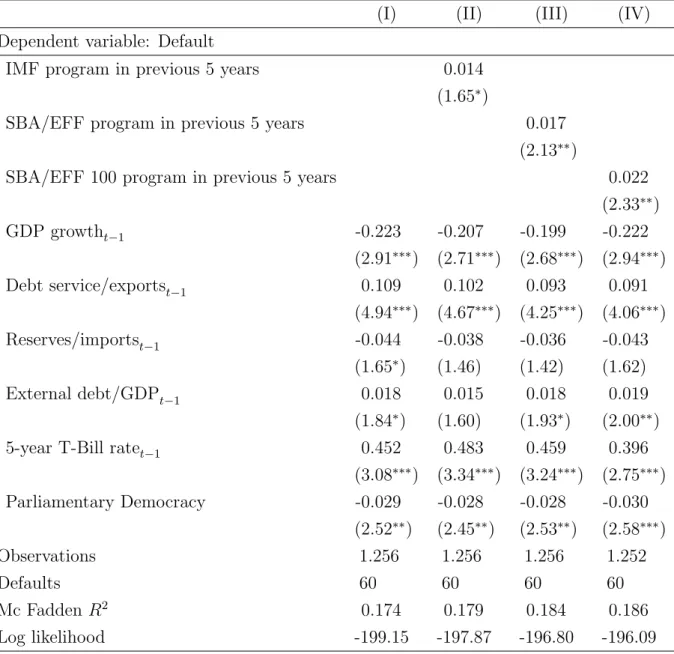
The basic results of our single equation analysis are summarized inTable 3. We present marginal effects evaluated at the means of covariates in all columns to ease the economic interpretation and the comparison between the different specifications. Since the null hypothesis of dynamic completeness can not be rejected for any of our model variants standard inference procedures are valid.17 The t-statistics of the coefficient estimates
given in parenthesis are therefore based on usual Huber/White standard errors.
Column (I) presents the estimates for our baseline specification that does not account for the effects of IMF interventions. Our results closely resemble those of Kohlscheen (2009) despite the larger time span covered in our analysis. Sovereign defaults become more likely in recessions, when a high debt service to exports ratio indicates pressing liquidity needs and when the debt burden is large relative to the economic size of the debtor country. Higher US interest rates also increase the probability of a sovereign default which is less common in parliamentary democracies even after controlling for the other covariates. Finally a large foreign reserves to import ratio is associated with a lower probability of sovereign debt crisis. The sign of all coefficient estimates are in line with our theoretical predictions. Regarding the goodness of fit our pseudo R2 takes a value of roughly 17.5 percent. This estimate is in the range obtained in previous research on the determinants of sovereign defaults.
insert Table 3 here
Turning to our main variables of interest the remaining columns show that sovereign debt crises are more likely to occur in the five years following an IMF program. Im-portantly, the sign of this effect does not depend on the concept used to identify IMF interventions although its statistical and economic significance increases monotonically from specification (II) to (IV). According to our results the adoption of any kind of IMF program increases the probability of a subsequent default by 1.4 percentage points in a sample with an overall default frequency of just 4.8 percent. SBA and EFF programs, especially large ones, induce an even bigger surge in default probabilities by 1.7 and
2.2 percentage points, respectively. These results support the notion that moral hazard and debt dilution effects are important byproducts of IMF programs. Since the largest effects are found for lending programs that exceed a country’s quota one may argue that these problems grow more severe with program size. Another explanation, however, points to an increased risk of simultaneity bias as large programs are targeted to coun-tries with deeper structural problems. We therefore do not consider them separately in the remaining study and focus on all SBA and EFF interventions instead which also excludes programs that qualify more as development assistance than as crisis prevention lending.18
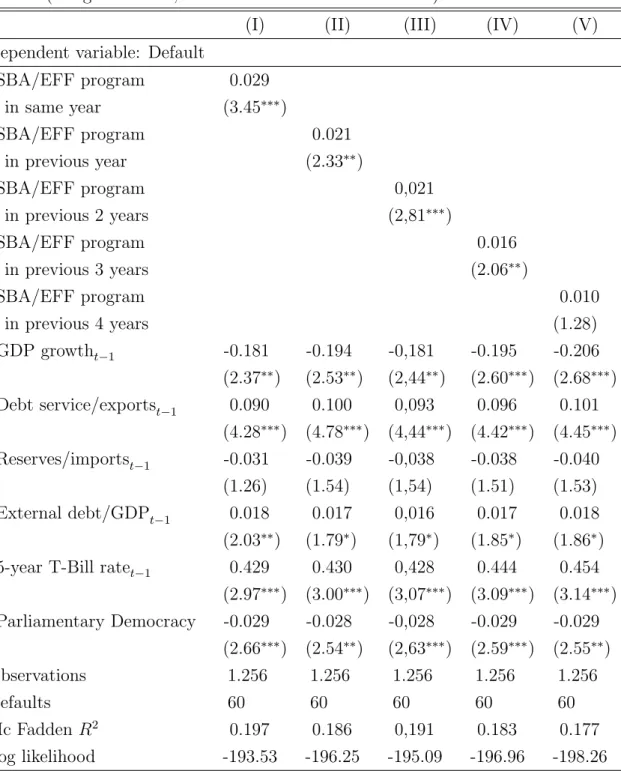
The results presented in Table 4 show that our conclusions do not rest on the specific time horizon employed in the measurement of IMF programs. Countries are more prone to sovereign debt crises if an IMF intervention took place in the previous four, three, two or just in the last year. These results are at odds with the idea that IMF lending prevents looming liquidity crises from unfolding in the short run while induced moral hazard becomes the dominant effect over a longer time horizon. Instead, the short run increase in default probabilities may even be seen as supportive of the idea that insuffi-cient IMF lending programs trigger sovereign debt crises (Zettelmeyer,2000). Finally it can be gauged from column (I) that IMF programs are particulary often accompanied by sovereign defaults in the year of their implementation. Since the case for reverse causality is obvious in this specification we do not allow for contemporaneous effects in the remainder of our paper.
insert Table 4 here
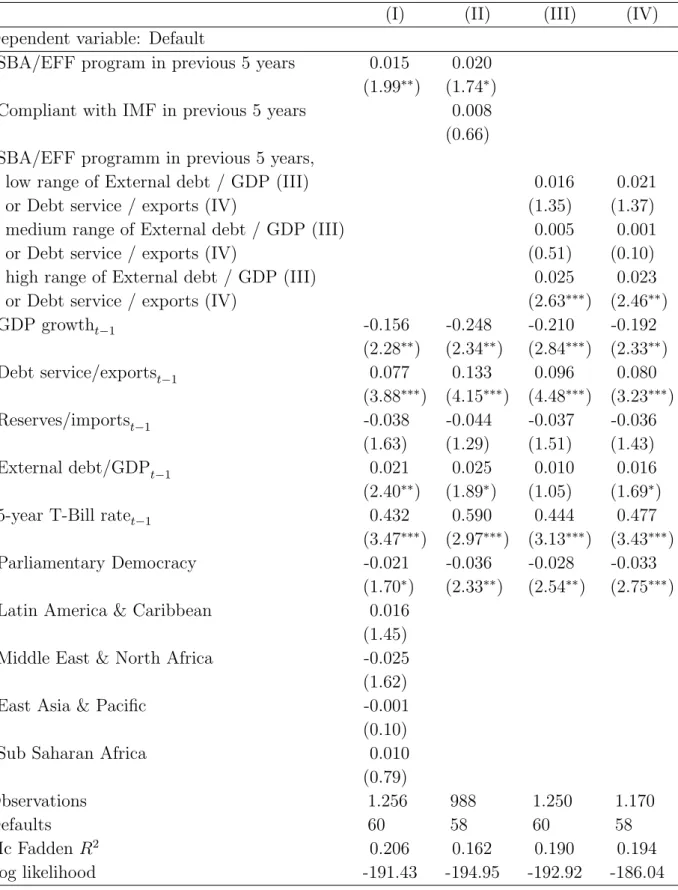
In further analyses summarized in Table 5 we explore the robustness of our results to alternative specifications which should also shed some light on the economic forces at work. One objection against our conclusions is that our IMF coefficient just picks up a geographical clustering in both IMF programs and sovereign debt crises. We test this hypothesis by including regional dummies in our baseline specification. As the estimates presented in column (I) show, all of the dummies turn out statistically insignificant while the sign and magnitude of our coefficient of interest is not altered. We are therefore confident that our finding of a positive effect of IMF programs on sovereign default probabilities does not merely reflect unobserved heterogeneity at the regional level.
insert Table 5 here
Another possible explanation for our results points to the problem of non-compliance with IMF policy conditions. If IMF programs worked mainly through the influence con-ditionality exerts on policy choices we would expect a reduction in sovereign risk to be limited to those countries that meet the conditions laid out in the lending agreement. Furthermore, governments that fall short of their promises soon after the disbursement of the first tranches of IMF credit are likely to be those with a large inclination to default on their other obligations too. A failure to differentiate between different compliance rates may therefore bias the coefficient on the IMF program variable substantially up-wards. We address this problem by augmenting our estimation equation with a dummy variable that takes the value 1 if a country was compliant with its IMF program in the five preceding years.19 Column (II) of Table 5 shows the results. While theoretically
convincing the distinction between compliers and non-compliers seems to be less impor-tant empirically. The presence of an IMF program per se increases the probability of a sovereign debt crisis for both country groups alike. Overall the evidence presented so far thus weakens the case for the importance of IMF conditionality while it is mostly in line with the moral hazard, debt dilution, and default triggering views of IMF lending.
The last part of this section puts the implications of the catalytic finance hypothesis un-der greater scrutiny. As emphasized above this theory implies that liquidity provisions by the IMF are most likely to induce catalytic effects when the economic fundamentals of the debtor country are neither too good nor too bad. Following Mody and Saravia (2006) we integrate this hypothesis in our empirical framework by interacting the IMF program indicator with dummy variables for a country’s relative position in the empiri-cal distribution of other factors influencing sovereign risk. More concretely, we construct three dummy variables for both the external debt to GDP and the debt service to ex-ports ratio by using the first and second tertile of the respective distribution as threshold values. Mirroring the time window employed in the measurement of IMF interventions every country-year observation is grouped according to its mean value during the five preceding years. Columns (III) and (IV) display the results of this exercise. The ev-idence is broadly supportive to the catalytic finance theory except for one important qualification. Although the coefficients on the IMF variables are always the lowest for
19Concretely, a country is coded as non-compliant when more than 25 % of the credit amount agreed
under an IMF program remains undrawn at program expiration (Dreher and Walter, 2010). The availability of the compliance variable limits our sample size in this specification.
the intermediate range of economic fundamentals, they never reach a negative sign. In-stead of setting the stage for a default risk reducing effect of IMF programs a proper economic environment merely seems to limit the damage they otherwise cause. Since a significant positive coefficient on the program variable is only found for the worst set of economic fundamentals another explanation indicates again the potential problem of endogeneity which is probably most pronounced for especially crisis-prone countries. We turn to this hypothesis in the next section.
4.2. Bivariate Probit Estimates
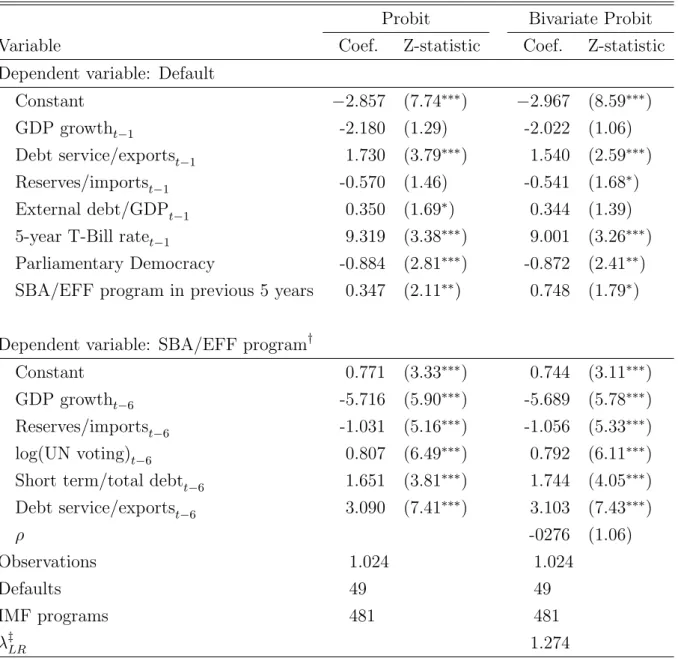
The parameter estimates of our bivariate probit specification are given in the third and fourth column of Table 6. Notice that these results are not directly comparable to the marginal effects reported earlier in this section. To allow for an assessment of the importance of endogeneity we therefore also present results for a specification that restricts the correlation of the two disturbances in the equations (1) and (2) to zero (see columns (I) and (II)). This version of the model is equivalent to an estimation of the two equations by the univariate probit methods employed in the first part this paper.
insert Table 6 here
Turning first to the determinants of program participation the estimation results of both the univariate and bivariate specifications support the assumption that IMF resources are targeted to and demanded by countries with weak fundamentals.20 Liquidity needs in particular seem to be an important aspect that characterizes program countries as the reserves to imports, the debt service to export and the short term to total debt ratio all enter significantly and with the correct sign. This is also true for the GDP growth rate and the UN voting variable where a positive coefficient indicates a preferred access to Fund resources for countries with closer political ties to the United States.
Most importantly from the perspective of this study a comparison of the univariate and bivariate regression results shows that our main conclusions are not altered when we ac-count for the simultaneity of the IMF variable. The coefficient on our program indicator 20Since the estimation results for the univariate default specification are discussed at length in
sub-section 4.1 we do not regard them separately here. Differences in significance levels are due to a reduction in sample size brought about by the higher lag order employed in the IMF program equation.
even increases slightly from 0.347 to 0.748 from the first to the latter specification. This is mirrored in an estimated correlation coefficientρ which is negative albeit not signif-icantly so, according to the usual Wald test. The hypothesis of no correlation between the two error terms is also not rejected by a lagrange multiplier test. Here the test statis-tic takes the value 1.274, which is well below the cristatis-tical value for any reasonable level of significance. Hence, the positive association between the presence of IMF programs and subsequent sovereign defaults documented throughout this study does not reflect a correlation in omitted factors which influence both program adoption and default deci-sion. Instead, our evidence strongly supports the idea that IMF interventions increase the likelihood of future debt crises as predicted by the moral hazard, debt dilution, and default triggering theories of IMF lending.
5. Conclusion
Although the IMF features prominently both in the history of sovereign debt crises and in recent policy proposals aimed at the prevention of such crises, surprisingly little is known on the effects of IMF program participation on the likelihood of subsequent defaults. In light of the inconclusive findings in the theoretical literature this paper attempts to investigate this issue empirically. Using univariate and bivariate probit specifications our results indicate that the adoption of an IMF program increases sovereign risk over the medium term. More concretely, we estimate that the probability of a sovereign default increases by approximately 1.5 to 2 percentage points in the aftermath of IMF programs. These findings cannot be contributed to a lack of compliance with conditionality but seem to reflect the effects of IMF interventions per se. Financial markets’ cautious reaction to Greece’s rescue package described in the introduction of this paper thus seems legitimate in the light of these results.
Further analyses additionally show that IMF programs are especially detrimental to fiscal solvency when Fund resources are targeted to countries with already weak fundamentals. Overall, our evidence is therefore consistent with the idea that debtor moral hazard is most likely to occur in these situations as predicted by the theoretical work on the catalytic finance hypothesis. Other explanations that point to the effects of debt dilution and the possibility of IMF triggered debt runs, however, are also possible. The separation of the effects in terms of these different explanations surely constitutes an interesting area for future research.
Regarding the policy implications of our findings, one important qualification has to be kept in mind before concluding that debt crises would become less likely in a world with-out IMF interventions. Since the pure existence of the IMF as a potential international lender of last resort may deter short-run creditors from running it is possible that the Fund has prevented several debt crises without being active. This possibility, however, should not preclude the IMF from a thorough analysis of the question whether too many resources have been devoted to countries which view IMF lending as a substitute for, rather than a complement to policy reform.
References
Alesina, A.,Prati, A. and Tabellini, G.(1990). Public confidence and debt man-agement: A model and a case study of Italy. In R. Dornbusch and M. Draghi (eds.),
Public Debt Management: Theory and History, Cambridge University Press, pp. 94– 118.
Arellano, C. (2008). Default risk and income fluctuations in emerging economies.
American Economic Review, 98 (3), 690–712.
Atoyan, R.andConway, P.(2006). Evaluating the impact of IMF programs: A com-parison of matching and instrumental-variable estimators.The Review of International Organizations,1, 99–124.
Barro, R. J. and Lee, J.-W. (2005). IMF programs: Who is chosen and what are the effects? Journal of Monetary Economics,52 (7), 1245–1269.
Bird, G. (2007). The IMF: A bird’s eye view of its role and operations. Journal of
Economic Surveys,21, 683–745.
— and Rowlands, D. (2009). The IMF’s role in mobilizing private capital flows: are there grounds for catalytic conversion? Applied Economics Letters, 16 (17), 1705– 1708.
Boz, E.(2009). Sovereign default, private sector creditors, and the IFIs. mimeo.
Celasun, O. and Harms, P. (2010). Boon or burden? The effect of private sector debt on the risk of sovereign default in developing countries.Economic Inquiry, forth-coming.
Cole, H. L. and Kehoe, T. J. (1996). A self-fulfilling model of Mexico’s 1994-1995 debt crisis. Journal of International Economics,41 (3-4), 309–330.
— and — (2000). Self-fulfilling debt crises. The Review of Economic Studies, 67 (1), 91–116.
Conway, P. (2006). The International Monetary Fund in a time of crisis: A review of Stanley Fischer’s IMF essays from a time of crisis: The international financial system, stabilization, and development. Journal of Economic Literature, 44 (1), 115–144.
Corsetti, G.,Guimar˜aes, B.and Roubini, N.(2006). International lending of last resort and moral hazard: A model of IMF’s catalytic finance. Journal of Monetary Economics, 53 (3), 441–471.
Cottarelli, C. and Giannini, C.(2006). Bedfellows, hostages, or perfect strangers? Global capital markets and the catalytic effect of IMF crisis lending. In A. Mody and A. Rebucci (eds.), IMF-Supported Programs - Recent Staff Research, International Monetary Fund, pp. 202–227.
Detragiache, E. and Spilimbergo, A.(2001). Crises and Liquidity: Evidence and
Interpretation. IMF Working Paper 05/8, International Monetary Fund.
— and — (2004). Empirical models of short-term debt and crises: Do they test the creditor run hypothesis? European Economic Review,48 (2), 379 – 389.
Diwan, I. and Rodrik, D. (1992). External Debt, Adjustment, and Burden Sharing:
A Unified Framework, Princeton Studies in International Economics, vol. 73. Inter-national Finance Section, Dept. of Economics, Princeton University.
Drazen, A.(2002). Conditionality and ownership in IMF lending: A political economy approach. IMF Staff Papers, 49, 36–67.
Dreher, A. (2005). Does the IMF influence fiscal and monetary policy? The Journal
of Policy Reform, (8), 225–238.
— (2006). IMF and economic growth: The effects of programs, loans, and compliance with conditionality. World Development, 34 (5), 769–788.
—(2009). IMF conditionality: Theory and evidence. Public Choice, 141, 233–267. — and Sturm, J.-E. (2010). Do IMF and World Bank influence voting in the UN
general assembly? mimeo.
—andVaubel, R.(2004). Do IMF and IBRD cause moral hazard and political business cycles? Evidence from panel data. Open Economies Review,15, 5–22.
— and Walter, S. (2010). Does the IMF help or hurt? The effect of IMF programs on the likelihood and outcome of currency crises. World Development, 38 (1), 1–18. Edwards, M. S.(2006). Signalling credibility? The IMF and catalytic finance.Journal
Eichengreen, B., Gupta, P. and Mody, A. (2008). Sudden stops and IMF-supported programs. In S. Edwards and M. G. P. Garcia (eds.), Financial Markets Volatilty and Performance in Emerging Markets, University of Chicago Press, pp. 219–264.
—,Kletzer, K.andMody, A.(2006). The IMF in a world of private capital markets.
Journal of Banking & Finance,30 (5), 1335–1357.
Fafchamps, M. (1996). Sovereign debt, structural adjustment, and conditionality.
Journal of Development Economics, 50 (2), 313–335.
Federal Reserve Bank of St. Louis (2010). Economic Data - FRED.
Fischer, S.(1999). On the need for an international lender of last resort.The Journal
of Economic Perspectives, 13 (4), 85–104.
Independant Evaluation Office of the International Monetary Fund (2007). Structural conditionality in IMF-supported programs.
International Monetary Fund (2009). International Financial Statistics. CD-ROM, October 2009.
Jensen, N. M. (2004). Crisis, conditions, and capital - The effect of International Monetary Fund agreements on foreign direct investment inflows. Journal of Conflict Resolution, 48 (2), 194–210.
Keefer, P. (2009). Database of Political Institutions: Changes and Variable
Defini-tions. mimeo, World Bank.
Kohlscheen, E. (2009). Sovereign risk: Constitutions rule. Oxford Economic Papers,
62 (1), 62–85.
Kruger, M. and Messmacher, M. (2004). Sovereign Debt Defaults and Financing
Needs. IMF Working Paper 04/53, International Monetary Fund.
Manasse, P. and Roubini, N. (2009). ’Rules of thumb’ for sovereign debt crises.
Journal of International Economics,78 (2), 192 – 205.
Marchesi, S.(2003). Adoption of an IMF programme and debt rescheduling. An em-pirical analysis. Journal of Development Economics, 70 (2), 403 – 423.
—and Thomas, J. P.(1999). IMF conditionality as a screening device. The Economic
Journal, 109 (454), 111–125.
Meltzer Commission (2000). Report of the International Financial Institutions Ad-visory Commission.
Mody, A. and Saravia, D. (2006). Catalysing private capital flows: Do IMF pro-grammes work as commitment devices? The Economic Journal, 116 (513), 843–867. Morris, S. and Shin, H. S. (2006). Catalytic finance: When does it work? Journal
of International Economics, 70 (1), 161–177. ¨
Ozler, c. (1993). Have commercial banks ignored history? The American Economic
Review, 83 (3), 608–620.
Pescatori, A. and Sy, A. N. (2007). Are debt crises adequately defined? IMF Staff
Papers,54 (2), 306–337.
Polity IV(2009). Political regime characteristics and transitions, 1800-2009.
Sachs, J. D. (1984). Theoretical Issues in International Borrowing, Princeton Studies
in International Economics, vol. 54. International Finance Section, Dept. of Eco-nomics, Princeton University.
— (1989). Conditionality, debt relief, and the developing country debt crisis. In J. D. Sachs (ed.), Developing Country Debt and the World Economy, National Bureau of Economic Research, pp. 275–284.
Saravia, D.(2010). On the role and effects of IMF seniority. Journal of International
Money and Finance, 29 (6), 1024 – 1044.
Standard & Poor’s(2006). Default study: Sovereign defaults at 26-year low, to show little change in 2007.
Standard & Poor’s(2009). Default, transition, and recovery: Sovereign defaults and rating transition data, 2008 update.
Steinwand, M. and Stone, R. (2008). The International Monetary Fund: A review of the recent evidence. The Review of International Organizations, 3, 123–149. van der Veer, K. and de Jong, E. (2010). IMF-Supported Programs: Stimulating
Van Rijckeghem, C. and Weder, B. (2009). Political institutions and debt crises.
Public Choice, 138, 387–408.
Vaubel, R. (1983). The moral hazard of IMF lending. The World Economy, 6 (3), 291–303.
Wilde, J. (2000). Identification of multiple equation probit models with endogenous dummy regressors. Economics Letters, 69 (3), 309–312.
Wooldridge, J. M. (2002). Econometric Analysis of Cross Section and Panel Data. MIT Press.
World Bank(2010). World Development Indicators and Global Development Finance Database.
Zettelmeyer, J. (2000). Can official crisis lending be counterproductive in the short run? Economic Notes,29 (1), 13–29.
—and Joshi, P. (2005).Implicit Transfers in IMF Lending, 1973-2003. IMF Working Paper 05/8, International Monetary Fund.
Table 1: Sovereign Debt Crises: Frequency Conditional on IMF Programs Frequency (%)
Yes No χ2†
New IMF program in 5.02 2.40 10.64∗∗∗
previous 5 years?
New Standby or Extended Fund 5.79 2.26 18.05∗∗∗ Facility Arrangements in previous 5 years?
New large Standby or Extended Fund 10.50 2.71 32.64∗∗∗ Facility Arrangements in previous 5 years?
†The null hypothesis of independence between the frequency of sovereign debt crises and IMF programs is distributed asχ2(1). ∗∗∗, ∗∗ and ∗ denote significance levels of 1%, 5% , and 10%.
Table 2: Summary Statistics
Mean Std. Dev. Max Min Obs.
Default 0.05 0.21 1.00 0.00 1256
IMF program in previous 5 years 0.57 0.49 1.00 0.00 1256 SBA/EFF program in previous 5 years 0.47 0.50 1.00 0.00 1256 SBA/EFF 100 program in previous 5 years 0.13 0.33 1.00 0.00 1252 Compliant with IMF in previous 5 years 0.70 0.46 1.00 0.00 988
GDP growtht−1 0.04 0.05 0.27 -0.23 1256
Debt service/exportst−1 0.21 0.15 1.29 0.00 1256
Reserves/importst−1 0.37 0.34 2.79 0.00 1256
External debt/GDPt−1 0.49 0.31 3.36 0.03 1256
5-year T-Bill ratet−1 0.07 0.03 0.14 0.03 1256
Parliamentary Democracy 0.22 0.42 1.00 0.00 1256
log(UN voting)t−6 -1.62 0.52 -0.58 -4.68 1233
Short term/total debtt−6 0.13 0.10 0.65 0.00 1223
Table 3: IMF Programs and Sovereign Debt Crises: Baseline Estimations (marginal effects, evaluated at means of covariates)
(I) (II) (III) (IV)
Dependent variable: Default
IMF program in previous 5 years 0.014 (1.65∗)
SBA/EFF program in previous 5 years 0.017
(2.13∗∗)
SBA/EFF 100 program in previous 5 years 0.022
(2.33∗∗) GDP growtht−1 -0.223 -0.207 -0.199 -0.222 (2.91∗∗∗) (2.71∗∗∗) (2.68∗∗∗) (2.94∗∗∗) Debt service/exportst−1 0.109 0.102 0.093 0.091 (4.94∗∗∗) (4.67∗∗∗) (4.25∗∗∗) (4.06∗∗∗) Reserves/importst−1 -0.044 -0.038 -0.036 -0.043 (1.65∗) (1.46) (1.42) (1.62) External debt/GDPt−1 0.018 0.015 0.018 0.019 (1.84∗) (1.60) (1.93∗) (2.00∗∗)
5-year T-Bill ratet−1 0.452 0.483 0.459 0.396
(3.08∗∗∗) (3.34∗∗∗) (3.24∗∗∗) (2.75∗∗∗) Parliamentary Democracy -0.029 -0.028 -0.028 -0.030 (2.52∗∗) (2.45∗∗) (2.53∗∗) (2.58∗∗∗) Observations 1.256 1.256 1.256 1.252 Defaults 60 60 60 60 Mc FaddenR2 0.174 0.179 0.184 0.186 Log likelihood -199.15 -197.87 -196.80 -196.09
The absolute values of robust (Huber/White) z-statistics are shown in parenthesis. ∗∗∗, ∗∗ and ∗ denote significance levels of 1%, 5% , and 10%.
Table 4: IMF Programs and Sovereign Debt Crises: Alternative Time Horizons (marginal effects, evaluated at means of covariates)
(I) (II) (III) (IV) (V)
Dependent variable: Default
SBA/EFF program 0.029 in same year (3.45∗∗∗) SBA/EFF program 0.021 in previous year (2.33∗∗) SBA/EFF program 0,021 in previous 2 years (2,81∗∗∗) SBA/EFF program 0.016 in previous 3 years (2.06∗∗) SBA/EFF program 0.010 in previous 4 years (1.28) GDP growtht−1 -0.181 -0.194 -0,181 -0.195 -0.206 (2.37∗∗) (2.53∗∗) (2,44∗∗) (2.60∗∗∗) (2.68∗∗∗) Debt service/exportst−1 0.090 0.100 0,093 0.096 0.101 (4.28∗∗∗) (4.78∗∗∗) (4,44∗∗∗) (4.42∗∗∗) (4.45∗∗∗) Reserves/importst−1 -0.031 -0.039 -0,038 -0.038 -0.040 (1.26) (1.54) (1,54) (1.51) (1.53) External debt/GDPt−1 0.018 0.017 0,016 0.017 0.018 (2.03∗∗) (1.79∗) (1,79∗) (1.85∗) (1.86∗) 5-year T-Bill ratet−1 0.429 0.430 0,428 0.444 0.454
(2.97∗∗∗) (3.00∗∗∗) (3,07∗∗∗) (3.09∗∗∗) (3.14∗∗∗) Parliamentary Democracy -0.029 -0.028 -0,028 -0.029 -0.029 (2.66∗∗∗) (2.54∗∗) (2,63∗∗∗) (2.59∗∗∗) (2.55∗∗) Observations 1.256 1.256 1.256 1.256 1.256 Defaults 60 60 60 60 60 Mc FaddenR2 0.197 0.186 0,191 0.183 0.177 Log likelihood -193.53 -196.25 -195.09 -196.96 -198.26
The absolute values of robust (Huber/White) z-statistics are shown in parenthesis. ∗∗∗, ∗∗
Table 5: IMF Programs and Sovereign Debt Crises: Robustness (marginal effects, evaluated at means of covariates)
(I) (II) (III) (IV)
Dependent variable: Default
SBA/EFF program in previous 5 years 0.015 0.020 (1.99∗∗) (1.74∗) Compliant with IMF in previous 5 years 0.008
(0.66) SBA/EFF programm in previous 5 years,
low range of External debt / GDP (III) 0.016 0.021
or Debt service / exports (IV) (1.35) (1.37)
medium range of External debt / GDP (III) 0.005 0.001
or Debt service / exports (IV) (0.51) (0.10)
high range of External debt / GDP (III) 0.025 0.023 or Debt service / exports (IV) (2.63∗∗∗) (2.46∗∗)
GDP growtht−1 -0.156 -0.248 -0.210 -0.192 (2.28∗∗) (2.34∗∗) (2.84∗∗∗) (2.33∗∗) Debt service/exportst−1 0.077 0.133 0.096 0.080 (3.88∗∗∗) (4.15∗∗∗) (4.48∗∗∗) (3.23∗∗∗) Reserves/importst−1 -0.038 -0.044 -0.037 -0.036 (1.63) (1.29) (1.51) (1.43) External debt/GDPt−1 0.021 0.025 0.010 0.016 (2.40∗∗) (1.89∗) (1.05) (1.69∗)
5-year T-Bill ratet−1 0.432 0.590 0.444 0.477
(3.47∗∗∗) (2.97∗∗∗) (3.13∗∗∗) (3.43∗∗∗) Parliamentary Democracy -0.021 -0.036 -0.028 -0.033
(1.70∗) (2.33∗∗) (2.54∗∗) (2.75∗∗∗) Latin America & Caribbean 0.016
(1.45) Middle East & North Africa -0.025 (1.62)
East Asia & Pacific -0.001
(0.10)
Sub Saharan Africa 0.010
(0.79)
Observations 1.256 988 1.250 1.170
Defaults 60 58 60 58
Mc FaddenR2 0.206 0.162 0.190 0.194
Table 6: IMF Programs and Sovereign Debt Crises: Bivariate Probit Estimation Probit Bivariate Probit
Variable Coef. Z-statistic Coef. Z-statistic
Dependent variable: Default
Constant −2.857 (7.74∗∗∗) −2.967 (8.59∗∗∗)
GDP growtht−1 -2.180 (1.29) -2.022 (1.06)
Debt service/exportst−1 1.730 (3.79∗∗∗) 1.540 (2.59∗∗∗) Reserves/importst−1 -0.570 (1.46) -0.541 (1.68∗) External debt/GDPt−1 0.350 (1.69∗) 0.344 (1.39) 5-year T-Bill ratet−1 9.319 (3.38∗∗∗) 9.001 (3.26∗∗∗) Parliamentary Democracy -0.884 (2.81∗∗∗) -0.872 (2.41∗∗) SBA/EFF program in previous 5 years 0.347 (2.11∗∗) 0.748 (1.79∗)
Dependent variable: SBA/EFF program†
Constant 0.771 (3.33∗∗∗) 0.744 (3.11∗∗∗)
GDP growtht−6 -5.716 (5.90∗∗∗) -5.689 (5.78∗∗∗) Reserves/importst−6 -1.031 (5.16∗∗∗) -1.056 (5.33∗∗∗) log(UN voting)t−6 0.807 (6.49∗∗∗) 0.792 (6.11∗∗∗) Short term/total debtt−6 1.651 (3.81∗∗∗) 1.744 (4.05∗∗∗) Debt service/exportst−6 3.090 (7.41∗∗∗) 3.103 (7.43∗∗∗) ρ -0276 (1.06) Observations 1.024 1.024 Defaults 49 49 IMF programs 481 481 λ‡LR 1.274
† Additional decade dummies used. ‡ The likelihood ratio test statistic is distributed χ2(1). ∗∗∗,∗∗, and ∗ denote significance levels of 1%, 5% , and 10%.
Appendix A. Country Coverage
Argentina El Salvador Madagascar Romania
Benin Fiji Malaysia Russian Federation
Bolivia Georgia Mali Senegal
Botswana Ghana Mexico South Africa
Brazil Guatemala Mongolia Sri Lanka
Bulgaria India Morocco Thailand
Burkina Faso Indonesia Mozambique Tunisia
Cameroon Jamaica Nigeria Turkey
Chile Jordan Pakistan Ukraine
China Kazakhstan Panama Uruguay
Colombia Kenya Papua New Guinea Venezuela
Costa Rica Latvia Paraguay Vietnam
Dominican Republic Lebanon Peru
Ecuador Lithuania Philippines
Appendix B. Data Sources and Definitions
Name Source Definition
Dependent variable
Default Standard & Poor’s (2006, 2009)
Dummy variable coded as 1 in the first year of a sovereign default.
IMF variables
IMF program Dreher (2006) - Extended time covering from web site
IMF program agreed, dummy variable.
SBA/EFF pro-gram
Dreher (2006) - Extended time covering from web site
IMF Standby Arrangement or Extended Fund Facility Arrangement agreed, dummy variable.
SBA/EFF 100 program
IMF (2009) Change in total agreed SBA and EFF loans exceeding 100 percent of quota, dummy variable.
Compliant with IMF
Dreher and Walter (2010) Dummy variable that takes the value 1 if a country was compliant with its IMF pro-gram. Non-compliance is identified as peri-ods where at least 25% of the agreed credit amount remained undrawn at program ex-piration.
Appendix B - continued
Name Source Definition
Control variables
Debt service/ exports
World Bank(2010) Ratio of debt service on external debt to ex-ports of goods and services
Reserves/ imports
World Bank(2010) Ratio of total reserves minus gold to imports of goods and services
Democratic Polity IV (2009) Dummy indicating democratic regimes, identified as country-year observations with non-negativ POLITY score as inKohlscheen (2009).
Parliamentary Keefer (2009) Dummy signalizing a parliamentary form of government as indicated by a value of 2 for the system variable as inKohlscheen(2009). Parliamentary
Democracy
Polity IV (2009) and Keefer (2009)
Dummy variable coded as 1 for parliamen-tary democracies. The construction of this variable relies on the definition of the Demo-cratic and Parliamentary dummy variables given above.
GDP growth World Bank(2010) Real GDP growth rate 5 year T-Bill
rate
FRED (2010) Yield to maturity of US T-Bills with a con-stant maturity of 5 years
External debt/GDP
World Bank(2010) Ratio of external debt stocks to GDP
Short term/ total debt
World Bank(2010) Ratio of short term to total external debt
UN voting Dreher and Sturm (2010) Fraction of votes a country cast together with the United States in the UN General Assembly