PROGRESS ON LASER SOURCES FOR DIRCM APPLICATION AT CILAS
Bruno Crépy, Guillaume Closse, Sandrine Cussat-Blanc, Catherine Grèzes-Besset*, Hélène Krol*,Jean Pierre Lemette, Marc Le Nevé, Jean-Michel Melkonian, Jean Montagne, Pierre Morin, Olivier Squaglia, Nathalie Valette*
CILAS Orléans, 8 Avenue Buffon – BP 6319 - 45063 Orléans, France *CILAS Aubagne, 15 Avenue de la Roche Fourcade – 13400 Aubagne, France
ABSTRACT
Wereport on the development and characteristics of infrared solid state laseras compact and robust light sources for Directed Infrared Countermeasures(DIRCM).
DIRCM against infrared missile seekers requires wavelength tunable laser sources. When adding an optical parametric oscillator to a pump laser source, it is possible to cover the 2-5 µm wavelength transmission windows. For more than five years, CILAS has developed critical technologies for the development of a laser source adapted for DIRCM application. This includes: The choice of the crystals, the optical coatings in band II, the thermal management and an optimized oscillator configuration insensitive to repetition rate variation in a wide range. The scope of this presentation is to recall performances of the technologies developed and to present the technical base line of our laser concept. This work is supported by the French MOD (DGA).
Keywords: Beam quality, coating, DIRCM, ITAR, laser, MANPADS, OPO, ZGP.
1. INTRODUCTION
The warfighter is operating in a highly technological environment. With the proliferation of portable surface-to-air missiles (MANPADS) and the development of various sensors capable of tracking a target, there is an increasing need to protect many military platforms.
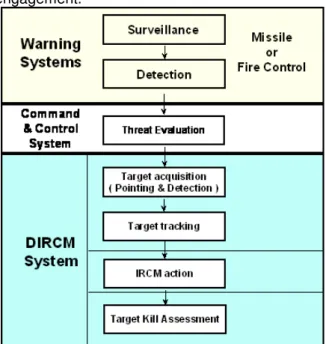
One of the most effective approaches to do so is to use advanced mid infrared laser sources emitting in the 2-5 µm region aimed at jamming or dazzling incoming heat seeking missiles. A schematic bellow (Figure 1) shows the principle of such a system. After being activated by a missile warning system, the DIRCM system tracks the incoming missile, directs an infrared laser beam on the guided missile so as to disorient, saturate, or irreversibly destroy the IR detectors and circuitry arranged in the target seeking head. The power, pulse frequency and spectral composition of the laser beam are adjustable and selectable as
required to be adapted to any particular defensive engagement.
Figure 1: Typical DIRCM system architecture The current baseline for IRCM has been moving away from broadband flash lamps toward Optical Parametric Oscillators (OPO) sources which are non linear optical shifter, because of their much reduced power consumption and higher modulation capabilities. One of the key parameter to judge of the effectiveness of an IR countermeasure is the ratio of jamming energy to the aircraft’s own IR signature. For high energy flash lamps, this ratio ranges between 10:1 to 50:1, whereas for a laser based system the ratio is close to 1000:1 leading to a better efficiency. Furthermore, flashlamps cannot operate faster than a few hundred Hertz, whereas modulation frequencies up to 10 kHz are typically needed nowadays.
2. REQUIREMENTS FOR THE LASER SOURCE
The key underlying component is the MWIR laser source, which is incorporated in a turret mounted to the belly of the aircraft. The laser source
required for this application is very specific and required the development of very sophisticated technology. The definition and the performances of the laser source will have great impact on the turret it self. This is particularly the case for the brilliance and the polarization of the out put beam.
This is no sense to define the out put power of the beam quality independently since the objective it to deposit a maximum of optical energy in front of the IR seeker. At several km from the platform to protect, this optical load is function of the divergence and the mean output power (P) of the laser source. For the laser designer, this figure of merit can be expressed such as P/ (M2)2 where M2 is the well known beam quality factor. Regarding this formula, this increase of the output power of a laser source simultaneously with the beam quality factor is not an improvement of performance. Unfortunately this behaviour is typically obtained during the power increase of a laser source. The final specification is a trade off between the tracking capability of the DIRCM system (that tends to increase the laser spot) and the power consumption plus the maximum diameter of the optical window of the turret (that tends to reduce the laser spot).
The beam polarisation is a critical parameter to isolate the emission and the reception during the tracking of the threat. If one does not care, the DIRCM reception sensor will be dazzled.
The requirements of the laser sources is summarized in the here after.
Powerful laser (Watt class typical)
Multi band emission, wavelength emission ≥ 2 Very good beam quality (M2 close to the
diffraction limit) to reduce the diameter of the turret windows
Very good stability for each pulse repetition frequency (<30% of variation)
Small pulse duration for range finding (less than 50 ns)
Increase modulation frequency to increase the number of laser pulse when laser firing (frequency upper than 10 kHz)
Multi threats capability : Long time of continuous firing
Pointing stability : Less than 1/5 of the whole divergence
Short spectral width and spectral tunability to cancel counter measure capability
Very short time of readiness between stand by
mode and firing mode
Efficient to minimize the power consumption
stand by mode and firing mode Excellent level of polarisation
High reliability during firing mode (safety system !!)
High MTBF during stand by mode (represents 99,99…% of the “on mode” duration)
On/off contrast : Better than 1/500
Operational thermal range : -40°C to +70°C Volume < 10 liters
Design ITAR free for European autonomy
3. RELEVANT TECHNOLOGIES DEVELOPED DURING CESAM PROGRAM
The French MoD has entrusted CILAS in 2003 with the design study and prototyping of a laser source adapted for the protection of military platforms (transport aircraft, transport air wings, fighter aircraft and fighter air wings).
The program was divided in 2 main parts.
The first part between 2003 and 2005 concerned the development of the relevant technologies and the laboratory demonstration capabilities.
The second part of the program began in 2005 with the conceptual, preliminary and detailed design of the demonstration prototype following with the procurement, manufacturing and tests of this demonstrator. The laser source will be delivered to the French MoD (CELAR) during September 2009 for laboratory characterization on IR seekers. The technologies developed during this program are multiple and cover large field of competence: Thermal management: In order to minimize the volume of the source and to reduce maintenance issue, the liquid cooling is forbidden. Two critical parts of the laser source are impacted by this constraint: the laser crystal and the pump laser diodes. During operation, the laser diodes pump the laser crystal.
Nearly half of the power consumption is converted in useful pump optical energy whereas the other part is thermally dissipated and shall be removed efficiently from the diodes modules to ovoid spectral shifting. The spectral emission of the diode modules is thermal dependant (typically 0,3 nm/°C). If the spectral shift is too large, there is no more matching between the spectral emission of the diodes and the spectral absorption of the laser crystal. In that case there is a decrease of the global efficiency of the laser. The architecture retained consists of thermal capacitance unit that allow a minimal firing duration without any active cooling of the modules. That leads to a dramatic
decrease of the electrical consumption of the laser source during firing sequence.
Nearly 30% of the optical energy absorbed in the laser crystal is transformed in thermal load and shall be removed to prevent optical distortion and to decrease of the beam quality. One way to proceed consists of the integration of the thermal spreader. Several materials were tested (sapphire, diamond, silicon carbide…). The present design allows duration of the firing sequence upper than 30seconds without any degradation of the beam quality.
Pockels cell of the pump laser: RTP crystals feature excellent extinction ratios (better than 20 dB) combined with low angular tolerance (less than 1°). RTP offers a significant advantage over other E-O materials due to its relatively low operating voltages and the absence of piezo-electric ringing. Low switching voltage is important in applications where the power supply has to remain as small and as simple as possible. The absence of piezo-electric ringing allows Q-switching at frequencies in the 100 kHz range while maintaining short pulse length. The effort consisted of the development of different crystallographic samples to demonstrate optical quality and very low ionic conduction to prevent blackening of the optical device. This work was done with the support of Cristal laser in France.
OPO configurations: Different optical parametric oscillator (OPO) configurations were studied and tested such as cascade OPO using a first stage of KTP following by a second stage of ZGP and periodically poled lithium niobate crystals. This last configuration offers significant advantages: ITAR free crystals, industrially mature, simple design minimizing the number of components. The different OPO stages were tested in laboratory and in the climatic chamber over a wide thermal range comparable to the operational one.
Optical coatings: CILAS has developed special facilities to produce reliable Mid IR optics well adapted for powerful applications (see [1] to [7]). An automated cleaning line (Figure 2) has been installed for the preparation of the substrates before coating in order to minimize the contamination of the optical components and CILAS has studied and developed various cleaning processes for a large variety of substrates. Moreover, CILAS has developed an Ion Assisted Deposition System dedicated to infrared applications. On this vacuum system, CILAS has automated the production process involving an in-situ infra-red optical monitoring that allows a very
good agreement between theoretical and experimental results during the process.
Figure 2: Cleaning process at CILAS Aubagne (France) The mid IR mirrors and ZGP coatings were tested using classical damage tests (LIDT) but also in the OPO cavity.
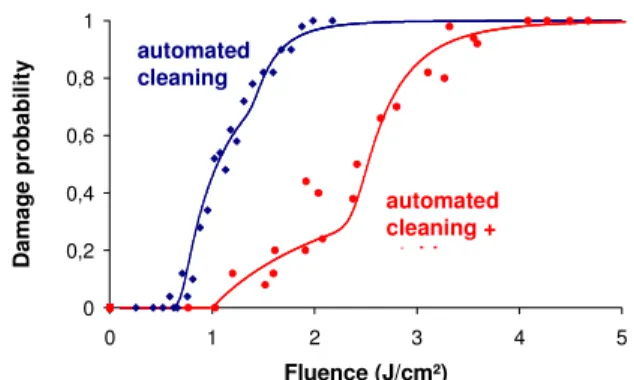
Figure 3: ZnSe mirrors used in the OPO stages manufactured by CILAS Aubagne (France) The Influence on laser induced damage at 1 µm and 2 µm of optical substrates fabrication steps (bulk material, polishing, cleaning) has been studied. Detailed analysis was performed on SiO2
and ZnSe materials.
Figure 4: Illustration of the impact of the cleaning process on the damage threshold
0 0,2 0,4 0,6 0,8 1 0 1 2 3 4 5 Fluence (J/cm²) Da m a g e p ro b a b il it y automated cleaning automated cleaning + etching
CILAS has developed a coating process of the ZGP crystals and obtained transmission and damage threshold comparable to the state of art.
4. MILDA, THE MID-INFRARED LASER SOURCE FOR DIRCM APPLICATION CILAS has decided to design, manufacture and test a demonstration prototype of DIRCM source with the following objectives:
Demonstration of the performances of the laser source (output power, beam quality, optical axis stability…) at ambient temperature and evaluation of the impact of the operational thermal range.
Delivery of DIRCM laser source to DGA/DET/CELAR to tests IR seekers on their DIRCM test bench
The optomechanical part of the source is rugged and design very compact. We use commercial power supply instead of specific electrical boards because the interface with the host system is not yet defined. These commercial power supplies were modified and up graded to allow the driving of the source with the typical jamming code sequences. A software interface was developed on excel platforms. The user shall enter the jamming sequence.
As the operational duty cycle of the source is low, it is not convenient to use the nominal firing mode for optical adjustment. A special mode was defined (as training mode) with the same mean output power as the operational one to keep the same thermal load inside the laser. This mode allows a continuous operation of the laser with the same beam quality. Cleaning processes developed in CILAS over the last 5 years were used to ovoid organic contamination of the laser and for increasing the lifetime and the reliability of the product. All the materials used in the source are compatible with the cleaning process.
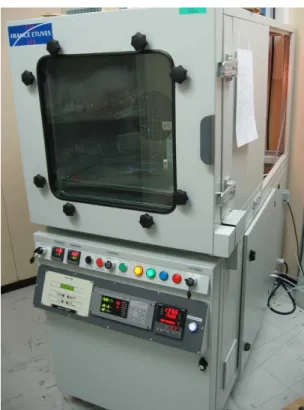
Two vacuum chambers are available to clean our components. A rough vacuum bakeout (vacuum 10-2-10-3 mbar) permits a preliminary cleaning of the non critical component of the lasers. A high vacuum bakeout (vacuum 10-5 -10-7 mbar) is used for the final cleaning stage during which residual gas analysis is done (Figure 5).
Figure 5: High vacuum bakeout used during the cleaning of the laser source
During the manufacturing process, the pump source and the OPO stage were fully characterized within operational thermal range and after submission to vibrations.
The final source was characterized at ambient temperature and after submission to climatic and vibration environments.
The volume of MILDA is less than 10 liters including an empty volume dedicated to the electrical compartment.
The overall volume can be still optimized by reducing of the spacing between the different sub systems that composed MILDA.
Figure 6: Demonstration prototype MILDA The laser source showed very promising results fully compatible with the requirements of the French MoD.
Coupling to a small turret, this product is a smart technology for providing tracking, identification and
jamming function capabilities for DIRCM systems.
5. CONCLUSIONS
CILAS is military laser European leader since 1966. CILAS has developed most the critical technologies to manufacture an efficient, compact and rugged DIRCM source for integration on military platform (transport aircraft, transport air wings, fighter aircraft and fighter air wings). A demonstration prototype is built, characterized and delivered to the DGA/CELAR for further impact evaluation on IR seekers. This laser source presents an ITAR free solution for integration in a directed infrared counter measure system while strongly reducing the risks of development.
6. ACKNOWLEDGEMENTS
We would like to acknowledge the financial support from the French Ministry of Defence (DGA)
7. REFERENCES
[1] Krol, H., Gallais, L., Commandré, M., Grèzes-Besset, C., Torricini, D., Lagier, G. , “Influence of polishing and cleaning on laser-induced damage threshold of substrates and coatings at 1064-nm,” Optical Engineering, vol. 46, issue 2, p. 023402 (2007).
[2] Natoli, JY. , Gallais, L., Akhouayri, H., Amra, C., “Laser-induced damage of materials in bulk, thin-film, and liquid forms,” Applied Optics, 41, 3156-66, (2002).
[3] Grèzes-Besset, C., Torricini, D., Chazallet, F., “Real-time lateral optical monitoring for the production of complex multilayer stacks”, SPIE, 5963, 59630E.1-59630E.10 (2005).
[4] Krol, H., Gallais, L., Natoli, JY. , Grèzes-Besset, C., Commandré, M., “Development of 2-µm laser damage test facility,” SPIE, 5991, 599129 (2005). [5] Krol, H., Gallais, L., Commandré, M., Grèzes-Besset, C., Torricini, D., Lagier, G., “LIDT improvement of multilayer coatings by accurate analysis of fabrication steps,” SPIE, 5963, 596311, (2005).
[6] Krol, H., Gallais, L., Grèzes-Besset, C., Natoli, JY., Commandré, M., “Investigation of nanoprecursors threshold distribution in laser damage testing,” Optics Communication, Vol. 256, Issues 1-3, 184-189 (2005)
[7] Krol, H., Grèzes-Besset, C., Gallais, L., Natoli, JY. , Commandré, M., “Study of laser-induced damage at 2-µm on coated and uncoated ZnSe substrates,” SPIE, 6403, 640316 (2006).