A COMPARISON OF VOLTAGE STABILITY ASSESSMENT
TECHNIQUES IN A POWER SYSTEM
I.G. Adebayo* and Y. Sun*
* Department of Electrical and Electronic Engineering Science, University of Johannesburg, Johannesburg, 2006, South Africa
[email protected] & [email protected]
Abstract: Voltage stability analysis has of recent been a growing concern to power system utilities due to several incidence of blackouts that occurred lately in some part of the globe. This paper discusses some existing voltage stability techniques such as L-Index, Voltage Collapse Proximity Index (VCPI) and modal analysis of the reduced Jacobian. A comparative analysis of these techniques is also presented. The total computational time taken by each approach to attain a solution is also estimated in this work. The effectiveness of all the approaches is tested on the IEEE 14-bus power system. Simulation results obtained show that the use of modal analysis in the study of voltage stability in a power system will be of advantage compared with other techniques as it saves time and require less computational efforts.
Key words: Power flow, Voltage collapse, Voltage stability, Power system, Indices
1. INTRODUCTION
Power system voltage stability is one of the challenging issues confronted by the power system company [1]. Due to the complex and large interconnected nature of the modern power system, alongside with economic and environmental constraints, voltage instability has become an increasingly serious problems. Consequently, power systems are stressed to operate close to their loadability limits [2]. The incessant occurrence of voltage instability has been considered as one of the growing threats to the secure operation of the power systems as a result of the continuous increase in load demand and restriction in system expansion. Voltage stability is mainly concerned with the ability of a power system to maintain acceptable voltage at all network load buses both under normal conditions and after being subjected to a disturbance [3]. The phenomenon of voltage collapse is the sequence of event that accompany voltage instability. Voltage collapse is characterized by a progressive and uncontrollable decline in voltage, which can occur because of the inability of the network to meet the increasing demand for reactive power [4]. The blackouts experienced in North America in 1996 and 2003 and in Europe in 2003 are typical examples of large-scale blackouts where voltage collapses played a significant role [5]. Other countries where this phenomenon has occurred include France, Sweden, Belgium, Japan, Germany, and in U.S.A [6] [7].
Since then, the growing concern of power system utilities and researchers have been bothered on how to proffer a solution to the incessant and continuous occurrence of
voltage collapse in a power system. To accomplish this, a considerable number of techniques and algorithms were proposed in the literature. The use of power flow based techniques to solve voltage stability related problems in a power system have played a key role. Some of these techniques include Continuation Power Flow (CPF), multiple power flow solutions, optimization based methods, modal analysis, sensitivity analysis, the use of PV and QV curves and so on [8]-[14]
Recently, the use of voltage stability indices to predict the proximity of the system to voltage collapse have been proposed [15]. These voltage stability indices can either be used to identify the critical bus of a power system or the stability of each line connected between two nodes in an interconnected power network or assess the voltage stability margins of a system (Reis and Barbosa 2006). A general overview of the major referenced sources shows that most voltage stability indices, which employ various approaches to predict voltage collapse, provide sufficient information about critical buses and lines of a power system [5]. These indices include, but not limited to voltage stability index [17], voltage collapse proximity index [18], Fast voltage stability index [19], New Line Stability Index [20] and so on.
In this paper, we investigate and compare the performance of some of these indices. The voltage stability indices and methods which are of interest in this paper are, L-Index [17], modal analysis of the reduced Jacobian matrix [13] and Voltage Collapse Proximity Index [18].
The remainder of this paper is organized as follows: Section 2 gives the brief mathematical formulations of the voltage stability indices and techniques (VSIAT) to be investigated while section 3 presents the description of the test case used. Results and discussion are presented in section 4. The concluding part of this paper is presented in section 5.
2. MATHEMATICAL FORMULATIONS OF VSIAT
2.1 Voltage stability index – L-Index [17]
The bus voltage stability index named L-index which is based on power flow solution was proposed by [17] to identify weak and voltage collapse load bus in a power system. The L index is a quantitative measure for the assessment of the distance of the actual state of the system to the stability limit. The L index describes the stability of the complete system and is given by:
g i j i ji jV
V
F
L
11
(1)
L G LL LG GL GG L GV
V
Y
Y
Y
Y
I
I
(2)Where
I
G,
I
L andV
G,
V
L represent the currents and voltages at the generator and load nodes.
YGG
,YGL
,YLL
and
YLG
are the correspondingportions of the network
Y
-bus matrix.The algebraic manipulations of equation (2) gives equation (3)
G L GG GL LG LL G LV
I
Y
K
F
Z
I
V
(3) WhereF
LG = -
YLL 1 YLG jiF
are the complex elements of
F
LG matrix.LL
Z
is the total impedance interconnectivity between load busesGL
K
is the negative transpose of matrixF
LGThe L – indices for given load conditions are computed for all load nodes. The values of these ranges between 0 and 1. The maximum of the L-index gives the proximity of the system voltage collapse.
This implies that if the values of L-indices for the load nodes is close to 0 (zero), it means that the system is voltage stable and close to 1 (unity), is an indication that the system is liable or approaches voltage collapse.
2.2 Voltage Collapse Proximity Index (VCPI)
The VCPI suggested by Balamourougan et al., 2004 is based on the notion of power flow solution. This method employs the voltage magnitude and voltage angle information at nodes and the admittance matrix of the network to predict voltage collapse. The VCPI of ith node is given as in (4) i N m m m i V V VCPI
1 1 ' 1 (4) where N m i j j ij im mV
Y
Y
V
1 ' (5)Vm is the Phasor voltage at bus m, Vi represents the phasor voltage at bus i. The admittance between node i and m is represented by Yim. Yij is the admittance between node i and j, i is the monitoring bus, m are other buses connected to bus and N is the bus set of the system. VCPI values varies from 0 to 1. If the value is 0, the load bus is considered voltage stable and if the value of VCPI is close or equal to 1, the bus is unstable and susceptible to voltage collapse.
2.3 Modal Analysis of the reduced Jacobian Technique
The modal analysis method developed in [13] uses the reduced Jacobian matrix to analyze the system and provide both a relative proximity of the system to voltage instability, as well as the mechanism or key contributing factors to instability.
Details mathematical formulation involved could be found in [13]. The summarized form of the equations involved is presented as follows:
First, we need to establish the linearized steady state system power voltage equation and it is given:
V
J
J
J
J
Q
P
QV Q PV P
(6)At each operating point, the active power is usually kept constant and the voltage stability of the system is evaluated by considering the incremental relationship between the reactive power (Q) and the voltage magnitude (V).
J
J
V
J
J
Q
Q QV PV P
0
(7)We can then establish the incremental change in reactive power as follows from equation (7):
Q
J
R
V
(8)where
P
and
Q
are the incremental change in the real and reactive power respectively.
V
and
are the change in voltage magnitude and the phase angle respectively.J
P.
J
PV,
J
Q andJ
QV represent the elements of Jacobian matrix.J
R is the reduced Jacobian matrix.The reduced Jacobian matrix is given as:
QV Q P PV
R
J
J
J
J
J
1 (9)Based on equations (8) and (9), incremental change in voltage magnitude is then established. The modes of the power system may be defined by the eigenvalues and the right and left eigenvectors of
R
J [21] [13]. Details of the mathematical formulations involved by this approach are presented in Gao et al., 1992. Assuming that the left and right eigenvectors of the system are represented by
and
respectively, and the eigenvalues is taken to be
. The bus participation factor measuring the contribution ofth
i
bus to thej
th mode is given by:
P
ij
ij
ji (10)Using the bus participation factor, the critical bus can be identified from equation (10), which is the highest contributing factor for a power system to reach voltage collapse situation.
3. TEST CASE STUDY
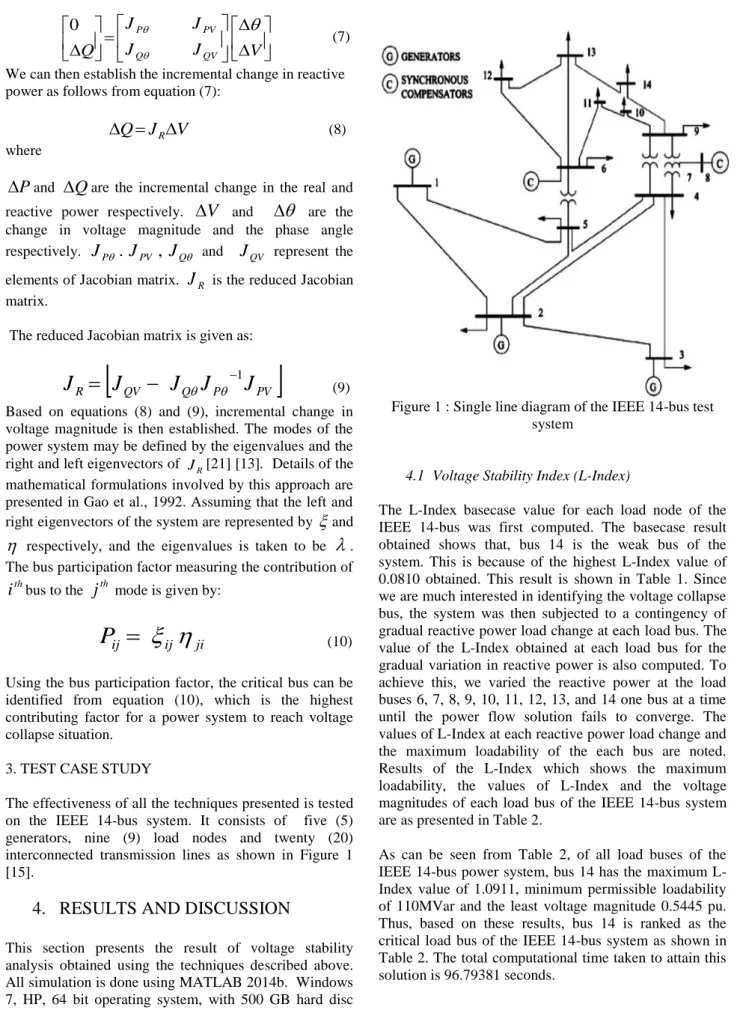
The effectiveness of all the techniques presented is tested on the IEEE 14-bus system. It consists of five (5) generators, nine (9) load nodes and twenty (20) interconnected transmission lines as shown in Figure 1 [15].
4.
RESULTS AND DISCUSSION
This section presents the result of voltage stability analysis obtained using the techniques described above. All simulation is done using MATLAB 2014b. Windows 7, HP, 64 bit operating system, with 500 GB hard disc and 4 GB random access memory laptop is used to perform the program solutions obtained.
Figure 1 : Single line diagram of the IEEE 14-bus test system
4.1 Voltage Stability Index (L-Index)
The L-Index basecase value for each load node of the IEEE 14-bus was first computed. The basecase result obtained shows that, bus 14 is the weak bus of the system. This is because of the highest L-Index value of 0.0810 obtained. This result is shown in Table 1. Since we are much interested in identifying the voltage collapse bus, the system was then subjected to a contingency of gradual reactive power load change at each load bus. The value of the L-Index obtained at each load bus for the gradual variation in reactive power is also computed. To achieve this, we varied the reactive power at the load buses 6, 7, 8, 9, 10, 11, 12, 13, and 14 one bus at a time until the power flow solution fails to converge. The values of L-Index at each reactive power load change and the maximum loadability of the each bus are noted. Results of the L-Index which shows the maximum loadability, the values of L-Index and the voltage magnitudes of each load bus of the IEEE 14-bus system are as presented in Table 2.
As can be seen from Table 2, of all load buses of the IEEE 14-bus power system, bus 14 has the maximum L-Index value of 1.0911, minimum permissible loadability of 110MVar and the least voltage magnitude 0.5445 pu. Thus, based on these results, bus 14 is ranked as the critical load bus of the IEEE 14-bus system as shown in Table 2. The total computational time taken to attain this solution is 96.79381 seconds.
Table 1: L-Index and voltage mag. basecase results
Table 2 : Results of L-Index and Voltage Mag. for a reactive power load variation
4.2 Voltage Collapse Proximity Index (VCPI)
Similar procedures were followed as in L-Index method to identify a voltage collapse bus. The values of VCPI for each load bus was computed. For this method, the IEEE 14 bus system was subjected to gradual reactive power load change and power flows were performed at every variation in reactive power load. Results of the VCPI obtained at each reactive power load increase on every bus is presented in Table 3.
Table 3: Results of the VCPI
Also, with the VCPI method, bus 14 has the maximum value of the index (0.9289), minimum permissible load of 110MVar and least voltage magnitude of 0.5445 p.u as shown in Table 3. Therefore, based on the VCPI technique, bus 14 is the most critical bus of the IEEE 14
bus system. The total computational time taken to arrive at this solution is 110.499751 seconds.
4.3 Modal analysis of the reduced Jacobian matrix
For the modal analysis approach, we first need to find the critical mode (smallest eigenvalue) of the system. To achieve this, eigenvalue decomposition was applied on the reduced Jacobian matrix to compute the eigenvalues of the system. Thereafter, critical mode which corresponds to the smallest eigenvalue of the system is identified and the critical bus which is prone to voltage collapse is identified by computing the participation factor for each load bus. The bus with the maximum value of participation factor is the critical bus. Result obtained is shown in Table 4.
Table 4: Results of the modal analysis technique
Mode 6 has the smallest eigenvalues of 2.6552 as shown in Table 4. This is then taken as the critical mode of the IEEE 14-bus test system. The participation factor for each bus relative to the critical mode identified is then computed. The bus with the highest participation factor (0.3210) is found to be bus 14. Thus, with the modal analysis technique, bus 14 was also the critical bus susceptible to voltage collapse. For this approach, it only takes the total computational time of 0.703451second to arrive at a solution.
4.4 A brief Comparison of all the approaches presented
From the results of the three techniques presented, that is, voltage stability index (L-Index), Voltage Collapse Proximity Index (VCPI) and the modal analysis of the reduced Jacobian matrix, it can be seen that all the techniques identified load bus 14 of the IEEE 14-bus system as the most critical bus of the system. Nonetheless, by considering the total computational time taken to attain this solution, we can also see that, with the modal analysis method, it only takes just a single computational time of 0.703451second to identify a voltage collapse bus as compared with L-index (96.79381 seconds) and VCPI (110.499751 seconds) which involve reactive power load variation at every load bus before the voltage collapse bus can be known.
Bus No Base case L-Index Voltage Mag. (p.u) Computational Time (secs) 6 0.0484 1.0378 7 0.0414 1.0449 8 0.0480 1.0317 9 0.0736 1.0268 0.789765 10 0.0705 1.0272 11 0.0393 1.0530 12 0.0223 1.0662 13 0.0336 1.0560 14 0.0810 1.0137 Rank Bus No Qmax (MVar) L-Index Voltage Magnitud e (p.u) Computational Time (seconds) 9th 6 580 0.7418 0.6107 21.077781 7th 7 320 0.8520 0.5875 11.921328 8th 8 550 0.7994 0.6060 20.882349 5th 9 220 0.8954 0.5807 8.204540 2nd 10 170 0.9907 0.5524 6.339087 4th 11 192 0.9055 0.5735 7.110976 3rd 12 178 0.9499 0.5692 6.661098 6th 13 280 0.8776 0.5940 10.479865 1st 14 110 1.0911 0.5445 4.116785 Rank Bus No Qmax (MVar) VCPI Voltage Magnitude (p.u) Time (seconds) 9th 6 580 0.7334 0.6107 24.890321 7th 7 320 0.8087 0.5875 12.098761 8th 8 550 0.7934 0.6060 22.760987 5th 9 220 0.8550 0.5807 10.342109 2nd 10 170 0.9004 0.5524 7.092154 4th 11 192 0.8723 0.5735 8.809316 3rd 12 178 0.8956 0.5692 7.409452 6th 13 280 0.8203 0.5940 11.328326 1st 14 110 0.9289 0.5445 5.768325 Rank Bus No Eigenvalu es Mode Particip ation Factor Time 9th 6 65.8369 1 0.0043 5th 7 39.0437 2 0.0698 8th 8 21.6551 3 0.0086 3rd 9 19.0640 4 0.2011 0.703451 2nd 10 16.1505 5 0.2400 4th 11 2.6552 6 0.1069 7th 12 11.1912 7 0.0174 6th 13 5.5562 8 0.0310 1st 14 7.6451 9 0.3210
4.5 Contributions of this work
The issue of voltage collapse has been a growing threat to power system utilities. This has led to numerous techniques been proposed by many authors in the literature which are used for voltage stability analysis in a power system. Some of these techniques have their advantages and shortcomings. One of the contributions of this paper is to compare some of the power flow based techniques and bring out the significant one that may be of tremendous important in the analysis of voltage stability, especially to ensure proper planning and operation of a power system. We have also computed the total computational time taken by each method as presented in this work.
5. CONCLUSION
This paper demonstrates a comparative analysis and study of the performance of some of the static voltage stability indices in a power system. The effectiveness of those indices is tested on the IEEE 14-bus power system. All the simulation is done using MATLAB 2014b. Results of the simulation obtained show that the three static voltage stability techniques considered are in agreement as bus 14 was identified as the critical bus of the IEEE 14 bus system. However, the use of modal analysis approach as compared with other techniques considered will be of great advantage in the analysis of voltage stability of a power system as it saves time and requires less computational burden.
6. REFERENCES
[1] V. Jayasankara,, N.Kamaraj , N.Vanaja. “Estimation of voltage stability index for power system employing artificial neural network technique and TCSC placement”. Neurocomputing, Elsevier, vol. 73, 2010, pp. 3005-3011. [2] M.V.Suganyadevi & C.K.Babulal, ‘Estimating of
Loadability Margin of a Power System by comparing Voltage Stability Indices’. In IEEE International Conference on “Control, Automation, Communication and Energy Conservation -2009, 4th-6th June 2009, pp 1-4. [3] ] P. Kundur, J. Paserba, V. Ajjarapu, G. Andersson, A. Bose,
C. Canizares, N. Hatziargyriou, D. Hill, A. Stankovic, C. Taylor, T. Van Cutsem, V. Vittal, ”Definition and classification of power system stability IEEE/CIGRE joint task force on stability terms and definitions,” IEEE Transactions on Power Systems, vol. 19, no. 3, pp. 1387-1401, Aug. 2004.
[4] H.C. Nallan & P. Rastgoufard, Computational voltage stability assessment of a large-scale power systems. Electric Power System Research (EPSR), vol. 38, 1997, pp.177-181.
[5] S. Pérez-Londoño, L.F. Rodríguez & G. Olivar, “A Simplified Voltage Stability Index (SVSI)” Electric Power System Research (EPSR), vol.63, 2014, pp. 806-813. [6] Reis C,Barbosa FPM. Line indices for voltage stability
assessment.In:Pro-ceedings of the IEEE Bucharestpowertechconference;2009.p.1–6.
[7] I.G. Adebayo, A.A. Jimoh & A.A. Yusuff, Prediction of voltage collapse through Voltage Collapse Proximity Index and Inherent Structural Characteristics of Power system. In
IEEE 2015 Asia-Pacific Power and Energy Engineering Conference (APPEEC), 2015, pp. 1-5.
[8] V. Ajjarapu & B. Lee Bibliograph on voltage stability IEEE Trans. on Power Systems, vol. 13 pp. 115-125, 1998. [9] Tamura, Y., Mori, H., Iwamoto, S.: ‘Relationship between
voltage instability and multiple load flow solutions in electric power systems’, IEEE Trans. Power Appar. Syst., 1983, (5), pp. 1115–1125.
[10] Thukaram, D., Bansilal Parthasarathy, K.: ‘Optimal reactive power dispatch algorithm for voltage stability improvement’, Int. J. Electr. Power Energy Syst., 1996, 18, (7), pp. 461–468
[11] Ajjarapu, V., Lau, P.L., Battula, S.: ‘An optimal reactive power planning strategy against voltage collapse’, IEEE Trans. Power Syst., 1994, 9, (2), pp. 906–917
[12] C. W. Taylor, Power System voltage stability, McGraw-Hill, 1994
[13] B. Gao, G. K. Morison and P. Kundur, "Voltage stability evaluation using modal analysis," in IEEE Transactions on Power Systems, vol. 7, no. 4, pp. 1529-1542, Nov 1992. [14] Lof, P.-A., Andersson, G., Hill, D.: ‘Voltage stability
indices for stressed power systems’, IEEE Trans. Power Syst., 1993, 8, (1), pp. 326–335
[15] A.S.Telang & P.P. Bedekar., “Load Flow Based Voltage Stability Indices to Analyze Voltage Stability and Voltage Security of the Power System”. In IEEE 2015 5th Nirma University International Conference on Engineering (NUiCONE), 2015, pp. 1-6.
[16] C. Reis and F. P. M. Barbosa, "A comparison of voltage stability indices," MELECON 2006 - 2006 IEEE Mediterranean Electrotechnical Conference, Malaga, 2006, pp. 1007-1010.
[17] Kessel, P. and Glavitsch, H. 1986. “Estimating the Voltage Stability of a Power System”, IEEE Power Engineering Review, vol. PER-6, no. 7, 72-72.
[18] V. Balamourougan, T.S. Sidhu & M.S. Sachdev. Technique for online Prediction of voltage collapse, IEEE Proc. Gener. Transm. Distr. Vol.151, No 4, Pp. 453-460, 2004
[19] I.Musirin, T.K.A.Rahman, “Novel Fast Voltage Stability Index (FVSI) for Voltage Stability Analysis in Power Transmission System,” 2002 Student Conference on Research and Development Proceedings, Shah Alam, Malasia, pp. 265-268, July 2002.
[20] A. Y-Goharrizi & R. Asghari. “A Novel Line Stability Index (NLSI) for Voltage Stability Assessment of Power Systems”. Proceedings of the 7th WSEAS International Conference on Power Systems, Beijing, China, September 15-17, 2007, pp. 164-166.
[21] C. Sharma and M. G. Ganness, "Determination of the applicability of using modal analysis for the prediction of voltage stability," 2008 IEEE/PES Transmission and Distribution Conference and Exposition, Chicago, IL, 2008, pp. 1-7.