20
IDENTIFYING STRUCTURAL DOMAINS
IN PROTEINS
Stella Veretnik, Jenny Gu, and Shoshana Wodak
INTRODUCTION
Analysis of protein structures typically begins with decomposition of the structure into more basic units called structural domains. The underlying goal is to reduce a complex protein structure to a set of simpler, yet structurally meaningful units, each of which can be analyzed independently. Structural semi-independence of domains is their hallmark: domains often have compact structure that can fold (and sometimes function) independently. The total number of distinct structural domains is currently hovering around one thousand: they are represented by the unique folds in SCOP classification (Murzin et al., 1995) or unique topologies in CATH classification (Orengo et al., 1997). Interestingly, this is what Chothia predicted at a rather early stage of the Structural Genomics era (Chothia, 1992).
A significant fraction of these domains is universal to all life forms, others are kingdom-specific and yet others are confined to subgroups of species (Ponting and Russell, 2002;Yang, and Doolittle, and Bourne, 2005). The enormous variety of protein structures is then achieved through combination of various domains within a single structure. This ‘‘combin-ing’’ of domains can be achieved by combining together single domain polypeptide chains within a noncovalently linked structure or by combining domains (via gene fusions/ recombination) on a single polypeptide chain that folds into the final structure (Bennett, Choe, and Eisenberg, 1994). There are benefits to both strategies: the former can be seen as a more economic and modular approach in which many different structures can be put together with relatively few components within the cell. The latter, combining a specific set of modules within a single polypeptide chain, ensures that they are expressed together and localized in the same cells or cellular compartments (Tsoka and Ouzounis, 2000). This chapter is concerned with this latter case: the decomposition of the multidomain polypeptide chain into structural domains.
Structural Bioinformatics, Second Edition Edited by Jenny Gu and Philip E. Bourne Copyright2009 John Wiley & Sons, Inc.
Sequence information is often insufficient for identifying structural domains in the protein because the same structure can be reached from widely divergent sequence space (typically down to 30% sequence identity). Therefore, knowledge of protein structure is often a prerequisite to the delineation of structural domains. With the current rapid increase in the number of solved structures, a fast and consistent delineation of structural domains has great potential as well as great importance. Yet, in spite of the attention given over the last 30 years to the problem of domain delineation, it is not completely resolved as of today. While there are many methods for domain identification, the consistency of agreement among methods is 80% or less with the complex multidomain structures presenting most of the challenges (Holland et al., 2006). Some of the methods for domain identification are based exclusively, or partially, on the knowledge of human experts, while the other ones (computational methods) attempt to solve this problem in a completely automated way (Veretnik et al., 2005; Veretnik and Shindyalov, 2006). Expert methods are nearly always superior to the computational methods because experts can employ myriads of algorithms based on prior knowledge, biological and structural sensibility that ultimately will lead to a structure partitioning which might be inconsistent with some of the prior cases. Computational methods, on the contrary, are not able to reconcile the contradictions within the structural data set that might be internally inconsistent due to its biological complexity. Hence, current computational methods have difficulties in defining domain boundaries if the new examples require ingenious solutions that are contradictory to those previously acquired. The advantage of computational methods, however, is that they are fast and consistent—a feature of great importance in the era of structural genomics.
This chapter presents an overview of computational methods for parsing experimentally determined protein 3D structures into structural domains. The basic concepts underlying the domain parsing methods have been developed nearly 30 years ago, and has changed little since then. The actual algorithms, on the contrary, have undergone some new developments recently in terms of speed, generality, as well as fine-tuning. More important still, because of the increased complexity of the structures solved, we know much more today about the world of protein folds and their diversity. This makes the domain assignment problem more challenging, yet it also provides a broader data set of structures for tuning/improving algorithms. Before proceeding, we make a short note on terminology: the terms ‘‘partition-ing,’’ ‘‘delineation,’’ ‘‘decomposition,’’ ‘‘cutt‘‘partition-ing,’’ and ‘‘assignment’’ are used interchange-ably here and have no special meaning associated with a particular term when referring to the partitioning of a protein chain into structural domains.
DEFINITIONS OF STRUCTURAL DOMAINS
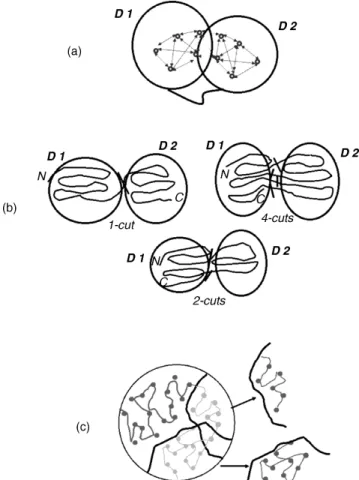
Structural domains can be thought of as the most fundamental units of the protein structure that capture the basic features of the entire protein. Among such features are (1) stability, (2) compactness, (3) presence of the hydrophobic core, and (4) ability to fold indepen-dently. These structural/thermodynamic properties of domains suggest that atomic inter-actions within domains are more extensive than that between the domains (Wetlaufer, 1973; Richardson, 1981). From this, it follows that domains can be identified by looking for groups of residues with a maximum number of atomic contacts within a group, but a minimum number of contacts between the groups, as illustrated in Figure 20.1a. The spatial compactness of domains sometimes results in noncontiguous domains where stretches of residues that are distant on the polypeptide chain are found in close proximity in the folded
structure (Figure 20.1b). This situation may arise as a result of gene insertion events or domain swapping (Bennett, Choe, and Eisenberg, 1994). Domains are the building blocks of the proteins: different combinations of domains result in variety of protein structures. Frequently, domains are associated with specific functions, such as binding a ligand, DNA or RNA or interacting with other protein domains.
Figure 20.1. Illustration of the problem of parsing the protein 3D structure into structural domains. (a) Most commonly, structural domains are defined as groups of residues with a maximum number of contacts within each group and a minimum number of contacts between the groups. Domains may be composed of one or more chain segments. Any domain assignment procedure must therefore be able to cut the polypeptide chains as many times as necessary. (b) When both domains are composed of contiguous chain segments (continuous domains), only a one-chain cut (1-cut) is required. When one domain is continuous and the other discontinuous, a situation that may arise as a result of gene insertion, then the chain has to be cut in two places (2-cuts). When both domains are discontinuous, additional chain cuts may be required. In the example shown, the chain is cut in four places (4-cuts), and thus the domain on the left hand side contains three chain segments, whereas that on the right contains two chain segments. (c) This drawing shows two solutions to the problem of partitioning the protein 3D structure into substructures. To partition the 3D structure into domains, many such solutions need to be examined to single out the one that satisfies the criterion given in (a). Figure also appears in Color Figure section.
ALGORITHMS FOR IDENTIFYING STRUCTURAL DOMAINS: INSIGHT INTO
HISTORY AND METHODOLOGY
Using the above definitions for domains as guidelines, systematic partitioning of structures into domains has been undertaken. This task can be done manually by experts in protein structure or automatically by encoding basic rules and assumptions in an algorithm. The former has the advantage of employing human expertise with myriads of algorithms integrating prior experience, common sense, topological sensibility, and other knowledge. The latter, while far less sophisticated, has the advantage of speed and consistency that are critical in the current era of structural genomics, when the sheer number of solved structures overwhelms human experts.
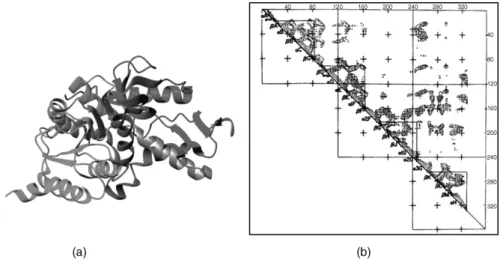
The firstmanualsurvey of structural domains in proteins was carried out nearly 30 years ago (Wetlaufer, 1973) using visual inspection of the then-available X-ray structures. Wetlaufer defined domains as regions of the polypeptide chain that form compact globular units, sometimes loosely connected to one another. At about the same time, the first so-called Ca–Cadistance plots were computed (Phillips, 1970; Ooi and Nishikawa, 1973) and shown to be useful for identifying structural domains. Domains were identified visually in these plots by looking for series of short Ca–Cadistances in triangular regions near the diagonal, separated by regions outside the diagonal where few short distances occur, as illustrated in Figure 20.2. Manual and semimanual surveys became more extensive and systematic after 1995; currently there are three major sources of information regarding domains: SCOP
Figure 20.2. Domain structure of dogfish lactate dehydrogenase, determined using the Ca–Ca
distance map. (a) Ribbon diagram of lactate dehydrogenase, showing the NAD binding (green) and catalytic domains (red). In gray is part of the helix, spanning residues 164–180, linking the two domains. (b) Distance map and structural domains in lactate dehydrogenase. Contours represent
Ca–Cadistances of 4, 8, and 16 Awithin the subunit of dogfish lactate dehydrogenase. Elements of
secondary structure are identified along the diagonal. Triangles enclose regions where short Ca–Ca
distances are abundant. The NAD binding domain comprises the first two triangles (counting from the N-terminus) that are subdomains. The catalytic domain comprises the last two triangles (the C-terminal domain). Taken from Rossman and Liljas (1974) and reproduced by permission of Academic Press (London) Ltd. Figure also appears in Color Figure section.
(Murzin et al., 1995, Chapter 17), AUTHORS (Islam, Luo, and Sternberg, 1995), and CATH (Orengo et al., 1997, Chapter 18). We will discuss the evaluating procedure for domain assignment later in the chapter.
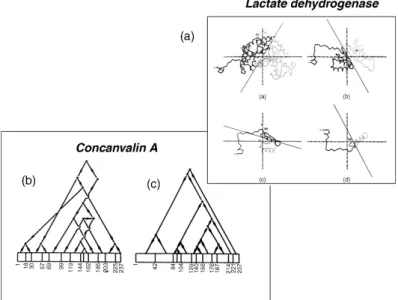
Rossman and Liljas performed the first systematicalgorithmicsurvey of domains for a set of protein 3D-structures (Rossman and Liljas, 1974) by analyzing Ca–Ca distance maps. This was followed a few years later by three other studies conducted by Crip-pen (1978) and Rose (1979) and by Wodak and Janin (1981b), and Janin and Wodak (1983) (Table 20.1). The methods described in these studies involved different algorithms and produced different results, but had one major aspect in common: the protein 3D structure was partitioned in a hierarchical fashion that yields domains and smaller substructures, as illustrated in Figure 20.3. Surveys of these smaller substructures in a set of proteins revealed recurrent structural motifs comprising of two or three secondary structure elements joined by loops (Wodak and Janin, 1981a; Zehfus and Rose, 1986). Interestingly,
Figure 20.3. Illustration of the hierarchic partitioning of protein 3D structures into substructures performed by three of the early automatic domain analysis methods. (a) The partitioning procedure of Rose et al. (1979) is applied to dogfish lactate dehydrogenase. The chain tracing of the subunit is projected into a ‘‘disclosing plane’’ passing through its principal axes of inertia. A line is then found that divides the projection into two parts of about equal size. The different projections represent (from left to right and from the bottom down) the whole subunit (residues 1–331) of the N-terminal domain (1–161) and the subdomain (residues 1–90 and 1–49). Taken from Rose (1979) and reproduced with permission of Academic Press (London) Ltd. (b) Domain and subdomain hierarchies in concanavalin A adapted from Crippen (1978). It represents an ascending hierarchy of clusters starting from 13 ‘‘reasonably straight segments’’ at the bottom of the hierarchy and culminating with the entire concanavalin A subunit. (c) The domain and subdomain hierarchy in concanavalin A, adapted from Wodak and Janin (1981b). It describes the descending hierarchy derived from identifying the minimum interface area between substructures in successive interface area scans. Unlike the hierarchy in (b), this one generates continuous substructures. The agreement with the hierarchy in (b) is therefore poor.
T A B L E 2 0 .1 . Summary of Domain Decompositio n Methods 1974–2007 Method Y ear Generation Strate gy T ype of Domains Generated Approaches/Models Used Comparison to Representati v e Data Set Cross- Validation No v el/ Interesting Features Rossman and Liljas (1974) 1974 First generation T op-do wn Contiguous Distance plots of the structure against itself using C a distances, search for strong interactions close to diagonal No No Crippen (1978) 1978 First generation Bottom-up Contiguous and noncontiguous Clustering of small structural units No No The only fi rst generation method to
produce noncontiguous domains
Rose (1979) 1979 First generation T op-do wn Contiguous Cutting the projection of 3D structure onto 2D domain disclosing plain No No W odak and Janin (1981a) W odak and Janin (1981b) 1981 First generation T op-do wn Contiguous Finding minimum in the interface between two domains No No 492
PUU (Holm and Sander , 1994) 1994 Second generation T op-do wn Contiguous and noncontiguous Rendering of the contact matrix, constructed using rigid body oscillation Ye s N o DETECTIVE (Swindells, 1995a) 1995 First generation Bottom-up Contiguous and noncontiguous Building of the hydrophobic core No No Islam, Luo, and Sternber g (1995) 1995 Second generation T op-do wn Contiguous and noncontiguous Finding minima in the interdomain contact density Ye s N o DOMAK (Siddiqui and Barton, 1995) 1995 Second generation T op-do wn Contiguous and noncontiguous Splitting structure by
maximizing intradomain/ interdomain
contacts Ye s N o So wdhamini and Blundell (1995) 1995 Second generation Bottom-up Contiguous and noncontiguous Clustering of secondary structures Ye s N o NCBI method (Madej et al., 1995) 1995 Second generation T op-do wn Contiguous and noncontiguous Similar to PUU, also intradomain contact density is at least two times the interdomain Y es N o Approach similar to PUU, b u t the performance is signifi cantly better T aylor (1999) 1999 Second generation Bottom-up Contiguous and noncontiguous Clustering of residues in spatial proximity using Ising model Y es N o Careful analysis of splitting b -strands between domains STR UDL (W ernisch, Hunting, and W odak, 1999) 1999 Second generation þ T op-do wn Contiguous and noncontiguous Finding minimum interdomain contacts using K ernighan–Lin graph heuristics Ye s Y es ( continued ) 493
TABLE 2 0.1 ( Co ntinue d ) Method Y ear Generation Strate gy T ype of Domains Generated Approaches/Models Used Comparison to Representati v e Data Set Cross- Validation No v el/ Interesting Features DomainP arser (Xu, Xu, and Gabo w , 2000) 2000 Second generation þ T op-do wn Contiguous and noncontiguous Finds minimum interdomain contacts using graph theoretical approach with maximum flo w/ minimum cut using F ord–Fulkerson algorithm Y es Y es Careful tuning of the method
during postprocessing step
(Xuan, Ling, and Chen, 2000) 2000 Second generation Bottom-up Contiguous and noncontiguous Assemble domains from rudimentary fragments using fuzzy clustering Ye s N o PDP (Ale xandrov and Shindyalo v, 2003) 2003 Second generation T op-do wn Contiguous and noncontiguous Finding partitioning with minimal number of contacts between domains Y es N o Unconstrained splitting of secondary structures among domains, still the best method tested HVdWD (Hierarchy of v an der W aals Domains) (Berezo vsk y, 2003) 2003 Second generation Bottom-up Contiguous and noncontiguous Clustering of short se gments. Both initial se gments and the clustering threshold are based primarily on v an der W aals interactions among atoms Y es N o Considers decomposition under dif ferent thresholds. Results can contain dif ferent le v els of decomposition 494
K undu, Sorensen, and Phillips (2004) 2004 Second generation T o p d o w n Contiguous and noncontiguous Decomposition of the structure using Gaussian Network Model; assumes semi-independent motion of domains Ye s N o Sisla K V , and V ishv eshwara 2005 2005 T op-do wn Contiguous and noncontiguous Identifi es strongly interacting units by applying spectral analysis to the contact matrices [idea similar to PUU] Y es N o Thresholds for decomposition may v ary depending on the compactness of the protein structure DePot (T aylor and V aisman, 2006) 2006 Second generation Bottom-up Contiguous and noncontiguous Hierarchical clustering of residues starting with indi vidual residues and using Delaunay tessellation of the protein structure [idea similar to T aylor , 1999] Ye s N o Dif ferent thresholds of residue proximity are
considered during decomposition
DDOMAIN (Zhou et al., 2007) 2007 Second generation þ T op-do wn Contiguous only Similar to PDP , fi nding partition with lo west o v erall interaction between domains Y es Y es Most extensi v e use or training/ testing data sets DomainICA (Emmert-Streib and Mushe gian, 2007) 2007 Second generation þ T op-do wn Contiguous only P artitioning the graph of nodes representing secondary structures, by maximizing the cycle distrib ution on the graph Y es Y es Uses exclusi v ely topological data of secondary structures. No postprocessing step 495
the systematic identification of similarly defined smaller substructures in proteins was recognized years later as a useful way for predicting regions in proteins that would form first during folding (nucleation sites) (Moult and Unger, 1991; Berezovsky, 2003). Over 20 different algorithmic approaches have been applied to this problem in the subsequent three decades (this survey covers methods up to 2007). The overarching theme of structural partitioning is based oncontact density, that is, the simple fact that there are more residue-to-residue contacts within a structural unit than between the structural units. The implementations of this principle can be very different in different methods as can be seen in Table 20.1, but the underlying idea always comes back to finding regions with a high density of interactions.
Methodologically, algorithms can be separated into first generation: methods published during the period 1974–1995; and second generation algorithms: methods published from 1994 until now. The first generation of algorithms was based on a very limited set of available structural data at the time thus, some rather general principles were difficult to capture due to the paucity of structural examples. For the same reason, neither a systematic comparison against a representative data set nor separation of the data into training and testing subsets was possible until the middle 1990s. The second generation methods, which began around 1994, relied on a large set of structures for training and they routinely compare performance of the algorithm against a representative data set, typically assigned by human experts. Surprisingly, the methodological rigor is often absent and the algorithms are often trained and tested on the same set of data. Methods that incorporated cross-validation to test the algorithm during development by using nonoverlapping training and testing data sets are more balanced in their approach and we assign them as ‘‘second generationþ’’ (Table 20.1). The majority of the second generation methods are able to deal with noncontiguous domains (Zehfus, 1994).
Domain identification can be divided into two fundamental approaches: top-down (starting from the entire structure and proceeding through iterative partitioning into smaller units) and bottom-up (defining very small structural units and assembling them into domains). Some methods use both the approaches within their algorithm by first decom-posing the structure and then reassembling them, or vice versa. Here, we classify each method based on its chief or overall approach to the domain identification. Generally, the process of domain decomposition is performed in two steps: (1) tentative domains are constructed either by splitting the structure into domains or building domains from smaller units; (2) these tentatively defined domains are evaluated in a postprocessing step. Overall, an amazing array of approaches has been put forward over the years to solve the domain decomposition problem; the strategies vary from maximizing intradomain contacts to minimizing domain–domain interface, from semi-independent motion of domains to clustering residues in spatial proximity. Other techniques applied for domain definition come from graph theoretical approaches (i.e., Kernighan–Lin graph heuristics, Network flow, Delaunay tessellation), rigid body oscillation, spectral analysis, Ising model, Gaussian Network Model, and so on (Table 20.1). In spite of this variety of approaches and techniques, an interesting observation emerges when one carefully com-pares the performance of the algorithms: most of the algorithms solve correctly 70–80% of the available structures, faltering on the remaining ones because of their complex, multidomain structures. Typically, all methods correctly identify potential boundaries between the structurally compact regions. However, in some cases the number of boundaries are overpredicted leading to too many assigned domains (overcut) or underpredicted leading to fewer assigned domains (undercut). Thus, the problem still remaining is not
‘‘where does the boundary of domains fall?’’, but rather ‘‘is the identified boundary a true domain boundary?’’ Some of the difficulties come from very complex and contradictory scenarios that are presented by existing protein structures, making it nearly impossible to capture by a simple set of rules. This, in turn, is part of the complexity inherent in biology in general. In this case, complexity arises in that some domains are not globular, lack a hydrophobic core in the absence of the binding partner, have relatively low intradomain contact density, or have extensive interactions along the domain–domain interface. Identifying a correct subset of domain boundaries from the set of potential boundaries is the next (and maybe the final) frontier in solving the domain assignment problem for structures.
ALGORITHMS FOR IDENTIFYING STRUCTURAL DOMAINS: IN-DEPTH
Of the more recent second generation methods for domain assignment, several make elegant use of graph theoretical methods. In this section, we discuss two such methods that use somewhat different techniques to address the problem of partitioning protein structure into structurally meaningful domains. First, we will discuss STRUctural Domain Limits (STRUDL) (Wernisch, Hunting, and Wodak, 1999) followed by DomainParser (Guo et al., 2003).The procedure implemented in STRUDL views the protein as a 3D graph of interacting residues, with no reference to any covalent structure. The problem of identifying domains then becomes that of partitioning this graph into sets of residues such that the interactions between the sets is minimum. Since, this problem is NP-hard, efficient heuristic proce-dures—procedures capable of approximating the exact solution with reasonable speed—are an attractive alternative. The algorithm used in this case was a slightly modified version of the Kernigan–Lin heuristic for graphs (Kernighan, 1970). The application of this heuristic to domain assignment is summarized in Figure 20.5.
A useful, though not essential, aspect of this application is that the interactions between residue subsets were evaluated using contact areas between the atoms. This area was defined as the area of intersection of the van der Waals sphere around each atom and the faces of its weighted Voronoi polyhedron. This contact measure is believed by the authors to be more robust than counting atomic contacts due to its lower sensitivity to distance thresholds.
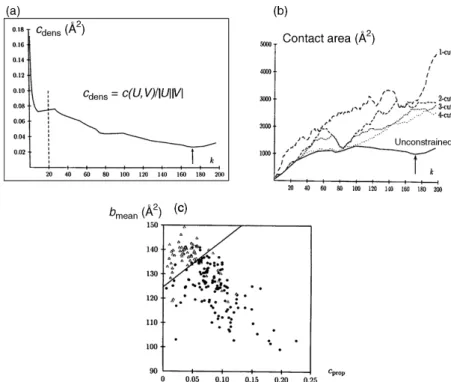
To identify domains for which the limits and size are not known in advance, the partitioning procedure described in Figure 20.4 is repeatedktimes, withkrepresenting all the relevant values of the domain size, ranging from 1 toN/2, andNbeing the total number of residues in the protein. The partition with minimum contact area, identified for each value ofk, is recorded. This information is then used to compute aminimum contact density profile. In this profile, the minimum contact area found for eachkis normalized by the product of the sizes of the corresponding domains, to reduce noise (Holm and Sander, 1994;Islam, Luo, and Sternberg, 1995) and plotted against k. The domain definition algorithm then searches for the global minimum in this profile. Figure 20.5a illustrates the profile obtained for a variant of thep-hydroxy-benzoate hydroxylase mutant (PDB-RCSB code 1dob), a 394-residue protein composed of two discontinuous domains. The global minimum in theminimum contact density profile, although quite shallow, is clearly visible atk¼172, and yields the correct solution. The corresponding partition cuts the chain in five distinct locations yielding two domains, comprising six chain segments.
The smaller of the two domains contains 172 residues; the largest contains 222 (394–172) residues.
Once the global minimum is identified in theminimum contact density profile, a decision must be taken to either accept or reject the corresponding partition, with a rejection corresponding to classifying the structure as a one-domain protein. An obvious criterion on which to base such decision is the actual value of the contact area density in profiles such as that of Figure 20.5a. If this value is below a given threshold, the partition is accepted; otherwise, it is rejected. But this simple criterion is unfortunately not reliable enough. Following other authors, additional criteria that represent expected properties of domains and of the interfaces between them were therefore used to guide the decision (Rashin, 1981; Wodak and Janin, 1981b). The choice of these criteria was carefully optimized on a training set of 192 proteins using a discriminant analysis, and tested on a different, much larger set of proteins, as summarized in Figure 20.5c. Finally, once a partition is accepted, the entire procedure is repeated recursively on each of the generated substructures until no further splits are authorized. This recursive approach was shown to successfully handle proteins composed of any number of continuous or discontinuous domains.
As always, assessing the performance of the method is a crucial requirement. Fortu-nately, the significant increase in the number of different proteins of known structure presently offers a more extensive testing ground. STRUDL was applied to a set of 787 Figure 20.4. Domain identification using the graph heuristic procedure implemented in STRUDL (Wernisch, Hunting, and Wodak, 1999). (a) Overview of the major steps in the STRUDL algorithm (b)
The residue exchange procedure in STRUDL. ResiduesueUandveV(filled circles) are selected so as
to produce a maximal decrease or, if that is not possible, a minimal increase in the contact area
betweenUandVupon exchange. Once moved toV, residueuis flagged (empty circle) and can
hence not be moved back toU. The exchange procedure stops whenVcontains only flagged
residues. Among all partitions with contact areaCi, withi¼0,. . .,nthe one with minimum contact
areaCminis selected.
Figure 20.5. Parameters used to partition and/or to evaluate domain partitioning in STRUDL.
(a) The minimum contact density profile for thep-hydroxy-benzoate hydroxylase mutant (1DOB).
TheCdensvalue in A
, is computed using the formula given in the figure. In this formula,c(U,V) is the
contact area between the two residue groupsUandV, and|U|and|V|are the number of residues inU
andV, respectively. The plotted values represent the minimum ofCdenscomputed for a given
domain sizek, wherek¼1,N/2, withNbeing the total number of residues in the protein chain.
Hence|U|and|V|equalkandN–k, respectively. The arrow atk¼172 indicates the global minimum of
this profile. The dashed line delimits the value ofk¼20 below which splits are not allowed to avoid
generating domains containing less than 20 residues. (b) The profiles of minimum contact areac(U,
V) in Acomputed as a function ofk, the number of residues in the smallest substructureU, for the
same protein as in (a). Shown are the profile with no constraints on the number of chain cuts, as in the STRUDL procedure, and four other p-cut profiles, obtained by limiting the number of allowed chain cuts p (see Wernisch et al., 1999 for details). Those are 1-cut (- - -), 2-cuts (- - -), 3-cuts (- - -), and
4-cuts ( ). The global minimum of the contact area (arrow) can only be located in the unconstrained
profile, illustrating the advantages of STRUDL over other procedures in which the number of
allowed chain cuts is fixed. (c) Plot of the mean burialbmeanin A
, versus the contact area ratiocprop.
Both quantities are evaluated for domain partitions corresponding to the global minimum in the
contact area density profiles computed by STRUDL.bmeanis the average interresidue contact area of
a given substructure.Cpropis the ratio of the contact area of the putative domains to the sum of the
interresidue contact areas in the entire proteins. The straight line optimally separating the single (filled circles) from the multidomain proteins (empty circles). This optimal separation entails however, 19 errors—proteins classified in the wrong category—out of the total of 192 protein considered in the set.
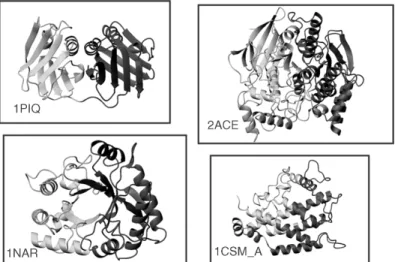
representative protein chains from the PDB (Bernstein et al., 1977; Berman et al., 2000), and the results were compared with the domain definitions that were used as the basis for the CATH protein structure classification (Orengo et al., 1997). This definition was based on a consensus definition produced by Jones et al. (1998) using three automatic procedures, PUU (Holm and Sander, 1994), DETECTIVE (Swindells, 1995a), and DOMAK (Siddiqui and Barton, 1995), as well as by manual assignments. Results showed that domain limits computed by STRUDL coincide closely with the CATH domain definitions in 81% of the tested proteins and, hence, that it performs as well as the best of the above-mentioned three methods. In contrast to these methods, however, it uses no information on secondary structures to prevent the splittingb-sheets, for instance. The 19% or so protein for which the domain limits did not coincide, represent interesting cases which could, for the most part, be rationalized either on the basis of the intrinsic differences between the approaches (in this case, STRUDL versus CATH) or by the variability and complexity inherent in real proteins. Several of these cases are illustrated in Figures 20.6 and 20.7. Figure 20.6 shows cases where STRUDL splits proteins into two domains that are considered a single architecture by CATH. Among the shown examples are the DNA polymerase processivity factor PCNA (1PLQ), which clearly shows an internal duplication, and the lant seed protein narbonin (1NAR), which adopts a TIM barrel fold that many automatic domain assignment proce-dures tend to split into two domains. Differences of this type could be rationalized by the fact that CATH imposes criteria based on chain architecture and topology, whereas STRUDL does not. Figure 20.7 illustrates two cases, where the results of STRUDL and CATH differ by the assignment of a single relatively short protruding chain segment. Such cases illustrate the inherent noisiness in the backbone chain trace, which invariably affects domain assignments. DomainParser uses a top-down graph theoretical approach for domain decomposition and an extensive postprocessing step. During the training stage of the algorithm, multiple
Figure 20.6. Examples of single domain, single architecture proteins in CATH (Jones et al., 1998), which STRUDL (Wernisch, Hunting, and Wodak, 1999) splits into two domains. Shown are the domain assignments produced by STRUDL. For the exact domain limits, the reader is referred to
the STRUDL Web site. The displayed protein ribbons belong toTorpedo californica
acetylcholines-terase monomer (1ACE), the lant seed protein narbonin (1NAR), the eukaryotic DNA polymerase processivity factor PCNA (1PLQ), and Chorismate mutase chain A monomer (1CSM_A).
parameters are tuned; the method is then validated on a SCOP data set. Domain decompo-sition is addressed by modeling the protein structure as a network consisting of nodes (residues) and edges (connections between residues). A connection between any two residues is drawn when they are adjacent in the sequence or, alternatively, are in physical proximity in the structure. The strength of the interaction between two residues is expressed as the capacity of the edge to connect the two nodes. This edge capacity is a function of (a) the number of atom–atom contacts between residues; (b) the number of backbone contacts between residues; (c) the existence of backbone interactions across a beta-sheet; and (d) whether both residues belong to the same beta-strand. The values for all parameters involved in edge capacity are optimized during the training stage of the algorithm.
The partitioning of the network into two parts is then equivalent to decomposing a given structure into two domains. Ideally, partitioning should be done using the edges with least capacity, which will result in partitioning a structure along the least dense interactions among the residues. The problem of partitioning the network is solved using themaximum flow/ minimum cuttheorem by Ford–Fulkerson as implemented by Edmond and Karp. Briefly, the approach is as follows: artificial source and sink nodes are added to the network (Figure 20.8a). A ‘‘bottleneck’’—a set of critical edges in the network flow—is found by gradually increasing the flow of all edges in a network. Removing the set of critical edges from the network prevents flow from the source to the sink. At this point, nodes that are connected to the source represent one interconnected part of the network, while nodes connected to the sink are the second interconnected part of the network. Since the node capacity is increased gradually, it is expected that nodes with least capacity (least residue– residue contacts) will be the ones contributing to the bottleneck. The process of subdividing the network into two parts is repeated multiple times by connecting the source and sink to Figure 20.7. Different assignments by STRUDL (Wernisch, Hunting, and Wodak, 1999) and CATH (Jones et al., 1998), illustrating the effect of ‘‘noise,’’ or decorations, in the protein chain trace. The STRUDL assignments are displayed on the left hand side, and the CATH assignments are displayed on the right. The short chain segments, which CATH assigns to separate domains, are shown in blue. Some of the discrepancies may be due to simple ‘‘slips’’ in the CATH assignments that have been, or will be, corrected. Figure also appears in Color Figure section.
different parts of the network; a set of minimal cuts is collected and evaluated during a postprocessing step. The entire procedure is then repeated in each of the resulting domains until either the domain’s size drops below 80 residues or the partitioning produces domains that do not meet necessary conditions of domain definitions.
The stopping criteria are multifaceted and defined by (1) domain size (no less than 35 residues), (2) beta-sheets kept intact, (3) compactness of domain above threshold gm, (4) size of the domain–domain interface below thresholdfm, (5) the ratio of the number of residues and the number of segments in the domain is above thresholdls. The values for gm,fm, ls and minimum domain size are determined during the training stage of the algorithm. A suite of additional parameters exists—these are involved in a postprocessing step of the algorithm in which an assessment is made about whether the substructure meets the additional criteria of a structural domain. These parameters are (1) hydrophobic moment (Figure 20.8b), (2) the number of segments in the partitioned domain (Figure 20.8f), (3) compactness (Figure 20.8c), (4) the size of domain interface relative Figure 20.8. Domain decomposition using the DomainParser algorithm. (a) Schematic represen-tation of protein structure as a directed flow network. The value on each edge represents the edge’s
capacity. Artificial nodes ‘‘start’’ and ‘‘sink’’ are denoted bysandt,respectively. (b–g) are examples
of parameters used by the algorithms. (b) zero- and second-order spherical moment profile of structure 2ilb, (c) compactness of structure, (d) size of the domain interface relative to the domain’s volume, (e) measure of relative motions between domains, (f) distribution of the number of segments per domain, and (g) distribution of domain sizes. (h) Neural network architecture for evaluation of decomposed individual domains.
to the domain’s volume (Figure 20.8d), and (5) relative motion between compact domains (Figure 20.8e). Distribution for each of the parameters for true versus false domains is collected during the training stage using 633 correctly partitioned domains and 928 incorrectly partitioned domains. Multiple neural networks are then investigated; the best one has nine input nodes, six nodes in the hidden layer, and one output node (Figure 20.8h). Performance of the DomainParser method is then evaluated using a set of 1317 protein chains in which domains are defined by SCOP.
DOMAIN ASSIGNMENTS: EVALUATING AUTOMATIC METHODS
A chief reason for the existence of over two dozen methods for domain decomposition is the complexity of the problem itself: it is nearly impossible to capture succinctly the principles of domain decomposition and apply them successfully to the entire universe of protein structures. Thus, every new method strives to reach a bit further beyond existing methods in its ability to decompose complex structures. With so many different methods available, it is essential to be able to compare the performance of the algorithms, to determine the fraction, as well as the type, of successfully partitioned proteins.Evaluation of automatic methods is an essential part of algorithm development process and the performance of a method is often reported in the second generation of algorithms. To evaluate the performance of a new domain assignment method, authors usually apply it to a set of proteins for which experts who are either crystallographers or protein classifiers have produced domain assignments manually. However, authors of each method use different data sets for evaluation of their algorithms; thus, it is nearly impossible to cross-compare the performance of various methods. Only one consistent benchmark data set existed until recently and it is a set of 55 protein chains consistently assigned by Jones et al. (1998). This data set was assembled by finding a consensus using the Islam et al. data set among four automatic methods: PUU (Holm and Sander, 1994), DETECTIVE (Swindells, 1995b), DOMAK (Siddiqui and Barton, 1995), and the method developed by Islam, Luo, and Sternberg (1995). For the evaluation, any two assignments (one from the benchmark set, another by the algorithmic method) were considered similar if they had the same number of domains and at least 85% of the residues were assigned to the same domain. Fifty-five proteins is a very small benchmark set, thus it is likely that its resolution will be insufficient to detect differences between the methods. New benchmark data sets were compiled recently (Veretnik et al., 2004; Holland et al., 2006) specifically for the purpose of cross-comparing the performance of the algorithms as well as highlighting the strengths and weaknesses of each algorithmic method. The data set is assembled using a principle of consensus approach among the human experts: it includes proteins for which three expert methods (CATH, SCOP, and AUTHORS) produce similar domain decompositions. Such consensus approach eliminates the more complicated structures for which no agreement can be reached among human experts. This fraction of ‘‘controversial’’ proteins is intentionally left out, so as not to further complicate the issue. The 315 proteins in this new benchmark (Benchmark_2 in Holland et al., 2006) are realistically distributed between single-domain and multidomain proteins to avoid the typical bias toward one-domain proteins (Table 20.2). Furthermore, each type of topology combination, as determined by CATH classification on the level of Topology, occurs only once per data set to ensure that a broad range of topologies found in the protein universe are equally represented. The above benchmark data set was used to evaluate four recent publicly available automatic methods: PUU (Holm and Sander, 1996), DomainParser (Xu, Xu, and
T A B L E 2 0 .2 . Benchmark Data Sets Constructed for Evaluation of Computational Methods for Domain Assignmen ts from 3D Structure T ype of Chain Jones et al. (1998) Benchmark Islam, Luo,
and Sternberg (1995) Benchmark
V eretnik et al. (2004) Benchmark_1 Holland et al. (2006) Benchmark_2 Holland et al. (2006) Benchmark_3 Co v erage of Structural Space by Chains in Benchmark_2 (Using CA TH T opologies) Class 1 Arch:5 Topol: 227 Class 2 Arch:19 Topol: 139 Class 3 Arch:12 Topol: 368 Class 4 Arch:1 Topol: 86 T otal Arch:37 Topol: 820 1-Domain 30 (55%) 1530 (64.7%) 318 (85%) 106 (33.7%) 106 (39.1%) Arch: 2 T opol: 14 Arch: 9 T opol: 26 Arch: 6 T opol: 23 Arch: 1 T opol: 7 Arch: 18 T opol: 70 2-Domain 20 (36%) 720 (30.5%) 40 (10.7%) 140 (44.4%) 108 (39.9%) Arch: 5 T opol: 30 Arch: 8 T opol: 20 Arch: 8 T opol: 27 Arch: 1 T opol: 2 Arch: 22 T opol: 79 3-Domain 3 (5.4%) 85 (3.6%) 15 (4.0%) 54 (17.1%) 45 (16.6%) Arch: 4 T opol: 16 Arch: 9 T opol: 18 Arch: 7 T opol: 33 none Arch: 20 T opol: 67 4-Domain 2 (3.6%) 25 (1.1%) 1 (0.3%) 8 (2.5%) 7 (2.6%) Arch: 2 T opol: 2 Arch: 3 T opol: 4 Arch: 5 T opol: 15 none Arch: 10 T opol: 21 5-Domain 0 2 (0.1%) 0 5 (1.6%) 5 (1.9%) None Arch: 5 T opol: 6 Arch: 4 T opol: 6 none Arch: 9 T opol: 12 6-Domain 0 0 0 2 (0.6%) 0 Arch: 1 T opol: 1 none Arch: 3 T opol: 3 none Arch: 2 T opol: 2 T otal 55 2363 374 315 271 504
Gabow, 2000; Guo et al., 2003), PDP (Alexandrov and Shindyalov, 2003), and NCBI (Madej, Gibrat, and Bryand, 1995). The evaluation includes information about the success rate of each algorithm and an analysis of errors in terms of predicting fewer domains (undercut) or too many domains (overcut) (Figure 20.9a). A more scrutinized examination was also conducted by inspecting (1) the performance of domain boundary prediction for each example of multidomain structures (Figure 20.9b–e), (2) tendencies for methods to fragment domains into noncontiguous stretches of polypeptide chain (Figure 20.10a), and (3) the precision of overlap of domain boundaries (Figure 20.10b).
Finally, a composite evaluation that accounts for the correct number of domains, fragments, and domain boundary assignment can be a more comprehensive approach to conducting a cross-comparison of performances of various algorithms (Figure 20.10c and d). By changing the weighing schema of individual performance components of the methods, it allows for comparisons to be conducted from different angles that stress particular features of interest. In our analysis, the PDP method is a clear winner regardless of the weight that is attributed to individual parameters. On the contrary, the performance of DomainParser improves to the point of outperforming the NCBI method when a higher weight is given to the precision of boundaries rather than prediction of the correct number of domains.
This type of systematic analysis can link performance of an algorithm in terms of its strength and weaknesses to particular assumptions found in the algorithm, as well as to the specific data sets on which algorithms had been trained. For example, the superior performance of PDP can be partially linked to its ability to cut through secondary structures, Figure 20.9. Comparison of the performance of domain assignment methods using Benchmark_2 data set (built on the principle of consensus among expert-based assignments: expert consensus). Four currently available algorithmic methods are evaluated: DomainParser, PDP, PUU, and NCBI. Structure is considered to be assigned correctly if the algorithm predicts the same number of domains as predicted by expert consensus. Correctly assigned structures are represented in grey, structures with too many assigned domains (overcut) are in black, and the structures with too few domains (undercut) are indicated by the dotted pattern. (a) Performance of each method on the entire Benchmark_2 data set. (b–e) Performance of individual methods on structures grouped by the number of domains they contain. (b) PDP method. (c) DomainParser method. (d) NCBI method. (e) PUU method.
particularly b-sheets, and assign them to different domains. This particular property is interpreted differently in all other tested methods. On the contrary, a complete ‘‘taboo’’ on cutting any secondary structure element, as imposed in the NCBI method, results in poorly matched domain boundaries in cases where the proper domain boundaries do occasionally fall within secondary structure elements rather than loops. A tendency toward very compact domains forces the PUU algorithm to build domains out of many discontinuous fragments that often do not make sense from the evolutionary perspective. Rigorous tuning of multiple parameters in the DomainParser algorithm results in excellent prediction on the level of domain boundaries and the number of domain fragments, but at the same time it produces a large fraction of undercut structures. This might partially be due to the training and testing data set that is based on SCOP, an expert database with significant level of undercut Figure 20.10. Comparison of the performance of domain assignment methods using Bench-mark_2.(a) Evaluation of correct placement of domain boundaries using different levels of strin-gency of overlap of the predicted domain assignment and expert consensus assignment. As stringency of overlap increases, a larger fraction of structures fails the domain overlap test. (b) Evaluation of assignment of noncontiguous domains by different methods. Most of the methods predict more noncontiguous domains than experts. (c) Performance of each method using three main criteria: (1) fraction of structures with correctly assigned number of domains, (2) correctly assigned noncontiguous domains, and (3) correct placement of domain boundaries (at 80% precision threshold). (d) Composite evaluation of performance, which combines three components described in (e) , using different weighting schema. The first component in the schema is the fraction of correctly assigned domains; second component: correctly fragmented domains; third compo-nent: correct placement of domain boundaries (at 80% precision threshold). Regardless of the weighting schema, PDP always appears the best method, while PUU is worse. The performance of DomainParser improves significantly when a larger weight is given to correct fragmentation and boundary placement, so that eventually it surpasses the performance of NCBI method.
predictions compared to CATH and AUTHORS. Another issue is that the threshold for splittingb-strands andb-sheets might be set incorrectly. In summary, analysis of algorithm performance offers both a relative ranking of the methods among themselves as well as insights into particular areas of difficulties for each method; these may lead to new insights and further improvements.
DOMAIN PREDICTION BASED ON SEQUENCE INFORMATION
Identifying protein domains by using only sequence information is even a more challenging task. However, this approach is not limited to proteins with solved 3D structures. For the vast majority of protein sequences, the structure is unknown thus, sequence-based methods are of great importance and, indeed, this area of research is very active. The detriments of predicting boundaries of structural domains without knowing the structure are (1) the level of correct assignments is lower than that for structure-based methods; this difference becomes particularly sharp in the cases of multidomain proteins with complex architectures, and (2) only a few of the sequence-based methods can predict noncontiguous domains that constitute about 10% of all domains (Holland et al., 2006). There is almost no overlap or collaboration between sequence-based and structure-based methods, as we will see from terminology and evaluation methods. The very subject of prediction of structural domains is coached here in terms of predicting domain boundaries.
Sequence-based methods can be divided into several categories: (1) prediction in the absence of sequence information, (2) methods that use information from single sequence (when no homologous sequences are available), (3) methods based on multiple homolo-gous sequences, and (4) methods that incorporate structure prediction from sequences.
Algorithms Based Purely on Domain and Protein Sizes
‘‘Domain Guess by Size’’ (DGS) (Wheelan, Marchler-Bauer, and Bryant, 2000) is an example of an algorithm that does not use any sequence or structure information. Rather, it predicts protein partitioning based exclusively on the size of the protein. The algorithm predicts several probable outcomes by using likelihood functions based on empirical distributions of protein length, domain length, and segment number as observed in the PDB. This is the only method in the sequence-based category that can predict noncontiguous domains. DGS identifies domain boundaries with 57% accuracy and an error margin of20 residues for two-domain proteins. If proteins were simply chopped in half, this approach will only yield an 8% success rate.
Algorithms Based on Single Sequence Information
When prediction of domain boundaries is based on a single sequence, the amino acid propensity is typically calculated for linker regions associated with domain boundaries. Each residue in the sequence is scored with linker index to construct a linker profile and boundaries are identified with a threshold for the scores. DOMcut (Suyama and Ohara, 2003) identifies domain linkers with 53.5% sensitivity and 50.1% selectivity using a linker index deduced from a data set of domain/linker segments. Armadillo (Dumontier et al., 2005) uses a linker index enhanced by positional confidence scores leading to a performance of 56% and 37% sensitivity for two- and multidomain proteins, respectively. These simple strategies
indicate that amino acid propensities in linker regions are distinct and differ from the rest of the protein. Such potential patterns in linker regions have further been exploited by using more advanced machine learning techniques such as neural networks. CHOPnet (Liu and Rost, 2004b), PPRODO (Sim 2005), and a newly developed neural network (Ye et al., 2007) report69% accuracy for two-domain proteins.
Algorithms Based on Multiple (Homologous) Sequences
The challenges of identifying boundary regions are diminished when there is detectable sequence homology to the characterized domains. Several algorithms use linkages between the similarities in sequences such as CHOP (Liu and Rost, 2004a). These similar sequences can also be aligned to generate multiple sequence alignments (MSA) that are subsequently analyzed to identify domain boundaries. Domaination (George and Heringa, 2002a) is an example of an algorithm that analyzes features in the MSA to partition proteins into domain units. Nagarajan et al. developed an approach to identify transition positions between domains within the MSA using several probabilistic models (Nagarajan and Yona, 2004). Clustering of the sequences is also a popular approach in identifying domains and is a strategy employed by DIVCLUS (Park and Teichmann, 1998), MKDOM (Gouzy, Corpet, and Kahn, 1999), and ADDA (Heger and Holm, 2003). Finally, the use of taxonomic information has been shown to be useful to help identify domains as well (Coin, Bateman, and Durbin, 2004).
Adding Predicted Structure to Sequence Prediction
While domain identification can be achieved using a purely sequence-based strategy, the use of structural information either integrated during the training or prediction process when developing sequence-based domain identification can impart added advantage. As an example, a comparison between the sequence and structural alignments of domains illustrates the added advantage of using the information content inherent in structural data leading to an improvement over sequence alignments (Marchler-Bauer et al., 2002). We will discuss the strategies that have been employed to improve sequence-based identification of domains and highlight how the use of structural data has been helpful in the development of these tools.
Incorporatingab initiostructure prediction, either at the secondary or tertiary structure level, has also been used to identify domain boundaries. Sequence-based secondary structure predictors have reached performances as high as 78% accuracy and can be used to help delineate domain boundaries. DomSSEA (Marsden, McGuffin, and Jones, 2002) aligns secondary structure predictions to known templates to identify continuous domains. This approach correctly predicted the number of domains with 73.3% accuracy. Domain boundary predictions were at 24% accuracy for multidomain proteins. Although DomS-SEA does not identify boundaries at a high performance rate, this strategy has not been abandoned and has recently been used in SSEP-Domain (Gewehr and Zimmer, 2006). SSEP-Domain incorporates other profile information and improves predictions to a reported 91.28% overlap between the predicted and true values for single- and two-domain proteins.
Incorporation of generated tertiary structural models has also been explored for domain boundary predictions. SnapDragon (George and Heringa, 2002b) generates several struc-tural models based on the assumption that hydrophobic residues cluster together in space.
Boundaries are predicted based on observed consistencies between structural models of other proteins for a given multiple sequence alignment. The structures may not be atomically accurate models, but they provide an approximation of where the boundaries may be. SnapDragon reports an accuracy of 63.9% for domain boundary predictions in multidomain proteins. Ginzu and RosettaDOM have both incorporated to make automated prediction of domain boundaries (Kim et al., 2005). Ginzu has been utilized for protein sequences with detected homology to a protein with structural data. RosettaDOM generates structures using ab initio structural prediction to generate 400 models to identify domain boundaries, a similar concept to SnapDragon. For difficult targets requiringde novostructures, Rosetta-DOM reports an 82% overlap in prediction for domains and 54.6% accuracy for domain boundary prediction in multidomain proteins with an error margin of 20 residues. According to CASP6 evaluators, the reported performance is comparable to domain boundary predictions conducted by experts. For a more comprehensive overview of the field of adding structure predictions to sequence information, see a review written by Kong and Ranganathan (2004).
Combining Multiple Methods: MetaMethods
Methods that incorporate multiple sources of information result in improved predictions, which is shown by the results of including the predictions of secondary and tertiary structures to the pure sequence information. Several hybrid and consensual approaches have been implemented to leverage the strength of multiple independent predictions. Meta-DP is a metaserver that couples 10 domain predictors and can be extended to include more predictors (Saini and Fischer, 2005). DOMAC integrates template-based andab initio methods, a concept similar to the strategy that is used by Ginzu and RosettaDOM (Cheng, 2007). The difference is that DOMAC invokes theab initiodomain predictor DOMpro, another neural network based predictor. Finally, the Dom-Pred server has been recently set up to provide users with results from two different methods, domains predicted from sequence (DPS) and DomSEA (Marsden et al., 2002), with the idea that domain boundary prediction is a computer-assisted task requiring user intervention for this difficult problem (Bryson, Cozzetto, and Jones, 2007).
Evaluating the Performance of Sequence-Based Methods
Similar to structure-based methods, the sequence-based methods still lack a well-established data set on which methods can be evaluated consistently and cross-compared. Various data sets are coming from SCOP (Lo Conte et al., 2000), PFAM (Bateman et al., 2002), DOMO (Gracy and Argos, 1998), SMART (Schultz et al., 1998), and 3Dee (Siddiqui, Dengler, and Barton, 2001). While for structure-based methods the assignment is attempted on a relatively small group of the structures, the sequence-based methods have the ‘‘luxury’’ of using the entire data sets of sequences. Thus, a more conventional analysis of performance can be adopted. The number of missed boundaries (false negatives) and the number of predicted incorrect boundaries (false positives) are calculated and reported using the terms of the sensitivity and selectivityof the methods. This evaluation approach, while statistically appealing, does not lend itself to an intuitive understanding of what is happening with respect to the individual protein structures (as we do have for structure-based methods). Does a method predict the correct number of domains with the wrong positions of the boundaries or do they tend to predict too many/too few domains?
The success of domain boundary placement is also a variable parameter: some methods assume that the boundary is placed correctly if it falls within an error window of10 residues of the true boundary (which is usually a point between two residues in a sequence), while others tolerate errors as large as20 residues. Some construct compromises by varying the error margin based on size, which is defined as 10% of the length of the protein sequence. This lack of uniform standards for prediction evaluation makes it even more difficult to cross-compare sequence-based methods. A different measure to evaluate success is to calculate the overlap score between the predicted and actual definition of the domain region rather than basing it on the definition of the domain boundary (Jones et al., 1998). The performances of the predictors have been reported to perform as well as up to94% for single domains. Currently, most predictors report performances at an accuracy of 70% with 50% sensitivity and selectivity. The performances of these algorithms decrease when the number of domains found within a protein increases. Lastly, domains formed by discontinuous segments are difficult to identify and most performance reports are for continuous segments. As the sequence-based domain identifiers improve, we challenge the field to reduce the error margin (often reported with20 residues).
CONCLUSIONS AND PERSPECTIVES
In this chapter, we presented an overview of the principles underlying the detection of the structural domains in proteins and of the computational procedures that implement these principles to assign domains from the atomic coordinates of complete proteins. This overview showed that significant progress has been achieved over the years in the generality and reliability of the algorithms for domain detection. One should add that progress has also been achieved in calculation speed. The more recent second generation methods that cut the polypeptide chain in multiple places simultaneously are orders of magnitude faster than the older methods that produce these cuts sequentially, so much so that the computational demands of domain assignment methods have ceased to be an issue with the present-day computer speeds.
On the contrary, we showed that some important limitations in performance remain and there is definitely room for improvement. While the second generation algorithms elegantly solve the problem of partitioning the structures into domains composed of several chain segments and can detect any number of domains, an additional postprocessing step or additional criteria are needed to deal with the inherent variability of natural protein structures, as well as with the inherent fuzziness in domain definition. Another constructive point to consider in future algorithm development is the merging of consensus results for domain assignments performed on multiple structures of related proteins (Taylor, 1999). This strategy has improved prediction performances for secondary structures and identifi-cation of the relationships between proteins using sequence data; therefore, an improvement in domain boundary assignment should also be expected.
The use of domain–domain interfaces is another source of potential improvement. A study by Jones, Marin, and Thornton (2000) reports the properties of residues of domain–-domain boundaries to resemble intermolecular interface residues rather than core residues. Ofran and Rost (2003) also reported distinct amino acid compositions and residue–residue interaction preferences between homo- and hetero-domain interacting regions. These additional biophysical and sequence selection knowledge criteria can add value to the existing computational methods.
An improved understanding of the sequence rules that define domains will have a significant impact on structural genomics efforts (Chapter 40) and provide many potential applications. An example of an application could be the priority assignment of target proteins with structures that potentially contain a compact domain and should be easier to crystallize, in principle. Alternatively, a better understanding of the sequence space and how it defines the domain boundaries will provide an insight into the evolution and diversification of protein structure and function.
Critical for improved domain boundary determination is the availability of proper benchmark data sets incorporated into the evaluation process to allow for a cross-comparison of different computational methods to highlight strengths and weaknesses that will lead to improved methodologies. However, construction of a proper benchmark data set requires agreement among human experts that is sometimes difficult to achieve in the most difficult and contentious cases of architectures and which are currently excluded (Veretnik et al., 2004). The very existence of the architectures for which multiple plausible domain decompositions exist refutes our simple-minded tendency to fit one approach for partitioning to all structures. As more protein structures are solved, the fraction of such ‘‘controversial’’ proteins is likely to increase. The best way to address this inherent complexity of the protein structures may be by accepting the possibility of alternative domain decompositions and implementing this feature in new algorithms.
Some of the latest algorithms have such a capacity already (Berezovsky, 2003; Taylor and Vaisman, 2006) and simply use a series of thresholds instead of a single threshold during structure decomposition. In general, the main difficulty encountered by current algorithms is not the lack of ability to find potential domain boundaries, rather it is the ability to identify a subset of ‘‘true’’ domain boundaries out of the pool of potential domain boundaries. Thus, performing domain decomposition using multiple thresholds could possibly overcome this challenge by allowing the exploration of a single solution for relatively simple structures and multiple solutions for proteins with more complex architectures. The future success of algorithms for domain decomposition may require a shift in our thinking about what constitutes a good solution for this complex problem and is likely to promote the consider-ation of alternative decomposition scenarios as an essential part of the solution.
WEB RESOURCES
CHOP: http://www.rostlab.org/services/CHOP/. DomPred: http://bioinf.cs.ucl.ac.uk/dompred/ Meta-DP: http://meta-dp.cse.buffalo.edu/
DOMAC: http://www/bioinfotool.org/domac.html
AUTHORS (as reported in Islam et al.): http://www.bmm.icnet.uk/domains/test/dom-rr .html
CATH: http://www.cathdb.info/latest/index.html
Consensus benchmark: http://pdomains.sdsc.edu/dataset.php
DDomain (source code for download): http://sparks.informatics.iupui.edu/ (interactive Web site): http://sparks.informatics.iupui.edu/hzhou/ddomain.html
DomainParser (interactive Web site and source code): http://compbio.ornl.gov/structure/ domainparser/
NCBI (interactive Web site, enter PDB code in the small window on the right side of the page): http://www.ncbi.nlm.nih.gov/Structure/MMDB/mmdb.shtml
PDP algorithm (interactive Web site, no source code): http://123d.ncifcrf.gov/pdp.html PUU (a static list of domains): http://iubio.bio.indiana.edu/soft/iubionew/molbio/protein/ analysis/Dali/domain/3.0/DaliDomainDefinitions
Note: be aware that the file Domain Definition at http://ekhidna.biocenter.helsinki.fi/dali/ downloads does not define domains according to PUU, rather according to DomainParser. SCOP: http://scop.mrc-lmb.cam.ac.uk/scop/
REFERENCES
Alexandrov N, Shindyalov I (2003): PDP: protein domain parser.Bioinformatics19:429–430. Bennett MJ, Choe S, Eisenberg D (1994): Domain swapping: entangling alliances between proteins.
Proc Natl Acad Sci U S A91:3127–3131. [The original paper describing the domain swapping
principle and suggesting it as a general principle for the evolution of multimeric proteins.] Berezovsky IN (2003): Discrete structure of van der Waals domains in globular proteins.Protein Eng
16:161–167. [One of the first methods to introduce multiple possible outcomes based on progressively relaxing the threshold for compactness.]
Berman HM, Westbrook J, Feng Z, Gilliland G, Bhat TN, Weissig H, Shindyalov IN, Bourne PE (2000): The Protein Data Bank.Nucleic Acids Res28:235–242.
Bernstein FC, Koetzle TF, Williams GJ, Meyer EE Jr, Brice MD, Rodgers JR, Kennard O, Shimanouchi T, Tasumi M (1977): The Protein Data Bank: a computer-based archival file for macromolecular structures.J Mol Biol112:535–542.
Bryson K, Cozzetto D, Jones DT (2007): Computer-assisted protein domain boundary prediction using the DomPred server.Curr Protein Pept Sci8:181–188.
Cheng J (2007): DOMAC: an accurate, hybrid protein domain prediction server.Nucleic Acids Res35: W354–356.
Chothia C (1992): Proteins. One thousand families for the molecular biologist.Nature357:543–544. [Before any complete genome sequences were available, this short note presents arguments in support of the idea that the number of protein folds shared by all organisms is limited to about 1000.]
Coin L, Bateman A, Durbin R (2004): Enhanced protein domain discovery using taxonomy.BMC
Bioinform5:56.
Crippen GM (1978): The tree structural organization of proteins.J Mol Biol126:315–332. [One of the very first systematic procedures for identifying structural domains in proteins. The only first-generation method that includes non-contiguous domains.]
Dumontier M, Yao R, Feldman HJ, Hogue CW (2005): Armadillo: domain boundary prediction by amino acid composition.J Mol Biol350:1061–1073.
Emmert-Streib F, Mushegian A (2007): A topological algorithm for identification of structural domains in proteins.BMC Bioinform8:237.This algorithm uses only topological information of secondary structures and is more a proof of principle than an actual method.
George RA, Heringa J (2002a) An analysis of protein domain linkers: their classification and role in protein folding.Protein Eng15:871–879.
George RA, Heringa J (2002b) Protein domain identification and improved sequence similarity searching using PSI-BLAST.Proteins48:672–681.
George RA, Heringa J (2002c) SnapDRAGON: a method to delineate protein structural domains from sequence data.J Mol Biol316:839–851.
Gewehr JE, Zimmer R (2006): SSEP-domain: protein domain prediction by alignment of secondary structure elements and profiles.Bioinformatics22:181–187.
Q1, Q2
Q3
Gouzy J, Corpet F, Kahn D (1999): Whole genome protein domain analysis using a new method for domain clustering.Comput Chem23:333–340.
Gracy J, Argos P (1998): DOMO: a new database of aligned protein domains.Trends Biochem Sci
23:495–497.
Guo JT, Xu D, Kim D, Xu Y (2003): Improving the performance of DomainParser for structural domain partition using neural network.Nucleic Acids Res31:944–952.
Heger A, Holm L (2003): Exhaustive enumeration of protein domain families. J Mol Biol328: 749–767.
Holland TA, Veretnik S, Shindyalov IN, Bourne PE (2006): Partitioning protein structures into domains: why is it so difficult?J Mol Biol361:562–590. [This paper introduces most comprehen-sive benchmark dataset available as of today. It also discusses the principles behind each computational method and how the encoded assumptions affect the performance of the method.] Holm L, Sander C (1994): Parser for protein folding units.Proteins19:256–268. [The first truly general algorithm for defining structural domains that can identify domains comprised of multiple chain segments.]
Holm L, Sander C (1996): Mapping the protein universe.Science273:595–603.
Islam SA, Luo J, Sternberg MJ (1995): Identification and analysis of domains in proteins.Protein Eng
8:513–525.
Janin J, Wodak SJ (1983): Structural domains in proteins and their role in the dynamics of protein function.Prog Biophys Mol Biol42:21–78.
Jones S, Stewart M, Michie A, Swindells MB, Orengo C, Thornton JM (1998): Domain assignment for protein structures using a consensus approach: characterization and analysis. Protein Sci
7:233–242. [A useful systematic comparison between different methods for assigning structural domains in proteins.]
Jones S, Marin A, Thornton JM (2000): Protein domain interfaces: characterization and comparison with oligomeric protein interfaces.Protein Eng13:77–82.
Kernighan BW (1970): An efficient heuristic procedure for partitioning graphs.Bell Sys Tech J
49:291–307.
Kim DE, Chivian D, Malmstrom L, Baker D (2005): Automated prediction of domain boundaries in CASP6 targets using Ginzu and RosettaDOM.Proteins61:(Suppl 7): 193–200.
Kong L, Ranganathan S (2004): Delineation of modular proteins: domain boundary prediction from sequence information.Brief Bioinform5:179–192.
Kundu S, Sorensen DC, Phillips GN Jr (2004): Automatic domain decomposition of proteins by a Gaussian Network Model.Proteins57:725–733.
Liu J, Rost B (2004a) CHOP: parsing proteins into structural domains. Nucleic Acids Res 32: W569–W571.
Liu J, Rost B (2004b) Sequence-based prediction of protein domains. Nucleic Acids Res
32:3522–3530.
Lo Conte L, Ailey B, Hubbard TJ, Brenner SE, Murzin AG, Chothia C (2000): SCOP: a structural classification of proteins database.Nucleic Acids Res28:257–259.
Madej T, Gibrat J-F, Bryand SH, (1995): Threading a database of protein cores.Proteins23:356–369. Marchler-Bauer A, Panchenko AR, Ariel N, Bryant SH, (2002): Comparison of sequence and
structure alignments for protein domains.Proteins48:439–446.
Marsden RL, McGuffin LJ, Jones DT, (2002): Rapid protein domain assignment from amino acid sequence using predicted secondary structure.Protein Sci11 2814–2824.
Moult J, Unger R (1991): An analysis of protein folding pathways.Biochemistry30:3816–3824. Murzin AG, Brenner SE, Hubbard T, Chothia C (1995): SCOP: a structural classification of proteins
database for the investigation of sequences and structures.J Mol Biol247:536–540.