Air Force Institute of Technology
AFIT Scholar
Theses and Dissertations Student Graduate Works
3-11-2011
Spear Phishing Attack Detection
David T. Merritt
Follow this and additional works at:https://scholar.afit.edu/etd
Part of theComputer and Systems Architecture Commons,Digital Communications and
Networking Commons, and theOS and Networks Commons
This Thesis is brought to you for free and open access by the Student Graduate Works at AFIT Scholar. It has been accepted for inclusion in Theses and Dissertations by an authorized administrator of AFIT Scholar. For more information, please [email protected].
Recommended Citation
Merritt, David T., "Spear Phishing Attack Detection" (2011).Theses and Dissertations. 1415.
SPEAR PHISHING ATTACK DETECTION
THESIS
David T. Merritt, Captain, USAF
AFIT/GCE/ENG/11-05
DEPARTMENT OF THE AIR FORCE
AIR UNIVERSITY
AIR FORCE INSTITUTE OF TECHNOLOGY
Wright-Patterson Air Force Base, Ohio
The views expressed in this thesis are those of the author and do not reflect the official policy or position of the United States Air Force, Department of Defense, or the United States Government. This material is declared a work of the U.S. government and is not subject to copyright protection in the United States.
AFIT/GCE/ENG/11-05
SPEAR PHISHING ATTACK DETECTION
THESIS
Presented to the Faculty
Department of Electrical and Computer Engineering
Graduate School of Engineering and Management
Air Force Institute of Technology
Air University
Air Education and Training Command
In Partial Fulfillment of the Requirements for the
Degree of Master of Science in Computer Engineering
David T. Merritt, BSCE
Captain, USAF
March 2011
AFIT/GCE/ENG/11-05
SPEAR PHISHING ATTACK DETECTION
David T. Merritt, BSCE Captain, USAF
Approved:
_________________________________
_______________
Dr. Barry E. Mullins (Chairman) Date
_________________________________
_______________
Dr. Richard A. Raines (Member) Date
_________________________________
_______________
AFIT/GCE/ENG/11-05
Abstract
This thesis addresses the problem of identifying email spear phishing attacks, which are indicative of cyber espionage. Spear phishing consists of targeted emails sent to entice a victim to open a malicious file attachment or click on a malicious link that leads to a compromise of their computer. Current detection methods fail to detect emails of this kind consistently.
The SPEar phishing Attack Detection system (SPEAD) is developed to analyze all incoming emails on a network for the presence of spear phishing attacks. SPEAD analyzes the following file types: Windows Portable Executable and Common Object File Format (PE/COFF), Adobe Reader, and Microsoft Excel, Word, and PowerPoint. SPEAD’s malware detection accuracy is compared against five commercially-available email anti-virus solutions. Finally, this research quantifies the time required to perform this detection with email traffic loads emulating an Air Force base network.
Results show that SPEAD outperforms the anti-virus products in PE/COFF malware detection with an overall accuracy of 99.68% and an accuracy of 98.2% where new malware is involved. Additionally, SPEAD is comparable to the anti-virus products when it comes to the detection of new Adobe Reader malware with a rate of 88.79%. Ultimately, SPEAD demonstrates a strong tendency to focus its detection on new malware, which is a rare and desirable trait. Finally, after less than 4 minutes of sustained maximum email throughput, SPEAD’s non-optimized configuration exhibits one-hour delays in processing files and links.
v
Acknowledgements
I am truly grateful for my thesis adviser, Dr. Barry Mullins, for his perfect blend of mentorship, trust, and encouragement. I also thank Bill Kimball for his contagious enthusiasm for brilliant thinking, Tom Dube for his challenging insights and trustworthy advice, and Dr. Rick Raines for fostering the environment that allows men like this to be great at what they do.
I thank the love of my life, who fully supports the pursuit of my passions and journeys alongside me with encouragement. Because of her, I have a contentment that can only come from knowing I’m not alone in my pursuits.
Ultimately, I thank the Lord for giving me the passions that He has. What a wonderful feeling to know my deepest desires are put there by Him for my pleasure and His glory.
vi
Table of Contents
Abstract ... iv Acknowledgements ... v Table of Contents ... vi List of Figures ... ix List of Tables ... xi I. Introduction ... 1II. Literature Review ... 4
2.1 Spear Phishing Defined... 4
2.2 Detecting Phishing Attacks ... 5
2.2.1 Content-Based Filtering ... 5
2.2.2 Application-Based Filtering ... 7
2.2.3 Limitations of Phishing Detection ... 8
2.3 Detecting Malware ... 9
2.3.1 Static Analysis Techniques ... 10
2.3.1.1 Signature-Based Static Analysis ... 10
2.3.1.2 Anomaly-Based Static Analysis ... 14
2.3.1.3 Limitations of Static Analysis ... 16
2.3.2 Dynamic Analysis Techniques ... 17
2.3.2.1 Signature-Based Dynamic Analysis ... 18
2.3.2.2 Anomaly-Based Dynamic Analysis ... 21
2.3.2.3. Limitations of Dynamic Analysis ... 22
2.4 Detecting Email-Borne Malicious Code ... 23
2.5 Spear Phishing Detection Framework ... 27
2.5.1 Special Purpose versus General Purpose Systems ... 28
vii
2.5.3 Using Malware Type Recognition (MaTR) for Static Analysis .... 30
2.5.4 Using ESCAPE for Dynamic Analysis ... 31
III. Methodology ... 36
3.1 Problem Definition... 36
3.2 Goals and Hypotheses ... 37
3.3 Approach ... 38
3.3.1 Experiment #1: Find an Optimal Configuration ... 43
3.3.2 Experiment #2: Determine SPEAD Detection Accuracy ... 44
3.3.3 Experiment #3: Determine Commodity A/V Detection Accuracy .. 44
3.3.4 Experiment #4: Characterize SPEAD Latency ... 45
3.4 System Design ... 45
3.4.1 Email Collection ... 46
3.4.2 Email Processing ... 47
3.4.3 Malware Detection ... 50
3.4.3.1 MaTR’s Role in Malware Detection ... 51
3.4.3.2 ESCAPE’s Role in Malware Detection ... 51
3.5 System boundaries ... 53 3.6 System Services ... 54 3.7 Workload... 55 3.8 Performance Metrics ... 56 3.9 System Parameters ... 57 3.10 Factors ... 61 3.11 Evaluation Technique ... 62 3.12 Experimental Design ... 66 3.13 Methodology Summary ... 66
IV. Results and Analysis ... 68
4.1 Results and Analysis of Experiment 1 ... 68
4.2 Results and Analysis of Experiments 2 and 3 ... 70
viii
4.2.2 Comparing File Detection Metrics ... 73
4.2.2.1 PE/COFF Malware Detection Results... 75
4.2.2.2 Adobe Reader Malware Detection Results ... 79
4.2.2.3 Microsoft Excel Malware Detection Results ... 84
4.2.2.4 Microsoft Word Malware Detection Results ... 87
4.2.2.5 Microsoft PowerPoint Malware Detection Results ... 88
4.2.3 Comparing URL Detection Metrics ... 89
4.3 Results and Analysis of Experiment 4 ... 91
4.3.1 File Latency Results and Analysis ... 92
4.3.2 URL Latency Results and Analysis ... 98
4.3.3 Overall Latency Analysis ... 99
4.4 Summary ... 100
V. Conclusions ... 102
5.1 Research Conclusions ... 102
5.1.1 Goals #1 and #2: Construct a spear phishing detection system ... 102
5.1.2 Goal #3: Compare this system to the current industry standard .... 103
5.1.3 Goal #4: Characterize the detection latency of this system ... 104
5.2 Significance of Research... 105
5.3 Recommendations for Future Research ... 106
ix
List of Figures
Figure Page
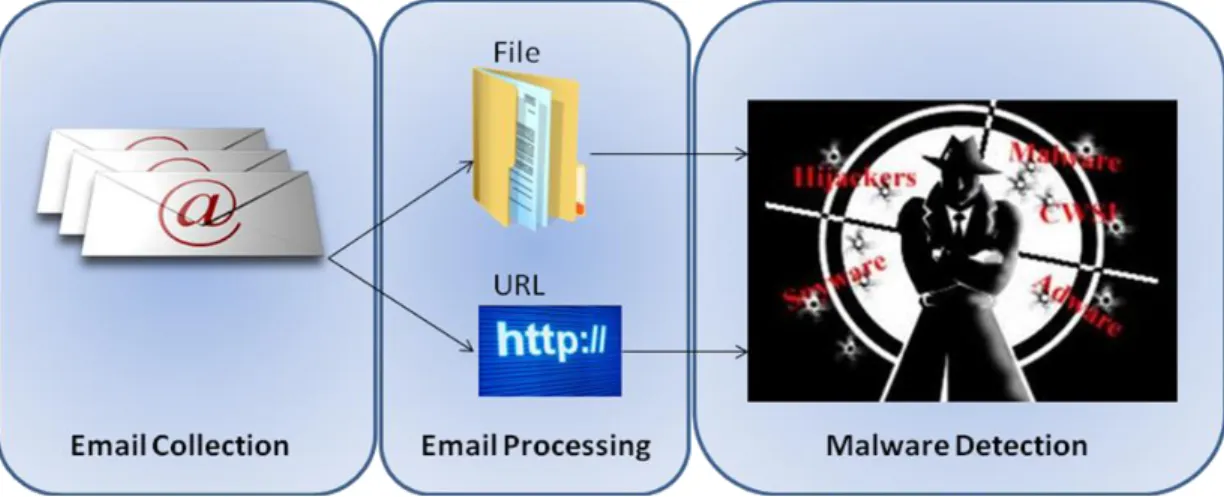
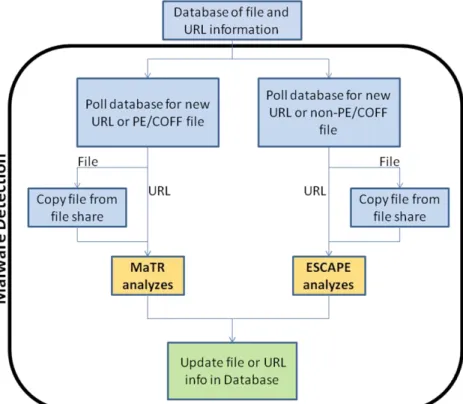
1. High-level Flowchart of SPEAD Functionality ... 39
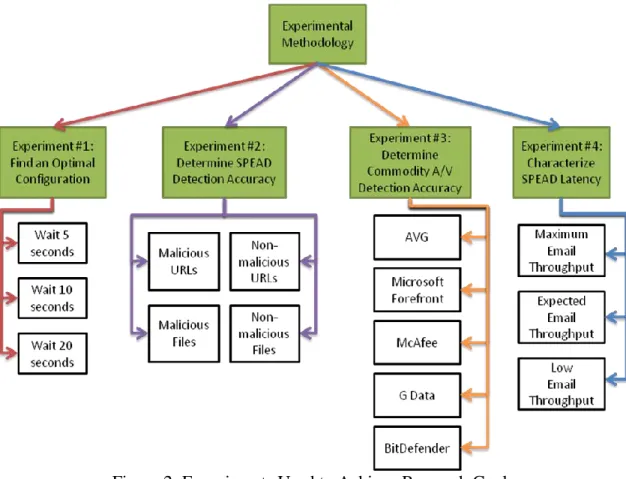
2. Experiments Used to Achieve Research Goals ... 43
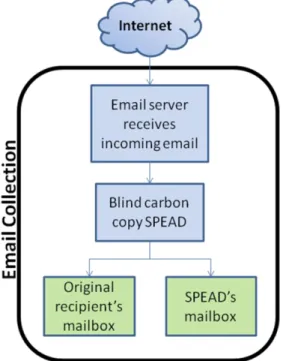
3. SPEAD’s Email Collection Flowchart... 46
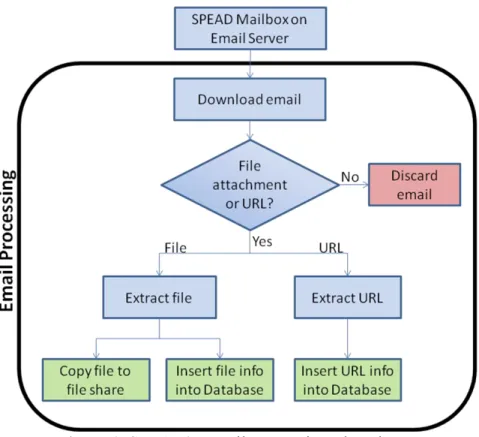
4. SPEAD’s Email Processing Flowchart ... 47
5. SPEAD’s Malware Detection Flowchart ... 50
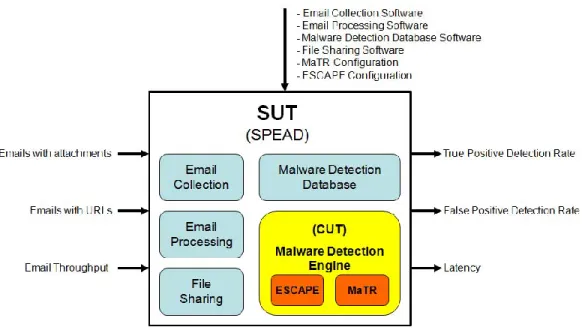
6. Spear Phishing Attack Detection System ... 53
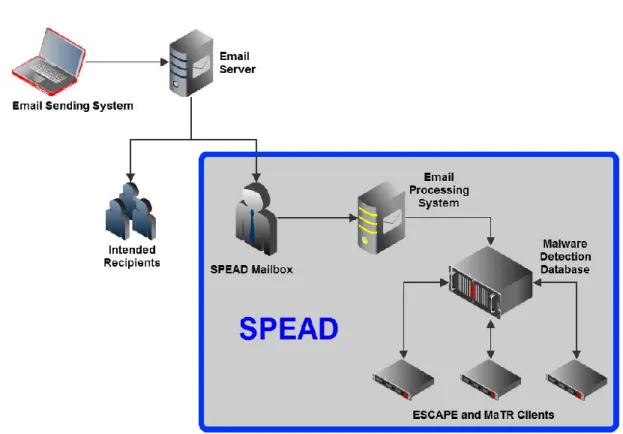
7. Experimental Setup ... 63
8. Results of URL Tests for ESCAPE Wait Times ... 69
9. Collage of Screenshots Showing SPEAD File Processing Validation ... 71
10. Screenshot of URL Mismatch ... 72
11. Screenshot Showing SPEAD’s URL Processing Validation ... 73
12. p-Value Interpretation Scale [RaS02] ... 75
13. Comparison of Differences in Means of PE/COFF Detection Accuracies for SPEAD versus Others ... 76
14. Comparison of Differences in Means of Adobe Reader Novel Malware Detection Accuracies for SPEAD versus Others... 81
15. Odds Ratios of Novel:Known Adobe Reader Malware Detection ... 82
16. Odds Ratios of Novel:Known Microsoft Excel Malware Detection ... 85
17. Odds Ratios of Novel:Known Microsoft Word Malware Detection ... 88
18. Latency Results for All Files at Each Email Throughput Speed ... 93
x
20. Latency Results for PE/COFF Files at Each Email Throughput Speed... 96 21. Latency Results for URLs at Each Email Throughput Speed ... 98
xi
List of Tables
Table Page
1. Malicious File and URL Corpus ... 41
2. Non-malicious File and URL Corpus ... 42
3. Four ESCAPE Client Configurations ... 52
4. Email Statistics from One-week Observation of an Air Force Base ... 56
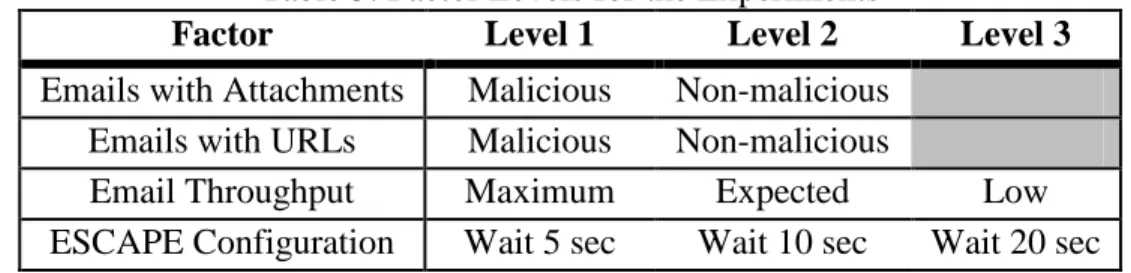
5. Factor Levels for the Experiments ... 61
6. Results of File Tests for ESCAPE Wait Times ... 69
7. Comparison of Overall Detection Metrics for Files ... 74
8. Example 2x2 Table for SPEAD Detection Metrics ... 74
9. PE/COFF Detection Results for Novel and Known Malware ... 78
10. Adobe Reader Detection Results for Novel and Known Malware ... 80
11. Microsoft Excel Detection Results for Novel and Known Malware ... 84
12. Microsoft Word Detection Results for Novel and Known Malware ... 87
13. Microsoft PowerPoint Detection Results for Novel and Known Malware ... 89
14. URL Detection Results for All Platforms ... 90
I. Introduction
Cyber espionage is responsible for an annual loss of billions of dollars in the United States alone [Rep09] [Eps08]. Because of the low cost of entry into and the anonymity afforded by the Internet, any curious or incentivized person can likely gather important information off private, corporate, or government computer networks [USC08]. Proprietary information from a company's innovative products or research and development often holds a high monetary value. If that information is about national defense assets or national strategy decision-making, then the value is arguably immeasurable.
History has shown that espionage traditionally requires strategically-placed spies or monitoring devices tailored and molded to the environment in which they operate. The same is true in the way spies infiltrate computer networks. Inherently, espionage occurs against a highly targeted victim or group. Some examples of this are the insider amongst senior leaders of an organization [Mes08], the undercover detective within a drug cartel, or the classic secret agent planted in a foreign agency. Cyber espionage is no different in that its success is dependent on how well-tailored it is to its targeted victims.
In recent years, the cyber espionage threat has been widely published and acknowledged by computer security analysts as wells as the mainstream public [Kei10] [Zet10] [Mes08] [Hin08] [GET08] [Rep09] [SAN08]. Historically, the most common method for infiltrating a network is through targeted spear phishing emails with malicious file attachments or web site links [Kei10][Zet10] [SAN08]. The infamous attacks against Google and dozens of other corporations in early 2010, dubbed ―Operation Aurora‖, used
2
targeted spear phishing emails in this manner [Jac10]. Both the emails and attachments are products of effective social engineering methods that tailor the content to the recipients of the emails. When an unsuspecting, targeted user opens the attachment or clicks on the link, the cyber spy establishes a foothold on the computer and affected network. The spy can then use his specialized malware to search for interesting data on the victim computer or network and exfiltrate this potentially sensitive data, like source code or intellectual property, from the victim network to a place of his choosing.
Because spear phishing emails are targeted, tailored to their targets, and relatively rare when compared to other email-borne malware infection vectors, current technology does not adequately protect against them. Commodity anti-virus applications generally focus their detection on the malicious software that is already known to exist. The objective of this research is to develop an email-based system that integrates automated malware detection algorithms that provide the capability to detect previously unknown malware. Such a system can be used to analyze files and web site links within emails, specifically looking for and recognizing spear phishing emails that commonly use new malware. This capability significantly limits the primary attack vector for cyber espionage. This system provides an invaluable risk mitigation and information protection tool to a person, corporation, or government aiming to protect their trade secrets, intellectual property, or crown jewels from cyber spies.
This thesis is organized into five chapters. Chapter 2 reviews the relevant literature, and it concludes with a review of the research related to the system designed in this thesis. Chapter 3 describes the methodology used to design and evaluate this system. The results and analysis of the experiments is discussed in detail in Chapter 4. Finally,
3
Chapter 5 concludes this thesis body with a summary of this work, its contributions, and where this work can be extended for future research.
4
II. Literature Review
his chapter defines spear phishing and discusses the relevant bodies of research needed to perform spear phishing detection. Section 2.1 introduces and defines spear phishing. Next, Section 2.2 discusses the relevancy of traditional phishing detection research. A thorough review of malware detection technologies is provided in light of static, dynamic, signature-based, and anomaly-based analysis techniques in Section 2.3. Email-borne malicious code detection algorithms are described in Section 2.4. This chapter concludes with a description of the research ideas used for this thesis in the context of the spear phishing attack detection framework.
2.1 Spear Phishing Defined
Spear phishing is a phishing attack targeted at a relatively smaller target set, and it usually uses malicious attachments and web site hyperlinks in the email content. In addition, the email content is highly customized to the target and would probably mean almost nothing to an email recipient outside the target group or organization. Spear phishing emails sent to a handful of selected victims is indicative of cyber espionage. In addition, if the content of the email is very specific and relevant to the industry, then this would be a telltale sign of cyber espionage. The same thought process applies to a compromised web site that hosts information or services that cater to a select business, organization, or niche market.
One way to differentiate between spear phishing and conventional phishing attacks are by the level of sophistication of social engineering require by the attacker. For phishing emails, knowing the demographics, locale, or common financial institutions
5
in an area aid an attacker in customizing their phishing attack. However, for spear phishing attacks, both the emails and attachments/links are the products of very focused social engineering methods that tailor the content to each individual recipient of the emails.
Spear phishing attacks are email-borne infection vectors, so there is a relatively long and arbitrary amount of time from when an email is delivered until the malicious file or code compromises its target. Also, spear phishing has a different purpose than a worm or email virus. Its goal is not to indiscriminately spread far and wide but to surreptitiously establish a foothold into a specific network or system.
2.2 Detecting Phishing Attacks
Identifying phishing attempts is a difficult and unsolved problem due to the inherent vulnerability residing at the receiving end of phishing emails—a human. The prevalence of phishing web sites and emails attests to the success phishers are having with their attempts. When a web site or email emulates a known legitimate site or email, it is relatively easy to fool most Internet users. While phishing training may help the human only slightly, significant advancements are made toward effective technical solutions that are categorized into two groups: content-based filtering and application-based filtering.
2.2.1 Content-Based Filtering
Content-based filtering refers to statistical analysis, data mining, feature set selection, machine learning, and/or heuristics-based detection mechanisms applied to either email content or web site content.
6
Fette et al. establish a machine learning algorithm on a feature set designed to highlight human-targeted deception behaviors in email [FST07]. Their approach is named PILFER, and it is a machine learning-based approach to classifying phishing attempts. PILFER uses data directly present in email as well as data collected from external sources. This combined approach creates a feature vector, which is used to train a model for classification. Their feature vector consists of 10 features: Internet Protocol (IP) addresses within web links, age of linked-to domains, non-matching links, ―Here‖ links to a non-modal domain (anomalous links to the non-dominate domain present in the email), HTML (Hyper Text Markup Language) emails, number of links, number of domains, number of dots (e.g., www.this.is.a.bad.site.com), contains JavaScript, and output from third party spam filters. PILFER inputs this feature vector into a random forest as a classifier, where numerous decision tress are created. Preliminary experiments show a 96% detection rate with only a 0.1% false positive rate over 860 phishing and 6,950 non-phishing emails.
L’Huillier et al. propose an online phishing classification scheme using adversarial data mining and signaling games in [LWF09]. They implement a game-theoretic data mining framework that uses dynamic games of incomplete information to build a classifier to detect phishing attempts. The feature set consists of email content-based features, of which there are four categories: email structures related to different email formats, properties of every link in a message, HTML/JavaScript/forms used, and the SpamAssasin’s output score for the email in question. This work achieves a high detection accuracy of 99%.
7
Bergholz et al. propose a number of novel features that are tailored to phishing email detection [BDG+10]. These new features extend the work of L’Hullier et al. by adding a word list to their basic feature set, and advanced graphical features are added as well. These graphical features are image distortion (i.e., attempts to defeat character recognition tools), logo detection (i.e., compared to original logo), and hidden text salting. Hidden text salting consists of random strings, spacing, coloring, spelling, etc. to fool automated appliances but remain invisible to humans. These features are passed into a text classification-based classifier (e.g., random forests or support vector machines). Experiments with these novel features yield a 99.46% accuracy rate, which is slightly higher than that reported by L’Hullier et al.
2.2.2 Application-Based Filtering
Application-based filtering refers to a specific method of implementing a phishing detection or prevention mechanism. This category encompasses email client or web browser plugins as well as modified email architecture.
Zhang et al. developed an automated test bed for evaluating anti-phishing tools in [ZEC+07]. They evaluate 10 popular appliance-based anti-phishing tools using 200 phishing URLs (Uniform Resource Locators, or links) from two sources and over 500 legitimate URLs. The results of their evaluation show that only one of the tools could consistently identify over 90% of phishing URLs. However, this same tool also had a 42% false positive rate. In addition, the authors point out numerous methods to exploit vulnerabilities in multiple anti-phishing tools that resulted in phishing sites being labeled as legitimate. Most of the tools use a blacklist of URLs that they would obtain
8
dynamically and frequently. Only one tool uses heuristics-based detection instead of an explicit blacklist. This tool also has high false positive rates. The major contribution of this effort is the authors’ conclusion that the success of anti-phishing tools using blacklists relies on very large amounts of data being collected frequently.
Crain et al. propose a tool to assist users in identifying legitimate emails [COP10]. This tool, called Trusted Email, allows companies to establish keys with their clients/customers. This key is used to sign and encrypt emails between the legitimate company and its user. This approach’s strength is that it uses existing technology in a novel way to dramatically improve email security. A client-based plugin provides feedback to users when: 1) a key establishment email arrives, 2) a signed email arrives, and 3) a forged email is detected. A small pilot study shows that all users reject all emails marked as phishing, and they also accept all emails that are signed. However, most of them also rejected all unsigned, legitimate emails, which may be a result of the small group of people and their insight into this research.
2.2.3 Limitations of Phishing Detection
The content filtering techniques focus their detection on anomalous behavior indicative of phishing. This implies that all phishing attempts use non-standard behavior. However, spear phishing specifically emulates a valid user behaving in a legitimate manner and emailing appropriate recipients. Therefore, the content-based filtering algorithms likely will not recognize legitimate-looking spear phishing emails.
On the other hand, application-based filtering shows promise, but it relies heavily on the use of blacklists that must be constantly updated. But there is an inherent
9
challenge with this: any new phishing attempts will have to be discovered first before it can be added to a known bad blacklist. Even heuristic-based detection suffers from unacceptable false positive rates [ZEC+07]. Therefore, current application-based and content filtering-based phishing detection techniques likely will not catch spear phishing attacks, especially ones crafted and targeted for the purpose of cyber espionage.
2.3 Detecting Malware
Malware comes in many forms with many names: virus, Trojan, worm, downloader, rootkit, keylogger, adware, spyware, and more. For simplicity and convenience, the root of the name (i.e., ―malicious software‖) is used to define the generic use of the term. Any unwanted and malicious program or code running on a system is referred to as malware.
Malware detection is the implementation of a technique or techniques that attempt to identify programs or code that behave in a malicious manner contrary to the intended use of a system. Naturally, detection of unknown malware is the goal, assuming a cyber spy will use sophisticated, novel malicious programs to establish footholds on a computer and within a network. A malware detector typically takes two inputs: 1) the program or code under inspection, and 2) its knowledge of malicious behavior [IdM07]. While there are a myriad of techniques currently in use operationally and academically that reliably detect most malware on a system, these techniques can be categorized into three analysis methods based on how they gather information to detect malware: static, dynamic, or hybrid [IdM07] [HoB05]. These analysis methods are further broken down into signature-based and anomaly-based detection, which differ in their manner of
10
categorizing their knowledge of malicious behaviors. All of the following methods of malware detection focus on Windows Portable Executables due to the overwhelming prevalence of this type of malware in the wild [VxH10].
2.3.1 Static Analysis Techniques
Static analysis gathers information about malicious behavior using syntactical or structural properties of the program under inspection [IdM07]. It requires establishing sets of file features, or feature vectors, based on file content. This file content typically consists of byte sequences (n-grams), metadata, and/or sequences of instructions and application programming interface (API) or system calls. One advantage of statically analyzing code is that, in general, it can be done relatively quickly without the need to execute the malware. Another advantage is that the program, ideally, can be analyzed holistically due to the availability of all the malware’s code. Code obfuscation can make this more difficult, but, more often than not, malware is not obfuscated. Thus, static analysis can yield insight into how the malware is programmed and not just visible behavior at runtime.
2.3.1.1 Signature-Based Static Analysis
Signature-based analysis of malware has historically been a euphemism for commodity anti-virus products. However, the use of the term in this paper simply means that the detection algorithm compares a suspect program against known malicious features. Signature-based analysis includes most of the automated malware detection mechanisms. This is because most data mining methods use machine learning on feature sets based on n-grams, strings, instructions/code, file headers, and program structure.
11
Schultz et al. is an early adopter of a data mining technique for malware analysis. In [SEZS01], they use static analysis-based data mining for detecting new malicious executables. They use three data mining schemes to identify malicious Windows or MS-DOS executables: DLL information, strings, and byte sequences (or n-grams). These schemes differ in their approach to extract feature sets from the executables. These feature sets were used to train RIPPER (an inductive rule learner), Naive-Bayes, and Multi Naïve-Bayes (with voting) classifiers. The approach with the best detection accuracy is the one using the GNU strings program to extract strings as feature sets for a Naïve Bayes classification algorithm. However, Schultz et al acknowledge that strings are not robust and can be sufficiently evaded by encrypting the malware.
A similar approach is used by Kolter et al. in [KoM04] and later in [KoM06], where they used data mining and n-gram analysis to tackle two malware detection issues: (1) classifying between benign and malicious executables, and (2) categorizing malicious executables according to their payload. This method uses n-gram analysis to determine the n-grams with the highest information gain. The top n-grams become the feature sets which the classifier algorithms use to determine if an executable is malicious. These n-grams are used to train classifier algorithms based on the following inductive learning methods: Instance-Based Learner, TFIDF, Naïve-Bayes, support vector machines (SVMs), decision trees, boosted Naïve-Bayes, boosted SVMs, and boosted decision trees. The boosted decision tree performs better than the rest of the classifiers. This methodology has been fielded as an application called MECS, the Malicious Executable Classification System. One acknowledged limitation to this method is its high computational overhead when selecting features.
12
Abou-Assaleh et al. continues this work in the area of byte-sequences and data mining by using a Common N-Gram (CNG) analysis classification method to create malware profile signatures in [ACK+04] and [ACKS04]. These profile signatures are class profiles of normalized frequencies of the most frequently-appearing n-grams. The authors use n-grams between one and 10 bytes in size, and they set lower and upper bounds on the number of n-grams used to 20 and 5,000, respectively. The experiment in [ACK+04] achieves an average accuracy of 98%, but it only tested 65 Windows executables. The experiments in [ACKS04] use almost 800 samples of Windows executables, but the average detection rate dropped to 91%.
Henchiri and Japkowicz use machine learning and knowledge of malware family types for feature selection in [HeJ06]. Specifically, they focus on intra-family and inter-family n-gram thresholds to strategically select or eliminate features for the final feature selection. This focus on malware family types for feature selection is the first of its kind. Experiments with 3,000 samples (approximately half of them malicious) and varying feature sets show a detection accuracy consistently in the mid-90th percentile.
Sung et al. pioneers the use of sequences of Windows API calls in a signature-based methodology in [SXC+04]. The authors create a signature-based detection system called Static Analyzer of Vicious Executables (SAVE) that extracts API sequences from suspect programs and compares these sequences against a signature database of known malicious behavior. Each API call is mapped to a global 32-bit integer identification number. The 16 most significant bits represent the Win32 module, and the 16 least significant bits represent the API call in this module. An API calling sequence is the sequence of these 32-bit numbers. The similarity of the API sequence with that of
13
signatures in a database of malicious API sequences is determined. The similarity between the API sequences under investigation and known malicious sequences is based on the cosine measure, the extended Jaccard measure, and the Pearson correlation measure for similarities between sequences. If certain sequences are deemed sufficiently similar, then the program is labeled as malicious. On only 20 malware samples, this approach successfully detected all of them. However, an experiment on larger sample sizes is needed to prove the reliability and robustness of this technique. Also, this method of malware detection can be evaded by polymorphic and metamorphic malware.
Ye et al. extend [SXC+04]’s work on API call sequences with their development of an Intelligent Malware Detection System (IMDS) that uses Objective-Oriented Association (OOA) mining-based classification in [YWL+07]. This work requires the development of a Portable Executable parser to construct the API execution sequences. The authors generate rules based on these API sequences by using their own extension to the FP-Growth algorithm, called the OOA_Fast_FP-Growth algorithm. They test their algorithm against nearly 3,000 executables, and IMDS achieves a 93% accuracy rate in detecting malware. However, because the feature set is based on API sequences, this technique is limited by the same polymorphic and metamorphic evasion techniques as the malware detection scheme in [SXC+04].
In [CJS+05], Christodorescu et al. use abstract models, or templates, that describe the behavior of malicious code. These templates of malware signatures consist of a 3-tuple of instructions, variables, and symbolic constants. These templates are formed in an attempt to generalize the signature of an instance of malware while maintaining the semantics of the malicious code’s behavior. This algorithm successfully detects all
14
variants of certain malware, but the sample size is relatively small. Additionally, this scheme relies on IDA Pro’s ability to disassemble a binary accurately. Otherwise, the algorithm’s detection algorithm is significantly hindered.
In [TSF09], Tabish et al. show that malicious and benign files are inherently different at the byte level. Thus, they use statistical analysis on byte-level content of a file divided into fix-sized blocks. Then, this approach uses statistical and information-theoretic features for these blocks to quantify the file content at the byte level. This scheme is tested against trained classifier models for six common benign file types (DOC, EXE, JPG, MP3, PDF, and ZIP) and six common malware types (backdoor, Trojan, virus, worm, constructor, and miscellaneous). The results of these experiments show a detection accuracy over 90% for all tested malware types. While this scheme also shows a relatively high accuracy for classifying malware into families, its overall detection accuracy appears to be no better than most other malware detection methods.
2.3.1.2 Anomaly-Based Static Analysis
Most static analysis-based malware detection focuses on characterizing the unique aspects of malicious files. On the other hand, anomaly-based analysis focuses on characterizing legitimate files and then looks for anomalous file behavior.
In [SWL07], Stolfo et al. focus on a new type of stealthy malware threat called embedded malware. Their approach uses statistical analysis on byte-level file content to detect anomalous files segments that may be indicative of embedded malicious code. This technique attempts to model numerous benign file types to produce a model revealing what all files of each type should look like. Anomalous and suspicious
15
behavior is indicated by any deviation from these models. Each file type is represented by a set of statistical n-gram models based on a compact representation of each file type, called a Fileprint. This detection scheme is put to experiment using three scenarios: 1) detecting malware embedded in a randomly chosen benign file, 2) distinctly detecting malware amongst benign executables, and 3) identifying obfuscated, self-encrypted files. This technique is able to detect between 72% and 95% of malicious code embedded in PDF files, depending on the location of the embedding. The detection rate for the malware versus benign executable and self-encrypted files varies widely, which suggests that the comparison method may have been too weak for reliable malware or malicious encrypted file detection in general.
In [SKF08], Shafiq et al. enhance the pioneering work of Stolfo et al. by using statistical anomaly detection to identify embedded malware and locate its position within an infected file. This technique addresses the issue of commodity anti-virus software's inability, in general, to detect embedded malware using their signature-based detection engines. This technique characterizes the statistical properties of a benign file using Markov grams, which are conditional gram distributions (as opposed to traditional n-grams). The authors conclude that a simple n-gram distribution does not yield enough information to accurately identify embedded malware. This algorithm then uses an entropy rate to quantify the variations in the Markov n-grams of a benign file that are caused by embedded malware. The algorithm looks for anomalous entropy rates that do not fall within the Gaussian distribution of benign entropy rates. While this method does require a training phase, malware is not required to train this algorithm’s detector,
16
making it a "true" anomaly detector that relies completely on a robust model of benign behavior.
This approach does have several limitations. While this method of embedded malware detection outperforms commercial-off-the-shelf (COTS) anti-virus products and the few other embedded malware detectors, it does so at the cost of a high rate of false positives. The false positive rates for .doc and .pdf files are high due to the inherent ubiquity of embedded objects within these file formats. Because of this, the benign behavior model for these file types take into account entropy rates that are hindered by numerous perturbations from embedded objects. Also, this method of detection is vulnerable to a mimicry attack that shapes the embedded malware to have a statistical distribution similar to "normal" or benign behavior.
2.3.1.3 Limitations of Static Analysis
There are numerous limitations to static analysis. Investigating a program’s full functionality may never be possible if there are complex inter-component/system interactions between the malware and other collaborative code from other programs, as discussed in [LeM06]. Also, in their work on testing malware detectors, [ChJ04] explain how code/data obfuscation caused by encryption, packing, polymorphism, and metamorphism is a significant obstacle to overcome, especially if the static analysis-based technique is to be automated. COTS anti-virus products are notoriously vulnerable to these evasion techniques. For example, on-access obfuscation, where instructions are decrypted only during execution, makes static analysis extremely difficult and time-consuming [ChJ04].
17
The efforts of Moser, et al. in [MKK07] further address the limits of static analysis for malware detection. They specifically focus on the viability of evading semantics-aware detection schemes, where the behavior of the malware is modeled abstractly to determine whether a specific piece of code exhibits a specific behavior or function. Moser et al. accomplish this by using a primitive known as an opaque constant, which refers to a code sequence that loads a constant into a register and whose value cannot be determined statically. Opaque constants strategically replace certain register load operations with semantically equivalent instructions, thus generating a code sequence that always produces the same result. Effectively, control flow can become scrambled, and data locations and usage can be hidden from static analysis. This technique is applied to the source code of the target program, which allows much flexibility in applying these obfuscation transformations. In fact, the authors prove that the creation of an algorithm to determine the precise result of an opaque constant-obfuscated code sequence is an NP-hard problem.
2.3.2 Dynamic Analysis Techniques
Detecting malware by analyzing the code during execution is called dynamic analysis. This run-time analysis technique provides relatively immediate and measurable empirical evidence of what an unknown binary is doing or trying to accomplish. As a bonus, dynamic analysis is effective against binaries that obfuscate themselves or are self-modifying. This is due to the fact that the destiny of all programs is to be run on a system, so when the program is running, its behavior and subsequent system modifications can be captured.
18
2.3.2.1 Signature-Based Dynamic Analysis
Kephart and Arnold pioneered the efforts for automated extraction of malware signatures in [KeA94]. They developed an effective extraction method for malware signatures by allowing viruses to infect large numbers of files. With a plethora of various infected files, they harvest byte sequences in sizes of 12 to 36 bytes. This process yields a myriad of signatures, and the ones with the lowest estimated false positive probabilities are selected for the final signature-based detection engine. This methodology was incorporated into IBM’s AntiVirus product during the 1990s. Arnold and Tesauro extended this work into a neural network classifier in [ArT00]. They use n-grams and multiple neural networks in a voting procedure to eliminate false positives and aid in detecting unknown Win32 viruses.
Lee and Mody successfully automate malware detection using runtime behavioral data and machine learning in [LeM06]. Their methodology quantifies a file’s runtime behavior into a form of sequenced events. It normalizes this data for canonical-based storage in a database. Their scheme constructs classifiers for machine learning with the stored event sequences as input. They use a technique called Opaque Object to represent this classification data. This specific approach allows objects to represent data in rich syntax and semantics. It also yields a similarity distance between any two objects, which factors into their classification method based on clustering. The authors use a Microsoft-developed distributed system of virtual machine-based ―workers‖ with kernel mode monitor agents running on them. As files under investigation are executed, the monitor agent intercepts and monitors all system calls in kernel mode. The authors acknowledge
19
the limiting factors of lack of code structural information, environment conditions, and ineffective virtualization as obstacles to accurate malware classification.
Willems et al. takes steps towards automating much of the dynamic analysis required by advanced, in-depth malware analysis in [WHF07]. They use their own tool (now a commercial product) called CWSandbox to monitor all malware system calls and generate a detailed report to simplify a malware analyst’s task. They use API hooking and dynamic link library (DLL) injection to run CWSandbox as a rootkit, thus evading detection by sophisticated malware. CWSandbox collects information exposing the malware’s behavior. This information consists of file modification/creation, Windows registry changes, DLLs that are loaded, virtual memory footprint, process creation, network connections, and miscellaneous events pertaining to kernel driver or protected storage access attempts. This tool is unique in its ability to bridge the gap between automated, autonomous malware detection and in-depth, human-based analysis. Unfortunately, it is still a relatively slow method of automating malware detection, with an effective throughput of only 500 binaries per day per instance of CWSandbox.
Bailey et al. extend Willem et al.’s efforts in fingerprinting malware behavior using runtime system state changes in [BOA+07]. They execute malware in virtualized environments to perform causal tracing of system objects created during the malware’s execution. These system events are exported to a server that builds causal dependency graphs of these events. This aids in validating that the events being caused by the malware are not normal system events. This approach goes beyond the capability of CWSandbox by using classification algorithms to automate detection of malware. The authors implement a tree structure based on a hierarchical clustering algorithm. An
20
inconsistency measure is calculated for this tree structure to break the tree into meaningful groups or clusters. These clusters serve as models to measure program behaviors against.
Ding et al. implement a behavior-based dynamic heuristic analysis approach to proactively detect unknown malware in [DJB+09]. This approach categorizes behavior features based on Win32 API calls and their specific parameters. An automatic behavior-tracing system is developed to collect the behavior features during runtime. The authors opt for two independent detection models: a statistical detection model and a mixture of expert (MoE) model. The malware behavior features are broken into six classes of malicious behaviors related to files, processes, windows operation, networking, registry settings, and windows services. After comparing the results of malicious and benign executables in the context of these six classes, a more detailed 35-dimension feature vector is defined where each dimension accounts for one kind of behavior. This feature vector is the input to the statistical and MoE models for ultimate classification of malware. After experiments, the statistical model of malware detection achieves a 96% true positive detection rate with a nearly 35% false positive rate. The MoE model achieves a 1% false positive rate, but it can only reach a 75% detection accuracy rate.
Dai et al. takes a different approach to dynamically quantify malware behavior in [DGL09]. The authors focus their work on feature set selection via static and dynamic means. This hybrid method of extracting statistical information is relatively rare and, thus, unique. This comprehensive effort uses multiple data mining approaches: simple heuristics (PE headers and strings), n-grams, static instruction sequences, and dynamic instruction sequences. A separate algorithm is used to obtain instruction sequence blocks
21
of significance, and the top instruction associations are selected for the feature set. The selected feature sets for each data mining approach are utilized for support vector machine training. The dynamic instruction sequence-based SVM outperformed the other data mining approaches with a malware detection accuracy of over 91%.
2.3.2.2 Anomaly-Based Dynamic Analysis
True anomaly-based dynamic analysis is a rare technique for malware detection. Many methods may claim they are anomaly-based, but for the purpose of this research, anomaly-based implies a quantification of benign behavior, not a quantification of heuristic-based malicious behavior. It is difficult to find published work in this area, which implies that this method of malware detection is still novel, or this method is not a worthwhile pursuit. However, the idea of quantifying benign program execution at runtime should be no less daunting than doing it statically. At least one published effort clearly attempts this task, and another non-published effort successfully achieves this, which is discussed in Section 2.5.
Apap et al. present a host-based intrusion detection system for Windows that focuses specifically on registry accesses in [AHH+02]. The Registry is a worthwhile location to monitor runtime execution of programs. This is because Registry activity tends to be regular over time, with most programs accessing only at startup/shutdown or at specific time intervals. Therefore, anomalous and irregular activity may be relatively easy to identify. Additionally, many malware infections launch programs or change keys that have not been launched or changed since the operating system had first been installed. The authors exploit this beneficial scenario by developing a system called
22
RAD (Registry Anomaly Detection) to monitor registry accesses in real-time to detect the activity of malware. This work is an extension of a network packet header-based anomaly detector called PHAD (Packet Header Anomaly Detection). The RAD system is divided into three basic components: an audit sensor, a model generator, and an anomaly detector. The sensors log registry activity to a database while the model generator reads this data to determine models of normal registry behavior. Finally, the anomaly detector uses the model as a point of comparison for all registry accesses to determine their potentially malicious intent. After training RAD for two days on benign behavior, the system is put to test. It performs well, achieving a 100% detection rate of malicious activity in certain scenarios. However, there are many false positives in most scenarios, and most of these false positives are caused by legitimate processes that did not run during the two-day training phase. This lack of an exhaustive training phase reveals an inherent limitation to dynamic analysis-based anomaly detection.
2.3.2.3. Limitations of Dynamic Analysis
Just as there are limitations to static analysis that are addressed by dynamic analysis, the opposite is true as well. Dynamic analysis-based malware detection generally requires orders of magnitude more time to perform than static-based techniques. Also, the malware has to run for a long enough duration to capture sufficient malware information, but it also has to be run quickly enough to be scalable. This makes dynamic analysis vulnerable to intentional or inadvertent time-delayed evasion techniques. Specifically, when a program under inspection is executed, the monitoring agent only witnesses a single instance of execution of that program. If malware is
23
programmed to activate at a certain time, dynamic analysis will almost surely miss this behavior. Bailey et al. draw attention to the fact that anti-VM (virtual machine) evasion techniques exist [BOA+07]. Finally, malware that depends on user input may not reveal its full functionality without manual intervention or an advanced clicking emulator to simulate humanlike mouse clicks.
2.4 Detecting Email-Borne Malicious Code
Detecting malware sent by email can be seen as an extension to the malware detection problem in general. However, there are some advantages to detecting malware within special purpose applications. This is further discussed in the next section. It is important to note that many email-based malware detection solutions do not take advantage of the special purpose application, and they are simply commodity anti-virus products that run the same scans with the same signatures used on client-based systems. While this is convenient and necessary to prevent common, known malware from infiltrating a network via email, it still lacks the ability to detect most new malware and 0-day attacks. Fortunately, there is work in this area that has set the precedent for tracking malicious emails.
Shih et al. propose a method of detecting unknown malicious emails [SCY05]. Their method evaluates the malice of an email attachment by focusing solely on the behavior of the email and not the contents of the attachment itself. This technique evaluates three classifiers against four versions of commodity anti-virus software. The three classifiers it uses are the Naïve Bayes, the Bayesian network, and the decision tree classifiers. Their feature sets consist of 11 email content-based features: mail content
24
type, mail size, MIME (Multipurpose Internet Mail Extensions) format, attachment, number of attachments, attachment size, script language, subject, carbon copy, and recipient. All three of these classification approaches outperform the four anti-virus products in detecting five variants of known malware. However, targeted and tailored spear phishing emails will likely evade a detection technique that relies on anomalous email behavior.
Schultz et al. makes a significant contribution to this field of email-borne malware detection with their seminal work call MEF (Malicious Email Filter) [SEZB01]. MEF is a tool that detects malicious Windows executables using Procmail and a UNIX mail server. This tool offers three key contributions: 1) detection of known and unknown malware attachments, 2) automatic distributed propagation of detection models, and 3) ability to monitor the propagation of malicious email attachments. This framework uses a Naïve Bayes classifier to detect malware, and this classifier is generated by a data mining algorithm trained over a given set of data. MEF has the ability to detect similar but unknown malware, and its probabilistic classification methods allow the tool to identify borderline executables, meaning they are on the border of the threshold between malicious and benign. These borderline cases provide an opportunity for expert analysts to make a determination. In turn, the detection models can be updated with this valuable new insight, and MEF can update a central server with the updated detection models for distribution to other MEF outposts.
MEF also tracks the propagation of email attachments. It stores a unique identifier (hash) for every email attachment in a database as well as log data pertinent to each email. The logs of malicious attachments are sent to the central server. Therefore,
25
the central server can use the unique identifier and contextual log data to track the spread of malicious attachments via email. MEF is tested against a signature-based malware detection approach that emulates commodity anti-virus software on mail servers. The data set consists of 4,300 files, 1,000 of which are benign. MEF significantly outperforms the signature-based approach with an accuracy rate of over 97%. The experiments do not evaluate MEF’s detection model updating or its malicious attachment propagation tracking. Additionally, the detection of unknown malware is not thoroughly evaluated.
Bhattacharyya et al. extends the work of Schultz et al. with their Malicious Email Tracking (MET) system [BaH02]. MET shifts focus away from the three major capabilities of MEF and towards a dramatically improved malicious email propagation tracking capability. MET maintains a database of statistics about the trajectory of email attachments, and this affords the tool a global perspective on the spread of malicious software via email (assuming a global MET presence). This database of email attachment trajectory data also provides the ability to determine all the points of entry of email-borne malware into a network. Another tangential benefit of this technique is the ability to reduce the spread of self-replicating malware through email.
MET gathers the core statistics for each email attachment, which consists of the prevalence of an attachment and its birth rate. Prevalence is the number of times a MET client observes an attachment, and the birth rate is the average number of copies sent from the same user. MET has built-in heuristics to determine if an attachment is self-propagating, and this information can be communicated to a central MET server for distribution to other MET clients. This is how self-replicating malware can be prevented
26
after the initial infection. The limitation to this approach is obvious: there will be an initial infection and likely multiple infections before the trajectory data begins to line up with the classifier model. Also, a targeted spear phishing attack is designed to emulate legitimate behavior and appropriate recipients. Thus, a detection technique that tracks email trajectory likely will not recognize anything anomalous in a spear phishing email.
Finally, there is one documented framework for detecting 0-day worms and viruses in email, as proposed by Sidiroglou et al. in [SIK+05]. This framework is an email worm vaccine architecture, and it uses the Registry Anomaly Detection (RAD) mechanism, designed by Apap et al. in [AHH+02], to detect malware in emails. RAD monitors Windows registry accesses in real-time to detect the activity of malware. The authors design the system to use a Simple Mail Transfer Protocol (SMTP) proxy between the Internet and the protected email server. This proxy intercepts all incoming emails, extracts all attachments, and runs the attachments on a virtual machine that uses RAD to detect anomalous behavior. Upon detection of a malicious file and therefore malicious email, the SMTP proxy is notified, and the email message is discarded. Experiments are run with publicly available attacks delivered via email, and this system achieves a 100% detection rate with a false positive rate of 5%. However, this anomaly-based dynamic analysis technique has its drawbacks. Because RAD has to be trained on ―normal‖ behavior, many false positives are caused by legitimate processes that do not run during the training phase of RAD. This lack of an exhaustive training phase reveals an inherent limitation to this method of malware detection in emails. Additionally, these experiments do not appear to use unknown malware, which leave the claim of detecting 0-day worms and viruses untested. Finally, not all malicious code alters the Windows registry. This
27
limits the detection footprint of RAD, which limits the scope of detectable malware offered by this email worm vaccine architecture.
The email-focused malware detection techniques discussed to this point are either unlikely to detect novel malware in targeted emails due to the difficulty in detecting malware that leaves such a small network footprint (i.e., it does not spread indiscriminately like a worm), or their ability to detect unknown malware remains untested. Also, none of these techniques takes into account the download of malware or the exploitation of web browsers caused by URLs within emails. This is a significant drawback to using any of these techniques to detect spear phishing emails that use malicious URLs.
2.5 Spear Phishing Detection Framework
This section’s purpose is to extend the literature review into the introduction of the spear phishing detection framework proposed in this research. Special purpose and general purpose systems are discussed first, followed by the principles behind a malware detection approach that combines static and dynamic analysis. Finally, the two malware detection algorithms selected for this research are introduced and discussed.
This research effort attempts to build a spear phishing detection framework that is implemented at the email server/service level of the network. It uses both dynamic and static analysis techniques to detect the presence of malicious email attachments, especially novel/unknown malware.
There are two important questions about this spear phishing detection framework that need to be answered: 1) Why implement this framework at the server/service level
28
and not as a client-based application? and 2) Why use a dynamic analysis-based approach when it is notorious for its overhead costs in time and resources? Both of these questions are answered in the following sections.
2.5.1 Special Purpose versus General Purpose Systems
Client workstations are general purpose computers, thus they have to be able to handle multiple types of user input, applications, and functionality. Because of this, the set of all possible actions that a general purpose computer can perform is intractably large. Essentially, their behavior can be unpredictable. In addition, client-based computers have to provide virtually instantaneous feedback and response, or real-time computing, to user inputs. This has become the norm and the expectation from virtually all computer users. Because of this, dynamic-analysis based malware detection has to take into account a myriad of possible files, processes, and network connections being created, modified, and/or terminated. Also, the malware detection product cannot introduce much latency, or else the enterprise-wide adoption of the product will meet many obstacles.
Email servers, on the other hand, are intended to be special purpose computers, though not quite as special purpose as an embedded system (i.e., cell phone, DVD player, electronic gadget, etc.). However, in comparison to client workstations, email server behavior is more predictable, and so is its file, process, and network connection creation, modification, and/or termination. Even though commercial email server software is designed to meet the needs of a broad and diverse customer base, it still operates according to a much more limited baseline behavior than a general purpose system does.
29
Additionally, latency is not a significant issue. Email delays are acceptable to the point that they are not surprising, and many times they go unnoticed by the email recipients. Therefore, malware detection products have more leeway in time to perform more in-depth analysis on email.
In addition, having a malware detection framework at the network boundary can stop malware at the point of entry into a network instead of waiting to stop it at the client. In most situations, this is a preferred approach over letting the malware reach its target before preventing its execution. Typically, there are many network points of entry, but using email as an attack vector has proven to be effective and reliable for cyber espionage. Also, it is easier to manage/administrate software at the server/service-level vice the client/distributed user-level.
2.5.2 Combining Dynamic and Static Analysis of Malware
In almost all related work for malware detection, authors emphasize the need to augment static analysis with dynamic analysis and vice versa. Hybrid approaches are somewhat rare, but the benefits of combining both approaches are synergistic. While static analysis prevails in speed and exhaustive code analysis, it falters in obfuscated code and embedded malware analysis. While dynamic analysis lacks in analysis speed and time-delayed evasion, it prevails in determining actual code execution sequences and functional behavior. Using a spear phishing detection framework that follows a hybrid approach for malware detection alleviates many of the limitations of static and dynamic analysis.
30
2.5.3 Using Malware Type Recognition (MaTR) for Static Analysis
A very important piece of a spear phishing prevention framework is its ability to identify malicious attachments to emails. There are precedents for accomplishing this using static analysis-based techniques for malware detection. Specifically, the MEF [SEZB01] and MET [BaH02] tools, in addition to Shih et al.’s work [SCY05], demonstrate that using signature-based static analysis in combination with email services is a viable and effective means to detecting email-borne malware.
Malware Type Recognition (MaTR) is a research initiative that extends the malware detection technologies to include the additional context of malware family types [DRP+10]. At the time of this thesis research, MaTR prototype version 1.00 is the current prototype. This prototype implements MaTR’s best-performing pattern recognition technique and feature sets to perform automated static analysis for malware detection and malware type classification. The additional context of malware type provides significant actionable information for network defenders. This situational awareness is vitally important for identifying cyber espionage through spear phishing-borne malware, second only to the tool’s fundamental ability to determine malware from non-malware. Also, this context can be used to prioritize more aggressive dynamic analysis efforts.
In the context of this thesis, MaTR is a signature-based static analysis scheme that is comparable to Tabish et al.’s work in [TSF09]. Thus, MaTR is one of the only static analysis-based methods for performing malware type classification as well as having very high detection rates (>99%). It uses program structures and anomaly features of malware that are unique to certain classifier models. This method of static analysis is proven to be very accurate in detecting malware. MaTR uses these feature sets to form classifier
31
models that are used in a two-stage sequence. The first stage is malware detection, and the second stage is malware classification.
Ultimately, there are three primary reasons to use MaTR as the static analysis-based malware detection engine for the spear phishing detection framework:
1) Malware type classification makes the output of the product actionable. 2) High true positive and true negative detection rates with very low false
positive and false negative detection rates compared to all other methods of malware detection.
3) Readily available resources for research associated with MaTR at AFIT. It is important to note the limitations of MaTR as well. MaTR is prone to the same static analysis limitations in general. However, many of the detection-evading techniques are manifested as feature sets of MaTR, thus making it more resilient to these inherent limitations. Additionally, the MaTR prototype is substantially less accurate in classifying malware into types than it is in detecting malware from non-malware.
2.5.4 Using ESCAPE for Dynamic Analysis
The ESCAPE platform is a true anomaly-based, dynamic analysis technique designed to prevent malicious code from executing [Kim10]. The Air Force currently uses ESCAPE in a web crawling implementation to automate the detection and collection of malicious code that traverses the Internet. The key to its success lies in its ability to whitelist, or sign, executable code that is known to be legitimate and subsequently track and prevent the execution of unknown/unsigned code.
32
ESCAPE is implemented as a device driver at the kernel level of the Windows XP, Vista, and 7 operating systems. Since a device driver runs at the system level, ESCAPE runs in Ring 0 and can thus implement kernel hooks as necessary. ESCAPE hooks the System Service Dispatch Table (SSDT), which is a kernel structure that contains pointers to addresses for the system services. The SSDT is used to look up the function that handles a given system call [HoB05]. Specifically, ESCAPE hooks the NtAllocateVirtualMemory, NtProtectVirtualMemory, NtMapViewOfSection, NTCreateUserProcess, NtTerminateProcess, and NtSetInformationProcess Windows system functions. In the SSDT, ESCAPE overwrites the pointers to these functions to point to its hook function.
Hooking these functions allows ESCAPE to modify the memory protection characteristics of all pages in memory that are allocated or mapped into [RuS04]. This is due to the memory page protection argument that is passed to all six of these functions when they are called. ESCAPE uses these hooks to force every page in memory to be non-executable, essentially enabling hardware-based Data Execution Prevention for every page in memory.
ESCAPE also hooks the Interrupt Descriptor Table (IDT), which contains addresses to the functions that handle each interrupt, in order to hook the Page Fault Handler [HoB05]. ESCAPE then allows pages in memory to be executed only if it has a valid cryptographic signature. ESCAPE pre-computes the HMAC (Hash-based Message Authentication Code) of every executable section within every file image on the system or application under its protection. This is how ESCAPE whitelists, or signs, executable code. This technique does assume, however, that the initial HMAC computation for all
33
the executable code is performed on legitimate, known good code. Thus, ESCAPE has the ability to detect the execution of new, unknown, or unverified code caused by an attempt to transfer execution flow to an instruction in a page marked as non-executable. Essentially, ESCAPE uses its kernel access and privileges to protect user-level applications and processes from memory corruption exploits.
An additional feature ESCAPE offers is the ability to use a list of exceptions for unsigned, non-whitelisted code that results from legitimate application functionality. This requires a training period where the protected application is used exhaustively in order to determine if any unsigned code attempts to run legitimately. If so, the signature for this code can be added to an exceptions list, thereby reducing the rate of false positives.
ESCAPE has demonstrated its effectiveness in detecting and preventing malicious code execution resulting from Internet browsing to malicious web sites. Its first real-world use is in a virtual environment that spawns numerous web crawlers to visit known or potentially malicious web sites. As the web crawlers visit sites, ESCAPE detects unknown and potentially malicious code execution caused by web-borne exploit attempts against web browsers. Using this code and memory page whitelisting approach, ESCAPE discovers 0-day exploits as well as known exploits without using signature-based matching algorithms.
Although its proactive malicious code detection capability is desirable, ESCAPE is still vulnerable to a return-to-libc attack due to the inherent nature of the attack using only legitimately executable code. Another potential weakness of ESCAPE’s code whitelisting technique is manifested when a page in memory is marked as non-executable