Declarative Automated Cloud Resource Orchestration
Changbin Liu
University of Pennsylvania 3330 Walnut St, Philadelphia PA, USA[email protected]
Boon Thau Loo
University of Pennsylvania 3330 Walnut St, Philadelphia
PA, USA
[email protected]
Yun Mao
AT&T Labs - Research 180 Park Ave, Florham Park,
NJ, USA
[email protected]
ABSTRACT
As cloud computing becomes widely deployed, one of the challenges faced involves the ability to orchestrate a highly complex set of subsystems (compute, storage, network re-sources) that span large geographic areas serving diverse clients. To ease this process, we present COPE (Cloud Or-chestration Policy Engine), a distributed platform that al-lows cloud providers to perform declarative automated cloud resource orchestration. In COPE, cloud providers specify system-wide constraints and goals using COPElog, a declar-ative policy language geared towards specifying distributed constraint optimizations. COPE takes policy specifications and cloud system states as input and then optimizes com-pute, storage and network resource allocations within the cloud such that provider operational objectives and customer SLAs can be better met. We describe our proposed integra-tion with a cloud orchestraintegra-tion platform, and present initial evaluation results that demonstrate the viability of COPE using production traces from a large hosting company in the US. We further discuss an orchestration scenario that in-volves geographically distributed data centers, and conclude with an ongoing status of our work.
Categories and Subject Descriptors
K.6.4 [Computing Milieux]: Management Of Comput-ing And Information Systems—System Management; C.2.4 [Computer Systems Organization]: Computer Commu-nication Networks—Distributed Systems
General Terms
Design, Languages, Management
Keywords
Cloud computing, Resource orchestration, Declarative queries, Distributed optimizations
1.
INTRODUCTION
Permission to make digital or hard copies of all or part of this work for personal or classroom use is granted without fee provided that copies are not made or distributed for profit or commercial advantage and that copies bear this notice and the full citation on the first page. To copy otherwise, to republish, to post on servers or to redistribute to lists, requires prior specific permission and/or a fee.
SOCC’11,October 27–28, 2011, Cascais, Portugal. Copyright 2011 ACM 978-1-4503-0976-9/11/10 ...$10.00.
Cloud resource orchestration [16] involves the creation, management, manipulation and decommissioning of cloud resources, i.e., compute, storage and network, in order to realize customer requests, while conforming to operational objectives of the cloud service providers at the same time. We argue that cloud orchestration is highly complex. First, as many recent proposals [22, 25, 4, 24, 5] have articu-lated, cloud management is inherently complicated due to the scale, heterogeneity, infrastructure, and concurrent user services that share a common set of physical resources. Sec-ond, configurations of various resource types interact with each other. For example, the locations of virtual machines (VMs) have an impact on storage placement, which in turn affect bandwidth utilization within and external to a data center. Third, cloud resources have to be deployed in a fash-ion that not only realizes provider operatfash-ional objectives, but also guarantees that the customer service-level agree-ments (SLAs) can be constantly met as runtime conditions change. All in all, the orchestration process is complex and potentially error prone if performed manually, and motivates the need for better management tools that enable us to au-tomate part or all of the decision process.
As a first step towards addressing these challenges, this paper presents our initial work on COPE (Cloud Orchestra-tion Policy Engine), a platform that enables cloud providers to automate the process of cloud orchestration via the use of declarative policy languages. COPE allows cloud providers to formally model cloud resources and formulate orchestra-tion decisions as a constraint optimizaorchestra-tion problem given goals and cloud constraints. In COPE, we envision a dis-tributed network of controllers, each of which resides over a cloud orchestration platform [16], coordinating resources across multiple data centers. Each COPE node utilizes a constraint solver for efficiently generating the set of orches-tration commands, and a distributed query engine [2, 17] for communicating policy decisions among different COPE nodes. Specifically, this paper makes the following contribu-tions:
• Cloud orchestration as a constraint optimization problem. We propose a unified framework for mathe-matically modeling cloud resources orchestration as a con-straint optimization problem (COP). Operational objec-tives and customer SLAs are specified in terms of goals, which are subjected to a number ofconstraintsspecific to the cloud deployment scenario. These specifications are then fed to a COPE constraint solver, which automati-cally synthesizes orchestration commands. We show that
this framework is general enough to capture a variety of cloud resource orchestration scenarios within and across data centers.
• Declarative configuration. To ease the process of spec-ifying the above models, we provide a declarative policy language called COPElog that allows cloud providers to specify goals and constraints of resource orchestration. To validate COPE, we conduct an experiment based on ac-tual hosting traces obtained from a large hosting company in the US. In 8 COPElog rules, we demonstrate the ability of COPE to perform automated VM migrations to ensure good load distribution within data centers.
• Distributed optimizations.To scale the above configu-ration process and provide autonomy to smaller groups of local administrators such asfederated cloud[6] infrastruc-tures, we extend the earlier formulation to consider a dis-tributed optimizations-based approach. This approach al-lows different cloud operators to configure a smaller set of resources while coordinating amongst themselves to achieve a global objective. COPE utilizes a distributed query engine integrated with constraint solving capabilities for coordinating distributed optimizations. We demonstrate its feasibility via a case study involving dynamic load-balancing across data centers. We conclude with a discus-sion of open issues and challenges, and speculate how dis-tribution optimizations may apply to a number of emerg-ing cloud scenarios.
2.
SYSTEM OVERVIEW
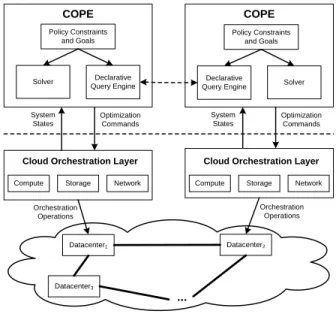
Figure 1 presents a system overview of COPE, which is de-signed for a cloud environment comprising of geographically distributed data centers via dedicated backbone networks or the Internet. COPE can be deployed in either acentralized ordistributedmode.
Network Storage Cloud Orchestration Layer
Solver Optimization Commands Declarative Query Engine Datacenter1 Datacenter2 Datacenter3 Compute Policy Constraints and Goals Network Storage Cloud Orchestration Layer
Compute COPE Solver Declarative Query Engine Policy Constraints and Goals COPE Orchestration Operations Orchestration Operations System States Optimization Commands System States
Figure 1: COPE in the Cloud
In a centralizeddeployment scenario, the entire cloud is configured by one centralized COPE node. It takes as
in-put system states (e.g. node CPU load, memory usage, net-work traffic statistics) gathered from the cloud, and a set of provider policy constraints and goals specified in a declar-ative policy language called COPElog. These specifications are then used by aconstraint solverto automatically gener-ateoptimization commands. These commands are then fed into acloud orchestration layerto generate physical orches-tration operations to directly manipulate cloud resources. Our target orchestration layer is Data-centric Management Framework (DMF) [16], which provides high-level orchestra-tion commands relieving operators from working with ad-hoc configuration scripts. DMF further provides a convenient transactional semanticsfor orchestration commands, where the ACID property is preserved for a series of orchestration commands grouped as a transaction.
In a distributed deployment scenario, there are multiple COPE instances, typically one for each data center. A dis-tributed deployment brings two advantages. First, cloud en-vironments like federated cloud [6] may be administered by different cloud providers. This necessitates each provider running its own COPE for its internal configuration, but co-ordinate with other COPE nodes for inter data center con-figurations. Second, even if the cloud is entirely under one administrative domain, for scalability reasons, each cloud operator may choose to configure a smaller set of resources using local optimization commands. A distributed query en-gine [2] is used to coordinate the exchange of system states and optimization output amongst COPE nodes, in order to achieve a global objective.
3.
MOTIVATING EXAMPLES
To illustrate both deployment models, we present two mo-tivating scenarios,SimpleCloudandFollow-the-Sun.
3.1
SimpleCloud
We consider a hypothetical cloud service called Simple-Cloud, a simplified version of what cloud service providers might offer. In SimpleCloud, a customer may spawn new VMs from an existing disk image, and later start, shutdown, or delete the VMs. SimpleCloud is realized within a data center, and used to host a variety of client applications. Given that SimpleCloud is located within one data center, one can deploy COPE as a centralized controller node for the entire data center, issuing commands to the cloud or-chestration layer to manipulate VM placement.
COPE takes as input real-time system states (e.g., CPU and memory load, migration feasibility), and a set of policies specified by the cloud provider. An example optimization goal is to reduce the cluster-wide CPU load variance across all machines, so as to avoid hot-spots. Constraints can be tied to each machine’s resource availability (e.g. each ma-chine can only run up to a fixed number of VMs, run certain classes of VMs, and not exceed its own memory limits), or security concerns (VMs can only be migrated across certain types of machines). Another possible policy is to minimize the total number of VM migrations, as long as a load vari-ance threshold is met across all machines. Alternatively, to consolidate workloads one can minimize the number of hosts that are hosting VMs, as long as each application receives sufficient resources to meet customer demands. Given these optimization goals and constraints, COPE can be executed periodically, or triggered whenever imbalance is observed, or whenever the VM’s CPU and memory usage changes.
In today’s deployment, providers typically perform load balancing in an ad-hoc fashion. For instance, VM migra-tions can be triggered at an overloaded host machine, whose VMs are migrated to a randomly chosen machine currently with light load. While such ad-hoc approaches may work for a specific scenario, they are unlikely to result in configu-rations that can be easily customized upon changing policy constraints and goals, and whose optimality cannot be easily quantified.
3.2
Follow-the-Sun
Our second motivating example is based on the Follow-the-Sun [22] scenario, which aims to migrate VMs across geographical distributed data centers based on customer dy-namics. Here, the geographic location of the primary work-load (i.e., majority of customers using the cloud service) de-rives demand shifts during the course of a day, and it is beneficial for these workload drivers to be in close proximity to the resources they operate on. The migration decision process has to occur in real-time on a live deployment with minimal disruption to existing services.
In this scenario, the cloud infrastructure service aims to optimize for two parties: enable service consolidation (for providers) to reduce operating costs, and improve applica-tion performance (for customers), while ensuring that cus-tomer SLAs of web services (e.g. defined in terms of the average end-to-end experienced latency of user requests) are met. In addition, they may be performed to reduce inter-data center communication overhead [27, 5]. Since inter-data cen-ters in this scenario may belong to different cloud providers (similar to federated cloud [6]), Follow-the-Sun may be best suited for a distributed deployment, where each COPE node is responsible for controlling resources within their data cen-ter.
In the rest of the paper, to illustrate COPE’s capabili-ties, we first focus on the centralized deployment scenario in Section 4 using the SimpleCloud scenario, followed by a discussion of the distributed Follow-the-Sun scenario in Sec-tion 5.
4.
CENTRALIZED ORCHESTRATION
Using the SimpleCloud scenario, we provide a complete ex-ample to illustrate COPE’s capabilities: (1) expressing cloud orchestration as a constraint optimization problem (COP), (2) expressing COP using a declarative policy language, and (3) present a trace-driven evaluation of COPE using actual traces from a large hosting company. We focus on the cen-tralized deployment, and defer discussion of distribution to Section 5.
4.1
COP Specifications
A COP takes as input a set ofconstraints, and attempts to find an assignment of values chosen from an domain to a set ofvariablesto satisfy the constraints under anoptimization goal. The goal is typically expressed as a minimization over a cost function of the assignments.
COPE uses a declarative policy languageCOPElogto con-cisely specify the COP formulation in the form of policy goals and constraints. Additional derivation rules are used to process intermediate system states for use by the solver in processing the COP program. Our declarative language COPElog is based on Datalog, a recursive query language used in the database community for querying graphs. Our
choice of Datalog as a basis for COPElog is driven by Dat-alog’s conciseness in specifying dependencies among system states, including distributed system states that exhibit recur-sive properties. Its root in logic provides a convenient mech-anism for expressing solver goals and constraints. Moreover, there exists distributed Datalog engines [2] that will later facilitate distributed COP computations.
COPElog extends traditional Datalog with constructs for expressing goals and constraints and also distributed com-putations. These specifications are compiled into execution plans executed by a distributed query engine that includes modules for constraint solving. To illustrate COPElog, we consider the following program, which expresses a COP that aims to achieve load-balancing within a data center. For simplicity, this example is centralized, and we will revisit the distributed extensions in the next section.
goal minimize C in stdevCPU(C).
var hostAssign(Hid,Vid) forall vm(Vid,CPU,Mem). r1 aggCPU(Hid,SUM<CPU>) :- hostAssign(Hid,Vid), vm(Vid,CPU,Mem). r2 stdevCPU(STDEV<CPU>) :- aggCPU(Hid,CPU). r3 aggMem(Hid,SUM<Mem>) :- hostAssign(Hid,Vid), vm(Vid,CPU,Mem). c1 aggMem(Hid,Mem) -> Mem<=mem_thres. c2 hostAssign(Hid,Vid) -> vm(Vid,CPU,Mem), CPU>load_thres. c3 hostAssign(Hid,Vid) -> host(Hid).
In COPElog, regular Datalog rules are used to generate intermediate tables used by the solver. This is specified as regular Datalog rules of the form p :- q1, q2, ..., qn, resulting in the derivation ofp, whenever the rule body (q1
andq2and... andqn) is true. We adopt standard Data-log terminoData-logy throughout the paper, and refer to each term within a rule (e.g.q1,q2) as apredicate, and the correspond-ing derivation obtained (e.g.p) during rule body execution are referred to as tuples. Attributes in upper case refer to variables, while lower case refers to constants.
Language extensions. Two reserved keywordsgoaland
var specify the goal and variables used by the constraint solver. Constraint rules of the form F1 -> F2, F3, ..., Fn, denotes the logical meaning that whenever F1 is true, then the rule body (F2andF3and... andFn) must also be true to satisfy the constraint. Unlike a Datalog rule, which derives new values for a predicate, a constraint restricts a predicate’s allowed values, hence representing an invariant that must be maintained at all times. These are used by the solver to limit the search space when computing the opti-mization goal.
Program description. The above program takes as in-putvm(Vid,CPU,Mem) and host(Hid) tables. Each vm en-try stores information of a virtual machine (VM) uniquely identified byVid. Additional monitored information (i.e. its CPU utilizationCPU and memory usageMem) are also sup-plied in each entry. This monitored information can be pro-vided by the cloud infrastructure, which regularly updates CPU and memory utilization attributes in thevmtable. The
hosttable stores the set of currently available machines that can run VMs. Given these input tables, the above program expresses the following:
• Optimization goal: Minimize the CPU standard devia-tion attributeCinstdevCPU.
• Variables: As output, the solver generates entries in
hostAssign(Hid,Vid), where each entry indicates VMVid
is assigned to hostHid. Vidis bounded via theforallto all existing VMs stored invm(Vid,CPU,Mem).
• Derivation rules: Rules r1 aggregates the CPU of all VMs running on each host. Ruler2takes the output from
r1and then computes the system-wide standard deviation of the aggregate CPU load across all hosts. The output fromr2is later used by the constraint solver for exploring the search space that meets the optimization goal.
• Constraints: Constraint c1 expresses that no host can accommodate VMs whose aggregate memory exceeds its physical limit (a predefined thresholdmem_thres). Simi-larly, constraintc2restricts migration to only VMs whose CPU load is above a predefined thresholdload_thres. c2
is used to reduce unnecessary migrations, by removing the VMs with light load from the list. Constraintc3ensures that VMs are only assigned to hosts that are currently available.
Orchestration. The DMF orchestration layer executes the above program either as a one-time query, periodically, or in a continuous fashion. The continuous version would re-quire running the program as a continuous query, and then triggering the solver whenever a rule body predicate is up-dated (e.g. reported changes to monitored CPU or mem-ory usage for a given VM). The output of the solver is the
hostAssign(Hid,Vid)table. For each entry, the DMF con-troller will invoke a migration operation if VMVidcurrently resides in another location other thanVid.
Using COPElog, it is easy to customize policies simply by modifying the goals, constraints, and adding additional derivation rules. For instance, if the overhead of VM migra-tion is too high, we can set an optimizamigra-tion goal that mini-mizes the number of VM migrations. We can also add a rule (continuous query) that triggers the COP program when-ever load imbalance is observed (i.e.CinstdevCPU exceeds a threshold). Alternatively, we can optimize for the fewest number of unique hosts used for migration while meeting customer SLAs when consolidating workloads.
4.2
COPElog Compilation and Execution
COPE’s compiler and runtime system is implemented by integrating the RapidNet [2] distributed query engine with the Gecode [1] constraint solver. RapidNet was originally designed as a platform for declarative networks [17]. We adopted its usage in order to leverage its distributed Data-log engine. This allows us to execute the derivation rules in COPElog programs using standard query processing tech-niques involving database operators, such as joins (variable matching in rule body), aggregation (e.g. SUM, STDEV), selection filters, rule head renaming, etc.
Whenever an orchestration decision is required, COPElog programs are compiled into executable code in RapidNet, which invokes Gecode’s high-performance constraint solving modules. Our compilation process maps COPElog’s goal,
var, and constraints into equivalent COP primitives in Gecode. These modules are invoked either as a one-time program submitted to COPE,periodically(via periodic timer events generated from COPElog rules), or in acontinuousfashion triggered by incremental maintenance [18] as the body pred-icates are updated.
Gecode adopts the standard branch-and-bound searching approach to solve the optimization while exploring the space of variables under constraints (e.g. c1-3). In addition to these constraints, rules that use solver results as input (e.g.
r1 and r3) are rewritten into constraints to further prune the search space.
One of the interesting aspects of COPE from a query pro-cessing standpoint, is our integration of RapidNet (an in-cremental bottom-up distributed Datalog evaluation engine) and Gecode (a top-down goal-oriented constraint solver). This integration allows us to implement a distributed solver that can perform incremental and distributed constraint op-timizations.
4.3
Evaluation
To demonstrate the capabilities of COPE, we perform a trace-driven experiment executing the COPElog program for the SimpleCloud scenario. As input to the experiment, we use data center traces obtained from a large hosting company in the US. The data contains up to 248 customers hosted on a total of 1,740 statically allocated physical processors (PPs). Each customer application is deployed on a subset of the PPs. The entire trace is one-month in duration, and the trace primarily consists of sampling of CPU and memory utilization at each PP gathered at 300 seconds interval.
Workload generation: From the trace, we generate a workload in a hypothetical cloud environment similar to Sim-pleCloud where there are 15 physical machines geographi-cally dispersed across 3 data centers (5 hosts each). Each physical machine has 32GB memory. By default we config-ure two types of VMs: local and migratable. We preallocate 56 local VMs on each of 15 hosts, and 8 migratable VM on each of 12 hosts, where the other 3 hosts serve as storage servers for each of the three data centers. This allows us to simulate a deployment scenario involving about 1000 VMs. The workload is generated as follows:
• VM spawn: CPU demand (% PP used) is aggregated over all PPs belonging to a customer at every time interval. We compute the average CPU load, under the assumption that load is equally distributed among the allocated VMs. Whenever a customer’s average CPU load per VM exceeds a predefined high threshold and there are no free VMs available, one additional VM is spawned on a random host by cloning from an image template.
• VM stop and start: Whenever a customer’s average CPU load drops below a predefined low threshold, one of its VMs is powered off to save resources (e.g. energy and memory). We assume that powered-off VMs are not re-claimed by the cloud. Customers may bring their VMs back by powering them on when the CPU demands be-come high later.
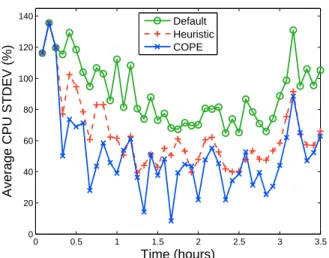
Our COPE prototype periodically (every 20 minutes) ex-ecute the COPElog program in Section 4.1, to perform a COP computation that orchestrates load balancing via VM migration within each data center. The program takes as input thevm(Vid,CPU,Mem) table, which is updated by the workload generator, as well as the host(Hid) table. Fig-ure 2 shows the average CPU standard deviation of three data centers achieved by the COPElog program over a 3.5 hours period. During this period, there are on average 16.8 VM migrations every interval.
0 0.5 1 1.5 2 2.5 3 3.5 0 20 40 60 80 100 120 140 Time (hours)
Average CPU STDEV (%)
Default Heuristic COPE
Figure 2: Average CPU standard deviation of three data centers
To validate that COPE is achieving good load balancing, we compare COPE against two strawman approaches De-faultandHeuristic. Defaultis the most na¨ıve strategy, which simply does no migration after VMs are initially placed on a random host. Heuristicis a threshold-based policy that migrates VMs from the most loaded host (i.e. with the high-est aggregate CPU of the VMs running on it) to the least one, until the most-to-least load ratio is below a thresholdK
(K is 1.2 in our experiment). Heuristicemulates an ad-hoc strategy that a cloud operator may adopt in the absence of COPE. As evidence of the effectiveness of COPE, we observe that COPE is able to more effectively perform load balanc-ing, achieving a 44% and 18% reduction of the degree of CPU load imbalance as compared toDefaultandHeuristic, respectively.
Note that the above results validate the capability of COPElog in enforcing one particular load balancing policy. By customizing the COPElog rules, one could have flexibly implemented different policies that load balances memory usage, or achieve another optimization goal of minimizing the number of VM migrations, as previously described.
In terms of solver overhead, we note that on a Intel Quad core 2.33GHz PC with 4GB RAM running Ubuntu 10.04, the solver takes an average of 0.6 seconds (6.1 seconds at maximum) to complete each COP execution. The memory footprint is 217KB (on average), and 409KB (maximum). For larger-scale data centers with more migratable VMs, the solver will require exponentially more time to terminate. This makes it hard to reach the optimal solution in reason-able time. In the next section, we will discuss distributed deployment scenarios that can potentially improve scalabil-ity.
5.
DISTRIBUTED ORCHESTRATION
As noted in Section 2, distributed deployments are re-quired in cases where orchestration spans multiple cloud providers, or to improve scalability by partitioning an expen-sive COP operation into smaller operations (this typically results in an approximate solution). We use the Follow-the-Sunexample to highlight these distributed capabilities.
5.1
COP Formulation
We first present a COP-based mathematical model of the Follow-the-Sun scenario. Recall that in the scenario, cloud providers decide to migrate VMs across data centers in order to consolidate resources and better meet customer demands. In this model, there aren autonomous geographically dis-tributed data centersC1, ..., Cn at location 1,2, ..., n. Each data center is managed by one COPE node. Each siteCihas a resource capacity (set to the maximum number of VMs) denoted asRi. Each customer specifies the number of VMs to be instantiated, as well as a preferred geographic location. We denote the aggregated resource demand at locationjas
Dj, which is the sum of total number of VMs demanded by
all customers at that location. Given the resource capacity and demand,Ci currently allocatesAji resources (VMs) to meet customer demandDj at locationj.
In the formulation,Mijk denotes the number of VMs mi-grated fromCitoCjto meetDk. WhenMijk>0, the cloud orchestration layer will issue commands to migrate VMs ac-cordingly. This can be periodically executed, or executed on demand whenever system parameters (e.g., demandDor resource availabilityR) changes dramatically.
A na¨ıve algorithm is to always migrate VMs to customers’ preferred locations. However, it could be either impossi-ble, when the aggregated resource demand exceeds resource capacity, or suboptimal, when the operating cost of a desig-nated data center is much more expensive than neighboring ones, or when the traffic patterns incur high communication cost, e.g. the majority of the access clients for the VMs are far away from the preferred data center.
In contrast, COPE’s COP approach attempts to optimize based on a number of factors captured in the cost function. In the model, we consider three main kinds of cost: (1) oper-ating cost of data centerCjis defined asOCj, which includes typical recurring costs of operating a data center; (2) com-munication cost of meeting resource demandDi from data centerCj is given asCCij; (3) migration costM Cij is the communication overhead of moving a VM from Ci to Cj. Given the above variables, the COP formulation is:
min (aggOC+aggCC+aggM C) (1)
aggOC= n X j=1 ( n X i=1 (Aij+ n X k=1 Mkji)∗OCj) (2) aggCC= n X j=1 n X i=1 ((Aij+ n X k=1 Mkji)∗CCij) (3) aggM C= n X i=1 n X j=1 (( n X k=1
max(Mijk,0))∗M Cij) (4)
subject to: ∀j:Rj≥ n X i=1 (Aij+ n X k=1 Mkji) (5)
∀i, j, k:Mijk+Mjik= 0 (6)
Optimization goal. The COP aims to minimize the aggregate cost of cloud providers. In the above formula, it is defined as the sum of the aggregate operating costaggOC
(2) across all data centers, aggregate communication cost
aggCC(3) to meet customer demands served at various data centers, and the aggregate VM migration costaggM C (4),
all of which are computed by summing upOCj,CCij, and
M Cij for the entire system.
Constraints. The COP is subjected to two constraints. In Constraint (5), each data center cannot allocate more resources than it possesses. Constraint (6) ensures the zero-sum relation between migrated resources betweenCiandCj for demandk.
In Appendix A, we validate the above COP formulation via performing a preliminary utility analysis using a syn-thetic workload. In the absence of actual traces that mir-rors actual costs (operating, migration, communication), our synthetic workload provides an initial starting point for vali-dating the formulation. Note that our COP formulation can be further customized based on provider/customer needs. For example, an alternative optimization goal is to mini-mize service latency in SLAs under the constraint that cus-tomer budget is fixed [27]. We can also impose restrictions on the maximum quantity of resources to be migrated due to high CPU load or router traffic in data centers, or impose constraints that the total cost after optimization should be smaller by a threshold than before optimization. This can prevent instability issues like recurring massive VM migra-tion among specific data centers. Our model can also be extended to support other resource types (e.g. storage, net-work) beyond VM. We leave these extensions as future work.
5.2
COPElog Specifications
We next demonstrate how COPE can be used to realize a distributed implementation of the above model. At a high level, we utilize an iterative distributed graph-based com-putation strategy, in which all nodes execute alocal COP, and then iteratively exchange COP results with neighboring nodes until a stopping condition is reached. In this execu-tion model, all data centers are represented as nodes in a graph, and a link exists between two nodes if resources can be migrated across them. The following COPElog program implements the local COP at a given nodeX:
// goal declaration
goal minimize C in totalCost(@X,C). // variable declaration
var migVM(@X,Y,D,R) forall eSetLink(@X,Y,D). // totalCost definition r1 totalCost(@X,SUM<C>) :- link(@X,Y), aggCost(@Y,C). // aggCost definition r2 aggCost(@X,C) :- aggOpCost(@X,C1), aggCommCost(@X,C2), aggMigCost(@X,C3), C=C1+C2+C3.
// aggregate operating cost
r3 aggOpCost(@X,SUM<Cost>) :- curVM(@X,D,R1), migVM(@X,Y,D,R2), opCost(@X,C), Cost=C*(R1-R2).
// aggregate communication cost
r4 aggCommCost(@X,SUM<Cost>) :- curVM(@X,D,R1), migVM(@X,Y,D,R2), commCost(@X,Y,C), Cost=C*(R1-R2).
// aggregate migration cost
r5 aggMigCost(@X,SUM<Cost>) :- migVM(@X,Y,D,R), migCost(@X,Y,C), Cost=R*C, Cost>0.
COP COPElog
symbolRi resource(I,R) symbolAij curVM(I,J,R) symbolMijk migVM(I,J,K,R) equation (1) rulegoal, r1-2
equation (2) ruler3
equation (3) ruler4
equation (4) ruler5
equation (5) ruler6-7, constraintc1
equation (6) ruler8
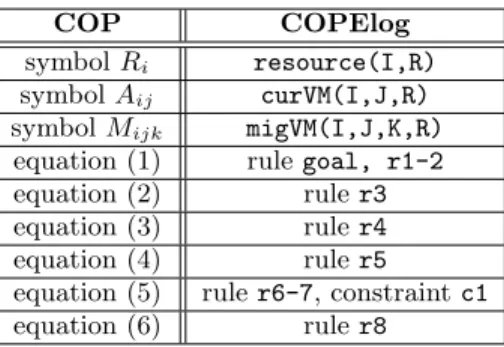
Table 1: Mappings from COP to COPElog.
// constraints on VM migration quantity r6 aggCurVM(@X,SUM<R>) :- curVM(@X,D,R). r7 aggMigVM(@X,SUM<R>) :- migVM(@X,Y,D,R). c1 aggMigVM(@X,R2) -> resource(@X,R),
aggCurVM(@X,R1), R1-R2>=R. // propagate results to ensure symmetry
r8 migVM(@Y,X,D,R2):- migVM(@X,Y,D,R1), R2=-R1.
The above program is written using distributed variant of Datalog used in declarative networking [17], where the lo-cation specifier@denotes the source location of each corre-sponding tuple. This allows us to write rules where the input data spans multiple nodes, a convenient language construct for formulating distributed optimizations. Table 1 summa-rizes the mapping from COP symbols to COPElog tables, and COP equations to COPElog rules/constraints identi-fied by the rule labels. In the table,Ri is stored as a
re-source(I,R)tuple. Likewise, theRattribute inmig(I,J,K,R)
stores the value ofMijk.
The localized COP program works as follows. Instead of minimizing the global total cost of all data centers, the op-timization goal is the total cost within a local region (node
Xand its neighbors). Periodically, an eSetLinkevent trig-gers the local COP operation at data centerX, which then randomly selects one of its links to start alink negotiation process with its neighborYfor resource demand atD. The eS-etLink(@X,Y,D)tuple is generated periodically at nodeXvia an extra COPElog rule, whereYandDdenotes the neighbor randomly chosen for the current negotiation process and the resource demand location, respectively. To avoid conflicts, for any givenlink(X,Y), the link negotiation protocol se-lects the node with the larger identifier (or address) to carry out the subsequent process.
As part of this negotiation process, each node exchanges its aggregate system stateaggCost(derived using rules r2-r5) with its neighboring nodes. This is achieved by using ruler1, where nodeXcollects its neighbors’aggCosttables, and then perform aSUMaggregate, stored intotalCost. The negotiation process then solves alocalCOP (by minimizing
totalCost) to determine the quantity of resources that can be migrated to the specific neighbor. The COP is expressed by solving the optimization goal, under the specified con-straintc1, together with rulesr6andr7. The migration re-sultmigVMis then propagated to immediate neighbors using rule r8 to ensure symmetry. Above process is then itera-tively repeated until all links have been assigned values or when a stopping condition is reached.
Distributed Execution. The COPElog compilation pro-cess (in Section 4.2) requires minimal modification in
or-der to implement the above distributed program. COPE uses RapidNet for executing distributed Datalog rules, which already provides a runtime environment for implementing these rules. At a high level, each distributed rule or con-straint (with multiple distinct location specifiers) is rewrit-ten using alocalizationrewrite [17] step. This transformation results in rule bodies that can be executed locally, and rule heads that can be derived and sent across nodes. The beauty of this rewrite is that even if the original program expresses distributed properties and constraints, this rewrite process will realize multiple local COP operations at different nodes, and have the output of COP operations via derivations sent across nodes. For example, rule r8 takes the output of a local COP execution at nodeX, and sends that to nodeYto continue on the optimization process in the next iteration.
6.
RELATED WORK
Prior to COPE, there have been a variety of systems that use declarative logic-based policy languages to express con-straint optimization problems in resource management of computing systems. [23] proposes continuous optimization based on declaratively specified policies for autonomic com-puting. [21] describes a model for automated policy-based construction as a goal satisfaction problem in utility comput-ing environments. The XSB engine [3] integrates a tabled Prolog engine with a constraint solver. Rhizoma [26] poses to use rule-based language and constraint solving pro-gramming to optimize resource allocation. It focuses on self-deployed applications in overlay networks to maximize the utilization of well-connected, lightly loaded nodes. [19] uses a logic-based interface to a SAT solver to automatically gen-erate configuration solution for a single data center.
Unlike the above systems, COPE is designed for a different application domain – one that aims to achieve cost reduction and maximize infrastructure utilization by automatically or-chestrating the cloud based on policies configured by cloud providers. Another unique feature of COPE is its support fordistributed optimizations, achieved by using the COPElog language which supports distribution, and the integration of a distributed query engine with a constraint solver.
7.
ONGOING STATUS
This paper presents our initial work on the COPE sys-tem, which is a first step towards our eventual vision of en-abling automated cloud resource orchestration realized and controlled using declarative languages. Resource allocation in the cloud is an inherent distributed optimization prob-lem. We have demonstrated in this paper the viability of COPE in the centralized optimization scenario, using trace-driven simulations obtained from an actual hosting service. Realizing COPE in its full entirety requires a distributed pol-icy language and optimization environment. Towards that goal, we introduce the COPElog framework, which combines unique features from declarative networking and constraint solving.
We are currently in the process of developing a full-fledged COPE prototype that will be integrated with the DMF cloud orchestration platform. We intend to evaluate the Simple-Cloud and Follow-the-Sun scenarios on the Shadownet [8] testbed. At this point of time, we have already successfully deployed DMF on Shadownet for two scenarios. The Simple-Cloud scenario consists of about 1000 VMs on 15 Shadownet
hosts, while the Follow-the-Sun scenario is a smaller-scale limited deployment. A live demonstration [15] was carried out recently.
Building upon the basic policies described in this paper, we hope to incorporate into the optimization framework, re-cent models on resource provisioning and deployment anal-ysis in the cloud. For example, [20] proposes a server oper-ational cost optimization model for cloud computing service that involves scaling CPU frequency and powering on/off VMs over a time horizon. [13, 14] proposes a pricing model that offers cloud users the choice of different execution speeds corresponding to different prices. Similarly, [12] explores the feasibility of migrating enterprise applications to the cloud, based on a cost-benefit analysis. We plan to explore the applicability of COPE to enable such resource provisioning and cost-benefit analysis.
We also plan to release the COPE prototype as open-source, for use by other researchers to implement resource management policies in the cloud. Finally, we will explore more complex scenarios beyond resource migration, partic-ularly those that involve network management tasks [7] in-curred as a result of cloud orchestration, and orchestration procedures required for mobility [9], virtualized desktop [11] and database consolidation [10].
8.
ACKNOWLEDGEMENTS
The authors would like to thank Jacobus E. Van der Merwe and the anonymous reviewers for their helpful comments on the earlier versions of the paper. This work is supported by NSF grants CCF-0820208 and CNS-1040672.
9.
REFERENCES
[1] Gecode constraint development environment. http://www.gecode.org/.
[2] RapidNet. http://netdb.cis.upenn.edu/rapidnet/. [3] XSB Project. http://xsb.sourceforge.net/.
[4] Agarwal, S., Dunagan, J., Jain, N., Saroiu, S., Wolman, A., and Bhogan, H.Volley: automated data placement for geo-distributed cloud services. InNSDI (2010).
[5] Al-Fares, M., Radhakrishnan, S., Raghavan, B., Huang, N., and Vahdat, A.Hedera: dynamic flow scheduling for data center networks. InNSDI (2010).
[6] Campbell, R., Gupta, I., Heath, M., Ko, S. Y., Kozuch, M., Kunze, M., Kwan, T., Lai, K., Lee, H. Y., Lyons, M., Milojicic, D., O’Hallaron, D., and Soh, Y. C.Open cirrus cloud computing testbed: federated data centers for open source systems and services research. InHotCloud(2009). [7] Chen, X., Mao, Y., Mao, Z. M., and Van der Merwe, J.
Declarative Configuration Management for Complex and Dynamic Networks. InCoNEXT (2010).
[8] Chen, X., Mao, Z. M., and Van der Merwe, J.ShadowNet: A Platform for Rapid and Safe Network Evolution. InProc. USENIX ATC (2009).
[9] Chun, B.-G., Ihm, S., Maniatis, P., Naik, M., and Patti, A.
Clonecloud: Elastic execution between mobile device and cloud. InEuroSys(2011).
[10] Curino, C., Jones, E., Madden, S., and Balakrishnan, H.
Workload-aware database monitoring and consolidation. In SIGMOD(2011).
[11] Das, T., Padala, P., Padmanabhan, V. N., Ramjee, R., and Shin, K. G.Litegreen: saving energy in networked desktops using virtualization. InUSENIX ATC(2010).
[12] Hajjat, M., Sun, X., Sung, Y.-W. E., Maltz, D., Rao, S., Sripanidkulchai, K., and Tawarmalani, M.Cloudward bound: planning for beneficial migration of enterprise applications to the cloud. InSIGCOMM(2010).
[13] Henzinger, T. A., Singh, A. V., Singh, V., Wies, T., and Zufferey, D.FlexPRICE: Flexible provisioning of resources in a cloud environment. InIEEE Conference on Cloud
[14] Henzinger, T. A., Singh, A. V., Singh, V., Wies, T., and Zufferey, D.A marketplace for cloud resources. InEMSOFT (2010).
[15] Liu, C., Mao, Y., Chen, X., Fernandez, M. F., Loo, B. T., and der Merwe, K. V.Towards transactional cloud resource orchestration. InNSDI (poster and demo)(2011).
[16] Liu, C., Mao, Y., Van der Merwe, J., and Fernandez, M.Cloud Resource Orchestration: A Data-Centric Approach. InCIDR (2011).
[17] Loo, B. T., Condie, T., Garofalakis, M., Gay, D. E., Hellerstein, J. M., Maniatis, P., Ramakrishnan, R., Roscoe, T., and Stoica, I.Declarative Networking. InCommunications of the ACM (CACM)(2009).
[18] Mengmeng Liu, Nicholas Taylor, Wenchao Zhou, Zachary Ives, and Boon Thau Loo. Recursive Computation of Regions and Connectivity in Networks. InICDE (2009).
[19] Narain, S., Levin, G., Malik, S., and Kaul, V.Declarative infrastructure configuration synthesis and debugging.J. Netw. Syst. Manage. 16 (September 2008), 235–258.
[20] Qian, H., and Medhi, D.Server operational cost optimization for cloud computing service providers over a time horizon. In HotICE (2011).
[21] Sahai, A., Singhal, S., Machiraju, V., and Joshi, R.Automated policy-based resource construction in utility computing environments. InIEEE/IFIP Network Operations and Management Symposium(2004).
[22] Van der Merwe, J., Ramakrishnan, K., Fairchild, M., Flavel, A., Houle, J., Lagar-Cavilla, H. A., and Mulligan, J.Towards a ubiquitous cloud computing infrastructure. InLANMAN (2010).
[23] White, S. R., Hanson, J. E., Whalley, I., Chess, D. M., Segal, A., and Kephart, J. O.Autonomic computing: Architectural approach and prototype.Integr. Comput.-Aided Eng. 13 (April 2006), 173–188.
[24] Wood, T., Gerber, A., Ramakrishnan, K., Shenoy, P., and der Merwe, J. V.The case for enterprise-ready virtual private clouds. InHotCloud(2009).
[25] Wood, T., Shenoy, P., Venkataramani, A., and Yousif, M.
Black-box and gray-box strategies for virtual machine migration. InNSDI(2007).
[26] Yin, Q., Schuepbach, A., Cappos, J., Baumann, A., and Roscoe, T.Rhizoma: a runtime for self-deploying, self-managing overlays. InProceedings of Middleware(2009).
[27] Zhang, Z., Zhang, M., Greenberg, A., Hu, Y. C., Mahajan, R., and Christian, B.Optimizing cost and performance in online service provider networks. InNSDI(2010).
APPENDIX
A.
FOLLOW-THE-SUN SIMULATIONS
Using the Follow-the-Sun scenario, we present a prelim-inary validation of our COP formulation. The goal of our evaluation is to validate that executing the COP results in VM placement which minimizes the total cost (as described in Section 5.1). We also examine the scalability of COPE.
Our experiment setup consists of 3 data centers geograph-ically distributed at three locations, with the number of mi-gratable VMs all set to 60. Initially each data center has 35, 35, and 30 VMs respectively. This roughly corresponds to a random placement of VMs across the 3 data centers.
We consider three time phases within a single day in which there are drastic changes in user locations, i.e. morning, af-ternoon, and evening, denoted astime = 0,1,2. Given an aggregate customer demand of 100, we modify customer lo-cations as follows. Attime = 0, all customer are located near data center DC0. This means that demand at DC0
is D0 = 100. As the Sun moves, attime = 1, customers move closer toDC1, henceD1= 100. Finally, at time= 2, demand shifts again toDC2.
Based on the above customer mobility pattern, at the be-ginning of each time phase, we execute the COP that deter-mines the VM migrations necessary to minimize the cloud providers’ total cost. As a strawman, we compare against
Default, where all the VMs continue to reside in their orig-inal location regardless of time phase. In our analysis, we consider abstract cost values as follows. We set the operating cost for all data center to be 4. The migration cost between data centers areM C=
2 4 0 1 1 1 0 1 1 1 0 3
5, where the value in row
iand columnjdenoteM Cij. Finally,CC=
2 4 0 3 5 3 0 4 5 4 0 3 5.
Given that data centers may span geographic regions, com-munication costs between data centers may differ.
Table 2 summarizes our evaluation results, where we com-pare the total cost ofCOPEagainst the strawmanDefault approach. We further provide a breakdown of VMs per data center at each time interval.
Time 0 1 2 Default DC0 35 60 40 DC1 35 40 60 DC2 30 0 0 Total Cost 655 580 840 COPE DC0 60 40 0 DC1 40 60 40 DC2 0 0 60 Total Cost 548 540 618
Table 2: Evaluation results of the Follow-the-Sun scenario.
We observe that the output from our solver produced the following migration patterns: attime= 0, 25 VMs are mi-grated fromDC2 toDC0, and 5 VMs fromDC2 toDC1; at
time= 1, 20 VMs are migrated fromDC0 toDC1; and at
time= 2, 1 VM is migrate from DC0 toDC1, 39 VMs are migrated fromDC0toDC2, and 21 VMs fromDC1toDC2. While the absolute number of VMs migrated are highly de-pendent on cost parameters, we note that the general trend of shifting VMs based on demand is followed. Based on this migration pattern, we observe thatCOPEachieved a lower total cost compared toDefault.
In terms of solver execution time, we note that on a Intel Quad core 2.33GHz PC with 4GB RAM running Ubuntu 10.04, the solver takes less than 2.6 seconds to complete each COP execution. For larger number of data centers up to 6, the solver returns the answer within seconds.