Group-based parent training programmes for
improving emotional and behavioural
adjustment in young children
Barlow, J, Bergman, H, Kornør, H, Wei, Y & Bennett, C
Published PDF deposited in Coventry University’s Repository
Original citation:
Barlow, J, Bergman, H, Kornør, H, Wei, Y & Bennett, C 2016, 'Group-based parent training
programmes for improving emotional and behavioural adjustment in young
children' Cochrane Database of Systematic Reviews, vol 8, CD003680
https://dx.doi.org/10.1002/14651858.CD003680.pub3
DOI
10.1002/14651858.CD003680.pub3
ESSN 1469-493X
Publisher: Cochrane Collaboration
Copyright © and Moral Rights are retained by the author(s) and/ or other copyright
owners. A copy can be downloaded for personal non-commercial research or study,
without prior permission or charge. This item cannot be reproduced or quoted extensively
from without first obtaining permission in writing from the copyright holder(s). The
content must not be changed in any way or sold commercially in any format or medium
without the formal permission of the copyright holders.
Cochrane
Database of Systematic Reviews
Group-based parent training programmes for improving
emotional and behavioural adjustment in young children
(Review)
Barlow J, Bergman H, Kornør H, Wei Y, Bennett C
Barlow J, Bergman H, Kornør H, Wei Y, Bennett C.
Group-based parent training programmes for improving emotional and behavioural adjustment in young children.
Cochrane Database of Systematic Reviews2016, Issue 8. Art. No.: CD003680. DOI: 10.1002/14651858.CD003680.pub3.
T A B L E O F C O N T E N T S 1 HEADER . . . . 1 ABSTRACT . . . . 2 PLAIN LANGUAGE SUMMARY . . . .
4 SUMMARY OF FINDINGS FOR THE MAIN COMPARISON . . . .
8 BACKGROUND . . . . 9 OBJECTIVES . . . . 9 METHODS . . . . 13 RESULTS . . . . Figure 1. . . 14 Figure 2. . . 19 Figure 3. . . 20 25 DISCUSSION . . . . 27 AUTHORS’ CONCLUSIONS . . . . 28 ACKNOWLEDGEMENTS . . . . 28 REFERENCES . . . . 40 CHARACTERISTICS OF STUDIES . . . . 99 DATA AND ANALYSES . . . .
Analysis 1.1. Comparison 1 Group-based parent training programmes compared to control (postintervention), Outcome 1 Emotional and behavioural problems (parent report). . . 104 Analysis 1.2. Comparison 1 Group-based parent training programmes compared to control (postintervention), Outcome 2
Emotional and behavioural problems (teacher report): postintervention. . . 105 Analysis 1.3. Comparison 1 Group-based parent training programmes compared to control (postintervention), Outcome 3
Externalising problems (parent report). . . 105 Analysis 1.4. Comparison 1 Group-based parent training programmes compared to control (postintervention), Outcome 4
Externalising problems (teacher report). . . 108 Analysis 1.5. Comparison 1 Group-based parent training programmes compared to control (postintervention), Outcome 5
Externalising problems (observer report): short-term follow-up (< 1 year). . . 109 Analysis 1.6. Comparison 1 Group-based parent training programmes compared to control (postintervention), Outcome 6
Externalising problems subscales: hyperactivity-inattention (parent report). . . 110 Analysis 1.7. Comparison 1 Group-based parent training programmes compared to control (postintervention), Outcome 7
Externalising problems subscales - hyperactivity-inattention (observer report): short-term follow-up (< 1 year). 111 Analysis 1.8. Comparison 1 Group-based parent training programmes compared to control (postintervention), Outcome 8
Internalising problems (parent report). . . 112 Analysis 1.9. Comparison 1 Group-based parent training programmes compared to control (postintervention), Outcome 9
Internalising problems (teacher report). . . 113 Analysis 1.10. Comparison 1 Group-based parent training programmes compared to control (postintervention), Outcome
10 Internalising problems (observer report): short-term follow-up (< 1 year). . . 114 Analysis 1.11. Comparison 1 Group-based parent training programmes compared to control (postintervention), Outcome
11 Social skills (parent report). . . 115 Analysis 1.12. Comparison 1 Group-based parent training programmes compared to control (postintervention), Outcome
12 Social skills (observer report). . . 116 Analysis 1.13. Comparison 1 Group-based parent training programmes compared to control (postintervention), Outcome
13 Parent-child interaction - negative behaviour (observer report). . . 117 Analysis 1.14. Comparison 1 Group-based parent training programmes compared to control (postintervention), Outcome
14 Parent-child interaction - negative behaviour (parent report): postintervention. . . 118 Analysis 1.15. Comparison 1 Group-based parent training programmes compared to control (postintervention), Outcome
15 Parent-child interaction - positive behaviour (observer report). . . 119 Analysis 1.16. Comparison 1 Group-based parent training programmes compared to control (postintervention), Outcome
16 Subgroup analyses at postintervention - emotional and behavioural: duration of programmes. . . 120
i Group-based parent training programmes for improving emotional and behavioural adjustment in young children (Review)
Analysis 1.17. Comparison 1 Group-based parent training programmes compared to control (postintervention), Outcome 17 Subgroup analyses at postintervention - emotional and behavioural problems (parent report): by type of
intervention. . . 121 Analysis 1.18. Comparison 1 Group-based parent training programmes compared to control (postintervention), Outcome
18 Sensitivity analyses at postintervention - emotional and behavioural problems (parent report): without quasi-RCTs. . . 122 Analysis 2.1. Comparison 2 Sensitivity analysis 1 (ICC = 0), Outcome 1 Externalising problems (parent report). . . 123 Analysis 2.2. Comparison 2 Sensitivity analysis 1 (ICC = 0), Outcome 2 Externalising problems (teacher report). . . 125 Analysis 2.3. Comparison 2 Sensitivity analysis 1 (ICC = 0), Outcome 3 Externalising problems subscales -
hyperactivity-inattention (parent report). . . 126 Analysis 2.4. Comparison 2 Sensitivity analysis 1 (ICC = 0), Outcome 4 Internalising problems (teacher report). . . 127 Analysis 2.5. Comparison 2 Sensitivity analysis 1 (ICC = 0), Outcome 5 Parent-child interaction - negative behaviour
(observer report). . . 128 Analysis 3.1. Comparison 3 Sensitivity analysis 2 (ICC = 0.02), Outcome 1 Externalising problems (parent report). . 129 Analysis 3.2. Comparison 3 Sensitivity analysis 2 (ICC = 0.02), Outcome 2 Externalising problems (teacher report). 131 Analysis 3.3. Comparison 3 Sensitivity analysis 2 (ICC = 0.02), Outcome 3 Externalising problems subscales -
hyperactivity-inattention (parent report). . . 132 Analysis 3.4. Comparison 3 Sensitivity analysis 2 (ICC = 0.02), Outcome 4 Internalising problems (teacher report). . 133 Analysis 3.5. Comparison 3 Sensitivity analysis 2 (ICC = 0.02), Outcome 5 Parent-child interaction - negative behaviour
(observer report). . . 134 Analysis 4.1. Comparison 4 Sensitivity analysis 3 (ICC = 0.1), Outcome 1 Externalising problems (parent report). . 135 Analysis 4.2. Comparison 4 Sensitivity analysis 3 (ICC = 0.1), Outcome 2 Externalising problems (teacher report). . 137 Analysis 4.3. Comparison 4 Sensitivity analysis 3 (ICC = 0.1), Outcome 3 Externalising problems subscales -
hyperactivity-inattention (parent report). . . 138 Analysis 4.4. Comparison 4 Sensitivity analysis 3 (ICC = 0.1), Outcome 4 Internalising problems (teacher report). . 139 Analysis 4.5. Comparison 4 Sensitivity analysis 3 (ICC = 0.1), Outcome 5 Parent-child interaction - negative behaviour
(observer report). . . 140 141 ADDITIONAL TABLES . . . . 149 APPENDICES . . . . 163 WHAT’S NEW . . . . 163 HISTORY . . . . 164 CONTRIBUTIONS OF AUTHORS . . . . 164 DECLARATIONS OF INTEREST . . . . 165 SOURCES OF SUPPORT . . . . 165 DIFFERENCES BETWEEN PROTOCOL AND REVIEW . . . .
167 INDEX TERMS . . . .
[Intervention Review]
Group-based parent training programmes for improving
emotional and behavioural adjustment in young children
Jane Barlow1, Hanna Bergman2,3, Hege Kornør4, Yinghui Wei5, Cathy Bennett6
1Division of Mental Health and Wellbeing, Warwick Medical School, University of Warwick, Coventry, UK.2Enhance Reviews
Ltd, Wantage, UK.3Cochrane Response, Cochrane, London, UK.4Center for Child and Adolescent Mental Health, Eastern and
Southern Norway, Oslo, Norway.5Centre for Mathematical Sciences, School of Computing, Electronics and Mathematics, University
of Plymouth, Plymouth, UK.6Centre for Technology Enabled Health Research (CTEHR), Coventry University, Coventry, UK
Contact address: Jane Barlow, Division of Mental Health and Wellbeing, Warwick Medical School, University of Warwick, Gibbett Hill Road, Coventry, CV4 7LF, [email protected].
Editorial group:Cochrane Developmental, Psychosocial and Learning Problems Group.
Publication status and date:New search for studies and content updated (conclusions changed), published in Issue 8, 2016. Review content assessed as up-to-date: 29 July 2015.
Citation: Barlow J, Bergman H, Kornør H, Wei Y, Bennett C. Group-based parent training programmes for improving emotional and behavioural adjustment in young children.Cochrane Database of Systematic Reviews2016, Issue 8. Art. No.: CD003680. DOI: 10.1002/14651858.CD003680.pub3.
Copyright © 2016 The Cochrane Collaboration. Published by John Wiley & Sons, Ltd.
A B S T R A C T
Background
Emotional and behavioural problems in children are common. Research suggests that parenting has an important role to play in helping children to become well-adjusted, and that the first few months and years are especially important. Parenting programmes may have a role to play in improving the emotional and behavioural adjustment of infants and toddlers, and this review examined their effectiveness with parents and carers of young children.
Objectives
1. To establish whether group-based parenting programmes are effective in improving the emotional and behavioural adjustment of young children (maximum mean age of three years and 11 months); and
2. To assess whether parenting programmes are effective in the primary prevention of emotional and behavioural problems. Search methods
In July 2015 we searched CENTRAL (the Cochrane Library), Ovid MEDLINE, Embase (Ovid), and 10 other databases. We also searched two trial registers and handsearched reference lists of included studies and relevant systematic reviews.
Selection criteria
Two reviewers independently assessed the records retrieved by the search. We included randomised controlled trials (RCTs) and quasi-RCTs of group-based parenting programmes that had used at least one standardised instrument to measure emotional and behavioural adjustment in children.
Data collection and analysis
One reviewer extracted data and a second reviewer checked the extracted data. We presented the results for each outcome in each study as standardised mean differences (SMDs) with 95% confidence intervals (CIs). Where appropriate, we combined the results in a meta-analysis using a random-effects model. We used the GRADE (Grades of Recommendations, Assessment, Development, and Evaluation) approach to assess the overall quality of the body of evidence for each outcome.
1 Group-based parent training programmes for improving emotional and behavioural adjustment in young children (Review)
Main results
We identified 22 RCTs and two quasi-RCTs evaluating the effectiveness of group-based parenting programmes in improving the emotional and behavioural adjustment of children aged up to three years and 11 months (maximum mean age three years 11 months). The total number of participants in the studies were 3161 parents and their young children. Eight studies were conducted in the USA, five in the UK, four in Canada, five in Australia, one in Mexico, and one in Peru. All of the included studies were of behavioural, cognitive-behavioural or videotape modelling parenting programmes.
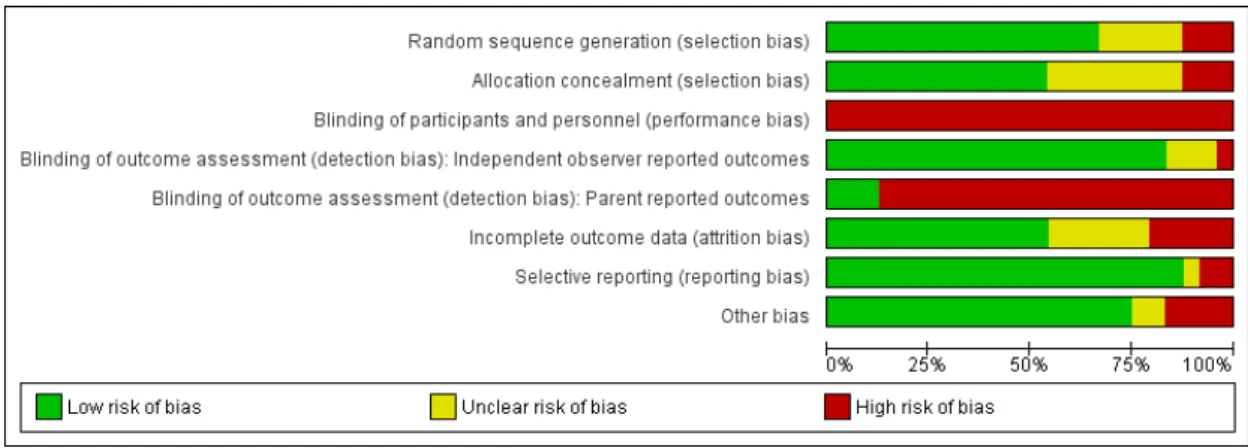
We judged 50% (or more) of the included studies to be at low risk for selection bias, detection bias (observer-reported outcomes), attrition bias, selective reporting bias, and other bias. As it is not possible to blind participants and personnel to the type of intervention in these trials, we judged all studies to have high risk of performance bias. Also, there was a high risk of detection bias in the 20 studies that included parent-reported outcomes.
The results provide evidence that group-based parenting programmes reduce overall emotional and behavioural problems (SMD -0.81, 95% CI -1.37 to -0.25; 5 studies, 280 participants, low quality evidence) based on total parent-reported data assessed at postintervention. This result was not, however, maintained when two quasi-RCTs were removed as part of a sensitivity analysis (SMD -0.67, 95% CI -1.43 to 0.09; 3 studies, 221 participants). The results of data from subscales show evidence of reduced total externalising problems (SMD -0.23, 95% CI -0.46 to -0.01; 8 studies, 989 participants, moderate quality evidence). Single study results show very low quality evidence of reductions in externalising problems hyperactivity-inattention subscale (SMD -1.34; 95% CI -2.37 to -0.31; 19 participants), low quality evidence of no effect on total internalising problems (SMD 0.34; 95% CI -0.12 to 0.81; 73 participants), and very low quality evidence of an increase in social skills (SMD 3.59; 95% CI 2.42 to 4.76; 32 participants), based on parent-reported data assessed at postintervention. Results for secondary outcomes, which were also measured using subscales, show an impact on parent-child interaction in terms of reduced negative behaviour (SMD -0.22, 95% CI -0.39 to -0.06; 7 studies, 941 participants, moderate quality evidence), and improved positive behaviour (SMD 0.48, 95% CI 0.17 to 0.79; 4 studies, 173 participants, moderate quality evidence) as rated by independent observers postintervention. No further meta-analyses were possible. Results of subgroup analyses show no evidence for treatment duration (seven weeks or less versus more than eight weeks) and inconclusive evidence for prevention versus treatment interventions.
Authors’ conclusions
The findings of this review, which relate to the broad group of universal and at-risk (targeted) children and parents, provide tentative support for the use of group-based parenting programmes to improve the overall emotional and behavioural adjustment of children with a maximum mean age of three years and 11 months, in the short-term. There is, however, a need for more research regarding the role that these programmes might play in the primary prevention of both emotional and behavioural problems, and their long-term effectiveness.
P L A I N L A N G U A G E S U M M A R Y
Group-based parent training programmes for improving emotional and behavioural adjustment in young children Review question
We wanted to know whether group-based parent training programmes are effective in improving emotional and behavioural adjustment in young children.
Background
Emotional and behavioural problems are common among infants and toddlers and, for many children, these problems persist into school age and adolescence. Parenting practices play a significant role in the development of emotional and behavioural problems in children. Programmes targeting parents of infants and toddlers have the potential to prevent the occurrence of such problems. Study characteristics
We searched the scientific literature for all randomised controlled trials (RCTs, in which participants are randomly allocated to one of two or more treatment groups) and quasi-RCTs (where participants are allocated to a treatment group using methods that are not strictly random e.g. date of birth), published up to July 2015; we found 24 trials (22 RCTs and two quasi-RCTs) to include in the
USA, five in the UK, four in Canada, five in Australia, one in Mexico, and one in Peru. All of the included studies were of behavioural, cognitive-behavioural or videotape modelling parenting programmes.
Key results and quality of the evidence
Overall, we found low quality evidence from the included populations of universal and at-risk (targeted) children and parents, that group-based parenting programmes can improve the overall emotional and behavioural development of young children. However, this finding was no longer significant when we removed two studies that used quasi-methods of randomisation. Data from subscales showed moderate quality evidence of an improvement in externalising problems (negative behaviours directed towards the external environment such as aggression or delinquency). On the whole, results from single studies were of poor quality and showed no effect on internalising problems (e.g. depression and anxiety), but showed an improvement on one subscale measure of hyperactivity-inattention and in social skills. There was moderate quality evidence from subscales that group-based parenting programmes also improve parent-child interaction in terms of a reduction in negative behaviours, and an increase in positive behaviours. Our methodological concerns about these studies included inconsistency (different studies yielded different results), unclear risk of bias, and small sample sizes. More research is needed to assess whether the identified benefits continue over time and whether they can prevent the occurrence of such problems.
3 Group-based parent training programmes for improving emotional and behavioural adjustment in young children (Review)
S U M M A R Y O F F I N D I N G S F O R T H E M A I N C O M P A R I S O N [Explanation]
Group- based parent training programmes for improving emotional and behavioural adjustment in young children at postintervention Patient or population:young children
Settings:interventions were delivered in the com m unity or at schools/ preschools in Australia, Canada, Peru, the UK, and the USA
Intervention:group-based parent training program m es
Control:waiting list, no intervention, or treatm ent-as-usual
Outcomes Illustrative comparative risks* (95% CI)
Relative effect (95% CI)* *
Number of participants (studies)
Quality of the evidence (GRADE)
Comments
Emotional and behavioural problems (parent report) Scales used: BSI- II, BSQ, CAPES, CBCL, CBQ
postintervention
The m ean child em otional and behavioural problem s, as reported by parents, in the intervention groups was
0.81 standard deviations lower (1.37 to 0.25 lower) com pared to the control group representing a large differencef avouring group-based parent training pro-gram m es SM D -0.81 (-1.37 to -0.25) 280 (5 studies) ⊕⊕ Low1,2 -Externalising problems (parent report)
Scales used: CBCL, ECBI
postintervention
The m ean child externalis-ing problem s, as reported by parents, in the interven-tion groups was0.23 stan-dard deviations lower (0. 46 to 0.01 lower) com pared to the control group repre-senting a small difference
f avouring group-based par-ent training program m es
SM D -0.23 (-0.46 to -0.01) 989 (8 studies) ⊕⊕⊕ M oderate2 -G ro u p -b a se d p a re n t tr a in in g p ro g ra m m e s fo r im p ro v in g e m o ti o n a l a n d b e h a v io u ra l a d ju st m e n t in y o u n g c h ild re n (R e v ie w ) C o p y ri g h t © 2 0 1 6 T h e C o c h ra n e C o lla b o ra ti o n . P u b lis h e d b y Jo h n W ile y & S o n s, L td .
Exter-nalising problems - hyper-activity- inattention (parent report)
Scales used: HSQ
postintervention
The m ean child hyperac-tivity-inattention externalis-ing problem s, as reported by parents, in the interven-tion groups was1.34 stan-dard deviations lower(2.37 to 0.31 lower) com pared to the control group represent-inga moderate difference
f avouring group-based par-ent training program m es
SM D -1.34 (-2.37 to -0.31) 19 (1 study) ⊕ Very low1,3 -Internalising problems (parent report)
Scale used: CAPES
postintervention
The m ean child internalis-ing problem s, as reported by parents, in the interven-tion groups was0.34 stan-dard deviations higher (0. 12 lower to 0.81 higher) com pared to the control group representinglittle or no difference SM D 0.34 (-0.12 to 0.81) 73 (1 study) ⊕⊕ Low3
-Social skills (parent report) Scale used: VABS
postintervention
The m ean child social skills, as reported by parents, in the intervention groups was
3.59 standard deviations higher(2.42 to 4.76 higher) com pared to the control group representing a large differencef avouring group-based parent training pro-gram m es SM D 3.59 (2.42 to 4.76) 32 (1 study) ⊕ Very low1,3
Parent child interaction -negative behaviour (ob-server report)
Scales used: DPICS, IBCS
The m ean child negative be-haviour during parent-child interaction, as reported by independent observers, in SM D -0.22 (-0.39 to -0.06) 941 (7 studies) ⊕⊕⊕ M oderate1 -G ro u p -b a se d p a re n t tr a in in g p ro g ra m m e s fo r im p ro v in g e m o ti o n a l a n d b e h a v io u ra l a d ju st m e n t in y o u n g c h ild re n (R e v ie w ) C o p y ri g h t © 2 0 1 6 T h e C o c h ra n e C o lla b o ra ti o n . P u b lis h e d b y Jo h n W ile y & S o n s, L td .
postintervention the intervention groups was
0.22 standard deviations lower (0.39 to 0.06 lower) com pared to the control group representing a small differencef avouring group-based parent training pro-gram m es
Parent child interaction -positive behaviour (ob-server report)
Scales used: Attachment Q- set, DPICS
postintervention
The m ean child positive be-haviour during parent-child interaction, as reported by independent observers, in the intervention groups was
0.48 standard deviations higher(0.17 to 0.79 higher) com pared to the control group representing a small differencef avouring group-based parent training pro-gram m es SM D 0.48 (0.17 to 0.79) 173 (4 studies) ⊕⊕⊕ M oderate4
-* The ef f ect sizes are dif f erences in standard deviations. To f acilitate interpretation we have used rules of thum b in interpretation of ef f ect size (section 12.6.2 inHiggins 2011), where a standard deviation of 0.2 represents a sm all dif f erence between groups, 0.5 represents a m oderate dif f erence, and 0.8 represents a large dif f erence.
* * Several dif f erent scales were used to m easure outcom es, theref ore, the ef f ect sizes were estim ated by calculating SM Ds.
BSI- II: Bayley Scale of Inf ant Developm ent II;BSQ: Behaviour Screening Questionnaire;CAPES: Child Adjustm ent and Parent Ef f icacy Scale;CBCL: Child Behaviour Checklist;CBQ: Child Behaviour Questionnaire;CI: Conf idence interval;DPICS: Dyadic Parent-Child Interaction Coding System ;ECBI: Eyberg Child Behaviour Inventory;GRADE: Grades of Recom m endation, Assessm ent, Developm ent and Evaluation; HSQ: Hom e Situations Questionnaire;IBCS: Interpersonal Behaviour Construct Scale;SM D: Standard m ean dif f erence;VABS: Vineland Adaptive Behaviour Scale.
GRADE Working Group grades of evidence
High quality:Further research is very unlikely to change our conf idence in the estim ate of ef f ect.
M oderate quality:Further research is likely to have an im portant im pact on our conf idence in the estim ate of ef f ect and m ay change the estim ate.
Low quality:Further research is very likely to have an im portant im pact on our conf idence in the estim ate of ef f ect and is likely to change the estim ate.
Very low quality:We are very uncertain about the estim ate.
G ro u p -b a se d p a re n t tr a in in g p ro g ra m m e s fo r im p ro v in g e m o ti o n a l a n d b e h a v io u ra l a d ju st m e n t in y o u n g c h ild re n (R e v ie w ) C o p y ri g h t © 2 0 1 6 T h e C o c h ra n e C o lla b o ra ti o n . P u b lis h e d b y Jo h n W ile y & S o n s, L td .
1Downgraded one level f or risk of bias; inadequate allocation concealm ent and/ or random isation. Three out of the f ive included
studies did not adequately conceal participant allocation and two studies did not adequately carry out random isation, and were judged to be at high risk of bias.
2Downgraded one level f or inconsistency; heterogeneity was considerable (I² > 50%).
3Downgraded two levels f or im precision; only one study with sm all num ber of participants was included. 4Downgraded one level f or im precision; f our studies with only 173 participants were included.
xxxxxxxxxxxxxxxxxxxxxxxxxxxxxxxxxxxxxxxxxxxxxxxxxxxxxxxxxxxxxxxxxxxxxxxxxxxxxxxxxxxxxxxxxxxxxxxxxxxxxxxxxxxxxxxxxxxxxxxxxxxxxxxxxxxxxxxxxxxxxxxxxxxxxxxxxxxxxxxxxxxxxxxxxxxxxxxxxxx G ro u p -b a se d p a re n t tr a in in g p ro g ra m m e s fo r im p ro v in g e m o ti o n a l a n d b e h a v io u ra l a d ju st m e n t in y o u n g c h ild re n (R e v ie w ) C o p y ri g h t © 2 0 1 6 T h e C o c h ra n e C o lla b o ra ti o n . P u b lis h e d b y Jo h n W ile y & S o n s, L td .
B A C K G R O U N D
Description of the condition
The epidemiology of child emotional and behavioural problems
The prevalence of emotional and behavioural problems in very young children (under three years of age) is high. The Copenhagen Child Cohort Study (6090 infants) found a population preva-lence of regulatory problems (including emotional, behavioural, eating, and sleeping disorders) in children aged 1.5 years to be in the region of 18% (Skovgaard 2008;Skovgaard 2010). The rate of behavioural problems among older preschoolers is also high. One study found a six-month prevalence of behavioural and emo-tional symptoms of 12.4% in a sample of 1887 German preschool children (Furniss 2006), and a study of a nationally representa-tive sample of Turkish toddlers, aged two to three years, found 11.9% of children in the clinically significant range, and 18.6% of the children in the borderline range, using a measure of child be-haviour (Erol 2005). Although some of these disturbances reflect developmental problems from which some children may recover, many such regulatory disturbances are stable over time with as many as 49.9% of infants and toddlers (aged 12 to 40 months) showing a continuity of emotional and behavioural problems one year after initial presentation (Briggs-Gowan 2006).
Infant regulatory problems have a strong association with delays in motor, language, and cognitive development, and continuing par-ent-child relational problems (DeGangi 2000a;DeGangi 2000b). Difficult temperament, non-compliance, and aggression in in-fancy and toddlerhood (ages one to three years) are associated with internalising and externalising psychiatric disorders at five years of age (Keenan 1998), and emotional and behavioural problems in young children also predict an increased risk of a range of poor long-term outcomes, including depression, alcohol and drug mis-use, and psychosocial problems such as poor work and marital outcomes, delinquency, and criminal behaviour (Champion 1995;
Farrington 1991;Farrington 1994;Kazdin 1990;Loeber 1997;
Moffit 1996;Offord 1994;Robins 1990;Robins 1991;Rutter 1996). For example, the Dunedin study showed that antisocial behaviour at age 13 years was predicted by externalising behaviour at age three, and behavioural problems at age five (Robins 1991). A 22-year, follow-up study showed that peer-rated aggression at age eight predicted the number of convictions by age 30, as well as the seriousness of the crimes (Eron 1990).
Description of the intervention
Parenting programmes
Parenting programmes are focused, short-term interventions aimed at helping parents improve their relationship with their child, and preventing or treating a range of emotional and be-havioural problems. The use of parents as modifiers of their chil-dren’s behaviour began in the 1960s when it was shown that by using behavioural modification techniques, parents could suc-cessfully decrease tantrums, self destructive behaviours, verbal ag-gression, excessive crying, thumbsucking, soiling, school phobia, speech dysfunction, seizures, oppositional behaviour, and antiso-cial and immature behaviour (Johnson 1973;Rose 1974). This early work was conducted with individual families, and the use of groups did not begin until the 1970s. The expansion of group-based parenting programmes has taken place in a number of coun-tries over the past few decades (Pugh 1994).
Parenting programmes are underpinned by a range of theoreti-cal approaches (including: Behavioural, Family Systems, Adlerian, Attachment and Psychodynamic), and can involve the use of a range of techniques in their delivery, including discussion, role play, watching video vignettes and homework. They are typically offered to parents over the course of eight to 12 weeks, for about one to two hours each week. They can be delivered on a one-to-one basis or to groups of parents, and are provided in a number of settings ranging from hospital/social work clinics to community-based settings such as general practice (GP) surgeries, schools, and churches. They typically involve the use of a manualised and stan-dardised programme or curriculum, and are aimed at increasing the knowledge, skills, and understanding of parents.
Parenting programmes are now being offered in a variety of set-tings, and guidance from the National Institute for Health and Clinical Excellence (NICE) supports their use with children aged three to 10 years with conduct/behavioural problems (Dretzke 2009;Furlong 2012;NICE 2006). Other reviews have demon-strated their effectiveness in improving maternal psychosocial health in the short-term, including reducing anxiety and depres-sion, and improving self esteem (Barlow 2014), and meta-ethno-graphic evidence points to a range of benefits of taking part in a group with other parents (Kane 2007). It has also been suggested that group-based parenting programmes may be a more effective method of supporting parents of children with sleep problems than individually-tailored behavioural programmes (Szyndler 1992).
How the intervention might work
Parenting and child mental health
Recent research has suggested that infant regulatory problems can best be understood in a relational context, and that disturbances to the parent-child relationship and parental psychosocial adver-sity are significant risk factors for infant emotional, behavioural, eating and sleeping disorders (Skovgaard 2008;Skovgaard 2010). There is a significant body of research underpinned by social
learn-ing theory, which addresses the relationship between early par-enting practices and child emotional and behavioural problems. This shows that positive, proactive parenting (involving praise, en-couragement, and affection) is strongly associated with high child self esteem and social and academic competence, and is protective against later disruptive behaviour and substance misuse (Kumpfer 2004). Parenting practices characterised by harsh and inconsistent discipline, little positive parental involvement with the child, and poor monitoring and supervision, however, have been shown to be associated with an increased risk of a range of poor outcomes, including delinquency and substance abuse (Patterson 1993), as a result of the coercive cycles of interaction that are established in early childhood (Patterson 1989).
While early research shows such parenting and family interaction variables to explain up to 30% to 40% of child antisocial behaviour (Patterson 1989), more recent research has suggested that many of the family correlates of aggressive child behaviour are present in infancy before the onset of such coercive cycles (Lyons-Ruth 1996), and research has found that both insecure and disorganised infant attachment behaviours are precursors to a range of child behavioural problems, particularly for children living in high risk contexts such as poverty (Egeland 1979).Egeland 1993b, for ex-ample, found that intrusive parent-infant interactions were associ-ated with avoidant attachment at 12 months and with more nega-tive, non-compliant and hyperactive behaviour at 42 months. In-fant attachment problems have been found to be associated with a range of later problems, including externalising disorders (Fearon 2010). Furthermore, this body of research has identified a range of parental behaviours as being important in terms of infant at-tachment security, including parental sensitivity (De Wolff 1997); the specific nature or quality of the attunement or contingency between parent and infant (Beebe 2010); the parent’s capacity for what has been termed ‘maternal mind-mindedness’ (Meins 2001) or ’reflective function’ (Slade 2001); and a range of atypical or anomalous parenting behaviours (Madigan 2006).
Why it is important to do this review
The above body of research suggests that early parenting is key to child emotional and behavioural functioning, and it has been suggested that the promotion of the mental health of infants and toddlers is key to the prevention of mental disorders throughout the lifespan (Fonagy 1998). In addition, there is consensus that early interventions designed to support parenting during the first two years of life are key to reducing later social and health in-equalities (Marmot 2010). This reflects increased understanding about the way in which social adversity during this period is bi-ologically embedded as a result of early parent-child interactions (Shonkoff 2009). To date, however, there has been no attempt to synthesise the evidence concerning the effectiveness of parenting programmes that are directed at infants and toddlers, and that have a different focus from interventions that are directed at older
children (those between three and eight years of age). In addition, although most current evidence from controlled trials address the use of parenting programmes as part of secondary, high risk ap-proaches to prevention, it has been argued on theoretical grounds that they would be more effective if delivered as part of a pop-ulation-based approach (Barlow 2003a;Sanders 2008), in which they are offered to all parents with the aim of preventing problems before they occur and promoting child health. Although at least one parenting programme has been designed and delivered as part of a population-based public health approach e.g. Triple P (Prinz 2009;Sanders 2002;Sanders 2008), parenting programmes have been typically used to date in a secondary/tertiary preventive role (i.e. the treatment of early mental health problems). It may be, however, that they have an important role to play in the primary prevention of mental health problems and the promotion of men-tal health. This review aims to address these issues.
O B J E C T I V E S
1. To establish whether group-based parenting programmes are effective in improving the emotional and behavioural adjustment of young children (maximum mean age of three years and 11 months); and
2. To assess whether parenting programmes are effective in the primary prevention of emotional and behavioural problems.
M E T H O D S
Criteria for considering studies for this review
Types of studies
Randomised controlled trials (RCTs) and quasi-RCTs.
Studies in which participants were randomly allocated to an ex-perimental or a control group, the latter being a waiting list, no intervention (including treatment-as-usual or normal service pro-vision), or a placebo control group.
We included quasi-RCTs, defined as trials where allocation was conducted on the basis of a pseudo-random sequence such as odd/ even hospital number, date of birth, or alternation (Higgins 2011). We also included cluster-RCTs and cross-over trials (seeUnit of analysis issues), which we labelled as such.
We did not include studies that compared two different therapeu-tic modality groups without a control group.
9 Group-based parent training programmes for improving emotional and behavioural adjustment in young children (Review)
Types of participants
Studies were eligible for inclusion in the review if they targeted parents (or any adult defined as a primary carer, including mothers, fathers, foster parents, grandparents, or relatives) of children from birth to three years of age (including studies in which the maxi-mum mean age of the children was three years and 11 months), with or without emotional or behavioural problems (i.e. the pro-gramme is aimed either at treating existing emotional or be-havioural problems, or preventing the development of such prob-lems). We included studies involving parents of a child older than three years of age providing that the maximum mean age of all the children in that study was three years and 11 months. This reflects the fact that whilst this review focuses on interventions that are developmentally appropriate for children from birth to three years of age, a number of studies evaluating relevant interventions may well have included children who are slightly older than this (i.e. up to five years) in addition to younger children.
We excluded studies which targeted parents of children over three years of age or in which the mean age of the sample was greater than three years and 11 months. We also excluded studies that fo-cused on specific conditions other than emotional and behavioural problems (e.g. physical disabilities, autism, etc.), and studies that included parents of children born pre-term or with complications. SeeDifferences between protocol and review.
Types of interventions
Studies evaluating the effectiveness of any group-based parenting programme were eligible for inclusion irrespective of the theoret-ical basis underpinning the programme (i.e. behavioural, cogni-tive-behavioural, humanistic, etc. were all eligible for inclusion). We excluded studies evaluating group-based programmes that also included individual one-to-one sessions. Although we have not included studies that are provided on an individual basis, we have included group-based programmes that provide one or two brief telephone sessions as an adjunct to the programme with the aim of reinforcing what has been learned or to trouble shoot, or both. We have excluded group-based programmes that provide telephone sessions on a one-to-one basis to deliver aspects of the programme. In addition, we excluded programmes that began in the prenatal period.
Types of outcome measures
Previous versions of this review included one broad outcome: child emotional and behavioural adjustment. For this update, we have kept this as the primary outcome, but we have also included mea-sures of externalising and internalising problems, where these are reported as subscales.
Primary outcomes
1. Total emotional and behavioural problems, as measured using a standardised instrument, such as the Behaviour Screening Questionnaire (BSQ,Richman 1971) or the Child Behaviour Questionnaire (CBQ,Rutter 1970).
2. Externalising problems, as measured using subscales from standardised instruments, such as the intensity subscale of the Eyberg Child Behaviour Inventory (ECBI,Eyberg 1978), or the externalising subscale of the Child Behaviour Checklist (CBCL,
Achenbach 2000). Specific externalising problems, such as hyperactivity and inattention, as measured using subscales from standardised instruments, such as the inattentive subscale of the ECBI (Eyberg 1978), or the hyperactivity subscale of the Strengths and Difficulties Questionnaire (SDQ,Goodman 1997).
3. Internalising problems, as measured using a standardised instrument such as the Behavioural Inhibition Questionnaire (BIQ,Bishop 2003), or the internalising subscale of the CBCL (Achenbach 2000).
Secondary outcomes
1. Social skills, as measured using subscales from a
standardised instrument, such as the Social Behaviour subscale from the ECBI (Eyberg 1978).
2. Parent-child interaction, as measured using subscales from standardised instruments, such as the Negative and Positive Behaviour subscales of the Dyadic Parent-Child Interaction Coding System (DPICS,Robinson 1981).
Timing of outcome assessments
We collected outcome measures for different time points and cat-egorised them as:
• post-treatment;
• short-term follow-up (less than one year);
• medium-term follow-up (one to three years); and
• long-term follow-up (more than three years). Our primary time point is postintervention.
Outcomes of the ’Summary of findings’ table
We used the Grades of Recommendations, Assessment, Develop-ment, and Evaluation (GRADE) approach to summarise and in-terpret findings (Schünemann 2008), and used GRADEprofiler Guideline Development Tool to import data from Review Man-ager 5 to create ’Summary of findings’ tables (GRADEpro GDT 2015;RevMan 2014). These tables provide outcome-specific in-formation concerning within-study risk of bias (methodological quality), heterogeneity, directness of evidence, precision of effect estimates, risk of publication bias, and the sum of available data on all outcomes rated as important to patient care and decision making. The GRADE approach specifies four levels of quality.
1. High quality: further research is very unlikely to change our confidence in the estimate of effect.
2. Moderate quality: further research is likely to have an important impact on our confidence in the estimate of effect and may change the estimate.
3. Low quality: further research is very likely to have an important impact on our confidence in the estimate of effect and is likely to change the estimate.
4. Very low quality: we are very uncertain about the estimate. Different scales were used in the included studies to measure the same outcomes, and we therefore combined them in the analyses using standardised mean differences (SMDs), seeData synthesis. To facilitate interpretation of SMDs in the ’Summary of findings’ table, we used rules of thumb, where a standard deviation (SD) of 0.2 represents a small difference between groups, 0.5 represents a moderate difference, and 0.8 represents a large difference (section 12.6.2 inHiggins 2011). We included the following outcomes in the ’Summary of findings’ table.
1. Emotional and behavioural problems.
2. Externalising problems, including hyperactivity and inattention.
3. Internalising problems. 4. Social skills.
5. Parent-child interaction: negative and positive behaviour. We included outcomes measured at the primary time point, post-intervention, in the ’Summary of findings’ table.
Search methods for identification of studies
Electronic searches
We originally ran searches for the first version of this review in 2000, and updated them in 2007/8 (Appendix 1). For this update, we initially ran searches in June 2014 using the original strategies (Appendix 2). We then revised the searches in order to increase their sensitivity, and added a filter to limit the records to RCTs (seeDifferences between protocol and review). In July 2014, we ran the revised strategies inAppendix 3for all available years in each database. We did not apply any language or date restrictions. We ran the revised searches most recently in July 2015, to find any new studies published since 2014 (seeAppendix 4for a record of the searches for this update).
We searched the following databases.
1. Cochrane Central Register of Controlled Trials
(CENTRAL; 2015, Issue 6; part of the Cochrane Library),and which includes the Cochrane Developmental, Psychosocial and Learning Problems Group Specialised Register.
2. Ovid MEDLINE (1946 to July week 3 2015). 3. Embase (1980 to 2015 week 30; Ovid). 4. CINAHL (1938 to 30 July 2015; EBSCOhost). 5. PsycINFO (1967 to 2015 July week 3; Ovid).
6. ERIC (1966 to 30 July 2015; EBSCOhost).
7. Sociological Abstracts (1952 to 23 July 2015; Proquest). 8. Social Sciences Citation Index (SSCI; 1970 to 29 July 2015; Web of Science).
9. Conference Proceedings Citation Index - Social Science & Humanities (CPCI-SS&H; 1990 to 29 July 2015; Web of Science).
10. Cochrane Database of Systematic Reviews (CDSR; 2015, Issue 7; part of the Cochrane Library).
11. Database of Abstracts of Reviews of Effects (DARE; 2015, Issue 2; part of the Cochrane Library).
12. BIOSIS Citation Index (1926 to 2 October 2015; Web of Science).
13. Dissertation Abstracts (all available years; Proquest), searched 2 October 2015.
14. World Health Oganisation International Clinical Trials Registry Platform(WHO ICTRP; all available years), searched 31 July 2015.
15. ClinicalTrials.gov(all available years), searched 31 July 2015.
Searching other resources
We searched reference lists of included studies and relevant sys-tematic reviews for additional eligible studies.
Data collection and analysis
Selection of studies
We reviewed titles and abstracts of studies identified through searches of electronic databases to determine whether they met the inclusion criteria. For this updated review, two authors inde-pendently assessed titles and abstracts. They then obtained full copies of reports that appeared to meet the inclusion criteria, and again, independently assessed the reports for eligibility for inclu-sion in the review. Any uncertainties were resolved by JB. We did not exclude non-English language publications. We recorded the selection process in sufficient detail to complete a PRISMA flow diagram (Moher 2009), and ’Characteristics of excluded studies’ table.
Data extraction and management
For this updated review, the Enhanced Reviews Team (Rosie Asher and Nicola Maayan) extracted data and this was cross-checked by one of the review authors (HB) using web-based data extrac-tion forms, and entered intoRevMan 2014. Any disagreements were resolved by discussion with JB. Where data were not avail-able in the published trial reports, we contacted trial authors to supply missing information. Nine trial authors provided missing data (Hutchings 2007;Morawska 2011; Niccols 2008; Niccols
11 Group-based parent training programmes for improving emotional and behavioural adjustment in young children (Review)
2009; Nicholson 2002;Perrin 2014;Sutton 1992;Tiedemann 1992; Webster-Stratton 1982), and details are provided in the
Characteristics of included studiestables. We extracted the following data.
Study methods
1. Study design (e.g. RCT or quasi-RCT). 2. Unit of allocation.
3. Follow-up duration.
Participants
1. Inclusion/exclusion criteria. 2. Number (total/per group).
3. Age distribution of participants and children. 4. Gender.
5. Ethnicity. 6. Country.
7. Setting (number of sites, recruitment, intervention delivery).
Interventions
1. Intervention conditions. 2. Duration.
3. Type of prevention (primary/secondary/tertiary). 4. Details of intervention.
Outcomes
1. Prospectively stated. 2. Incomplete.
We have reported the scales and subscales used by each study in theCharacteristics of included studiestables.
Data
1. Scale. 2. Timepoint. 3. Person reporting.
4. Methods of analysis (intention-to-treat/per-protocol analysis).
5. Comparability of groups at baseline (yes/no).
Assessment of risk of bias in included studies
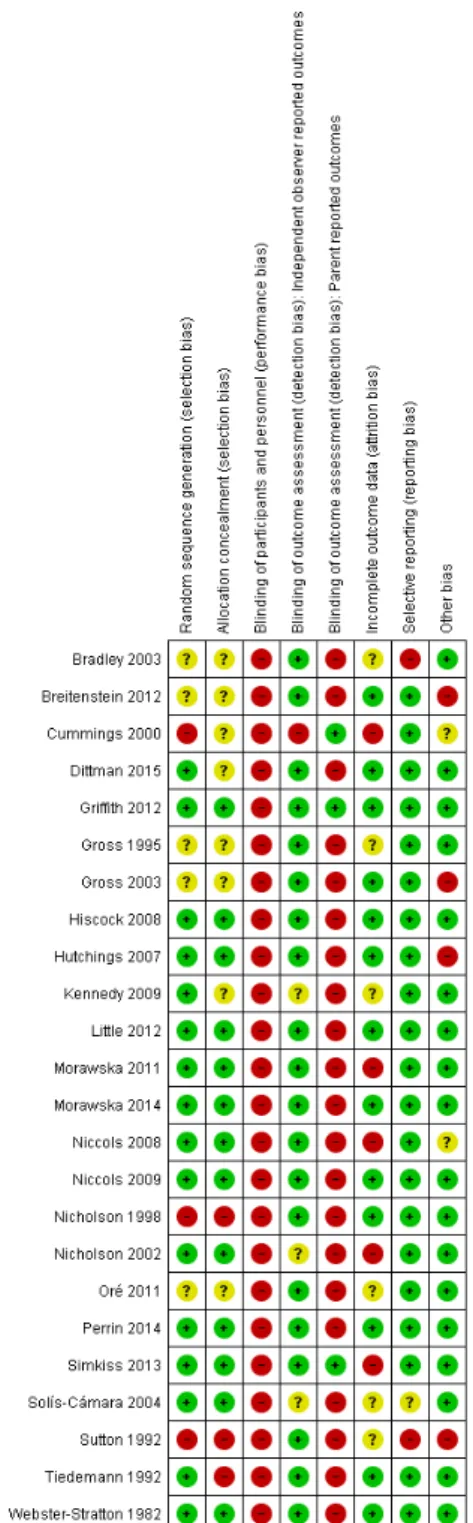
For this updated version of the review, two review authors inde-pendently assessed the risk of bias within each included study as ’low risk’, ’high risk’, and ’unclear risk’ (unreported or uncertain risk of bias) across six domains (Higgins 2011); disagreements were resolved through discussion with JB (for more information please see the ’Characteristics of included studies’ tables). Where infor-mation was not available in the published trial reports to make
a judgement about the risk of bias, we contacted trial authors and asked them to supply missing information. Nine trial authors replied to our requests, see theCharacteristics of included studies
tables for full details.
We assessed risk of bias across the following six domains. 1. Sequence generation: we assessed the method used to generate the allocation sequence to determine if it produced comparable groups.
2. Allocation concealment: we assessed the method used to conceal allocation sequence to see whether it was adequate in terms of whether the intervention schedules could have been foreseen in advance of, or during, recruitment.
3. Blinding: we assessed whether any steps were taken to blind participants, personnel, and outcome assessors to which intervention a given participant might have received. This domain was split into (a) blinding of participants and personnel, (b) blinding of outcome assessors for independent observer outcomes, and (c) blinding of outcome assessors for parent-rated outcomes.
4. Incomplete outcome data: we assessed whether incomplete data were dealt with adequately by the reviewers, and how data on attrition and exclusions were reported, compared with the total randomised.
5. Selective outcome reporting: we assessed whether any attempt had been made to reduce the possibility of selective outcome reporting by investigators.
6. Other sources of bias: we assessed whether the study was apparently free of other problems that could put it at a high risk of bias, such as baseline differences or insufficient consideration of clustering effects in cluster-RCTs.
Measures of treatment effect
We analysed data from continuous outcomes that were measured with similar, but not identical instruments, using SMDs with 95% CIs. All analyses included all participants in the treatment groups to which they were allocated, whenever possible.
Unit of analysis issues
Cluster-randomised trials
Including cluster-randomised trials in a meta-analysis with indi-vidually-randomised trials can produce over-precise results due to ’unit of analysis errors’, and underestimations of effect due to ’herd effects’ (Section 16.3.2 inHiggins 2011). We combined data from cluster-randomised trials with individually-randomised tri-als in the same meta-analysis. If clustering was accounted for in a cluster trial, we used the study-reported summary statistics in our meta-analysis. Where clustering was not accounted for, we used the intracluster correlation coefficient (ICC) to calculate the in-flated standard error (Higgins 2011). We replaced the
originally-reported standard error by the inflated standard error in our meta-analysis. If the study did not report the ICC, we used the ICC from similar studies. We then conducted a sensitivity analysis assuming a set of different values for the ICC (seeSensitivity analysis).
Cross-over trials
Two of the included studies were cross-over trials (Cummings 2000;Webster-Stratton 1982). A major problem with cross-over trials is the carry-over effect, which occurs if an effect of the treat-ment in the first phase is carried over to the second phase (Elbourne 2002). Therefore, we only used data from the first phase of these trials.
Dealing with missing data
We assessed missing data and dropouts/attrition for each included study and reported it in the ’Risk of bias’ tables (Characteristics of included studies).
Assessment of heterogeneity
We assessed clinical and methodological heterogeneity by compar-ing the distribution of important participant factors between trials (e.g. age), and trial factors (randomisation concealment, blinding of outcome assessment, losses to follow-up, treatment type, co-interventions). We assessed statistical heterogeneity by examining the I² statistic (Higgins 2002), a quantity which describes approxi-mately the proportion of variation in point estimates that is due to heterogeneity rather than sampling error. In addition, we used the Chi² test of heterogeneity to determine the strength of evidence for heterogeneity and Tau² to assess between-study variability.
Assessment of reporting biases
Tests for publication bias can be conducted by inspecting funnel plots for asymmetry. However, these tests should only be carried out when there are at least 10 studies included in the meta-analysis (see section 10.4.3.1 inHiggins 2011). Asymmetry can be due to publication bias, but can also be due to a real relationship between trial size and effect size. We did not include any meta-analyses in this review with 10 or more studies, consequently we did not draw funnel plots nor carry out tests for publication bias.
Data synthesis
The studies included in this review used a range of scales to measure similar outcomes (e.g. the outcome of ’emotional and behavioural problems’ was measured using scales such as the BSQ (Richman 1971) and the CBQ (Rutter 1970). Where studies reported both total and subscale results for the same scale, we did not include the total score because including both would introduce linear depen-dencies among the measures (Shadish 1992), and subscales pro-vide more specific information than total scores (Shadish 1992). We standardised the results from these different measures by di-viding the mean difference in postintervention scores for the inter-vention and treatment group by the pooled SD, to obtain a SMD. Where appropriate, we combined the results in a meta-analysis us-ing a random-effects model. We based our decision about whether to combine data in this way by the level of heterogeneity present in the population, intervention, and outcomes used in the primary studies. As expected, we did not find any dichotomous outcomes.
Subgroup analysis and investigation of heterogeneity
We conducted planned subgroup analyses for the primary out-come: to explore the effectiveness of longer (i.e. eight weeks or more) and shorter programmes, and to examine primary preven-tive programmes and secondary/tertiary programmes.
Sensitivity analysis
We conducted sensitivity analyses to test if the findings of the meta-analyses were robust by examining the effect of including quasi-RCTs and cluster-quasi-RCTs (seeUnit of analysis issuesandDifferences between protocol and review).
R E S U L T S
Description of studies
Results of the search
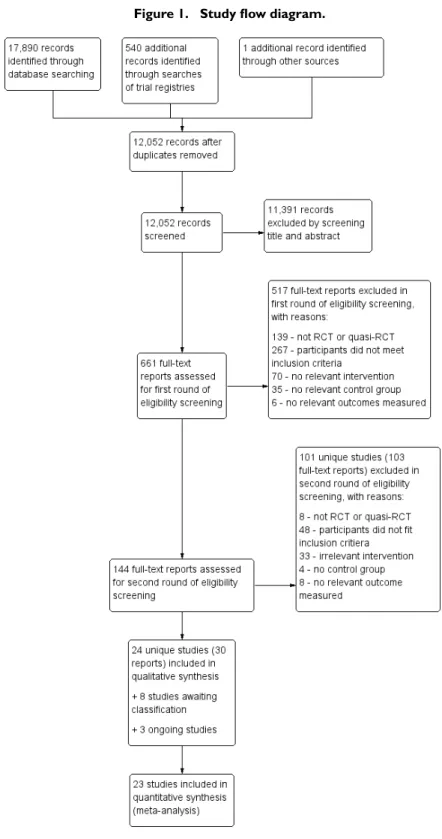
We revised our original search strategies for this update and con-ducted a new search, which identified 18,431 records. After de-duplication, we screened 12,052 records for inclusion in this up-date, seeFigure 1.
13 Group-based parent training programmes for improving emotional and behavioural adjustment in young children (Review)
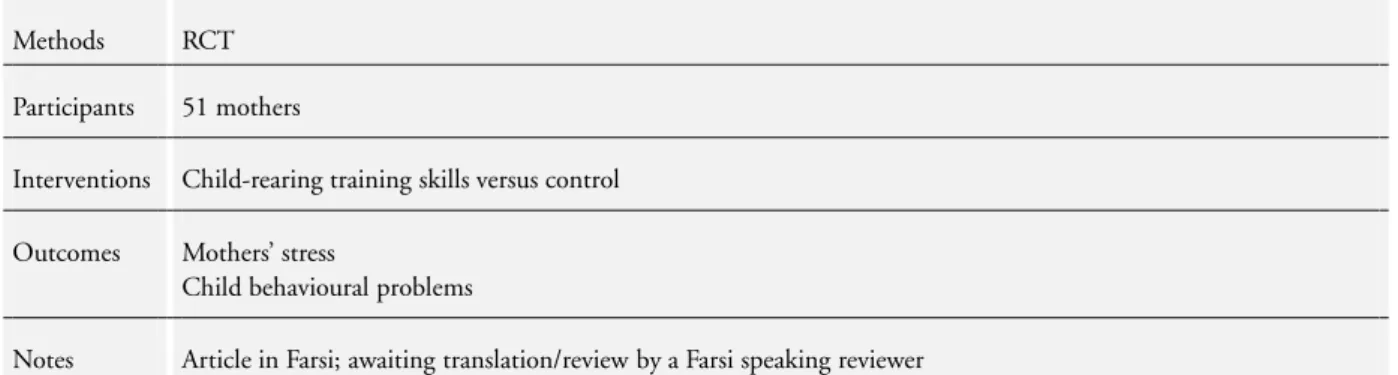
Two reviewers independently examined the titles and abstracts. The majority of articles reviewed were written in English. All articles written in languages other than English had an abstract written in English, and we excluded most of these studies on the basis of information contained in the abstracts. We included two studies published in Spanish (Oré 2011;Solís-Cámara 2004). Due to pending translation, one study published in Persian (Farzadfard 2008), and one study published in Chinese (Wang 2000), are currently awaiting classification (Characteristics of studies awaiting classification). We identified and obtained the full-texts of 661 potentially eligible reports (i.e. by matching de-tails in the abstract against the inclusion criteria), and subsequently excluded 620 reports (see Excluded studies). We identified 24 included studies (Bradley 2003;Breitenstein 2012;Cummings 2000; Dittman 2015; Griffith 2012; Gross 1995; Gross 2003;
Hiscock 2008; Hutchings 2007; Kennedy 2009; Little 2012;
Morawska 2011;Morawska 2014;Niccols 2008;Niccols 2009;
Nicholson 1998;Nicholson 2002;Oré 2011;Perrin 2014;Simkiss 2013; Solís-Cámara 2004; Sutton 1992; Tiedemann 1992;
Webster-Stratton 1982); eight studies awaiting classification (
Farzadfard 2008;Herbert 2007;Sandy 1983;Schlarb 2012;Wang 2000;Zhu 2014; ISRCTN39288126;ISRCTN88988596), and three ongoing studies (ISRCTN16513449;ISRCTN11079129;
ISRCTN17488830).
Included studies
An examination of the full-texts of the 661 potentially relevant reports resulted in 24 studies (30 reports) being included. We included eight of these studies in the previous version of this review (Barlow 2010). We added 16 new studies as included studies in this review. In addition, we identified eight studies as awaiting classification (seeCharacteristics of studies awaiting classification), and three ongoing studies (seeOngoing studies).
All 24 included studies (22 RCTs and two quasi-RCTs) in this review provided data on the effectiveness of group-based parenting programmes in improving emotional and behavioural adjustment in young children.
The studies were published over a 35-year period, the earliest being
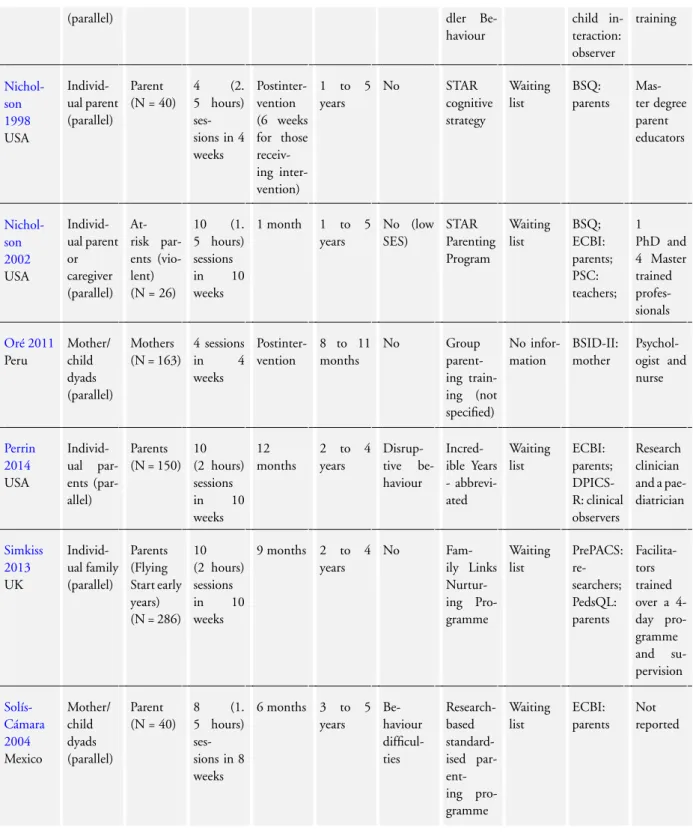
Webster-Stratton 1982and the most recent,Dittman 2015. There were some important differences between the studies, and we have summarised these alongside the main study characteristics below. An overview is provided inTable 1and further details are in the
Characteristics of included studiestables.
Design
Sixteen studies were RCTs that randomly allocated individuals, families or parent-child dyads to intervention and control con-ditions utilising a parallel design. Three studies were cluster-ran-domised trials:Breitenstein 2012andGross 2003used day care
centre as the unit of allocation,Hiscock 2008randomised by pri-mary care health centre. Two studies were quasi-RCTs (Nicholson 1998;Sutton 1992).Nicholson 1998allocated some parents on the basis of the night that they were able to attend the programme (e.g. one night included the parent-education group, and the sec-ond night included the wait-list control group). Only participants with no preferences were randomised to the two study condi-tions; remaining families were allocated on the basis of preference.
Sutton 1992comprised a quasi-randomised design in which par-ticipants were sequentially allocated to one of four study condi-tions. Eleven families who were initially randomised to the wait-list control group were reallocated to the intervention group. Two studies were cross-over trials (Cummings 2000;Webster-Stratton 1982).Cummings 2000reported that 37 parents participated in the study, but only 31 participants were randomised to the inter-vention (n = 15) or the control (n = 16) condition. Six of the par-ents who first participated in the wait-list control group, partici-pated later in the intervention group and therefore were double-counted. Data forWebster-Stratton 1982were reported separately for each of the two cross-over stages; due to potential carry-over effects we only used data from the first stage.
Of the three cluster trials,Hiscock 2008accounted for clustering in their analysis by using multilevel models. The remaining two cluster trials reported means and SDs based on descriptive statistics (Breitenstein 2012;Gross 2003), so we set out to calculate the inflated standard errors in order to account for clustering and obtain approximate correct analysis (Higgins 2011). However, the intracluster correlation coefficients (ICCs) were not reported in these two studies (Breitenstein 2012;Gross 2003).Hiscock 2008
reported an ICC of 0.03. We used this value (ICC = 0.03) to compute the inflated standard errors in theBreitenstein 2012and
Gross 2003studies, which were included in one or more of the following meta-analyses (Analysis 1.3;Analysis 1.4;Analysis 1.6;
Analysis 1.9;Analysis 1.13). In order to assess the impact of this chosen ICC value, we conducted sensitivity analyses by assuming a set of different ICC values (0, 0.02, and 0.1). We assumed an ICC of 0 in sensitivity analysis one (seeAnalysis 2.1,Analysis 2.2,
Analysis 2.3,Analysis 2.4,Analysis 2.5); we set the ICC at 0.02 in sensitivity analysis two (seeAnalysis 3.1,Analysis 3.2,Analysis 3.3,Analysis 3.4,Analysis 3.5); lastly, we used a larger ICC value of 0.1 in sensitivity analysis three (Analysis 4.1,Analysis 4.2,Analysis 4.3,Analysis 4.4,Analysis 4.5).
Sample sizes
There was considerable variation in sample size between studies. Overall, the number of participants (primary carer and index child pair) initially randomised per study ranged from 23 inGross 1995
to 733 inHiscock 2008. In two studies some participants were
15 Group-based parent training programmes for improving emotional and behavioural adjustment in young children (Review)
included in the analysis twice (i.e. once as a control case and again as an intervention case;Cummings 2000;Sutton 1992).
Setting
Eight studies were conducted in the USA (Breitenstein 2012;
Cummings 2000; Gross 1995; Gross 2003; Nicholson 1998;
Nicholson 2002; Perrin 2014; Webster-Stratton 1982), five in the UK (Griffith 2012; Hutchings 2007; Little 2012; Simkiss 2013;Sutton 1992), four in Canada (Bradley 2003;Niccols 2008;
Niccols 2009;Tiedemann 1992), five in Australia (Dittman 2015;
Hiscock 2008;Kennedy 2009;Morawska 2011;Morawska 2014), and one each in Mexico (Solís-Cámara 2004) and Peru (Oré 2011). Twelve studies were multicentre trials (Breitenstein 2012;Dittman 2015; Griffith 2012; Gross 2003; Hiscock 2008; Hutchings 2007; Little 2012; Morawska 2011; Morawska 2014; Perrin 2014; Simkiss 2013; Sutton 1992), 10 were single-centre tri-als (Bradley 2003; Cummings 2000; Gross 1995; Kennedy 2009;Niccols 2008;Niccols 2009;Nicholson 1998;Nicholson 2002; Tiedemann 1992; Webster-Stratton 1982), and two did not provide sufficient information to be classified (Oré 2011;
Solís-Cámara 2004).
The trials were mostly conducted in community settings such as community-based agencies, medical centres and day care centres. Six studies did not report details of where the study was set or where the intervention was delivered (Griffith 2012;Gross 1995;
Niccols 2008;Niccols 2009;Nicholson 2002;Simkiss 2013).
Participants
Participants comprised primary carer-index child pairs. The target primary carers were predominantly mothers or fathers, or both. Two studies involved foster parents, grandparents or other rela-tives as the primary carer (Gross 2003;Nicholson 2002). Four-teen studies recruited children without emotional and behavioural problems, one of which recruited parents who were deemed to be ’at-risk’ on the basis of their frequent use of verbal and cor-poral punishment (Nicholson 2002). Of these 14 studies, four recruited from low-income samples (Breitenstein 2012;Griffith 2012;Gross 2003;Nicholson 2002).
Twelve studies recruited children experiencing emotional or be-havioural difficulties such as conduct problems, hostile/aggres-sive behaviour, self destructive behaviour, or hyperactivity.Bradley 2003recruited preschoolers with behavioural problems.Dittman 2015included children whose parents were concerned with dis-obedient or non-compliant behaviour.Gross 1995included par-ents of children meeting the criteria for behavioural difficulty as measured by the intensity scale of the Eyberg Child Behaviour Inventory (ECBI,Eyberg 1978).Hutchings 2007also recruited children scoring above the clinical cut-off on either the problem or intensity subscales of the ECBI (Eyberg 1978).Kennedy 2009
included parents of children scoring high on behavioural
inhibi-tion.Little 2012included parents of children at risk of social-emo-tional or behavioural disorders reaching the “high need” thresh-old of the “total difficulties” score of the Strengths and Difficul-ties Questionnaire (SDQ).Morawska 2014included parents who were concerned about and seeking assistance for their child’s eat-ing or mealtime difficulties.Perrin 2014included parents of chil-dren who had disruptive behaviours on the Infant-Toddler Social-Emotional Assessment (ITSEA) scale (Carter 2003).Solís-Cámara 2004included parents of children described as fulfilling criteria for behavioural difficulties, but no further details were provided.
Sutton 1992recruited children described as exhibiting ’difficult’ behaviour, but provided no further criteria.Tiedemann 1992 in-cluded married mothers of siblings with parent-reported difficul-ties in sibling interaction.Cummings 2000did not provide de-tails about the use of eligibility criteria to select participants, but described the programme as being aimed at addressing children’s negative behaviours, including sleep problems and toileting. There was considerable variation across studies in terms of the in-clusion of mothers and fathers. Six studies recruited only mothers (
Hiscock 2008;Niccols 2008;Niccols 2009;Oré 2011;Tiedemann 1992; Webster-Stratton 1982). Twelve studies recruited par-ents, but predominantly mothers participated (Breitenstein 2012;
Cummings 2000; Dittman 2015; Griffith 2012; Gross 2003;
Morawska 2011;Morawska 2014; Nicholson 1998;Nicholson 2002;Perrin 2014;Simkiss 2013;Solís-Cámara 2004); one study recruited couples (Gross 1995); and five studies recruited parents, but did not provide details on participant gender (Bradley 2003;
Hutchings 2007;Kennedy 2009;Little 2012;Sutton 1992). The age range of target parents was between mid-20s and mid-30s. Thirteen studies included some older children (up to five years of age), but still met our criterion that the maximum mean age of children in the study was no greater than three years and 11 months. In addition,Tiedemann 1992included mothers of at least two children aged between two years and six months and six years and 11 months. Data for the younger children (mean age 38.0 months) were analysed and reported separately, which allowed the study to be included in this review. Further details of the participant ages are given in theCharacteristics of included studiestables.
Interventions
Fourteen studies examined the effectiveness of programmes aimed at the primary prevention of emotional and behavioural problems, whereas 12 studies evaluated the effectiveness of parenting pro-grammes targeted at children with early problems, ’difficult’ chil-dren, or children with existing problems (secondary or tertiary pre-vention) (Bradley 2003;Cummings 2000;Dittman 2015;Gross 1995;Hutchings 2007;Kennedy 2009;Little 2012;Morawska 2014;Perrin 2014;Solís-Cámara 2004;Sutton 1992;Tiedemann 1992).