ISSN 1990-9233
© IDOSI Publications, 2013
DOI: 10.5829/idosi.mejsr.2013.16.08.11938
Correspondence Author: Mastura Jaafar, School of Housing Building and Planning,
Knowledge and Technical Skills of Project Managers and
Time Performance of Power Plant Construction Projects in Iran
Mastura Jaafar and Behnam Khalatbari
School of Housing Building and Planning, Universiti Sains Malaysia, 11800, Penang, Malaysia
Abstract:The construction industry in Iran is known for its late project delivery. The increasing percentage of incomplete projects calls for comprehensive study. Various factors that include knowledge and technical skills have been hypothesized to influence the time performance of power plant construction projects. This paper aims to examine the knowledge and technical skills of project managers as well as their correlation with the time performance of power plant construction projects in Iran. Thirty technical managers who work in power plant construction sites were surveyed. The descriptive analysis of data indicates that the respondents have minimal knowledge on project time, risk, procurement and scope management. To effectively manage the power plant time performance, project managers need to enhance their knowledge on project structure and risks and opportunity. This study contributes significant findings for the improvement of the power plant industry in Iran.
Key words: Time performance Knowledge and technical skills Project managers Construction management Power plant construction projects Iran
INTRODUCTION largest sectors in Iran’s economy and the government
In recent years, many studies have focused on the Power plants provide highly significant contribution to area of project time performance, which is the most critical the high electric power consumption of approximately 75 issue in the field of construction management [1-4]. million Iranians [8]. Therefore, numerous power plants Time performance is a serious problem because high cost need to be developed to cover the vast area of Iran. Given and labor are spent in the attempt to complete the project that population growth is expected to reach 90 million in on time. However, similar to other countries, Iran the next 10 years and several old power plants are commonly encounters delays in construction projects, becoming inefficient, different stations are being including power plants [5]. According to the reports of continuously built and developed. In total, 29 power the Office for Supervision and Evaluation of Designs [6] plants are under construction in Iran. Power plant in 2001, 2002 and 2003, Iranian construction projects have construction is a national project and is initiated by the experienced delays of about 30, 74.5 and 75% Iranian government. In terms of implementation, the respectively. The increasing percentage of delay indicates Ministry of Power would award the project to either the a serious problem in Iranian construction projects, which main contractor (who would be involved in managing and could be costly for both the owner and the contractor. supervising the project) or the ministry, who would Iran is one of the pioneers among developing subsequently appoint a sub-contractor to do the project. economies in the Middle East that focuses on the A number of studies have assessed the cause of construction industry as an important area for delay of construction projects in Iran, several Middle development. Power plant construction projects are Eastern countries and other developing countries. These considered as the most important because of their include: Al-Barak [9], Assef et al. [10], as well as Al-significant influence on Iran’s development. In addition, Khalil and Al-Ghafly [11] in Saudi Arabia: Mezher and power plant constructions are considered as one of the Tawil [12] in Lebanon; Mansfield et al. [13] as well as spends billions of dollars every year in major projects [7].
Aibinu and Jagboro [14] in Nigeria; Al-Momani [15] in Lindebaum and Jordan [25] highlighted the emphasis on Jordan; Koushki et al. [16] in Kuwait; as well as Faridi and client satisfaction and Phua [26] proposed that the El-Sayegh [7] in the United Arab Emirates (UAE). establishment of correlation between resources is Previous studies on the Iranian construction industry important for the attainment of client objectives in terms focused on examining the factors that cause delay of utility, function, quality, time and cost. This argument [17,18,5]. Furthermore, these studies have identified that highlights the need to consider the fundamental aspects the lack of professional and efficient project management of project management in project integration, monitoring, is an undeniable problem. as well as control of project contributions and output. Voetschet al. [19] found a significant and positive Management of the construction process is one of the relationship of management knowledge and technical important categories for a successful project performance skills of project managers with the time performance of the [27]. Compared with the other dimensions of project construction projects. Management knowledge was performance, time has been the main concern of many described by the Project Management Institute (PMI) [20] researchers [28,29,30] as almost 99% of construction to include nine knowledge areas used to support the five projects worldwide encounter delays [31]. Assaf and Al processes of project development stages, which are Hejji [32] as well as Stumpf [33] indicated that a project initiating, planning, executing, controlling and closing. completed within the pre- planned time is a rare event These knowledge areas in project management are: despite today’s advanced technology and management integration, scope, time, cost,quality, human resource, understanding of project management techniques. communications, risk and procurement. On the other In construction, delay means a time overrun either hand, El-Sabaa [21] defined technical skills “as an beyond the contract date or the date that the parties have understanding of and proficiency in, a specific kind of agreed upon for project delivery, both cases of which are activity, particularly one that involves methods, usually costly [34]. According to Sweis et al. [31], delay processes, procedures or techniques”. Goodwin [22] in construction projects is connected to the construction defined technical skills as an important and useful skill of part of the project. The majority of delays occur during project management, as well as explained the worthiness the construction phase during which many unpredicted of examining the extent to which technical skill is an factors are involved [35]. Numerous studies have essential requirement for the project manager defined. assessed project delays, such as Al-Barak [9], Mansfield Ives [23] likewise found technical skills as one of the et al. [13], Assef et al. [10], Mezher and Tawil [12], success attributes of a project manager. Al-Khalil and Al-Ghafly [11], Al-Momani [15], Odeh and This research aims to investigate the knowledge and Battaineh [28], Aibinu and Jagboro [14], Koushki et al. technical skills of project managers in Iran and to examine [16], Faridi and El-Sayegh [7], Assaf and Al-Hejj [32], the relationship between these skills and the time Alaghbari et al. [29], Sambasivan and Soon [30], Levy performance of power plant projects. A questionnaire [27], Ramanathan et al. [34], Ibironke et al. [38], as well as survey was conducted among the respondents who are, Le- Hoai et al. [1]. Among the important reasons cited by or has been, technical managers in power plant Odeh and Battaineh [28] as well as Sambasivan and Soon construction sites in Iran. This research would contribute [30] are client-related, contractor inefficiency, lack of to the knowledge gap on power plant construction from competent consultant, as well as material and labor the perspective of project management. problems. More importantly, Asnaashari [18] highlighted
Literature Review leads to delay in Iran. According to Khoshgoftar [5],
Construction Project Delay: Construction is one of the improper planning, poor site and contract management, critical stages in any project development. This stage lack of communication between parties, unskilled sub-normally involves the highest number of parties and contractors and inadequate contractor experience are workers and becomes the real test of conceptual ideas among the top 10 causes of delays.
placed into the blue print. Project management is Zakeriet al. [17], Asnaashari [18] and Khoshgoftar important in determining the construction success. [5] in Iran; Al-Barak [9], Assef et al. [10], as well as Al-The primary concern of construction project management Khalil and Al-Ghafly [11] in Saudi Arabia; Mezher and is generally agreed to be planning, control and Tawil [12] in Lebanon; Mansfield et al. [13] as well as coordination of a project from conception to completion Aibinu and Jagboro [14] in Nigeria; Al-Momani [15] in (including commissioning) on behalf of a client [24]. Jordan; Koushki et al. [16] in Kuwait; as well as Faridi and project management as one of the top five factors that
El-Sayegh [7] in the United Arab Emirates (UAE) highlighted the significant influence of the knowledge and technical skills of project managers on time performance of project construction.
Knowledge and Technical Skills of Project Managers: Fig. 1: The Research framework. Knowledge is a recurrent combination of experience,
values, contextual information and specialist insight that project (PMBOK). A few of the necessary skills for a offers a framework for evaluating and incorporating new project manager include: leadership, good communication experiences and information [37]. “The knowledge often and negotiation, ability to solve problems and becomes embedded not only in document or repositories organization management. Meredith and Mantel [24] but also in routines, processes, practices and norms” categorized the necessary skills for a project manager into: [38]. Project management routines and processes could be re-communication, organizational, team building, divided into five phases and nine knowledge areas [39]. leadership, coping and technological skills. Katz [44] Mohamad [40], Heldmanand and Mangano [2], as suggested that effective administration is based on three well as Kerzner [3] believed that a significant interaction fundamental improvable skills, namely, behavioral occurs between the different knowledge areas. For (human), contextual and technical. Despite their instance, project cost management primarily includes interrelation, these skills can be developed independently. consideration on design, value engineering and The successful project manager possesses technical optimization, estimation, cash flow management, contract competence gained through a career in advanced administration, as well as financing and cost control. technology environment [45]. In a technical project, the However, in the real world, other knowledge areas would manager needs to thoroughly understand the major likewise produce significant impacts with varying extents technical issues apart from the complex and subtle [41]. Mohamad [40] argued that project time management second-tier problems [46]. This is the reason why project is the least understood concept in the construction managers should have an engineering background. In
industry. general, technical personnel and executives should be
In order to become a successful project manager, one assured that the project manager makes the right technical should have relevant experience, knowledge on the decisions.
required technology and skills in the use of computer as Goodwin [22] stated that technical skills are pointed out by El-Sabaa [21] wherein, “Technical skill important and useful in project management. He involves specialized knowledge and analytical ability in mentioned that the extent of technical skills as an the use of the tools and techniques of the specific essential requirement for the project manager is worthy of discipline, e.g. construction engineering or information examination. Moreover, Ives [23] likewise found technical
systems.” skills as one of the success attributes of a project
Khanet al. [42] categorized technical skills into the manager. following elements based on IPMA [43]: project
management success, interested parties, project Research Framework: The purpose of this research is to requirements and objectives, risk and opportunity, assess the time performance of power plant construction quality, project organization, teamwork, problem in Iran. According to previous studies, one of the resolution, project structures, scope and deliverables, time methods to effectively improve project performance is by and project phase resources, cost and finance, enhancing the knowledge and skills of project managers. procurement and contract, changes, control and reports, This research used a framework that was modeled from information and documentation, communication, start-up, previous studies. Figure 1 shows the framework
as well as close-out. arrangement.
A number of general management skills are To describe the relationship between the knowledge applicable either only on certain projects or application and technical skills of the project manager with the time areas. General management skills comprise much of the performance of power plant, nine different knowledge foundation for building project management skills and are areas of project management should be considered and often essential for the project manager. Hence, general compared with technical skills. These nine knowledge management skills are frequently required on any given areas are listed below:
(I) project integration management, (ii) project scope management, (iii) projecttimemanagement, (iv) project cost management, (v) project quality management, (vi) project human resource management, (vii) project communications management, (viii) project risk management and (ix) project procurement management.
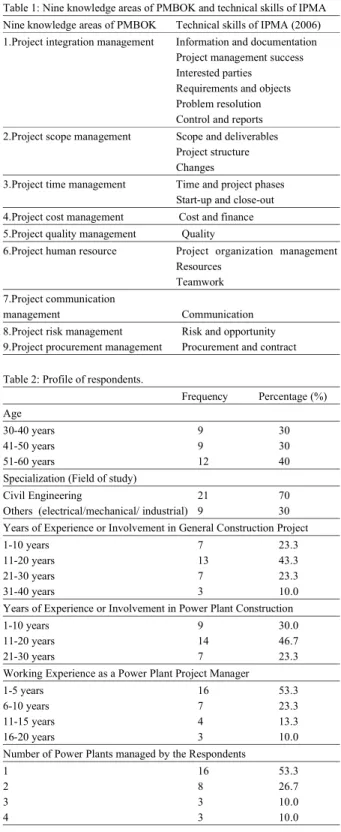
In an attempt to match the technical skills from Khan et al. [42] based on IPMA [43] and knowledge [39] based on explanations of the nine project management knowledge areas, related skills relative to each knowledge area are listed in Table 1.
Data Analysis: Descriptive analysis was employed to rank the technical skills and knowledge areas of project managers, whereas the correlation technique was utilized to determine the relationship between time performance and various technical skills possessed by the project manager of the power plant construction. The Statistical Package for Social Sciences (SPSS) version 18.0 for windows was used in the analysis. Responses were encoded into the system using numbers to represent the actual data collected. Data were entered directly into the SPSS using a data entry interface.
Profile of Respondents: Table 2 shows the profile of respondents in terms of age, field of study, years of work experience and experiences in the construction field. Most respondents (40%) are between 51-60 years old, whereas the rest are 30-40 and 40-50 years old (30% per group).
Table 2 shows that 21 project managers worked in the field of civil construction and nine were assigned to electrical, mechanical, or industrial tasks. Only one respondent acquired a degree in project management, whereas the rest are graduates of other management fields. Most respondents (43%) have 11-20 years of experience in the construction industry. Table 2 likewise reveals that 46% of the respondents have 11-20 years experience in the construction of power plant. More than half of the respondents (53%) indicated that they have been a project manager for 1-5 years and 16 (53.3%) have managed only one power plant. All respondents reported a delay in their project, which indicates that all of the projects were completed beyond the planned duration.
Table 3 shows the length of delay that the respondents experienced in their projects. This information can be associated with the different stages of project completion wherein a few constructions are newly started whereas the others are almost finished. Most of the recorded delays fall between 1-10 months (66%).
Table 1: Nine knowledge areas of PMBOK and technical skills of IPMA Nine knowledge areas of PMBOK Technical skills of IPMA (2006) 1.Project integration management Information and documentation
Project management success Interested parties
Requirements and objects Problem resolution Control and reports 2.Project scope management Scope and deliverables
Project structure Changes
3.Project time management Time and project phases Start-up and close-out 4.Project cost management Cost and finance 5.Project quality management Quality
6.Project human resource Project organization management Resources
Teamwork 7.Project communication
management Communication 8.Project risk management Risk and opportunity 9.Project procurement management Procurement and contract Table 2: Profile of respondents.
Frequency Percentage (%) Age
30-40 years 9 30
41-50 years 9 30
51-60 years 12 40
Specialization (Field of study)
Civil Engineering 21 70
Others (electrical/mechanical/ industrial) 9 30 Years of Experience or Involvement in General Construction Project
1-10 years 7 23.3
11-20 years 13 43.3
21-30 years 7 23.3
31-40 years 3 10.0
Years of Experience or Involvement in Power Plant Construction
1-10 years 9 30.0
11-20 years 14 46.7
21-30 years 7 23.3
Working Experience as a Power Plant Project Manager
1-5 years 16 53.3
6-10 years 7 23.3
11-15 years 4 13.3
16-20 years 3 10.0
Number of Power Plants managed by the Respondents
1 16 53.3
2 8 26.7
3 3 10.0
4 3 10.0
Table 3: The delay in the construction process in terms of months. Delayed Frequency Percentage (%)
1-10 20 66.7
11-20 9 30.0
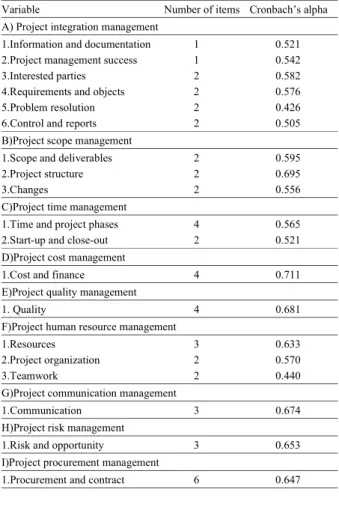
Reliability: To assess the internal consistency and reliability of the questionnaire, we calculated the Cronbach’s alpha value for the technical competency skills of the respondents (project managers of power plants) categorized under the nine related knowledge areas of project management. The cut-off point of 0.5 Cronbach’s alpha value indicates sufficient reliability for the five-point scale measurement [47]. Table 4 shows the results of the reliability test.
Teamwork and problem resolution obtained Cronbach’s alpha values of 0.440 and 0.426, respectively, which are below the cut-off point. Thus, these items were excluded in the data analysis due to low reliability.
Descriptive Analysis: A number of descriptive analyses were conducted to understand the ranking of project management knowledge failure, knowledge areas and technical skills of power plant construction project managers in Iran. Table 5 lists the results of the analysis of failure of project management knowledge.
Based on Table 5, the respondents recognized knowledge on project time management (M= 4.33) as the most useful to prevent delays in the construction of power plants. Knowledge toward scope (M= 4.11) and toward risk (M= 4.00) follow. Table 6 indicates the level of understanding of the project managers for each knowledge area.
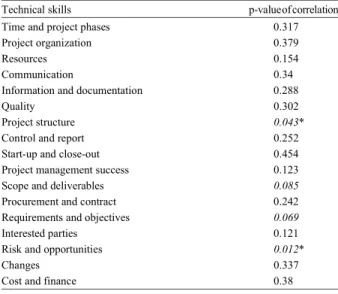
According to the analysis, power plant construction managers are classified based on their level of knowledge toward knowledge management items. Managers showed the least level of knowledge toward project scope management (3.11) and then toward project procurement management (3.27), project time management (3.30) and project risk management (3.34). The knowledge of project managers toward the above mentioned items was lower than the proposed cut-off point (3.50). Therefore, these areas may cause delay in the project time performance. Correlation Analysis: This section describes the correlation analysis between the technical skills of project managemers and time performance of construction power plants in Iran. This section determines a correlation between technical skills of the project managers and delay of power plant construction projects in Iran. The results of correlation analysis are presented in Table 7.
As shown in Table 7, two variables, namely, risk and opportunity (0.012) and project structure (0.043) are significantly correlated to time performance at p<0.05 value.
Table 4: Reliability test for knowledge and skills of project managers. Variable Number of items Cronbach’s alpha A) Project integration management
1.Information and documentation 1 0.521 2.Project management success 1 0.542
3.Interested parties 2 0.582
4.Requirements and objects 2 0.576
5.Problem resolution 2 0.426
6.Control and reports 2 0.505
B)Project scope management
1.Scope and deliverables 2 0.595
2.Project structure 2 0.695
3.Changes 2 0.556
C)Project time management
1.Time and project phases 4 0.565 2.Start-up and close-out 2 0.521 D)Project cost management
1.Cost and finance 4 0.711
E)Project quality management
1. Quality 4 0.681
F)Project human resource management
1.Resources 3 0.633
2.Project organization 2 0.570
3.Teamwork 2 0.440
G)Project communication management
1.Communication 3 0.674
H)Project risk management
1.Risk and opportunity 3 0.653 I)Project procurement management
1.Procurement and contract 6 0.647 Table 5: Failure of project management knowledge.
Failure Mean Std. Deviation
Time Management 4.33 .68 Scope Management 4.11 .89 Risk Management 4.00 .83 Procurement Management 3.50 .71 Cost Management 3.49 .99 Integration Management 3.46 .80 Human Resource Management 3.45 .69 Communication Management 3.40 .92
Quality Management 3.10 .77
Cut-off Point = 3.50.
Table 6: The level of understanding of project managers regarding the knowledge areas.
Knowledge area Mean Std. Deviation Integration management 4.62 0.9
Communication 4.52 1.1
Cost management 4.48 1.1
Quality management 4..00 0.7
Human resource management 3.95 1.5
Time management 3.30 2.2
Risk management 3.34 0.8
Procurement management 3.27 1
Scope management 3.11 1.7
Table 7: Correlation between technical skills and time performance. Technical skills p-valueof correlation
Time and project phases 0.317
Project organization 0.379
Resources 0.154
Communication 0.34
Information and documentation 0.288
Quality 0.302
Project structure 0.043*
Control and report 0.252
Start-up and close-out 0.454
Project management success 0.123
Scope and deliverables 0.085
Procurement and contract 0.242 Requirements and objectives 0.069
Interested parties 0.121
Risk and opportunities 0.012*
Changes 0.337
Cost and finance 0.38
*Correlated p<0.05 and ** Strongly Correlated p<0.01. DISCUSSION
The discussions are developed through the use of academic literature and empirical evidence according to a few subsections that include the demographic data of respondents, results of descriptive analyses of knowledge and the relationship between project time performance and the technical skills of managers in power plant construction projects in Iran.
Generally, no official statistical data exists on the time performance of power plant construction projects in Iran. Similarly, no official professional body registers or monitors the time performance of projects, such as PMI that came out with the PMBOK Guide standard. However, two organizations, namely, the Office for Supervision and Evaluation of Designs and the Iran Construction Engineering Organization, have developed standards and certification programs for project management companies as well as established particular database for the registration of time performance of all construction companies through the National Competency Standard (NCS). However, very few companies are enthusiastic to report their time performance to these organizations. This low number may be related to either the lack of competition among construction companies or the lack of control from the government (www.tceo.ir).
Profile of Respondents: This study includes 30 respondents who were construction project managers of power plants in Iran. The respondents have different ages, fields of study and experiences. Among them, 30% are between 30-40 years old, 30% are between 41-50 years
old and 40% are 51-60 years old. Data analysis revealed that 70% of the respondents are civil engineers; a proof that most power plant construction projects in Iran are managed by engineers and not by academic project managers. Almost all (except one) project managers have practical experience. However, they are not academic graduates of project management, which is an important factor in selecting a project manager for large industrial projects in developed countries.
The lack of a comprehensive law to employ an academically educated project manager is a serious issue in large power plant projects. Given that project management is a new field being offered in the universities in Iran, most of the project managers are generally graduates of other engineering fields. No rule exists to force companies to employ project managers with management background. Iran’s project management is considered traditional and therefore, causes delay in construction projects [18].
Traditional management style can be improved by enhancing the knowledge and skills of the project managers. Pant and Baroudi [48] believed that project management practice has to educate and train future professionals. In fact, project management is renowned as a professional discipline within the teaching and learning of the knowledge it holds, as well as its emphasis on the aspects of literature, research and bodies of knowledge. As such, we could be inferred that the teachings in project management are embodied by the project managers. Therefore, a valid question is whether the project management programs offered by various universities provide students with the appropriate knowledge and skills in preparation for their entry into the workforce.
Knowledge of Project Managers: The majority of the respondents indicate that management knowledge toward time of project, scope and risk are the three most important factors regarding which managers should enhance their knowledge (Table 5).
The statement Al Mharmah and Abassi [49] supports the results of this study. The importance of management knowledge toward project time, scope and risk leads to project success, as acknowledged by Baker et al. [50], Chan et al. [51] and Anton [52]. Furthermore, according to recent literature, the abovementioned items have been recognized as the most influential factors in improving construction project time performance [53,54].
In addition, not only project time performance but Starkweather [61] agreed that having the ability to manage also the success of a project is highly related to the
knowledge of project managers toward these items. This issue is supported by Collins and Baccarini [55] as well as Tabish and Jha [54]. Moreover, Collins and Baccarnin [55] noted that the success of a project would likely contribute to organizational performance. Therefore, issues of lacking management knowledge could lead to project delay and can be solved by hiring the right project manager who has proper management knowledge toward failure of project management knowledge areas.
The result of the analysis as shown in Table 6 regarding the level of knowledge of project managers revealed that management knowledge toward time, scope and risk as well as procurement management have the least value. These findings are consistent with the existing literature in terms of the importance of these factors. All respondents reported that they experienced delays in their project, which indicates that all of the projects were completed beyond the planned duration. These extensions may be due to the low level of knowledge on time, scope and risk management.
In summary, the results indicate that project time management, scope management and risk management are the priority knowledge areas that must be learned by project managers of power plant construction in Iran. Time Performance and Technical Skills: The data analyses revealed that the respondents viewed managers’ skills to have a significant impact on the time performance of construction projects. Among the 17 skills listed in Table 7, respondents highlighted project structure as well as risk and opportunity as the most influential factors on the time performance of construction projects. The importance of these skills was likewise observed by Gaddis[45], Martin [46], Chan et al. [51], Chen and Partington [56], as well as Kerzner [3].
The skills of a project manager on project structure have been highlighted as an important factor in the time performance of construction projects in Iran. Previous studies showed that managers with better skills in managing different project structures would influence their projects’ performance [57,58]. As different projects have different structures, managers should be familiar with this divergence in order to achieve effective time performance.
Risk and opportunity is another skill that influences the time performance of construction projects. DuBrin [59], Martin [46], Hyvari [60], as well as Stevenson and
project risk would help managers achieve better time performance. According to Barkley [62], each construction project would have its particular set of risks, such as cost overruns and substandard quality, weather, shortage of materials, price fluctuations, shortage of skilled labor and currency fluctuations. These risks may influence the time performance of construction projects. Prabhakar [63] reported that a project manager must be prepared in order to control such risks. In addition, risk management skills are necessary to organize, motivate and provide a positive influence to team members as well as make them confident to achieve the project goals and objectives [46, 63, 64].
The results of the correlation analysis between time performance and managers’ skills indicated that risk and opportunity as well as project structure are positively correlated with time performance.
Previous risk studies in the field of project management by Ventovuori et al. [65], as well as the findings of the present study, suggest that project managers should consider the following issues related to risk:
Identifying Risks in the Project: This is related to the understanding of the risk subjects by the project management team. In this case, the project management team has difficulties in detecting or separating risk management from other activities. Lack of Risk Management Knowledge: This issue is very common among management teams as risks are only identified as it appears during project implementation. On the other hand, the project management team seldom identifies risks unless they become involved in the project.
Lack of Risk Management Motivation: In this case, the project management team assumes that their project would not be related to the risks experienced by other teams. Therefore, the team shows no strong motivation to anticipate the possible risks for their project.
Incomplete Designs: This is one of the most common risks in construction sites. In such situation, the design complexity of the project may cause difficulties in completing certain parts of work. Information Flow Breaks: This issue occurs when information was not supplied during the contraction of the project. In this situation, the lack of information causes delays, misunderstandings and logistics problems that increase project risks.
Foreign Workers: This is a controversial issue among Project Innovation: represents the portion of the project management teams. A few people believe that
foreign workers intensify project risks. Others believe that risks brought about by foreign workers are not a serious problem, particularly in huge construction projects.
Competition Based on the Lowest Bid: In huge construction projects, particularly those of the government, the management team is forced to award the project to the lowest bidder. In this case, risk of failure or delay may be increased because of the lack of proper planning regarding the total costs.
Force Majeure: This type of risk cannot be excluded, as they cannot be avoided, particularly in national construction projects such as power plants. Thus, risks may be increased.
For the project structure, successful project management teams are those who are able to deliver projects in line with planned time objectives. However, this task is sometimes challenged by the complexity of project structure [14], which is one of the factors that effectively influence the time performance of the construction project.Therefore, the project management team should develop activities to control the effects of this issue on the project cycle time. According to Khoshgoftar [5], the project structure in Iran would influence the project time performance based on the following characteristics:
Project Size: the size of the project that has to be delivered upon completion. When the project comprises several enormous phases, then the chance of delay increases. In the case of Iran power plant construction projects, size is moderately associated with time performance, among other factors. However, project cycle time grows as the project size increases, which directly influences the time performance.
Project Interconnectivity: evaluates the integration between different parts of the project. When interconnectivity is high, a change or delay in any part would influence the whole project and consequently, affect project time performance. In the case of Iran power plant construction projects, interconnectivity appears as the most influential factor among project structure characteristics. Power plant constructions have high interconnectivity and thus a change in any part influences the project cycle time, particularly when changes occur due to references.
project that must be innovated from previous projects. A high level of innovation could influence the project time performance because the working condition is new for both managers and workers. Therefore, familiarization with all aspects of the project may require longer time. In the case of Iran power plant construction projects, innovation demonstrates a less dramatic influence on project time performance. People working in the project are familiar with the project as it moves forward and changes in cycle time indicate an increasing trend as project innovation moves to higher levels.
CONCLUSIONS
The present research aimed to investigate the level of knowledge of project managers, as well as the effects of their knowledge and technical skills on time performance in power plant construction projects in Iran. To date, no research on project management attempted to empirically investigate the antecedents of project time performance. Each aspect of skills of the project manager is perceived to produce a unique contribution to the time performance of power plant construction.
The findings demonstrate that the issues associated with the knowledge and skills of a project manager and the time performance of power plant construction are mostly consistent with those of previous studies, as discussed and cited in the literature review.
Among all the parameters that have been analyzed in the present study, three knowledge areas, namely, time management, scope management and risk management, as well as, two technical skills, namely, risk and opportunity as well as project structure, were determined to have a significant effect on the time performance of power plant project managers. The results reflect the viewpoint of the project managers who participated in this study.
From the theoretical perspective, the present research has enriched the existing information through the integration of a few distinct bodies of knowledge that has certainly broadened the understanding of forecasters of time performance of power plant construction projects in Iran. Evidently, Iran lacks literature and standard practices in predicting time performance of power plant projects. Therefore, this study is a modest attempt to fill this gap in the scope of theoretical perspective. Scholars and practitioners are encouraged to seize this opportunity and strive to further highlight this issue. The key construct of knowledge and managerial skills that affect the time performance of power plant construction projects in Iran were already identified.
All this while, time performance - on-time project 8. Statistical Center of Iran, 2010. National Census of delivery - has been taken as the key element that leads to
organizational accomplishment. Therefore, a major concern for managers is to amplify the elements that are important in this concern. The present study suggests that managers and practitioners should pay attention to the factors that would push the projects to be delivered at the proposed time.
The present study focused on Iranian power plant construction projects. Thus, Iranian construction companies, particularly power plant construction companies, have to consider the perception of the proposed factors. In general, the findings provide valuable insight for managers to adopt various and effective tools in their workplace. To achieve firm missions and objectives, as well as to obtain and maintain competitive advantages, managers and decision makers should apply effective management approaches. The current trend emphasizes on-time project delivery as one of the most essential assets in project accomplishment. This has become an important issue in Iran as well. This tendency can facilitate useful information for existing practitioners in this country.
REFERENCES
1. Le-Hoai, L., Y.D. Lee and A.T. Nguyen, 2013. Estimating Time Performance for Building Construction Projects in Vietnam. KSCE J. of Civil Eng., 17: 1-8.
2. Heldman, K. and V. Mangano, 2009. PMP Project Management Professional Exam Review Guide. John Wiley and Sons.
3. Kerzner, H., 2009. Project Management: A Systems Approach to Planning, Scheduling and Controlling (10th ed.). John Wiley and Sons, New Jersey. 4. Krahn, J. and F. Hartman, 2004. Important Leadership
Competencies for Project Managers: The Fit between Competencies and Project Characteristics. Proceedings of the PMI Research Conference, London.
5. Khoshgoftar, M., 2010. Causes of delays in Iranian construction projects. Int. J. of Cons. Manag., 10(2): 53-69.
6. Office for Supervision and Evaluation of Designs, 2006. Tehran, Iran.
7. Faridi, A.S. and S.M. EL-Sayegh, 2006. Significant factors causing delay in the UAE construction industry. Construction Management and Economics. 24: 1167-1176..
Iran, Tehran.
9. Al-Barak, A.A., 1993. Causes of contractors’ failures in Saudi Arabia. Master thesis, CEM Dept. KFUPM. Dhahran, Saudi Arabia.
10. Assaf, S.A., M. Al-Khalil and M. Al-Hazmi, 1994. Causes of delay in large building construction projects. J. Manag. in Eng., 11(2): 45-50.
11. Al-Khalil, M.I. and M.A. Al-Ghafly, 1999. “Important Causes of Delay in Public Utility Projects in Saudi Arabia”. J. Cons. Manag. and Econ., 17: 647-655.
12. Mezher, T. and W. Tawil, 1998. Causes of delays in the construction industry in Lebanon. Engineering, Construction and Architectural Management, 5(3): 252-60.
13. Mansfield, N.R., O.O. Vgwu and T. Doran, 1994. Causes of Delays and Cost overrun in Nigeria Construction Project. Int. J. Pro. Manag., 12: 254-260.
14. Aibinu, A.A. and G.O. Jagboro, 2002. The effects of construction delays on project delivery in Nigerian construction industry. Int. J,. Proj. Manag., 20: 593-599.
15. Al-Momami, A.H., 2000. Construction delays: A Quantitative Analysis. Int. J. Proj. Manag., 18(1): 51-59.
16. Koushki, P.A. K. Al-Rashid and N. Kartam, 2005. Delays and cost increases in construction of private residential projects in Kuwait. Constr Manage. Econ. ,23(3): 285-294.
17. Zakeri, M., P.O. Olomolaiye, G.D. Holt and F.C. Harris, 1996. A survey of constraints on Iranian construction operative's productivity. Const. Manage. Econ., 14: 417-26.
18. Asnaashari, E., 2009. Causes of Construction Delays in Iran. The 25th Annual ARCOM Conference, Nottingham, UK.
19. Voetsch, R.J., D.F. Cioffi and F.T. Anbari, 2004. Project Risk Management Practices and their Association with Reported Project Success. Proceedings from IRNOP.
20. PMI, 2006. Project Management Competency Development (PMCD) Framework, 2nd ed.. Project Management Institute, Newtown Square, PA. 21. El-Sabaa, S., 2001. The skills and career path of
an effective project manager. Int. J,. Proj. Manag., 19(1): 1-7.
22. Goodwin, R.S.C., 1993. Skills Required of Effective 37. Alavi, M. and D.E. Leidner, 2001. Review: Knowledge Project Managers. J. Manag. in Eng., 9(3): 217-226. management and knowledge management systems: 23. Ives, M., 2005. Identifying the contextual elements of Conceptual foundations and research issues. MIS
project management within organizations and their Quarterly, 25(1): 107-136.
impact on project success. Proj. Manag. J., 38. Davenport, T.H., 1998. Putting the enterprise into
36(1): 37-50. the enterprise system. Harvard Business Review.
24. Meredith, J.R., J. Samuel and J. Mantel, 2012. Project 76(4): 121-31.
Management: A Managerial Approach (8 Edition).th 39. Project Management Institute (PMI), 2004. A Guide John Wiley and Sons Inc. Hoboken, NJ. to the Project Management Body of Knowledge 25. Lindebaum, D. and P.J. Jordan, 2012. Relevant but (Third Ed.). PA, OSA, Upper Darby.
exaggerated: the effects of emotional intelligence on 40. Mohamad, R., 2003. The need for systematic project project manager performance in construction. Cons. management in construction industry. Macroworks,
Manag. and Econ., 30: 575-583. Malaysia.
26. Phua, F.T.T., 2013. Construction management 41. McGeorge, D. and A. Palmer, 1997. Construction research at the individual level of analysis: current Management: New Directions. Blackwell Science, status, gaps and future directions. Cons. Manag. and Oxford.
Econ., 31: 167-179. 42. Khan, A., T.Y. Ting, A.W. Gale and M. Alam, 2009. 27. Levy, S.M., 2011. Project management in Project Mangement of Total Care Projects in the construction (6th Ed). The McGraw Hill companies. Construction Industry. Project Perspectives. 28. Odeh, A.M. and H.T. Battaineh, 2002. Causes of pp: 84-91.
Construction Delay: Traditional Contracts. 43. IPMA, 2006. ICB - IPMA Competence Baseline, International Int. J,. Proj. Manag., 20(1): 67-73. Version 3.0. International Project Management 29. Alaghbari, W., M. Razali, S. Kadir and G. Ernawat, Association, Nijkerk.
2007. The significant factors causing delay of 44. Katz, R.I., 1991. Skills of an Effective Administer building construction projects in Malaysia. Eng. Business Classics: Fifteen Key Concepts for Cons. Archite. Manag., 14(2): 192-206. Managerial Success. Havard Business Review. 30. Sambasivan, M. and Y.W. Soon, 2007. Causes and 45. Gaddis, P.O., 1959. The Project Manager. Harvard
effects of delays in Malaysian construction industry. Business Review. 1959(May-June), 89-97.
Int. J,. Proj. Manag., 25: 517-526. 46. Martin, C.C., 1976. Project Management. Amaco, 31. Sweis, G., R. Sweis, A.A. Hammad and A. Shboul, New York.
2008. Delays in construction projects: The case of 47. Norusis, M.J., 2005. SPSS 13.0 Guide to Data Jordan. Int. J,. Proj. Manag., 26: 665-674. Analysis. Prentice Hall, Upper Saddle River, NJ. 32. Assaf, S.A. and S. Al-Hejji, 2006. Causes of delay in 48. Pant, I. and B. Baroudi, 2008. Project management
large construction projects. Int. J. Proj. Manag., education: The human skills imperative. Int. J. Proj.
24: 349-357. Manag., 26: 124-128.
33. Stumpf, G.R., 2000. Schedule Delay Analysis. Cost 49. Al-Mharmah, H. and G.Y. Abassi, 2000. Eng. J. AACE International., 42(7): 32-43. Project management practice by the public sector in 34. Ramanathan, C., S. Narayanan and A.B. Idrus, 2012. a developing country. Int. J. Proj. Manag.,
Construction delays causing risks on time and cost; 18(2): 105-109.
a critical review. Aus. J. of Cons. Econ. and Build., 50. Baker, B.N., D.C. Murphy and D. Fisher, 2008.
12(1): 37-57. Factors Affecting Project Success, in: Cleland, D.I.
35. Kumaraswamy, M.M. and D.W.M. Chan, 1998. King, W.R. (Eds.), Project Management Handbook Contributors to construction delays. Cons. Manag. (second edition). John Wiley and Sons, Inc.
and Econ., 16: 17-29. Hoboken, NJ.
36. Ibironke, O., T. Oladinrin, O. Adeniyi and I. Eboreime, 51. Chan, A.P.C., D. Scott and A.P.L. Chan, 2004. 2013. Analysis of Non-Excusable Delay Factors Factors Affecting the Success of a Construction Influencing Contractors’Performance in Lagos State, Project. J. Cons. Eng. and Manag., 130: 153-155. Nigeria. J. Cons. in Developing Countries, 52. Anton, D.W., 1988. Measurement of Project Success.
53. Chiu, Y.C., 2010. An introduction in history to project 61. Stevenson, D.H. and J.A. Starkweather, 2010. PM management. Wily Publication, NJ. critical competency index: IT execs prefer soft skills. 54. Tabish, S.Z.S. and K.N. Jha, 2012. Success Traits for Int. J. Proj. Manag., 28(7): 663-671.
a Construction Project. J. of cons. Eng. and Manag., 62. Barkley, B., 2004.Project Risk Management,
McGraw-138: 1131-1138. Hill, New York.
55. Collins, A. and D. Baccarini, 2004. Project Success 63. Prabhakar, G.P., 2005. Switch Leadership in - A Survey. J. Con. Research, 5(2): 211-231. Projects An Empirical Study Reflecting the 56. Chen, P. and D. Partington, 2006. Three Conceptual Importance of Transformational Leadership on Levels of Construction Project Management Work. Project Success across Twenty Eight Nations. Proj. Int. J. of Proj. Manag., 24: 412-421. Manag. J., 36(4): 35-60.
57. Cleland, D.I. and L.R. Ireland, 2010. Project Manager's 64. Patanakul, P. and D. Milosevic. 2006. Assigning new Portable Handbook (3rd ed.). The McGraw-Hill product projects to multiple-project managers: What Companies, Inc. Delhi, San Juan, Seoul, Singapore, market leaders do. J. of High Tech. Manag. Research,
Sydney, Toronto. 17(1): 53-67.
58. Crawford, L.H., 2000. Profiling the Competent Project 65. Ventovuori, T., J. Kankainen and J. Pekkanen, 2002. Manager.Paper presented at the Proceedings of PMI Projektituotannon asiakkuus. Helsinki University of Research Conference, Paris, France. Technology Construction Economics and 59. Du Brin, J., 2008. Essentials of Management. 8th ed. Management Publications, TKK-RTA.
New York: Cengage Learning.
60. Hyvari, I., 2006. Success of projects in different organizational conditions. Proj. Manag. J., 37(4): 31-41.