A Cloud-based Medical Intelligent System
1Deng-Yang Huang,
2Hao-En Chueh
*1
Department of Information Management,Yuanpei University, [email protected]
2
Department of Information Management,Yuanpei University, [email protected]
Abstract
Since “To Err is Human” was used in the Institute of Medicine Report in 1999, patient safety has become one of the important research subjects in the medical field. And nursing staffs play a role shouldering a lot of workload in hospitals. The purpose of this study was to help them through cloud computing. This study used a cloud-based structure to design the Private Cloud inside a hospital to provide the hospital a ubiquitous information environment, so that the nursing staffs could operate using this medical intelligent system. This way, the training time for new nursing staffs could be reduced and the medical quality could therefore be improved. Also, the delivery of real-time information could reduce communication errors. And clinical practice was improved to increase the convenience for nursing staffs to work. The system will be actually implemented inside a hospital. And a survey will be conducted with the nursing staffs to find out their experiences in using the system, in order to modify and improve the system. And a cloud computing structure suitable for medical institutions will be designed and analyzed.
Keywords
: Cloud Computing, Medical Intelligent System, Nursing Cart1. Introduction
Hospitals are the institutions people may contact from life to death. Because they interact with people so often, chances of encountering problems are rather high. And hospitals are responsible to offer patients the best caring and precise and professional medical care. However, general hospitals still record medical information with paper and pens. Even if there are e-systems, nursing staffs still can’t carry systems around with them to know patents’ statuses. They still depend on pens and paper to record. And in hospitals, nursing carts are mainly used to help nursing staffs with their medical operation procedures and management of medicaments and doses. However, in hospitals, paces are very fast, and it is difficult to know numbers of medicaments in carts in time. In sum, there are 4 major issues: (1) not being able to retrieve patients’ information in time through traditional case histories; (2) lack of efficient communication; (3) not being able to confirm numbers of equipment; and (4) wrong treatment steps.
For these 4 major issues, this study designed a ubiquitous medical intelligent nursing-cart system based on Android Cloud, and combined the system with RFID technology, QR-Code, mobile devices, and wireless internet applications, to help nursing staffs in hospitals with their operation procedures, improve their working efficiency, reduce medical negligence, . The main motivations of this study were to (1) improve nursing staffs’ clinical practices, (2) reduce mistakes caused by communication problems between/among nursing staffs, (3) helping nursing staffs with medicament check and item search, and (4) helping nursing staffs to perform their medical operation procedures correctly in a shorter time.
2. Related works
2.1. Patient safety
The purpose of patient safety is to take necessary measures during a medical process to avoid or prevent ill effects on or damages to patents, including preventing errors, biases, and accidents. And one way to improve patient safety is to reduce unsafe designs, operations, and behaviors in systems (Taiwan Joint Commission on Hospital Accreditation, 2005).
The patient safety annual goals of the Joint Commission on Accreditation of Healthcare Organizations from 2007 to 2010 and the Patient Safety Committee, Department of Health, R.O.C. have addressed the importance of healthcare, in hopes of achieving better effectiveness in healthcare:
1. Improve the accuracy of patient identification.
2. Improve the effectiveness of communication among caregivers.
3. Accurately and completely reconcile medications across the continuum of care. 4. Improve the safety of using medications.
5. Improve recognition and response to changes in a patient’s condition.
2.2. Cloud computing
According to the definition by NIST (National Institute of Standards and Technology, Information Technology Laboratory), cloud computing is a conceptual model. Based on users’ needs, data are stored in a super computer through the internet to be processed. And users can access shared resources conveniently (e.g. the internet, server, storage, application, and service) and can achieve rapid configuration and deployment with the least management possible (Jiang, 2010).
The 5 basic characteristics of cloud computing:
1. On-demand self-service: Users can one-sidedly use its computing power and retrieve required information automatically without interacting with service providers all the time;
2. Broad network access: Users can connect to the internet through various platforms, such as mobile phone, laptop, and PDA;
3. Resource pooling: The computing resources it provides can be pooled for the multi-tenancy mode, automatically and dynamically allocating resources based on users’ demands. Users feel
independent while not knowing or having no control over where service-providing resources are; 4. Rapid elasticity: Provided services are rapid and flexible. For users, its functions seem to be
unlimited; and
5. Measured service: It provides a measuring ability which can be used to monitor resource usage while a service is provided to achieve automatic control and ubiquitousness of the cloud system. The features and advantages of cloud computing: 1. Users not needing to consider hardware structure on the cloud end; 2. Space saving; 3. Low costs besides mechanisms such as fault tolerance and disaster recovery; and 4. High scalability and charges based on amounts of resources used.
The industrial value change of cloud computing:
1. Fundamental facility: IT infrastructure related to the fundamental structure on the cloud end, such as server, network facility, power, radiator, storage device, and other hardware, which are all what operators in the technology industry in Taiwan are good at;
2. Cloud platform: The most important technology of cloud computing, oligopolistic by large foreign enterprises;
3. Application services: Cloud applications, also opportunities for application providers around the world, such as Google Docs and Facebook; and
4. Terminal equipment: User-end products, such as laptop, mobile phone, and tablet computer.
3. Architecture
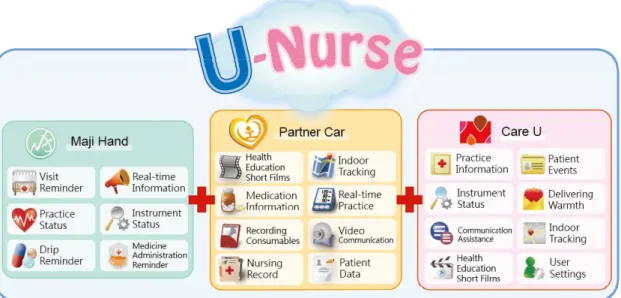
This study developed an Android Cloud based platform, a ubiquitous medical intelligent nursing-cart system combining 3 application platforms. The target users are nursing staffs. Therefore, the system is called “U-Nurse” for short. Figure 1 shows the main structure of the system. The 3 platforms are the mobile phone platform, “Maji Hand”, the tablet computer and nursing-cart platform, “Partner Car”, and the web platform, “Care U”.
Through the cloud computing and RFID technologies and wireless network applications, this system helps hospital nursing staffs to with their operation processes, to increase medical process efficiency, reduce medical negligence, and improve clinic practices, so that patents can receive the best medical care and hospitals can save costs for setting up servers. These are the main design concepts of this study.
Figure 1. U-Nurse
With the design of this study, the computing functions of cloud computing and users’ data clouds can be integrated. When users need to use this system, data computation based on their demands will be performed and related information will be returned to users, without depending on hardware equipment inside hospitals. If hospitals have to purchase hardware equipment, there are also expenses regarding IT staffs. Besides providing nursing information timely and precisely, this system can also help nursing staffs to take care of patients more rapidly and reduce errors, so that patients can receive the best medical care possible.
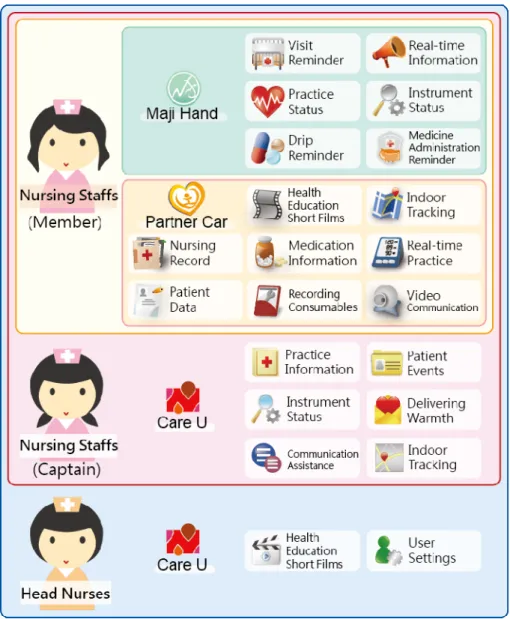
This study categorized user roles into: general nursing staffs, chief nursing staffs, and head nurses. General nursing staffs can use the functions of partner Car and the little assistant on the mobile platform which can help them take care of patients. Chief nursing staffs can use Care U on the web platform to find out practice status of their crews (general nursing staffs), so that they can offer advices or assistance. Head nurses can find out statuses of all nursing staffs through Care U on the web platform and improve nursing staffs’ practice behaviors through short films of health education.
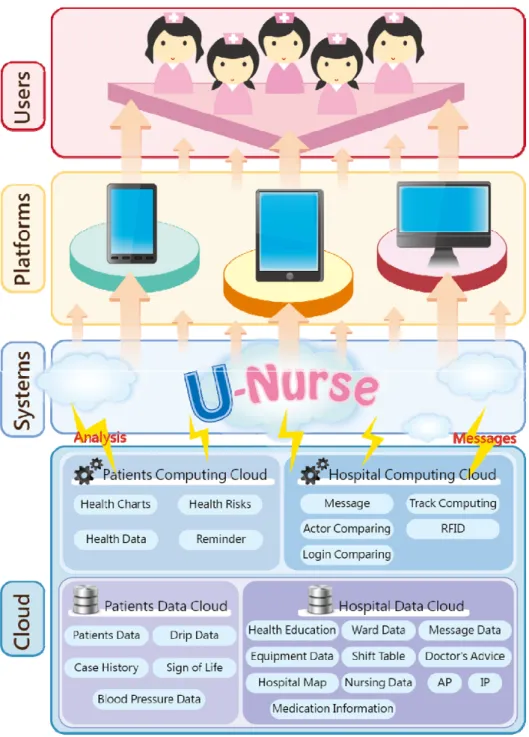
Figure 3. Android cloud based ubiquitous medical intelligent caring structure
Currently, the system structure is composed of 3 different types of clouds, data cloud, computing cloud, and application cloud, as shown in Figure 2 and Figure 3. Hospitals can access this system as long as there are basic tablet computers, RFID readers, video, and wireless networks, without high costs for system set-up. Through this system, with the characteristics of cloud computing, time-consuming computation and data processing are done on the cloud end. Users can retrieve information in a short time, increasing convenience in usage.
Figure 4. Functions of the cloud structure
4. User interface of the system
4.1. Maji hand
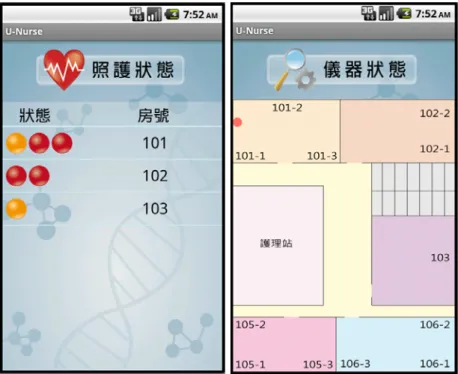
The detailed functions for mobile devices are listed below. Real-time information of patients can be provided to nursing staffs. And different light signals represent different importance. Nursing staffs can understand fully at a glance, so that they can offer patients immediate care.
1. Practice information: listing patients who need to be taken care of for the day with green and red lights representing whether patients have already been taken care of, to prevent medical negligence.
2. Visit reminder: Reminding nursing staffs through mobile phones at visiting times, to prevent situations such as forgetting time and to reduce unnecessary waste of time by making earlier preparation for visits.
3. Instrument status: locating nursing carts in a short time when needing them for emergency use, for this function can send required information to the cloud end for computing and send information back to the mobile platform to present accurate locations of nursing carts through coordinate maps. 4. Real-time information: Delivering information correctly in cases of needing to inform all nursing
staffs about certain important things or events.
5. Drip reminder: Sending out warning messages through mobile phones besides the back-end nursing system and nursing carts, so that nursing staffs can receive information even when they are not at nursing stations or near nursing carts.
6. Medicine administration reminder: Automatically sending reminders through mobile phones when patients haven’t got their medicine after scheduled times, to prevent situations such as forgetting to give patients medicines.
Figure 5.
Maji Hand
4.2. Partner car
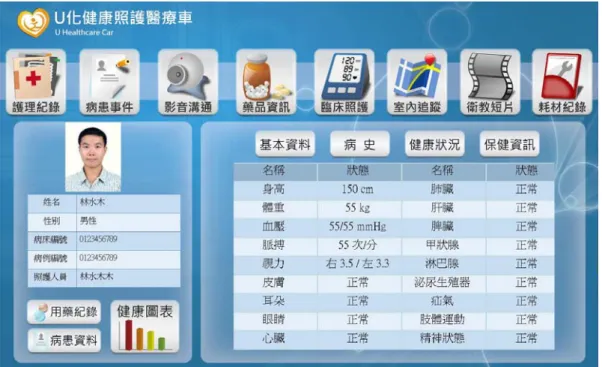
The detailed descriptions of the functions of the medical intelligent nursing cart are summarized in the table below. The “Partner Car” on the tablet computer platform and the nursing cart platform is composed of a traditional nursing cart, a tablet computer, video, and an RFID reader, along with wireless network. It can provide nursing staffs complete information of patients, so that they can take care of patients more rapidly, precisely, and conveniently, further reducing unnecessary medical negligence.
1. Patient data: Results of a patient’s latest health examination can be presented with health information related to this patient.
2. Health charts: A patient’s information such as height, weight, blood pressure, blood sugar, etc. is sent to the cloud end for computation and creating charts. The results are sent back to the Partner Car system to show the patient’s physical changes, so that doctors and nursing staffs can know the patient’s status better to offer more accurate medical services.
3. Medication administration record: This function can show the medication history of a patient and proper doses. When a patient shows some discomfort symptom for a medicine, this function can show this information to the doctor to replace the medicine for the patient.
Figure 6.
Partner Car
Figure 7.
Medication administration record
4. Event list: Nursing staffs can use this function to find out a patient’s medical events to offer assistance through correct procedure.
5. Reminding checklist: When some treatment for a patient is done, users can use this function to check the completion checkbox corresponding to the event.
6. Video communication: If a Partner Car user needs help, he can use this function to get in touch with nursing station or other nursing carts to look for help.
7. Medication information: When a nursing staff sees a medication he does not know, he can look for it using its name to get related information, including photos, doses, and side effects. 8. Drip warning: The RFID reader located on the drip stand can read the tag on the drip bag and the
weight of the bag can be calculated. If the weight is lower than a certain value, the system will send out a warning message to remind nursing staffs to replace the drip bag for the patient. 9. Needle replacement: Because drip needles are put into patients’ arms, patients may feel
discomfort. Therefore, when it’s time to change needles, the system will send out a warning message to nursing staffs to remind them to change the needles.
10.Blood pressure and body temperature: A patient has to go through a basic examination at a certain time every day to find out if there is anything unusual. With this function, the patient’s blood pressure and body temperature can be input to update his health charts in the nursing records.
11.Nursing cart positioning: Users can select the plate number of the Partner Car and the information will be sent to the cloud end for computing. Then the correct coordinates of the target will be sent back to the Partner Car platform to show the location.
12.Patient positioning: If a patient is not in his ward or in that level, nursing staffs can input the patient’s patient number to find out his whereabouts. Through cloud computing, the patient’s correct coordinates will be sent back to the Partner Car platform and the patient’s location will be marked on the map. This function can help with patient safety management.
13.Health education short films: Through this function users can watch educational short films regarding various medical situations and educational short films for the general public, in order to provide correct medical procedures and promotion of health education for nursing staffs. 14.Recording consumables: Every medicine placed on a Partner Car must be recorded. When using
this function, RFID tags on medicines can be read and the quantities of the medicines can be recorded.
4.3. Care U
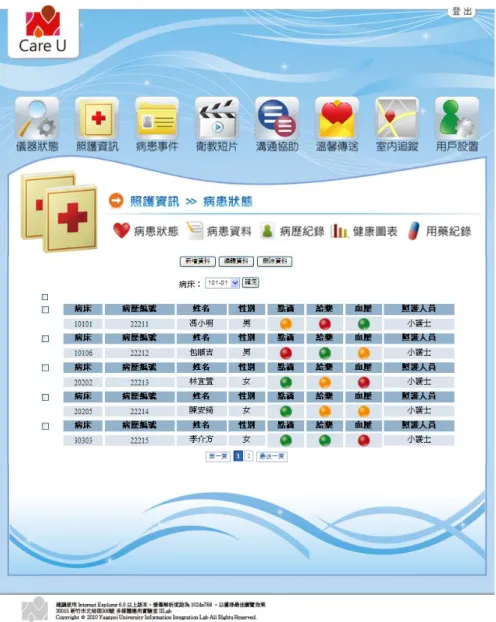
In every nursing station, there are desktop computers to look for related information. This study included this resource when designing the system. The detailed explanations of the functions are listed below. The “Care U” on the web platform is a combination of “Maji Hand” and “Partner Car”. It can present complete data through categories to provide nursing staffs statuses and information of all patients, so that managers can know well statuses of all patients.
1. Patient status: Users can use this function to find out the statuses of nursing staffs taking care of patients. The results are presented on a list. If there is anything wrong, the corresponding light becomes red to remind chief nursing staffs or head nurses.
2. Patient information: This function can show patients’ identities and personal information for nursing staffs to check.
3. Case history: Patients’ case histories are recorded through this function.
4. Health charts: Nursing staffs can input data from patients’ basic examinations everyday to the cloud to create health charts, which will be sent back to nursing staffs so that they can know patients’ health statuses.
5. Medication administration record: This function can show medicines every patient has to take and corresponding doses, so that nursing staffs using Partner Car can correctly record whether medicines have been given, in order to avoid medical negligence of wrong medication administration.
6. Patient event: Nursing staffs can use this function to add patients’ medical events of the present day. And this function also provides reminders for medical events to be performed in that day. 7. Instrument status: Chief nursing staffs and head nurses can find out which nursing staffs are using
Partner Car at the moment and locations of nursing carts, in order to avoid idleness of resources and to track statuses of consumables for each Partner Car.
Figure 8.
Care U
8. Health education short films: Head nurses can add short films of various medical events and health education. There are two categories for health education short films, one for nursing staffs, and the other for patients. Films are categorized so that nursing staffs can manage them and find them more easily.
9. Delivering warmth: Nursing staffs can remind patients’ families of time of patients’ operations through emails or of other important things.
10.Indoor tracking: If a patient is not in his ward or in that level, nursing staffs can input the patient’s patient number to find out his whereabouts. Through cloud computing, the patient’s correct coordinates will be sent back to the Partner Car platform and the patient’s location will be marked on the map. This function can help with patient safety management.
11.Communication assistance: This function can receive nursing staffs’ calls for help from Partner Car. However, this function can only receive calls for help. Users cannot use it to call for help. 12.User settings: Through this function, new accounts for new nursing staffs can be added and
Figure 9.
Health charts
5. Conclusion
This study built the “cloud-based ubiquitous medical intelligent practice structure” and will implement it into a hospital’s general wards for small-scale application and testing. And a survey will be conducted with the nurses regarding their satisfaction with the system in helping them with their jobs. The expected satisfaction is 75%.
Besides reducing medical negligence to avoid irreversible accidents, this study can also help nursing staffs to speed up their operation procedures and increase their efficiencies, as summarized below:
1. Shortening the time required for nursing staffs to find out patients’ health statuses: During shift changes, the nursing staffs who take over can get correct personal medical information and other information of patients, so that patients can receive more compete medical services.
2. Fast message delivery for nursing staffs: Through wireless network applications, time nursing staffs spend on operation procedures can be saved. For example, in case of an emergency in a ward, nursing staffs can request for help immediately from idle nursing staffs and nursing stations, to reduce chances of medical negligence.
3. Speeding up material preparation: Through RFID readers on nursing carts, tags of medical supplies can be read. Thus, the system can identify numbers and types of medical supplies in nursing carts in a short time, without spending time on checking out each item, therefore speeding up subsequent medical procedures.
4. Nursing cart indoor navigation system: The system can provide information regarding medical and heath materials, medical supplies, patients’ wards, and environments to nursing staffs in a short time, to improve their working efficiency.
5. Reducing chances of errors and improving working efficiency: Nursing information is presented in e-tables instead of in traditional written format or through word of mouth, reducing chances of errors.
The Department of Health, Executive Yuan proposed the 4-year “Health Care Value-added Platinum Program” in 2009. The program also described the importance of “using RFID in nursing carts”. And related medical care policy plans were also proposed. With the popularity of technology and
advancement of hardware nowadays, based on the points above, intelligent nursing carts will be one of the most important equipment for medical institutions in the future.
6. Acknowledgments
This research is supported by the National Science Council of the Republic of China under Grant NSC 101-2221-E-264-008.
7. References
[1] Alahmadi Ahmed, Soh Ben, Alghamdi Saleh, “A hybrid history based weighted voting algorithm for smart mobile e-health monitoring systems”, In Proceeding(s) of the IEEE 8th International Conference on Intelligent Sensors, Sensor Networks and Information Processing, pp.402-407, 2013.
[2] Deng-Yang Huang, The Design of IHE_based e-Healthcare Framework for Personal Health Record, Chang Gung University, R.O.C., 2005
[3] Dixie A Jones, Jean P Shipman, Daphne A Plaut, Catherine R Selden, “Characteristics of personal health records: findings of the Medical Library Association/National Library of Medicine Joint Electronic Personal Health ”, Journal of the Medical Library Association, Medical Library Association, vol. 98, no. 3, pp.243-249, 2010.
[4] Eric Dishman, “Inventing Wellness Systems for Aging in Place”, Computer, IEEE Computer Society Press, vol. 37, no. 5, pp.34-41, 2004.
[5] Kathy J. Liszka, Michael A. Mackin, Michael J. Lichter, David W. York, Dilip Pillai, David S. Rosenbaum, “Keeping a Beat on the Heart”, IEEE Pervasive Computing, IEEE, vol. 3, no. 4, pp.42-49, 2004.
[6] Lara Khansa, Jonathan Forcade, Girivaraprasad Nambari, Saravanan Parasuraman, Patrick Cox, “Proposing an Intelligent Cloud-Based Electronic Health Record System”, International Journal of Business Data Communications and Networking, IGI Publishing Hershey, vol. 8, no. 3, pp.57-71, 2012.
[7] Robert Steele, Amanda Lo, “Telehealth and ubiquitous computing for bandwidth-constrained rural and remote areas”, Personal and Ubiquitous Computing, Springer, vol. 17, no. 3, pp.533-543, 2013.
[8] Robert Steele, Kyongho Min, Amanda Lo, “Personal health record architectures: Technology infrastructure implications and dependencies”, Journal of the American Society for Information Science and Technology, Wiley-Blackwell, vol. 63, no. 6, pp.1079-1091, 2012.