Copyright
©
2012
The
Guilford
Press
Copyright © 2012.Purchase this book now: www.guilford.com/p/siegelc h A P t e R 1
Mind, Brain, and Relationships
The Interpersonal Neurobiology Perspective
T
he “mind” is rarely defined in fields that focus on mental experience. This avoidance may be due to any of several well-considered reasons. There is the understandable philosophical stance that definitions may restrict a full understanding, or the notion that the mystery of the mind makes us unable to characterize its defining features. Sometimes the word “mind” is used as a placeholder for the unknown, a marker of this mysterious source of our sub jective inner life. In this book, I honor these positions while taking the risky step of exploring a working definition of the mind that has been of great value in understanding how our lives develop and what a healthy mind may actually be. After all, if we do not attempt to define at least a core aspect of the mind itself, how can we state what might constitute a healthy mind?This book explores how recent findings from a range of sciences can bring us to a new understanding of the developing mind. The sciences give us many views of how the mind functions, providing in-depth but distinct perspectives on human experience. For example, neuroscience can inform us about how the brain gives rise to mental processes such as memory and per ception. Developmental psychology offers us a view of how children’s minds grow within families across time. Anthropology gives us insights into how relational experiences and communication patterns within different cultures directly shape the development of the mind. Psychiatry gives us a clinical view of how individuals may suffer from emotional and behavioral distur bances that profoundly alter the course of their lives. Often these disciplines function in isolation from one another. Yet when one attempts to synthesize their recent findings, an incredible convergence of many independent fields of study is revealed. This convergence can be called “consilience”—the dis covery of common findings from independent disciplines.1 These findings
shed light on how the mind emerges from the substance of the brain and is
Copyright
©
2012
The
Guilford
Press
shaped by our communication within interpersonal relationships. My aim is to provide an overview and integration of some of these scientific per spectives, which serve as a foundation for a neurobiology of interpersonal experience.
More specifically, to help you to understand the developing mind, I provide an integration of mental processes (such as memory and emo tion) with both neurobiology (such as neural activity in specific circuits) and interpersonal relationships (such as patterns of communication). This integration is indeed the challenge of the book, both in the writing and in the reading. My concern is with those who, like many of my past students, are new to neurobiology; the unfamiliar ideas and vocabulary may initially feel too overwhelming to continue. Numerous teaching experiences, how ever, have demonstrated that the outcome is worth the effort. I have tried to include enough of a background as the chapters evolve that each topic can be understood by those who may be totally unfamiliar with a given area. No prior expertise is required. New concepts and vocabulary are inevi table, but I have tried to incorporate information throughout the book in a “user-friendly” manner, summarizing the significance of certain findings and including reminders of certain trends as they recur in the book. What ever your personal, scholarly, or professional pursuits, you will have a better understanding of unpredictable experiences after having studied this mate rial. Learning this approach will support the scientific view that “chance favors the prepared mind,” in that your own mind will be prepared with this integrative perspective to understand and respond to what arises in life. There are many readily accessible concepts and much useful information just below the surface of these sometimes new names and ideas. A shared under standing from the beginning will help you in making sense of the intricate and exciting findings about interpersonal relationships and the developing mind. For those who are charting new waters, I welcome you to the exciting world of interdisciplinary study!
DEFInInG THE MInD
Here is a definition of the mind that enabled dozens of scientists to communi cate with one another about the mind: “A core aspect of the mind is an embodied
and relational process that regulates the flow of energy and information.” In the begin
ning of the Decade of the Brain, the 1990s, I offered this working definition to a group of over forty scientists in order to find a common starting place for us to address the connection between the mind and the brain. With this view, all of the researchers—from anthropologists to neuroscientists—could find a common way of describing each discipline’s way of exploring the nature
Copyright
©
2012
The
Guilford
Press
of reality. Energy and information flow
is what is shared among people within a The mind is an embodied and relational process that regulates the
culture, and this flow is what is measured
flow of energy and information.
in subjects within a brain scanner. In this working definition, we also found a way
to meet for over four years, sharing our various perspectives on the nature of what it means to be human. It was in the fertile soil of this gathering that the seeds of the interdisciplinary field that ultimately became interpersonal neurobiology (IPNB) were first sown. IPNB embraces everything from our deepest relational connections with one another to the synaptic connections we have within our extended nervous systems. It encompasses the interper sonal power of cultures and families, as well as insights into molecular mecha nisms; each contributes to the reality of our subjective mental lives. IPNB is not a branch of neuroscience, but a broad field drawing on the findings from a wide range of disciplines that explore the nature of what it means to be human. Based on science, IPNB seeks to create an understanding of the inter connections among the brain, the mind, and our interpersonal relationships. IPNB can also be used to understand our relatedness beyond the interper sonal, to other living creatures and to our whole planet. With this approach, new strategies for both understanding and promoting well-being are possible. We can both define the mind and outline practical steps for how to cultivate a healthy mind as it develops across the lifespan.
The ideas of this framework are organized around three fundamental principles:
1. A core aspect of the human mind is an embodied and relational pro cess that regulates the flow of energy and information within the brain and between brains.
2. The mind as an emergent property of the body and relationships is created within internal neurophysiological processes and relational experiences. In other words, the mind is a process that emerges from the distributed nervous system extending throughout the entire body, and also from the communication patterns that occur within relationships.
3. The structure and function of the developing brain are determined by how experiences, especially within interpersonal relationships, shape the genetically programmed maturation of the nervous sys tem.
To put it simply, human connections shape neural connections, and each contributes to mind. Relationships and neural linkages together shape the mind. It is more than the sum of its parts; this is the essence of emergence.
Copyright
©
2012
The
Guilford
Press
One view of the mind parallels a dictionary definition of the psyche: “1. the human soul; 2. the intellect; 3. psychiatry—the mind considered as a subjectively perceived, functional entity, based ultimately upon physical pro cesses but with complex processes of its own: it governs the total organism and its interaction with the environment.”2
This book extends this notion of the mind’s being more than “simply brain activity.” It offers an IPNB perspective that draws on the full range of scientific disciplines to integrate everything from the societal to the synaptic. On the brain side of mental life, current neuroscience reveals the connection between brain structure and function, and provides us with new insights into how experience shapes mental processes.3 By altering both the activity
and the structure of the connections between neurons, experience directly shapes the circuits responsible for such processes as memory, emotion, and self-awareness. We now know, too, that experience and the firing of neurons can alter the regulatory molecules that control gene expression—a process called “epigenesis.”4 These epigenetic changes reveal the powerful ways in
which experience modifies how the brain develops, sometimes across the lifespan. In fact, recent studies in neuroplasticity reveal how the brain con tinues to modify its structural connections with experience throughout life.5
Moreover, studies of evolution suggest that our mammalian brains are pro foundly social, and that relationships have a huge impact on neuronal func tion from the earliest days of our lives. On the relational side of our view of mind, we can draw upon a wide range of studies from development and family function to demonstrate the importance of patterns of communi cation between people to shape how the mind functions. We can use an understanding of the impact of experience on the mind to deepen our grasp of how the past continues to shape present experience and influence future actions. Insights into the mind, brain, relationships, and experience can pro vide a window into these connections across time, allowing us to see human development in a four-dimensional way.
This book synthesizes concepts and findings from a range of scien tific disciplines, including those studying attachment, child development, communication, complex systems, cultural anthropology, emotion, evolu tion, information processing, memory, narrative, and neurobiology. I have attempted to provide enough of an introduction so that those totally unfa miliar with these domains can understand the material and apply the rel evant findings in their professional work and personal lives. When we exam ine what is known about how the mind develops, we can gain important insights into the ways in which people can continue to grow throughout life. The mind does not stop developing, even as we grow past childhood and adoles
cence. Through understanding the connections between mental processes and
Copyright
©
2012
The
Guilford
Press
The mind does not stop developing, even as we grow past childhood and adolescence.
which interpersonal relationships—both early in life and throughout adulthood— continue to play a central role in shaping the emerging mind.
Energy and Information Flow
The mind—the regulatory process that creates patterns in the flow of energy and information—can be described as emanating in part from the activity of the neurons of the distributed nervous system.6 Keep in mind that the
“single-skull” view of mind as merely a product of the brain may be too limited. We have evolved to be social, and mental processes are a product of our inner neural connections as well as our interpersonal communicative connections with others. Without this reminder, it may be too easy to slip into the linear thinking that “mind is simply the brain’s activity.” The sci entifically grounded view proposed in this text is that the mind arises from beyond the functioning of an isolated nervous system. Both our internal neural functions and our shared communicative processes give rise to the process defined here as mind.
It is important to underscore this issue right from the start. Sometimes neuroscience researchers or the popular media imply that the mind is simply the output of the brain. In this often-expressed view, mental life is equated with brain activity—an outcome of the firing of neurons within the brain. But in this book I take a broader view that perceives mental processes as emerging from neural functions throughout the whole body (not only the brain in the skull) and from relational processes (not only from one bodily self or nervous system). The mind is embodied, not just enskulled. And the mind is also relational, not a product created in isolation. These relation ships include the communication an individual has with other entities in the world, especially other people. This book focuses especially on the impor tant ways in which interpersonal relationships shape how the mind emerges in our human lives. But we also have a relationship with nature, with this planet, with the Earth upon which we live, that shapes our mental (and physical) lives as well. This is a vital form of relationship that sustains us in the air we breathe and the water we drink. But this book is focused primarily on the person-to-person aspect of our relationships. This is the social nature of the “embodied and relational process that regulates the flow of energy and information.”
The implications of this definition are significant, as I hope you’ll see in the journey through these pages. One implication is that we don’t “own” our minds—that we, our individual “selves,” are interdependent on others for the functioning of our minds. This relational part of the definition makes
Copyright
©
2012
The
Guilford
Press
some people uncomfortable. Yet if you are in a family, or in a one-to-one relationship, you know that your subjective, inner mental life is profoundly influenced by others. On the scientific side, any anthrolopologist or sociolo gist knows from research how real this relational component of our mental lives truly is. And so what we need is a link that connects the social with the synaptic. To achieve the essential ability to move readily between these two levels of human reality, we will have to define the common ground that links them.
When one of us speaks to another, the voice box stimulates the move ment of air molecules manifested as kinetic energy. The eardrum responds to this energy flow by creating electrochemical energy movement within the acoustic nerve and downstream neural circuits of the brain. Ions flow in and out of the neural membranes, and the release of chemical transmitters activates downstream neurons. When these patterns of neural firing match with prior learning, then this “energy flow” has informational value, and the listener can understand what the speaker has said.
Here we can see how “communication” is based on the sharing of energy and information. But what are these shared elements of mental life? Several different measures of energy can be used to study the different forms that energy flow takes. Brain imaging studies examine the metabolic, energy-consuming processes in specific neural regions, or the blood flow to cer tain areas that are thought to be a clustering of localized neuronal activity. Electroencephalograms (EEGs) assess the electrical activity across the surface of the brain as measured by electrodes on the head. These assessments of “energy flow” are not popularized, unscientific views of the flow of some mysterious substance through the universe. Neuroscience studies the way in which the brain functions through the energy-consuming activation of neu rons. The degree and localization of this arousal and activation within the brain—this flow of energy—directly shape our mental processes.
But the mind is involved in more than the regulation of the flow of energy. The mind is also about regulating the flow of information.7
What is information? At the most basic level, “information” consists of swirls of energy that have symbolic meaning. If I say the term “glicanera,” and you do not understand Greek, you will not derive information from that sound. Yes, the letters themselves have information; a “g” is pronounced “gee,” and when it is combined with all the other letters, you can say the word “glicanera.” In that way, the letters are bits of information—squiggles that stand for certain sounds. But the whole word may have no symbolic reference. If you speak Greek, you will “know” that this word means “sweet water,” and that it is also the name of a magnificent beach
“Information” consists of swirls of energy that have symbolic meaning.
Copyright
©
2012
The
Guilford
Press
on Crete. Now you know that the word “glicanera” stands for something more than the sounds of the letters. This information comes from the way the symbolic meanings are embedded in that set of sounds—the pattern of energy flow in “glee-kah-nehr-ah.”
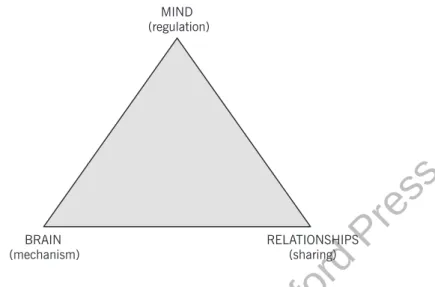
Within IPNB, we view mind, brain, and relationships as three aspects of energy and information flow. Brain is the embodied neural mechanism shap ing that flow; relationships are the sharing of the flow; mind is the embodied and relational process that regulates the flow of energy and information. If we ask, “Where is the mind?”, we can say that its regulatory functions are embodied in the nervous system and embedded in our interpersonal rela tionships. This emergent process of both the neural and the interpersonal locates the mind within both the physiological and relational frame of real ity. The mind develops in the interaction of at least these two facets of our human lives.
Mind, brain, and relationships are not three separate elements. Instead, we are proposing that they are “three aspects of one reality”—that is, energy and information flow. Just as we have heads and tails of one coin, we can have many facets of one entity. This aspect of mind regulates the flow of energy and information as it is shared within relationships and moves through the physical mechanisms of the brain, the embodied neural connections within the extended nervous system distributed throughout the whole body. This “embodied brain” is simply referred to hereafter as the “brain,” for ease of reference, reading, and writing. Please note, too, that a self-organizing pro cess like the mind is an emergent property of a system. This process both
arises from the interaction of the system’s elements (energy and information
flow within the body and are shared between people) and also regulates in a recursive way the very elements from which it arose. This recursive, reentry property of mind, typical of self-organizing emergent processes, means that relationships and brain shape mind and mind shapes relationships and brain. Mind, brain, and relationships are three aspects of one system: regulation, embodied mechanism, and sharing of energy and information flow. We’ll be exploring these intricate and fascinating aspects of the mind throughout the pages of our journey together. Figure 1.1 shows this triangle of human expe rience, with mind, brain, and relationships representing aspects of energy and information flow.
This may be a new way for you to think, but embracing mental, neural, and relational processes as involving energy and information flow patterns is a powerful way to blend science with the subjective nature of our human lives. Naturally, our mental experience is far more than a regulatory process; it involves the subjective quality of our consciousness and the inner ways of knowing that enrich our sense of feeling, meaning, purpose, love, connec tion, and wholeness. However, learning about the regulatory aspect of mind
Copyright
©
2012
The
Guilford
Press
MIND (regulation) BRAIN RELATIONSHIPS (mechanism) (sharing)FigURe 1.1. Three aspects of energy and information flow. Adapted from The Mind ful Therapist: A Clinician’s Guide to Mindsight and Neural Integration by Daniel J. Siegel. Copyright © 2010 by Mind Your Brain, Inc. Used by permission of W. W. Norton & Company, Inc.
empowers us to see more deeply into the ways the mind develops as the brain changes and as relationships evolve over time. As you’ll see, certain patterns of this flow involve a flexible and adaptive outcome; mind, brain, and rela tionships can be intentionally moved toward health. This pattern of healthy living involves the integration of energy and information within the nervous system
and between people. Integration is the organizing principle that links the ways
energy and information flow is shared (relationships), is shaped (the mecha nisms of the embodied nervous system or, termed simply, the brain), and is regulated (the mind).
Integration
The mind has distinct modes of processing information. For example, our sensory systems can respond to stimuli from the outside world, such as sights or sounds, and can “represent” this information as patterns of neural firing that serve as mental symbols. The activity of the brain creates “representa tions” of various types of information about the outer and inner worlds. For example, we have representations of sensations in the body, of percep tions from our five senses, of ideas and concepts, and of words. Each of these forms of representation is thought to be created in different circuits of the brain. These information-processing modes can act independently, and they also have important interactions with one another that directly affect
Copyright
©
2012
The
Guilford
Press
Linking differentiated parts into a functional whole is called “integration.”
their processing. We can have complex representations of sensations, perceptions, ideas, and linguistic symbols as we think, for example, of some time in the past. The weaving together of these distinct modes
of information processing into a coherent whole may be a central goal for the developing mind across the lifespan. This process of linking differentiated
parts into a functional whole is called “integration.” As we’ll see, integration is a
unifying principle that will help us to understand the linkage of mind, brain, and relationships throughout our discussions. Furthermore, in IPNB, we propose that integration is the heart of health.
Interpersonal relationships may facilitate or inhibit this drive to inte grate a coherent experience. Relationships early in life may shape the very neural structures that create representations of experience and allow a coher ent view of the world: Interpersonal experiences directly influence how we mentally construct reality. This shaping process occurs throughout life, but is most crucial during the early years of childhood. Patterns of relationships and emotional communication directly affect the development of the brain. Studies in animals, for example, have demonstrated that even short episodes of maternal deprivation have powerful neuroendocrine and epigenetic effects on the ability to cope with future stressful events. Studies of human subjects reveal that different patterns of child–parent attachment are associated with differing physiological responses, ways of seeing the world, and interpersonal relationship patterns.8 The communication of emotion may be the primary
means by which these attachment experiences shape the developing mind. Research suggests that emotion serves as a central organizing process within the brain. In this way, an individual’s abilities to organize emotions—a prod uct, in part, of earlier attachment relationships—directly shapes the ability of the mind to integrate experience and to adapt to future stressors.
Differentiation and Linkage
To understand integration, we must unpack its two fundamental components: “differentiation” and “linkage.” Differentiation is how parts of a system can become specialized, unique in their growth, individualized in their develop ment. Linkage involves the connection of separate areas to each other, often involving the sharing of energy and information flow. When differentiated areas become linked, they retain some of their essential qualities while also becoming a part of a functional whole. Here we see how integration makes the whole greater than the sum of its parts. In mathematics, we use terms such as “complexity” and “coherence” to describe such linkage of differenti ated parts. In biological terms, we can see how individuals develop, growing
Copyright
©
2012
The
Guilford
Press
ever more differentiated and interconnected over a lifetime and across the generations. In day-to-day terms, vitality and harmony emerge from inte gration. From simple, less integrated stages of development, differentiation and linkage can create more sophisticated and intricate functions. Such inte gration gives rise to flexible and adaptive functions. This is the essence of health.
There are important scientific implications for systems that link dif ferentiated parts to one another. Like a choir, they move toward harmony in an integrated state. Yet if such integration is impaired, the result is chaos, rigidity, or both. Chaos and rigidity can then be seen as the “red flags” of blocked integration and impaired development of a mind. Taking note of this pattern has profoundly useful implications for understanding impedi ments to health and for promoting health through integrative development. For example, attachment can be understood as how parents have come to integrate their own inner self-awareness with their relationship with their children—honoring differences, cultivating compassionate linkages. An integrated relationship is a healthy relationship.
Here is a fabulous finding verified by studies in neuroplasticity: How we learn to focus the mind can change the brain. If we learn the basic approach of linking differentiated parts of our lives—our nervous systems and our social connections with others—we can move internally and interpersonally toward integration and health. Lack of integration can help explain other wise mysterious patterns underlying how some individuals become stuck in their growth and development.9 Given that the focus of the mind can change
brain activity and structure, knowing something about brain anatomy and function can empower us to transform our lives and intentionally move our development toward health. This book creates a view of the develop ing mind by examining the interdependent mental, relational, and neural processes that are the foundational aspects of energy and information flow within and among people.
THE ORGanIzaTIOn OF THE BOOk
This book is composed of two general forms of information. First, scien tific findings from a range of disciplines are summarized and synthesized to construct a conceptual foundation for an “interpersonal neurobiology” of the developing mind. This scientific foundation creates a new, interdisci plinary view of established knowledge. Second, conceptual implications and new proposals derived from data, clinical experience, and synthetic reason ing across disciplines can then be drawn from this framework. Here we are “moving beyond the data” with caution and intention, but doing so out of
Copyright
©
2012
The
Guilford
Press
necessity. Much as in the old Indian fable of the blind men and the elephant, we need to fill in the gaps in our knowledge to create a “whole-elephant” view of reality. I have tried my best to clarify where we are synthesizing established views from science and where we are making hypotheses from this existing data.
Each chapter explores a major aspect of human experience: aware ness, memory, attachment, emotion, states of mind, representations, self-regulation, interpersonal connection, and integration.
Brain anatomy and awareness
In the remainder of this first chapter, we will dive into the basics of brain anatomy and function so that we start with a common understanding of this point on our triangle. Much remains unknown about neural processes, but having a basic scaffold of shared knowledge will be of great benefit. We will also begin to explore the wonderful and mysterious world of consciousness, examining some aspects of its subjective nature and its neural correlates. The fact is, we don’t really know how the physical property of neural fir ing and the subjective experience of being aware of something create each other. I raise this issue from the start because it is a fundamental unanswered question. Conscious awareness is a useful
modality for examining this fascinating We don’t really know how the physical property of neural firing
question, and we will explore the science
and the subjective experience of
of how neural function may be correlated being aware of something create with the subjective experience of being each other.
aware.
Memory
In Chapter 2, I summarize research on various forms of memory to help us understand how our earliest experiences shape not only what we remember, but also how we remember and how we shape the narrative of our lives. Memory can be seen as the way the mind encodes elements of experience into various forms of representation. As a child develops, the mind begins to create a sense of continuity across time, linking past experiences with present perceptions and anticipations of the future. Within these representa tional processes, generalizations or mental models of the self and the self with others are created; these form an essential scaffold for the growing mind’s interactions with the world.
The narrative process is one way that the mind attempts to integrate these varied representations and mental models. Autobiographical narratives are reviewed to explore how the mind creates coherence within its own
Copyright
©
2012
The
Guilford
Press
processes and how this central integrative function influences the nature of interpersonal relationships.
attachment
Awareness, memory, and autobiographical narrative set the stage for Chapter 3, which examines attachment in children and adults. Repeated patterns of children’s interactions with their caregivers become “remembered” in the various modalities of memory and directly shape not just what children recall, but how the representational processes develop. Behavior, emotion, percep tions, sensations, and models of others are engrained by experiences that occur before children have autobiographical memory processes available to them.
A profound finding from attachment research is that the most robust predictor of a child’s attachment to parents is the way parents narrate their own recollections of childhood during the Adult Attachment Interview. This implies that the structure of an adult’s narrative process—not merely
what the adult recalls, but how it is recalled—is the most powerful feature in
predicting how an adult will relate to a child. These attachment studies pro vide a framework for understanding how communication within relation ships facilitates the development of the mind.
Emotion
The primary ingredient of secure attachment experiences is the pattern of “emotional communication” between child and caregiver. This finding raises the fundamental question of why emotion is so important for the evolving identity and functioning of a child, as well as in the establishment of adult relationships. It also raises the question as to what exactly is “emotion.” Why does a child require emotional communication and the alignment of emo tional states for healthy development? To attempt to answer these questions fully, we need to synthesize a number of independent perspectives. The way the mind establishes meaning is closely linked to social interactions and both meaning making and relationships appear to be mediated via the same neural circuits responsible for initiating emotional processes. Emotion can thus be seen as an integrating process that links the internal and interpersonal worlds of the human mind.
States of Mind
Chapter 5 examines how different mental processes are organized within a state of mind. These states allow disparate activities of the brain to become linked at a given moment in time. A single brain functions as a system that
Copyright
©
2012
The
Guilford
Press
can be understood by examining the “theory of nonlinear dynamics of com plex systems,” or, more briefly, “complexity theory.” Chapter 5 proposes how the laws of complex systems that deal with emergent processes and self-organization can be applied not only to the single mind, but also to the func tioning of two or more minds acting as a single system. This new application allows us to deepen our discussion of states of mind and their fundamental importance in creating internal subjective experience and shaping the nature of human relationships.
Representations
Chapter 6 reviews in detail how the mind creates representations—mental symbols—of experience. Our internal experiences are constructive pro cesses. That is, our emotions, states of mind, and interpersonal relationships help shape the ways in which these representational processes develop.
This chapter also looks at how dif
ferences in the hemispheres of the brain Our internal experiences are shape the creation of representations. The constructive processes. brain has an asymmetry in its circuitry,
which leads to the specialization of func
tions on each side of the brain. The capacities to sense another person’s emo tions, to understand others’ minds, and even to express one’s own emotions via facial expressions and tone of voice are all mediated predominantly by the right side of the brain. In certain insecure attachment patterns, com munication between parent and child may lack these aspects of emotions and mental experience. In contrast, secure attachments seem to involve the sharing of a wide range of representational processes from both sides of the brain. In essence, balanced interpersonal communication allows the activity of one mind to sense and respond to the activity of another. The ways we connect with each other directly shape how we “regulate” our emotions and alter our states of mind. In other words, dyadic regulation directly shapes “self-regulation,” the topic of the next chapter.
Self‑Regulation
Chapter 7 explores self-regulation—the way the mind organizes its own functioning. Self-regulation is fundamentally related to the modulation of emotion and self-organization. As we’ll see, this process involves the regula tion of energy and information flow via the modulation of arousal and the appraisal of meaning. Emotion regulation is initially developed from within interpersonal experiences in a process that establishes self-organizational abilities.
Copyright
©
2012
The
Guilford
Press
Interpersonal ConnectionChapter 8 examines the nature of the connections between minds. Interper sonal relationships shape the mind by allowing new states to emerge within interactions with others. Early in development, patterns of communication between parent and child help determine the ways in which self-regulation emerges. Self-organization thus emerges out of self–other interactions. These patterns can help us to understand how relationships throughout life may facilitate emotional well-being. Examples from families and individual patients in psychotherapy are offered to illustrate these ideas.
Integration
How the self creates a sense of coherence across time is reflected in the con cept of integration, the central topic of Chapter 9. As noted earlier, “integra tion” refers to the way the mind links differentiated parts. The mind estab lishes a sense of coherence by linking states of mind across time.
By organizing the self across past, present, and future, the integrating mind creates a sense of coherence and continuity. Integration can be assessed by examining the structure of autobiographical narratives. Narrative coher ence is reflected in the way a life story is told and the manner in which life is lived. In this way, an attachment history revealed in an adult attachment nar rative reflects the individual’s capacity to integrate a coherent sense of self. Various forms of mental dysfunction may signal that integration is impaired, leading to a sense of paralysis or chaos. From the perspective of interpersonal neurobiology, the signs, symptoms, and syndromes described in the Diag
nostic and Statistical Manual of Mental Disorders (the DSM-IV-TR)10 can be
interpreted as actually describing chaos, rigidity, or both. However, human relationships can foster resilience and emotional well-being by facilitating an integrative capacity.
Throughout our journey together, we’ll be exploring new ways to understand established findings that move us further in understanding human development. My overall goal is to create a scientifically grounded, interdis ciplinary view that deepens our grasp of the developing mind and helps create stronger minds, healthier relationships, and more integrated brains for the generations ahead.
Let us now turn to look at the “brain” aspect of energy and information flow—but please keep in mind the complete triangle of mind, brain, and relationships as it reveals the interdependent nature of these three aspects of one reality. What are the mechanisms by which human relationships shape brain structure and function? How is it possible for the interactions between people to affect something so inherently different as the activity of neurons?
Copyright
©
2012
The
Guilford
Press
Exploring insights from neurobiology—the study of the way neurons work and how the brain functions—will greatly enhance our ability to address these basic questions. We’ll then turn to some basic ideas about how we can use awareness, the mental experience of consciousness, to intentionally alter the structure of the brain. The very focus of our attention can create neural firing patterns that can change the
brain’s physical connections. Given that Our social experiences can directly interpersonal relationships guide how we shape our neural architecture. focus our attention and therefore how our
neural firing patterns emerge, our social
experiences can directly shape our neural architecture. Put simply, our rela tional connections shape our neural connections. This interactive process occurs throughout the lifespan.
THE EMBODIED BRaIn
The Organization of the Brain
The brain is a complex system of interconnected parts. At its most basic level, the skull-based portion of the nervous system consists of over one hundred billion “neurons” and trillions of supportive “glia” cells. Collectively, these neurons are over two million miles long. Each neuron has an average of ten thousand connections that directly link it to other neurons.11 Thus there are
thought to be about one million billion of these connections, making it “the most complex structure, natural or artificial, on earth.”12 A neuron is one of
the basic types of cells in the nervous system; it consists of a cell body, receiv ing ends called “dendrites,” and a long axonal length that reaches out to other neurons. The neuron sends an electrical impulse, called an “action potential,” down its long axons; this releases a neurotransmitter at the space at the end, called a “synapse,” which then excites or inhibits the downstream neuron. This is an example of electrochemical energy flow. A synapse is the connection that functionally links neurons to one another. These synaptic connections help form the linkages that are the foundation for the intricate architecture of the brain. Because of the spider-web-like interconnections, activation of one neuron can influence an average of ten thousand other neurons. The resulting set of neurons that are firing together is called a “neural net profile,” which signifies a pattern of neural activity clustered into a functional whole. Such a neural net profile, for example, can be a neural representation activated when we think of the Golden Gate Bridge or the Eiffel Tower. Each time we think of that particular structure, a similar neural net profile will become activated. The vast numbers of neural connections are not static; the brain continu ally changes its synaptic interconnections in response to experience.13 This
Copyright
©
2012
The
Guilford
Press
infinite. The number of possible “on–off” patterns of neuronal firing even in a given moment of time is immense, estimated as a staggering ten times ten one million times (ten to the millionth power). The brain is obviously capable of an imponderably huge variety of activity; the fact that it is often organized and functional is quite an accomplishment!
Neurons and glia are organized in various levels of complexity, from small clusters called “nuclei” to larger assemblies called “circuits,” “regions,” and “hemispheres.” These various groupings have internal interconnections that enable neural firing to cluster into specialized patterns limited to that specific area; the output of these differentiated areas then links with the output of other regions by way of intergroup fibers that enable cross-group communication to occur. These neural clusters can be classified in a num ber of ways, including their anatomical placement in the lower, central, and upper areas of the brain. Figure 1.2 is a schematic drawing of the basic struc ture of the brain.
Lower Brain Structures
The “lower structures” include those circuits of the brainstem deep within the skull that mediate basic elements of energy flow, such as states of arousal
FigURe 1.2. Diagram of the right hemisphere of the human brain. The lower areas include the cerebellum and the brainstem; the central areas include the limbic regions (amygdala, hippocampus) and thalamus; the upper areas include the cortical regions. Copyright 2012 by Mind Your Brain, Inc.
Copyright
©
2012
The
Guilford
Press
and alertness and the physiological state of the body (temperature, respi ration, heart rate). Clusters of neurons in this region are also responsible for the survival reactions of fight–flight–freeze and are fundamental to the “polyvagal theory” of self-regulation.14 This theory suggests that our inter
actions with others directly shape how these deep structures in the brain respond with a sense of safety and receptivity or with a sense of danger or life threat. At the top of the brainstem is the thalamus, an area that serves as a gateway for incoming sensory information. It has extensive connections to other regions of the brain, including the neocortex, just above it. As we shall see, one theory of awareness considers the activity of a thalamocortical circuit to be a central process for the mediation of conscious experience.15
Other proposals suggest that various regions contribute to different elements of consciousness, and to a wide range of senses of a self.16
The lower regions of the brain also house the hypothalamus and the pituitary, which are responsible for “physiological homeostasis,” or bodily equilibrium, established by way of neuroendocrine activity (neuronal firing and hormonal release). The body proper is intimately integrated with skull-based neural tissue by way of these hormonal and other regulatory processes, such as the immune and musculoskeletal systems. When we use the term “brain,” we can now see that it makes no sense in our conceptualizations to separate this skull-based structure from the body as a whole. Stress is often responded to by the “hypothalamic–pituitary–adrenocortical (HPA) axis,” and this system can be adversely affected by trauma. Studies reveal that early childhood stress can even negatively affect the ways in which gene expres sion is regulated in these important areas of the brain’s stress response system. Such gene regulation alterations in response to experience are a part of a process called “epigenesis.”17 This HPA neuroendocrine axis, along with the
autonomic nervous system (regulating such things as heart rate and respira tion) and the neuroimmune system (regulating the body’s immunological defense system), are ways in which the function of the brain and body are intricately intertwined. When we see that
social interactions directly shape the ways in which these integrative processes func tion, we can see how relationships and the embodied brain are really part of one larger system.
Central Brain Structures
The more centrally located “limbic regions”—including the clusters of neu rons called the “hippocampus” and “amygdala”—play a central role in coor dinating the activity of various regions. The limbic regions are thought to
Relationships and the embodied brain are really part of one larger system.
Copyright
©
2012
The
Guilford
Press
play an important role in mediating emotion, motivation, and goal-directed behavior, as well as in the integration of memory and the engagement of an attachment system that enables mammalian young to depend upon their parents for safety and security. Limbic structures permit the integration of a wide range of basic mental processes, such as the appraisal of meaning, the processing of social signals, and the activation of emotion. This region houses the medial temporal lobe (toward the middle of the brain, just to the sides of the temples), including the hippocampus, which is thought to play a central role in flexible forms of memory (e.g., in the recall of facts and auto biographical details) and identifying the context of an ongoing experience.
Upper Brain Structures
The “upper structures” toward the top of the brain, such as the cerebral cor tex (sometimes called the “neocortex”), mediate more complex information-processing functions such as perception, thinking, and reasoning. This “outer bark” of the brain consists of highly folded layers, usually about six cells deep, that are filled with “cortical columns” of highly linked neuronal clusters. The grouped columns process information, and their communica tion with other columnar areas allows increasingly complex functions to emerge. In general, the cortex matures from back to front, with the frontal regions continuing active growth well into young adulthood. These frontal neocortical areas are considered to be the most evolutionarily “advanced” in humans; they mediate the complex perceptual and abstract representations that constitute our associational thought processes.
The frontmost part of the frontal neocortical region–the “prefrontal cortex”—has two important aspects: the ventral and medial zones, and the lateral prefrontal cortex (also known as the dorsolateral prefrontal cortex). The dorsolateral prefrontal cortex rests to the sides (thus “lateral”). It is thought to play a major role in working memory—placing something in the chalkboard of the mind to dial a phone number, for example—and the focusing of conscious attention. The middle prefrontal area includes the orbitofrontal cortex (just behind and above the orbits of the eyes), the dorsal and ventral aspects of the medial prefrontal cortex, the ventrolateral pre-frontal cortex, and the anterior cingulate cortex. Some authors consider the anterior cingulate and the orbitofrontal regions as part of the limbic area, while others recognize the interface role these regions play between the lower limbic and the higher cortical areas and refer to them at times as “par alimbic cortex.” In this manner, the middle prefrontal region can be seen, in fact, as the uppermost part of the limbic system as well as a part of the frontal lobes of the neocortex. These bridging areas are part of a “team” of middle prefrontal regions that work together as a functional whole to link widely
Copyright
©
2012
The
Guilford
Press
separated areas to one another. They have important integrative functions that help coordinate and balance cortical activity of thought and feeling with the lower limbic, brainstem, and bodily areas’ functions. As we’ll soon see, this region also links the perception of communication signals from other people to these internally mediated neural firing patterns, creating a wide spectrum of integration ranging from the somatic to the social.
neural Integration
The brain as a whole functions as an interconnected and integrating system of subsystems. “Interconnected” means that the long axonal fibers link widely separated clusters of neurons to each other in a spider-web-like configura tion. “Integrated,” as we’ve seen, means that these separate, differentiated areas maintain their unique features while also becoming linked. It’s crucial to keep in mind that integration is not becoming blended or “all one,” but rather involves the maintenance of differences while facilitating connection. This is truly how the whole is greater than the sum of the parts. The linkage of differentiated parts of a system is the definition of integration, and when it occurs in the brain, we call this “neural integration.” The outcome of neural integration is optimal self-regulation with the balancing and coordination of disparate regions into a functional whole. Although each element of such a system contributes to the functioning of the whole, certain regions play an important role in integrating brain activity. These include the limbic areas (especially the hippocampus), the prefrontal regions, the corpus callosum (which links the left and right sides of the brain to each other), and the cerebellum (which plays a role in linking bodily motion, mental states, and cognitive processing). All of these areas have unique and extensive input and output pathways linking widely distributed areas in the brain. When we look to understand how the mind develops, we need to examine how the brain comes to regulate its own processes. Such self-regulation appears to be car ried out in large part by the process of integration that may depend on these and other integrative circuits.
To summarize this point succinctly, self-regulation appears to depend upon neural integration. As we’ll see, optimal relationships are likely to stimulate the growth of integrative fibers in the brain,
whereas neglectful and abusive relationships specifically inhibit the healthy growth of neural integration in the young child.18 Even impairments to
health that are not experientially derived, such as autism, bipolar disorder, and schizophrenia, have now been shown to reveal impairments to neural integration.19
Self-regulation appears to depend upon neural integration.
Copyright
©
2012
The
Guilford
Press
To gain a visual grasp of some of this brain structure, it may be help ful to use a readily available, three-dimensional model. It will enable you to have neuroanatomy in the palm of your hand, so to speak. (See Figure 1.3.) If you make a fist with your thumb bent toward the center of your palm, and your fingers curled around it and resting on the lower part of your hand, you’ll have a model of the brain. Your lower arm represents the loca tion of the spinal cord inside the backbone, and your wrist is at the base of the skull. The various parts of your hand represent the three major regions discussed above—brainstem, limbic (central), and neocortical (upper) areas. If you look directly at your fist from the palmar side, the orbits of the eyes emerge around the areas of the fingernails of your third and fourth fingers. The ears extend from either side of your fist. Your fingers represent the neo cortex. Facing you are its frontal lobes; at the top are the neocortical areas that mediate motor control and somatosensory representations; to the sides and back of your hand are the posterior parts that generally mediate percep tual processing of the outside world but also play important roles in social perception, such as the temporal lobe of the cortex. The lower parts of the brain are represented by the midline portion of your lower palm. Just below your knuckles, deep inside your fist where the end of your thumb rests, is the limbic region. Most of the brain is split into the left and right hemispheres, which are connected with bands of tissue called the corpus callosum and
MIDDLE PREFRONTAL CORTEX CEREBRAL CORTEX LIMBIC REGIONS HIPPOCAMPUS AMYGDALA BRAINSTEM BASE OF SKULL SPINAL CORD
FIGURE 1.3. Hand model of the brain. Adapted from Siegel (2010a, p. 15). Adapted with permission from Bantam Books. Copyright 2012 by Mind Your Brain, Inc.
Copyright
©
2012
The
Guilford
Press
the anterior commissures, thought to serve as direct sources of information transfer between the two sides of the brain. The cerebellum, located at the back of your hand near its connection to your wrist, may also indirectly transfer information across the division that separates the two halves of the brain. The cerebellum itself may carry out a number of informational and integrating processes.
The areas of your fist jutting out from the front of your palm are the frontal lobes, beginning from your second knuckles forward to your finger nail areas. The very front of this anterior region, in front of the last knuckles, is the prefrontal cortex—an area we will be exploring throughout the book. The lateral prefrontal cortex rests to the sides and is represented by your index finger on one side and your fifth finger on the other. On your fist model, the more centrally located orbitofrontal area lies, as you may have guessed, just behind and above the orbits of the eyes, especially where your last knuckles bend and the tips of your fingers push inward toward your palm. These middle two fingernail areas in your hand model also symboli cally represent the related ventral and medial zones of this prefrontal region, and so let us refer to this cluster of horizontally and vertically “middle” regions simply by the term “middle prefrontal” cortex. Notice on your hand model that these middle two fingernail areas representing the position of the middle prefrontal region are adjacent to a number of areas from which they receive and to which they send information: the deeper structures of the brain that process sensory and bodily data, the limbic areas, and the neocor tex just above it. This three-dimensional hand model thus gives you a direct experiential/visual example of neural interconnections and the relevance of anatomy for coordinated function.
The brain is highly interconnected, and controversy exists in academic circles about how distinct these regions actually are in anatomy and func tion.20 The notion of a limbic “system,” for example, has been challenged,
because defining its limits (where it starts and where it ends) has been sci entifically difficult to accomplish. Nevertheless, the limbic and paralimbic regions appear to utilize specific neurotransmitters, to have highly intercon nected circuitry, to carry out complementary functions, and to have sim ilarities in their evolutionary history. For example, the middle prefrontal regions, sitting at the top of the limbic area and anatomically connected to a wide array of circuits in the neocortex and the deeper structures of the brain, carry out a vital role in the coordination of the activity from all three regions.21 As we shall see, recent studies from neuroscience suggest that this
middle prefrontal region may play a major role in many of the integrating processes we will be examining, such as self-awareness, empathy, memory, emotion regulation, and attachment.
Copyright
©
2012
The
Guilford
Press
Brain DevelopmentThe activation of neural pathways directly influences how connections are made within the brain and how the regulation of genes is altered. Though experience shapes the activity of the brain and the strength of neuronal con nections throughout life, experience early in life may be especially crucial in organizing the way the basic regulatory structures of the brain develop. These include, as suggested earlier, the integrative fibers of the brain. For example, traumatic experiences at the beginning of life may have profound effects on the integrative structures of the brain, which are responsible for basic regulatory capacities and enable the mind to respond later to stress.22
Thus we see that abused children have abnormal responses of their stress hormone levels, which are in part due to changes in the regulation of the genes in these areas of the brain responsible for reacting to stress.23 Cortisol
in sustained and elevated levels can become toxic to the brain.24
The essential take-home message here is that early experience shapes the regulation of synaptic growth and survival, the regulation of response to stress, and even the regulation of gene expression. Experience directly shapes regulation.
More common, everyday experiences also shape brain structure. The brain’s development is in part an “experience-dependent” process, in which experience activates certain pathways in the brain, strengthening existing connec tions and creating new ones. Development is also in part “experience-expectant,” in that genes instruct specific circuits to be created, such as the visual system, but that maintenance of those synap tic linkages requires stimulation from species general experiences, such as receiving light to the retina of the eyes. Lack of experience for these circuits can lead to cell death in a process called “apoptosis,” or to the diminution of synaptic connections in a process called “parcellation” or “pruning.” This is sometimes called a “use-it-or-lose-it” principle of brain development. Whether experience-expectant or experience-dependent development is occurring, synaptic connections are maintained by ongoing neural firing that is created with experience.
An infant is born with a genetically programmed excess of neurons, and the postnatal establishment of synaptic connections is determined by both genes and experience. Genes contain the information for the general orga nization of the brain’s structure, but experience plays an important role in determining which genes become expressed, how they will be activated, and the timing of that activation. The expression of genes leads to the production of proteins that enable neuronal growth and the formation of new synapses.
Early experience shapes the regulation of synaptic growth and survival.
Copyright
©
2012
The
Guilford
Press
Experience—the activation of specific neural pathways—therefore directly shapes gene expression (i.e., “epigenesis”), and leads to the maintenance, creation, and strengthening of the connections that form the neural substrate of the mind. In epigenesis, the sequence of DNA in a chromosome does not change, but the molecules that control gene expression do. Early in life, interpersonal relationships are a primary source of the experience that shapes how genes express themselves within the brain. Changes in epigenetic regu lation of gene expression induced by experience can be long-lasting and may even be passed on to the next generation by way of the alterations of epige netic regulatory molecules in the sperm or egg.25
At birth, the cortex of the infant’s brain is the most undifferentiated part of the body. Genes and early experience shape the way neurons connect to one another and thus form the specialized circuits that give rise to mental processes. The early years are when basic architecture in the brain is laid down. The differentiation of circuits within the brain involves a number of processes, including these:
1. The growth of axons into local areas, and the development of axonal connections among widely distributed regions.
2. The growth of new neurons and the establishment of new and more extensive synaptic connections between neurons in certain regions, such as the hippocampus.
3. The growth of myelin along the lengths of neurons, which increases the speed of nerve conduction by one hundred times and reduces the refractory period during which a just-fired neuron must rest before firing again by thirty times. Thus myelin functionally enhances the linkage among synaptically connected nerve cells by three thousand times.
4. The modification of receptor density and sensitivity at the postsyn aptic “receiving” cells, making connections more efficient.
5. The balance of all these factors with the dying away or pruning of neurons and synapses resulting from disuse or toxic conditions such as chronic stress.
In experimental animals, enriched environments and exercise have been shown to lead to increased density of synaptic connections, and especially to an increased number of neurons and actual volume of the hippocam pus, a region important for learning and memory.26 Experiences also lead to
increased activity of neurons, which enhances the creation of new neurons and the growth of new synaptic connections or the strengthening of exist ing synapses. This experience-dependent brain growth and differentiation is thus referred to as an “activity-dependent” process.
Copyright
©
2012
The
Guilford
Press
Studies suggest, too, how gene expression is altered following experi ences. The fundamental mechanism of epigenesis is that neural firing can lead to the “turning on” or “expression” of genes that enable protein production. Protein production in turn creates structural changes, allowing neurons, for example, to form new synaptic linkages or to strengthen existing ones. Experience can also induce changes in the molecules on the chromosome that do not code for protein synthesis, but instead function to regulate the expression of the adjacent gene. Epigenetic changes induced by experience alter how and when genes are expressed, and thus have a powerful impact on neural connections. Studies are now beginning to reveal the important ways in which we may have embedded in our own nuclear material the ways in which our parents and even our grandparents experienced stress, had altera tions in their epigenetic control mechanisms, and then passed these changes on to us via the gametes from which we were formed.27 There are profound
implications of these new findings for our understanding of development and the emergence of patterns of growth, temperament and other inborn quali ties of nervous system functioning, and the intergenerational transmission of stress and trauma.
Interpersonal experiences continue to influence how our minds func tion throughout life, but the major structures—especially those that are responsible for self-regulation—are initially formed in the early years. As proposed earlier, regulation emerges from integration. And for this reason, it will be helpful to keep a close eye on unfolding research that may continue to reveal how interpersonal experience shapes the growth of the integrative regulatory circuits of the brain. The essential proposal is that the integra tive communication stimulates the healthy growth of integrative fibers in the brain. Given the proposal that integration enables regulation, we will look closely at the early years of life to understand the ways in which the mind develops and comes to regulate its own processes through interactions with important caregivers. New findings on the study of neuroplasticity reveal that the brain is open to further development throughout the lifespan.28 From studies of early interpersonal experience, we
can try to understand how relationships may continue to foster the develop ment of the mind throughout life.
Information Processing and neurobiology
From an information-processing perspective, brain anatomy and neural cir cuit functioning can be understood as follows. Signals consisting of elec trochemical energy flow patterns from the brain’s deep structures represent
Interpersonal experiences continue to influence how our minds function throughout life.
Copyright
©
2012
The
Guilford
Press
physiological data from the body. They are received and processed by the centrally located limbic structures. More elaborately processed data from the activities of the limbic region itself are integrated by the adjacent paralim bic areas, including the orbitofrontal cortex and anterior cingulate. Another middle prefrontal area, the “insula” (which is a portion of the ventrolateral prefrontal cortex), receives direct input from the body as well. These areas send emotional and somatosensory input to the neocortex, which also pro cesses perceptual representations via the thalamus and the sensory cortices, conceptual representations from the associational cortices, and linguistic rep resentations from the language-processing centers. In one view, information-processing links input from various regions by way of integrative circuits, such as the associational cortices and middle prefrontal cortex, which take in the different neural “codes,” coordinate the information contained within these signals, and “translate” them into transformed neural activity. The transformed information is then sent as output to the various regions. Such neural translation of the various forms of representations allows for informa tion to be both processed and then communicated in different codes to the relevant regions. This translation process allows for a type of neural integra tion of complex information within the brain and yields highly complex neural output and mental capacities.29
An analogy is this: We can transmit information in an electronic mail message containing the twenty-six letters of the alphabet, spacing, and a handful of punctuation marks. This email is transmitted as energy flow through cables or the air. The energy flow is then translated back into information—its symbolic value as letters, spacing, and punctuation marks. Through the same wires, we can send an entire photograph or even a video. Though the message contains different information (note, photo, video), the fundamental medium in which the data are transmitted is identical— electrical impulses flowing as patterns of energy through a wire of a cable, or through the air for WiFi. The information contained within the differ ent messages varies in its patterns and its complexity. Without the proper receiving device to translate these electrical impulses into words, pictures, or video, the complex representation has no meaning. This will happen if you open a .pdf file with a word-processing program. You will find symbols that make no sense. Energy will abound on your computer screen, but the pattern of that energy will be indecipherable. It will have no informational value; it will not be symbolic of something other than being a mess of squiggles on a screen. If I spoke to you in Greek and you did not know that language, you would receive the energy, but it would not have informational value for you. Information is in the eye and ear of the beholder.
The same principle is true with the brain. Neural activity is the funda mental form in which energy flows and then information can be transmitted.
Copyright
©
2012
The
Guilford
Press
This electrochemical energy flow consists of action potentials with ions moving in and out of the membrane, release of the chemical neurotransmit ters, and chemical activation of the downstream receptors. The sending area is capable of transmitting a certain kind of information as neural codes. The receiving circuits or systems must be capable of processing such signals for them to have any meaning; in other words, they need to stand for something that is useful beyond just the neural firing itself. The brain is genetically pro grammed to be able to differentiate its regions, which carry different forms of sending and receiving information—swirls of energy flow that stand for something other than merely neural firing patterns. These forms vary in pat tern and complexity from the most “simple” signals of the deeper structures (such as heart rate) to the more complex ones of the neocortex (such as ideas about freedom or about the mind itself ).
Experience not only serves to activate the energy flow to these regions; it is necessary for the proper development of the brain itself. Experience-expectant and experience-dependent maturation are a part of even the basic sensory systems of our brains. The brain must “use it or lose it” in many cases of brain specialization. For example, studies in animals reveal that the lack of exposure to certain types of visual information, such as vertical lines, during a critical period early in life leads to loss of the capacity for perceiving such lines later in life. Specific forms of experience are necessary for the normal development of information-processing circuits in the visual cortex.30 As
discussed earlier, this has been called “activity-expectant” development, in that genetically created circuits “expect” exposure to minimal inputs (light or sound) to maintain those pathways. The same process may occur for other systems in the brain, such as the attachment system. Children who have had no experience with an attachment figure (not merely suboptimal attachment, but a lack of attachment) for the first several years of life may suffer a signifi cant loss of the capacity to establish intimate interpersonal relationships later on.31 Even the ability to perceive the mental side of life may require interac
tions with caregivers in order to develop properly.32
In this way, we can reexamine one of our initial questions: How does experience shape the mind? A general principle can be proposed here: Expe
riences can shape not only what energy and information enters the mind, but also how the mind processes that information. To “process” here means to make meaning
out of energy flow patterns, to create symbolic value out of swirls of neural firing patterns. How this occurs can be
Experiences can shape not only seen as the modification of the actual cir
what energy and information enters cuits of the brain responsible for process-the mind, but also how process-the mind ing that particular type of information. If processes that information. you don’t speak Greek, you won’t know