WPs
3.q sv
POLICY
RESEARCH WORKING PAPER
295
8
Globalization and Woirkers
in Developing Countries
Martin Rama
The World Bank
Development Research Group
Public Services
January 2003
Public Disclosure Authorized
Public Disclosure Authorized
Public Disclosure Authorized
POLIcy RESEARCH WORKING PAPER 2958
Abstract
Stories on the positive and negative effects of Third, it describes the pattern of job destruction and job globalization on workers in developing countries creation associated with globalization. Because these two abound. But a comprehensive picture is missing and processes are not synchronized, the fourth issue
many of the stories are ideologically charged. This paper addressed is the impact on unemployment rates. Fifth, reviews the academic literature on the subject, including the paper reviews the labor market policies that can be several studies currently under way, and derives the used to offset the adverse effects of globalization on implications for public policy. First, it deals with the employment and labor earnings. Finally, it discusses how effects of openness to trade, foreign direct investment, the international community could encourage developing and financial crises on average wages. Second, it countries to adopt sound labor market policies in the discusses the impact of exposure to world markets on the context of globalization.
dispersion of wages by occupation, skill, and gender.
This paper-a product of Public Services, Development Research Group-is part of a larger effort in the group to assess the impact of labor market policies and institutions on economic performance. Copies of the paper are available free from the World Bank, 1818 H Street NW, Washington, DC 20433. Please contact Hedy Sladovich, room MC3-607, telephone 202-473-7698, fax 202-522-1153, email address [email protected]. Policy Research Working Papers are also posted on the Web at http://econ.worldbank.org. The author may be contacted at [email protected]. January 2003. (38 pages)
The Polcy Research Workmg Paper Senes dissemdnates the findRtgs of work in progress to encourage the exchange of adeas about development issues An objectivoe of the series is to get the fintdtttgs otit quickly, evoen if the presentations are less than fully polrshed. The
papers cany the nanies of the autihors artd sboulid be cited accordingly. 7*e findntgs iltterpretations, anid coniclustons expressed in this
Globalization and Workers
in Developing Countries
Martin Rama
Development Research Group,
World Bank, 1818 H Street, N.W.
Washington, DC 20433
[email protected]
This paper was written for a volume on "Managing Globalization." The author is grateful to Gordon Betcherman, Richard Freeman, Emanuela Galasso, Peter Lanjouw, Dorsati Madani, Remco Oostendorp and Tzafiris Tzannatos for inputs and comments, and to Manuel Felix for excellent research assistance.
1.
Introduction
The labor market is one of the main channels through which globalization can affect developing countries. Increased import penetration, export sales, competition in services, foreign direct investment and exchange rate fluctuations prompted by
international capital movements could all, in principle, have an impact on employment and labor earnings. A common concern is that "cheap" labor and the "race to the bottom" may be the flip side of globalization. To become more competitive, countries may need to dismantle their trade barriers, abolish their legal monopolies, privatize their state-owned enterprises and reduce over-staffing in their bloated bureaucracies. These reforms could lead to the massive loss of "good jobs" and boost unemployment rates. The
macroeconomic fluctuations resulting from short-term capital movements could also increase job insecurity. On the other hand, the delocalization of production to developing countries in sectors such as food processing, textiles or garments, could also increase the demand for labor, thus expanding employment opportunities and raising workers'
earnings. New jobs in export industries might not be as good as the privileged jobs lost in protected sectors, but for the young women from rural areas who are hired in large numbers by those industries, they could be much better than the alternatives.
Anecdotal evidence on all these positive and negative effects of globalization on the labor market abounds. But a comprehensive picture is missing. Lacking this picture, the policy debate has taken strong ideological biases, from all sides. For some, all the fuzz about the negative impact of globalization on workers is just a disguise to support protectionism, and to introduce new obstacles to the free flow of goods, services and capital across countries. Those who hold this view tend to downplay any adverse effects of openness on employment and wages. For others, the adverse effects are large enough to justify an immediate policy response, under the form of additional labor market regulation and more generous social security programs, supplemented by sanctions for those countries that fail to comply. This perspective often exaggerates the effectiveness of labor market interventions in developing countries, and minimizes some of the side effects of both domestic interventions and international sanctions. Rigorous economic analysis and, more importantly, solid economic evidence, are the only way to defuse these ideological claims.
A third view takes a different stance. It sees wage earners as a privileged elite in most developing countries, where farmers and the self-employed account for most of the labor force. From this perspective, whether this elite stands to lose from globalization should not be a concern, as long as the poor are better off. But this view is questionable on both economic and political grounds. From an economic perspective, the first-order effects of globalization on the labor market are probably those it has on salaried employment and wages. If these effects are small, it is dubious that the poor will have much too gain from globalization. From a political perspective, salaried workers in formerly protected activities or in the public sector are one of the social groups more able to articulate and convey its grievances. Alienating this group may delay the opening up of the economy and the adoption of much needed economic reforms. The key issue, therefore, is finding
cost-effective ways to mitigate the adverse effects of globalization on salaried workers, while making it work for the poor.
This paper proposes an analytical review of the evidence on the impact of
globalization on employment and wages, including some preliminary results from work in progress. This review does not always disentangle the effects of increased exposure to international trade from those of new technologies, or of capital flows across countries. But from the perspective of developing countries, trying to isolate those effects may be a bit specious. Globalization is, precisely, the combination of all these changes in the way developing countries interact with the rest of the world. Selling goods and services abroad often require the use of new, skill-biased technologies. These technologies are in turn embodied in capital goods. And the latter need to be imported from industrial countries. The key issue, therefore, is not to identify which of the channels is the most relevant, but rather to assess the labor market impact of the overall package. Moreover, globalization also puts pressure on the governments of developing countries to reform domestically, so as to make their economies more competitive. Allowing competition in utilities, or privatizing state-owned enterprises are often part of the globalization
"package". This review will also address the labor market impact of these reforms. The next section of the paper deals with the impact of openness to trade and foreign direct investment on wages. The focus is on aggregate figures and the dynamics of the adjustment process. Section three goes beyond the aggregates, and assesses whether globalization has a differential impact on workers depending on their occupation,
educational attainment, or gender. Section four reviews the effects of globalization on job destruction and job creation. Because these two processes are not synchronized, an impact in unemployment rates is conceivable. This impact is discussed in section five. The next two sections of the paper deal with the appropriate policy responses to globalization. Section six reviews a variety of programs that have been used in
developing countries to mitigate the impact ofjob losses and declines in earnings. Section seven discusses the role the international community should play in promoting a sound policy response to globalization in developing countries. Section eight concludes.
2.
Aveirzge Wages
According to the most popular model in international trade theory, globalization should equalize factor prices across countries. Thanks to trade in goods and services, and to capital mobility, labor earnings should become similar in industrial and developing countries. This convergence could take place even in the absence of any international migration. If this is correct, globalization has to be beneficial to workers in developing countries.
At a first glance, the abyssal differences in wage levels between say, Bangladesh and the United States, cast doubts on the validity of this argument. But several studies have shown that there is substantially more wage equalization across countries than suggested by the raw data. Trefler (1993) analyzed the variance of wages measured in purchasing power parity across 33 countries, industrial and developing. He found that 90 percent of the variance could be explained by differences in productivity. This line of research was
expanded by Freeman (1994), who considered 51 countries and relied on indirect productivity indicators, such as the average schooling of the population, and its urbanization rate. According to Freeman's results, a third of the variance in average wages in manufacturing could be ascribed to those indirect productivity indicators, and another third to differences in purchasing power parities. Using a broader sample, Rodrik (1999) showed that a strong relationship existed between wages and productivity in the manufacturing sector. Rodrik also showed that the outcome depended on the political regime, as wages are higher (other things equal) in more democratic countries.
While these studies do not directly deal with globalization, they all suggest that its effect on wages should be positive. To begin with, they all reveal that a strong association exists between wages and productivity at the country level. It is generally accepted that productivity grows faster in more open economies (see, for instance, Sachs and Wamer,
1995; and Sala-i-Martin, 1997). Therefore, wages can be expected to grow faster too. In addition, both Freeman and Rodrik include the ratio of foreign trade to GDP among the explanatory variables in their regressions. The coefficient multiplying this ratio reflects the direct impact of openness on wages, not its indirect impact through productivity levels. That coefficient turns out to be positive in all the specifications in both studies. It is statistically insignificant in the study by Rodrik, but highly significant in the study by Freeman.
The hypothesis that wages grow faster in more open economies is supported by figure 1, which was constructed using wage data from dozens of occupations in 70 countries. The wage data were originally collected by the International Labor Office through its October Survey, and subsequently standardized in a comparable format by Freeman and Oostendorp (2000). The October Survey, conducted since 1924, has rarely been used for research purposes, because the raw data in it suffer from comparability problems. Occupations (e.g., bricklayer, teacher) are defined quite precisely. But
depending on the country and occupation, the raw data may refer to wages or to earnings. The reported figure may be minimum, a maximum, an average, a median or other
indicators. Figures can also refer to men, women or both. And the reference period can be the hour, the day, the week or the month, among others. Freeman and Oostendorp re-calibrated these data so as to make them comparable, by assuming a stable relationship between different wage measures. The data used in figure 1 correspond to the average monthly wages of men, in current U.S. dollars.
The 70 countries considered in figure 1 are classified in three groups, using the approach proposed by Dollar and Kraay (2001). The first group, which is by far the largest, is made of countries that are not yet fully integrated with international markets. The two other groups, much smaller, are composed of industrial countries, which have been open for quite a long time, and of "recent" globalizers. These groups comprise 14 and 13 countries respectively. Figure 1 reports the growth rate of the average wage between the 1980s and the 1990s, for the largest common set of occupations across all 70 countries. This growth rate is highest for the recent globalizers, and lowest for the non-globalizers. Therefore, the results reported in figure 1 suggest that openness is good for workers.
IFiiune Wgage WGrowtn by CoUImtnry GTO3nps 35 30-o' 25 25 c20- ~15-2 10 0~
Non-globalizers Rich countries Globalizers
Source: Based on work in progress by Freeman, Oostendorp and Rama (2001). Wages are measured in current U.S. dollars, as averages across a common set of occupations, using data from Freeman and Oostendorp (2000). Countries are classified as non-globalizers, rich or globalizers as in Dollar and Kraay (2001). Wage data for the 1980s are from period 1983-1989, whereas wage data for the 1990s are for 1990-1998.
A more disaggregated analysis reveals a more complex picture, however. First, the growth rates depicted in figure 1 are only relevant for those who do earn a wage, whereas globalization could in principle lead to substantial job losses. The impact of globalization on job creation and job destruction will be addressed in section 4. Second, these growth rates refer to average wages, but some workers may gain more than the average, while others may not do as well, or may even lose. The differential impact of globalization across workers will be discussed in section 3. And third, the growth rates in figure 1
summarize a long-time trend, but the dynamics of globalization could involve a
temporary decline in wages. The issue then is whether the present value of the gains from globalization is large enough to offset the short-term losses. The rest of this section deals with the dynamics of wage adjustment.
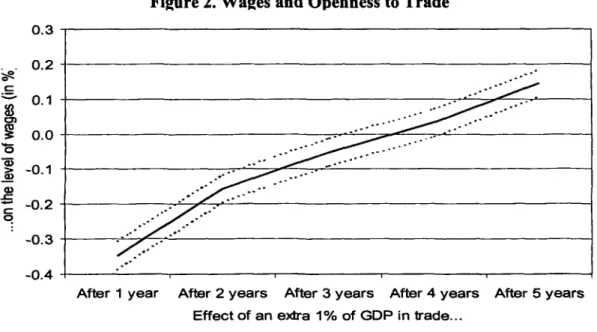
Figures 2 and 3 summarize the impact of openness on wages over a five-year period. These two figures were constructed based on a regression explaining the level of wages as a function of two openness indicators: the ratio of foreign trade to GDP and the ratio of foreign direct investment (FDI) to GDP. In addition to these two indicators, the regression controls for country, occupation and year. The wage data are, again, from Freeman and Oostendorp (2000). The solid line in figures 2 and 3 indicates the point estimate of the coefficient multiplying the openness indicator considered. The dotted lines demarcate the 95 percent confidence interval for that coefficient.
Figure 2. Wages and Openness to Trade 0.3-0.2 0.0 --0. 1 -0.4
After 1 year After 2 years After 3 years After 4 years After 5 years
Effect of an extra 1% of GDP in trade...
Source: Based on work in progress by Freeman, Oostendorp and Rama (2001). This figure reports the results of a regression explaining the log of wages, in PPP dollars, as a function of the trade-to-GDP ratio (based in dollar figures). There is one observation per country, occupation and year, over period 1983-1998. The regression includes fixed effects for all countries, occupations and years. It also controls for the ratio of foreign direct investment to GDP. Data on wages are from Freeman and Oostendorp (2000) and data on other variables from the World Bank. The solid line reflects the point estimate of the coefficient of interest. The dotted lines indicate the 95 percent confidence interval.
Based on figures 2 and 3, the short-term impact of trade liberalization on wages is negative, whereas the short-term impact of foreign direct investment is positive. If the results in these figures are to be interpreted literally, an increase in foreign trade by 10 percent of GDP leads to a 3.5 percent decline in wages. An additional one percent of GDP in foreign investment, on the other hand, would raise wages by almost 2 percent. The combination of these two figures highlights the importance of the investment climate. If the opening up of the economy fails to attract foreign capital, wage losses could be sizeable.
While the impact of foreign direct investment on wages fades over time, the impact of openness to trade becomes significantly positive. According to figure 3, foreign direct investment has no significant effect on wages after five years. If figure 2 is to be
interpreted literally, the negative effect of openness to trade on wages is offset after three years. In practice, the precise timing of this reversal depends on the specification and the openness indicator used. For instance, the change in the sign of the coefficient takes place in the fifth year when using the openness indicator constructed by Sachs and Warner (1995), instead of the trade-to-GDP ratio. The indicator by Sachs and Warner combines the average tariff rate, the coverage of non-tariff barriers, the black market premium for foreign exchange, the existence of a marketing board for commodity exports, and the socialist nature of the economy.
Figuire 3. Wages asmd iForeigim MDirect RmvestmneiDnt 2.5 -ZR 2 - ..-... a)
1.5-0.5
""....
.
0 -0.5After 1 year After 2 years After 3 years After 4 years After 5 years Effect on an exra 1% of GDP in FDI...
Source: Based on work in progress by Freeman, Oostendorp and Rama (2001). This figure reports the results of a regression explaining the log of wages, in PPP dollars, as a function of the ratio of foreign direct investment to GDP (based in dollar figures). There is one wage observation per country, occupation and year, over period 1983-1998. The regression includes fixed effects for all countries, occupations and years. It also controls for the trade-to-GDP ratio. Data on wages are from Freeman and Oostendorp (2000) and data on other variables from the World Bank. The solid line reflects the point estimate of the
coefficient of interest. The dotted lines indicate the 95 percent confidence interval.
The evidence reviewed so far refers to the effects of international trade and foreign direct investment on wages. However, financial crises can have a substantial impact too. Using time series data from 67 crisis episodes, Diwan (2001) shows that the labor share of income falls, often dramatically. In most cases the subsequent recovery is not total, implying that episodes of crisis bring a net loss to labor. To the extent that international capital mobility makes financial crises more likely, the short-term losses from
globalization could be much larger than suggested by the evidence on the effects of international trade. For Diwan, the sheer magnitude of the losses is due to the fact that capital has become highly mobile, whereas labor is not. Because the returns to capital cannot be adjusted downwards in times of crises, the entire burden of the adjustment falls on labor.
3. The Distrnbutii of W@ gef
On the surface, it may seem that globalization does not affect the wage distribution. Figure 4 reports a measure of the dispersion of wages by occupation, across different levels of openness to trade. Each point in this figure corresponds to a country and year, over period 1983-1998. The data on wages by occupation are, once more, from Freeman and Oostendorp (2000). The dispersion measure used to construct this figure is the standard deviation of the log of wages, which measures the typical gap, in relative terms,
between the wage in any of the occupations considered and the average wage. If this gap is multiplied by one hundred, it can be interpreted as a percentage. The higher the gap, the higher is wage inequality.
According to figure 4, wage inequality across occupations does not increase with openness. If anything, it could decline. A more rigorous analysis, allowing for different levels of wage dispersion by country and year, fails to unveil any systematic impact of globalization Neither the ratio of trade to GDP, nor the openness indicator constructed by Sachs and Warner or the ratio of foreign direct investment to GDP have a statistically
significant effect on the dispersion of wages by occupation (Rama, 2001b). The results do not change when industrial countries are excluded from the analysis. However, this apparent neutrality of globalization hides important changes along two dimensions: education and gender.
According to the most popular model in international trade theory, globalization should reduce the wage premium to education in developing countries. In one of its simplest versions, this model considers two regions of the world and two factors of production: skilled and unskilled labor. The two regions differ in their endowments. Skilled labor is abundant in industrial countries and scarce in developing countries. Globalization can be interpreted as a dramatic reduction in trade barriers and
transportation costs. As a result of this reduction, the two regions of the world face an incentive to shift their product mix in favor of the sector in which they do have a comparative advantage. Thus, there is an increase in the demand for skilled labor in industrial countries, and an increase in the demand for unskilled labor in developing countries.
Figure 4. Dispersion of Wages across Occupations and Openness to Trade 1.4 -1.2 -6 1. - * 15 Z 0.6 cjn 0.2 0 0 50 100 1 50 200 250 300 Foreign trade in % of GDP
Source: The dispersion of wages by occupation was calculated using data from Freeman and
Oostendorp (2000). Data on the trade-to-GDP ratio are from the World Bank.
While the argument in the previous paragraph may sound a bit abstract, it has often been used in the policy debate. In its first comprehensive report on poverty, the World Bank (1990) claimed that labor-intensive growth was one of the main avenues to poverty alleviation. Given that (unskilled) labor is the main asset of the poor, removing trade barriers and other market distortions was seen as one of the most effective ways to reduce poverty. Wood (1994) used a similar argument to explain the diverging paths of
continental Europe and the United States. According to Wood, globalization was pushing down the wages of the unskilled in both. In the United States, this trend could explain increased inequality. In continental Europe, where minimum wages and other labor market interventions were deliberately used to prevent the decline in the wages of the unskilled, the trend led to high unemployment rates.
But is this argument relevant in practice? In industrial countries, most economists are skeptical. Skill-biased technological change, as reflected in the introduction of computer technology in a variety of activities, is seen as a more likely candidate than globalization to explain the fate of unskilled workers. The international trade theory
argument requires a change in relative prices. Goods produced with skilled labor should become cheaper in developing countries, and the same should happen to goods produced with unskilled labor in industrial countries. This latter effect appears to be too small to explain the relative decline in the wages of unskilled workers. Also, the international trade theory argument operates through a change in the structure of production between sectors. But in the North, changes in the composition of employment towards skilled labor have occurred mainly through shifts within sectors, rather than between sectors.
In developing countries, several studies suggest that the wage premium to
education has increased during periods of trade liberalization. Robbins (1997) examined wages in Colombia's seven principal cities over 1976-1994. He claimed that growth in the supply of skills lowered, and trade liberalization and real devaluation raised, wage dispersion. Robbins and Gindling (1999) present evidence that trade liberalization in Costa Rica led to an increase in the relative demand for more-skilled workers. Green, Dickerson, and Arbache (2000) examined the level and dispersion of wages, the skilled wage premium, and employment composition before and after trade liberalization in Brazil. They found a rise in the returns to college education, and a decrease in the returns to intermediate levels of education. Beyer, Rojas, and Vergara (1999) showed that a positive relationship existed between returns to education and openness in Chile, during 1960-1996. In their paper, the earnings gap between college graduates and workers with primary education decreases with the share of the labor force that has college education,
increases with openness and decreases with the relative price of tradable goods (more specifically, textiles).
One common difficulty in all these studies is to disentangle the effects of globalization from those of other shocks and policy reforms. Behrman, Birdsall, and Szekely (2000) address this difficulty by considering a variety of policy reform indicators across 18 Latin American countries over the period 1980-1998. These indicators are also combined in a composite reform index. Berman and others find that reform overall has had a short-run disequalizing effect of expanding wage differentials, although this effect tends to fade away over time. This disequalizing effect is due to the strong impact of
domestic financial market reform, capital account liberalization and tax reform. On the other hand, privatization contributed to narrowing wage differentials and trade openness had no effect. However, the paper also explores the effects of reforms on wage levels, and finds almost opposite results. Reforms had a positive effect on real average wages, but a negative effect on the wages of less-schooled workers.
While all these studies could be subject to methodological criticism, taken together they cast doubts on the empirical relevance of the international trade argument or, at least, of its simplest version. Several attempts have been made to reconcile the theory and the facts. One of them, by Wood (1997), points out that most of the evidence on
increased wage inequality comes from Latin America and, to some extent, Latin America may be suffering the same impact as industrial countries. The most dramatic aspect of
globalization in recent years has been the "China effect". Compared to Latin American countries, many developing countries in East Asia have large reserves of cheap unskilled
labor. The mass arrival of "made in China" products might have swept away the demand for unskilled labor in most of the region.
Other studies question that the action was really driven by trade flows. The international trade argument relies on a reallocation of production across sectors. But
studies focusing on sectors of activity, rather than on workers-with different, educational attainments, give little support to the reallocation hypothesis. First, it is not at all clear that trade barriers were really protecting activities that rely on skilled labor. For instance, Currie and Harrison (1997) found that protection in Morocco was significantly higher in
sectors with a higher share of unskilled workers, such as textiles and clothing. And Hanson and Harrison (1999) showed that the reduction in tariff protection resulting from Mexico's sweeping 1985 trade reform disproportionately affected low-skill industries.
Second, across a dozen "important" developing countries there is no clear trend in average wages across sectors, depending on whether they are export oriented or import competing (Ghose, 2000).
As in industrial countries, the focus has shifted to skill-biased technological change, rather than international trade. Berman and Machin (2000) used data from
manufacturing activities in both industrial and developing countries. Instead of looking at the wages of export-oriented and import-substitution sectors, they considered the ratio of non-production to production wages. Non-production workers are probably more skilled than production workers. Therefore, this ratio can be interpreted as a skill premium. Over two decades, Berman and Machin found a slightly upward trend in the ratio for industrial countries and a dramatically declining trend for developing countries, and especially for middle-income countries. At a first glance, this result is consistent with the basic
intemational trade model. However, they also find that most of the changes occur within sectors, rather than across sectors. Furthermore, the same sectors within manufacturing that substituted towards skilled labor in middle-income countries in the 1980s had been doing so in the United States since the 1960s. This pattern can be interpreted as evidence that skilled-biased technological change migrated from industrial to middle-income countries.
Another explanation relies on foreign direct investment and the resulting increase in the capital stock of developing countries. Capital and skilled labor are likely to be complements in production. The outsourcing of activities by multinationals from
industrial countries is a major trend in recent years. The resulting flow of capital may be small from the perspective of industrial countries, but it represents a huge addition from the point of view of developing countries. This higher capital stock should in turn lead to a higher demand for skilled labor. Feenstra and Hanson (1 997) analyze a panel of nine industries across Mexican states and conclude that outsourcing, under the form of maquiladoras, is associated with an increase in the share of non-production wages.
A quasi-experiment on the effect of the overall globalization package is the dranatic transition experienced by formerly planned economies in recent years. Countries in Eastern Europe and the former Soviet Union, as well as China and Vietnam, were suddenly confronted to the unleashing of market forces, openness to trade, and foreign direct investment. The result was an increase in the returns to education, as shown by figure 5. The observations in this figure are drawn from a variety of studies, using data sets with different coverage and relying on various econometric techniques.
Consequently, the estimated returns may not be strictly comparable, not even within the same country. However, there is an upward trend in all the countries considered. In some of them, the implicit effect of the transition on wage inequality is remarkably large. For instance, if the estimates for the Czech Republic are taken literally, the wage gap between a college-educated person and a worker with primary education increased by roughly 60 percentage points in less than one decade.
MFiguire S. Retuirms to Education ni Tiransitioim Ecozonmies 10 -9 C8 > 0 0~~~~~~ aB7
X
oHN ,06 [O o CZECHREP. k 5 X a ^ VETNAM x POLAND 4 O A RUSSIA3 2 ffi X ODA ° <0 o SLOVAKRE
co 0
-7 -6 -5 -4 -3 -2 -1 0 1 2 3 4 5 6 7 8 9 10 11 12 13 Years n the reform process
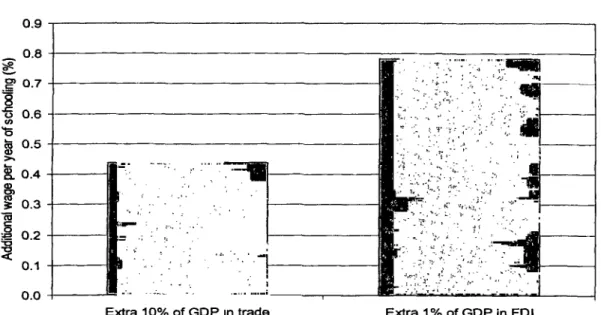
Transition economies represent an upper bound. Their initial returns to education were abnormally low, due to the deliberate earnings compression pursued by socialist regimes. For most developing countries confronting globalization, the initial wage inequality by skill is much higher. Still, a more systematic analysis of the relationship between openness indicators and returns to education confirms that globalization does increase the wage gap between skilled and unskilled workers, at least in the short run. Figure 6 shows the effect of increased openness on the wage premium to an additional year of schooling. This effect is estimated using data from more than three hundred studies on the returns to education in developing countries. Again, those studies use data sets with different coverage and do not necessarily rely on the same econometric
approach. But as long as the nature of the data and approach are not affected by openness, this diversity should not bias the results.
The bars in Figure 6 indicate point estimates for this effect, based on regressions that allow for different returns by country and year. These regressions include as the key explanatory variable an openness indicator, lagged one year. For the bar on the left, this indicator is the ratio of trade to GDP; for the bar on the right, it is the ratio of foreign direct investment to GDP. The estimated effects are sizeable. An extra one percent of
GDP in foreign direct investment raises the premium associated with an additional year of education by almost 0.8 percentage points. This is equivalent to increasing the wage gap between a college-educated person and a worker with primary education by roughly
10 percentage points. Moreover, the estimated effects are statistically significant and their size does not change much if other control variables are added to the regression, or a contemporary openness indicator is considered.
Figure 6. Returns to Education and Globalization 0.9 0.8 0.5 -K 0.4 0.3-02 02 0.1 -0.0 -_______,
Extra 10% of GDP in trade Extra 1% of GDP in FDI
The impact of globalization on the wage premium to education is likely to be
temporary. Over time, it should be offset by an increase in the relative supply of educated workers. The high wage premium for college-educated workers provides an incentive to seek additional education. As a result, the relationship between globalization and increased returns to skill should become weaker, or even vanish, in the longer run.
The impact of globalization on the gender gap in earnings, on the other hand, could be more durable. This gap can be measured as the difference in earnings between men and women that cannot be explained by their differences in educational attainment or work experience. In Vietnam, at the beginning of the reform process, this gap was close to 39 percent in the private sector and 29 percent in state-owned enterprises. Five years later, in 1997-98, it had shrunk to 26 percent and 19 percent respectively (Rama, 2001 a). A similar change was found in Mexico, in the context of trade liberalization. Artecona
and Cunningham (2001) showed that the gender gap in earnings declined more in sectors that were more exposed to foreign competition.
This evidence is admittedly scattered. But it is consistent with a non-competitive model of the labor market, where employers have some bargaining power to set wages and can therefore discriminate against women. Globalization, and the reform efforts associated with it, increase competition in product markets. This additional competitive pressure could reduce the scope for employers to set wages and discriminate against women.
4. Job Destr¢tnosn zimd Job P Ciraom
Looking at the average wage, or even at the wage distribution, is not enough to understand how globalization can affect individual workers. Specific groups could experience large gains or losses due to globalization. But if these groups are small, or if their movements up and down the ladder cancel each other, the impact on the average wage or the wage distribution may not be visible. The more substantial the churning effects, the more likely that globalization will be resisted by the potential losers. Job creation and job destruction are important mechanisms through which churning may occur. But the very nature of some continuing jobs can also change in the process. This is what happens when a worker ceases to be covered by a collective bargaining agreement, or when a permanent worker who enjoys all the perks and benefits extended by formal labor regulations is replaced by a temporary worker with limited rights.
A series of case studies on the effects of trade liberalization shows a considerable dispersion of the net impact on employment. In some countries, net job losses were quite minimal. In Morocco, for example, employment in the average private sector
manufacturing firm was basically unaffected by trade liberalization (Currie and Harrison, 1997). The shift in labor demand was modest in Mexico as well (Revenga, 1997). But in Uruguay, in a period in which trade union activities were banned, the decline was
substantial. During that period, reducing the protection rate within a sector by one percent led of an employment reduction between 0.4 and 0.5 percent within the same year. The employment effect became much smaller when trade union activities were allowed (Ramna, 1994).
Small declines in employment may hide substantial job churning however. The contrast between studies at the industry level and at the firm level is revealing in this respect. Seddon and Wacziarg (2001) used industry-level data to examine the impact of trade liberalization episodes on movements of labor across sectors. Their study found some labor reallocation between narrowly defined manufacturing activities. But the estimated effects were statistically insignificant and small in magnitude. On the other hand, Levinsohn (1999) used firm-level data to examine the pattern of job creation and job destruction in Chile during trade liberalization. Whereas net employment in
manufacturing fell by about 8 percent, in all years in this period about a quarter of all workers changed jobs.
Globalization also affected the nature of jobs in formerly protected sectors. In Morocco, there were significant employment losses in specific groups of firms, which started to rely more on low-pay, temporary workers. The share of temporary employment in manufacturing rose by nearly twenty percentage points between 1984 and 1990. In Mexico, trade reform reduced the rents available to be captured by firms and workers. As a result, an average tariff reduction of 20 percentage points led to an implied wage reduction of more than 5 percent. In Uruguay, trade liberalization was associated with lower wages in the period when trade unions were not active, despite the considerable reduction in employment. In the period with active unions, the membership rate was strongly correlated with tariff barriers and concentration at the industry level. This correlation suggests that workers in protected sectors enjoy higher wages and better working conditions than their counterparts in sectors exposed to foreign competition.
Overall, these studies show that there was pervasive rent sharing between the protected enterprises and their workers. The removal of trade barriers makes workers lose those rents, either because they lose their jobs altogether, or because the rent attached to their jobs becomes smaller. This interpretation is consistent with the one offered for the effect of globalization on the gender gap in earnings. In both cases, increased competition in product markets appears to reduce the size of labor market rents enjoyed by either employers or employees. On the other hand, there is no strong evidence to support the claim that labor demand has become more elastic as a result of globalization (Chinoy, Krisna, and Mitra, 1998; Maloney and Fajnzylber, 2000).
Another source ofjob destruction has been the downsizing of state-owned enterprises and government agencies. The most dramnatic retrenchment episodes took place in transition economies, where millions of workers needed to be reallocated to the private sector. But all regions in the world have had their dose of downsizing in recent years (Haltiwanger and Singh, 1999; Kikeri, 1997). In some cases, up to a half of the workforce in state-owned enterprises needs to be considered redundant, if those
enterprises are to be run as private firms (Belser and Rama, 2001). It could be argued that public sector downsizing is not directly connected to globalization, but the two are not independent either. Countries that remain isolated from the outside world can keep their state sectors untouched for much longer.
Studies following public sector workers after retrenchment, or comparing their earnings and benefits to those of similar private sector workers, reveal a consistent
pattern of losses from job separation (Rama, 1999). Other things equal, the decline in earnings and benefits is smaller for more educated workers, and larger for those with more seniority in the public sector. However, the total loss may not be as large for the latter, as they usually have fewer years of work before retirement. Studies focused on welfare, rather than just earnings and benefits, also show larger losses for workers with more dependents. Finally, women can also lose more than men. They are not necessarily more likely to be targeted by downsizing programs, but they are more likely to
experience a large drop in earnings. The gender gap in earnings tends to be smaller in the public sector than out of it, implying a bigger loss, in relative terms, for separated
women. Moreover, the public sector usually offers benefits that are highly valued by women, such as maternity leave, flexibility of hours and daycare facilities. These benefits are more rare in the private sector, and generally unavailable in the informal sector, where most of the new jobs taken by separated workers are. Not surprisingly, women are more likely than men to withdraw from the labor force after downsizing (Rama and MacIsaac, 1999).
Globalization has also led to substantial job creation, however. The most visible part of this creation is associated with foreign direct investment and, particularly, with export-processing zones. The latter are often defined as fenced-in industrial estates specializing in manufacturing for exports that offer free-trade conditions and a liberal regulatory environment. But this definition is too restrictive. In countries like China or Mauritius, firms are not geographically constrained in industrial estates. In others, they are allowed to sell part of their output in the domestic market (Madani, 1999). In theory, export-processing zones represent a sub-optimal mechanism to integrate a country with world markets, the optimum being to offer free-trade conditions and a liberal regulatory environment across the board. In some countries, such as Sri Lanka, social and political constraints may prevent the complete removal of barriers and regulations in sectors with powerful vested interests. In this case, export-processing zones can be seen as a way to reform "at the margin". In other countries, like China, special zones have been a way to experiment market-oriented reforms.
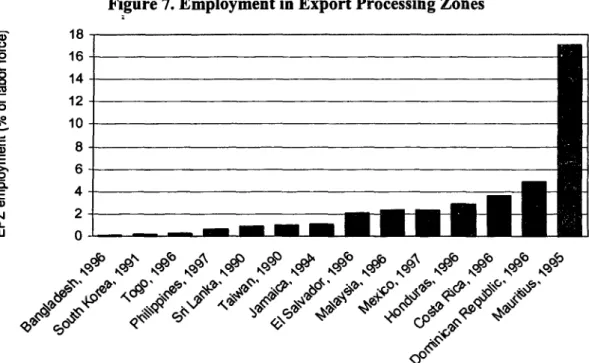
Regardless of their theoretical merits, export-processing zones have been a powerful engine of employment generation. Figure 7 reports the share of the total labor force employed in these zones in selected countries during the 1990s. The case of
Mauritius is outstanding. But the share is considerable in several of the other countries as well, especially when taking into account that agricultural activities and the informal sector still employ a considerable fraction of the labor force.
On the other hand, jobs in the export-processing zones are not as good as the "privileged" jobs in protected activities or in the public sector. One of the features of these zones is their flexibility with labor laws. In some countries, the flexibility is explicit. For instance, prior to 1993 the Dominican Republic law did not impose the minimum wage on export-processing zones. In other countries, the zones are not excluded from labor laws, but the latter are not enforced either. Lax governmental supervision and opposition to labor unionization and union activities are common. As a result, jobs in export-processing zones are less secure than formal sector jobs out of them. As regards wages and working conditions, they vary substantially depending on the size,
nationality and corporate policy of the firm, the type of industrial production, labor market conditions and the country's institutions and regulations.
Figure 7. Employment in Export Processing Zones
8 18 16 -_ ~~1412 -at0 10 8-E 6-E 4 N ~~2 W9 0 9 09 00~~~~~1
Source: Constructed using data gathered by Madani (1999).
Most of the jobs in export-processing zones are held by women. In the Caribbean zones approximately 80 percent of the workforce is female, and the percentage is almost as high in the Philippines. This female bias is especially strong in garment production. Several reasons have been advanced to explain why women, many young and single, are sought after as prospective employees. Women are said to be more diligent and have more dexterity than men. Also, the fact that most of them marry and leave after a few years implies that they tend not to get involved with trade unions. Last but not least, women tend to be paid less than men. Madani concludes that, despite their lower pay, women might be the unintended beneficiaries from the formation of export-processing zones. Many would have remained fully or partially employed in the informal sector, or stayed at home, were it not for them.
The pattern is similar in countries that have not relied massively on export-processing zones, but where exporting firms have tapped local labor markets, attracting workers from the surrounding villages. Industries such as textiles and electronics have massively hired young, literate, largely single women, who frequently ended up earning more than in traditional sectors, such as agriculture or cottage industries. This female bias has been observed even out of the wage sector. Evidence from Ghana and Uganda reveals that women had substantial economic mobility in response to economic reforms. In these two countries, rural women became increasingly engaged in non-farmn employment activities, moving into the non-farm sector at faster rates than men (World Bank, 2001).
To the extent that globalization does translate into significant job creation in developing countries, the potential impact on poverty can be dramatic. But this impact depends significantly on where the job creation occurs. In China much of the impetus for the rapid economic growth during the 1980s came from a tremendous expansion of rural township and village enterprise activities. These frins often emerged out of the
community level structures which had been in place prior to the introduction of the household responsibility system in agriculture in the late 1 970s, and typically became involved in labor-intensive export oriented manufacturing activities (Byrd and Lin, eds.,
1990). The inroads into rural poverty which were achieved in China during this period were nothing short of remarkable (World Bank, 2000b). In other parts of the developing world a similarly strong negative relationship between poverty and the non-farm sector has been observed. Even where non-farim employment opportunities accrue primarily to the relatively educated and skilled (and thus non-poor), benefits to the poor are often still discernable. This is due to the relationship between the wage rates earned by agricultural laborers in rural areas, who are generally highly represented among the poor, and the tightening of rural labor markets which generally accompanies an expanding non-farm sector (Lanjouw and Lanjouw, 2000).
On the other hand, there is a legitimate concern that participation in world markets may be associated with an increase in child labor. The latter could have a detrimental effect on child welfare, both in the short term and in the longer term, though reduced schooling. Policy reforms that promote labor-intensive production could therefore be a mixed blessing for the poor. For example, a recent study of child labor in a city in western India concluded that: "The prevalence and absolute expansion of child labor in a period and region of relatively high growth of aggregate output indicates that the nature of economic growth is flawed" (Swaminathan, 1998, page 1526). The argument merits closer scrutiny. An important issue is whether sectors exposed to international
competition tend to be more intensive in child labor. Unfortunately, the evidence in this respect is scattered.
According to statistics assembled by the International Labour Office, about 70 percent of the children who work are employed as unpaid family helpers in rural areas (Ashagrie, 1997). Around 5 percent of all child workers could actually be employed in export industries. A well-known example is the carpet industry in Uttar Pradesh. An International Labour Office survey of carpet-weaving enterprises found that a quarter of the workers were less than 14 years old. Children and adults perform the same job in these enterprises, with roughly the same productivity. But children workers have lower wages. Given how competitive the industry is, some argue that small loom owners would not be able to absorb the decrease in profits, were child labor banned. Garment
manufacturing in Bangladesh was another notorious example. However, enterprises stopped employing children under 14 years of age due to a consumer boycott in industrial countries. It is through the sex industry that globalization could have its most adverse impact on the children of developing countries. Lower travel costs and better information networks may be associated with a growth in sexual tourism, including pedophilia. The children affected may only represent a tiny fraction of all the children who work. But the implications for their well-being are dramatic enough to warrant swift public action.
5.
Unemployment
While globalization prompts both job destruction and job creation, the timing of these two processes might not be synchronized. During periods of trade liberalization, and more generally of economic reform, job destruction rates can be expected to proceed at a much faster pace than job creation. Globalization could therefore be associated with higher unemployment rates. Moreover, exposure to international markets could amplify macroeconomic fluctuations. Terms-of-trade volatility and speculative capital flows
could lead to booms and busts, increasing the variability of unemployment rates. Even if the average unemployment rate remained unchanged over the business cycle, job
turnover could increase, and with it the feeling of economic insecurity.
Before addressing the impact of globalization on unemployment, it is important to emphasize that the very concept of unemployment is somewhat ambiguous in many developing countries. According to the standard definition, an unemployed person is
someone who would like to work at the prevailing wage rate, and is actively searching a job, but cannot find one. This definition is problematic in countries where the salaried relationship is not prevalent, and employment in household enterprises and farms is common. Assessing the willingness to work becomes difficult in this context. Minor changes to the questionnaire of the survey instrument used to measure unemployment may dramatically affect the results. Thus, in Jamaica the "unemployment rate" is roughly twice as high as the so-called "jobless rate", the difference being due to allegedly
discouraged job seekers. Measuring employment is difficult as well. For instance, it could be argued that someone spending a few hours a week as a street vendor, or helping in a farm or a household enterprise, is not really employed.
This ambiguity also has implications when it comes to understanding the determinants of unemployment. In many developing countries, a large portion of the unemployed is made of educated, middle-class young adults who have not worked before. Because their families can afford a protracted job search, these young adults can wait for a "privileged" job opening in the salaried, formal sector, and discard the available alternatives in the informal sector.
Several studies have documented the importance of the gap between "privileged" jobs and other jobs as a determinant of unemployment irl developing countries. For Sri Lanka, Dickens and Lang (1995) were among the first to question the hypothesis that education was the main reason for unemployment. Controlling for sex, sector and age, they showed that there was no relationship between education and unemployment for urban youth and only a weak relationship for rural youth. Even the latter relationship is brought into doubt when accounting for unemployment duration. Typical unemployment spells last four
years or more, and duration is not related to education. Dickens and Lang concluded that more educated youth had higher unemployment rates simply because they have left
school more recently. For Egypt, Assaad (1997) examined the combined impact of the employment guarantee for graduates and public sector compensation policies on unemployment rates. These policies encouraged queuing for government jobs,
contributed to high graduate unemployment rates, and reduced the employment of graduates in the private sector. Despite substantial wage erosion in the public sector in
recent years, government wages, when appropriately corrected for worker heterogeneity, were on par with, or higher than, private sector wages, especially for graduates.
To the extent that globalization erodes labor market rents, the incentive to wait for "privileged" jobs, rather than taking readily available ones, could be reduced. However, this might be a long-term effect. In the short term, there is evidence that unemployment can go up, some times substantially.
Figure 8 reports the unemployment rates of four successful globalizers during the first two decades of their reform process. The countries are Chile, Mauritius, Poland and Sri Lanka. Each of them can be considered a model in its own region. Needless to say, economic policies were not always ideal in all of them. Chile had a failed experience of exchange rate based stabilization, leading to a massive financial crisis. Mauritius relied on an export-processing zone regime that is not, theoretically, the most efficient way to integrate with the rest of the world. Poland and Sri Lanka maintained their protection of bloated and inefficient industries and state-owned enterprises. Still, on average the economic management of these countries is probably close to the best that can realistically be expected.
IFgnre 0. [JmeaieoilloymEeam Ites in ccesfTunl 001bosiani r
25 20-D15 -- CHILE --- MAURITUS E D -o \ t; tD \ .' __----. POLAND ER 10 - SRI LANKA 5 -0 IN 4 Cb b
Year In the reform process
Source: Constructed data gathered by Rama and Artecona (2002).
All four successful globalizers have in common a long period of high unemployment rates after the launching of the economic reforms. The precise year chosen to draw figure 8 is, admittedly, subject to controversy. For Chile and Poland, the year one in the figure is the end of the socialist regime, even if many important reforms happened subsequently. For Sri Lanka, the year one is 1977, when a large trade
liberalization process was launched. For Mauritius, it is 1970, when the export-processing zone regime was introduced. Other dates would be defensible as well. When the initial year of the reforms is modified, it becomes unclear whether globalization actually led to
higher unemployment rates. However, the conclusion that high unemployment rates failed to decline for a long time seems robust.
Two developing regions are missing in figure 8, despite the fact that they both have successful globalizers in their ranks. East Asia and the Pacific is the region with the best record in this respect. But in all its successful globalizers unemployment rates remained very low for decades, until the crisis of the late 1990s. The Middle East and North Africa region, on the other hand, does not include many success stories. While Tunisia is one of them, a high and stable unemployment rate is one of the few weak points in its otherwise remarkable performance. However, the case of Tunisia is more in accordance with figure
8 than its stubbornly high unemployment rate suggests. This is because the survey instruments that were used to measure unemployment over the last few decades did not use comparable questions to assess the willingness to work. An assessment of
comparable estimates actually reveals a steady, if slow, decline in the unemployment rate since the 1980s (Rama, 1998).
In the long run, open economies do not appear to have higher unemployment rates, as shown by figure 9. If anything, their unemployment rates are lower. The comparability issues raised at the beginning of this section could cast doubts on the interpretation of this figure. But to the extent that country- and period-specific biases are independent from the degree of openness of the economy, the pattern described by the figure should be
basically correct. This pattern is one of high dispersion of unemployment rates in more closed economies, and convergence towards a relatively narrow range in more open economies.
Figure 9. Unemployment Rates and Openness to Trade 35 30--.25 L'20-D a- 15 E 10 5 0 0 50 100 150 200 250 300 Foreign trade In % of GDP
Source: Average unemployment rates over five-year periods are from Rama and Artecona (2002). Data on the trade-to-GDP ratio are from the World Bank.
Other studies reach a similar conclusion. In Latin America, during two decades of increased exposure to foreign trade and international capital Imovements there was only a mild upward trend in unemployment rates. The increase was dramatic in a few countries, such as Argentina, Colombia or Paraguay. But the median rate grew by only one
percentage point (World Bank, 2000a). This relative stability is in contrast with the popular perception, as reflected in opinion polls. Risk of unemployment ranks as one of the main concerns voiced by those surveyed, in most of the region. Another interesting puzzle is that many of those who became unemployed in recent years used to work in the informal sector of the economy and, therefore, were not directly exposed to import competition or exchange rate fluctuations (Arango and Maloney, 2000).
6. lRaDw toD MMEZite thne (:o$t$
As globalization can create losers, and not just winners, it is important to identify what, if anything, can be done do to mitigate the impact of economic reforms aimed at integrating the economy more closely to the rest of the world. A large array of
government interventions has been tried in the developing world, and the lessons learned in one country could prove useful in others. Some of these interventions are intended to help workers cope with job loss. Others could be used to limit the negative effects of globalization on specific groups of workers and households. These negative effects could include the potential decline in the earnings of unskilled workers, the reliance on child labor in export-oriented industries, and the increased volatility of employment and earnings potentially associated with terms-of-trade fluctuations and short-term capital movements. Even if these negative effects do not materialize in the end, preparedness would be key to build support for economic reforms.
The most effective ways to mitigate the adverse effects of globalization are probably out of the labor market. If exposure to international trade and foreign direct investment increases the returns to education, thus widening the earnings gap between skilled and unskilled workers, an effective education policy should be a priority. Higher, and more evenly distributed levels of schooling would be key to ensure that the gains from globalization are widespread. If intemational capital flows and the resulting macroeconomic fluctuations may lead to a substantial decline in the labor share of income, sound fiscal and financial policies should be a priority. Minimizing the risk that the country will default on its obligations, and that a banking crisis will occur, would help avoiding panic and herd behavior by foreign investors.
But labor market policies are needed too, especially to mitigate the impact ofjob loss. These policies can be classified in two groups: one-time interventions and permanent programs. One-time interventions have been used in industrial countries to process the restructuring of declining industries, such as steel mills or shipyards. In developing
countries, they have been common in the context of public sector downsizing. Offering compensation and assistance to those bound to lose their jobs has been a way to defuse resistance to privatization, trade liberalization or market deregulation in industries where
insiders are vocal and powerful. Compensation of this sort can be criticized on the grounds that public sector workers are seldom poor, and tend not to fall in poverty in
large numbers, even long after job separation. Using scarce budget resources on them seems at odds with poverty alleviation efforts. But the alternative to compensation could simply be lack of restructuring.
If they were perfectly designed, compensation packages for redundant workers would turn them indifferent to job loss, thus making economic reforms optimal in the
sense of Pareto. However, the experience suggests that the design of these packages is far from ideal. Examples of over-compensation and under-compensation abound, sometimes within the same downsizing program. Packages are often based on precedents, such as the number of years of salary, or of months of salary per year of service, offered in other countries or sectors. A more sensible basis to assess the amount of compensation needed to achieve indifference is the analysis of microeconomic data on the earnings redundant workers could hope to make after separation. This analysis is feasible in developing countries, and several methods can be used to compute the loss in benefits as well (Assaad, 1999; Chong and Rama, 2001 a).
A downsizing program can be seen as an investment operation, with compensation packages and other related expenditures representing the up-front spending, and benefits being reaped over the years. But some important costs and benefits can be hidden. For instance, some analyses omit to consider among the costs of downsizing the unfunded liabilities created by early retirement programs. More importantly, the distinction
between financial returns and economic returns is often ignored. The difference between the two can be substantial, as shown by a case study on the Algerian retrenchment program (Ruppert, 1999). Financial returns compare costs and savings from the budget perspective, whereas economic returns measure the impact on aggregate output. In particular, economic returns take into account the employment alternatives of retrenched workers. Economic returns can be low when there are limited employment alternatives, as in the one-company town setting (Rama and Scott, 1999). On the other hand, they could be very high when restructuring activities such as ports or telecommunications, whose inefficiency is a hindrance to other sectors.
As regards permanent programs to help workers cope with job loss, the most obvious example is unemployment insurance. In fact, there are a growing number of voices calling for the set up of this program in middle-income developing countries. This recommendation may surprise at a time when unemployment insurance is under fire in industrial countries, due to its adverse incentive effects. Several studies have shown that long-lasting benefits encourage the unemployed to stay out of a job. For this reason, some suggest to adopt a mandatory savings account program instead. This program can be part of the old-age pension system, especially when pension benefits depend on past
contributions. In this case, workers can add any unused savings to their old-age pension account, and "borrow" from their old-age pension entitlement in the event ofjob loss.
In the case of developing countries, however, both the adverse incentive effects of unemployment insurance and the merits of individual savings accounts might be overstated. When the informal sector is large, it is very difficult to monitor that the beneficiaries are really unemployed. Therefore, unemployment benefits create an incentive to stay out of the formal sector while benefits last, not to stay out of a job. As
regards mandatory savings accounts, they do not involve any risk pooling: only a spreading of the earnings loss from unemployment over the life cycle. If workers cannot "borrow" from their old-age pension account, and they do become unemployed when they are still young, they might not have enough resources to cope with job loss (unless the mandatory savings rate is very high). On the other hand, if they can "borrow" substantially, they face an incentive to become unemployed, get as indebted as possible, and withdraw permanently from the formal sector to avoid repaying their debt.
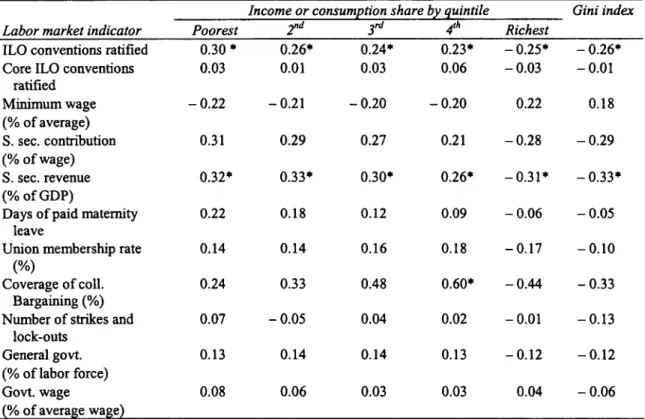
Another potential shortcoming of unemployment insurance and mandatory savings accounts programs is that they may not reach the poorest workers. Table 1 summarizes the findings of a comparative study on income support programns for the unemployed in Latin America (World Bank, 2000a). This region has experienced with a variety of programs, and can be seen as a laboratory by other middle-income countries. Table 1
shows that very few of the workers covered by unemployment insurance in Brazil and by mandatory savings accounts in Colombia, belong to the population group with the lowest earnings or consumption. These two income support programs are well suited for workers in protected industries, who are usually enrolled with social security. But the evidence discussed in the previous section indicates that many, among those who lose their jobs, come from the informal sector. Unemployment insurance and mandatory savings accounts are not the appropriate programs to assist them.
Tab1e ll. LImcone $snpj pot 7grosms ffr 9¢e IJmempnloyed
Workers Spending Share of beneficiaries by earnings or consumption legally per Cost of 0%o)
covered benefi- the
Program and by the ciary program 2nd 2nd
country program (US$) falls on Poorest poores, Middle richest Richest
Public works in In 3,100 Taxpayers 78.6 15.3 3.5 2.1 0.4
Argentina principle
all
Training Eligible 393 Taxpayers 69.9 15.5 8.1 5.0 1.5
in Mexico on age,
education
Severance pay Salaried, 760 Workers 4.7 9.5 28.6 33.3 23.8
in Peru with and
given employers
seniority
Unemployment Salaried 664 Workers 10.6 24.6 19.1 25.1 13.6
insurance in in social and
Brazil security employers
Individual Salaried Not Workers 0.0 4.3 Not 19.1 76.6
accounts in in social available applicable
Colombia security
Note: Constructed using data from World Bank (2000a).
At the other end of the spectrum, there are income support programs for the unemployed that do reach poor workers. Public works, like the Maharastra employment guarantee scheme in Iadia and the Trabajar program in Argentina, are among them (Ravallion, Datt and Chaudhuri, 1993; Datt and Ravallion, 1994; Jalan and Ravallion,