A CASE STUDY THAT SHOWS THE IMPORTANCE OF COLOR
IN WEB COLLABORATIVE EDUCATIONAL ENVIRONMENT
Ana L. Dias1, Marcos A.R.Silva1, Junia C.Anacleto1, Luciana M.Silveira2, Rosângela A.D.Penteado11 – Department of Computing – Federal University of São Carlos (UFSCAR), Brazil {ana_dias, marcos_silva, junia, rosangela}@dc.ufscar.br
2- Department of Technology – Technological University of Paraná (UTFPR), Brazil [email protected]
Keywords: Common Sense, Colors, Emotions, Motivational Design Patterns, Web Project, Case Study.
Abstract: Collaborative learning supported by computers increases due to the tendency schools have to get assumed to digital inclusion in curriculum and to explore this potential as an alternative complementary to the traditional teaching methodology. According to this new practice the individual skills are valued and contribute to build up learning, which belongs to the group. However, it can be seen that learning through computing environment is not always effective because it can generate lack of motivation, little involvement and collaboration. It is always difficult to engage apprentices in learning activities in order to motivate them both to persist in challenging tasks and to value education, generally. This paper presents a Case Study applied to a School that shows the colors and their meanings as cultural as a stimulus to motivation and learning, through the application of Motivational Patterns in a Web collaborative educational environment.
1 INTRODUCTION
It is observed the growth of computers use and web software adoption by institutions like elementary and high-schools. In those institutions, the e-learning supported by web tends to increase because Schools want to use such environment as one more educational tool and, in developing countries; they need to use Information and Communication Technologies (ICT) to promote digital inclusion. Also, it is more and more necessary for Schools to leverage the collaboration among apprentices in order to develop learning activities on the web. On the other hand, it can be seen that web collaborative e-learning is not always effective, because it may also generate lack of motivation, little engagement and collaboration, once apprentices are not used to used ICT in the School context of collaboration.
In order to change such scenario, many aspects have to be analyzed. In this paper the importance is taken to the motivational aspects that can lead the apprentice to be engaged into the collaborative task through the Web, considering the apprentices’ cultural values which interfere in the performance of each apprentice. Therefore, this paper explore the potential of color and their cultural meanings
expressed in common sense knowledge as successful solutions to recurring problems of lack of motivation once society and culture can influence on interface development. Empirical results for the practical use of color are shown exemplifying how colors and emotions communicate in practice.
2 THE LEARNING SUPPORTED
BY COMPUTERS
The effects of computers at School depends on several factors, but the generality of the research points to the possibility of developing new cognitive skills, including: greater responsibility for the work of apprentices, new bonds of mutual assistance, and new relations between educator-apprentice may reflect the motivation of apprentices for learning (Freire, 1981). However, even with the support of the computer at School, some educators are many difficulties in the classroom. There is a relative consensus among educators about what is the main problem of apprentices in School: the majority point to the lack of interest.
There are some behaviors to motivation of apprentices in stimulating learning. Specifically, this
study focuses on the three models of behavior identified by Clear and Kassabova (2005) combined with those identified by Seifert (2004) (this paper considers as motivational problems): I- Apprentices act only to attain extrinsic motivation and hope that the content learned is meaningful to them instead of them even engage in the activity seeking a way to make learning meaningful. II- Keep the enthusiasm and involvement of apprentices in educational Web computing environment so that they feel pleasure and satisfaction during the proposed activity by the educator, committed with the learning.
III-Apprentices are dependent on the motivation of another participant who works collaboratively with him, feeling a lot of guilt, despair, humiliation and disappointment.
According to Stipek (1996), it is important to consider several factors for the success of learning is achieved. Among these factors are: the use of technology in Schools, educators with knowledge of the technologies involved, and the motivation of apprentices to use new methods of teaching. Besides these factors, it is essential to consider the differences between apprentices that complicate the definition of universal parameters that can be used to motivate them.
3 COLORS AND CULTURE
Colors symbolically constructed in culture are considered as a differential factor in the quality of Web environments. It is important to study and understand the meanings of colors, since these are open to interpretation and therefore can vary from culture to culture. In this context, this paper explores the question of colors and their meanings based on common sense, to support the design of educational solutions that promote collaboration.Common sense is defined here as a set of facts known by most people, covering a large part of human experience, knowledge of spatial aspects, physical, social and psychological of day to day human beings (Anacleto et al., 2006). This paper uses the common sense of OMCS-Br Project, which aims to explore the Web as a way of building a knowledge base, through templates, as shows in Figure 1.
Figure 1: Example of the templates.
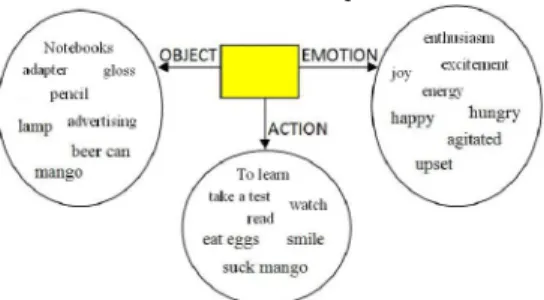
To analyze the information collected by these templates, it is being done a classification of emotions, actions and objects (Dias, 2009). Figure 2 shows an example with the yellow color, where the square shows the color to be analyzed.
Figure 2: Yellow color associated emotions, actions and objects.
The variety of the colors seduces the people to use exaggerated colors. To increase the security that the designer has to manipulate and assign the colors in a harmonious way in an educational collaborative Web environment, this paper shows how to solve some problems found in apprentices during the learning through Patterns.
4 PATTERNS
This paper adopts the meaning of Pattern as described by Alexander et al. (1977): "Pattern is a solution to certain problem in a particular context." The Motivational Patterns formalized in this research (Dias, 2009), help designers choose the right way the colors to be used in educational environments, collaborative Web aiming to motivate apprentices to collaborate with their colleagues. The Motivational Design Pattern set created is based on color has three Patterns: "Engaging in learning" (P1), "Keeping engaged" (P2), "Engaging with the group" (P3). In order to observe the use of the Pattern, it was realized a Case Study with P2 Pattern because it is related to educational environment. Therefore, it is presented below.
Pattern name: Keeping engaged (P2)
Problem: To keep the enthusiasm and engagement of apprentices in Web collaborative educational environment so that apprentices (committed to the learning) can feel pleasure and satisfaction during the proposed activity.
Context: The Web collaborative educational environment has been increasingly used as an option to improve teaching and learning.
when using the Web collaborative educational environment.
In order to help designers to develop web interface taking into consideration this problem to avoid it or decrease the chances of it happening, it was analyzed all information related with colors, obtained through OMCS-Br Project, to identify what colors can be used in this case. According to common sense base, Brazilians can feel both excitement and joy (60%) when remember into the yellow color.
After choosing yellow from common sense, it was observed that some experts in the field (Pastoreau, 1997; Silveira et al., 2005) also describe that yellow color can transmit heat, light and fun, besides being energy, active color transmitting optimism. Using it concentration and ease of communication can be improved using this color. However, using a wrong way can bring sadness or discouragement.
It is very difficult to use just one color to develop the whole interface, then, the color schemes presented below are based on the Color Application Methodology (Silveira et al., 2005) to support the implementation of the yellow color as a solution The methodology is described in four kinds of schemes, spinning the classic color wheel, such as: Basic, Opposite, Analogous and Triad.
Basic schemes:
Neutral 1: to choose a shade on the color circle, in this case yellow, combined with shades of brown. To use yellow and the interval between this tone and its mixture with medium brown.
Neutral 2: to harmonize three shades of brown from the fixed yellow tone and its composition with three shades of brown.
Gray colored: to mix yellow with medium gray (50% black, 50% white), creating infinite ranges of gray colored. You can use the two "ends" of the palette, i.e., yellow and medium gray at the same time.
Opposite schemes:
Broken Tones: to use the yellow color and its complementary color (opposite color to 180 degrees). The palette is made of yellow toward its complement, through the center of the circle, i.e., neutral gray.
Complementary: to work only with the chosen fixed color, in this case, the yellow with its complement, violet blue. This scheme, which does not pass through the center of the circle using the gray, differs from the broken tone.
Complementary doubles: to find the complementary color from the chosen color as the main one, for example, yellow color, and find its complementary color. From the yellow color move clockwise, choosing the second successor in case of color red, and then find the complementary color to red, in this case cyan color.
Divided Complementary: to combine three colors. For example, from the yellow color, to find the two adjacent colors to the complementary color, i.e., find the color before and after its complement.
Shock schemes: to find, for example, from the yellow color, the interval between complementary color and its primary color which increases brightness or other primary that decreases brightness.
Analogous schemes:
To form schemes from neighboring tones (similar color) in the color circle until its complement. From two to seven tones can be used to achieve harmony.
Triad schemes:
To employ three equidistant colors on the wheel result in triangulations with the primary, secondary and tertiary colors. Considering this Pattern, a combination of primary colors (cyan, magenta and yellow), since yellow is a primary color.
5 CASE STUDY
To make possible the Case Study, we applied the P2 Pattern in an educational collaborative Web environment, known as Contexteller (Silva et al., 2009). This Pattern was chosen because according educators, the apprentices they have some characteristics described on problem of P2. The color combination chosen was the first scheme presented in Analogous schemes.
Figure 3: Application of P2 Pattern in Contexteller.
Initially, we defined some practices, as follows:
Goals: observe, along with educators and apprentices, aspects related to motivation and engage in individual, group and collaboration among apprentices. Hypothesis: the application of color regarding their common sense meaning in Web collaborative educational environments may reflect positively on the motivation of apprentices.
Method: the Case Study was performed in a School of the state of São Paulo – Brazil with 50 thousand people.
5.1 Description of Scenario
It was used some computers with external mouse, headphones headset with microphone, XP Windows operating system and software to capture user interaction. Figure 4 shows pictures of some participants in the Case Study local.
Figure 4: Apprentices interacting with Contexteller and answering the questionnaires.
5.2 Developing the Case Study
All users participating in the Case Study signed a consent term to the development and dissemination of results, but their names could not be identified. Two groups, with 5 students, was selected to participate in the Case Study by two teachers of the school, because the Contexteller tool supports only five apprentices working simultaneously.
The educator played with master role that was responsible for presenting and lead the story, and the apprentices were players who could continue the story. The interaction between educators and apprentices through the Game, lasted about 40 minutes for each group.
Educators and apprentices worked with the interfaces changed, however, they did not know about the differences of colors in order to avoid any influence on the data collected. The interfaces modified can be seen in Figure 5.
Figure 5: Contexteller Interfaces.
The same group was not used in both interfaces to avoid prejudice or favor the second application because of the apprentices´ knowledge obtained on the environment with the first interaction. The Case Study results will be discussed in the next Section.
5.3 Case Study Results
After the finished of the Case Study, has begun the phase of data analysis. This section presents the results, which were divided into four subsections according to Methods used.
5.3.1 Pre-Section Questionnaire
Before presenting the tool Contexteller to apprentices, they were invited to fill out the questionnaire Pre-session (in order to collected according to the participant’s backgrounds, the familiarity with computers, computer games, their satisfaction to hear and tell stories), as in Table 1:
Table 1: Pre-section questionnaire answers. Group 1: Gray Interface Group 2: Interface with
P2 They like Game that
need to use the imagination
They do not like to Game that need to use
imagination They like to hear stories
because use the imagination
2 participants said they do not like to hear stories
They do not like to tell stories
They do not like to tell stories Familiar with the
computer and Internet
Familiar with the computer and Internet
5.3.2 SAM Questionnaire
The Participants were invited to fill out the questionnaire SAM (Self Assessment Manikin), to record emotional responses taking into consideration a variety of stimuli (Hayashi et al., 2008), after the first contact with the interface of the Contexteller. Everyone should express their opinion about the interface, marking an option in every emotion displayed: pleasure to displeasure, degree of arousal and dominance to submissiveness. Figure 6 shows the votes obtained. One apprentice marked the first figure of the last column (the best pointing for the degree of pleasure to displeasure) and so on, so that the total of votes for each line resulted in 5, the total number of apprentices.
Figure 6: Gray Interface punctuation.
The points were made as follows: each circle represents a value, the first round (from left to right) is 1, second circle represents a value equal to 2, so on until the last circle that is the value 9.
The result presented in the votes of the interface seems to be consistent with information collected in the Pre-section questionnaire, because most of the apprentices said like stories, and the answers were positives in pleasure to displeasure, degree of arousal and dominance to submissiveness.
Apprentices in Group 2 also filled out a questionnaire SAM. Figure 7 shows the total of votes.
Figure 7: Interface with P2 punctuation.
If the votes of emotion Pleasure to displeasure are added (Figures 6 and 7), whereas the values 1 to 9 as explained above, we can see that the Gray Interface received 32 points while the Interface with P2 received 34 points. These results, although similar, showed evidence that the Pattern used helped in motivating the participants.
For the emotion Dominance to submissiveness, the Gray Interface received 36 points while the Interface with P2 received 33 points. Comparing these results with the videos collected, it was observed that the apprentices, who used the Gray Interface, were not collaborating with each other, i.e. there was a greater individualism which may have influenced a greater Dominance to submissiveness because they were just thinking on their characters. In contrast, analyzing the videos of the group using the Interface with P2, it was apparent that they were concerned to cooperate with each other and this may have influenced to a lesser Dominance to submissiveness, because when there is a collaboration between a group, the control is more dependent on all participants than just one.
5.3.3 Logs
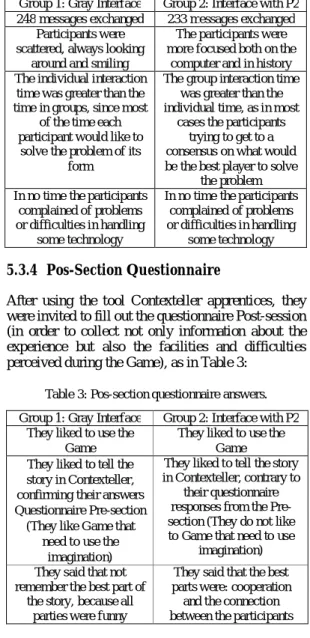
To measure engagement, we analyzed the logs made during whole contact with the Game in order to find factors that could demonstrate the levels of attention and interest of the participants. Thus, some quantitative criteria were used to measure the behavioral level of the participants: number of messages exchanged in the environment, the message content and length of interaction (individual and group), as shown in Table 2.
Table 2: Information obtained in the logs. Group 1: Gray Interface Group 2: Interface with P2 248 messages exchanged 233 messages exchanged
Participants were scattered, always looking
around and smiling
The participants were more focused both on the
computer and in history The individual interaction
time was greater than the time in groups, since most
of the time each participant would like to
solve the problem of its form
The group interaction time was greater than the individual time, as in most
cases the participants trying to get to a consensus on what would be the best player to solve
the problem In no time the participants
complained of problems or difficulties in handling
some technology
In no time the participants complained of problems or difficulties in handling
some technology
5.3.4 Pos-Section Questionnaire
After using the tool Contexteller apprentices, they were invited to fill out the questionnaire Post-session (in order to collect not only information about the experience but also the facilities and difficulties perceived during the Game), as in Table 3:
Table 3: Pos-section questionnaire answers. Group 1: Gray Interface Group 2: Interface with P2
They liked to use the Game
They liked to use the Game They liked to tell the
story in Contexteller, confirming their answers Questionnaire Pre-section (They like Game that
need to use the imagination)
They liked to tell the story in Contexteller, contrary to
their questionnaire responses from the Pre-section (They do not like to Game that need to use
imagination) They said that not
remember the best part of the story, because all
parties were funny
They said that the best parts were: cooperation and the connection between the participants
The Post-section questionnaire of educators is also interesting. The educator felt satisfied when interacting with apprentices to tell the history and answered that the Contexteller allow the apprentices´ expression and the collaborative work.
6 CONCLUSIONS
When a Web environment does not use any color combination scheme, there is a possibility of this environment´s colors do not help the learning
concentration of the users. In an educational collaborative Web environment, the concentration needs to be maximum because it is easier for the apprentice to be seduced by what is happening around him. Therefore, the ideal is both to have a color combination scheme which shows out every detail of the environment and to highlight the points that should attract the apprentice’s attention.
In this context, this paper presented the results obtained in the Case Study. It was interesting to note that some data analysed, such as: concentration, engagement and commitment to the development of story, showed evidence that the Interface with P2 helped in the participants´ motivation. Finally, another datum that we observed, related to designers in Web environment development, was that it is important more details about colors schemes and theirs cultural meanings in order to help designers chosen the best colors.
REFERENCES
Alexander, C. et al. A pattern language: towns, buildings, construction. New York: Oxford Univ. Press, 1977. Anacleto, J.C. et al. Can Common Sense uncover cultural
differences in computer applications?. In: IFIP World Computer Congress, 2006, 1-10.
Clear, T.; et al. Motivational patterns in virtual team collaboration. In: Australian Conference on Computing Education, Austrália: NSW, 2005, 51-58. Dias, A.L. et al. Web Collaboration Motivated by Colors
Emotionally based on Common Sense. In: IEEE SMC 2009, San Antonio-Texas, 2009.
Freire, P. Pedagogia do Oprimido. Rio de Janeiro: Paz e Terra, 1981.
Hayashi, E. C. S. et al. Avaliando a qualidade afetiva de sistemas computacionais interativos no cenário brasileiro. In: Workshop Usabilidade, Acessibilidade, Inteligibilidade. Anais... Porto Alegre: IHC, 2008, 1-5. Pastoreau, M. Dicionário das cores do nosso tempo.
Lisboa: Estampa, 1997.
Seifert, T.L. Understanding student motivation. Educational Research, 2004.
Silva, M. A. R. et al. Promoting Collaboration through a Culturally Contextualized Narrative Game. In: Enterprise Information Systems, 2009, 870-881. Silveira, L. M. et al. Metodologia de Aplicação de Cores
no Projeto Web.In: XI WebMedia-Web e Multimidia: Desafios e Soluções, 2005, P. Caldas, 2005, 97-126. Stipek, D. J. Motivation and instruction. In: Handbook of
Educational Psychology. NY: Simon & Schuster Macmillan, 1996.
Zagury, T. O professor refém: para pais e professores entenderem por que fracassa a educação no Brasil. Editora: Record, 2008.