Efficient Chain Structure for High-Utility
Sequential Pattern Mining
JERRY CHUN-WEI LIN 1, (Senior Member, IEEE), YUANFA LI2, PHILIPPE FOURNIER-VIGER 3, YOUCEF DJENOURI 4, AND JI ZHANG5, (Senior Member, IEEE)
1Department of Computer Science, Electrical Engineering and Mathematical Sciences, Western Norway University of Applied Sciences, Bergen 5063, Norway 2School of Computer Science and Technology, Harbin Institute of Technology (Shenzhen), Shenzhen 518055, China
3School of Humanities and Social Sciences, Harbin Institute of Technology (Shenzhen), Shenzhen 518055, China 4SINTEF Digital, 0373 Oslo, Norway
5Faculty of Health, Engineering and Sciences, University of Southern Queensland, Toowoomba, QLD 4350, Australia
Corresponding author: Jerry Chun-Wei Lin ([email protected])
This work was supported in part by the Western Norway University of Applied Sciences.
ABSTRACT High-utility sequential pattern mining (HUSPM) is an emerging topic in data mining, which considers both utility and sequence factors to derive the set of high-utility sequential patterns (HUSPs) from the quantitative databases. Several works have been presented to reduce the computational cost by variants of pruning strategies. In this paper, we present an efficient sequence-utility (SU)-chain structure, which can be used to store more relevant information to improve mining performance. Based on the SU-Chain structure, the existing pruning strategies can also be utilized here to early prune the unpromising candidates and obtain the satisfied HUSPs. Experiments are then compared with the state-of-the-art HUSPM algorithms and the results showed that the SU-Chain-based model can efficiently improve the efficiency performance than the existing HUSPM algorithms in terms of runtime and number of the determined candidates.
INDEX TERMS High utility sequential pattern mining, sequence, SU-Chain structure, data mining.
I. INTRODUCTION
Pattern mining is considered to find the valuable relationships between items/objects in the databases, and many variants of knowledge were then investigated in different applica-tions and domains, such as association-rule mining (ARM) [1], [10], sequential-pattern mining (SPM) [2], [9], [22], [23], and high-utility-itemset mining (HUIM) [6], [12], [13], [18], among others. SPM which discovers high frequent sequence from sequence database, is one of the important research areas in data mining and knowledge discovery since it shows the correlations of the ordered events, which can be applied in many real-life applications and situations. For exam-ple, the sequence data can be extracted from the Weblog, DNA sequence, or trajectory datasets. Several algorithms [9], [22], [23] have been proposed to improve the mining efficiency regarding SPM but most of them do not, how-ever, consider the other factors or attributes in the databases (i.e., importance, weight or interestingness). To solve this limitation and provide more useful and meaingful informa-tion, the high-utility sequential pattern mining (HUSPM) [17], [29], [32], [33] was presented to consider both utility The associate editor coordinating the review of this manuscript and approving it for publication was Changsheng Li.
and sequence factors to reveal the set of high-utility sequen-tial patterns (HUSPs) from the databases. It takes the quanti-ties and unit profits of the items into account to mine the set of HUSPs as the required knowledge for decision making. In the HUSPM, a sequence is considered as a HUSP if its sequence utility is no less than the pre-defined minimum utility value. However, the task of HUSPM is more complex than that of traditional SPM since the sequence utility does not hold the downward closure property, thus the search space to discover the required HUSPs has become huge. Many algorithms were presented to design the pruning strategies and new upper-bound values to reduce the search space such as USpan [32], HUS-Span [29], ProUM [7] and HUSP-ULL [8]. USpan was introduced to utilize the lexicographic quantitative sequence tree for mining the HUSPs, but the upper-bound value is over-estimated, thus the search space to find the required infor-mation is too huge. HUS-Span consists of two tighter upper bounds, respectively named as prefix extension utility (PEU) and reduced sequence utility (RSU) to establish the upper-bound values of the promising candidates. With the designed pruning strategies and the new upper bounds, the HUS-Span can greatly reduce the size of the unpromising candidates to mine the HUSPs. However, the HUS-Span still has to generate many unpromising candidates to completely mine
the HUSPs, and the database is required to be projected at each time by the level-wise approach. Moreover, the used PEU in the HUS-Span is not updated at each iteration, thus the upper bound is still overestimated; more unpromising candidates are still required to be determined. ProUM [7] and HUSP-ULL [8] are the state-of-the-art approaches by introducing the projection mechanism and efficient pruning strategies to mine the HUSPs.
The above algorithms still suffer the limitation of mem-ory usage (i.e., the state-of-the-art HUSP-ULL), we thus design an efficient sequence-utility (SU)-Chain structure to keep more information for the later mining progress. The projection approach is also utilized in the SU-Chain-based algorithm to speed up the generation progress of the promising candidates. Moreover, several pruning strategies are utilized in the SU-Chain structure to identify the irrele-vant information for the early pruning progress, thus those items can be removed from the projected database, and the search space can be also reduced. From the experiments, we can also observe that the developed SU-Chain struc-ture can produce better performance compared to the pre-vious works regarding the runtime and number of examined candidates.
The organization of this paper is stated below. Literature review is discussed in Section 2. Preliminaries and problem statement of the designed model are studied in Section 3. The designed sequence-utility-chain-based model is devel-oped in Section 4. Experiments are conducted and discussed in Section 5. Finally, the conclusion and future works are mentioned in Section 6.
II. LITERATURE REVIEW
High utility itemset mining (HUIM) [6], [12], [13], [18], [28], [31] is to consider the utility factor of the itemsets to reveal the high profitable itemsets from the databases. Compared with association rule mining (ARM) [1], [10], conventional HUIM does not hold the downward closure property thus the search space of the promising candidates is huge. To efficiently mine the high-utility itemsets (HUIs) and reduce the size of the search space, Liuet al.[13] pro-posed the transaction-weighted utility (TWU) concept, which is used to estimate the upper bound of the itemset utility value. Tseng et al. extended the FP-tree and proposed the UP-growth [25] and UP-growth+[26] algorithms to exploit the nature of the tree for compressing the search space. Linet al.[14] also presented the HUP-tree, which is based on the TWU concept and FP-tree structure [10]. The HUP-tree uses the HUP-tree structure to keep the necessary information of the promising candidates, and the HUP-growth mining algorithm was presented to discover the required HUIs based on the HUP-tree structure. Liu and Qu [15] proposed the HUI-Miner algorithm, which converts the original database into an utility-list structure and mines the HUIs efficiently from the utility-list to avoid the generation progress of the huge candidates. Zidaet al.[35] designed a novel algorithm called EFIM, which consists of two upper bounds on utility
to reduce the size of the search space. Several algorithms [11], [20], [30] using the evolutionary computations have been discussed to find the HUIs in a limit time. Research directions include the improvement of high-utility itemset mining [19], high-utility itemset mining for IoT uncertain data [18], and mining top-khigh-utility itemsets [27] are also the interesting issues and been developed in progress.
High-utility sequential-pattern mining (HUSPM) is an emerging field in recent decades since it considers both utility and sequence factors to discover the utility utility sequential patterns (HUSPs) from the sequence dataset. HUSPM can also be considered for sequence mining of Website logs [34]. Shie et al. [24] proposed the UMSP algorithm and the UM-span algorithm for mining high-utility mobile sequences based on the mobile-business applications. To exploit the use-fulness of web page access sequence data, Ahmedet al.[3] proposed two tree structures, respectively called UWAS-tree and IUWAS-UWAS-tree, to process the static and dynamic databases. Subsequently, Ahmedet al.[4] proposed a high-utility sequential pattern mining algorithm for processing general sequences, namely, the layer-by-layer search UL algorithm and the pattern-extended US algorithm. However, there is no formal definition of high-utility sequential pat-tern mining. Yin et al. [32] officially defined high-utility sequential pattern mining and proposed an efficient algo-rithm, USpan, for mining general sequence patterns with utility values. To simplify the parameter setting, Yinet al.[33] then proposed the TUS algorithm for discovering the
top-khigh-utility sequential patterns. Lanet al.[16], [17] first introduced the concept of fuzziness into sequence mining and then proposed a high-utility sequential pattern mining algorithm to simplify the mining results and reduce the search space. Alkan and Karagoz [5] proposed a high-utility sequen-tial pattern extraction (HuspExt) algorithm, which is used to calculate the Cumulated Rest of Match (CRoM) to obtain a smaller upper bound. The complexity of the search space can thus be reduced. Wanget al.[29] subsequently proposed the HUS-Span algorithm to reduce the unpromising candidates by introducing two utility upper bounds called PEUs and RSUs. However, it is still challenging to find the HUSPs from a very big dataset. In addition, Gan et al. then presented a projection method called ProUM [7] and the HUSP-ULL [8] to efficiently mine the HUSPs, which are the state-of-the-art approaches based on the utility-list structure.
III. PRELIMINARIES AND PROBLEM STATEMENT
LetI={i1,i2,. . .,im} be the finite set ofmdistinct items.
A quantitative item, abbreviated as q-item, is denoted as (ik,qk), which is used to represent the item with its purchase
quantity. An itemset is denoted asw=[i1,i2,. . .,ih] is a
subset ofIwhereh≤m. A quantitative itemset, abbreviated asq-itemset, is denoted asv=[(i1,q1), (i2,q2),. . ., (in,qh))]
is the set of severalq-items. Without loss of generality, here we assume that the items (q-items) are sorted asalphabetic
order in itemset (q-itemset) through the items in itemset. A sequence is denoted ast =< w1,w2,. . .,wd >is the
TABLE 1. A quantitative sequence database.
TABLE 2. A profit table.
sorted list of one or more itemset. A quantitative sequence, abbreviated asq-sequence is denoted as s=< v1,v2,. . .,
vd >, which is the sorted list of one or more q-itemset.
A quantitative sequence database, abbreviated asq-sequence databaseS={s1,s2,. . .,sn} is the set ofq-sequence where
eachq-sequence is associated with a unique identifier called
sid. Table1shows a quantitative sequential database. It has fourq-sequences and six items, denoted fromatof. Table2
shows the unit profits of the items that appear in Table1. Here, several definitions regarding the HUSPM are given below.
Definition 1: Let the utility of an itemir in aq-itemsetv
denote asu(ir,v), and is defined as:
u(ir,v)=q(ir,v)×pr(ir), (1)
whereq(ir,v) is the quantity in aq-itemsetvandpr(ir) is the
profit of an itemir.
Example 1: Take an example as follows. The utility of an itemain the firstq-itemset ofs1in Table1is calculated as:
u(a,[(c:6)(a:3)])=q(a,[(c:6)(a:3)])×pr(a)=3×3=9
Definition 2: Let the utility of aq-itemset in aq-sequence
sdenote asu(X,s), and is defined as:
u(X,s)= X X∈s∧ir∈X
u(ir,X) (2)
Example 2: Take an example as follows. The utility of a q-itemset [(c:6)(a:3)] in q-sequence s1 is calculated as:
u([(c:6)(a:3)], s1) =u(c,[(c:6)(a:3)])+ u(a,[(c:6)(a:3)])= 6×2+3×3=21.
Definition 3: Let the utility of aq-sequence in a quantita-tive sequential databaseDdenote asu(s), and is defined as:
u(s)= X s∈D∧X∈s
u(X,s) (3)
Example 3: Take an example as follows. The utility of the
q-sequences1 in Table1 is calculated as: u(s1) = u([(c : 6)(a:3)],s1)+u([(e:2)(c:2)],s1)+u([(e:6)(b:3)],s1)+
u([(c:2)],s1)=21+6+18+4(=49).
Definition 4: Let the utility of a quantitative sequential database Ddenote asu(D), which is the sum of the utility of each itsq-sequence and defined as:
u(D)=X s∈D
u(s) (4)
Example 4: Take an example as follows. The utility of the quantitative sequential databaseDin Table1is calculated as:
u(D)=u(s1)+u(s2)+u(s3)+u(4)(=49+67+81+133) (=330).
Definition 5: Given two itemsets,wa=[ia1,ia2,. . .,iam] andwb =[ib1,ib2,. . .,ibn], whereiak ∈ I(1 ≤ k ≤ m) andibk0 ∈ I(1 ≤ k
0 ≤ n), if there exists positive integers
1≤ j1≤ j2≤ · · · ≤ jm ≤nsuch thatia1 =ibj1,ia2 =ibj2,
. . ., iam = ibjm, then wb containswa, which is denoted as wa⊆wb.
Example 5: The itemset [a,c] contains the itemsets [a], [c] and [a,c].
Definition 6: Given a q-itemset va = [(ia1, qa1) (ia2, qa2). . . (iam, qam)] and a q-itemset vb = [(ib1, qb1) (ib2, qb2). . .(ibn, qbn)], where iak ∈ I(1 ≤ k ≤ m) and ibk0 ∈ I(1 ≤ k0 ≤ n), if there exists positive integers 1≤j1≤j2≤ · · · ≤jm≤nsuch thatia1 =ibj1∧qa1 =qbj1,
ia2 =ibj2∧qa2 =qbj2,. . .,iam =ibjm∧qam =qbjm, thenvb
containsva, which is denoted asva⊆vb.
Example 6: Take an example as follows. The q-itemset [(c:6)(a:3)] inq-sequences1in Table1contains theq-itemset [(c:6)],q-itemset [(a:3)] andq-itemset [(c:6)(a:3)].
Definition 7: Given two sequencesta=< wa1,wa2,. . .,
wam >and tb =< wb1,wb2,. . .,wbn >, wherewak ⊆I (1 ≤ k ≤ m) andwbk0 ⊆I(1 ≤ k
0 ≤ m) are both itemsets,
if there exists positive integers 1≤j1 ≤j2 ≤ · · · ≤jm ≤n
such thatwa1⊆wbj1,wa2⊆wbj2,. . .,wam ⊆wbjm, thentais
the subsequence oftb, which is denoted asta⊆tb.
Example 7: Take an example as follows. A sequence
<[a,b],[a,c],[b,c]> is the subsequence of the sequence
<[a,b],[a,b,c], [a,b],[b,c]>.
Definition 8: Given twoq-sequencessa=<va1,va2,. . .,
vam >andsb=<vb1,vb2,. . .,vbn >, wherevak(1≤k≤m) andvbk0 (1 ≤ k
0 ≤ n) are bothq-itemsets, if there exists
positive integers 1≤j1≤j2≤ · · · ≤jm ≤nsuch thatva1 ⊆
vbj1,va2 ⊆vbj2,. . .,vam ⊆vbjm, thensais theq-subsequence
ofsb, which is denoted assa⊆sb.
Example 8: Take an example as follows. Theq-sequences
<[(c:6)],[(e:2)(c:2)]> and <[(b:2)],[(e:6)(b:3)]> are two
q-subsequences of theq-sequences1in Table1.
Definition 9: Given aq-sequences=<v1,v2,. . .,vn>
and a sequencet=<w1,w2,. . .,wm >, ifn=mand the
items inviare same as the items inwi, where1≤i≤n, then sis said to matcht, which can be denoted ast∼s.
Example 9: Take an example as follows. A sequence
<[c][e,b]>matches thes1in Table1. Notice that the twoq -itemsets may be considered as different although they contain the same itemset because of the quantities and the position of aq-sequence. Therefore, it is possible that more than one
q-subsequence of aq-sequence matches the given sequence. The sequence <[c]> has three matches in s1:<[(c:6)]>,
<[(c:2)]>, and<[(c:2)]>.
Definition 10: A q-itemset containing k items is called
k-q-itemset. A q-sequence containing k items is called
FIGURE 1. The lexicographic enumeration (LE)-tree of the search space.
Example 10: Take an example as follows. Theq-sequence
s1 is a 7-q-sequence. The firstq-itemset ofq-sequence is a 2-q-itemset.
Definition 11: Let the utility of a sequence t in a
q-sequencesdenote asu(t,s), and is defined as:
u(t,s)=max{u(sk)|t ∼sk∧sk ⊆s}, (5)
where∼denotes the matched relationship andt ∼sk repre-sents thatskis the match oft.
Example 11: Take an example as follows. The utility of a sequence<[a], [b]>in theq-sequences1 of Table1is cal-culated as:u(<[a],[c]>,s1)=max{u([a :3],[c :2],s1),
u([a : 3],[c : 2],s1)}=max{13, 13}=24. This example shows that a target sequence in high-utility sequential pattern mining may have multiple utility values in a transaction, which is quite different from traditional high-utility itemset mining and frequent itemset mining. Different evaluation criteria choose different utility values, and here the maximum value is used as the utility value of the target sequence.
Definition 12: Let the utility of a sequencetin a quantita-tive sequence databaseDdenote asu(t), and is defined as:
u(t)=max{u(t,s)|t∼sk∧sk ⊆s} (6) Example 12: Take an example as follows. The utility of a sequence<[a],[b]>in Table1 is calculated as:u(< [a], [c] >) = u(< [a],[c] >,s1)+u(< [a],[c] >,s2)+u(< [a],[c] >,s3)+u(<[a],[c] >,s4)=13+18+13+34 (=78).
Definition 13: A sequence t in a quantitative sequential database Dis a high utility sequential pattern (HUSP) if it satisfies the condition as:
HUSP← {t|u(t)≥δ×u(D)}, (7) whereδ is minimum utility threshold andu(D) is the total utility of theq-sequenceD.
Example 13: Take an example as follows. The utility of the sequence <[a],[b]> in the q-sequence database D is
u(< [a], [c] >) = 78, and the utility of the q-sequence databaseDisu(D)=330. If the minimum utility threshold
is set to 0.2, then the sequence<[a],[b]>is considered as a high-utility sequential pattern in the sequence databaseD
since 178≥0.2×330 (= 66).
Problem Statement: Given a quantitative sequence
database and a user-defined minimum utility threshold, the task of high utility sequential pattern mining (HUSPM) is to find the complete set of high utility sequential patterns (HUSPs) in which the utility value of each sequence is no less thanδ×u(D) from the quantitative database.
IV. DEVELOPED SEQUENCE-UTILITY (SU)-CHAIN-BASED MODEL
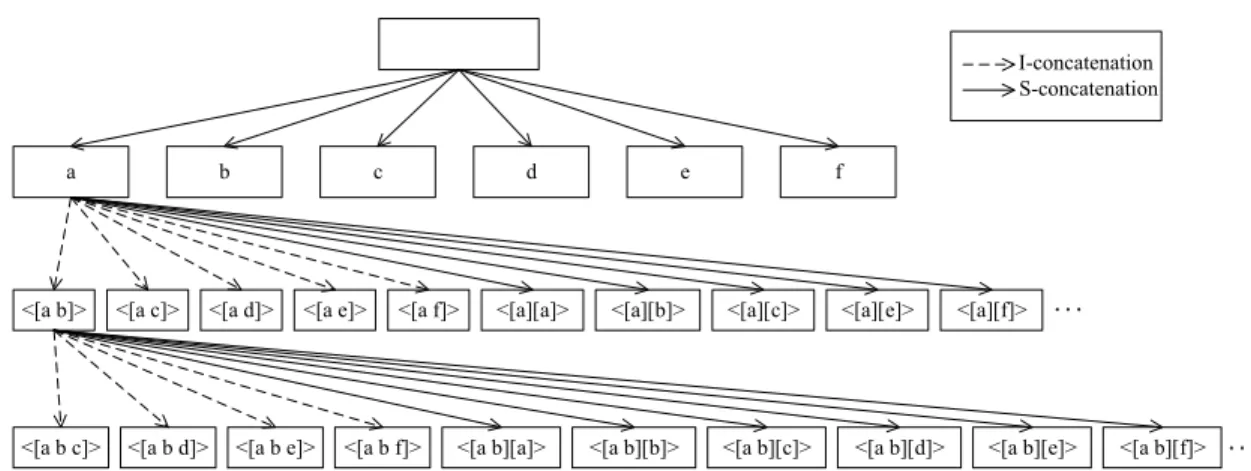
In this paper, we present a novel sequence-utility (SU)-Chain structure to keep more information for further mining pro-cess. A lexicographic enumeration (LE)-tree is used here to represent the search space of the promising candidates, which can be shown as Figure1.
In Figure 1, the I-Concatenation and S-Concatenation
are used in the pattern-growth mechanism [29], [32] to generate the possible and promising HUSPs. Based on the
I-Concatenation and S-Concatenation for the enumeration tree, all the possible and promising candidates can be pro-duced and explored. In order to ensure the integrity of the mining results, we should concatenate items in a certain order [7], [8]. It is noted that the definition of sequence order is also suitable forq-sequence. According to the definition of sequence order, we could produce all candidate sequences completely without loss of integrity.
For the HUS-Span [29] and ProUM [7], it needs to gen-erate the projection database of a sequence t using the original database. A designed sequence-utility (SU)-Chain here can be considered to produce the projection database for the sequence. While exploring the child nodes in the LE-tree, this projection database could be passed to the child nodes after updating. This progress can be used to reduce time consumption. Table3 shows the SU-Chain of a sequence<a> from Table 1. The SU-Chain is a set of projection sequences and utility-lists. The element of the utility-lists contains four fields as:concatenation positionpi;
TABLE 3. The built SU-Chain of the running example of the sequence<a>.
Algorithm 1SU-Chain Construction
Input:suc, SU-Chain oft;i, Concatenation Item;type,
I-ConcatenationorS-Concatenation
Output:suc’, the SU-Chain of new sequence.
1 suc0= ∅;
2 foreach proseq, ul∈sucdo
3 find the concatenation candidate itemsC;
4 ifi∈Cthen
5 build new utility listul’;
6 projectproseqto the new projection sequence proseq’ suc0←suc0∪(ul0,proseq0)
7 returnsuc’
themaximum utility at concatenation positionpi; the
util-ity of remaining sequences/t,pi;a pointerpointing to either
the (i+1)-th concatenation position ornull.
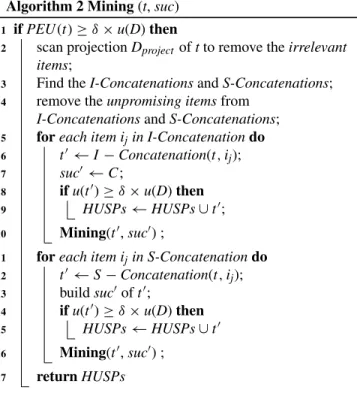
Based on the SU-Chain, the projection sequence can thus be maintained for later generation of the promis-ing candidates for examination. Also, it is easy to find theI-ConcatenationandS-Concatenation of the sequences. Thus, the computational cost can be greatly reduced to mine the required HUSPs. The designed SU-Chain structure is then presented in Algorithm1. The main construction process is divided into three parts as: (1) find the candidate concatena-tion items ofI-ConcatenationorS-Concatenation; (2) build the new utility-list; and (3) project the required sequences.
In order to efficiently reduce the size of the search space for mining HUSPs, several pruning strategies [21], [32] can thus incorporated with the designed SU-Chain structure to improve mining performance. Several definitions, theorems and pruning strategies are then given below.
Definition 14: SWU(t) is used to denote the sequence weighted utilization oftin theq-sequence databaseSUD, and defined as:
SWU(t)= X s∈SUD
{u(s)|t⊆s} (8)
Theorem 1 Given a sequence t, for each sequence t0
that could be generated bytusing concatenation operations, we then can obtain that:u(t0)≤SWU(t)
Proof:As the above definition, it is obvious thatu(t0)≤ SWU(t0) holds. Sincet ⊆t0,SWU(t0)=P
s∈D{u(s)|t 0 ⊆s}
≤P
s∈D{u(s)|t ⊆s}.
Pruning strategy 1:According toTheorem 1, For a given
sequencet, ifSWU(t) is less than the minimum utility value, the utility of any sequences which could be generated bytwill
Algorithm 2 Mining(t,suc)
1 ifPEU(t)≥δ×u(D)then
2 scan projectionDprojectoftto remove theirrelevant items;
3 Find theI-ConcatenationsandS-Concatenations; 4 remove theunpromising itemsfrom
I-ConcatenationsandS-Concatenations;
5 foreach item ijin I-Concatenationdo 6 t0←I−Concatenation(t,ij);
7 suc0←C;
8 ifu(t0)≥δ×u(D)then
9 HUSPs←HUSPs∪t0;
10 Mining(t0,suc0) ;
11 foreach item ijin S-Concatenationdo 12 t0←S−Concatenation(t,ij); 13 buildsuc0oft0; 14 ifu(t0)≥δ×u(D)then 15 HUSPs←HUSPs∪t0 16 Mining(t0,suc0) ; 17 returnHUSPs
be less than the minimum utility value. And these sequences could be safely pruned from theLE-treewithout affecting the complete mining results.
Definition 15: PEU(t,s) is used to denote the prefix exten-sion utility oftinq-sequences, and defined as:
PEU(t,s)=
max{u(t,p,s)+ru(s/t,p)},
0. (9)
wheremax{u(t,p,s)+ru(s/t,p)}holds if ru(s/t,p) > 0,
otherwise, thePEU(t,s) is set as 0.
Definition 16: PEU(t) is used to denote the prefix exten-sion utility oftinq-sequence, and defined as:
PEU(t)= X s∈D∧t⊆s
PEU(t,s) (10)
Theorem 2 Given a sequence t, for each sequence t0
that could be generated bytusing concatenation operation,
u(t0)≤PEU(t)
Proof: From the above definition, u(t0) ≤ PEU(t0) holds. PEU(t0,s) = max{u(t0,p0,s) + ru(s/t0,p0)} =
max{u(t,p,s) + u(ij) + ru(s/t0,p0)}. ij is the concatena-tion item at the concatenaconcatena-tion posiconcatena-tion p0. since p0 ≥ p, u(ij) + ru(s/t0,p0) ≤ ru(s/t,p), Therefore, PEU(t0,s)
≤ max{u(t,p,s) + ru(s/t,p)} = PEU(t,s). Therefore, PEU(t0)=P
s∈D∧t0⊆sPEU(t0,s)≤Ps∈D∧t0⊆sPEU(t0,s)≤ P
s∈D∧t⊆sPEU(t,s). Thenu(t
0)≤PEU(t).
Pruning strategy 2:According toTheorem 2, For a given
sequencet, ifPEU(t) is less than the minimum utility value, the utility of any sequences which could be generated bytwill be less than the minimum utility value. And these sequences could be safely pruned from theLE-treewithout affecting the complete mining results.
FIGURE 2. Runtime under variousδthresholds.
Furthermore, the pruning strategies used in the HUSP-ULL [8] can also be incorporated with the designed SU-Chain structure as follows.
Pruning strategy 3: Given a sequence t0 and t, t0 is
generated by t andij using concatenation operation. Then ij is the concatenation candidate item of sequencet. Thus,
ifP
s∈D∧t0⊆sPEU(t,s) is less than the minimum utility value, thenij calledunpromising itemis removed from the set of
concatenation candidate items not to generate the sequence
t0. Therefore, ifijis theI-concatenation candidate item, then
we can removeijfrom the set ofI-concatenation items; ifij
is theS-concatenation candidate item, then we can removeij
from the set ofS-concatenation items.
Pruning strategy 4: Given an itemij and a sequencet.
t10 is generated by tand item ij using I-concatenation; and t20 is generated by t and item ij using S-concatenation. if
P
s∈D∧t10⊆sPEU(t,s) is less than the minimum utility value
and P
s∈D∧t0
2⊆sPEU(t,s) is less than the minimum utility value. Then we can remove the itemijcalledirrelevant item
from the projection database of the sequence t since this sequence is an super sequence generated bytand itemijcould
be high utility sequential pattern.
Using thePruning strategy 4to remove irrelevant items from projection database of a sequencetcould reduce the size of the projection database of the sequencet and its super-sequence because the projection databases of these super-sequences do not need to contain the irrelevant items. As the same time,
TABLE 4.Characteristics of the datasets.
Removing the irrelevant items could lower the upper bound value ofPEU(t).
V. EXPERIMENTAL EVALUATION
In this section, several experiments were conducted to eval-uate the proposed SU-Chain compared to the state-of-the-art USpan [32], HUS-Span [29] and HUSP-ULL [8] approaches. Six real-life datasets were used in the experiments to eval-uate the performance in terms of runtime and number of generated candidates. The characteristics of six datasets are shown in Table4. The parameters of the used datasets indi-cate:#|D| states the total number of sequences; #|I| is the number of distinct items;Cis the average number of itemsets per sequence; andMaxLenstates the maximum number of items per sequence.
A. RUNTIME
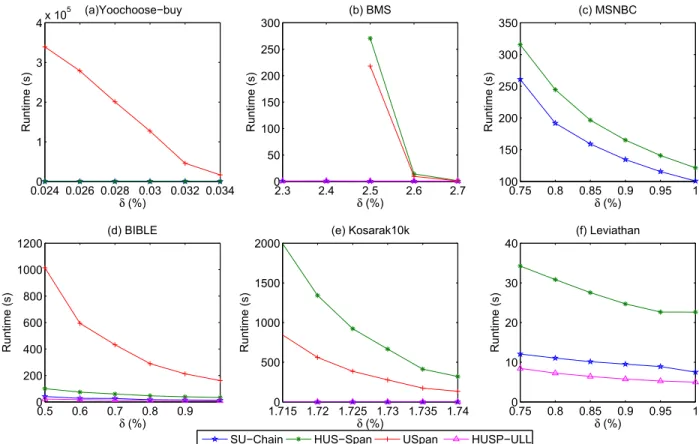
Experiments were conducted under the various minimum utility thresholdδand the results are then shown in Figure2.
TABLE 5. Number of determined candidates and final HUSPs under variousδthresholds.
From the results, it can be observed that the designed SU-Chain-based algorithm outperforms the state-of-the-art USpan and HUS-Span algorithms in terms of runtime per-formance. The state-of-the-art HUSP-ULL algorithm has slightly better performance than that of the SU-Chain-based algorithm, for example in Figure2(d), when the threshold is set as 1%, the SU-Chain-based model requires 13.1 seconds and the state-of-the-art HUSP-ULL needs 9.6 seconds. When the threshold is set as 1.715%, the SU-Chain-based model needs 0.79 seconds and the HUSP-ULL requires 0.2 seconds. When the threshold is set as 1%, the SU-Chain-based model requires 7.5 seconds while the HUSP-ULL needs 4.9 sec-onds. However, for the databases shown in Figures2(a),2(b), and 2(c), the designed SU-Chain-based model needs less runtime than that of the HUSP-ULL algorithm, especially the HUSP-ULL has the memory leakage problem in Figures2(a) and2(c). Generally, the designed SU-Chain-based algorithm can obtain better performance compared to the most HUSPM algorithms, especially it has better capacity to keep more information for efficiency improvement.
B. NUMBER OF GENERATED CANDIDATES
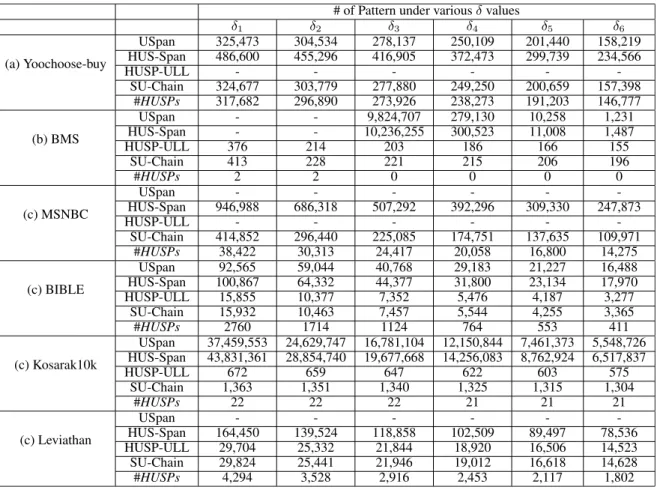
In order to evaluate the effectiveness of the compared algo-rithms, the number of generated candidates and the number of discovered HUSPs under different minimum utility thresh-olds are then conducted and shown in Table5. The #HUSPs
represents the number of HUSPs and ‘‘-’’ denotes that the run-time of the performed algorithm exceeds 10,000 seconds or it cannot be performed in a limited main memory.
From the given results, it can be observed that the designed SU-Chain-based algorithm generates less candidates than the previous USpan and HUS-Span algorithms. As the less can-didates are required to be explored, less runtime is needed. When the minimum utility threshold increases, the num-ber of the determined candidates decreases, and vice versa. This is reasonable since less patterns are then generated based on the higher minimum utility threshold. We also can observe that the USpan and HUS-Span cannot generate the results in the Yoochoose-buy dataset, and the HUSP-ULL cannot obtain the results both in Yoochoose-buy and MSNBC datasets. Although the HUSP-ULL has a very slight bet-ter performance than the SU-Chain-based algorithm (almost 1-2 seconds different), the number of generated candidates are nearly similar. However, the designed SU-Chain-based algorithm can obtain good performance for handling the Yoochoose-buy and MSNCBC datasets than that of the state-of-the-art HUSP-ULL approach.
VI. CONCLUSION AND FUTURE WORK
In this paper, we present a Sequence-Utility (SU)-chain ture to keep the projection database and its utility-list struc-ture. Based on the designed SU-Chain-based model and the
utilized pruning strategies, the SU-Chain-based algorithm successfully obtains good results than the other compared algorithms, especially the designed SU-Chain-based algo-rithm can reduce the leakage problem of the memory com-pared to the state-of-the-art HUSP-ULL approach. In the future, we will then address the dynamic situation to effi-ciently update the discovered HUSPs for transaction insertion based on the Hadoop or Spark platform. How to efficiently design a better structure used in the MapReduce framework is also an interesting topic for the further study.
REFERENCES
[1] R. Agrawal and R. Srikant, ‘‘Fast algorithms for mining association rules in large databases,’’ inProc. Int. Conf. Very Large Data Bases, 1994, pp. 487–499.
[2] R. Agrawal and R. Srikant, ‘‘Mining sequential patterns,’’ inProc. Int. Conf. Data Eng., 1995, pp. 3–14.
[3] C. F. Ahmed, S. K. Tanbeer, and B.-S. Jeong, ‘‘Mining high utility Web access sequences in dynamic Web log data,’’ inProc. 11th ACIS Int. Conf. Softw. Eng., Artif. Intell., Netw. Parallel/Distrib. Comput., Jun. 2010, pp. 76–81.
[4] C. F. Ahmed, ‘‘A novel approach for mining high-utility sequential patterns in sequence databases,’’Electron. Telecommun. Res. Inst. J., vol. 32, no. 5, pp. 676–686, Oct. 2010.
[5] O. K. Alkan and P. Karagoz, ‘‘CRoM and HuspExt: Improving efficiency of high utility sequential pattern extraction,’’IEEE Trans. Knowl. Data Eng., vol. 27, no. 10, pp. 2645–2657, Oct. 2015.
[6] R. Chan, Q. Yang, and Y. D. Shen, ‘‘Mining high utility itemsets,’’ inProc. IEEE Int. Conf. Data Mining, Nov. 2003, pp. 19–26.
[7] W. Gan, J. C. W. Lin, J. Zhang, H. C. Chao, H. Fujita, and P. S. Yu, ‘‘ProUM: Projection-based utility mining on sequence data,’’Inf. Sci., vol. 513, pp. 222–240, Mar. 2020.
[8] W. Gan, J. Chun-Wei Lin, J. Zhang, P. Fournier-Viger, H.-C. Chao, and P. S. Yu, ‘‘Fast utility mining on complex sequences,’’ 2019,
arXiv:1904.12248. [Online]. Available: http://arxiv.org/abs/1904.12248 [9] J. Han, J. Pei, B. Mortazavi-Asl, Q. Chen, U. Dayal, and M.-C. Hsu,
‘‘FreeSpan: Frequent pattern-projected sequential pattern mining,’’ in
Proc. 6th ACM SIGKDD Int. Conf. Knowl. Discovery Data Mining (KDD), 2000, pp. 355–359.
[10] J. Han, J. Pei, Y. Yin, and R. Mao, ‘‘Mining frequent patterns without candidate generation: A frequent-pattern tree approach,’’Data Mining Knowl. Discovery, vol. 8, no. 1, pp. 53–87, Jan. 2004.
[11] S. Kannimuthu and K. Premalatha, ‘‘Discovery of high utility itemsets using genetic algorithm with ranked mutation,’’Appl. Artif. Intell., vol. 28, no. 4, pp. 337–359, Apr. 2014.
[12] M. Liu and J. Qu, ‘‘Mining high utility itemsets without candidate gener-ation,’’ inProc. 21st ACM Int. Conf. Inf. Knowl. Manage. (CIKM), 2012, pp. 55–64.
[13] Y. Liu, W. Liao, and A. N. Choudhary, ‘‘A two-phase algorithm for fast discovery of high utility itemsets,’’ inProc. Pacific-Asia Conf. Adv. Knowl. Discovery Data Mining, 2005, pp. 689–695.
[14] C.-W. Lin, T.-P. Hong, and W.-H. Lu, ‘‘An effective tree structure for min-ing high utility itemsets,’’Expert Syst. Appl., vol. 38, no. 6, pp. 7419–7424, Jun. 2011.
[15] M. Liu and J. Qu, ‘‘Mining high utility itemsets without candidate gener-ation,’’ inProc. 21st ACM Int. Conf. Inf. Knowl. Manage. (CIKM), 2012, pp. 55–64.
[16] G.-C. Lan, T.-P. Hong, H.-C. Huang, and S.-T. Pan, ‘‘Mining high fuzzy utility sequential patterns,’’ inProc. Int. Conf. Fuzzy Theory Its Appl. (iFUZZY), Dec. 2013, pp. 420–424.
[17] G.-C. Lan, T.-P. Hong, V. S. Tseng, and S.-L. Wang, ‘‘Applying the maxi-mum utility measure in high utility sequential pattern mining,’’Expert Syst. Appl., vol. 41, no. 11, pp. 5071–5081, Sep. 2014.
[18] J. C.-W. Lin, W. Gan, P. Fournier-Viger, T.-P. Hong, and V. S. Tseng, ‘‘Efficient algorithms for mining high-utility itemsets in uncertain databases,’’Knowl.-Based Syst., vol. 96, pp. 171–187, Mar. 2016. [19] J. Liu, K. Wang, and B. C. M. Fung, ‘‘Mining high utility patterns in one
phase without generating candidates,’’IEEE Trans. Knowl. Data Eng., vol. 28, no. 5, pp. 1245–1257, Dec. 2016.
[20] J. C.-W. Lin, L. Yang, P. Fournier-Viger, T.-P. Hong, and M. Voznak, ‘‘A binary PSO approach to mine high-utility itemsets,’’Soft Comput., vol. 21, no. 17, pp. 5103–5121, Mar. 2016.
[21] J. C. W. Lin, J. Zhang, and P. Fournier-Viger, ‘‘High-utility sequential pattern mining with multiple minimum utility thresholds,’’ inProc. Int. Joint Conf. (APWeb-WAIM), 2017, pp. 215–229.
[22] P. Sharma and G. Balakrishna, ‘‘PrefixSpan: Mining sequential patterns by prefix-projected pattern,’’Int. J. Comput. Sci. Eng. Surv., vol. 2, no. 4, pp. 111–122, Nov. 2011.
[23] R. Srikant and R. Agrawal, ‘‘Mining sequential patterns: Generalizations and performance improvements,’’ inProc. Int. Conf. Extending Database Technol., 1996, pp. 3–17.
[24] B. E. Shie, J. F. Hsiao, V. S. Tseng, and P. S. Yu, ‘‘Mining high utility mobile sequential patterns in mobile commerce environments,’’ inProc. Int. Conf. Database Syst. Adv. Appl., 2011, pp. 224–238.
[25] V. S. Tseng, C. Wu, B. Shie, and P. S. Yu, ‘‘Up-growth: An efficient algo-rithm for high utility itemset mining,’’ inProc. ACM SIGKDD Int. Conf. Knowl. Discovery Data Mining, 2010, pp. 253–262.
[26] V. S. Tseng, B.-E. Shie, C.-W. Wu, and P. S. Yu, ‘‘Efficient algorithms for mining high utility itemsets from transactional databases,’’IEEE Trans. Knowl. Data Eng., vol. 25, no. 8, pp. 1772–1786, Aug. 2013.
[27] V. S. Tseng, C. W. Wu, P. Fournier-Viger, and S. Y. Philip, ‘‘Efficient algo-rithms for mining top-Khigh utility itemsets,’’IEEE Trans. Knowl. Data Eng., vol. 8, no. 1, pp. 54–67, Jan. 2016.
[28] B. Vo, H. Nguyen, T. B. Ho, and B. Le, ‘‘A novel approach to extract high utility itemsets from distributed databases,’’Comput. Informat., vol. 31, no. 6, pp. 1597–1615, 2013.
[29] J.-Z. Wang, J.-L. Huang, and Y.-C. Chen, ‘‘On efficiently mining high utility sequential patterns,’’Knowl. Inf. Syst., vol. 49, no. 2, pp. 597–627, Jan. 2016.
[30] J. M.-T. Wu, J. Zhan, and J. C.-W. Lin, ‘‘An ACO-based approach to mine high-utility itemsets,’’Knowl.-Based Syst., vol. 116, pp. 102–113, Jan. 2017.
[31] H. Yao, H. J. Hamilton, and C. J. Butz, ‘‘A foundational approach to min-ing itemset utilities from databases,’’ inProc. SIAM Int. Conf. Data Mining, Dec. 2013, pp. 482–486.
[32] J. Yin, Z. Zheng, and L. Cao, ‘‘USpan: An efficient algorithm for mining high utility sequential patterns,’’ inProc. 18th ACM SIGKDD Int. Conf. Knowl. Discovery Data Mining (KDD), 2012, pp. 660–668.
[33] J. Yin, Z. Zheng, L. Cao, Y. Song, and W. Wei, ‘‘Efficiently mining
top-Khigh utility sequential patterns,’’ inProc. IEEE 13th Int. Conf. Data Mining, Dec. 2013, pp. 1259—1264.
[34] L. Zhou, Y. Liu, J. Wang, and Y. Shi, ‘‘Utility-based Web path traversal pattern mining,’’ inProc. 7th IEEE Int. Conf. Data Mining Workshops (ICDMW), Oct. 2007, pp. 373–380.
[35] S. Zida, pp. Fournier–Viger, J. C. W. Lin, C. W. Wu, and V. S. Tseng, ‘‘EFIM: A fast and memory efficient algorithm for high-utility itemset mining,’’Knowl. Inf. Syst., vol. 51, no. 2, pp. 595–625, 2017.
JERRY CHUN-WEI LIN(Senior Member, IEEE) received the Ph.D. degree from the Department of Computer Science and Information Engineering, National Cheng Kung University, Tainan, Taiwan. He is currently a Full Professor with the Depart-ment of Computer Science, Electrical Engineer-ing and Mathematical Sciences, Western Norway University of Applied Sciences, Bergen, Norway. He is also the Project Co-Leader of well-known SPMF: An Open-Source Data Mining Library, which is a toolkit offering multiple types of data mining algorithms. He has published more than 300 research articles in refereed journals, such as the IEEE TKDE, IEEE TCYB, ACM TKDD, and ACM TDS, and international conferences, such as the IEEE ICDE, IEEE ICDM, PKDD, and PAKDD. His research interests include data mining, soft computing, artificial intelligence and machine learning, and privacy-preserving and security technologies. He is a Fellow of the IET and ACM. He serves as the Editor-in-Chief for theInternational Journal of Data ScienceandPattern Recognition.
YUANFA LI is currently pursuing the master’s degree with the School of Computer Science and Technology, Harbin Institute of Technology (Shenzhen), China. His research interests include big data analytics and cloud computing.
PHILIPPE FOURNIER-VIGER received the Ph.D. degree in computer science from the Univer-sity of Quebec, Montreal, in 2010. He is currently a Full Professor and a Youth 1000 Scholar with the Harbin Institute of Technology (Shenzhen), Shenzhen, China. He is the Founder of the popular SPMF open-source data mining library, which has been cited in more than 800 research arti-cles. His research interests include pattern mining, sequence analysis and prediction, and social net-work mining. He is also the Editor-in-Chief (EiC) of theData Mining and Pattern Recognition(DSPR) journal.
YOUCEF DJENOURIreceived the Ph.D. degree in computer engineering from the University of Science and Technology Houari Boumediene (USTHB), Algiers, Algeria, in 2014. From 2014 to 2015, he was a Permanent Teacher–Researcher with the University of Blida, Algeria, where he is currently a member of LRDSI Lab. He was granted a Postdoctoral Fellowship from Unist University, South Korea. He worked on the BPM Project sup-ported by Unist University, in 2016. In 2017, he was a Postdoctoral Research with Southern Denmark University, where he has working on urban traffic data analysis. He was granted a Postdoc-toral Fellowship from the European Research Consortium on Informatics and Mathematics (ERCIM). He worked with the Norwegian University of Science and Technology (NTNU), Trondheim, Norway. He is currently a Researcher Scientist with SINTEF Digital, Oslo, Norway. He is working on topics related to artificial intelligence and data mining, with a focus on asso-ciation rules mining, frequent itemsets mining, parallel computing, swarm and evolutionary algorithms, and pruning association rules. He has published over 24 refereed conference papers, 20 international journal articles, two book chapters, and one tutorial article in the areas of data mining, parallel computing, and artificial intelligence.
JI ZHANG(Senior Member, IEEE) received the B.E. degree from the Department of Information Management and Information Systems, Southeast University, China, in 2000, the M.Sc. degree from the Department of Computer Science, National University of Singapore, in 2002, and the Ph.D. degree from the Faculty of Computer Science, Dal-housie University, Canada, in 2008. From 2008 to 2009, he was a Postdoctoral Research Fellow with the CSIRO ICT Center, Hobart, Australia. He is currently an Associate Professor in computing with the University of South-ern Queensland (USQ), Australia. He has published over 140 articles in major peer-reviewed international journals and conferences. His research interests are in big data analytics, knowledge discovery and data mining (KDD), and information privacy and security. He is a member of ACM, a Fellow of Australian Endeavour, a Fellow of Queensland, Australia, and a Scholar of Izaak Walton Killam, Canada.