MINING HIGH UTILITY PATTERNS OVER DATA STREAMS
MORTEZA ZIHAYAT KERMANI
A DISSERTATION SUBMITTED TO THE FACULTY OF GRADUATE STUDIES IN PARTIAL FULFILMENT OF THE REQUIREMENTS
FOR THE DEGREE OF DOCTOR OF PHILOSOPHY
GRADUATE PROGRAM IN DEPARTMENT OF ELECTRICAL ENGINEERING AND COMPUTER SCIENCE
YORK UNIVERSITY TORONTO, ONTARIO
JULY 2016
c
Abstract
Mining useful patterns from sequential data is a challenging topic in data mining. An important task for mining sequential data is sequential pattern mining, which discov-ers sequences of itemsets that frequently appear in a sequence database. In sequential pattern mining, the selection of sequences is generally based on the frequency/support framework. However, most of the patterns returned by sequential pattern mining may not be informative enough to business people and are not particularly related to a business objective. In view of this,high utility sequential pattern (HUSP) mining has emerged as a novel research topic in data mining recently. The main objective of HUSP mining is to extract valuable and useful sequential patterns from data by considering theutilityof a pattern that captures a business objective (e.g.,profit, user’s interest). In HUSP mining, the goal is to find sequences whose utility in the database is no less than auser-specified minimum utility threshold.
Nowadays, many applications generate a huge volume of data in the form of data streams. A number of studies have been conducted on mining HUSPs, but they are
mainly intended for non-streaming data and thus do not take data stream characteristics into consideration. Mining HUSP from such data poses many challenges. First, it is infeasible to keep all streaming data in the memory due to the high volume of data accu-mulated over time. Second, mining algorithms need to process the arriving data in real time withone scanof data. Third, depending on the minimum utility threshold value, the number of patterns returned by a HUSP mining algorithm can be large and overwhelms the user. In general, it is hard for the user to determine the value for the threshold. Thus, algorithms that can find the most valuable patterns (i.e., top-k high utility patterns) are more desirable. Mining the most valuable patterns is interesting in both static data and data streams.
To address these research limitations and challenges, this dissertation proposes tech-niques and algorithms for mining high utility sequential patterns over data streams. We work on mining HUSPs over both a long portion of a data stream and a short period of time. We also work on how to efficiently identify the most significant high utility patterns (namely, the top-k high utility patterns) over data streams.
In the first part, we explore a fundamental problem that is how the limited memory space can be well utilized to produce high quality HUSPs over theentire data stream. An approximation algorithm, calledMAHUSP, is designed which employs memory adaptive mechanisms to use a bounded portion of memory, to efficiently discover HUSPs over the entire data streams.
The second part of the dissertation presents a new sliding window-based algorithm to discoverrecent high utility sequential patternsover data streams. A novel data structure namedHUSP-Tree is proposed to maintain the essential information for mining recent HUSPs. An efficient and single-pass algorithm named HUSP-Stream is proposed to generate recent HUSPs fromHUSP-Tree.
The third part addresses the problem of top-k high utility pattern mining over data streams. Two novel methods, namedT-HUDSandT-HUSP, for finding top-k high utility patterns over a data stream are proposed. T-HUDS discovers top-khigh utility itemsets
andT-HUSPdiscovers top-khigh utility sequential patternsover a data stream.T-HUDS
is based on a compressed tree structure, calledHUDS-Tree, that can be used to efficiently find potential top-khigh utility itemsets over data streams.T-HUSPincrementally main-tains the content of top-k HUSPs in a data stream in a summary data structure, named
TKList, and discovers top-k HUSPs efficiently.
All of the algorithms are evaluated using both synthetic and real datasets. The per-formances, including the running time, memory consumption, precision, recall and F-measure, are compared.
In order to show the effectiveness and efficiency of the proposed methods in real-life applications, the fourth part of this dissertation presents applications of one of the proposed methods (i.e., MAHUSP) to extract meaningful patterns from a real web click-stream dataset and a real biosequence dataset. The utility-based sequential patterns are
compared with the patterns in the frequency/support framework. The results show that high utility sequential pattern mining provides meaningful patterns in real-life applica-tions.
Acknowledgements
First and foremost, I would like to express my sincere appreciation to my supervisor Prof. Aijun An for her continuous support of my PhD study and research, for her patience, motivation, enthusiasm, and immense knowledge. Her guidance helped me in all the time of research and writing of this thesis. I could not have imagined having had a better advisor and mentor for my PhD study.
I would like to thank my committee members, Prof. Parke Godfrey and Prof. Jarek Gryz for their great support and invaluable advice. I also show gratitude for Prof. Nick Cercone (former thesis committee member), an excellent professor and pioneer in the data mining area, who unfortunately passed away a few months before the official dis-sertation defense.
The members of both data mining and database labs have contributed immensely to my personal and professional time at York University. The group has been a source of friendships as well as great collaborators. I am also thankful to the administrative and technical staff of our department for their finest support.
Lastly, I would like to thank my family for all their encouragement and love. Words cannot express the feelings I have for my parents for their constant unconditional support in every aspect of my life.
Table of Contents
Abstract ii
Acknowledgements vi
Table of Contents viii
List of Tables xiv
List of Figures xvi
1 Introduction 1
1.1 Background . . . 1
1.1.1 High Utility Itemset Mining . . . 7
1.1.2 High Utility Sequential Pattern mining . . . 9
1.2 Motivation . . . 10
1.3.1 Incremental High Utility Sequential Pattern Mining over the
En-tire Data Streams . . . 13
1.3.2 Mining Recent High Utility Sequential Patterns over Data Streams 14 1.3.3 Mining Top-k High Utility Patterns over Data Streams . . . 15
1.3.4 High Utility Sequential Patterns in Real Life Applications . . . 16
1.4 Research Contributions . . . 16
1.4.1 Memory Adaptive High Utility Sequential Pattern Mining over Data Streams . . . 16
1.4.2 Sliding Window-based High Utility Sequential Pattern Mining over Data Streams . . . 17
1.4.3 Top-k High Utility Pattern Mining over Data Streams . . . 18
1.4.4 Mining Meaningful Patterns in Real Life Applications . . . 19
1.5 Thesis Structure . . . 20
2 Literature Review 24 2.1 Frequent Pattern Mining . . . 24
2.1.1 Frequent Itemset Mining . . . 24
2.1.2 Frequent Sequential Pattern Mining . . . 26
2.1.3 Frequent Sequential Pattern Mining over Data Streams . . . 29
2.2 High Utility Pattern Mining . . . 32
2.2.1 High Utility Itemset Mining . . . 33
2.2.2 High Utility Itemset Mining over Data Streams . . . 39
2.2.3 High Utility Sequential Pattern Mining . . . 42
2.2.4 Top-k High Utility Itemset/Sequence Mining . . . 46
2.3 Summary . . . 47
3 Memory Adaptive High Utility Sequential Patterns over Data Streams 48 3.1 Introduction . . . 48
3.2 Definitions and Problem Statement . . . 51
3.3 Memory Adaptive High Utility Sequential Pattern Mining . . . 55
3.3.1 Overview of MAHUSP . . . 55
3.3.2 MAS-Tree Structure . . . 57
3.3.3 Rest Utility: A Utility Upper Bound . . . 61
3.3.4 MAS-Tree Construction and Updating . . . 63
3.3.5 Memory Adaptive Mechanisms . . . 68
3.3.6 Mining HUSPs from MAS-Tree . . . 73
3.3.7 Correctness . . . 74
3.4 Experiments . . . 77
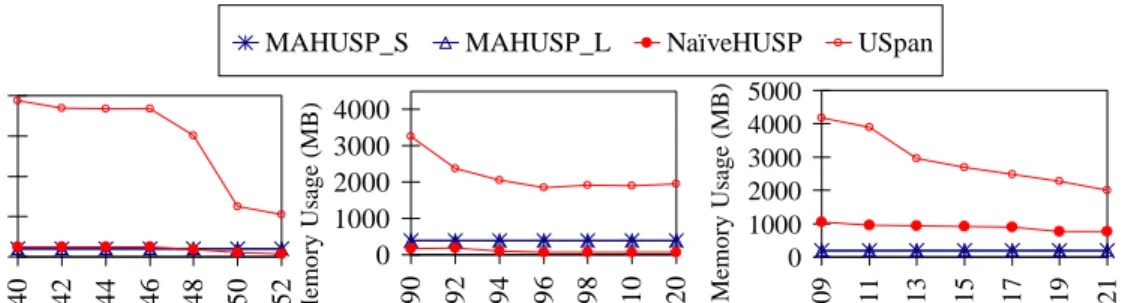
3.4.2 Time and Memory Efficiency of MAHUSP . . . 82
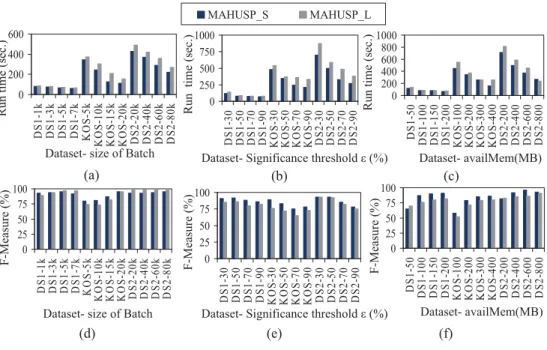
3.4.3 Parameter Sensitivity Analysis . . . 84
3.5 Summary . . . 86
4 Sliding Window-based High Utility Sequential Pattern Mining over Data Streams 88 4.1 Introduction . . . 88
4.2 Definitions and Problem Statement . . . 94
4.3 Sliding Window-based High Utility Sequential Pattern Mining over Data Streams . . . 97
4.3.1 Initialization phase . . . 99
4.3.2 Update Phase . . . 115
4.3.3 HUSP Mining Phase . . . 122
4.4 Experiments . . . 123
4.4.1 Methods in Comparison . . . 125
4.4.2 Performance evaluation for sliding two hundred consecutive win-dows . . . 126
4.4.3 Number of Potential HUSPs . . . 128
4.4.4 Time Efficiency of HUSP-Stream . . . 129
4.4.6 Effectiveness of SFU Pruning . . . 133
4.4.7 Performance Evaluation with Window Size Variation . . . 135
4.4.8 Scalability . . . 136
4.5 Summary . . . 137
5 Top-k High Utility Pattern Mining over Data Streams 141 5.1 Top-k High Utility Itemset Mining over a Data Stream . . . 142
5.1.1 Preliminaries and Problem Statement . . . 144
5.1.2 Challenges and New Definitions . . . 146
5.1.3 T-HUDS: Top-k High Utility Itemset Mining over a Data Stream 153 5.2 Top-k High Utility Sequential Pattern Mining over Data Streams . . . . 180
5.2.1 Definitions and Problem Statement . . . 183
5.2.2 Top-k High Utility Sequential Pattern Mining over Data streams 185 5.3 Experimental Results . . . 193
5.3.1 T-HUDS Performance Evaluation . . . 193
5.3.2 T-HUSP Performance Evaluation . . . 211
5.4 Summary . . . 217
6 Mining Meaningful Patterns in Real Life Applications 221 6.1 A Utility-based Users’ Reading Behavior Mining . . . 221
6.1.2 Demonstration . . . 226
6.2 A Disease-related Gene Expression Sequence Discovery . . . 229
6.2.1 Definitions . . . 231
6.2.2 Demonstration . . . 234
6.3 Summary . . . 238
7 Conclusions and Future Work 239 7.1 Summary of Contributions . . . 240
7.2 Future Work . . . 243
List of Tables
1.1 An example of sequential data in a retail store . . . 2
1.2 An example of a web clickstream dataset . . . 3
1.3 An example of a time course microarray dataset . . . 4
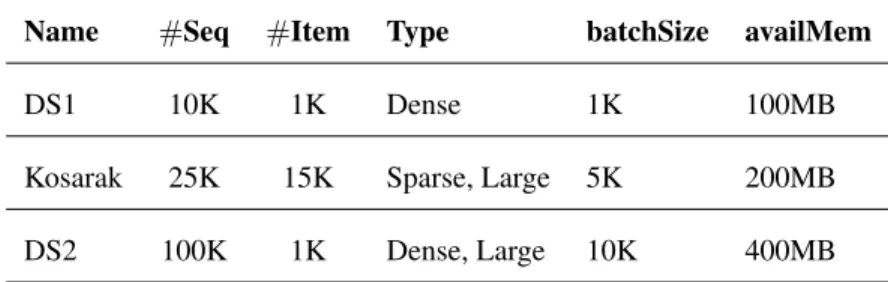
3.1 Dataset characteristics . . . 78
4.1 Summary of Notations . . . 93
4.2 Parameters of IBM data generator . . . 123
4.3 Details of parameter setting . . . 124
5.1 Summary of Notations . . . 152
5.2 Notations . . . 184
5.3 Details of the datasets . . . 194
5.4 Number of candidates generated in phase I . . . 200
5.5 Memory comparison (MB), k=600 . . . 204
5.7 Number of candidates at the end of first phase for different versions of T-HUDS: . . . 206 5.8 Parameters of IBM data generator . . . 211 5.9 Details of parameter setting . . . 213
6.1 Top-4 HUSPs versus Top-4 FSPs with respect to time spent and support 222 6.2 (a) An example of a time course microarray dataset, (b) Fold changes of
gene/probe values . . . 229 6.3 Converted utility-based sequential dataset from time course microarray
dataset in Table 6.2(a) . . . 234 6.4 Top-20 genes related to pneumonia . . . 235 6.5 Top-4 HUSPs versus Top-4 FGSs with respect to utility and support . . 236
List of Figures
1.1 Data stream processing models . . . 12
1.2 Thesis profile . . . 23
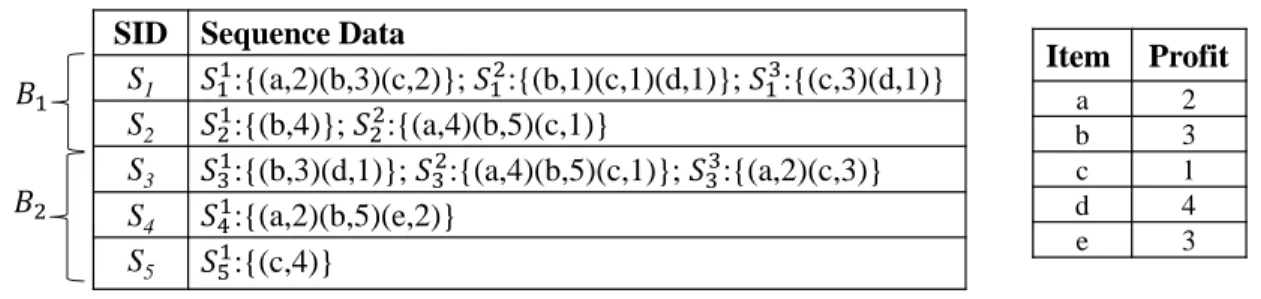
3.1 An example of a data stream of itemset-squences . . . 51
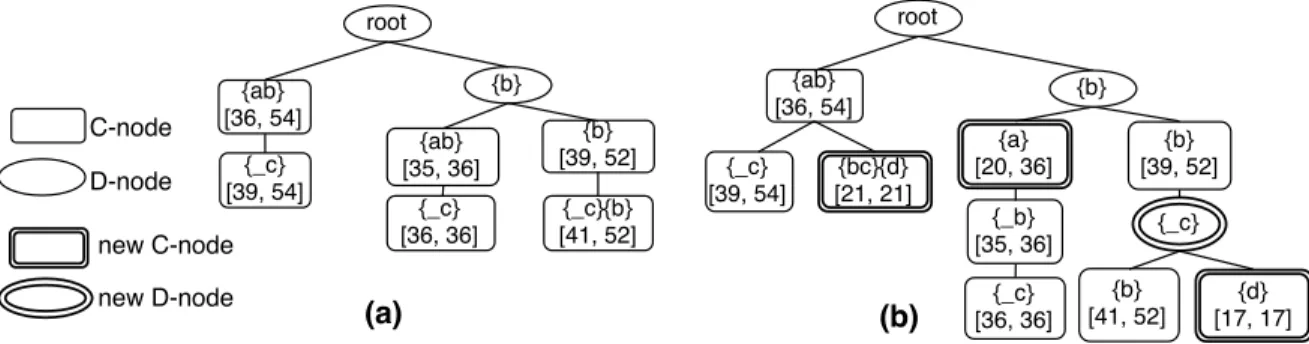
3.2 An example ofMAS-TreeforB1 in Figure 3.1. . . 58
3.3 Precision performance on the different datasets . . . 80
3.4 Recall performance on the different datasets . . . 80
3.5 F-Measure performance on the different datasets . . . 81
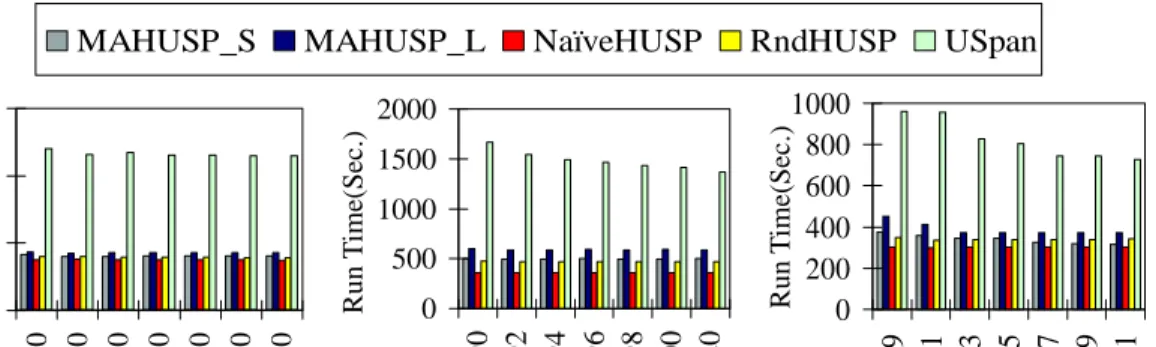
3.6 Execution time on different datasets. . . 82
3.7 Memory Usage on different datasets. . . 83
3.8 Parameter sensitivity on different datasets. . . 84
4.1 An example of a data stream of itemset-squences . . . 94
4.2 ItemUtilListsfor items inSW1in Figure 4.1 . . . 101
4.4 I-Step and S-Step to constructSeqUtilListsof the sequences h{ab}iand
h{ab}{d}i. . . 106
4.5 An overview ofItemU tilListsupdate step . . . 118
4.6 An overview of HUSP-Tree update step . . . 120
4.7 The updated (i)ItemU tilListsand (ii)SeqU tilList({ab})after remov-ingT1from and addingT6to the window . . . 121
4.8 Execution time and sliding time (shown in logarithmic scale) over con-secutive windows . . . 126
4.9 Number of PHUSPs on different datasets . . . 128
4.10 Execution time and sliding time (shown in logarithmic scale) on different datasets . . . 130
4.11 Sliding time on different datasets . . . 131
4.12 Memory Usage of the algorithms . . . 132
4.13 Impact of SFU on Run Time . . . 133
4.14 Impact of SFU on Number of PHUSPs . . . 134
4.15 Impact of SFU on Memory Usage. . . 135
4.16 Evaluation of HUSP-Stream under different window sizes . . . 136
4.17 Scalability of HUSP-Stream on different datasets: (a) Memory Usage , (b) Run Time . . . 137
5.2 HUDS-Tree after inserting transaction inSW1 in Figure 5.1. . . 157
5.3 (a) An example of a data stream of itemset-sequence and sliding windows over the data stream, (b) an example of external utility table . . . 183 5.4 Reached threshold on (a) Connect-4, (b) IBM, (c) BMS-POS,(d)
Chain-Store Datasets . . . 198 5.5 Run time on (a) Connect-4, (b) IBM, (c) BMS-POS, (d) ChainStore
Datasets . . . 201 5.6 Run Time for Phase I: (a) Connect-4, (b) IBM, (c) BMS-POS, (d)
Chain-Store . . . 202 5.7 Run Time for Phase II: (a) Connect-4, (b) IBM, (c) BMS-POS, (d)
Chain-Store . . . 203 5.8 Run time for different versions of T-HUDS: (a) IBM, (b) BMS-POS, (c)
ChainStore datasets . . . 207 5.9 Impact of P ref ixU til on the number of generated candidates on (a)
IBM, (b) BMS-POS, (C) ChainStore datasets . . . 208 5.10 Impact ofP ref ixU tilon run time on (a) IBM, (b) BMS-POS, (c)
Chain-Store datasets . . . 208 5.11 Effect of the window size on the run time: (a) IBM, (b) BMS-POS, (c)
ChainStore datasets . . . 209 5.12 Scalability of T-HUDS on different datasets (k=500). . . 210
5.13 Number of potential HUSPs on (a)DS1, (b) BMS, (c) DS2, (d) Chain-Store Datasets . . . 214 5.14 Run time on (a) DS1, (b) BMS, (c) DS2, (d) ChainStore Datasets . . . . 216 5.15 Memory usage on(a)DS1, (b) BMS, (c) DS2, (d) ChainStore Datasets . 217
6.1 (a) Run time, (b) Memory Usage on theGlobedataset . . . 223 6.2 (a) Precision, (b) Recall and (c) F-Measure performance on the Globe
dataset . . . 223 6.3 An example of a web clickstream dataset . . . 224 6.4 The importance of news articles based on popularity and recency . . . . 224 6.5 (a) Run time, (b) Memory Usage on theGSE6377dataset . . . 237 6.6 (a) Precision, (b) Recall and (c) F-Measure performance on theGSE6377
1
Introduction
1.1
Background
Nowadays, huge volumes of data are produced in the form of sequences. A sequence
is an ordered list of events with or without concrete notions of time [44]. A sequence databaseconsists of a set of sequences. These sequential data are valuable sources of information not only to find a particular event at a specific time, but also to discover particular sequential relationships by analysing the occurrences of certain events or sets of events. Sequential data are produced by many applications such asconsumer shopping sequences, Web access logs, DNA sequences, sequences infinancial markets, etc. Here are three examples drawn from different domains, where sequential data are produced.
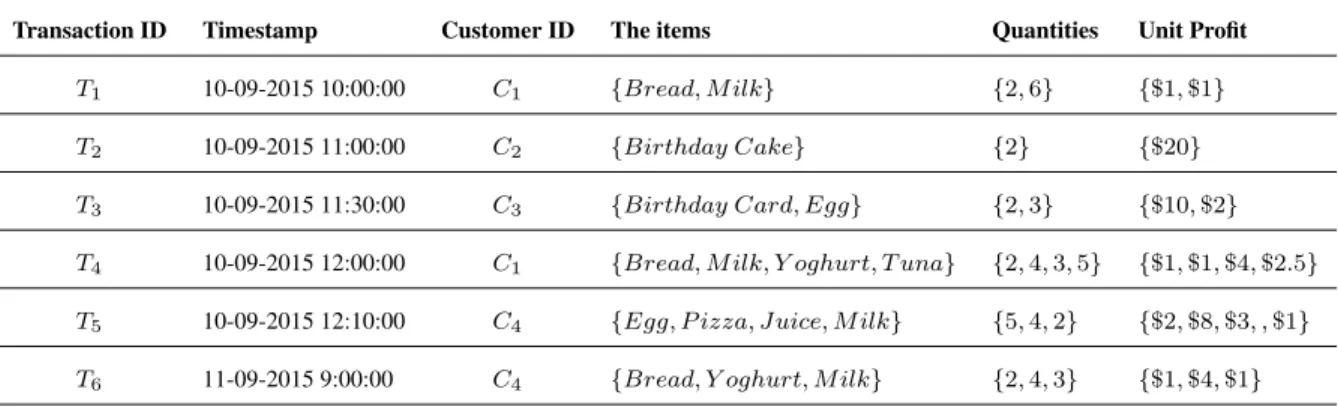
1) Retail Business: Table 1.1 shows an example of sequential data from a retail store. Each record is a customer transaction. In this table, the first column contains IDs assigned to the transactions. The second column shows time stamps for the transactions. The last three columns represent the information about the purchased items in each trans-action, the quantity of each purchased item in the transaction and the unit profit. In this
Table 1.1: An example of sequential data in a retail store
Transaction ID Timestamp Customer ID The items Quantities Unit Profit
T1 10-09-2015 10:00:00 C1 {Bread, M ilk} {2,6} {$1,$1}
T2 10-09-2015 11:00:00 C2 {Birthday Cake} {2} {$20}
T3 10-09-2015 11:30:00 C3 {Birthday Card, Egg} {2,3} {$10,$2}
T4 10-09-2015 12:00:00 C1 {Bread, M ilk, Y oghurt, T una} {2,4,3,5} {$1,$1,$4,$2.5}
T5 10-09-2015 12:10:00 C4 {Egg, P izza, J uice, M ilk} {5,4,2} {$2,$8,$3, ,$1}
T6 11-09-2015 9:00:00 C4 {Bread, Y oghurt, M ilk} {2,4,3} {$1,$4,$1}
dataset, extracting customers’ shopping behavior patterns can address several important questions such as how to increase revenue by recommending products based on previ-ously observed shopping behaviours.
2) News Portal: Table 1.2 shows an example of a news portal clickstream dataset Dwith 5 sessions{S1, S2, S3, S4, S5}. Each session contains a sequence of tuples,
cor-responding to the list of articles that a reader read in a visit to the news portal. For each article that a user read, the article id, whether the user clicked on the like button, whether she/he shared the news in a social media and the time that the user spent on the article are recorded. For example, tuplehnw1,1,1,14iin S1 means that a user visited news nw1,
pressed the like button, sharednw1 in a social media and also spent 14 minutes to read
news articlenw1. From such a dataset, modeling users’ reading behavior is a major way
to obtain a deep insight into the users. Reading behaviour patterns are useful for the por-tal designers to understand users’ navigation behavior and improve the porpor-tal design and
Table 1.2: An example of a web clickstream dataset Session 〈 , , , 〉 S 〈 , 1, 1,14〉〈 , 1, 0,3〉〈 , 1, 1, 22〉〈 , 0, 1,7〉 S 〈 , 0, 0,4〉〈 , 1, 0,15〉〈 , 1, 1,18〉 S 〈 , 1, 1,14〉〈 , 0, 0,1〉〈 , 1, 0,19〉〈 , 0, 1, 3〉 S 〈 , 1, 0,4〉〈 , 1, 0,8〉〈 , 0, 0,13〉 S 〈 , 1, 0,9〉〈 , 1, 0,2〉
e-business strategies. These patterns can be also used to build a news recommendation system.
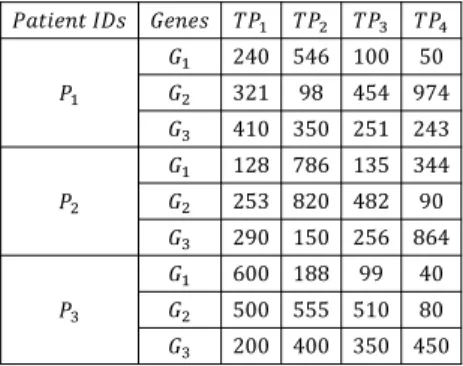
3) Bioinformatic: Microarray has been widely used in the biomedical field for iden-tifying genes that are differentially expressed in different biological states (e.g. diseased versus non-diseased). Table 1.3 shows a part of a time course microarray dataset obtained from a biological investigation which consists of three patients whose IDs areP1,P2 and
P3. In this table, the gene expression values of three genesG1, G2 andG3are presented
over four time pointsT P1, T P2, T P3 and T P4. Identifying potential gene regulations
that occur in a period of time is important for biologists. Such patterns allow researchers to compare gene expression in different tissues, cells or conditions and provide some information on the relative levels of expression of thousands of genes among samples (usually less than a hundred).
Motivated by the above examples and many examples from other businesses that involve sequential data, mining patterns in sequential data has become an interesting re-search topic. The problem ofsequential pattern miningwas first introduced by Agrawal
Table 1.3: An example of a time course microarray dataset 240 546 100 50 321 98 454 974 410 350 251 243 128 786 135 344 253 820 482 90 290 150 256 864 600 188 99 40 500 555 510 80 200 400 350 450 1 2.2 −2.4 −4.8 1 −3.2 1.4 3.0 1 −1.1 −1.6 −1.6 1 6.1 1.0 2.6 1 3.2 1.9 −2.8 1 −1.9 −1.1 2.9 1 −3.1 −6.6 −15 1 1.1 1.0 −6.2 1 2 1.7 2.2 ( ) ( )
and Srinkant [2] as follows. Given a sequence database, where each sequence consists of a list of transactions ordered by transaction time and each transaction is a set of items, sequential pattern mining is to discover all sequential patterns that frequently ap-pear in the database. For example in Table1.1, mining sequential patterns is to find the sequences of products that are frequently purchased by customers in a time order. In the last two decades many techniques and algorithms such asAprioriAll[2], GSP[53],
FreeSpan[29],PrefixSpan[50],SPADE[71] andSPAM[9] have been proposed to mine sequential patterns. The mined patterns have been used for different purposes such as
customer acquisition[14], web page design [12] and future location prediction of mobile users [59].
Despite the usefulness of sequential pattern mining in many applications, these ap-proaches assume that all items are equally important and consider only binary frequency values of items in transactions. In [16], the authors showed that such approaches were not sufficiently practical for industrial needs. In their study, the patterns returned by
se-quential pattern mining methods were handed over to business people, the results showed that business people were not able to effectively take over and interpret the patterns to solve business problems. According to their study, there are three reasons for the prob-lem. First, many patterns returned by sequential pattern mining may not be informative enough so that business people do not know which patterns are truly interesting and ac-tionable for their business. Second, most of the patterns are not particularly related to a business need. Third, business people often do not know how to take actions on them to support business decision-making and operations. Below are three applications drawn from retail business, news portal and bioinformatics where frequency-based sequential pattern mining is not sufficiently practical.
1) Mining profitable shopping behaviour: In Table 1.1 the number of occurrences of an item in a transaction (e.g., quantity) and the importance of an item (e.g., unit profit) are not considered in the traditional framework of sequential pattern mining. Hence, such a framework may discover a large number of sequential patterns having low selling profits and lose the valuable information on important patterns that will contribute high profits. According to the table, selling a Birthday Cake is much more profitable (e.g., $40 in total) than selling a bottle ofmilk(e.g., $15 in total), but a pattern containing a
Birthday Cakeis much more infrequent than the one with a bottle of milk. Hence, the sequences contain such profitable items may not be discovered by existing approaches. However, these profitable patterns are important in making business decisions for
maxi-mizing revenue or minimaxi-mizing marketing or inventory costs.
2) Mining user reading behaviour: There are some common deficiencies in most previous approaches to user reading behaviour mining based on frequency-based pattern mining in news domain. First, they discover patterns based on statistical measures such as frequency which do not take the user’s interest into account. It is very common that not all the news opened by the user are of interest to him/her. For example, in Table 1.2, the user in sessionS3 clicked on the news nw4 to find that it is not very interesting to
him/her since he/she only spent one minute to browse the news article. Second, the in-trinsic characteristics of news reading make web usage mining in news domain different than other domains. The news domain is a dynamic environment. When users visit a news portal, they are looking for new information or even surprising ones. However, the traditional approaches ignore the fact that the value of a news article changes over time.
3) Mining disease-related gene expression sequences: Applying frequency-based sequential pattern mining approaches to Table 1.3, we are able to identify potential gene regulations that occur in a period of time frequently. These methods mostly choose im-portant gene expression sequences based on thefrequency/supportframework. Usually, such datasets are collected to study a specific disease. However, as clinical studies have shown, the frequency alone may not be informative enough to discover gene expression sequences regarding an specific disease. For example, some genes are more important than others in causing a particular disease and some genes are more effective than others
in fighting diseases. The sequences contain these highly valuable genes may not be dis-covered by the frequency-based approaches because they neither consider the importance of each gene, nor temporal behavior of genes under biological investigation.
Considering these challenges, the important question is how to find sequential pat-terns of business interest. In view of this,utilitywas introduced into sequential pattern mining to discover patterns based on a business objective such as increasing profits, re-ducing costs, user’s interest or a specific disease. This led tohigh utility pattern mining
where the patterns are selected as interesting patterns based on their utility value. There are two main branches of high utility pattern mining which are highly related to the topic of this thesis.
1.1.1 High Utility Itemset Mining
LetI ={i1, i2, ..., im}be a set of items and each itemij ∈Iis associated with a positive
number p(ij), called its external utility (which can be the price or profit) of item ij.
Let D be a set of N transactions: D = {T1, T2, ..., TN} such that for ∀Tj ∈ D, Tj =
{(i, q(i, Tj))|i∈I, q(i, Tj)is the quantity of itemiin transactionTj}. Utility of an item
iin a transactionTj is defined as: u(i, Tj) = q(i, Tj)×p(i). Hence, the utility of an
itemsetX in a transactionTj is defined by: u(X, Tj) =
P
i∈X
u(i, Tj). For example, in
Table 1.1, utility of itemset{Bread, Y oghurt}is(2×$1 + 3×$4) + (2×$1 + 4×$4) = $32. An itemset is ahigh utility itemset (HUI)if its utility (such as the total profit that
the itemset brings) in a database is no less than a minimum utility threshold.
Mining HUIs is computationally more complex than mining frequent itemsets. This is due to the fact that the utility of an itemset does not have thedownward closure prop-erty, which would allow effective pruning of search space during the HUI mining pro-cess. In fact, the utility of an itemset may be higher than, equal to, or lower than those of its super-itemsets and sub-itemsets [3, 52, 66]. In the last decade, several techniques and algorithms have been proposed for mining high utility itemsets. TheM EU (Mining with Expected Utility) [64] is the first high utility itemset mining method. The authors defined the problem of mining high utility itemsets, and proposed a theoretical model of high utility itemset mining. Specifically, two types of utilities for items, namely trans-action utility (referred as internal utility in our definitions above) and external utility, were first proposed. They also proposed a utility upper bound called Expected Utility
for the itemset to prune unpromising candidates. TheTwo-Phase method presented in [42] is one of the most cited papers in high utility itemset mining. The authors proposed an over-estimate utility (i.e., T W U) model for mining high utility itemsets. The main advantage ofT W U is its downward closure property. In the first phase,Two-Phase dis-covers all itemsets whose TWU is more than the threshold (i.e.,HT W Uitemsets). Then in the second phase, it scans the database one more time to extract the true high utility itemsets from the HTWU itemsets. Based on the T W U model, CTU-Mine [24] was proposed that is more efficient thanTwo-phase in dense databases when the minimum
utility threshold is very low. To reduce the number of candidates in each database scan, the isolated item discarding strategy (IIDS) was proposed in [37]. ApplyingIIDS, the authors proposed two efficient algorithms F U M andDCG+. The authors of [34] pro-posed tighter upper bounds of utility values thanT W U values. In [57] a pattern growth approach (i.e., UP-Growth) was proposed to discover high utility patterns in two scans of database. The improved version of UP-Growth [57] was presented in [55]. Recently, some works have focused on mining HUIs in one scan of database. HUI-Miner (High Utility Itemset Miner) proposed by [40] is able to discover HUIs in one scan of database. In [33] a high utility itemset approach is proposed that discovers HUIs in a single phase without generating candidates.
1.1.2 High Utility Sequential Pattern mining
High utility itemset mining methods do not consider the ordering relationships between items or itemsets. Considering the sequential orders between itemsets makes the mining process much more challenging than mining high utility itemsets. To address this prob-lem,high utility sequential pattern (HUSP) mining has emerged in data mining recently [3, 4, 66]. HUSP mining finds sequences of items or itemsets whose utility is higher than a user-specified utility threshold. The concept of HUSP mining was first proposed by Ahmed et al [4]. They defined an over-estimated sequence utility measure, SW U, which has thedownward closure property, and proposed the UL and US algorithms for
mining HUSPs which use SW U to prune the search space. Shie et al. [52] proposed a framework for mining HUSPs in a mobile environment. Yin et al. [66] proposed the
USpanalgorithm for mining HUSPs, in which a lexicographic tree was used to extract the complete set of high utility sequential patterns.
1.2
Motivation
Adata streamis an ordered and unbounded list of records (e.g., items/itemsets/sequences). Many applications generate huge volumes of data streams such as network monitor-ing,ATM operations in banks, sensor networks, web clickstreams,transactions in retail chainsand many others. For example, Table 1.1 can be considered as a part of a data stream consisting of transactions ordered by their time stamps. Since transactions are done by different customers, this data stream can be also conisdered to have multiple se-quences of transactions, each corresponding to a customer. A customer is likely to shop more than once in the retail store. Hence, the sequences of customers such asC1 andC2
become longer and longer over time and also it is very likely that new customers start shopping in the future and thus new sequences can be generated as time evolves.
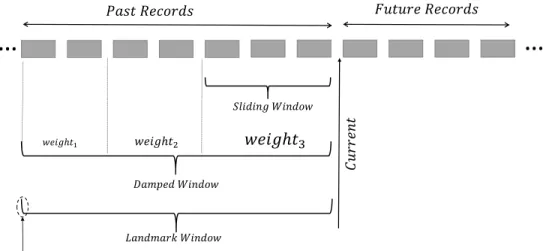
An algorithm dealing with data streams need to process the data in real time with one scan of data. There are three main types of stream-processing models: damped window based,sliding window basedandlandmark window based.
data record (e.g., a transaction) is assigned with a weight that decreases over time. There-fore, in this model, recent data are more important than old ones. However, it is difficult for users who are not domain experts to choose an appropriate decay function or decay rate for this model. Thesliding window basedmodel captures a fixed number of most recent records in a window, and it focuses on discovering the patterns within the window. When a new record flows into the window, the oldest one is expired and its effect is elim-inated from the window. Focusing on recent data can detect new characteristics of the data or changes in data distributions quickly. However, in some applications long-term monitoring is necessary and users want to treat all data elements starting from a past time point equally and discover patterns over a long period of time in the data stream. The
landmark windowbased model is used for such a purpose, which treats all data records starting from a past time point (calledLandmark) until the current time equally and dis-covers patterns over a long period of time in the data stream. Figure 1.1 summarizes the different stream processing models. In this figure, a data record can be an item, a transaction or a sequence.
All in all, mining such data poses many challenges due to its intrinsic characteristics. First, it is infeasible to keep all streaming data in the memory due to the high volume of data accumulated over time. Second, mining algorithms need to process the arriving data in real time with one scan of data. Third, the distribution of data varies over time, and hence analysis results need to be updated in real time.
…
…
Figure 1.1: Data stream processing models
There are some recent studies on mining data streams, including approximate fre-quency counts over data streams [38, 45, 48], mining frequent patterns in data streams[21, 35, 65] and high utility itemset mining over data streams [7, 42, 56], but no work has been done to mine high utility sequential patterns over data streams. The advantage of mining HUSPs over mining frequent sequential patterns from a data stream is that a business objective can be considered during pattern discovery as the utility. There are unique challenges in discovering HUSPs over data streams. Below, we first present the research objectives and challenges and then we describe our contributions to address the challenges.
1.3
Research Objectives
The objective of this dissertation is to develop techniques and algorithms for mining high utility sequential patterns over data streams. We work on mining HUSPs over both a long portion of a data stream and a short period of time. We also work on how to efficiently identify the most significant high utility patterns (namely, the top-k high utility patterns) over data streams. In this dissertation, we assume that the data in the data stream arrive very fast and in a large volume, hence mining algorithms need to process the arriving data in real time with one scan of data. In particular, we define and address the following research issues.
1.3.1 Incremental High Utility Sequential Pattern Mining over the Entire Data Streams
In some applications long-term monitoring or planning is necessary and users want to discover patterns over a long period of time in the data stream. For example, the users may want to detect important buying sequences of customers since the beginning of a year or since the store changed its layout. A complete re-scan of a long portion of a data stream is usually impossible or prohibitively costly. Mining from a dynamically-increasing data streams allows incremental maintenance of patterns over a long period of time in a data stream. However, incremental mining of HUSPs over a data stream is
challenging due to the need of capturing the information of data over a potentially long period of time. Since real-time stream processing does not allow us to scan the data more than once, information about the data processed so far need to be summarized and kept in memory. However, it is possible that the amount of information we need to keep exceeds the size of available memory. Thus, to avoid memory thrashing or crashing, memory-aware data processing is needed to ensure that the size of the data structure does not exceed the available memory, and at the same time the mining algorithm should be able to adapt its computation and memory usage to produce the best possible solutions under the memory constraint. That is, accurate approximation of the information needed for the mining process is necessary.
1.3.2 Mining Recent High Utility Sequential Patterns over Data Streams
In some applications such as network traffic monitoring and intrusion detection, users are more interested in information that reflect recent data rather than old ones. That is, the mining method should capture most recent records (i.e., transactions/sequences) in a window, and focus on discovering the patterns within the window. When a new record flows into the window, the oldest one should be eliminated. To discover recent HUSPs, a naive approach is to apply an existing algorithm on static data to re-generate all HUSPs when the new record is added to the window and the oldest record is expired. However, this approach is very time-consuming because it needs to re-run the whole
mining process on the window even just a very small portion of the data is changed.
1.3.3 Mining Top-k High Utility Patterns over Data Streams
A threshold-based high utility pattern (i.e., itemset/sequence) mining approach enables us to discover the complete set of high utility patterns with a pre-defined minimum utility threshold. However, it is often difficult for the user to specify a minimum utility thresh-old, especially if the user has no background knowledge in the application domain. If the threshold is set too low, a large number of patterns can be found, which is not only time and space consuming [61], but also makes it hard to analyze the mining results. On the other hand, if the threshold is set too high, there may be very few or even no high utility patterns being found, which means that some interesting patterns are missed. Therefore, it is more reasonable to ask users to set a bound on the result size and discover top-k high utility patterns over data streams. The main challenge is that the minimum utility thresh-old is not given in advance to mine top-k high utility patterns. In the threshthresh-old-based high utility pattern mining approaches, the algorithms can prune the search space efficiently with the given threshold. However, in the scenario of top-k high utility pattern mining, the threshold is not provided. Therefore, the minimum utility threshold is initially set to 0. The mining task should gradually raise the threshold to prune the search space. Hence, the challenge is to design strategies to raise the threshold as high as possible to prune the search space as early as possible.
1.3.4 High Utility Sequential Patterns in Real Life Applications
Much of existing HUSP mining research has focused on devising techniques to discover patterns from databases efficiently. Relatively little attention has been paid to show ap-plicability of the algorithms in real life scenarios. There are several challenges to use a HUSP mining algorithm in a real life application such as how to define the utility so that it reflects the objective of the application effectively and how to convert input sequential database to a utility-based sequential database.
1.4
Research Contributions
1.4.1 Memory Adaptive High Utility Sequential Pattern Mining over Data Streams
To solve the problem of mining high utility sequential patterns over the entire data streams, we propose a memory-adaptive high utility sequential pattern mining over data streams. In particular, our method is based on a specific type of the landmark window in which thelandmarkis the beginning of the data stream. Our contributions are summa-rized as follows.
• We propose a novel method for incrementally mining HUSPs over data streams. Our method identifies high utility sequential patterns over a long period of time. • We propose a novel and compact data structure, calledMAS-Tree, to store potential
HUSPs over a data stream. The tree is updated efficiently once a new candidate is discovered.
• Two efficient memory adaptive mechanisms are proposed to deal with the situation when the available memory is not enough to add a new potential HUSPs to MAS-Tree.
• Using MAS-Tree and the memory adaptive mechanisms, our algorithm, called
MAHUSP, efficiently discovers HUSPs over a data stream with a high recall and precision. The proposed method guarantees that the memory constraint is satisfied and also all true HUSPs are maintained in the tree under certain circumstances.
1.4.2 Sliding Window-based High Utility Sequential Pattern Mining over Data Streams
To address the problem ofmining recent high utility sequential patterns over data streams, we propose a sliding window-based high utility sequential pattern mining over data streams. Our contributions are summarized as follows.
• We define the problem of sliding window-based high utility sequential pattern min-ing to discover recent HUSPs over data streams.
• We propose a new utility model, called suffix utility (SFU), to over-estimate the sequence utility. We prove that SF U of a sequence is an upper bound of the
utilities of its super-sequences, which can be used to effectively prune the search space in finding HUSPs.
• We propose efficient data structures named ItemUtilLists (Item Utility Lists) and
HUSP-Tree(High Utility Sequential Pattern Tree) for maintaining the essential in-formation of high utility sequential patterns in a sliding window over a data stream. • We propose a new one-pass algorithm calledHUSP-Stream (High Utility Sequen-tial Pattern Mining over Data Streams) for efficiently constructing and updating
ItemUtilListsandHUSP-Treeby reading a transaction in the data streamonly once.
1.4.3 Top-k High Utility Pattern Mining over Data Streams
To address the problem oftop-k high utility pattern mining over data streams, we pro-pose two methods to discover top-k high utility itemsets and top-k high utility sequential patterns over data streams. Our contributions are summarized as follows.
• We first propose a method, called T-HUDS, for mining top-khigh utility itemsets from data streams. Then, we propose another method, called T-HUSP, for mining top-k high utility sequential patterns over data streams.
• We propose several strategies for initializing and dynamically adjusting the mini-mum utility threshold during the top-kHUI/HUSP mining process.
• We conduct extensive experiments on both real and synthetic datasets to evaluate the performance of the proposed algorithms. Experimental results show that T-HUDS and T-HUSP serve as efficient solutions for the problems of top-k high utility itemset mining over data streams and top-k high utility sequential pattern mining over data streams, respectively.
1.4.4 Mining Meaningful Patterns in Real Life Applications
In order to demonstrate the applicability of the proposed methods in practical cases, we discover meaningful patterns in two real-life applications. Our contributions are summa-rized as follows.
• We conduct an analysis on a real web clickstream dataset obtained from a Canadian news web portal to extract web users’ reading behavior patterns.
• We analyze a publicly available time course microarray dataset to identify gene sequences correlated with a specific disease.
• Using several quality measures, the mined utility-based sequential patterns are compared with the patterns in the frequency/support framework. The results show that our methods provide more meaningful patterns in real-life applications.
1.5
Thesis Structure
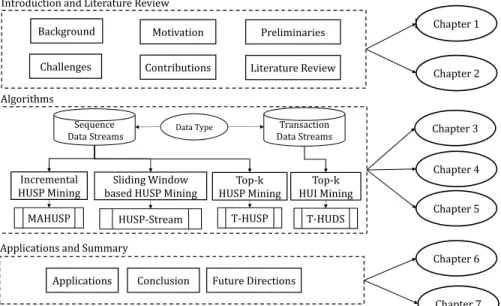
This dissertation is organized as follows.
In Chapter 2, we first present an introduction to the traditional frequent pattern mining framework, including existing work in frequent itemset/sequence mining over static data and data streams and top-k frequent itemset/sequence mining over data streams. Then, an overview of high utility pattern mining framework will be discussed. This overview de-scribes existing work in high utility itemset mining, high utility itemset mining over data streams, high utility sequential pattern mining and top-k high utility itemset/sequence mining.
In Chapter 3, we explore a fundamental problem that is how the limited memory space can be well utilized to produce high quality HUSPs over the entire data stream. We design an approximation algorithm, calledMAHUSP, that employs memory adaptive mechanisms to use a bounded portion of memory, to efficiently discover HUSPs over data streams. An efficient tree structure, calledMAS-Tree, is proposed to store potential HUSPs over a data stream. MAHUSPguarantees that all HUSPs are discovered under certain circumstances. Our experimental study on real and synthetic datasets shows that our algorithm cannot only discover HUSPs over data streams efficiently, but also adapt to allocated memory without sacrificing much the quality of discovered HUSPs.
se-quential pattern mining over a data stream. A novel data structure named HUSP-Tree
is proposed to maintain the essential information for mining HUSPs. HUSP-Tree can be easily updated when new data arrive and old data expire in a data stream. An efficient and single-pass algorithm named HUSP-Stream is proposed to generate HUSPs from
HUSP-Tree. When data arrive at or leave from the window,HUSP-Streamincrementally updatesHUSP-Treeto find HUSPs based on previous mining results. HUSP-Streamuses a new utility estimation model to more effectively prune the search space. Experimental results on real and synthetic datasets show that HUSP-Stream outperforms the state-of-the-art algorithms and serves as an efficient solution to the problem of mining recent high utility sequential patterns over data streams.
In Chapter 5, we propose two novel methods, namedT-HUDSandT-HUSP, for find-ing top-k high utility patterns (i.e., itemsets/sequences) over a data stream. T-HUDS
discovers top-k high utility itemsets andT-HUSPdiscovers top-k high utility sequential patterns over a data stream. T-HUDS is based on a compressed tree structure, called
HUDS-Tree, that can be used to efficiently find potential top-k high utility itemsets over sliding windows.T-HUDSuses a new utility estimation model to more effectively prune the search space. We also propose several strategies for initializing and dynamically adjusting the minimum utility threshold. We prove that no top-k high utility itemset is missed by the proposed method. Inspired by T-HUDS, we propose a single pass al-gorithm, called T-HUSP, to incrementally maintain the content of top-k HUSPs in the
sliding window in a summary data structure, namedTKList, and discover top-k HUSPs efficiently. In addition, two efficient strategies are proposed for raising the threshold. Our experiments are conducted on both synthetic and real datasets. The results show that both methods incorporating the proposed strategies demonstrate impressive performance without missing any top-k high utility itemset/sequential patterns.
In Chapter 6, in order to show the effectiveness and efficiency of our proposed meth-ods in real-life applications, we apply MAHUSP algorithm to a web clickstream dataset obtained from a Canadian news web portal to showcase users’ reading behavior and also to a real biosequence database to identify disease-related gene expression sequences. The results show that MAHUSP effectively discovers useful and meaningful patterns in both cases.
In Chapter 7, we review the contributions of the dissertation and summarize the di-rections for future.
Background Motivation Challenges Contributions Preliminaries Literature Review Chapter 1 Chapter 2 Chapter 3 Chapter 4 Chapter 5 Chapter 6 Chapter 7 Data Type Sequence
Data Streams Data StreamsTransaction
MAHUSP HUSP-Stream T-HUSP T-HUDS Incremental
HUSP Mining based HUSP MiningSliding Window HUSP MiningTop-k
Top-k HUI Mining
Applications Conclusion Future Directions Introduction and Literature Review
Algorithms
Applications and Summary
2
Literature Review
In this Chapter, we first introduce the traditional frequent pattern mining framework, which contains frequent itemset mining, frequent sequential pattern mining algorithms over static data and data streams and top-k frequent itemset/sequence mining over data streams. Then we present an overview of high utility pattern mining framework, which contains an introduction to the research so far, high utility itemset mining, high utility itemset mining over data streams, high utility sequential pattern mining and top-k high utility itemset/sequence mining.
2.1
Frequent Pattern Mining
2.1.1 Frequent Itemset Mining
Frequent itemsets play an essential role in many data mining tasks which association rules mining is one of the most popular ones. The motivation for finding association rules came from the need to analyze customer transactions data to examine customer behaviour in terms of purchased products. Association rules describe how often items
are purchased together. An association rulebeer→ diaper(80%)states that four out of five customers that bought beer also bought diaper. Such rules are helpful for decisions concerning product pricing, promotions, store layout and many others.
In 1994, Agrawal et al [1] proposed a property called Downward Closure Property, which also known as the Apriori Property[1] and defined as follows. Given two item-setsXandY,support(X)(i.e., frequency ofX) is equal or less thansupport(Y)(i.e., frequency of Y) if X ⊆ Y. Based on the apriori property, they proposed the Apriori algorithmto find frequent itemsets. An itemset is calledfrequent itemsetif its frequency is no less than a given minimum support threshold. The Apriori algorithm discovers fre-quent itemsets using a level-wise procedure. First, it scans the database to find 1-itemset candidates (itemsets with only one item) and prunes the candidates whose support is less than the minimum support threshold. Then, it joins the frequent 1-itemsets to generate 2-itemset candidates, and keeps those whose frequency satisfies the minimum support. The process repeats recursively until there is no more candidates to be generated, by which time the frequent itemsets have been discovered. With the foundation frequent pattern mining (namely, downward closure property), many algorithms were subsequently pub-lished [39].
However, Apriori-based algorithms generate a huge number of candidates and scans the original database multiple times to check the frequency of the candidates. In 2000, Han et al [30] proposed an algorithm called FP-Growth[30] to address this problem. The
FP-Growth algorithm is based on a divide-and-conquer strategy to find frequent itemsets without candidate generation. The foundation of the algorithm is a tree data structure namedFrequent-Pattern tree (FPtree), which stores the transaction database information. FP-Growth scans the database D once to find the frequent and infrequent items. The infrequent items are pruned from the original database, and the updated databaseD0 is retained. Then, the FP-tree is constructed based onD0. The FP-tree is then divided into a group of conditional databases, each one associated with one frequent pattern. Lastly, each conditional database is mined separately. The process is recursively invoked until no conditional databases can be generated.
Eclat[70], is another algorithm which is different fromAprioriandFP-Growth. Eclat
benefits from the structural properties of frequent itemsets to discover patterns efficiently. The items are organized into a subset lattice search space, which is decomposed into small independent chunks or sub-lattices, which can be stored in memory. The authors proposed lattice traversal techniques to discover all the long frequent itemsets and their subsets efficiently.
2.1.2 Frequent Sequential Pattern Mining
LetI ={i1, i2, ..., im}be a set of items andDbe a set ofN sequences:D ={S1, S2, ..., SN}
whereSj is a sequence of itemsets. The support of a sequence α = hX1, X2, ..., Xii in
α satisfies a minimum support threshold, α is afrequent sequential pattern. Given se-quence β = hX10, X20, ..., Xj0i i ≤ j), α is a sub-sequence of β or equivalently β is a super-sequence ofαif and only if there exist integers1≤e1 < e2 < ...ei ≤j such that
X1 ≤X 0 e1, X2 ≤X 0 e2, ..., Xi ≤X 0 ei.
Mining sequential patterns in sequence databases was first introduced by Agrawal et al [2]. Since then, quite a few algorithms have been proposed such as AprioriAll [2], GSP [53], FreeSpan [29] , PrefixSpan [50], SPADE [71] and SPAM [9] to find sequential patterns efficiently. These algorithms can be generally categorized as using ahorizontal database(e.g., AprioriAll, GSP, FreeSpan and PrefixSpan) or avertical database(e.g., SPADE, SPAM and ClaSP). A vertical representation provides the advantage of calcu-lating frequencies of patterns without performing costly database scans. This allows vertical mining algorithms to perform better on datasets having dense or long sequences than algorithms using the horizontal format. All of the above algorithms rely on the
downward closure property. Below, we briefly introduce the above algorithms.
AprioriAll: AprioriAll [2] is the first proposed algorithm to mine sequential pat-terns. It first finds all frequent 1-patpat-terns. Then, it constructs and retains two types of lists, called thecandidate listsand thefrequent pattern lists. For every (k + 1)-sequence candidate produced by joining two frequent k-sequences, it requires to scan the original database to calculate the support value. The process repeats until no more patterns can be formed.
SPADE: SPADE (Sequential PAttern Discovery using Equivalent classes)[71] uses a vertical data format and is a level-wise sequential pattern mining algorithm. SPADE avoids multiple scans of the original database. Instead, SPADE builds a list of sequence IDs and elements, calledID-list, for each candidate. The support count of the candidate can be easily calculated from the list without scanning the original dataset.
SPAM: SPAM (Sequential PAttern Mining) [9] is a depth-first algorithm. The au-thors introduced two novel joining operations called the sequence-extension step (S-Step), itemset-extension step (I-Step) and also a lexicographical tree for the first time.
SPAMuses a depth-first strategy to traverse the lexicographical tree to extract the com-plete set of frequent sequential patterns. SPAM also utilizes a vertical bitmap data struc-ture and puts it in the memory such that thejoiningoperation between two sequences is done extremely fast.
PrefixSpan: PrefixSpan (Prefix-projected Sequential pattern mining) [50] is an ex-tended pattern-growth approach for mining frequent sequential patterns and is the first algorithm that does not generate candidates. PrefixSpan uses the ”prefix” of the se-quence to project the database. Then, it scans the projected database for the items to be concatenated to the prefix, and calculates the support for each item. It removes the infrequent concatenation items and only keeps the frequent items. Finally, for each fre-quent concatenation item, a new prefix and its corresponding smaller projected database is constructed. The process continues until no more frequent concatenation items can be
scanned.
2.1.3 Frequent Sequential Pattern Mining over Data Streams
A desired feature of stream mining algorithms is that when records are inserted into or deleted from the database, the algorithms can incrementally update the patterns based on previous mining results, which is much more efficient than re-running the whole mining process on the updated database. Several studies such as [15, 18, 19, 32, 46] have been performed for mining sequential patterns over data streams. Below, we briefly introduce these algorithms.
MILE: MILE [19] is an efficient algorithm to mine sequential patterns over data streams. The proposed algorithm recursively uses the knowledge of existing patterns to mine the new patterns efficiently. One unique feature of MILE is when some prior knowledge of the data distribution in the data stream is available, it can be incorporated into the mining process to further improve the performance of MILE.
SMDS: SMDS has two main features: first, it summarizes batches of transactions using a sequence alignment method. This process works based on a greedy clustering algorithm. The algorithm provides distinct clusters of sequences by considering the main features of Web usage sequences. Second, frequent sequences found bySMDSare stored in a prefix tree structure. This data structure enablesSMDSto calculate the real support of each proposed sequence efficiently.
IncSpam: IncSpam[32] is single-pass algorithm to mine set of sequential patterns over a stream of itemset-sequences with a sliding window. The authors proposed a bit-sequence representation to reduce the memory requirement of the online maintenance of sequential patterns generated so far. The model receives sequences of a data stream and uses a bit-vector data structure, calledCustomer Bit-Vector Array with Sliding Window
(CBASW), to store the information of items for each sequence. Lastly, a weight function is adopted in this sliding window model. The weight function can judge the importance of a sequence and ensure the correctness of the sliding window model.
SPEED: SPEED [15] identifies frequent maximal sequential patterns in a data stream. SPEED is based on a novel data structure to maintain frequent sequential patterns cou-pled with a fast pruning strategy. At any time, users can issue requests for frequent maximal sequences over an arbitrary time interval. Furthermore, SPEED produces an approximate support answer with an assurance that it will not bypass a user-defined fre-quency error threshold.
SeqStream: SeqStream [18] mines closed sequential patterns in stream windows in-crementally. It works based on various novel pruning strategies and a synopsis structure calledIST(Inverse Closed Sequence Tree) to keep inverse closed sequential patterns in current window. There are two main tasks in SeqStream. The first one is to efficiently update supports of tree nodes when an element is inserted to or removed from the win-dow. The second one is to remove nodes that do not need to update or extend to eliminate
the related support counting and node extension costs as much as possible. SeqStream
uses an insertion database and removal database to update the support information of current IST. These two databases are usually much smaller than the whole database in the sliding window. Therefore the support update task can be completed quickly. For the second task, SeqStream adopts various pruning strategies to safely skip nodes that do not need to be handled.
2.1.4 Top-k Frequent Itemset/Sequence Mining
A challenging problem with many frequent pattern mining methods is that the user needs to supply a minimum support threshold. In frequent itemsets mining, several methods were proposed to find top-k frequent itemsets in static datasets [22, 23, 31, 49]. There are also several methods for finding top-k frequent itemsets over data streams. Golab et al. [28] proposed an algorithm, calledFREQUENT, for the top-k frequent item discovery in sliding windows. It performs well with bursty TPC/IP streams containing a small set of popular item types. Wong and Fu [60] proposed two algorithms to address the problem of top-k frequentl-itemsets (1≤l≤L) mining over data streams.TOPSIL-Miner[62] is another recent algorithm for mining top-k significant itemsets over data streams, which works based on a prefix tree structure. This method is an approximation method and does not guarantee that the exact set of top-k frequent itemsets is found. To address the difficulty of setting minimum support, the problem of top-k sequential pattern mining
was defined by [58]. The authors proposed an algorithm called TSP. They proposed two versions of TSP for respectively mining (1) top-k sequential patterns and (2) top-k closed sequential patterns. Although these algorithms are efficient, it is difficult (if not impossible) to simply adapt them to high utility itemset/sequence mining.
2.2
High Utility Pattern Mining
In the previous section, we reviewed several frequent pattern mining algorithms which aim to discover various types of frequent patterns such as items, itemsets and sequences. However, in frequent pattern mining, the number of occurrences of an item inside a trans-action is ignored in the problem setting, so is the importance (such as price or weight) of an item in the dataset. In order to assign different weights to items, weighted frequent pattern mining methods were proposed [54, 68, 69]. These methods work with different weights for different items. One of the first weighted frequent pattern mining methods is WARM (Weighted Association Rule Mining) [54]. Another method isWFIM [69] which was proposed to extend pattern growth algorithm to consider weighted items. This paper defined a weight range and a minimum weight constraint. Items were given different weights within the weight range. The support and weight of items were used to prune the search space. However these methods are just applicable when the frequency of an item in each transaction is either 1 or 0.
pattern is ahigh utility pattern (HUP)if its utility (such as the total profit that the pattern brings) in a dataset is no less than a minimum utility threshold. Below, we present two main types of high utility pattern mining approaches which are relevant to this disserta-tion.
2.2.1 High Utility Itemset Mining
MEU: TheM EU(Mining with Expected Utility) model [64] is the first high utility item-set mining method. In this paper, the authors defined the problem of high utility itemitem-set mining. They described two types of utilities for items, internal utility and external util-ity. The internal utility of an item in a transaction is defined according to the information stored in the transaction. The external utility of an item is based on information which are not available in the transaction. The external utility is proposed as a new measure for describing user preferences. By analyzing the utility relationships among itemsets, they identified the utility bound property and the support bound property. Furthermore, they defined the mathematical model of high utility itemset mining based on these prop-erties. M EU does not use the downward closure property, hence a heuristic approach was proposed to predict if a pattern should be added to the candidate set. M EU checks the candidate patterns using a prediction method with a high computational cost. Later, theU M ining algorithm [63] improved its performance. They defined an upper bound utility for each pattern. Using this upper bound, low utility patterns are pruned during
the mining process.
Two Phase Method: As mentioned before, the utility of an itemset may be equal to, higher or lower than that of its supersets and subsets. Therefore, we cannot directly use the anti-monotone property (also known as downward closure property) to prune the search space. To facilitate the mining task, Liu et al. [42] introduced the concept of
transaction-weighted downward closure, which is based on the following definitions.
Definition 1 Transaction-Weighted Utility (TWU)of an itemsetXover a datasetDis defined as:T W UD(X) =
P
X⊆TjVTj∈D
T U(Tj),whereT U(Tj)is the utility of transaction
Tj and is defined asT U(T) = P item∈T
u(item, T).
Clearly,T W UD(X)≥uD(X). In addition,T W U satisfies the downward closure
prop-erty, that is, for allY ⊆X,T W UD(Y)≥T W UD(X).
Definition 2 An itemset X is ahigh transaction-weighted utilization itemset (abbrevi-ated asHT W U) ifT W UD(X) ≥min util, wheremin utilis called aminimum utility threshold.
TheTwo-Phase method in [42, 43] proposed based on the overestimate utility (i.e., T W U) model. The general process for mining high utility itemsets using T W U from a database is as follows. In the first phase of Two-Phase, all of the HT W U itemsets are discovered. In the second phase, the database is scanned one more time and the true high utility itemsets are extracted from theHT W U itemsets. SinceT W UD(X)is
an overestimate of the true utility of X, the procedure does not miss any high utility itemset. But the true utility of a generated itemset may be lower than the minimum utility threshold. Thus,Two-Phaseuses the second phase to compute the exact utility of theHT W U itemsets and remove those whose utility is lower than the threshold.
CTU-Mine: Based on theT W U model,CTU-Mine[24] was proposed that is more efficient thanTwo-phasein dense databases when the minimum utility threshold is very low. In order to mine HUIs, a prefix tree, calledCUP-tree, is constructed. It consists of an ItemT ablecalledGlobalItemT able made up of all high T W U items and a tree calledGlobalCUP-Treewith nodes linked by pointers fromGlobalItemT able, contain-ing itemset information for utility mincontain-ing. GlobalItemT able contains all individual HT W U items sorted in descending order by their T W U values. Then, a new algo-rithm that traverses the tree using a bottom-up approach is presented. During mining process, the algorithm constructs another tree called a High Utility Pattern Tree ( HUP-Tree) to maintain high utility itemsets and their utility values computed by traversing the
LocalCUP-Tree. This data structure and algorithm extend the pattern growth approach. Later, to reduce the number of candidates in each database scan, the isolated item dis-carding strategy (IIDS) was proposed in [37]. UsingIIDS, two efficient algorithms F U M andDCG+were proposed by the authors.
IHUP: In [8], efficient tree structures were proposed to discover high utility item-sets in incremental databases. The authors proposed three new tree structures with the
build once mine manyproperty for high utility pattern mining in an incremental database. They designed the first incremental tree structure,Incremental High Utility Pattern Lex-icographic Tree(IHU PL−T ree), according to the items lexicographic order. This tree
can capture the incremental data without any restructuring operation, but the tree size cannot be guaranteed to be compact. The second incremental tree structure, Incremen-tal High Utility Pattern Transaction Frequency Tree (IHU PT F − T ree), is designed
according to the transaction frequency (descending order) of items to obtain a compact tree. However, it is not guaranteed that items having higher transaction frequency will also have a high utility value. If several low utility items appear in the upper portion of the tree, then the mining task will take longer. To ensure the candidates of high utility items will appear before low-utility items in any branch of the tree, the third incremental tree structure, Incremental High Utility Pattern-Transaction-Weighted Utilization Tree
(IHU PT W U −T ree) is designed according to transaction-weighted utilization of items
in descending order, which ensures that only nodes containing candidate items are par-ticipating in the mining operation. The proposed algorithm is calledIHU P and works as follows. It first constructs one of the proposed tree structures based on transactions and then applies a pattern growth approach to generate candidates. In the second scan, all HUIs are discovered from the generated candidates.
UP-Growth and UP-Growth+: In [57] a pattern growth approach (i.e., UP-Growth) was proposed to discover high utility itemsets in two scans. UP-Growth defines a tree
structure and four effective strategiesDGU,DGN,DLUandDLNfor mining HUIs. The information of high utility itemsets is maintained in a special data structure named UP-Tree (Utility Pattern Tree) such that the candidate itemsets can be generated with only two scans of the database. The improved version of [57] was presented in [55]. The proposed framework consists of three main steps. First, it scans the database twice to construct UP-Tree applying two proposed strategies: DGU and DGN. In the second step, either Up-Growth or the other proposed method, called UP-Growth+, is applied to generate candidates recursively. At the end, by computing the exact utility of each candidate, all HUIs are discovered.
Most of the above algorithms adopt a similar framework: firstly, generate candidate high utility itemsets from a database; secondly, compute the exact utilities of the candi-dates by scanning the database to identify high utility itemsets. However, the algorithms often generate a very large number of candidate itemsets and thus are confronted with two problems: (1) excessive memory requirement for storing candidate itemsets; (2) a large amount of running time for generating candidates and computing their exact util-ities. When the number of candidates is so large that they cannot be stored in memory, the algorithms will fail or their performance will be degraded due to memory thrashing.
Recently, some works have focused on mining HUIs in one scan of data base: HUI-Minerandd2HUP. Both algorithms work in a new framework, which discovers high util-ity itemsets without generating candidates. In the new framework, high utilutil-ity itemsets
are directly identified from a set-enumeration tree, which is the search space constructed by enumerating itemsets with prefix or suffix extensions. To facilitate the computation of itemsets’ utility values and prune unpromising itemsets efficiently, both HUI-Miner and d2HUP maintain utility information and utility upper bound information by two kinds of data structure respectively. By avoiding the generation of a large number of candidates, HUI-Miner and d2HUP show excellent performance and outperform the state-of-the-art algorithms based on FP-growth over one order of magnitude.
HUI-Miner: HUI-Miner (High Utility Itemset Miner) proposed by [40] is able to discover HUIs in one scan of database. HUI-Miner uses a new data storage, called
Utility-list, to maintain utility information about the patterns. Once Utility-list is con-structed, HUI-Miner does not need the database and can discover the HUIs and their exact utilities directly. The mining process is similar to Apriori-based algorithms but instead of scanning database several times,HUI-Minerscans the data once and after that it only scans theUtility-listseveral times.
d2HUP:In [33] a high utility itemset discovery approach (d2HUP) is proposed that
works in a single phase without generating candidates. They propose a novel data struc-ture to maintain original utility information, namedCAU L, during mining process and then enumerate patterns by prefix extensions. A high utility itemset growth approach is proposed, which enumerates an itemset as a prefix extension of another itemset. It com-putes the utility of each enumerated itemset and an upper bound on the utilities of prefix
extensions of the itemset in order to directly identify high utility itemsets and to prune the search space. The proposed utility upper bound is tighter thanT W U, and is further tightened by recursively filtering out items irrelevant in growing high utility itemsets with sparse data.
2.2.2 High Utility Itemset Mining over Data Streams
Recently, high utility itemset mining from data streams has become an active research topic in data mining [7, 42, 56].
THUI-Mine:THUI-Mine[56] was the first algorithm for mining temporal high util-ity itemsets from data streams. It explores the issue of efficiently mining high utilutil-ity itemsets in temporal databases such as data streams. THUI-Mine discovers temporal high utility itemsets from data streams efficiently and effectively. The underlying idea of
THUI-Minealgorithm is to integrate the advantages of Two-Phase algorithm [42] with the incremental mining techniques for mining temporal high utility itemsets. The main contribution ofTHUI-Mine is that it can efficiently identify the high utility itemsets in data streams so that the execution time for mining high utility itemsets can be reduced. That is,THUI-Minediscovers the temporal high utility itemsets in current time window and also discovers the temporal high utility itemsets in the next time window with limited memory space and less computation time by sliding window method. THUI-Minefirst finds the length-1 and length- 2 candidate patterns, and then all the candidate patterns