Methods and Tools for Temporal
Knowledge Harvesting
Dissertation
zur Erlangung des Grades
Doktor der Ingenieurwissenschaften (Dr.-Ing.)
der Naturwissenschaftlich-Technischen Fakultät I
der Universität des Saarlandes
Yafang Wang
Max-Planck-Institut für Informatik
Saarbrücken
2013
Dekan der
Naturwissenschaftlich-Technischen
Fakultät I Univ.-Prof. Mark Groves
Vorsitzender der Prüfungskommission Prof. Dr. Dietrich Klakow Berichterstatter Prof. Dr.-Ing. Gerhard Weikum Berichterstatter Prof. Dr.-Ing. Martin Theobald
Beisitzer Dr.-Ing. Klaus Berberich
Eidesstattliche Versicherung
Hiermit versichere ich an Eides statt, dass ich die vorliegende Arbeit selbstständig und ohne Benutzung anderer als der angegebenen Hilfsmittel angefertigt habe.
Die aus anderen Quellen oder indirekt übernommenen Daten und Konzepte sind unter Angabe der Quelle gekennzeichnet.
Die Arbeit wurde bisher weder im In- noch im Ausland in gleicher oder ähnlicher Form in einem Verfahren zur Erlangung eines akademischen Grades vorgelegt.
Saarbrücken, den 15.01.2013
To my Mum, Chuanwei Zhu To my Dad, Juyuan Wang
Acknowledgment
I would like to express my profound appreciation to my advisor, Prof. Dr.-Ing. Gerhard Weikum, for his extreme patience and support, and encouragement throughout my doctoral studies. Gerhard gave me the freedom to explore on my own, and at the same time offered the guidance to keep me on track. I am also greatly thankful for his careful reading and commenting on the manuscript. His excellent and friendly advice was essential to the completion of this dissertation. I am also deeply indebted to my colleagues with whom I worked on many publications that I published throughout the procedure of this dissertation. I would like to thank Prof. Dr.-Ing. Martin Theobald and Maximilian Dylla, for the stimulating discussions, for the sleepless nights we were working together before deadlines. I am grateful to Dr. Bin Yang and Lizhen Qu, for both the help of technical details of the work, and the fun we have had together in Saarbrücken. I wish to express my gratitude to Dr. Mingjie Zhu, Dr. Marc Spaniol, Dr. Spyros Zoupanos, Zhaochun Ren and Mohamed Yahya, for their help in many details of the work. I appreciate Kim Pecina and Maximilian Dylla, who were also very generous in helping me to translate the abstract and summary of this dissertation into German.
I am very thankful to all my colleagues at MPI and all my friends, with whom I have had lots of inspiring discussions and made great memories lasting forever. I also very much appreciate the help from Petra Schaaf and Andrea Ruffing, who were always ready for my questions about both my life in Germany and business issues. Last but not least, I would like to thank my family and in particular my parents, who have been a constant source of love, concern, support and strength all these years.
Abstract
To extend the traditional knowledge base with temporal dimension, this thesis offers methods and tools for harvesting temporal facts from both semi-structured and textual sources. Our contributions are briefly summarized as follows.
1. Timely YAGO: A temporal knowledge base called Timely YAGO (T-YAGO) which extends YAGO with temporal attributes is built. We define a simple RDF-style data model to support temporal knowledge. 2. PRAVDA:To be able to harvest as many temporal facts from free-text as
possible, we develop a system PRAVDA. It utilizes a graph-based semi-supervised learning algorithm to extract fact observations, which are further cleaned up by an Integer Linear Program based constraint solver. We also attempt to harvest spatio-temporal facts to track a person’s trajectory.
3. PRAVDA-live: A user-centric interactive knowledge harvesting system, called PRAVDA-live, is developed for extracting facts from natural language free-text. It is built on the framework of PRAVDA. It supports fact extraction of user-defined relations from ad-hoc selected text documents and ready-to-use RDF exports.
4. T-URDF:We present a simple and efficient representation model for time-dependent uncertainty in combination with first-order inference rules and recursive queries over RDF-like knowledge bases. We adopt the common possible-worlds semantics known from probabilistic databases and extend it towards histogram-like confidence distributions that capture the validity of facts across time.
All of these components are fully implemented systems, which together form an integrative architecture. PRAVDA and PRAVDA-live aim at gathering new
Abstract
facts (particularly temporal facts), and then T-URDF reconciles them. Finally these facts are stored in a (temporal) knowledge base, called T-YAGO. A SPARQL-like time-aware querying language, together with a visualization tool, are designed for T-YAGO. Temporal knowledge can also be applied for document summarization.
Abstract
Diese Dissertation zeigt Methoden und Werkzeuge auf, um traditionelle Wissensbasen um zeitliche Fakten aus semi-strukturierten Quellen und Textquellen zu erweitern. Unsere Arbeit lässt sich wie folgt zusammenfassen.
1. Timely YAGO: Wir konstruieren eine Wissensbasis, genannt ’Timely YAGO’ (T-YAGO), die YAGO um temporale Attribute erweitert. Zusätzlich definieren wir ein einfaches RDF-ähnliches Datenmodell, das temporales Wissen unterstützt.
2. PRAVDA: Um eine möglichst große Anzahl von temporalen Fakten aus Freitext extrahieren zu können, haben wir das PRAVDA-System entwickelt. Es verwendet einen auf Graphen basierenden halbüberwachten Lernalgorithmus, um Feststellungen über Fakten zu extrahieren, die von einem Constraint-Solver, der auf einem ganzzahligen linearen Programm beruht, bereinigt werden. Wir versuchen zudem räumlich-temporale Fakten zu extrahieren, um die Bewegungen einer Person zu verfolgen.
3. PRAVDA-live: Wir entwickeln ein benutzerorientiertes, interaktives Wissensextrahiersystem namens PRAVDA-live, das Fakten aus freier, natürlicher Sprache extrahiert. Es baut auf dem PRAVDA-Framework auf. PRAVDA-live unterstützt die Erkennung von benutzerdefinierten Relationen aus ad-hoc ausgewählten Textdokumenten und den Export der Daten im RDF-Format.
4. T-URDF:Wir stellen ein einfaches und effizientes Repräsentationsmodell für zeitabhängige Ungewissheit in Verbindung mit Deduktionsregeln in Prädikatenlogik erster Stufe und rekursive Anfragen über RDF-ähnliche Wissensbasen vor. Wir übernehmen die gebräuchliche Mögliche-Welten-Semantik, bekannt durch probabilistische Datenbanken
Abstract
und erweitern sie in Richtung histogrammähnlicher Konfidenzverteilungen, die die Gültigkeit von Fakten über die Zeit betrachtet darstellen.
Alle Komponenten sind vollständig implementierte Systeme, die zusammen eine integrative Architektur bilden. PRAVDA und PRAVDA-live zielen darauf ab, neue Fakten (insbesondere zeitliche Fakten) zu sammeln, und T-URDF gleicht sie ab. Abschließend speichern wir diese Fakten in einer (zeitlichen) Wissensbasis namens T-YAGO ab. Eine SPARQL-ähnliche zeitunterstützende Anfragesprache wird zusammen mit einem Visualisierungswerkzeug für T-YAGO entwickelt. Temporales Wissen kann auch zur Dokumentzusammenfassung genutzt werden.
Summary
To extend the traditional knowledge base with temporal dimension, this thesis offers methods and tools for harvesting temporal facts from both semi-structured and textual sources. Our contributions are briefly summarized as follows.
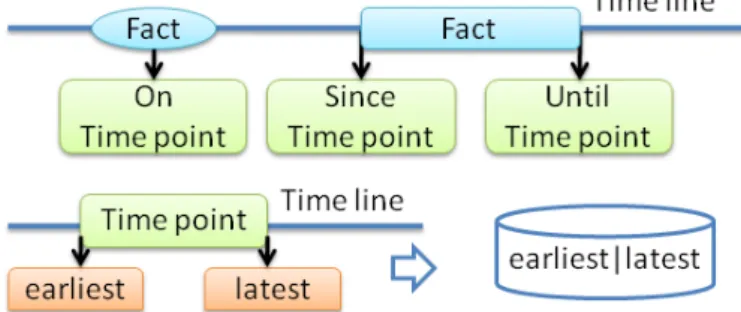
1. Timely YAGO: A temporal knowledge base called Timely YAGO (T-YAGO) which extends YAGO with temporal attributes is built. We define a simple RDF-style data model to support temporal knowledge. For temporal facts valid at a time point, we use the relationonto describe the validity time; for those valid during a time period, we use the relation sincefor the begin time point, and the relationuntilfor the end time point. Most of the temporal facts are extracted from semi-structured data (e.g., infoboxes, categories and lists of Wikipedia articles) via a rule-based method. A SPARQL-like time aware query language is provided for querying. The results are shown via a timeline visualization tool.
2. PRAVDA:To be able to harvest as many temporal facts from free-text as possible, we develop a system PRAVDA. It utilizes a graph-based semi-supervised learning algorithm, which guarantees a high recall and comparable precision with limited human created seeds. The graph is composed of fact candidate nodes and pattern nodes. Edges between fact candidate nodes and pattern nodes are introduced whenever a fact candidate appears with a pattern. Their weight is derived from the co-occurrence frequency. Edges between pattern nodes are created if their type pair is identical and the degree of their similarity delivers the edge’s weight. We use one label for each observation type (begin,during, andend) of each relation. Then label propagation is exploited to determine the label of each node. Once a fact candidate is labelled with a particular relation, it is called avalid fact observation. Afterwards, an Integer Linear
Summary
Program is used to clean out false hypotheses that violate temporal constraints. We also attempt to harvest spatio-temporal facts to track a person’s trajectory.
3. PRAVDA-live: A user-centric interactive knowledge harvesting system, called PRAVDA-live, is developed for extracting facts from natural language free-text. It is built on the framework of PRAVDA. It supports fact extraction of user-defined relations from ad-hoc selected text documents and ready-to-use RDF exports. Further features include support for temporally annotated relations, custom or mined extraction-patterns, and a constraint solver able to clean extracted fact observations by inter-fact constraints.
4. T-URDF: We present a simple and efficient representation model for time-dependent uncertainty in combination with first-order inference rules and recursive queries over RDF-like knowledge bases. We adopt the common possible-worlds semantics known from probabilistic databases and extend it towards histogram-like confidence distributions that capture the validity of facts across time. An algorithm is designed to reconcile multiple (potentially inconsistent) observations of temporal facts into a concise histogram. Thebegin, duringand endfact observations are aggregated into histograms respectively. Then we perform forward aggregation for the begin histogram, backward aggregation for the end histogram, and merge them with theduringhistogram. Query processing is done via a Datalog-like, rule-based inference engine, which employs the lineage of derived facts for confidence computations to remain consistent with the possible-worlds model.
All of these components are fully implemented systems, which together form an integrative architecture. PRAVDA and PRAVDA-live aim at gathering new facts (particularly temporal facts), and then T-URDF reconciles them. Finally these facts are stored in a (temporal) knowledge base, called T-YAGO. A SPARQL-like time-aware querying language, together with a visualization tool, are designed for T-YAGO. Temporal knowledge can also be applied for document summarization.
Zusammenfassung
Diese Dissertation zeigt Methoden und Werkzeuge auf, um traditionelle Wissensbasen um zeitliche Fakten aus semi-strukturierten Quellen und Textquellen zu erweitern. Unsere Arbeit lässt sich wie folgt zusammenfassen.
1. Timely YAGO: Wir konstruieren eine Wissensbasis, genannt ‘Timely YAGO’ (T-YAGO), die YAGO um temporale Attribute erweitert. Zusätzlich definieren wir ein einfaches RDF-ähnliches Datenmodell, das temporales Wissen unterstützt. Die Relation on beschreibt zeitliche Fakten, die zu einem bestimmten Zeitpunkt gültig sind; Fakten, die über eine längere Zeitspanne gültig sind, werden durch die Relationen since unduntilausgedrückt, die jeweils den Startpunkt und den Endpunkt des Zeitraums beschreiben. Der Großteil der temporalen Fakten wird aus semi-strukturierten Daten (z.B. Infoboxen, Kategorien und Listen von Wikipedia-Artikeln) durch regelbasierte Methoden extrahiert. Wir stellen eine SPARQL-ähnliche Abfragesprache mit Unterstützung der Zeitkomponente vor. Die Ergebnisse werden mit Hilfe eines Zeitleisten-Visualisierungstools präsentiert.
2. PRAVDA: Um eine möglichst große Anzahl von temporalen Fakten aus Freitext extrahieren zu können, haben wir das PRAVDA-System entwickelt. Es verwendet einen auf Graphen basierenden halbüberwachten Lernalgorithmus, welcher hohe Ausbeute bei vergleichbarer Präzision garantiert und mit einer geringen Anzahl von manuellen Annotationen zurechtkommt. Die Knoten des Graphen unterteilen sich in Muster-Knoten und Faktkandidat-Knoten. Kanten zwischen Muster-Knoten und Faktkandidat-Knoten werden in den Graphen eingefügt, wenn ein Faktkandidat innerhalb eines Musters im Freitext auftritt. Das Gewicht dieser Kanten wird durch die Frequenz des gemeinsamen Auftretens bestimmt. Des Weiteren fügen wir Kanten
Zusammenfassung
zwischen Muster-Knoten in den Graphen ein, wenn deren Typenpaar identisch ist, wobei das Kantengewicht durch die Ähnlichkeit bestimmt wird. Für jede Relation benutzen wir drei Annotationen, welche den Beobachtungstypen (begin, during und end) entsprechen. Danach wird Annotationsweitergabe verwendet um die Annotation jedes Knoten im Graphen zu bestimmen. Sobald ein Faktkandidat mit einer Relation annotiert ist, nennen wir ihn valide Faktbeobachtung. Anschließend wird ein ganzzahliges lineares Programm verwendet, um die falschen Hypothesen mit Hilfe von temporalen Bedingungen auszufiltern. Wir versuchen außerdem räumlich-temporale Fakten zu extrahieren, um die Bewegungen einer Person zu verfolgen.
3. PRAVDA-live: Wir entwickeln ein benutzerorientiertes, interaktives Wissensextrahiersystem namens PRAVDA-live, das Fakten aus freier, natürlicher Sprache extrahiert. Es baut auf dem PRAVDA-Framework auf. PRAVDA-live unterstützt die Erkennung von benutzerdefinierten Relationen aus ad-hoc ausgewählten Textdokumenten und den Export der Daten im RDF-Format. Weitere Merkmale beinhalten die Unterstützung von zeitlich annotierten Relationen, maßgeschneiderten oder gewonnenen Extrahierungsmustern und einen Constraint-Solver, der extrahierte Faktbeobachtungen durch zwischenfaktische Beschränkungen bereinigt.
4. T-URDF:Wir stellen ein einfaches und effizientes Repräsentationsmodell für zeitabhängige Ungewissheit in Verbindung mit Deduktionsregeln in Prädikatenlogik erster Stufe und rekursive Anfragen über RDF-ähnliche Wissensbasen vor. Wir übernehmen die gebräuchliche Mögliche-Welten-Semantik, bekannt durch probabilistische Datenbanken und erweitern sie in Richtung histogrammähnlicher Konfidenzverteilungen, die die Gültigkeit von Fakten über die Zeit betrachtet darstellen. Des Weiteren designen wir einen Algorithmus, der mehrere (potentiell inkonsistente) Beobachtungen von zeitlichen Fakten in präzise Histogramme überführt. Die Fakten begin, during und end werden jeweils in Histogramme aggregiert. Danach führen wir eine Vorwärtsaggregierung für die begin Histogramme, eine Rückwärtsaggregierung für die end Histogramme durch und fusionieren
beide mit dem during Histogramm. Anfragen werden mithilfe eines datalogähnlichen, regelbasierten Deduktionssystems beantwortet, welches die Abstammung von hergeleiteten Fakten für Konfidenzberechnungen einbezieht, um im Einklang mit dem Mögliche-Welten-Modell zu bleiben.
Alle Komponenten sind vollständig implementierte Systeme, die zusammen eine integrative Architektur bilden. PRAVDA und PRAVDA-live zielen darauf ab, neue Fakten (insbesondere zeitliche Fakten) zu sammeln, und T-URDF gleicht sie ab. Abschließend speichern wir diese Fakten in einer (zeitlichen) Wissensbasis namens T-YAGO. Eine SPARQL-ähnliche zeitunterstützende Anfragesprache wird zusammen mit einem Visualisierungswerkzeug für T-YAGO entwickelt. Temporales Wissen kann auch zur Dokumentzusammenfassung genutzt werden.
Contents
Abstract xi Abstract xiii Summary xv Zusammenfassung xvii 1. Introduction 1 1.1. Motivation . . . 1 1.2. Research Challenges . . . 3 1.3. Contributions . . . 5 1.4. Thesis Outline . . . 6 2. Related Work 9 2.1. Knowledge Harvesting . . . 92.2. Temporal Information Extraction . . . 11
2.3. Label Propagation . . . 12
2.4. Temporal and Probabilistic Databases . . . 12
2.5. Interactive Systems . . . 13
2.6. Summarization . . . 14
3. Knowledge Representation 17 3.1. Relation and Fact Types . . . 17
3.2. Time Points, Intervals, and Histograms . . . 18
3.3. Event and State Relations . . . 19
3.4. Temporal Knowledge Representation . . . 20
Contents
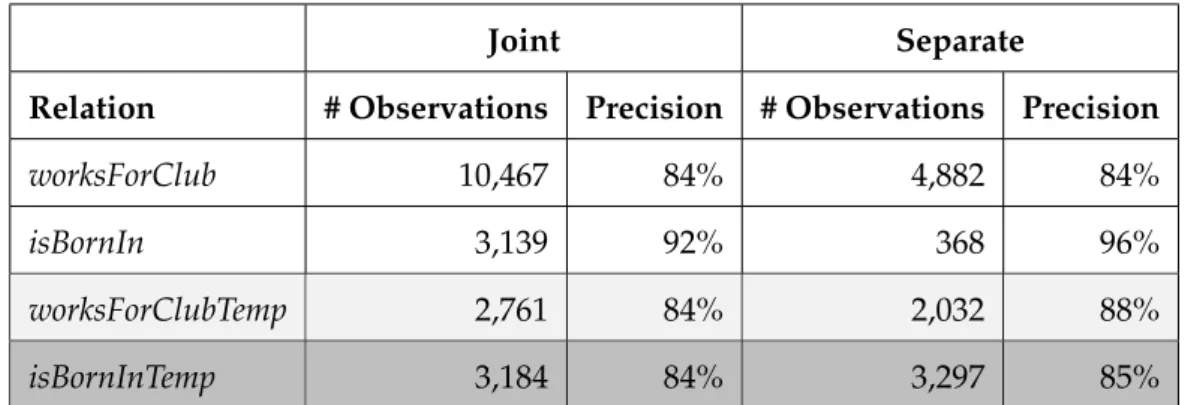
4.1. Problem Statement and Contributions . . . 23 4.1.1. Motivation . . . 23 4.1.2. Contributions . . . 24 4.2. Temporal Knowledge Harvesting from Semi-structured Text . . . 25 4.3. Temporal Knowledge Harvesting from Natural Language Free-text 28 4.3.1. Framework and System Overview . . . 28 4.3.2. Patterns and Graph Model . . . 30 Candidate Gathering . . . 31 Pattern Analysis . . . 32 Graph Model . . . 35 4.3.3. Label Propagation Algorithm . . . 36 Basic Objective Function . . . 37 Incorporating Inclusion Constraints . . . 39 Combining Base and Temporal Graphs . . . 41 4.3.4. Experiments . . . 43 System Implementation . . . 43 Experimental Setup . . . 44 Results on Base Fact Observation Extraction . . . 45 Results on Temporal Fact Observation Extraction with
Inclusion Constraints . . . 48 Results on Joint Base and Temporal Fact Observation
Extraction . . . 49 4.3.5. Conclusions . . . 51 4.4. Scalable Spatio-temporal Knowledge Harvesting . . . 51 4.4.1. Motivation . . . 51 4.4.2. Methodology . . . 52 4.4.3. Experiments . . . 54
5. Temporal Knowledge Cleaning 57
5.1. Problem Statement and Contributions . . . 57 5.2. Cleaning Temporal Fact Observations . . . 58 5.2.1. Problem Statement and Contributions . . . 58 5.2.2. Framework . . . 58 5.2.3. Applying Temporal Constraints . . . 59 5.2.4. Experiments . . . 61
Contents
Pipeline vs. Joint Model . . . 62 Increasing Recall . . . 63 5.2.5. Conclusions . . . 64 5.3. Temporal Fact Reasoning . . . 65 5.3.1. Problem Statement and Contributions . . . 65 5.3.2. Histogram Aggregation . . . 66 5.3.3. Rule-based Reasoning, Lineage, and Possible Worlds . . . 70 5.3.4. Experiments . . . 74 System Setup and Experiments . . . 74 Rules and Queries . . . 75 Experimental Results . . . 75 5.3.5. Conclusions . . . 77
6. Tools 79
6.1. Interactive Knowledge Harvesting . . . 79 6.1.1. Motivation . . . 79 6.1.2. Framework . . . 80 6.1.3. Algorithms . . . 81 6.1.4. Seed Fact Selection . . . 82 6.1.5. System Implementation . . . 83 User Interface . . . 84 6.1.6. Demonstration Scenarios . . . 90
7. Applications 93
7.1. Time Aware Querying of Temporal Knowledge . . . 93 7.1.1. Query Processing . . . 93 7.1.2. Use Case Scenario . . . 95 7.2. Summarization . . . 96 7.2.1. Problem Statement and Contributions . . . 96 7.2.2. System Architecture . . . 99 7.2.3. Evidence Aggregation Model . . . 100 Aggregating Events into State Histograms . . . 100 Extracting High-Confidence Intervals . . . 101 7.2.4. Sentence Generation and Reordering . . . 103 Knowledge Ordering . . . 103
Contents
Sentence Generation and Redundancy Elimination . . . . 105 7.2.5. Experiments . . . 106 Experimental Setup . . . 106 Example Summaries . . . 108 Experimental Results . . . 111 7.2.6. Conclusions and Outlook . . . 113
8. Conclusions 115
Bibliography 117
A. Rules and Queries 131
B. Convexity Proof 133
List of Figures 135
Chapter 1.
Introduction
1.1. Motivation
In recent years, automated fact extraction from Web contents has seen significant progress with the emergence of freely available knowledge bases, such as DBpedia [3], YAGO [62], KnowItAll [21]/TextRunner [89, 20], Kylin/KOG [86] or ReadTheWeb [13, 12]. These knowledge bases are constantly growing and contain currently (by example of DBpedia) several million entities and half a billion facts about them. This wealth of data supports the information needs of advanced Internet users by raising queries from keywords to entities. This enables queries like “Who is married to Prince Charles?” or “Who are the teammates of FIFA World Footballer Lionel Messi at FC Barcelona?”.
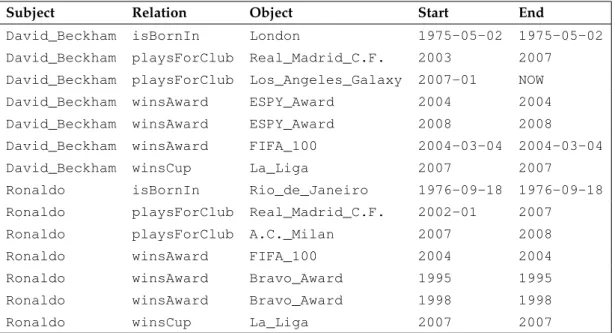
However, factual knowledge is highly ephemeral: people get married and divorced, politicians hold positions only for a limited time, and soccer players transfer from one club to another. Let us take YAGO as an example to show the purpose of this thesis. YAGO knows the facts in Table 1.1, which shows an excerpt from the YAGO knowledge base about David Beckham and Ronaldo. Obviously, these facts are time-agnostic. What if we want to know the timespan of Beckham and Ronaldo’s career in Real Madrid? Who is older? Beckham or Ronaldo? Have they ever been teammates? For the purpose of answering these questions, we aim at creatingtime-awareknowledge with validity time intervals of facts. For the example we could obtain the temporal knowledge in Table 1.2.
Clearly the temporal expressions are at diverse granularities. Some may even not be accurate especially when temporal information is retrieved from noisy
Chapter 1. Introduction
Subject Relation Object
David_Beckham isBornIn London
David_Beckham playsForClub Real_Madrid_C.F. David_Beckham playsForClub Los_Angeles_Galaxy David_Beckham winsAward ESPY_Award
David_Beckham winsAward FIFA_100 David_Beckham winsAward La_Liga
Ronaldo isBornIn Rio_de_Janeiro
Ronaldo playsForClub Real_Madrid_C.F.
Ronaldo playsForClub A.C._Milan
Ronaldo winsAward FIFA_100
Ronaldo winsAward Bravo_Award
Ronaldo winsAward La_Liga
Table 1.1.: An excerpt from the YAGO knowledge base about David Beckham and Ronaldo.
sources. The inaccuracy comes from imperfect extraction methods, careless authors of information sources, etc. For example, we might extract multiple start time points for David_Beckham playing for Los_Angeles_Galaxy, such as 2007, 2006-Dec-15 and 2007-Jan. When is the exact start time point?
Some interesting facts can be inferred with the temporal facts in Table 1.2. For example, “Beckham won La_Liga during the time he was in Real_Madrid”. The teammate relationship between Beckham and Ronaldo can be inferred as follows:
David_BeckhamplaysForClubReal_Madrid_C.F.from2003to2007 David_BeckhamplaysForClubLos_Angeles_Galaxyfrom2007toNOW RonaldoplaysForClubReal_Madrid_C.F.from2002to2007
RonaldoplaysForClubA.C._Milanfrom2007to2008
Therefore, Beckham and Ronaldo were teammates of Real_Madrid during the time from 2003 to 2007. Also they won La_Liga together for Real_Madrid by considering the additional facts:
David_BeckhamwinsCupLa_Ligain2007 RonaldowinsCupLa_Ligain2007
1.2. Research Challenges
Subject Relation Object Start End
David_Beckham isBornIn London 1975-05-02 1975-05-02
David_Beckham playsForClub Real_Madrid_C.F. 2003 2007
David_Beckham playsForClub Los_Angeles_Galaxy 2007-01 NOW
David_Beckham winsAward ESPY_Award 2004 2004
David_Beckham winsAward ESPY_Award 2008 2008
David_Beckham winsAward FIFA_100 2004-03-04 2004-03-04
David_Beckham winsCup La_Liga 2007 2007
Ronaldo isBornIn Rio_de_Janeiro 1976-09-18 1976-09-18
Ronaldo playsForClub Real_Madrid_C.F. 2002-01 2007
Ronaldo playsForClub A.C._Milan 2007 2008
Ronaldo winsAward FIFA_100 2004 2004
Ronaldo winsAward Bravo_Award 1995 1995
Ronaldo winsAward Bravo_Award 1998 1998
Ronaldo winsCup La_Liga 2007 2007
Table 1.2.: An excerpt from the YAGO knowledge base with temporal knowledge about David Beckham and Ronaldo.
We may further obtain the additional facts from a variety of sources:
David_BeckhamisBornInLondonon1975-05-02 David_BeckhamisBornInParison1975-05-02 David_BeckhamisBornInBerlinon1975-05-02
Beckham can only be born in one place on one day, so what is the birth place of Beckham? Obviously, this needs some form of data cleaning or reasoning on the uncertain information.
Relations have different flavors with respect to time aspect. Facts in relations likeisBornIn,winsAwardandwinsCupare valid on onetime point, whereas other relations likeplaysForClub are valid within a time period between the start and end time point.
The construction of a temporal knowledge base is a non-trivial task. We summarize the challenges in the next section.
1.2. Research Challenges
The automatic construction of a temporal knowledge base is challenging for various reasons.
Chapter 1. Introduction
Diverse Data Sources. Data sources are in various formats: structured, semi-structured and unsemi-structured. Semi-semi-structured and semi-structured text are easier to be handled by regular expressions. However, the irregularities and ambiguities of unstructured text, typically free natural language text, is difficult to define rules.
Reconciliation of Facts. The inconsistency of different sources and imperfect extraction methods cause noises in extracted facts. It is thus necessary to remove these noises and derive reasonable new facts. In particular, each temporal fact requires inferring the valid time interval from its multiple observations which might be in different granularities: year, month and day. It is thus desirable to design a comprehensive model to reconcile all the temporal fact observations, especially to deal with the different kinds of relations which are valid on a time point or during a time period. Afterwards, the valid time interval is helpful for reasoning new temporal facts.
High Precision vs. High Recall. The aggressive extraction methodology usually results in a large amount of facts but lower precision; while the conservative method ensures a better precision but lower recall. The trade off between the precision and recall is thus a tricky problem. On the other hand, increasing input manually labelled seed facts is able to increase recall. However, it is highly desirable to introduce as little human effort as possible. Interactive Knowledge Harvesting. Acquiring high-quality (temporal) facts for knowledge bases is a labor-intensive process. Although there has been recent progress in the area of semi-supervised fact extraction, these approaches still have limitations, including a restricted corpus, a fixed set of relations to be extracted or a lack of assessment capabilities. It is thus necessary to provide users with tools that allow them to interactively explore knowledge from their own documents.
Querying & Visualization. SPARQL is used for querying the time invariant knowledge bases. It is desirable to design a querying language for temporal knowledge bases, and provide a proper visualization tool to illustrate temporal knowledge.
1.3. Contributions
1.3. Contributions
In this thesis, methods and tools for harvesting temporal facts from both semi-structured and textual sources are presented. Our system addresses the issues pointed out in the previous section. Our contributions are briefly summarized as follows.
1. Timely YAGO: A temporal knowledge base called Timely YAGO (T-YAGO) which extends YAGO with temporal attributes is built. We define a simple RDF-style data model to support temporal knowledge. Most of the temporal facts are extracted from semi-structured data (e.g., infoboxes, categories and lists of Wikipedia articles) via rule-based method. A SPARQL-like time aware query language is provided for querying. The results are shown via a timeline visualization tool. Our Timely YAGO knowledge base system was published in the proceedings of the 13th International Conference on Extending Database Technology (EDBT 2010) [85].
2. PRAVDA:To be able to harvest as many temporal facts from free-text as possible, we develop a system PRAVDA. It utilizes a graph-based semi-supervised learning algorithm, which guarantees a high recall and comparable precision with limited human created seeds. Afterwards, an Integer Linear Program is used to clean out false hypotheses that violate temporal constraints. We also attempt to harvest spatio-temporal facts to track a person’s trajectory. Our PRAVDA temporal knowledge harvesting system was published in the proceedings of the 20th ACM Conference on Information and Knowledge Management (CIKM 2011) [83], the proceedings of the conference of the 50th Annual Meeting of the Association for Computational Linguistics (ACL 2012) [81] and the proceedings of the 20th International Conference on World Wide Web (WWW 2011) [84].
3. PRAVDA-live: A user-centric interactive knowledge harvesting system, called PRAVDA-live, is developed for extracting facts from natural language free-text. It supports fact extraction of user-defined relations from ad-hoc selected text documents and ready-to-use RDF exports.
Chapter 1. Introduction
Further features include support for temporally annotated relations, custom or mined extraction-patterns, and a constraint solver able to clean extracted facts by inter-fact constraints. Our interactive knowledge harvesting system was published in the proceedings of the 21th ACM Conference on Information and Knowledge Management (CIKM 2012) [80].
4. T-URDF: We present a simple and efficient representation model for time-dependent uncertainty in combination with first-order inference rules and recursive queries over RDF-like knowledge bases. We adopt the common possible-worlds semantics known from probabilistic databases and extend it towards histogram-like confidence distributions that capture the validity of facts across time. Query processing is done via a Datalog-like, rule-based inference engine, which employs the lineage of derived facts for confidence computations to remain consistent with the possible-worlds model. Our T-URDF temporal reasoning system was published in the proceedings of the Fourth International VLDB workshop on Management of Uncertain Data (MUD 2010) in conjunction with VLDB 2010 [82].
All of these components are fully implemented systems, which together form an integrative architecture. PRAVDA and PRAVDA-live aim at gathering new facts (particularly temporal facts), and then T-URDF reconciles them. Finally these facts are stored in a (temporal) knowledge base, called T-YAGO. A SPARQL-like time-aware querying language, together with a visualization tool, are designed for T-YAGO. Temporal knowledge can also be applied for document summarization.
1.4. Thesis Outline
We present temporal knowledge harvesting from both semi-structured data and free-text in Chapter 4. Chapter 5 describes how to clean and reason on the extracted temporal facts. Chapter 6 demonstrates the user-centric interactive knowledge harvesting system – PRAVDA-live. Finally Chapter 7 shows applications of temporal knowledge bases, including a time-aware
1.4. Thesis Outline
SPARQL-like query language for temporal knowledge and a document summarization system. The four main contributions, introduced in Section 1.3, are presented throughout these chapters. T-YAGO is presented in both Section 4.2 and Section 7.1.1. Section 4.3 and Section 5.2 discuss the whole framework of PRAVDA — t-fact observation extraction and cleaning. The entire Chapter 6 demonstrates PRAVDA-live. T-URDF is described in Section 5.3. We summarize our findings and highlight future research directions in Chapter 8.
Chapter 2.
Related Work
This chapter briefly reviews the literature on knowledge harvesting, temporal information extraction, label propagation, temporal and probabilistic databases, interactive systems, and summarization.
2.1. Knowledge Harvesting
Several projects have addressed the automatic construction of large knowledge bases.
Semi-structured approaches. Projects such as DBpedia [3] and YAGO [62, 29] automatically extract facts from semi-structured elements of Wikipedia, like infoboxes and categories. DBpedia uses attribute names in infoboxes as relation names instead of defining accurate relations with ranges and domains. Different relation names may refer to the same relation (e.g., length, length-in-km, length-km). YAGO defines relations with ranges and domains, and represents them in a canonical manner. YAGO combines the high quality of facts extracted from Wikipedia with the clean taxonomy of the concepts from WordNet.
Free-text approaches. Relation extraction from text aims at detecting and classifying semantic relationships between entities. Many machine learning methods have been devised to address this task. Supervised learning methods, such as [17, 95], suffer from the need for large amounts of manually labelled training data. Semi-supervised methods, such as [94], require less labelled data.
Chapter 2. Related Work
The method of [15] first attempted to apply graph-based label propagation to relation extraction. Recently distant supervision for relation extraction, such as [47, 88], has become popular. Instead of using a labelled corpus, the input of distant supervision only requires an existing knowledge base of seed facts. These advances in information extraction and the success of knowledge communities like Wikipedia have enabled the largely automated construction of fairly comprehensive knowledge bases. The KnowItAll project [21] focuses on automating the unary or binary fact extraction task on a very large scale manner. The ReadTheWeb project proposes an approach towards fact extraction based on coupled semi-supervised learning for information extraction (IE) : NELL [12, 13]. It exploits the ensemble-learning method with coupled pattern learners for retrieving both unary and binary facts. TextRunner project [20, 86] targets at fact extraction in an open-domain way, which aims at retrieving instances of all meaningful relations without pre-specification. However, all of these projects do not disambiguate entity mentions to entities. Kylin/KOG [86] aims at building a knowledge base from not only infoboxes and categories of Wikipedia articles, but also free-text. PROSPERA [49] designs an n-gram-itemsets based patterns, and applies frequent itemset mining to associate confidence to each pattern. Then the MaxSat-based reasoning is exploited to decide the true fact candidates. SOFIE [63] unifies fact extraction and cleaning into one framework. This framework includes word disambiguation, pattern matching and rule-based reasoning on the ontology. However all of the above mentioned projects do not consider temporal knowledge harvesting.
None of the aforementioned knowledge bases has a temporal dimension. They are all designed for time-invariant knowledge and built as snapshots in time. For example, while several of them know that people can have multiple spouses, none of them capture the time intervals for the various marriages. Birth and death dates of people are available, though, as they can be extracted at the level of base-facts such as Diego_Maradona isBornOn 30-October-1960. This is simpler than the kind of temporal facts that are tackled in this thesis.
2.2. Temporal Information Extraction
2.2. Temporal Information Extraction
Temporal knowledge as a first-class citizen in knowledge bases has been addressed solely by few prior projects: TOB [92], TIE [43], and CoTS [68]. TOB [92] focuses on extracting business-related temporal facts such as terms of CEOs. It uses an NLP machinery, with deep parsing of every sentence, and machine-learning methods for classifiers for specifically interesting relations. It workes reasonably well, but is computationally expensive, requires extensive training, and cannot be easily generalized to other relations. TIE [43] uses training data with fine-grained annotations to learn an inference model based on Markov Logic. This involves using consistency constraints on the relative ordering of events. This machinery is computationally expensive and cannot easily be scaled up. CoTS [68] determines the begin and end dates of temporal facts via a classifier. Afterwards an Integer Linear Program (ILP) infers the validity-intervals of facts based on intra- and cross-relation temporal constraints. The work by [45, 65] studies the properties of relations. [45] studies the temporal bounds of a certain relation. For instance, it can learn that a person cannot start a job at age two or get married before his/her birth. [65] analyzes whether a relation is time-dependent. For example, the isBornIn relation is time-invariant since one’s birth place never changes. However, these work do not focus on temporal fact extraction.
The NLP community has event extraction tasks in its SemEval workshop series [74], using representations such as TimeML and reference corpora such as Timebank [10]. The TARSQI toolkit [75] provides a suite of techniques for detecting events and temporal expressions, based on a dictionary of time-related adverbial phrases and regular-expression matching. These work mainly focus on detecting events (e.g., “her birthday”), relative expressions (e.g., “last Sunday”), and time-order relations (before, after, during, etc.). [87] uses a small set of seeds to learn pattern rules for various complex relations, such as joining (leaving) a job. The algorithm works on parsed input data, which requires preprocessing by a dependency parser. Moreover, temporal mentions associated with these relations are not considered. [40] proposes a new approach to parse the temporal dependency structures among all the events in a text. These basic tasks are still far from actual fact extraction.
Chapter 2. Related Work
instance, there is recent awareness of temporal IR: ranking of search results for keyword queries with temporal phrases [7, 50].
2.3. Label Propagation
Label propagation (LP) belongs to a family of graph-based semi-supervised learning methods. The first LP method [96] assumed that initial labels are fully correct. This assumption is inappropriate for our setting, as the seed patterns are not fully correct, but only associated with a confidence value. The Adsorption algorithm [4] copes with noisy initial labels, and is successfully used in video recommendation. The MAD algorithm [66] optimizes the Adsorption algorithm. The MADDL algorithm [66] incorporates possible dependencies on different labels into the optimization function. However, these dependencies must be symmetric, in contrast to asymmetric inclusion constraints introduced in Section 4.3 of this thesis. In a recent survey [67], MAD is regarded as the most effective label propagation algorithm across various data sets and experimental conditions. The nature of label propagation, whose solution can be iteratively approximated by the Jacobi method, makes it nicely scalable [4]. [52] describes a scalable implementation of label propagation on MapReduce to deal with Web-scale graphs.
2.4. Temporal and Probabilistic Databases
Temporal reasoning has a fairly long history through works in logics and AI, most notably in the seminal work by Allen et al. [23]. Work on temporal databases dates back to the early 1980’s [33]. Different semantics for associating time with facts have been defined. In the context of this thesis, we use the valid-time semantics, where the time recorded for facts in a database captures the reality of the world being modeled by the database. Extensions for traditional data models have been explored to accommodate temporal data in an efficient manner, both in terms of storage space and query processing. There has also been an extensive effort to develop query languages for querying temporal data. Most of these efforts were attempts to modify SQL to reduce the complexity of temporal queries [69]. There is a wealth of research on
2.5. Interactive Systems
probabilistic databases and the management of uncertain data. The book Probabilistic Databases [64] discusses the state of the art in representation formalisms and query processing techniques for probabilistic data. [32] is a state-of-the-art probabilistic database management system. [6, 57] present a framework for dealing with uncertain data and data lineage. This approach allows for the decoupling of data and confidence computations when processing queries over uncertain data [57], allowing for a wider range of query plans to be used while still maintaining the correctness of confidence computations. For dealing with probabilistic reasoning in the context of information retrieval, [24] presents a probabilistic version of Datalog. [25, 31, 73] present probabilistic extensions of RDF and discuss how SPARQL queries over such an extension can be supported. However, no notion of temporal reasoning has been considered in these contexts.
2.5. Interactive Systems
Freebase [11] is very related to our work, since users are encouraged to add facts. Nevertheless, there is no support for extraction from text documents. Crowdsourcing techniques have been applied to knowledge acquisition. Open Mind Common Sense (OMCS) [60] project acquires common sense knowledge from volunteers. Verbosity [76] achieves the same purpose in the form of an enjoyable game. [61] connects the result data from Verbosity to the OMCS project. CrowdER [79] develops a hybrid human-machine approach for entity resolution, where the machine passes over the data to generate the most likely matching pairs for people to verify. [35] exploits the wisdom of crowds to derive taxonomies. CrowdMap [56] studies the use of crowdsourcing for ontology alignment. [91] empirically studies the impact on precision and recall of changing the size of two types of resources: labelled data from distant supervision and crowdsourcing. The crowd is employed on collecting seed facts by sampling the training data. There are other crowdsourcing activities for data annotation such as KiWi [58] or Semantic Wiki [41]. However, those efforts do not aim at fact extraction for knowledge bases in terms of clarity and scale. Especially, none of the systems is designed for users performing fact extraction on any relations of interest.
Chapter 2. Related Work
2.6. Summarization
The two main approaches of document summarization strategies are abstractive and extractive summarization techniques [27]. Most of the existing work in abstractive document summarization usually considers advanced language generation techniques to produce a grammatical summary [18]. Some employ a form of Nature Language Generation (NLG) [46]. Some other approaches construct abstractive summaries by using the Cut-And-Paste algorithm [34], which compresses sentences by removing redundant information. Similar work use corpus-based methods for sentence compression [39]. In recent years, several parsing-free abstractive summarization strategies have been proposed. Opinosis [26] is proposed to generate summarization from redundant data sources by building a single graph-based representation. Similarly, a graph-based multi-sentence compression approach has been proposed in [22].
Extractive document summarization frameworks, which usually extract summaries based on machine learning methods, can be categorized into unsupervised methods and supervised methods. For the unsupervised methods, MEAD [51] is proposed based on a centroid-clustering-based strategy. After the PageRank method was proposed, several Markov Random Walk based methods [19, 77] were proposed to rank sentences by their saliency. A HITS-based ranking algorithm [90] has also been proposed for document summarization.
After topic models [9] were proposed, LDA has also been applied to document summarization [2, 78] based on various probabilistic methods for topic detection and clustering. Other related methods [14] consider the summarization task as a prediction problem based on a two-step hybrid generative model. Topic models could deal with sentence understanding at the topic-level by extracting latent semantic components. However, for a query-biased summarization task, usually those latent topics could not represent what “topic” the user exactly intends to search. For the supervised methods, HMM-based [16] and CRF-based algorithms [59] have proved to be effective in extractive document summarization. Meanwhile, structured SVM-based classifiers have also been applied [42] to document summarization, with the aim of enhancing the diversity, coverage and balance for the summary
2.6. Summarization
result.
All these work focus on documents in natural language text, which is different with our strategy by applying summarization for both semi-structured and unstructured contents on the web. Moreover, these extractive methods only extract sentences from unstructured data, however, our approach represents the semantics from both unstructured and semi-structured data.
There are also some works that aim to summarize factual information from a knowledge base. [93] defines the “RDF sentence” to summarize an ontology by ranking the ontology graph. MING [38] extracts an “informative” subgraph for given entity nodes in a knowledge base. [72] retrieves the salient type properties for a certain entity. These work only consider the existing knowledge base, and the “summary” is in the form of a subgraph or type properties, while our work automatically harvests the knowledge from data sources and represents the summary of queried relations in a nicely (chronologically) ordered set of natural-language sentences.
Chapter 3.
Knowledge Representation
3.1. Relation and Fact Types
We introduce the distinction between base relations (without temporality) and temporal relations (including temporality). Base relations indicate the relationships between two entities without any temporal information. A base relation Rb is commonly described with a type signature, sig(Rb) = (TYPE1,
TYPE2), meaning that the relation Rb only holds its semantic meaning for two
entities whose types are TYPE1 and TYPE2, respectively. A base relation
contains a set of base facts. Each base fact is in the form of (ei, ej), whereei and
ejindicate two entities whose types are consistent with the corresponding base
relation’s type signature. For example, worksForClub is a base relation with signature (PERSON, CLUB). The base fact (Lionel_Messi, FC_Barcelona)holds for theworksForClubrelation, whereLionel_Messiis aPERSONentity andFC_Barcelonais aCLUBentity.
Temporal relations indicate the relationships between two entities at specific time points or during particular timespans. Similar to base relations, a temporal relation is always associated with a type signature indicating the pertinent entity types. A temporal relation contains a set of temporal facts in the form of (ei,ej)@tk, whereeiandejare two entities with pertinent types, and
tk indicates a temporal mention (either a time point or a timespan). For
example, joinsClubTemp is a temporal relation with type signature (PERSON, CLUB). The temporal fact (David_Beckham, Real_Madrid)@2005 holds for the joinsClubTemp relation, indicating that David_Beckham joined Real_Madridin 2005.
Chapter 3. Knowledge Representation
Afact candidateis a pair of entities that occurs in a textual source (plus a time stamp in the case of temporal fact candidates), where the pair of entities must satisfy the type signature of any of the relations of interest. Once a fact candidate is labelled with a particular relation R, it is called a valid observation and added to the set of fact observations that are returned as the result of the knowledge harvesting phase. In particular, we distinguish the base fact observation (b-observation) with the temporal fact observation (t-observation). After the knowledge cleaning stage (see Chapter 5), noisy fact observations are filtered out. The remaining clean fact observations are called truefacts. Also we distinguish thebase fact(b-fact) with thetemporal fact(t-fact) respectively.
3.2. Time Points, Intervals, and Histograms
A time point t denotes the smallest time unit of fixed granularity. We have a discrete series of ordered time points 0, . . . , N (with a special designator N
which marks the end of the time range we consider). These time points could represent any desired—but fixed—granularity (e.g., years, days, or seconds, or even transaction-based counters).
A validity interval is represented as a left-closed, right-open or right-closed, interval, which is bounded by two time points (e.g., [1990, 2010) ), thus denoting a discrete and finite set of time points. This way, we are able to support both range-queries (i.e., “Is this fact valid in the range of [1999, 2006)?” ) and snapshot queries (i.e., “Is this fact valid at time point 2006?” ). A snapshot query can then simply be seen as a special-case range query by using an interval consisting of just a single time point (e.g.,[2006, 2006]). Every interval has a corresponding confidence value associated with it, which denotes the probability of the fact being valid for the given interval. Multiple, non-overlapping intervals can be concatenated to form a time histogram H. Intervals in a time histogram do not necessarily have to be contiguous. A gap between two consecutive intervals is equivalent to an interval with a confidence value of 0.
3.3. Event and State Relations
3.3. Event and State Relations
For t-facts, we further distinguish betweeneventandstaterelations. In an event relation, a fact is valid at exactly one time point. For example, Nicolas_Sarkozy isIn Beijing is valid on 25-Aug-2011 (or 2011, if the time point is available at a coarser granularity only). Actually, President Sarkozy visits China frequently. This results in multiple different facts of an event relation, each associated with different time points. By default, facts in an event relation are thus associated with a validity interval consisting of only one time point. For capturing uncertainty, however, validity intervals (and entire histograms) may cover more than one time point, as in the following example:
winsCupForClub(Beckham, Champions_League)[1999, 2001) :0.8
For simplicity, we assume a uniform distribution for the probability of a fact within the interval in this case. For example, for the interval[1999, 2001), which covers 2 time points with a confidence of 0.8, each time point in the interval would have a probability of 0.4. The confidences of all intervals (and implicitly also the confidences of the corresponding time points) must form a proper probability distribution, i.e., the sum of all intervals’ confidences may be at most 1.
For a state relation, a fact is valid atevery time pointof an interval. Hence, all time points in the interval are (implicitly) associated with the probability of the interval, as in the following example:
playsForClub(Beckham, Manchester_United)[1992, 2003) :0.3; [2003, 2007) :0.4
Here, for the interval[1992, 2003), which covers 12 time points with a confidence of 0.3, the fact is valid at each time point with probability of 0.3; and for the interval [2003, 2007), the fact is valid at each time point with probability of 0.4. For facts in a state relation, the confidences of all intervals must form a proper probability distribution.
For both event and state relations, the sum pof confidences for the intervals in a histogram may be less than 1. In general, a fact isinvalidfor all time points outside the range of time points captured by the histogram with probability
Chapter 3. Knowledge Representation
1−p. Moreover, different operations for slicing and coalescing intervals apply, depending on whether a fact belongs to either an event or a state relation.
The extraction of time periods for state facts is challenging, because there are typically only few occurrences of facts in input sentences with explicit time intervals. Ideally, there are sentences like “Maradona had a contract with FC Barcelona from July 1982 to June 1984”. However, such explicit sentences are rare in both news and web sources. Instead, we can find cues that refer to the begin, end, or some time point during the desired interval. For example, news articles would often mention sentences such as “Maradona did not play well in the match against Arsenal London” with a publication date of 15-May-1983 (a time point which is supposed to be contained within the corresponding state fact’s interval). Thus, we also focus on time points (begin, during and end events) for the extraction step and later aggregate these into intervals of state-oriented t-facts.
3.4. Temporal Knowledge Representation
A widely used formalism in knowledge representation is OWL. However, it is computationally expensive; instead we use a simpler RDF-style model. As in OWL and RDF, all objects are represented as entities in the YAGO data model. Two entities can stand in a relation, and we call this relational instance a fact. All facts are represented by unary or binary relations. Unary relations capture memberships in semantic types such as: David_Beckham instanceOf Soccer_Player. Binary relations like isBornOn, isBornIn, isMarriedTo, or winsAwardhold between entities of specific types; an example is:
David_BeckhamwinsAwardUEFA_Club_Player_Of_The_Year
This fairly simple model has proven to be very valuable for knowledge exploration and querying. However, facts actually have associated time information. For example, “David Beckham has won the UEFA Club Player of the Year” in “1999”. Therefore, in T-YAGO, we introduce the concept of temporal facts. A temporal fact is a relation with an associated validity time. The fact may be valid at a time point or within a time interval. In the current YAGO ontology, temporal facts cannot be directly represented. Facts are limited to binary relations while temporal facts have more than two arguments.
3.4. Temporal Knowledge Representation
To support temporal facts in a binary relation model, we decompose the n-ary fact into a primary fact and several associated facts. We assign a fact identifier to the primary fact, and then the associated facts are represented as the relation between the identifier and the remaining arguments. For example, for the
ternary relation between David_Beckham, the
UEFA_Club_Player_Of_The_Year, and 1999, we use the original time-agnostic fact as a primary fact with identifier #1. For temporal facts valid at a time point, we use the relation on to describe the validity time. Then we represent the temporal property of the primary fact as: #1on1999. For temporal facts that are valid during a time period, we use two relations to represent the interval: the relationsincefor the begin time point, and the relationuntilfor the end time point. For example, the fact that Beckham played for Real Madrid from 2003 to 2007 is represented as:
#2: David_BeckhamplaysForClubReal_Madrid
#2since2003
#2until2007
Sometimes it is impossible to extract accurate time points, say the exact day, and sometimes we may know only the begin or the end of a fact’s validity interval but not both. For these situations, we introduce a data type for time points with the earliest and latest possible time to constrain the range of the true time point. For example, if we know that Beckham started playing for Real Madrid in July 2003 and terminated his contract in 2007, we would add the temporal facts:
#2since[1−July−2003, 31−July−2003]
#2until[1−January−2007, 31−December−2007]
Chapter 3. Knowledge Representation
If we later learn that his contract with the team Los Angeles Galaxy started on July 1, 2007, and assuming a constraint that one must not play for two clubs at the same time, we could refine theuntilrelation for #2 into:
#2until[1−January−2007, 30−June−2007]
Chapter 4.
Temporal Knowledge Harvesting
The world is dynamic: periodic events like sports competitions need to be interpreted with their respective time points, and facts such as coaching a sports team, holding political or business positions, and even marriages do not hold forever and should be augmented by their respective timespans. This chapter addresses the problem of automatically harvesting temporal facts with such extended time-awareness. We describe how we gather temporal facts from semi-structured and free-text sources.
4.1. Problem Statement and Contributions
4.1.1. Motivation
Who were the teammates of the legendary Argentinean player Diego Maradona? How often has the pop singer Madonna been married, and to whom? Questions like these often arise from the information needs of Internet users, but are not supported by keyword-based search engines. Instead, answering them requires an understanding of entities and relationships embedded in Web contents, or even better, a knowledge base that contains facts about people, organizations, locations, etc. In the last few years, such knowledge bases have indeed been built and made publicly accessible, for example: DBpedia [3], YAGO [62], TextRunner [20], ReadTheWeb [12], the commercial knowledge portals freebase.com and trueknowledge.com, the computational knowledge engine wolframalpha.com, the entity search engine entitycube.research.microsoft.com, and others. Most of these have been automatically compiled, either by integrating structured sources (e.g.,
Chapter 4. Temporal Knowledge Harvesting
geospecies.org, geonames.org, world factbook, etc.), by harvesting semi-structured sources such as Wikipedia infoboxes, lists, and categories, or by information extraction from Web pages. Some of them involve a substantial amount of manual curation for quality assurance. Moreover, there is a strong momentum towards semantically inter-linking many knowledge sources into theLinked Datacloud [28], seelinkeddata.org.
However, the world is highly dynamic and nothing lasts forever! Knowledge evolves over time, and many facts are fairly ephemeral, e.g., winners of sports competitions, and occasionally even CEOs and spouses. In addition, many information needs by advanced users requiretemporal knowledge. For example, consider the following variations of the above example questions: Who were the teammates of Diego Maradona during the 1990 FIFA World Cup? When did Madonna get married, when did she get divorced? None of these questions are supported by existing knowledge bases. The problem that we tackle in this thesis is to automatically distill, from news articles and biography-style texts such as Wikipedia, temporal facts for a given set of relations. By this we mean instances of the relations with additional time annotations that denote the validity point or span of a relational fact. For example, for the winsAward relation between people and awards, we want to augment facts with the time points of the respective events; and for the worksForClub relation between athletes and sports clubs, we would add the timespan during which the fact holds. This can be seen as a specific task of extracting ternary relations, which is much harder than the usual information extraction issues considered in prior work.
4.1.2. Contributions
Knowledge harvesting enables the automatic construction of large knowledge bases. In this chapter, we present the methods of harvesting temporal facts from semi-structured and free-text sources. Also we made a first attempt to harvest spatio-temporal knowledge from news archives to construct trajectories of individual entities for spatio-temporal entity tracking.
In summary, the work in this chapter makes the following contributions: • handcrafted rules for extracting temporal facts from semi-structured
4.2. Temporal Knowledge Harvesting from Semi-structured Text
• a new model for distilling temporal facts from textual sources like news or biographies (see Section 4.3),
• an algorithm for extended label propagation with consideration of inclusion constraints (see Section 4.3.3),
• an algorithm for distilling spatio-temporal knowledge from textual sources (see Section 4.4),
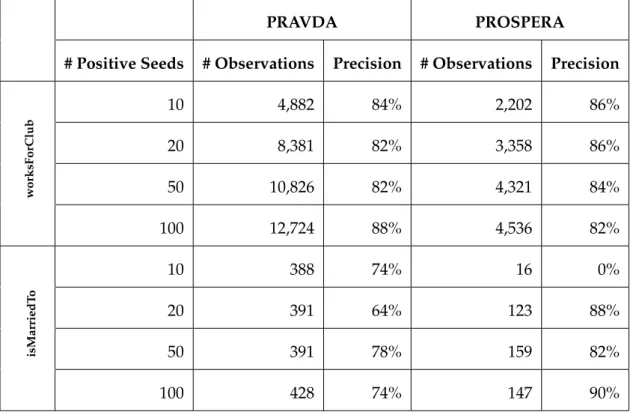
• experimental studies for knowledge harvesting from free-text sources, comparing the extraction of base facts (without time) against a state-of-the-art baseline [49], and demonstrating the effectiveness of harvesting temporal facts for a variety of relations from the domains of soccer and celebrities (see Section 4.3.4),
• the evaluation for the spatio-temporal knowledge harvesting on the 20 years’ New York Times news article corpus shows that our methods are effective and scalable (see Section 4.4.3).
4.2. Temporal Knowledge Harvesting from
Semi-structured Text
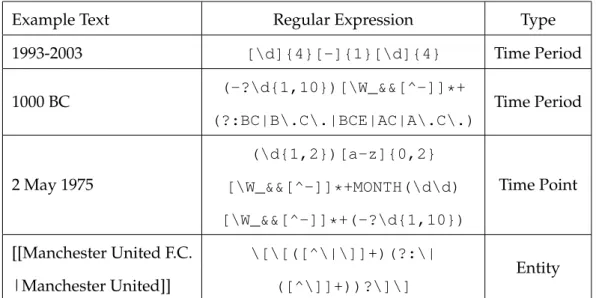
This section presents methods for constructing a temporal extension of the YAGO knowledge base [62]. Currently YAGO is built upon facts extracted from semi-structured infoboxes and category information in Wikipedia, and it is unified with the taxonomic class system of WordNet. Infoboxes are based on templates which are re-used for important types of entities such as countries, companies, sportsmen, politicians, etc. This allows YAGO to apply rule-based extraction for popular infobox attributes (the attributes in the "long tail" are typically skipped as they are highly diverse and noisy). Like YAGO, our approach to temporal fact extraction also focuses on the semi-structured elements in Wikipedia. However, as we need to detect also the validity time of each fact, our rules are more sophisticated than those of the original YAGO. We use regular expression matching for this purpose. For higher coverage, we also analyze additional elements in Wikipedia articles, most notably lists such as awards which contain many meaningful temporal facts. Here again, regular
Chapter 4. Temporal Knowledge Harvesting
Example Text Regular Expression Type
1993-2003 [\d]{4}[-]{1}[\d]{4} Time Period
1000 BC (-?\d{1,10})[\W_&&[^-]]*+ Time Period
(?:BC|B\.C\.|BCE|AC|A\.C\.) 2 May 1975 (\d{1,2})[a-z]{0,2} Time Point [\W_&&[^-]]*+MONTH(\d\d) [\W_&&[^-]]*+(-?\d{1,10}) [[Manchester United F.C. \[\[([^\|\]]+)(?:\| Entity |Manchester United]] ([^\]]+))?\]\]
Table 4.1.: Examples of regular expressions for identifying temporal expressions and entities.
expressions tailored to specific types of lists yield high return. Table 4.1 shows some regular expressions for identifying temporal expressions and entities from the source code of Wikipedia articles. In addition, our rule-based techniques can also bootstrap learning-based methods applied on the natural-language text of the full articles. For the latter, the lack of manually labelled training data is often the bottleneck if not a showstopper. Our rich collection of temporal facts in T-YAGO can serve as training data and reduce the need for expensive hand-labeling.
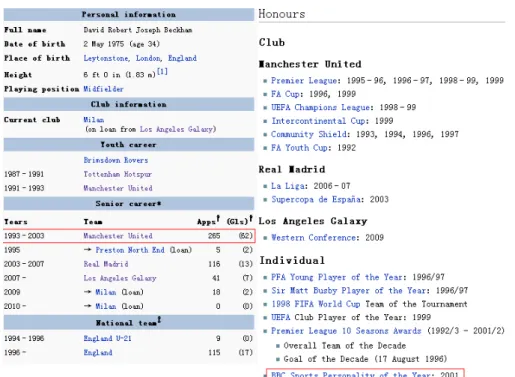
For illustration, Figure 4.1 lists the infobox and the honors list of David Beckham. For example, “Senior career” attributes are extracted as
playsForSeniorClub facts, yielding the facts
“David_Beckham playsForSeniorClub Manchester_United” and
“David_BeckhamplaysForSeniorClubReal_Madrid”. YAGO can accept only one
of these two fact candidates, as it enforces consistency constraints like a functional dependency from SoccerPlayer to SoccerClub (a player cannot simultaneously play for two clubs). The reason for this deficiency is that YAGO lacks temporal information. In T-YAGO, we can accept both facts if we can validate that they refer to disjoint time periods. We identify time points or intervals like 1993-2003 by pattern matching. This yields temporal facts like “#3 : David_Beckham playsForSeniorClub Manchester_United”,
4.2. Temporal Knowledge Harvesting from Semi-structured Text
Figure 4.1.: Temporal facts in infobox and honors list.
“#3 since 1993”, and “#3 until 2003” (with simplified notation, leaving out the [earliest, latest] part for brevity). Other time-annotated attributes are extracted in a similar way. From the honors lists we also obtain valuable knowledge such as “#4 : David_BeckhamwinsAwardBBC_Sports_Personality_of_Year” and
“#4on2001”.
The category systems for Wikipedia articles also contain temporal facts like those highlighted in Figure 4.2. We identify time points in category names and map them onto the timeline. The remaining part of the category name is treated as the entity. For example, from the first category in Figure 4.2 we extract the temporal fact “#5 : David_Beckham playsAs FIFA_World_Cup_players”,
“#5on1998”.
T-YAGO contains around 200,000 temporal facts from the sports domain. Among them, about 70,000 facts have been extracted from Wikipedia categories and lists embedded in articles. For evaluation, we randomly sample 50 facts for each relation. The precision of t-facts in relations of worksForTeam (including playsForYouthClub, playsForSeniorClub, playsForNationalTeam, and managesTeam), participatedIn, isBornIn and diedIn is above 90%. The precision of t-facts in winsAward is around 80%, as the facts are from lists which are not clean and
Chapter 4. Temporal Knowledge Harvesting
Categories: 1998 FIFA World Cup players | 2002 FIFA
World Cup players | 2006 FIFA World Cup players | 20th-century English people | 21st-20th-century English people | A.C. Milan players | BBC Sports Personality of the Year winners | British expatriate sportspeople in the United States |
...
| People from Leytonstone | Premier League players | Preston North End F.C. players | Real Madrid C.F. players | Serie A footballers | The Football League players |UEFA Euro 2000 players | UEFA Euro 2004 players | 1975 births| Living people
Figure 4.2.: Temporal facts from categories of David Beckham.
difficult to apply regular expressions.
4.3. Temporal Knowledge Harvesting from Natural
Language Free-text
4.3.1. Framework and System Overview
This section gives an overview on the system architecture for temporal knowledge harvesting from free-text. We introduce our system called PRAVDA (label PRopagated fAct extraction on Very large DAta) for gathering fact candidates and distilling facts with their temporal extent based on a new form of label propagation (LP). This is a family of graph-based semi-supervised learning methods, applied to (in our setting) a similarity graph of fact candidates and textual patterns. LP algorithms start with a small number of manually labelled seeds, correct facts in our case, and spread labels to neighbors based on a graph regularized objective function which we aim to minimize. The outcome is an assignment of labels to nodes which can be interpreted as a per-node probability distribution over labels. In our scenario, the labels denote relations to which the fact in a correspondingly labelled node belongs.
4.3. Temporal Knowledge Harvesting from Natural Language Free-text
We adopt the specific algorithm of [66], coined MAD (Modified Adsorption), with an objective function that combines the quadratic loss between initial labels (from seeds) and estimated labels of vertices with a data-induced graph regularizer and an L2 regularizer. The graph regularizer is also known as the un-normalized graph Laplacian, which penalizes changes of labels between vertices that are close. We develop substantial extensions, and show how to judiciously construct a suitable graph structure and objective function. Notably, we consider inclusion constraints between different relation labels for the same node in the graph. For example, we may exploit that a relation like joinsClub (with time points) is a sub-relation ofworksForClub(with timespans).
System Architecture. Figure 4.3 shows the architecture of our system for fact harvesting from Web sources. The system consists of five components:candidate gathering, pattern analysis, graph construction,label propagation, andnoise cleaning. The components are invoked in five phases. This chapter focuses on the first four phases; the noise cleaning phase is presentend in Chapter 5.
Figure 4.3.: System overview.
1. Candidate Gathering: This phase serves to collect potentially relevant sentences. A sentence is interesting if it contains entities in relevant types for a target relation of interest. We employ a test for the potential presence
Chapter 4. Temporal Knowledge Harvesting
of a base fact in a sentence, by checking for the existence of two noun phrases (denoting two entities) in the same sentence. In addition, we test for the existence of a temporal expression (currently only explicit date) in the sentence, thus producing raw input also for temporal fact candidates. This is discussed in Section 4.3.2.
2. Pattern Analysis: Based on a (small, manually crafted) set of seed facts for a particular relation (either base or temporal), seed patterns in the form of sets of word-level n-grams are extracted from the interesting sentences. For each target relation that we aim to extract, a statistical prior is then computed based on how strongly fact candidates have evidence in the form of seed patterns. This is discussed in Section 4.3.2.
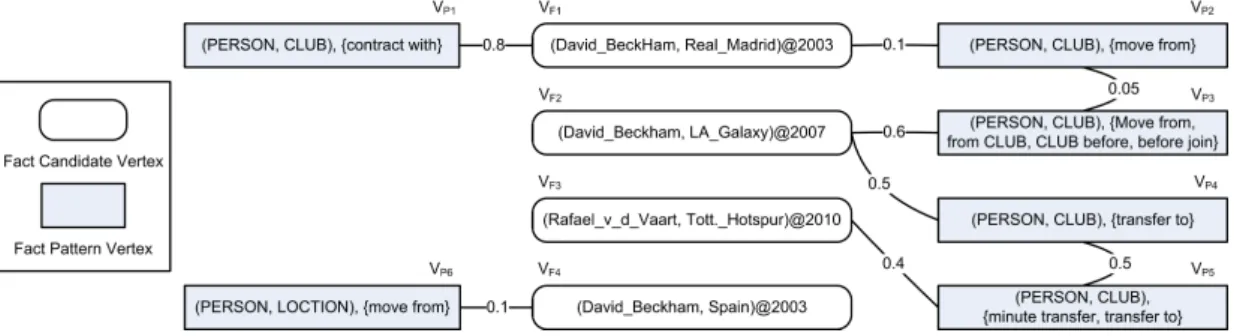
3. Graph Construction: To facilitate the knowledge harvesting procedure, the fact candidates and pattern candidates are represented as vertices of a graph. Edges represent the evidence connection between a pattern and a fact candidate, as well as the similarity between two patterns. The graph construction is presented in Section 4.3.2.
4. Label Propagation: Finally, a graph-based semi-supervised learning method is employed to harvest both base facts and temporal facts. To this end, we have developed an extended label propagation algorithm which is presented in Section 4.3.3.
4.3.2. Patterns and Graph Model
In this section, we first describe our candidate gathering approach, raising surface (text) strings to entities. Then, we introduce our pattern analysis method, which is based on “basic”, “seed” and “fact” patterns. Basic patterns are (entity) type-aware word-level n-grams of surface strings. Based on statistical analytics, those patterns yielding in high quality results for a certain relation become seed patterns. Fact patterns are finally derived from sentences where the similarity of an observed basic pattern and seed patterns exceeds a pre-defined threshold. Finally, we will explain the underlying (pattern-candidate) graph model between patterns and candidate sentences. To facilitate the following discussions, we use bold capital letters to indicate matrices, and normal lower-case letters to indicate scalar values.
4.3. Temporal Knowledge Harvesting from Natural Language Free-text
Candidate Gathering
Our approach is driven by target relations for which we would like to gather instances. The set of relations of interest is denoted asR={R1, R2, ...,Rm}. Each
is associated with a type signature and is either a base relation or a temporal relation. Type(R)contains all possible entity types in the type signatures of the relations inR.
We assume that there exists a knowledge base with typed entities which contains the individual entities whose types are inType(R). In this section, we consider relations of interest from the domains of soccer and celebrities, and use YAGO [62] as knowledge base. The YAGO knowledge base contains almost all the pertinent entities harvested from Wikipedia, such as persons (both sports people and celebrities), clubs, locations, awards, universities, and even a large fraction of people’s spouses. YAGO also provides us with a fairly complete dictionary of surface names for entities, including abbreviations (e.g., “ManU” for the entity Manchester_United). Thus, detecting mentions of entities in an input text is straightforward.
We consider a textual corpusC, e.g., a set of Wikipedia articles, news articles, or Web pages, as input for candidate gathering. The cor