Distributed Coverage Verification in Sensor Networks
Without Location Information
Alireza Tahbaz-Salehi and Ali Jadbabaie
Abstract— In this paper, we present a distributed algorithm for detecting coverage holes in a sensor network with no location information. We demonstrate how, in the absence of localization devices, simplicial complexes and tools from computational homology can be used in providing valuable information on the properties of the cover. In particular, we capture the combinatorial relationships among the sensors by the means of the Rips complex, which is the generalization of the proximity graph of the network to higher dimensions. Our approach is based on computation of a certain generator of the first homology of the Rips complex of the network. We formulate the problem of localizing coverage holes as an optimization problem to compute the sparsest generator of the first homology classes. We also demonstrate how subgradient methods can be used in solving this optimization problem in a distributed manner. Finally, non-trivial simulations are provided that illustrate the performance of our algorithm.
I. INTRODUCTION
Recent advances in computing, communication, sensing and actuation technologies have brought networks composed of hundreds or even thousands of inexpensive mobile sensing platforms closer to reality. This has induced a significant amount of interest in development of analytical tools for pre-dicting the behavior, as well as controlling the complexities of such large-scale sensor networks. Designing algorithms for deployment, localization, duty-cycling, communication and coverage verification in sensor networks form the core of this active area of research.
Of the most fundamental problems in this domain is the coverage problem. In general, this reflects how well a region of interest is monitored or tracked by sensors. In most applications, we are interested in a reliable coverage of the environment in such a way that there are no gaps left in the coverage. Algorithms for this purpose have been extensively studied [1]. One of the most prominent approaches for addressing the coverage problem has been the ‘computational geometry’ approach, in which the coordinates of the nodes and standard geometric tools (such as Delaunay triangulations or Voronoi diagrams) are used to determine coverage [2]. TheArt Gallery Problemis a very well-known example of utilizing this approach [3].
This research is supported in parts by the following grants: DARPA/DSO SToMP, NSF ECS-0347285, and ARO/MURI W911NF-05-1-0381.
Alireza Tahbaz-Salehi is with Department of Electrical and Systems Engineering and Department of Economics, University of Pennsylvania, Philadelphia, PA 19104 (e-mail: [email protected]).
Ali Jadbabaie is with the General Robotics, Automation, Sensing and Perception (GRASP) Laboratory, Department of Electrical and Systems Engineering, University of Pennsylvania, Philadelphia, PA 19104 (e-mail: [email protected]).
Such geometrical approaches often suffer from the draw-back that they can be too expensive to compute in real-time. Moreover, in most applications, they require exact knowledge of the locations of the sensing nodes. Although, this infor-mation can be made available in real-time by a localization algorithm or by the means of localization devices (such as GPS), it can only be used most effectively in an off-line pre-deployment analysis for large networks or when there are strong assumptions about the geometrical structure of the network and the environment. This drawback becomes more evident if the network topology changes due to node mobility or sensor failure. Finally, localization equipment adds to the cost of the network, which can be a limiting factor as the size of the network grows. Consequently, aminimal geometry approach for addressing these issues becomes essential.
More recently, topological spaces and their topological invariants have been used in addressing the coverage problem in the absence of geometric data, such as location or orienta-tion [4]–[9]. One notable characteristic of these studies is the use of topological abstractions which preserve many global geometrical properties of the network while abstracting away the small scale redundant details. For instance, in [4], [5], [7], the authors construct the Rips complex corresponding to the communication graph of the network and use the fact that the first homology group of this simplicial complex provides sufficient information about coverage. The first steps for implementing this idea as a distributed algorithm are taken in [8] and [9]. The authors show that the combinatorial Laplacians are the right tools for distributed computation of the elements of the homology groups, and hence, can be used for decentralized coverage verification. They present a consensus-like scheme based on a dynamical system whose stability properties determine the existence of coverage holes, although it fails to locate them.
In this paper, we present a distributed algorithm which is capable of “localizing” coverage holes in a network of sensors without any metric information. More precisely, following [6] and [8], we use tools from algebraic topology to represent the coverage properties of the sensor network by its Rips complex. We show that given a homology class of the Rips complex, the problem of finding the “tightest” cycle encircling the hole represented by that class can be formulated as an integer programming problem. Moreover, we present conditions under which the linear programming relaxation of this integer programming problem is exact and therefore, its solution provides the location of the coverage holes in the simplicial complexwithout use of any coordinate information. Finally, we show that if subgradient methods
[10] are used for solving this relaxation, the updates are distributed in nature and therefore, one can implement the computation of the tightest cycle around the hole as a de-centralized algorithm. Our approach is quite interdisciplinary in nature and combines results from multiagent systems, agreement and consensus problems [11], with recent ad-vances in coverage maintenance in sensor networks using computational algebraic topology methods and optimization techniques. Moreover, this novel approach is more general than the algorithms presented in [12]–[15], where it is explicitly assumed that the simplicial complex is embedded on an orientable surface. It is also different from the results in [16]: our hole detection algorithm is not limited to Rips complexes, is distributed in nature, and does not use node coordinates.
II. PROBLEMFORMULATION
Consider a collection ofnstationary sensors, denoted by V, deployed over a region of interestD ⊂R2. We assume
that these sensors are equipped with local communication and sensing capabilities, but are not capable of determining neither distance nor direction; a complete absence of metric information.
Throughout the paper, we assume that each sensor is ca-pable of communicating with other sensors within a radially symmetric domain of radiusrb, called thebroadcast disk. As
for the coverage, we assume a “capture” modality in which any subset of nodes which are in pairwise communication cover their entire convex hull. In other words, the region covered by the sensors is given by
A(V) =[{conv(Q)|Q⊆V , max
vi,vj∈Q
kvi−vjk2≤rb}
where V is the set of sensor locations and vi represents
the the location of the i-th sensor. This model, which is inspired by the results in [17], guarantees that the coverage and communication capabilities of the sensors are limited and based on proximity. As for the region of interestD, we assume that it is connected and compact and its boundary ∂D is connected and piecewise linear. Moreover, to avoid boundary effects, we assume that there are sensors, known asfence nodes, located on ∂Dsuch that each such sensor is capable of communicating with its two closest neighbors on ∂Don either side.
In the rest of the paper, we develop the required tools and present our distributed algorithm that is capable of localizingcoverage holes for the above mentioned coverage framework. Our results are also applicable to a symmetric coverage framework, in which each sensor can cover a radially symmetric region. More details on this model can be found in [4].
III. SIMPLICIALCOMPLEXES ANDHOMOLOGY This section is dedicated to the definition of simplicial complexes and their homological properties as they are the main mathematical tools used in this paper. A thorough treatment of the subject can be found in [18].
Given a set of pointsV, a k-simplex is an unordered set
{v0, v1,· · · , vk} ⊆V where vi 6=vj for all i 6=j. A face
of the k-simplex {v0, v1,· · ·, vk} is a (k−1)-simplex of
the form{v0,· · · , vi−1, vi+1,· · · , vk} for some0≤i≤k.
Clearly, anyk-simplex has exactlyk+ 1faces.
Definition 1: Asimplicial complexX is a finite collection of simplices which is closed with respect to inclusion of faces, i.e., ifσ∈X, then all faces ofσ are also inX.
The dimension of a simplicial complex is the maximum dimension of any of its simplices. Asubcomplex of X is a simplicial complexY ⊆X. A particular subcomplex ofX is itsk-skeletonconsisting of all simplices of dimensionkor lessX(k)={σ∈X : dimσ≤k}. Therefore, the 1-skeleton of any non-empty simplicial complex is a graph. Given a graph G, its flag complex F(G) is the largest simplicial complex whose 1-skeleton isG; every (k+ 1)-clique inG defines ak-simplex in F(G).
Given a simplicial complexX, twok-simplicesσiandσj
areupper adjacent(denoted byσiaσj) if both are faces of
a(k+ 1)-simplex inX. The two k-simplices are said to be lower adjacent(denoted byσi`σj) if both have a common
face. Having defined the concept of adjacency, one can define the upper and lower adjacency matrices, A(uk) and A
(k)
l
respectively, in order to book keep the adjacency relations between thek-simplices. The zeroth upper adjacency matrix of a simplicial complexA(0)u coincides with the well-known
notion of the adjacency matrix of the graph capturing its 1-skeleton.
A. Boundary Homomorphism
LetX denote a simplicial complex. Similar to the graphs, an orientation can be defined for X by defining an or-dering on all of its k-simplices. We denote the k-simplex
{v0,· · ·, vk} with an ordering by [v0,· · · , vk]. For each
k ≥ 0, define Ck(X) to be the vector space whose
basis is the set of oriented k-simplices of X, where a change in the orientation corresponds to a change in the sign of the coefficient as [v0,· · ·, vi,· · · , vj,· · ·, vk] = −[v0,· · · , vj,· · · , vi,· · · , vk]. We let Ck(X) = 0, if k is
larger than the dimension of X. Therefore, by definition, elements ofCk(X), calledk-chains, can be written as finite
formal sums P
jαjσ
(k)
j where the coefficientsαj ∈Rand
σj(k) are the oriented k-simplices of X. Also note that Ck
is a finite-dimensional vector space with the number of k-simplices as its dimension. With the above in mind, we now define the boundary map.
Definition 2: For an oriented simplicial complexX, de-fine thek-th simplicial boundary map to be the homomor-phism ∂k : Ck(X) → Ck−1(X), which acts on the basis
elements of its domain via ∂k[v0,· · ·, vk] =
k
X
j=0
(−1)j[v0,· · ·, vj−1, vj+1,· · ·, vk].
Intuitively, the above operator maps a k-chain to its faces. We denote the the matrix representation of thek-th boundary map relative to the bases of Ck and Ck−1 by Bk ∈ Rnk−1×nk, where n
In particular, the matrix representation of the first boundary map ∂1 is nothing but the edge-vertex incidence matrix of
the 1-skeleton of X. It is an easy exercise to show that Lemma 1: The map∂k◦∂k+1:Ck+1(X)→Ck−1(X)is
uniformly zero for allk≥1.
In other words, the boundary of anyk-chain has no boundary. B. Simplicial Homology
LetX denote a simplicial complex. Consider the following two subspaces ofCk(X):
ker∂k = {x∈Ck(X) :∂kx= 0}
im∂k+1 = {x∈Ck(X) :∃ys.t.x=∂k+1y}
An element in ker∂k is a subcomplex without a boundary
and therefore represents a k-dimensional cycle, while the elements in im∂k+1 are the boundary of a higher
dimen-sional chain, and therefore are known as k-boundaries. The k-cycles are the basic objects that count the presence of “k-dimensional holes” in the simplicial complex. But, certainly, many of the k-cycles in X are measuring the same hole; still other cycles do not really detect a hole at all − they bound a subcomplex of dimension k+ 1 in X. In fact, we say two k-cycles ξ and η are homologous if their difference is a boundary:ξ−η ∈im∂k+1. Therefore,
as far as measuring holes is concerned, homologous cycles are equivalent. Consequently, it makes sense to define the quotient vector space
Hk(X) = ker∂k/im∂k+1, (1)
known as thek-thhomologyofX, as the proper vector space for distinguishing homologous cycles. Note that Lemma 1 implies that im∂k+1is a subspace ofker∂k, makingHk(X)
a well-defined vector space.
Roughly speaking, when constructing the homology, we are removing the cycles that are boundaries of a higher order subcomplex from the set of allk-cycles, so that the remaining ones carry information about thek-dimensional holes of the complex. A more precise way of interpreting (1) is that any element of Hk(X) is an equivalence class of homologous
k-cycles. Therefore, each non-trivial homology class1 in a certain dimension identifies a corresponding “hole” in that dimension. In fact, the dimension of thek-th homology group ofX (known as itsk-thBetti number) identifies the number ofk-dimensional holes inX. For example, the dimension of H0(X)is the number of connected components ofX, while
the dimension ofH1(X)is equal to the number of holes in
its 2-skeleton.
C. Combinatorial Laplacians
The definitions and results of this subsection can be found in [19], [20].
Definition 3: Let X be a finite oriented simplicial com-plex. The k-th combinatorial Laplacian of X is the homo-morphismLk :Ck(X)→Ck(X)given by
Lk=∂k∗◦∂k+∂k+1◦∂k∗+1 (2)
1By the trivial homology class, we mean the equivalence class of all
null-homologousk-cycles on the simplicial complex.
where ∂∗k is the adjoint of the operator ∂k with respect to
the inner product that makes the basis orthonormal. The Laplacian operator, as defined above, is the sum of two positive semi-definite operators and therefore, any k-chain x∈kerLk satisfies
x∈ker∂k , x⊥im∂k+1
In other words, the kernel of thek-th combinatorial Laplacian consists of k-cycles which are orthogonal to the subspace im∂k+1, and therefore, are not k-boundaries. This implies
that the non-zero elements in the kernel ofLk are represen-tatives of the non-trivial equivalence classes of cycles in the k-th homology. This property was first observed by Eckmann [19] and is formalized in the following theorem [20].
Theorem 1: If the vector spaces Ck(X) are defined over R, then for allk there is an isomorphism
Hk(X)∼= kerLk (3)
whereHk(X)is thek-th homology ofX andLk is itsk-th
combinatorial Laplacian. Moreover, there is an orthogonal direct sum decomposition of the vector spaceCk(X)in the
form of
Ck(X) =im∂k+1⊕kerLk⊕im∂∗k,
in which the first two summands comprise the set ofk-cycles ker∂k, and the first summand is the set ofk-boundaries.
The immediate implication of the above theorem is that the dimension of the subspace in the kernel of the k-th combinatorial Laplacian operator is equal to the k-th Betti number of the simplicial complex.
Note that for a finite simplicial complex, the boundary operators have matrix representations with respect to the bases of vector spaces Ck(X). Therefore, one can use
matrices to represent the combinatorial Laplacian operators in a similar manner: define thek-th combinatorial Laplacian matrixas
Lk =BkTBk+Bk+1BkT+1∈R
nk×nk (4)
whereBk is the matrix representation of ∂k andnk is the
number ofk-simplices ofX. Note that the expression forL0
reduces to the well-known graph Laplacian matrix. Similarly, the combinatorial Laplacian matrices can be represented in terms of the adjacency and degree matrices [8] of the simplicial complex. More precisely, fork >0,
Lk =D(uk)−A (k) u + (k+ 1)Ink+A (k) l , (5) where A(uk) and A (k)
l are the upper and lower adjacency
matrices, respectively and D(uk)represents the upper degree
matrix. (5) implies that thei-th row ofLk only depends on
the local interactions between i-th k-simplex and its upper and lower adjacent k-simplices.
IV. DISTRIBUTEDCOVERAGEVERIFICATION IN THE ABSENCE OFLOCATIONINFORMATION
In this section, we present a distributed coverage verifica-tion algorithm that can be used in the absence of any metric information. Unlike computational geometry approaches for coverage, this algorithm is based on computational algebraic topology which does not depend on location and orientation information. In essence, we compute the kernel of the first combinatorial Laplacian of a simplicial complex correspond-ing to the cover and use the fact that the first homology of the cover is trivial, if and only if the coverage is hole-free. The contents of this section are mainly from [6] and [8].
Since no location information is available to the sensors, we need to capture their communication and coverage prop-erties combinatorially. For this purpose, we define what is known as theVietoris-Rips complexcorresponding to a given set of points [21].
Definition 4: Given a set of pointsV ={v1,· · ·, vn}in a
finite dimensional Euclidean space and a fixed radius , the Vietoris-Rips complex ofV,R(V), is the abstract simplicial complex whosek-simplices correspond to unordered(k+1) -tuples of points in V which are pairwise within Euclidean distanceof each other.
The Rips complex corresponding to the set of sensors contains some information about the covered region A(V). More precisely, the setA(V)is nothing but the image of the canonical projection map p:R(V)→R2 that maps each
simplex in the Rips complex affinely onto the convex hull of its vertices inR2, known as theRips shadow. The following
theorem due to Chambers et. al[17] indicates that the Rips complex is rich enough to contain the required topological and geometric properties of its shadow.
Theorem 2: Let V denote a finite set of points in the plane, with the corresponding Rips complex R(V). Then the induced homomorphism π∗ :π1(R(V))→ π1(A(V))
between the fundamental groups of the Rips complex and its shadow is an isomorphism.
Equivalently, Theorem 2 states that a cycle γ in the Rips complex is contractible if and only if its projection p(γ)is contractible in the Rips shadow [16]. The important implication of this theorem is that the first homologies of the Rips complex and its shadow are isomorphic as well. Therefore, the triviality of the first homology of the Rips complex provides a necessary and sufficient condition for a hole-free coverage of D.
In addition to the above, the Rips complex has the de-sirable property that it can be easily formed just by using communication among nearest neighbors. This is due to the fact that the Rips complex is the flag complex of the proximity graph and as a result, solely depends on connec-tivity information. This property makes the Rips complex a desirable combinatorial abstraction of the sensor network, which can be used for distributed coverage verification in the absence of location information. On the other hand, the combinatorial Laplacians carry valuable information about the topological properties of a simplicial complex.
In particular, kerL1(Rrb) ={0} guarantees that H1(Rrb)
is trivial and as a result, all the 1-cycles over the Rips complex are null-homologous. Therefore, based on Theorem 2, kerL1(Rrb) = {0} serves as a necessary and sufficient
condition for the Rips shadow to be hole-free. One way to compute a generic element in the kernel of the Laplacian matrix is through the dynamical system x˙(t) = −L1x(t)
which asymptotically converges to such an element. This implies the following theorem which was first stated and proved in [8].
Theorem 3: The linear dynamical system ˙
x(t) =−L1x(t), x(0) =x0∈Rn1 (6)
is globally asymptotically stable if and only if H1(R) =
0, where x(t) is a vector of dimension n1 (the number of
1-simplices of the simplicial complex) and L1 is the first
combinatorial Laplacian matrix of the Rips complexRrb. Note that for any initial condition x(0), the trajectory x(t);t ≥ 0 always converges to a point in kerL1. Thus
the asymptotic stability of the system is an indicator of an underlying trivial homology. In different terms, since x∗ = limt→∞x(t)is an element in the null space of L1, it
is a representative of a homology class of the Rips complex. Clearly, if x∗ = 0 for all initial conditions, then the first homology group of the simplicial complex consists of only a trivial class and therefore, the simplicial complex is hole-free.
The importance of using the first combinatorial Laplacian of the simplicial complex is not limited to the above theorem. Its very specific structure guarantees that the update equation (6) is effectively a local update rule. In fact, this update rule works in the spirit of a certain class of distributed algorithms known as gossip algorithms [22], whereby the local state value of an edge is updated using estimates from edges that are adjacent to it. The reader may also note the connection between the distributed update (6) and the distributed, continuous-time consensus algorithms, in which the graph Laplacian is used in order to reach a consensus (a point in the kernel) over a connected graph [11].
V. HOLELOCALIZATIONALGORITHM
In this section, we present a distributed algorithm which is capable of “localizing” coverage holes in a sensor network with no location or metric information. By hole localization, we mean detecting cycles over the proximity graph of the network that encircle the coverage holes. The tightest of such cycles provides information on the location and the size of the hole in the Rips shadow. Similar to the previous algorithm, the results of this section are also based on the algebraic topological invariants, namely the homology, of the cover and the Rips complex of the network. In essence, given a representative of a non-trivial homology class, our algorithm is capable of computing a sparse representative of that homology class in a distributed fashion, simply by removing components corresponding to contractible cycles and “tightening” it around the holes. Therefore, in order to find the shortest cycle in a homology class, the algorithm
needs an initial non-trivial 1-cycle in that class. Clearly, any non-zero point in kerL1 can potentially serve as such an
initial 1-cycle. The immediate advantage of usingx∈kerL1
is that one can easily compute such a point in a distributed manner as the limit of linear dynamical system (6).
Before presenting the algorithm, note that since no loca-tion informaloca-tion is available, we are using simplicial com-plexes which are combinatorial objects. Therefore, for hole localization in the absence of metric information, the best we can hope for is computing the shortest cycle encircling a hole, which is also a combinatorial object.
A. Computing the Sparsest Generator
Consider a simplicial complex X with the first combi-natorial Laplacian L1. By construction, any element in the
null space of L1 is a 1-cycle that is orthogonal to the
subspace spanned by the boundaries of the 2-simplices. In other words, x ∈ kerL1 ⊂ Rn1 implies x ∈ kerB
1 and
x ⊥ imB2. Therefore, as stated in section III, any
non-zero xin the kernel of the first combinatorial Laplacian is a representative element of a non-trivial homology class of X. However,xis not necessarily the sparsest representative of the homology class it belongs to. In general, given a generator xof a homology class, the sparsest generator of that class can be computed as the solution to the following integer programming optimization problem:
Minimize
y,z kyk0
subject to y=x+B2z
(7) wherek · k0 is the`0-norm of a vector, equal to the number
of non-zero elements of that vector, and B2 is the matrix
representation of the second boundary operator∂2. Note that
ifxis a 1-cycle, then the minimizer y∗ is also a 1-cycle in the kernel of B1. Moreover, the constraint y−x∈ imB2
guarantees that bothxandy∗are representatives of the same homology class, or in other words, adding and subtracting null-homologous cycles does not change the homology class. Therefore, any solution of the above optimization problem is the sparsest generator of the homology class thatxbelongs to, and has the desired property that it is the tightest possible cycle (in terms of the length) around the holes represented by that homology class.
B. LP Relaxation
The optimization problem (7) has a very simple formula-tion. However, due to the 0-1 combinatorial element in the problem statement, solving it is not, in general, computation-ally tractable. In fact, in [23] the authors show that computing the sparsest generator of an arbitrary homology class is NP-hard. A popular relaxation for solving such a problem is to minimize the `1-norm of the objective function rather than
its`0-norm [24]:
Minimize
y,z kyk1
subject to y=x+B2z
(8) This relaxation is equivalent to a linear programming (LP) problem and can be solved quite efficiently. An argument
similar to before shows that the minimizer of the above optimization problem is also a 1-cycle and is homologous to x, since their difference is simply a null-homologous cycle in the image ofB2.
In general, due to the relaxation, the minimizer of (8) is simply an approximation to the minimizer of (7) and has a larger `0-norm. However, in certain cases the solutions of
the two problems coincide. In the next theorem, we present conditions under which the two minimizers have the same zero/nonzero pattern. Under such conditions, we would be able to compute the sparsest generator of the homology class ofxefficiently.
Theorem 4: SupposeX is a simplicial complex with first combinatorial LaplacianL1, and consider the non-trivial
gen-eratorx∈kerL1. Also suppose that the sparsest generator of
any homology class is unique and is a linear combination of the shortest cycles that encircle the holes represented by that class. Then, the minimizers of problems (7) and (8) coincide.
Proof: See the Appendix.
The above theorem states that, under the given conditions, the `1 minimizer is the sparsest generator of its homology
class as well, and therefore, its non-zero entries indicate the edges of the 1-cycle that are tight around the holes. As a consequence, one can compute this sparse generator efficiently, using methods known for solving LPs.
One very important case for which the conditions of Theorem 4 hold is the case that the simplicial complex has only one hole. Another is the case that the holes in the simplicial complex are far from each other relative to their sizes. In either case, the shortest representative cycle of any homology class is simply a linear combination of the shortest cycles encircling the holes separately. It is important to note that even when the condition does not hold, the solution of (8) is a relatively sparse (although not necessarily the sparest) 1-cycle, and therefore, can be used as a good approximation to localize the holes.
C. Decentralized Computation: The Subgradient Method As mentioned before, unlike the original IP problem (7), one can convert (8) to a linear programming problem and solve it efficiently using methods known for solving LPs. However, applying thesubgradient method[25] enables us to compute the`1minimizer in a distributed manner. Although
the convergence would be slower than usual methods for solving linear programs, the added value of decentralization makes the method worthwhile.
One can rewrite the optimization problem (8) as Minimize
z∈Rn2
kx+B2zk1 (9)
wheren2 is the number of the 2-simplices of the simplicial
complex. A subgradient for the objective function in the above problem is the sign function. Therefore, the subgradi-ent update can be written as
z(k+1)=z(k)−αkBT2sgn(B2z(k)+x) (10)
with the initial condition z(0) = 0. Note that z is a
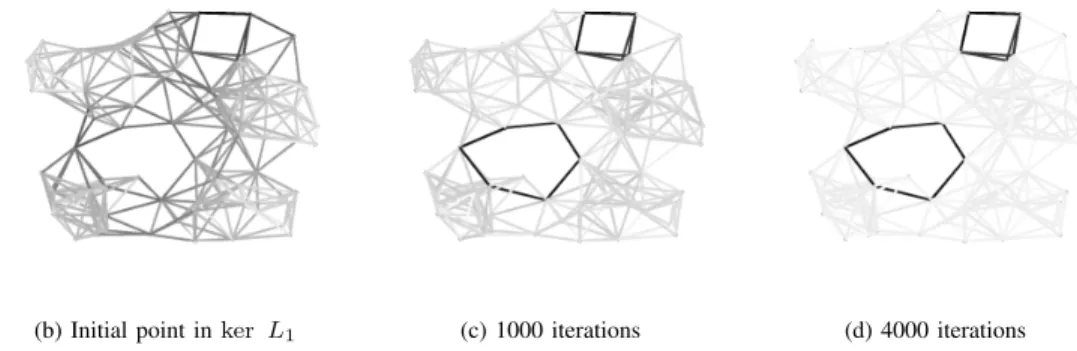
(a) The Rips shadow (b) Initial point inker L1 (c) 1000 iterations (d) 4000 iterations
Fig. 1. Subgradient methods can be used to localize the holes in a distributed fashion.
on the 2-simplices of the simplicial complex. The most important characteristic of (10) is that, due to the local structure of B2, it can be implemented in a distributed
manner, if the initial x is known locally. By picking a small enough constant step sizeαk, it is guaranteed that the
update (10) gets arbitrarily close to the optimal value [25]. By choosing more sophisticated dynamic step sizes we can improve the convergence properties of the above algorithm to the optimal solution, which under the conditions of Theorem 4 is the sparsest generator (or a convex combination of the sparsest generators) of the homology class of the initial 1-cycle x.
VI. SIMULATIONS
We demonstrate the performance of our algorithm with a randomly generated numerical example. Fig. 1(a) depicts the Rips shadow of a simplicial complex on n = 81 vertices distributed overR2. The 2-skeleton of this simplicial
complex consists of 81 vertices, 372 edges, and 66 faces (2-simplices). As expected from Fig. 1(a), the null space of the first combinatorial Laplacian of this Rips complex has dimension 2. We generated a point inx∈kerL1by running
the distributed linear dynamical system (6) with a random initial condition x(0). The edge-evaluation of the limiting x ∈ kerL1 is depicted in Fig. 1(b), where the thickness
of an edge is directly proportional to the magnitude of its corresponding component in x. It can be seen that for this 1-cycle in the null space ofL1, all the components more or
less have the same order of magnitude. In order to localize the two holes, we ran the subgradient update (10) with a diminishing square summable but not summable step size. The edge evaluation of the 1-cycles after 1000 and 4000 iterations are depicted in Figs. 1(c) and (d). These figures illustrate that after enough iterations, the subgradient method converges to a 1-cycle that has non-zero values only over the cycles that are tight around the holes. Therefore, the algorithm is capable of localizing the coverage holes. In Fig. 1(d), the value of the 12 edges adjacent to the holes are 3 orders of magnitude higher than all the others.
Note that our algorithm is only capable of finding the tightest minimal-length cycles surrounding the holes, which do not necessarily coincide with the cycles that are closer distance-wise to the holes. As stated before, after all, we
are not using any metric information and the combinatorial relations between vertices is the only information available. Moreover, in case there are two minimal-length cycles sur-rounding the same hole (as in the upper hole in Fig. 1), then any convex combination of those is also a minimizer to the LP relaxation problem (8). In such cases, the subgradient method in general converges to a point in the convex hull of the two solutions, rather than a corner solution.
VII. CONCLUSIONS
In this paper, we presented a distributed algorithm for detecting coverage holes in a sensor network, when no metric information is available. We used the simplicial complexes and their combinatorial Laplacians in order to abstract away the topological properties of the network. Furthermore, we showed how the simplicial homology groups of the Rips complex can provide information about the cover. In par-ticular, we illustrated the relationship between the kernel of the first combinatorial Laplacian of the Rips complex and the number of coverage holes. Moreover, we formulated the problem of localizing the coverage holes (in the sense of finding the tightest 1-cycle encircling them) as an optimiza-tion problem and used subgradient methods to solve it in a distributed fashion.
APPENDIX
STATEMENT ANDPROOF OFTHEOREM4
Consider an oriented simplicial complexX with the first Betti numberb, where the holes are labeled 1 throughb. By h(α1, . . . , αb) we denote the class of homologous 1-cycles
that encircle thei-th holeαimany times in a given direction.
We also assume that the shortest representative cycle that encircles one single hole is unique and is denoted byc∗
i. In
other words,
c∗i = arg minkck0
s.t. c∈h(ei)
whereeiis thei-th coordinate vector. Sincec∗i is the sparsest
1-cycle that encircles thei-th hole only once, we have the following lemma.
Lemma 2: c∗i is 1-cycle which only has value in
We now restate and prove Theorem 4.
Theorem 4: Given a simplicial complex X, suppose that arg minc∈h(α)kck0=P
b
i=1αic∗i, for allα∈Rb. Then, for
allα∈Rb we have, arg min c∈h(α) kck0= arg min c∈h(α) kck1.
Proof: First we prove that the two minimizers have the same zero/non-zero pattern. Given a classh(α), suppose that the`1 minimizer denoted byy does not have the same
pattern as the`0 minimizer. This means that there exists an
edgeσ1in the simplicial complex such thatyhas a positive
value on, but the`0minimizer does not. Sinceyis a 1-cycle,
there exists another edgeσ2lower-adjacent toσ1with a
non-zero value. Without loss of generality, we assume that the directions are defined such that all the values are positive. Reapplying the same argument implies that σ1 belongs to a
setEof edges, all with positive values and forming a simple loop over the simplicial complex. Moreover, it implies that ˜
cj = I{σj∈E} is a 1-cycle. Note that c˜is a simple 1-cycle
which only takes values in{0,1,−1}. Finally, defineγ >0 to be the smallest value that the edges in E take in the `1
minimizer y.
The 1-cycle˜cbelongs to some homology classh(µ), that is, the class of 1-cycles that encircle the i-th hole µi many
times. Without loss of generality, we can assume thatµi≥0
for all 0 ≤i≤b. Define y0 =y−γc˜+γ(Pb
i=1µic ∗ i) for which we have, ky0k1 ≤ ky−γ˜ck1+γ b X i=1 µikc∗ik1 = kyk1−γk˜ck1+γ b X i=1 µikc∗ik1 = kyk1−γk˜ck0+γ b X i=1 µikc∗ik0<kyk1,
The first inequality is a consequence of the triangular in-equality. The following equality is due to the fact that we assumed thatγ is the smallest value on the edges of˜c aty. In the next equality, we use that fact that ˜c and all c∗i are 1-cycles with values in {0,1,−1}, which means that their `1 and`0 norms are equal. Finally, the last inequality is due
to assumption of the theorem.
In summary, there exists a 1-cycle y0 homologous to y with a smaller `1-norm, which contradicts the fact that
y is the `1 minimizer. Therefore, arg minc∈h(α)kck0 and
argminc∈h(α)kck1 have the same zero/non-zero pattern for
all α. Also note that both minimizers belong to the same homology classh(α). As a result, the two must be equal.
ACKNOWLEDGMENT
The authors would like to thank Robert Ghrist for many helpful comments and discussions.
REFERENCES
[1] D. Gage, “Command control for many-robot systems,” Unmanned Systems Magazine, vol. 10, no. 4, pp. 28–34, 1992.
[2] S. Meguerdichian, F. Koushanfar, M. Potkonjak, and M. Srivastava, “Coverage problems in wireless ad-hoc sensor network,” in IEEE INFOCOM, 2001, pp. 1380–1387.
[3] A. Ganguli, J. Cortes, and F. Bullo, “Distributed deployment of asynchronous guards in art galleries,” in Proceedings of American Control Conference, Minneapolis, MN, June 2006, pp. 1416–1421. [4] R. Ghrist and A. Muhammad, “Coverage and hole-detection in sensor
networks via homology,” inProceedings of the Fourth Inernational Symposium on Information Processing in Sensor Networks, Los An-geles, CA, April 2005, pp. 254–260.
[5] V. de Silva, R. Ghrist, and A. Muhammad, “Blind swarms for coverage in 2-D,” in Robotics: Science and Systems, Cambridge, MA, June 2005.
[6] V. de Silva and R. Ghrist, “Coordinate-free coverage in sensor net-works with controlled boundaries via homology,” The International Journal of Robotics Research, vol. 25, no. 12, pp. 1205–1222, 2006. [7] ——, “Coverage in sensor networks via persistent homology,”
Alge-braic and Geometric Topology, pp. 339–358, 2007.
[8] A. Muhammad and M. Egerstedt, “Control using higher order Laplacians in network topologies,” inProceedings of the 17th Interna-tional Symposium on Mathematical Theory of Networks and Systems, Kyoto, Japan, 2006, pp. 1024–1038.
[9] A. Muhammad and A. Jadbabaie, “Decentralized computation of homology groups in networks by gossip,” inProceedings of American Control Conference, New York, NY, 2007, pp. 3438–3443. [10] N. Z. Shor, K. C. Kiwiel, and A. Ruszcay`nski,Minimization Methods
for Non-Differentiable Functions. New York, NY: Springer-Verlag New York, Inc., 1985.
[11] R. Olfati-Saber and R. Murray, “Consensus problems in networks of agents with switching topology and time-delays,”IEEE Transactions on Automatic Control, vol. 49, no. 9, pp. 1520–1533, Sept. 2004. [12] S. Cabello and B. Mohar, “Finding shortest separating and
non-contractible cycles for topologically embedded graphs,”Discrete and Computational Geometry, vol. 37, no. 2, pp. 213–235, 2007. [13] S. Cabello, M. DeVos, J. Erickson, and B. Mohar, “Finding one tight
cycle,” submitted to 19th Annual ACM-SIAM Symposium on Discrete Algorithms (2008).
[14] ´Eric Colin de Verdi`ere and F. Lazarus, “Tightening non-simple paths and cycles on surfaces,” inACM-SIAM Symposium on Discrete Algo-rithms, Jan. 2006, pp. 192–201.
[15] ——, “Optimal system of loops on an orientable surface,”Discrete and Computational Geometry, vol. 33, no. 3, 2005.
[16] E. W. Chambers, J. Erickson, and P. Worah, “Testing contractibility in planar Rips complexes,” submitted to 19th Annual ACM-SIAM Symposium on Discrete Algorithms (2008).
[17] E. W. Chambers, V. de Silva, J. Erickson, and R. Ghrist, “Rips complexes of planar point sets,” under Preperation. [Online]. Available: http://www.cs.uiuc.edu/∼jeffe/pubs/rips.html
[18] A. Hatcher,Algebraic Topology. Cambridge University Press, 2002. [19] B. Eckmann, “Harmonische Funktionen und Randwertaufgaben Einem Komplex,”Commentarii Math. Helvetici, vol. 17, pp. 240–245, 1945.
[20] A. M. Duval and V. Reiner, “Shifted simplicial complexes are Laplacian integral,”Transactions of the American Mathematical So-ciety, vol. 354, no. 11, pp. 4313–4344, 2002.
[21] L. Vietoris, “ ¨Uber den h¨oheren Zusammenhang kompakter R¨aume und eine Klasse von zusammenhangstreuen Abbildungen,”Mathematische Annalen, vol. 97, no. 1, pp. 454–472, 1927.
[22] S. Boyd, A. Ghosh, B. Prabhakar, and D. Shah, “Gossip algorithms: Design, analysis and applications,” inIEEE Infocom, vol. 3, March 2005, pp. 1653–1664.
[23] C. Chen and D. Freedman, “Quantifying homology classes II: Localization and stability,” 2007, Preprint. [Online]. Available: arXiv:0709.2512v2
[24] D. L. Donoho and J. Tanner, “Sparse nonnegative solution of under-determined linear equations by linear programming,”Proceedings of the National Academy of Sciences, vol. 102, no. 27, pp. 9446–9451, 2005.
[25] S. Boyd, L. Xiao, and A. Mutapcic, “Subgradient methods,” Oct. 2003, Lecture notes. [Online]. Available: http://www.stanford.edu/class/ee392o/subgrad-method.pdf