04 August 2020
POLITECNICO DI TORINO
Repository ISTITUZIONALE
Knowledge Graph Embeddings with node2vec for Item Recommendation / Palumbo, Enrico; Rizzo, Giuseppe; Troncy, Raphael; Baralis, ELENA MARIA; Osella, Michele; Ferro, ENRICO GIOVANNI. - ELETTRONICO. - (In corso di stampa). ((Intervento presentato al convegno Extended Semantic Web Conference 2018.
Original
Knowledge Graph Embeddings with node2vec
for Item Recommendation
Publisher: Published DOI: Terms of use: openAccess Publisher copyright
(Article begins on next page)
This article is made available under terms and conditions as specified in the corresponding bibliographic description in the repository
Availability:
This version is available at: 11583/2710123 since: 2018-06-29T09:51:47Z
for Item Recommendation
Enrico Palumbo1,2,3, Giuseppe Rizzo1, Rapha¨el Troncy2, Elena Baralis3,
Michele Osella1 and Enrico Ferro1
1
ISMB, Italy,
{palumbo,giuseppe.rizzo, osella, ferro}@ismb.it
2
EURECOM, France,
3
Politecnico di Torino, Italy,
Abstract. In the past years, knowledge graphs have proven to be ben-eficial for recommender systems, efficiently addressing paramount issues such as new items and data sparsity. Graph embeddings algorithms have shown to be able to automatically learn high quality feature vectors from graph structures, enabling vector-based measures of node related-ness. In this paper, we show how node2vec can be used to generate item recommendations by learning knowledge graph embeddings. We apply node2vec on a knowledge graph built from the MovieLens 1M dataset and DBpedia and use the node relatedness to generate item recommen-dations. The results show that node2vec consistently outperforms a set of collaborative filtering baselines on an array of relevant metrics.
Keywords: Knowledge Graphs Embeddings, Recommender Systems, node2vec
1
Background
In the past few years, recommender systems leveraging knowledge graphs have proven to be competitive with state-of-the-art collaborative filtering systems and to efficiently address issues such as new items and data sparsity [1,7,8,9,10,12]. node2vec has shown to be able to effectively learn features from graph struc-tures, outperforming existing systems in node classification and link prediction tasks [3]. In this paper, we show that node2vec can be effectively used to learn knowledge graph embeddings to perform item recommendation. node2vec is ap-plied on a knowledge graph including user feedback on items, modelled by the special relation ‘feedback’, and item relations to other entities. Then, recom-mendations are generated using the relatedness between users and items in the vector space. The evaluation on the Movielens dataset shows that: 1) node2vec with default hyper-parameters outperforms collaborative filtering baselines on all metrics and the MostPop algorithm on most metrics 2) node2vec with optimized hyper-parameters significantly outperforms all baselines under consideration.
2 Enrico Palumbo et al.
2
Approach
Item Recommendation: given a set of items I and a set of users U, the
problem of item recommendation is that of ranking a set of N candidate items
Icandidates ⊂I according to what a user may like. More formally, the problem
consists in defining a ranking function ρ(u, i) that assigns a score to any
user-item pair (u, i)∈U×Icandidatesand then sorting the items according toρ(u, i):
L(u) ={i1, i2, ..., iN} (1)
whereρ(u, ij)> ρ(u, ij+1) for anyj = 1..N−1.
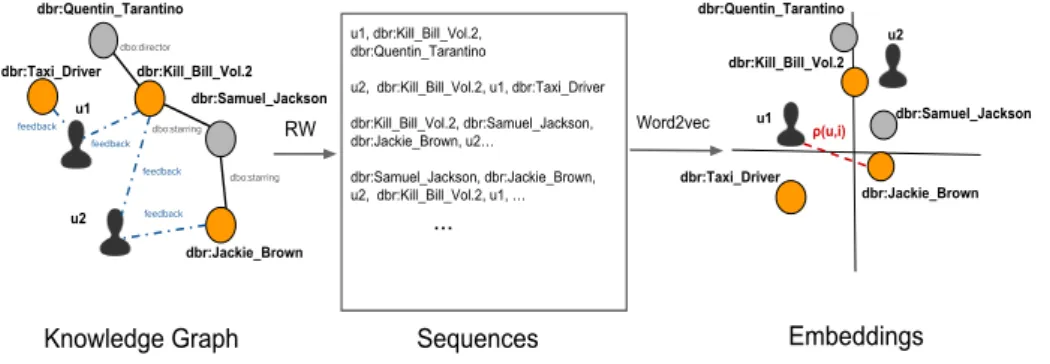
node2vec[3] learns representations of nodes in a graph through the application of the word2vec model on sequences of nodes sampled through random walks (Fig. 1). The innovation brought by node2vec is the definition of a random walk exploration that is flexible and adaptable to the diversity of connectivity patterns that a network may present. Given a knowledge graph K encompassing
users U, items I (the object of the recommendations, e.g. a movie) and other
entities E (objects connected to items, e.g. the director of a movie), node2vec
generates vector representations of the users xu and of the items xi (and of
other entitiesxe). Thus, we propose to use as a ranking function the relatedness
between the user and the item vectors: ρ(u, i) =d(xu, xi) where dis the cosine
similarity in this work.
Knowledge graph construction: the dataset used for the evaluation is
MovieLens 1M4 [4]. We used the publicly available mappings from MovieLens
1M items to the corresponding DBpedia entities [8] to create the knowledge
graph K using DBpedia data. We split the data into training Xtrain,
vali-dation Xval and test set Xtest, containing respectively 70%, 10% and 20%
of the ratings for each user. We selected a set of properties based on their
frequency of occurrence5: [“dbo:director”, “dbo:starring”, “dbo:distributor”,
“dbo:writer”,“dbo:musicComposer”, “dbo:producer”, “dbo:cinematography”, “dbo:editing”]. We add “dct:subject” to this set of properties, as it provides an
extremely rich categorization of items. For each propertyp, we include in K all
the triples (i, p, e) wherei ∈I ande∈E, e.g. (dbr:Pulp Fiction, dbo:director,
dbr:Quentin Tarantino). We finally add the ‘feedback’ property, modeling all
movie ratings that are r≥4 inXtrain as triples (u, f eedback, i).
Evaluation: we use the evaluation protocol known as AllUnratedItems [11] and we measure standard information retrieval metrics such as P@5, P@10, Mean Average Precision (MAP), R@5, R@10, NDCG (Normalized Discounted Cumulative Gain), MRR (Mean Reciprocal Rank). As baselines, we use collaborative filtering algorithms based on Singular Value Decomposition [6], ItemKNN with baselines [5] and the MostPop item recommendation strategy,
4 https://grouplens.org/datasets/movielens/1m/ 5
we sorted the properties used in DBpedia to describe the Movielens1M items ac-cording to their frequency and selected the first K properties so that the frequency of the K+1 property was less that 50% of the previous one.
which ranks items based on their popularity (i.e. total number of positive
ratings). The baselines are implemented using thesurprise python library6.
u1, dbr:Kill_Bill_Vol.2, dbr:Quentin_Tarantino
u2, dbr:Kill_Bill_Vol.2, u1, dbr:Taxi_Driver dbr:Kill_Bill_Vol.2, dbr:Samuel_Jackson, dbr:Jackie_Brown, u2…
dbr:Samuel_Jackson, dbr:Jackie_Brown, u2, dbr:Kill_Bill_Vol.2, u1, …
...
RW Word2vec
Knowledge Graph Sequences Embeddings
dbr:Kill_Bill_Vol.2 dbr:Samuel_Jackson dbr:Jackie_Brown u2 u1 dbr:Quentin_Tarantino dbr:Quentin_Tarantino u1 u2 dbr:Jackie_Brown dbr:Samuel_Jackson dbr:Kill_Bill_Vol.2 dbr:Taxi_Driver dbr:Taxi_Driver ρ(u,i) feedback feedback feedback feedback dbo:starring dbo:starring dbo:director
Fig. 1:Node2vec for item recommendation using the knowledge graph. Users are
repre-sented in black, items in orange and entities in grey. node2vec learns knowledge graph embeddings by sampling sequences of nodes through random walks and then applying the word2vec model on the sequences. The ranking function for item recommendation is then given by the node relatedness in the vector space.
3
Results
The results of the evaluation are reported in Tab. 1. In “node2vec (default)” the hyper-parameters have been set to their default value as reported in the original paper [3] and in the reference Python implementation available on
Github7 (p = 1, q = 1, num walks = 10, walk length = 80, window size =
10, iter = 1, dimensions = 128). We observe that “node2vec (default)” out-performs SVD and ItemKNN on all metrics, but that the MostPop approach performs slightly better on the P@5 and P@10 and on MRR. Note that MostPop, although trivial, is known to be quite effective on the Movielens 1M dataset as a consequence of the strong concentration of item feedback on a small number of highly popular items [2]. In “node2vec (opt)” we have optimized the hyper-parameters by a combination of grid-search and
manual search over the validation set, exploring the ranges: p ∈ {0.25,1,4},
q ∈ {0.25,1,4}, dimensions ∈ {200,500}, walk length ∈ {10,20,30,50,100},
window size∈ {10,20,30}, num walks∈ {10,50}. We found the configuration (p= 4, q = 1, num walks = 50, walk length = 100, window size = 30, iter = 5, dimensions= 200) to be optimal on the validation set in the explored range. We observed that the number of walks per node, the walk length, i.e. the maxi-mum length of random walk, and the context size are particularly significant to improve the performance. However, the hyper-parameters optimization is a time
6 http://surprise.readthedocs.io/en/v1.0.2/matrix_factorization.html 7
4 Enrico Palumbo et al.
consuming endeavor, as it requires running the whole evaluation pipelines with multiple configurations. Thus, in a future work, we will extend the evaluation to other datasets and investigate the relation between hyper-parameters and the graph structure, with the aim of elaborating some indications to guide the hyper-parameter search process.
Table 1: Results on the MovieLens 1M dataset sorted by NDCG
System P@5 P@10 MAP R@5 R@10 NDCG MRR node2vec (opt) 0.224 0.196 0.153 0.092 0.155 0.482 0.441 node2vec (default) 0.120 0.129 0.117 0.067 0.122 0.438 0.256 MostPop 0.145 0.129 0.092 0.049 0.085 0.406 0.307 SVD 0.068 0.062 0.043 0.020 0.037 0.329 0.164 ItemKNN 0.057 0.054 0.041 0.019 0.032 0.325 0.143 Random 0.007 0.007 0.008 0.002 0.003 0.246 0.030
References
1. Catherine, R., Cohen, W.: Personalized recommendations using knowledge graphs: A probabilistic logic programming approach. In: Proceedings of the 10th ACM Conference on Recommender Systems. pp. 325–332. ACM (2016)
2. Cremonesi, P., Koren, Y., Turrin, R.: Performance of recommender algorithms on top-n recommendation tasks. In: Proceedings of the fourth ACM conference on Recommender systems. pp. 39–46. ACM (2010)
3. Grover, A., Leskovec, J.: node2vec: Scalable feature learning for networks. In: Pro-ceedings of the 22nd ACM SIGKDD International Conference on Knowledge Dis-covery and Data Mining. pp. 855–864. ACM (2016)
4. Harper, F.M., Konstan, J.A.: The movielens datasets: History and context. ACM Transactions on Interactive Intelligent Systems (TiiS) 5(4), 19 (2016)
5. Koren, Y.: Factor in the neighbors: Scalable and accurate collaborative filtering. ACM Transactions on Knowledge Discovery from Data (TKDD) 4(1), 1 (2010) 6. Koren, Y., Bell, R., Volinsky, C.: Matrix factorization techniques for recommender
systems. Computer 42(8) (2009)
7. Noia, T.D., Ostuni, V.C., Tomeo, P., Sciascio, E.D.: Sprank: Semantic path-based ranking for top-n recommendations using linked open data. ACM Transactions on Intelligent Systems and Technology (TIST) 8(1), 9 (2016)
8. Ostuni, V.C., Di Noia, T., Di Sciascio, E., Mirizzi, R.: Top-n recommendations from implicit feedback leveraging linked open data. In: Proceedings of the 7th ACM conference on Recommender systems. pp. 85–92. ACM (2013)
9. Palumbo, E., Rizzo, G., Troncy, R.: Entity2rec: Learning user-item relatedness from knowledge graphs for top-n item recommendation. In: Proceedings of the Eleventh ACM Conference on Recommender Systems. pp. 32–36. ACM (2017) 10. Rosati, J., Ristoski, P., Di Noia, T., Leone, R.d., Paulheim, H.: Rdf graph
embed-dings for content-based recommender systems. In: CEUR workshop proceeembed-dings. vol. 1673, pp. 23–30. RWTH (2016)
11. Steck, H.: Evaluation of recommendations: rating-prediction and ranking. In: Pro-ceedings of the 7th ACM conference on Recommender systems. pp. 213–220. ACM (2013)
12. Yu, X., Ren, X., Sun, Y., Gu, Q., Sturt, B., Khandelwal, U., Norick, B., Han, J.: Personalized entity recommendation: A heterogeneous information network ap-proach. In: Proceedings of the 7th ACM international conference on Web search and data mining. pp. 283–292. ACM (2014)